
Apple Preserves Market Growth, Share & Trends by 2034
Coverage: by Type (Jam, Filling, Others); Application (Dairy and Frozen Desserts, Baked Product, Ice-Cream, Others) , and Geography (North America, Europe, Asia Pacific, and South and Central America)
- Status : Data Released
- Report Code : TIPRE00011269
- Category : Food and Beverages
- No. of Pages : 150
- Available Report Formats :


- Last update date : August 26, 2026


2025 Market Size
US$ 1.14 Bn
Base year value
2034 Forecast
US$ 1.53 Bn
Projected by 2034
CAGR 2026-2034
3.32 %
Growth rate
Addressable Market
US$ 12.12 Bn
(2026-2034)
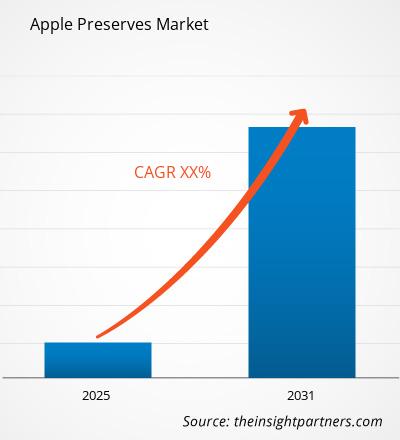
The global Apple Preserves market was valued at US$ 1.14 billion in 2025 and is expected to reach US$ 1.53 billion by 2034; it is estimated to record a CAGR of 3.32% during 2026-2034.
Apple Preserves Market Assessment and Insights
- North America is estimated to hold 33–35% share in 2025 and grow at a CAGR of 3.4–3.8% during 2026–2034, reflecting mature retail spread demand, bakery ingredient use, and strong cold-chain integration.
- US accounts for 82–86% of North America in 2025 and is projected to grow at a CAGR of 3.3–3.7% during 2026–2034, supported by branded preserves and industrial bakery demand.
- Europe represents 27–30% share in 2025 and is expected to grow at a CAGR of 3.0–3.4% during 2026–2034, led by Germany, France, Italy, Spain, and the UK.
- Asia Pacific holds 24–27% share in 2025 and is forecast to grow at a CAGR of 4.3–4.7% during 2026–2034, with China, India, Japan, South Korea, and Australia driving demand.
- Largest Segment: Jam holds 58–62% market share in 2025 and is expected to grow at a CAGR of 3.2–3.6% during 2026–2034, supported by breakfast, retail, and foodservice usage.
- High Growth Segment: Filling holds 38–42% market share in 2025 and is expected to grow at a CAGR of 4.0–4.4% during 2026–2034 as bakery and dessert processors seek bake-stable formats.
- Key companies analyzed in detail: AGRANA Beteiligungs-AG, Döhler GmbH, Fresh Food Industries LLC, Frulact, S.A., Ingredion Incorporated, Puratos Group, SVZ International B.V., The J.M. Smucker Company, Andros Group, Zentis GmbH & Co. KG.
Source: The Insight Partners' analysis based on proprietary research, government publications, company annual reports, investor presentations, industry databases, and expert interviews.
Processing has evolved from kettle-cooked fruit spreads toward controlled texture systems, aseptic packaging, and application-specific fruit preparations. The apple preserves market now depends on pectin optimization, particle-size control, water-activity management, and low-sugar stabilization. Procurement is being linked to the regional harvesting schedule of apples as well to ensure a steady supply of pulp, purees, and diced fruits to commercial manufacturers requiring consistency of viscosity, bakeability, and taste release.
In the future, investments will be geared towards Asia Pacific and some areas of the Middle East, where bakeries, frozen desserts, and retail organizations are incorporating fruit ingredients into packaged products in the form of identifiable and natural ingredients, thereby avoiding artificial ingredients. It will be important to manage costs due to sugar, energy, glass, and processed fruits.
Apple Preserves Market Report Scope
| Report Attribute | Details |
|---|---|
| Market size in 2025 | US$ 1.14 Billion |
| Market Size by 2034 | US$ 1.53 Billion |
| Global CAGR (2026 - 2034) | 3.32% |
| Historical Data | 2021-2024 |
| Forecast period | 2026-2034 |
Apple Preserves Market Analysis
Food manufacturers are using fruit preparations to improve indulgence, color, and perceived naturalness in yogurts, ice creams, pastries, and filled bakery products. This supports apple preserves market growth, particularly where apples create a cost-effective base for blended fruit systems. Apple is also valued because it delivers mild acidity, soluble solids, and texture compatibility across dairy and baked formats.
Supply conditions continue to be positive, though not without risks. According to the USDA, the global supply of fresh apples is expected to reach 81.72 million metric tons by 2025/26, with China, EU, and the United States being some of the leading producers. The diversified geographical sources enable processors to control for factors such as variety and concentration availability.
Competition is shaped by ingredient specialists, fruit-preparation companies, and branded preserve manufacturers. The apple preserves market analysis shows that AGRANA Beteiligungs-AG, Döhler GmbH, Frulact, S.A., Puratos Group, and SVZ International B.V. emphasize industrial customization, while The J.M. Smucker Company remains important in retail spreads. Ingredion Incorporated supports texture and clean-label formulation through hydrocolloids, starches, and sweetening systems.
Increasingly, strategic positioning is geared towards companies that have application laboratories and production facilities within the region. AGRANA offers applications for fruit preparation in dairy, ice cream, bakery, and food service, while Döhler offers applications for fruit pieces, purees, and systems in yogurt, desserts, ice cream, and bakery products. This means that it will be possible to match apple spreads to depositor needs.
● REPORT CUSTOMIZATION
Tailor This Report To Align With Your Specific Business Requirements
This report can be customized to align precisely with your business objectives, scope, and target markets. Customization options include tailored segmentation, geography, competitive analysis, and strategic insights to support informed decision-making.
Customize This Report →WHAT YOU CAN ADJUST
- ● Segmentations
- ● Geography
- ● Competitive Analysis
- ● Language Preferences
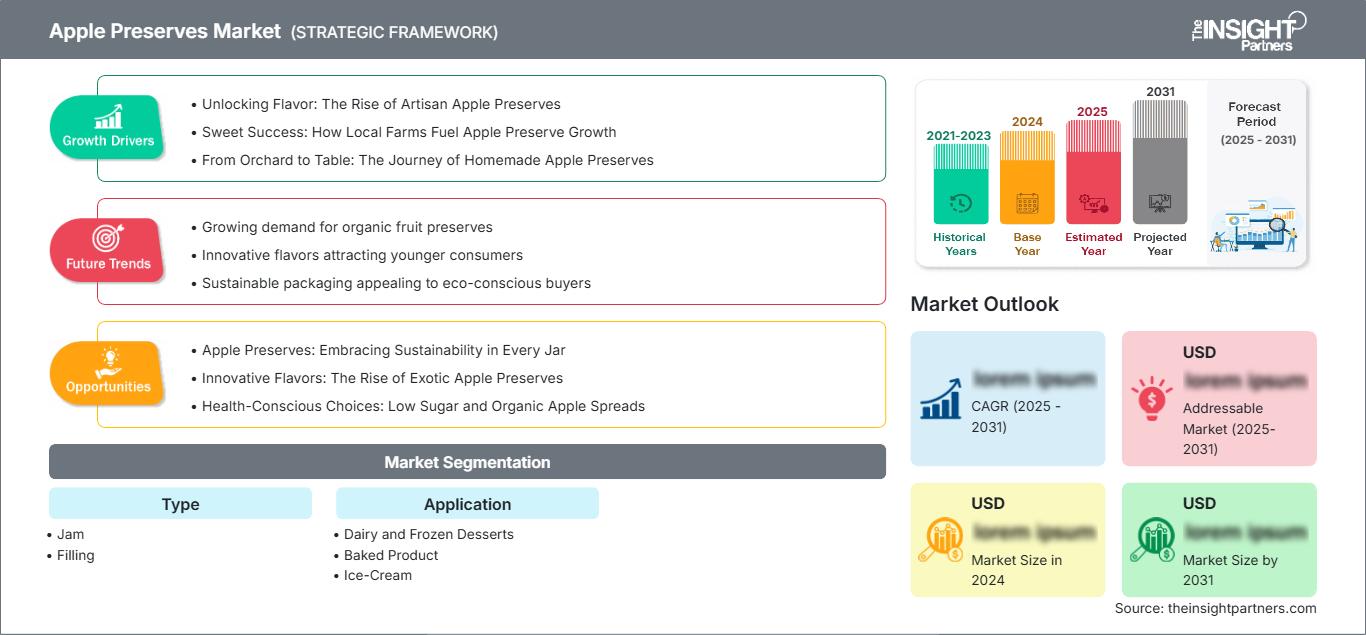
Apple Preserves Market: Strategic Insights
Regional Insights
North America apple preserves market
North America is estimated to account for 33–35% share in 2025 and expand at a CAGR of 3.4–3.8% during 2026–2034. The region benefits from strong apple processing clusters, large bakery distribution networks, and established frozen dessert consumption. The apple preserves market share is reinforced by widespread use of jams, toppings, and fruit-fill systems across retail, quick-service, and institutional channels.
Regional manufacturers prefer low sugar, resealable, and bake-stable fillings for automation in baking lines. The supply of apples in the U.S., specialty foods production in Canada, and growth in the bakery sector in Mexico contribute to regional sustainability. Moderate growth rates will be seen due to high category penetration, but growth in premium spreads, natural inclusions, and bakery ingredients will drive volume growth and value.
U.S. apple preserves Market
The U.S. represents 82–86% of North America in 2025 and is forecast to grow at a CAGR of 3.3–3.7% during 2026–2034. Demand is supported by household spreads, foodservice toppings, and industrial fillings for bakery items like pastries, pies, snack cakes, and frozen desserts. The three states of Washington, New York, and Michigan continue to be significant producers of apples, facilitating diversified supplies for processing firms.
Company presence aids in the development of the category domestically. The J.M. Smucker Company leads branded retail sales, whereas AGRANA Beteiligungs-AG, Döhler GmbH, Puratos Group, Ingredion Incorporated, and Andros Group provide products for the industrial sector. Commercial bakery production lines demand fillings that are stable against freezing, thawing, baking conditions, and high-speed depositing.
Europe apple preserves Market
Europe holds 27–30% share in 2025 and is expected to grow at a CAGR of 3.0–3.4% during 2026–2034. Germany leads in the country rankings as a result of bakery depth, specialists in fruit preparations, private label power, and closeness to apple preparations’ supply chains. The United Kingdom drives demand through breakfast spreads, dessert toppings, and bakery fillings, with retailers focusing on clean labeling, recyclability of packages, and portion control.
Germany benefits from existing ingredient suppliers and industrial bakeries that need constant apple preparations in order to make pastries, cakes, and dairy products. Zentis GmbH & Co. KG and AGRANA Beteiligungs-AG are companies contributing to the technical expertise in fruit preparations, spreads, and customized food industry applications.
France, Italy, and Spain add demand through patisserie, yogurt, gelato, and pastry traditions. France favors premium fruit content and origin cues, Italy supports dairy and frozen dessert applications, and Spain benefits from bakery modernization. Growth remains below Asia Pacific because retail shelf space is mature and reformulation priorities focus on sugar reduction rather than large volume expansion.
APAC apple preserves Market
APAC is estimated to hold 24–27% share in 2025 and expand at a CAGR of 4.3–4.7% during 2026–2034. China is the leading country because of its large apple crop, rising bakery chains, and growing dairy dessert base. Japan, South Korea, India, and Australia contribute through premium confectionery, convenience bakery, and frozen dessert formats.
Policy and infrastructure factors are improving market access. Cold-chain investment, food processing incentives, and modern retail expansion allow packaged fruit ingredients to move beyond metropolitan centers. Local suppliers compete on cost, while multinational firms differentiate through texture, safety validation, and customized low-sugar systems for regional taste profiles.
Middle East & Africa apple preserves Market
The Middle East & Africa is projected to grow at a CAGR of 3.6–4.0% during 2026–2034, with the UAE leading in imported premium spreads, foodservice bakery, and hotel dessert applications. Bakery production capabilities are growing in Saudi Arabia, whereas South Africa acts as the regional processing point for fruits and has an existing retail network.
Factors like energy, logistics, and infrastructure will affect the adoption. Apple products like purees, concentrates, and preserves are all imported into the Gulf, making efficient ports and cold storage a critical factor. In South Africa and the rest of MEA, there are organized retailers and quick service chains that drive packaged baked goods and desserts.
Segmentation Analysis
Type
The Type segment is projected to grow at a CAGR of 3.4–3.8% during 2026–2034. The apple preserves market scope across types is shaped by the difference between retail-oriented jam and industrial filling. Jam benefits from household familiarity and breakfast usage, while filling gains relevance in bakery, dairy, and frozen dessert manufacturing because it requires thermal stability, controlled viscosity, and consistent fruit distribution.
- Jam remains the larger type, supported by toast spreads, private-label jars, portion packs, and foodservice sachets. Its strategic role lies in dependable repeat purchase and broad retailer acceptance.
- Filling is gaining importance as bakery and dessert processors use apple-based systems for pies, pastries, snack cakes, frozen desserts, and layered dairy products requiring stable performance.
Application
The Application segment is expected to grow at a CAGR of 3.8–4.2% during 2026–2034. Application demand depends on how well apple preserves perform under heat, freezing, mixing, and storage. Dairy and frozen desserts use them for fruit contrast, baked products require bake-stable gels, and ice-cream producers need inclusions that remain soft at low temperatures without syneresis.
- Dairy and Frozen Desserts use apple preserves for yogurt layers, parfaits, cheesecakes, and chilled desserts, where fruit identity, acidity control, and visual appeal strengthen product differentiation.
- Baked Product demand is tied to pies, muffins, turnovers, Danish pastries, cookies, and snack cakes, where apple fillings offer a familiar flavor and reliable bake performance.
- Ice-Cream applications use apple preserves as swirls, ripples, toppings, and inclusions, with demand influenced by premium flavors, seasonal launches, and indulgent dessert positioning.
Opportunity Snapshot
| Application | Revenue Contribution | Trend Tag | Adoption Stage |
| Dairy and Frozen Desserts | High | Fruit Layers | Mature |
| Baked Product | High | Bake Stable | Scaling |
| Ice-Cream | Medium | Dessert Swirls | Scaling |
Apple Preserves Market Growth Drivers and Impact Analysis
Clean-label fruit systems moving into mainstream bakery
The bakeries are now using systems with fruit flavors to replace their artificial flavor-based filling systems with more recognizable labels and greater sensory appeal. The apple preserves are in line with this trend as apple purée, apple pieces, pectin, and sugar systems have the ability to modify based on heat stability, spreadability, and water management. The Puratos’ focus is on fruit filling systems with high fruit content and bake stability, which include apple-based products, aligning with the technical needs of commercial bakers. The effect of this trend is evident in pastries, pies, snack cakes, and filled confections, where the bakers require uniform deposit and clean-cut slices.
Stable apple availability supporting cost-effective formulation
An apple is a formulation fruit due to its abundance in the market, its excellent storage qualities, and its ability to serve as a neutral base for both texture and flavor systems. According to USDA statistics, there were 81.72 million metric tons of apples harvested globally in 2025/26, with China leading at 47 million metric tons, followed by the European Union with 11.52 million metric tons and the US with 5.03 million metric tons. Such abundance allows producers to mix fresh apples, concentrates, purees, and diced forms over the seasons. From a producer’s perspective, this diversity of supply options helps mitigate procurement risks in comparison to berry and tropical fruits.
Premium dessert innovation requiring fruit inclusions
Frozen desserts, frozen dairy, and luxury bakery lines have been relying on visible fruits and layers to support premium positioning strategies. Apple preparations are an ideal choice because they can be combined with cinnamon, caramel, vanilla, nut, biscuit, oat, and cream flavors without overpowering the base of the product. AGRANA mentions fruit preparations in dairy, ice cream, bakery, and foodservice applications, including fruit preparations with inclusions like cake pieces, nuts, and fruits. It is important for the higher-value products instead of commodity spreads. The effect can be observed from co-branded desserts, limited seasonal items, and multi-layered cups, where apple preparations are needed to survive freezing, defrosting, mixing, and baking.
Apple Preserves Market Future Trends
Precision texture design for automated processing
Future apple preserves market trends will be shaped by automated filling, high-speed bakery lines, and frozen dessert co-extrusion. Manufacturers will require tighter control over viscosity, fruit particle suspension, water activity, and pumpability. This moves product development from recipe adjustment toward process-specific engineering, where the same apple base may be modified for pies, snack cakes, swirl applications, or yogurt layers. Suppliers with rheology testing, pilot lines, and thermal processing knowledge will gain an advantage. As labor constraints and production efficiency remain priorities, processors will favor preserves that reduce line stoppages, leakage, bake-out, and freeze-thaw defects while maintaining fruit identity.
Reduced-sugar and fiber-supported formulations
Sugar reduction will become a stronger development pathway as retailers and food manufacturers pursue better-for-you positioning without sacrificing indulgence. Apple preserves offer a useful base because apple solids, natural acidity, pectin, and fiber can support the body when sugar levels decline. Ingredient suppliers are likely to combine apple preparations with soluble fibers, starches, citrus fiber, and high-intensity sweeteners to maintain mouthfeel. Ingredion’s 2025 sustainability and innovation disclosures emphasize clean-label and texture solutions, aligning with this direction. The challenge will be preserving shelf stability, sweetness release, and microbial control while meeting label expectations across dairy, bakery, and frozen dessert applications.
Apple Preserves Market Opportunities
Application-specific filling platforms for regional bakeries
Regional bakery chains and co-manufacturers represent a practical investment opportunity because they need reliable fillings but often lack internal fruit formulation expertise. Suppliers can build modular apple filling platforms differentiated by bake stability, particle size, sweetness, acidity, and packaging format. The apple preserves market Forecasts indicate stronger value creation where suppliers move from bulk products to customer-specific systems. This approach helps bakeries launch pies, turnovers, buns, muffins, and filled cookies with shorter development cycles. Commercial success depends on local technical support, small-batch flexibility, and pricing that balances premium quality with bakery margin pressure.
Foodservice and dessert channels in emerging cities
Emerging cities in the Asia Pacific and the Gulf are creating new demand for fruit-based dessert components across cafés, bakery chains, hotel kitchens, and ice-cream parlors. Suppliers can target these channels with pouches, aseptic packs, frozen packs, and ready-to-use toppings that reduce kitchen labor and waste. Döhler’s 2025 North American foodservice expansion through Tastecraft illustrates the strategic relevance of fruit garnish and inclusion formats. Similar models can be localized for apple-based toppings and fillings. The opportunity is not only volume growth but also higher margins from convenience, consistent quality, and operator-friendly packaging.
Frequently Asked Questions

- Comprehensive Market Sizing and Forecast Analysis
- Detailed Segmentation Analysis
- In-Depth Market Dynamics Assessment
- Regional and Country-Level Insights
- Competitive Landscape and Company Benchmarking
- Strategic Business Intelligence
Recent Reports
Testimonials

The Insight Partners provided valuable market intelligence that supported our global go-to-market strategy. Their team was professional, responsive, and attentive to our feedback, providing thoughtful analysis and helpful methodological clarifications throughout the project.
Junmo Kim Chief Financial Officer (CFO), Enertech Co., Ltd.
The Insight Partners' SCADA System Market report is comprehensive, with valuable insights on current trends and future forecasts. The team was highly professional, responsive, and supportive throughout. We are very satisfied and highly recommend their services.
RAN KEDEM Partner, Reali Technologies LTDs
I requested a report on a very specific software market and the team produced the report in a few days. The information was very relevant and well presented. I then requested some changes and additions to the report. The team was again very responsive and I got the final report in less than a week.
JEAN-HERVE JENN Chairman, Future Analytica
We worked with The Insight Partners for an important market study and forecast. They gave us clear insights into opportunities and risks, which helped shape our plans. Their research was easy to use and based on solid data. It helped us make smart, confident decisions. We highly recommend them.
PIYUSH NAGPAL Sr. Vice President, High Beam Global
The Insight Partners delivered insightful, well-structured market research with strong domain expertise. Their team was professional and responsive throughout. The user-friendly website made accessing industry reports seamless. We highly recommend them for reliable, high-quality research services
YUKIHIKO ADACHI CEO, Deep Blue, LLC.
This is the first time I have purchased a market report from The Insight Partners.While I was unsure at first, I visited their web site and felt more comfortable to take the risk and purchase a market report.I am completely satisfied with the quality of the report and customer service. I had several questions and comments with the initial report, but after a couple of dialogs over email with their analyst I believe I have a report that I can use as input to our strategic planning process.Thank you so much for taking the extra time and making this a positive experience.I will definitely recommend your service to others and you will be my first call when we need further market data.
JOHN SUZUKI President and Chief Executive Officer, Board Director, BK Technologies
I wish to appreciate your support and the professionalism you displayed in the course of attending to my request for information regarding to infectious disease IVD market in Nigeria. I appreciate your patience, your guidance, and the fact that you were willing to offer a discount, which eventually made it possible for us to close a deal. I look forward to engaging The Insight Partners in the future, all thanks to the impression you have created in me as a result of this first encounter.
DR CHIJIOKE ONYIA MANAGING DIRECTOR, PineCrest Healthcare Ltd.Reason to Buy
- Informed Decision-Making
- Understanding Market Dynamics
- Competitive Analysis
- Identifying Emerging Markets
- Customer Insights
- Market Forecasts
- Risk Mitigation
- Boosting Operational Efficiency
- Strategic Planning
- Investment Justification
- Tracking Industry Innovations
- Aligning with Regulatory Trends





 Get Free Sample for