
Aquaculture Automatic Feeding Machines Market Share, Demand & Growth by 2034
Coverage: by Type (Vibrating Feeder, Rotating Belt Feeder, Profi Feeder, Hatchery Feeder and Auger Feeder ); Operation (Electric, Pneumatic and Hydraulic); and Application (Fish Farming, Shrimp and Others), and Geography (North America, Europe, Asia Pacific, and South and Central America)
- Status : Data Released
- Report Code : TIPTE100000779
- Category : Manufacturing and Construction
- No. of Pages : 150
- Available Report Formats :


- Last update date : July 15, 2026


2025 Market Size
US$ 1.8 Bn
Base year value
2034 Forecast
US$ 4.04 Bn
Projected by 2034
CAGR 2026-2034
9.40 %
Growth rate
Addressable Market
US$ 26.07 Bn
(2026-2034)
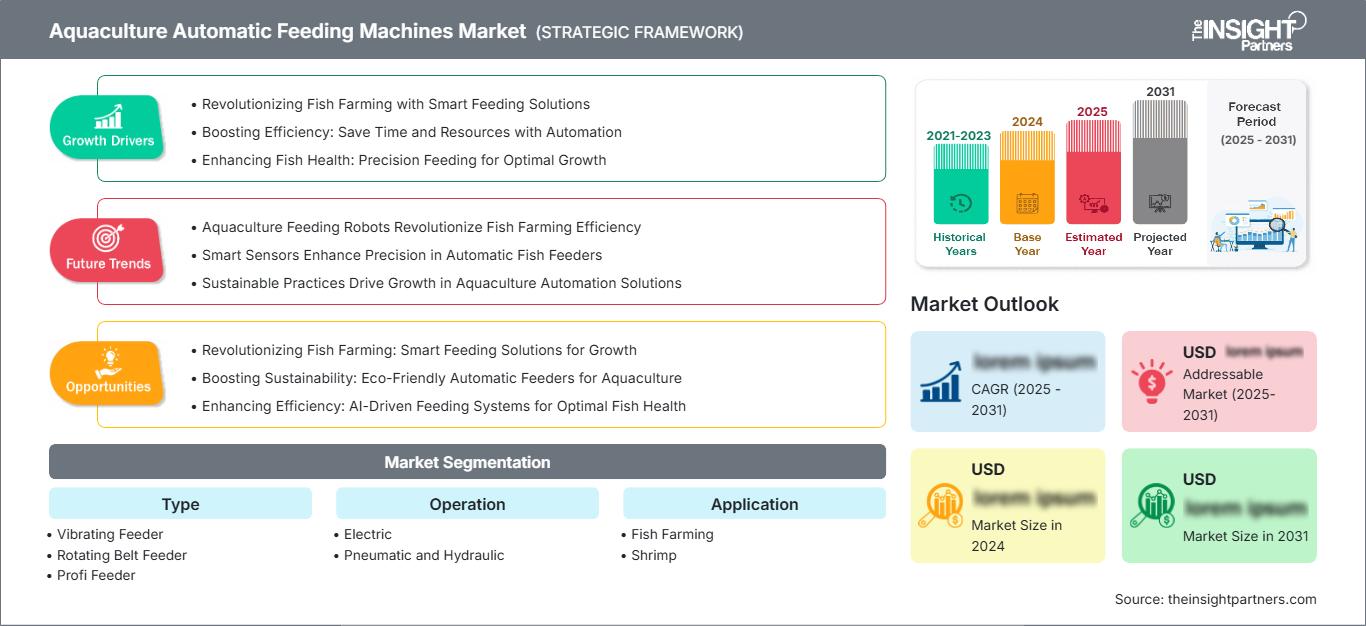
The aquaculture automatic feeding machines market size was estimated at US$ 1.8 Billion in 2025 and is expected to reach US$ 4.04 Billion by 2034 at a CAGR of 9.40%. This market highlights the growing automation in fish and shrimp farming industry that increasingly sees the control of feed amounting, less labor involvement, and improved feed conversion as key aspects.
In North America, aquaculture automatic feeding machines market size will be driven by recirculating aquaculture systems, offshore cage farms, and higher use of remote farms management systems. It is forecasted that the CAGR for this period (2026-2034) will be in the range of 8.6-9.1%, mainly due to labor shortage, more stringent regulation of nutrients discharge, and the integration of feed control into biomass monitoring system.
Aquaculture Automatic Feeding Machines Market Assessment and Insights
- North America accounted for 22–24% aquaculture automatic feeding machines market share in 2025 and is expected to grow at a CAGR range of 8.6–9.1% during 2026–2034 as RAS capacity, salmon farming, and digital farm controls expand.
- US represented 68–72% of North America in 2025 and is projected to record an 8.7–9.2% CAGR during 2026–2034, led by inland RAS and trout facilities.
- Europe held 25–27% share in 2025 and is expected to grow at an 8.8–9.3% CAGR during 2026–2034, with Norway, Scotland, Denmark, and Iceland leading automated feeding investments.
- Asia Pacific captured 36–38% share in 2025 and is forecast to grow at a 9.8–10.4% CAGR during 2026–2034, supported by China, India, Vietnam, Japan, and Australia.
- Largest Segment Fish Farming held 70–74% market share in 2025 and is expected to grow at an 8.9–9.4% CAGR during 2026–2034 due to cage and RAS adoption.
- High Growth Segment Shrimp held 26–30% market share in 2025 and is projected to grow at a 10.2–10.8% CAGR during 2026–2034 as intensive pond feeding improves.
- Key companies analyzed in detail: AKVA group ASA, Aquaculture Equipment Ltd., Asakua Su Ürünleri ve Teknolojileri, Fish Farm Feeder S.L., FUKUSHIN Co., Ltd., Pioneer A.E. Company Limited, Spirex Aquatec Ltd., Gael Force Group Ltd., IRAS A/S, FIAP GmbH
Source: The Insight Partners' analysis based on proprietary research, government publications, company annual reports, investor presentations, industry databases, and expert interviews.
The uptake of technology has evolved the aquaculture automatic feeding machines from time-related feeding devices to those that use sensors to detect hunger, oxygen levels, and even biomass. It is becoming common for commercial farms to consider the feeding device in the context of an integrated production control stack rather than a singular item. This shift will influence purchases by emphasizing the need for pellet integrity, feed tracking, remote-control diagnostics, and compatibility with cameras, blowers, silos, barges, and farm management systems.
In the future, funding will be directed towards the aquaculture sector in areas where production is increased without hiring more labor. Regulations on minimizing the wastage of feed, growing certification needs, and rising costs of feed have enhanced the economic feasibility of precision feeding technology. Additionally, the food security policies of Asia, Middle East, and Europe will facilitate the development of the technology that enhances productivity while reducing nutrient discharge per ton of fish.
Aquaculture Automatic Feeding Machines Market Report Scope
| Report Attribute | Details |
|---|---|
| Market size in 2025 | US$ 1.8 Billion |
| Market Size by 2034 | US$ 4.04 Billion |
| Global CAGR (2026 - 2034) | 9.40% |
| Historical Data | 2021-2024 |
| Forecast period | 2026-2034 |
Aquaculture Automatic Feeding Machines Market Analysis
The driving factors of the aquaculture automatic feeding machine market include savings in feed costs, manpower shortages, and the need for standardization of the feeding process across multi-site farms. Feed usually forms the largest share of the operating cost of farms raising fish and shrimps, hence small feed savings could significantly boost their bottom lines. Automation is also important for farms in order to maintain consistency in the feeding process at night and during bad weather conditions and staff shortages.
The value chain consists of feeder providers, silos and blower suppliers, control system software providers, farm operators, feed producers, and service providers. Favorable supply-side dynamics will benefit the vendors with hardware longevity, software maintenance, replacement parts, and specific dosing logic for different species of fish. Demand is higher where farms have to maintain high stocking density and consistent feeding process.
Competitive positioning is shifting toward integrated platforms. AKVA group ASA emphasizes centralized feeding and AI-supported monitoring, while Gael Force Group Ltd. connects feed barges, SeaFeed systems, and energy-efficient operations. Fish Farm Feeder S.L., FIAP GmbH, and FUKUSHIN Co., Ltd. remain relevant in hatchery, belt, and compact feeder categories where reliability and dosing accuracy matter.
Market analysis of aquaculture automatic feeding machines shows that there is a shift from buying machinery to productivity program. Purchasing is becoming more rational and buyers assess life-cycle cost, pellet breakage, maintenance period, and interoperation before investing. Some niche players such as Aquaculture Equipment Ltd., Asakua Su Ürünleri ve Teknolojileri, Pioneer A.E. Company Limited, Spirex Aquatec Ltd., and IRAS A/S are competing through customization of engineering and regional responsiveness.
● REPORT CUSTOMIZATION
Tailor This Report To Align With Your Specific Business Requirements
This report can be customized to align precisely with your business objectives, scope, and target markets. Customization options include tailored segmentation, geography, competitive analysis, and strategic insights to support informed decision-making.
Customize This Report →WHAT YOU CAN ADJUST
- ● Segmentations
- ● Geography
- ● Competitive Analysis
- ● Language Preferences
Aquaculture Automatic Feeding Machines Market: Strategic Insights
Regional Insights
North America aquaculture automatic feeding machines
The North American region is expected to capture 22-24% of the market share in the aquaculture automatic feeding machines industry in 2025, with a CAGR ranging from 8.6-9.1% estimated between 2026 and 2034. The use of this machinery is prominent among salmon, trout, tilapia, and land-based RAS facilities where repeatable feeding is necessary.
Some of the structural factors that influence the use of the machinery are rising cost of feed, monitoring of water discharge, and development of controlled-environment aquaculture close to consumption regions. Farms within the U.S. and Canada are favoring electric feeding machines connected with cameras and oxygen sensors due to remote monitoring capabilities.
U.S. aquaculture automatic feeding machines Market
The U.S. comprised 68–72% of North America in 2025 and is projected to achieve a 8.7–9.2% CAGR between 2026 and 2034. The demand is primarily for RAS, trout raceways, hatcheries, and shrimp recirculation projects looking to implement precise rationing, minimal handling, and enhanced biosecurity measures.
Market players consist of imported European feeder systems, domestic integrators, and specialized distributors for equipment installation. Fish farms are the main applications; however, indoor shrimp farms have been increasingly popular in warmer and coastal areas. Electric feeders are used the most due to easy connectivity with PLCs and alarms.
Europe aquaculture automatic feeding machines Market
Europe held 25–27% share in 2025 and is projected to grow at an 8.8–9.3% CAGR during 2026–2034. Norway is the leading country, followed by Scotland, Denmark, Iceland, France, Italy, and Spain, supported by salmon, trout, seabass, seabream, and hatchery automation.
The UK market is advantaged through the modernization of Scottish salmon. The use of feed barges and camera-assisted systems minimizes wastage at open sites. Germany and Denmark concentrate on the design of RAS systems, hatcheries, and components. The French, Italians, and Spanish markets display consistent adoption for the Mediterranean species, in which pellet efficiency and farm integration play vital roles.
APAC aquaculture automatic feeding machines Market
APAC accounted for 36–38% share in 2025 and is forecast to expand at a 9.8–10.4% CAGR during 2026–2034. China is the leading country, while Japan, South Korea, India, Australia, Vietnam, and Indonesia add demand through intensive fish and shrimp systems.
These include increased pond productivity goals, labor migration away from the countryside, and government endorsement of aquaculture development. Given the large size of the area, use of electric and pneumatic mechanisms becomes appealing due to the need for centralized feeding, increased survival rates, and consistent feeding schedules in many ponds, tanks, and cages.
Middle East & Africa aquaculture automatic feeding machines Market
Middle East & Africa is expected to grow at an 8.1–8.7% CAGR during 2026–2034, led by Saudi Arabia, the UAE, and South Africa. The region’s demand is linked to food security programs, coastal aquaculture projects, and high-value marine fish production.
Energy and infrastructure context shapes purchasing decisions. Farms in the Gulf prioritize corrosion resistance, backup power, and centralized systems that can operate in harsh climates. South Africa and Rest of MEA markets remain smaller but show potential where tilapia, trout, and marine cage farms require dependable feed scheduling.
Segmentation Analysis
Type
The Type segment is expected to register an 8.9–9.5% CAGR during 2026–2034. The aquaculture automatic feeding machines market scope across feeder types reflects the need to match pellet size, species behavior, water depth, and farm layout. Hatchery and belt feeders serve early life stages, while auger, pneumatic, and rotating systems are favored for larger farms seeking controlled distribution.
- Vibrating Feeder supports accurate small-dose delivery in hatcheries and nursery tanks, where frequent feeding improves uniformity and reduces cannibalism risk among fry and juvenile fish.
- Rotating Belt Feeder remains important for gradual feed release, low power requirements, and simple maintenance in hatchery and research environments requiring predictable feeding over fixed time windows.
- Profi Feeder addresses professional farm needs through programmable delivery, durable materials, and compatibility with operational routines where repeatability, reduced labor, and pellet control are essential.
- Hatchery Feeder is strategically important for early-stage aquaculture because precise micro-diet distribution can improve survival rates, growth uniformity, and transition efficiency before grow-out stocking.
- Auger Feeder is used where consistent mechanical dosing is required for pelletized feed, offering dependable throughput in tanks, raceways, and controlled production systems.
Operation
The Operation segment is projected to grow at an 8.7–9.3% CAGR during 2026–2034. Electric systems dominate compact and digitally connected installations, pneumatic systems support centralized delivery over longer distances, and hydraulic options serve demanding marine environments. Selection depends on farm size, energy availability, maintenance capability, and the distance between feed storage and culture units.
- Electric feeders are widely adopted in hatcheries, RAS, and pond systems because they integrate easily with timers, sensors, control panels, and cloud-based monitoring platforms.
- Pneumatic systems are strategically important for sea cages and large farms, enabling centralized feed transport from silos or barges to multiple pens with scalable distribution.
- Hydraulic operation is relevant in rugged marine settings where power transmission, resistance to harsh conditions, and integration with barge equipment support reliable feeding continuity.
Application
The Application segment is expected to record a 9.2–9.8% CAGR during 2026–2034. Fish farming remains the core revenue base because salmon, trout, tilapia, carp, seabass, and seabream operations use feeders across hatchery, nursery, and grow-out stages. Shrimp applications are gaining momentum as intensive ponds and indoor systems require frequent, controlled feeding with lower waste.
- Fish Farming is the largest application because finfish operations have established automation pathways, higher capital intensity, and strong need for feed conversion control across cages, tanks, and raceways.
- Shrimp is a high-growth application as farms intensify stocking, adopt acoustic and timer-based feeding, and seek lower feed waste in ponds and recirculating systems.
Opportunity Snapshot
| Application | Revenue Contribution | Trend Tag | Adoption Stage |
| Fish Farming | High | Precision Feeding | Mature |
| Shrimp | Medium | Pond Automation | Scaling |
Aquaculture Automatic Feeding Machines Market Growth Drivers and Impact Analysis
Feed Cost Optimization and Waste Reduction
Feeds are a major source of costs in aquaculture and hence the importance of having a precise feeding process. Aquaculture automatic feeding machines ensure that feed amounts are proportionate to the level of hunger of fish, their biomass, water temperature, and oxygen levels. The market impact is mainly felt in high density cages and RAS systems, whereby overfeeding will increase the burden of waste treatment, and underfeeding will lead to slower growth of the fish. Through aquaculture automatic feeding machines, feed conversion becomes easier along with harvesting time prediction and reduction of nutrients.
Labor Shortages Across Commercial Aquaculture Sites
Aquaculture facilities are normally found in faraway coastal, rural, or offshore areas from which it is not easy to obtain skilled workers. The use of automatic feeders helps avoid monotonous jobs for workers, making it easier to concentrate on the welfare of the fishes, maintenance, and monitoring operations. This is well seen in cases involving farms having multiple ponds, hatcheries, or groups of sea cages requiring more than one feeding round in a day. Worker safety is also improved because fewer trips with boats and handling activities close to tanks/cages are needed.
Expansion of RAS and Digitally Managed Farms
In recirculating aquaculture systems and digitally monitored farms, feeding must be precise, measured, and programmed, as feed production, oxygen, filtration, and water quality are directly related. Feeders in these systems are becoming more and more connected with monitors, alarms, and other aspects of the farming software, making the feeding process become a data process. In terms of market influence, this means that there will be more use of electric and auger systems in indoor farming and more centralized feeding systems for larger-scale farms. Investors are financing land-based salmon, shrimp, and tilapia farming near demand centers.
Aquaculture Automatic Feeding Machines Market Future Trends
AI-Assisted Appetite Detection
The aquaculture automatic feeding machines market trends include a focus on the use of AI technology to identify appetite through cameras and behavioral analysis, as well as sensors that measure the level of pellets being fed. These technologies will make the dependence on fixed feeding stations unnecessary by allowing the system to pause or alter feed distribution according to any change in the reaction of the fish. Throughout the forecast period, companies that integrate hardware with software for decision-making will have higher customer loyalty.
Low-Energy and Hybrid Feeding Infrastructure
Feeding systems that consume less energy would become more important as the farm monitors its energy usage such as fuel consumption, generator operation time and emissions produced by the feed barges or ponds far away from the farms. Using hybrid power systems, using solar power in the feeders and the best configuration of blowers could help to save money as well as increase the system availability. This development could be important for offshore farms growing salmons, rural hatcheries and shrimp farms in the warm climate.
Aquaculture Automatic Feeding Machines Market Opportunities
Shrimp Farm Intensification Programs
Shrimp farmers are using intensified pond farming and indoor farming to raise per-hectare yields, necessitating automatic feeding systems capable of delivering multiple small feedings with minimal waste. This is especially true in Asia and Latin America due to the consolidation of farms and the need for better record-keeping for exported shrimps. Aquaculture automatic feeding machines market forecast suggests that manufacturers providing durable shrimp feeders with financing options can successfully target mid-sized farms.
Integrated Retrofit Packages for Existing Farms
Many aquaculture farms operate legacy tanks, cages, or ponds that cannot justify full system replacement but can benefit from targeted automation retrofits. Suppliers can capture this opportunity by bundling feeders, controllers, sensors, installation, and training into modular packages. Retrofit demand is likely to be resilient because it improves productivity without requiring new site permits. Companies that provide clear payback models based on labor savings, feed reduction, and improved growth uniformity will be well placed to serve established producers upgrading in phases.
Recent Developments
- March 25, 2026 — Jetfeeder - announced the launch of the Directional Automatic Feeder, a precision feeding system engineered for intensive production environments where standard automated feeders fall short. In ponds with irregular geometries and complex internal infrastructure, conventional feeders distribute broadly — leaving feed to sink uneaten, accumulate as organic matter, and destabilize water quality. The Directional addresses this directly with a high-output motor and proprietary dispersion system adjustable to 60°, 100°, and 120° arc patterns, projecting feed accurately up to 12 meters to reach biomass regardless of pond layout.
- October 2025: AKVA group ASA — agreed to supply an AC700R feed barge to Arctic Fish in Iceland, including AKVA connect software for feeding and barge control, with delivery scheduled for July 2026 and transport planned for September 2026.
- June 2025- Yanmar Holdings Co., Ltd., FOOD & LIFE COMPANIES LTD. (F&LC) and Owasebussan Co., Ltd. have officially launched a joint demonstration test in June 2025 to promote sustainability in aquaculture using a remote automated feeding system for farmed yellowtail (Buri).
Frequently Asked Questions

- Comprehensive Market Sizing and Forecast Analysis
- Detailed Segmentation Analysis
- In-Depth Market Dynamics Assessment
- Regional and Country-Level Insights
- Competitive Landscape and Company Benchmarking
- Strategic Business Intelligence
Recent Reports
Testimonials

The Insight Partners' SCADA System Market report is comprehensive, with valuable insights on current trends and future forecasts. The team was highly professional, responsive, and supportive throughout. We are very satisfied and highly recommend their services.
RAN KEDEM Partner, Reali Technologies LTDs
I requested a report on a very specific software market and the team produced the report in a few days. The information was very relevant and well presented. I then requested some changes and additions to the report. The team was again very responsive and I got the final report in less than a week.
JEAN-HERVE JENN Chairman, Future Analytica
We worked with The Insight Partners for an important market study and forecast. They gave us clear insights into opportunities and risks, which helped shape our plans. Their research was easy to use and based on solid data. It helped us make smart, confident decisions. We highly recommend them.
PIYUSH NAGPAL Sr. Vice President, High Beam Global
The Insight Partners delivered insightful, well-structured market research with strong domain expertise. Their team was professional and responsive throughout. The user-friendly website made accessing industry reports seamless. We highly recommend them for reliable, high-quality research services
YUKIHIKO ADACHI CEO, Deep Blue, LLC.
This is the first time I have purchased a market report from The Insight Partners.While I was unsure at first, I visited their web site and felt more comfortable to take the risk and purchase a market report.I am completely satisfied with the quality of the report and customer service. I had several questions and comments with the initial report, but after a couple of dialogs over email with their analyst I believe I have a report that I can use as input to our strategic planning process.Thank you so much for taking the extra time and making this a positive experience.I will definitely recommend your service to others and you will be my first call when we need further market data.
JOHN SUZUKI President and Chief Executive Officer, Board Director, BK Technologies
I wish to appreciate your support and the professionalism you displayed in the course of attending to my request for information regarding to infectious disease IVD market in Nigeria. I appreciate your patience, your guidance, and the fact that you were willing to offer a discount, which eventually made it possible for us to close a deal. I look forward to engaging The Insight Partners in the future, all thanks to the impression you have created in me as a result of this first encounter.
DR CHIJIOKE ONYIA MANAGING DIRECTOR, PineCrest Healthcare Ltd.Reason to Buy
- Informed Decision-Making
- Understanding Market Dynamics
- Competitive Analysis
- Identifying Emerging Markets
- Customer Insights
- Market Forecasts
- Risk Mitigation
- Boosting Operational Efficiency
- Strategic Planning
- Investment Justification
- Tracking Industry Innovations
- Aligning with Regulatory Trends





 Get Free Sample for