
Arc Flash Protection Market Size, Demand & Growth by 2034
Coverage: By Equipment (Arc flash detection, Arc flash system, Personal protective equipment); End user (Oil and gas, Manufacturing and Processing, Transportation and Infrastructure, Other) , and Geography (North America, Europe, Asia Pacific, and South and Central America)
- Status : Data Released
- Report Code : TIPRE00027935
- Category : Energy and Power
- No. of Pages : 150
- Available Report Formats :


- Last update date : November 03, 2026


2025 Market Size
US$ 3.35 Bn
Base year value
2034 Forecast
US$ 5.32 Bn
Projected by 2034
CAGR 2026-2034
5.27 %
Growth rate
Addressable Market
US$ 39.32 Bn
(2026-2034)
The arc flash protection market was valued at US$ 3.35 Billion in 2025 and is projected to reach US$ 5.32 Billion by 2034, registering a CAGR of 5.27% from 2026 to 2034. Expansion of industrial electrical infrastructure, stricter workplace electrical-safety practices, modernization of switchgear and distribution systems, and increasing deployment of rapid detection and mitigation technologies are supporting sustained demand. The market is also being influenced by higher power density, aging electrical assets, and the need to reduce personnel exposure and unplanned downtime.
North America remains a structurally important market because of its established electrical-safety framework, extensive installed base, and ongoing investment in industrial and infrastructure assets. The region arc flash protection market size is expected to expand at a modeled CAGR of ~5% through 2034. Demand is supported by continued implementation of electrical safety programs, periodic hazard assessments, replacement of aging protection equipment, and adoption of active mitigation technologies in facilities where interruption and personnel risk carry substantial operating costs.
Arc Flash Protection Market Assessment and Insights
Regional Outlook
- North America: ~35% of the global market in 2025 | ~5% CAGR through 2034. Market position: North America holds the largest regional position, supported by mature electrical-safety practices, extensive industrial installations, established engineering standards, and continued replacement of legacy switchgear and protective devices.
- US: ~72% of North American market revenue in 2025 | ~5% CAGR through 2034. Market position: The US is the largest country market in North America, with demand spanning manufacturing, utilities, oil and gas, transportation, and critical infrastructure where electrical-risk assessment and personnel protection are embedded in operating practices.
- Europe: ~28% of the global market in 2025 | ~5% CAGR through 2034. Market position: Europe is a mature market characterized by stringent worker-safety requirements and industrial modernization. Germany leads Europe, followed by strong demand across the UK, France, Italy, and Spain.
- Asia Pacific: ~25% of the global market in 2025 | ~7% CAGR through 2034. Market position: Asia Pacific is the fastest-growing region, supported by industrial expansion, manufacturing investment, electrification, infrastructure construction, and modernization of electrical systems across China, Japan, South Korea, India, and Australia.
Segment Outlook
- Equipment: ~62% Share in 2025 | ~6% CAGR through 2034. Market position: Equipment represents the largest main segment because industrial buyers increasingly combine detection, mitigation, and worker protection within structured electrical-safety programs. Replacement cycles and modernization of switchgear further reinforce recurring demand.
- End user: ~38% Share in 2025 | ~7% CAGR through 2034. Market position: End-user demand is accelerating as energy-intensive facilities and infrastructure operators strengthen electrical-risk controls. New industrial capacity, modernization programs, and greater emphasis on operational continuity support adoption across diverse workplace environments.
Competitive Coverage
Schneider Electric SE, Larsen & Toubro Limited, ABB Ltd., General Electric Company, Siemens Limited, Basler Electric Company, DuPont de Nemours, Inc., Mitsubishi Electric Corporation, Eaton Corporation plc, Rockwell Automation, Inc.
Methodology
The Insight Partners follows Data Collection & Secondary Research, Primary Research, Data Analysis, and Data Triangulation & Final Review to validate market estimates and insights.
Source: The Insight Partners' analysis based on proprietary research, government publications, company annual reports, investor presentations, industry databases, and expert interviews.
It has transitioned from its dependence on traditional overcurrent devices and procedures to multilayered electrical risk management, which includes quicker fault sensing, protective relaying, arc-resistant equipment, maintenance mode operation, and design of lower incident energy. In addition, the shift has also been related to digitization, in which modern protection devices are now providing measuring, communication, and diagnostic features in addition to their basic protective function. This allows operators to take care of both personnel safety as well as equipment reliability without focusing only on arc flash compliance.
In the future, investments will not be limited to already developed North America and Europe and extend to developing Asian industries and infrastructure projects in emerging countries. Higher voltage as well as DC system architecture is also adding engineering considerations. IEEE has continued making progress in developing standards for arc flash studies, such as IEEE 1584.2-2025 for data acquisition in relevant low-voltage three-phase AC systems.
Arc Flash Protection Market Report Scope
| Report Attribute | Details |
|---|---|
| Market size in 2025 | US$ 3.35 Billion |
| Market Size by 2034 | US$ 5.32 Billion |
| Global CAGR (2026 - 2034) | 5.27% |
| Historical Data | 2021-2024 |
| Forecast period | 2026-2034 |
Arc Flash Protection Market Analysis
Demand has strong correlation with the installed base of switchgear, MCCs, distribution boards, substations, and industrial electrical equipment. Facility managers now consider protection in terms of lifecycle asset management since an arc flash could include exposure to harm by employees along with equipment damage, disruption of production, and costly repairs. OSHA highlights the NFPA 70E as one of the main references for reduction in the level of exposure to electrical hazards, whereas IEEE 1584 serves as the engineering guide for determining incident energy levels and arc flash boundaries.
The arc flash protection market report involves the manufacturing companies of the electrical equipment, the providers of the protection systems, the engineering contractors, the safety experts, PPE suppliers, the system integrators, facility managers and maintenance companies. The dynamics of supply go beyond the device itself and include engineering studies, installation, testing, training, labeling, maintenance, and replacement of the equipment. Some of the players that operate in multiple components of this ecosystem include Schneider Electric SE, ABB Ltd., Siemens Limited, Eaton Corporation plc, and Mitsubishi Electric Corporation.
Differentiation in the competition will occur in terms of reaction time, integration with switchgear and protective relays, interoperability with digital power management systems, ease of retrofitting, and reduction of incident energy without causing unwanted operational disruptions. Schneider Electric SE, ABB Ltd., Siemens Limited, and Eaton Corporation plc have diverse electrical product ranges, while General Electric Company, Mitsubishi Electric Corporation, Larsen & Toubro Limited, and Rockwell Automation, Inc. have complementary industrial and infrastructural products. DuPont de Nemours, Inc. offers PPE, while Basler Electric Company offers protection equipment used in power systems applications.
Investment needs are moving towards solutions that integrate sensing, protection, analytics, and maintenance functions. Consumers are now opting for products that can fit in their electrical infrastructures rather than products that must completely replace existing systems. Such a scenario favours suppliers who have large installed bases, engineering skills, retrofitting skills, and maintenance facilities. There are also opportunities for specialists who can handle risky applications like process plants, data centers, transport infrastructures, and industrial applications handling high currents.
● REPORT CUSTOMIZATION
Tailor This Report To Align With Your Specific Business Requirements
This report can be customized to align precisely with your business objectives, scope, and target markets. Customization options include tailored segmentation, geography, competitive analysis, and strategic insights to support informed decision-making.
Customize This Report →WHAT YOU CAN ADJUST
- ● Segmentations
- ● Geography
- ● Competitive Analysis
- ● Language Preferences
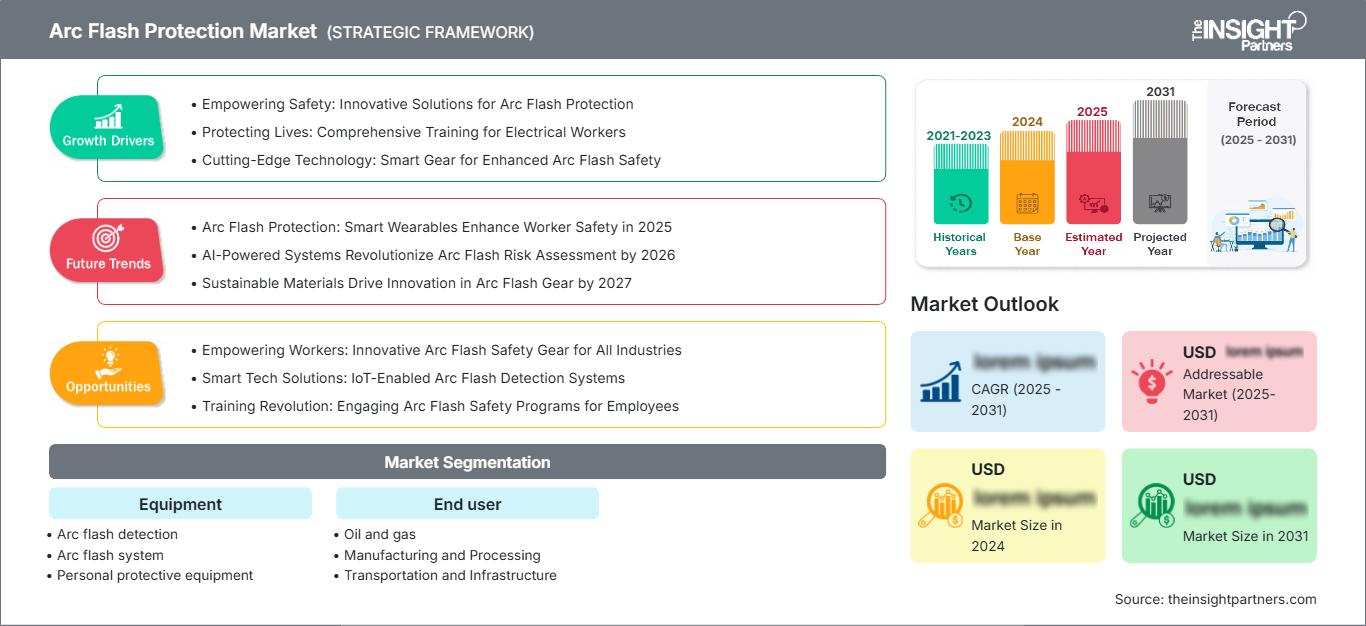
Arc Flash Protection Market: Strategic Insights
Regional Insights
North America arc flash protection market
North America accounted for a modeled ~35% of the global market in 2025 and is expected to expand at ~5% CAGR through 2034. The region benefits from a large installed base of industrial electrical equipment and mature electrical-safety practices. The US represents the principal demand center, while Canada contributes through energy, mining, manufacturing, utilities, and infrastructure applications. Replacement of aging switchgear and modernization of protection systems remain important demand mechanisms.
The regional market also benefits from established use of engineering studies, incident-energy assessments, arc-rated PPE, and equipment designed to contain or reduce arc energy. OSHA's electrical-safety framework and the industry's use of NFPA 70E and IEEE 1584 provide an established technical context for hazard assessment and mitigation.
U.S. arc flash protection market
The US represented a modeled ~72% of North American arc flash protection market share in 2025 and is expected to grow at ~5% CAGR through 2034. Demand is concentrated in manufacturing, oil and gas, utilities, transportation, commercial facilities, and critical infrastructure. The breadth of installed electrical equipment creates recurring requirements for assessments, protective-device upgrades, maintenance, and replacement.
US suppliers and international manufacturers compete through switchgear, relays, detection systems, arc-resistant equipment, software, PPE, and engineering services. Electrical safety programs increasingly connect hazard calculations with equipment labeling, work procedures, training, and PPE selection. Eaton Corporation plc, Schneider Electric SE, Rockwell Automation, Inc., Basler Electric Company, and General Electric Company have relevant capabilities spanning these applications, supporting a diverse replacement and retrofit market.
Europe arc flash protection market
Europe represented ~28% of the global arc flash protection market share in 2025 and is projected to grow at ~5% CAGR through 2034. Germany is the leading country in Europe, supported by its large industrial base, machinery manufacturing, automotive production, chemicals, energy infrastructure, and advanced electrical engineering ecosystem. The UK maintains demand across utilities, transportation, manufacturing, and infrastructure, while France benefits from industrial facilities, energy assets, and infrastructure modernization.
Germany's industrial concentration supports strong requirements for engineered protection and maintenance, while France and Italy provide substantial demand from manufacturing and infrastructure applications. Spain is supported by industrial facilities, renewable-energy infrastructure, transport assets, and electrical-system modernization. Across the region, suppliers compete on integration, compliance, reliability, retrofit capability, and lifecycle service rather than solely on individual protective components.
APAC arc flash protection market
Asia Pacific represented ~25% of the global market in 2025 and is expected to expand at ~7% CAGR through 2034, making it the fastest-growing region. China is the leading country in Asia Pacific, supported by large manufacturing capacity, industrial electrification, infrastructure investment, and extensive deployment of electrical distribution equipment. Japan and South Korea contribute through advanced manufacturing, electronics, automotive, and energy-intensive industrial facilities.
India and Australia provide additional demand through industrial expansion, infrastructure development, utilities, mining, and energy projects. The region's growth mechanism is strongly connected to new electrical installations as well as modernization of existing systems. As industrial operators adopt more structured electrical-safety programs, demand is moving toward integrated protection, detection, equipment containment, and PPE rather than isolated safety products.
Middle East & Africa arc flash protection market
Middle East & Africa is expected to register ~6% CAGR through 2034. Saudi Arabia is the leading country in the Middle East & Africa region where evidence supports the strongest concentration of large energy, infrastructure, and industrial investment. The UAE also provides significant demand through utilities, commercial infrastructure, transportation, and large-scale development projects.
South Africa contributes through mining, manufacturing, utilities, and infrastructure, while the rest of the region is influenced by oil and gas projects, power-system expansion, industrial facilities, and infrastructure modernization. Energy-intensive applications require protection strategies that limit both personnel exposure and equipment downtime. Investment in new substations, distribution networks, processing facilities, and industrial projects should therefore support adoption of modern protection technologies.
Segmentation Analysis
Equipment
Equipment is the largest main segment in the arc flash protection market, accounting for a modeled ~62% share in 2025 and expanding at ~6% CAGR through 2034. Demand reflects the need to combine hazard detection, energy reduction, equipment protection, and worker protection within electrical-system designs. Replacement of aging equipment and integration of protection into digitally monitored installations strengthen the segment's position. Buyers increasingly evaluate response time, retrofit compatibility, maintenance requirements, and interoperability when selecting protection solutions.
- Arc flash detection: Rapid detection technologies identify abnormal optical, current, or combined signatures and enable protective devices to initiate fast interruption. Their value is highest where reducing clearing time can materially lower incident energy and equipment damage.
- Arc flash system: Integrated systems coordinate detection, relays, breakers, enclosures, and control functions to mitigate fault energy. They are particularly relevant in medium- and low-voltage installations where engineered protection must operate with existing distribution architectures.
- Personal protective equipment: PPE remains an essential personnel-control layer where exposure cannot be eliminated. Demand is shaped by incident-energy assessments, work practices, arc ratings, comfort, durability, and requirements for workers across industrial and infrastructure environments.
End user
End user is the higher-growth main segment, with a modeled ~38% share in 2025 and ~7% CAGR through 2034. Growth is driven by expansion and modernization of electrical assets across facilities with high production continuity requirements. Operators increasingly integrate arc-flash mitigation into broader electrical-safety management, asset maintenance, and operational-risk programs. Procurement decisions therefore increasingly consider lifecycle reliability and downtime avoidance alongside worker protection.
- Oil and gas: Refineries, petrochemical plants, terminals, pipelines, and upstream facilities contain complex electrical systems operating alongside combustible materials. Protection requirements emphasize fast fault clearing, equipment containment, maintenance procedures, and worker protection.
- Manufacturing and Processing: Factories and processing plants depend on motor-control centers, switchgear, drives, and distribution systems. Demand is reinforced by automation, higher electrical loads, production-continuity requirements, and modernization of legacy equipment.
- Transportation and Infrastructure: Rail, airports, ports, tunnels, utilities, and public infrastructure increasingly depend on reliable electrical distribution. Protection solutions help address worker exposure and operational continuity across geographically distributed electrical assets.
Opportunity Snapshot
| End Users | Revenue Contribution | Trend Tag | Adoption Stage |
| Oil and gas | High | Process Safety | Mature |
| Manufacturing and Processing | High | Factory Modernization | Scaling |
| Transportation and Infrastructure | Medium | Infrastructure Electrification | Scaling |
Arc Flash Protection Market Growth Drivers and Impact Analysis
Expansion of Industrial Electrical Infrastructure
Industrial expansion increases the number and complexity of electrical assets that require engineered protection. New manufacturing facilities, processing plants, energy projects, warehouses, transportation systems, and infrastructure installations add switchgear, motor-control centers, transformers, drives, and distribution equipment to the addressable base. As electrical loads rise, the consequences of uncontrolled faults become more significant, encouraging facility owners to incorporate mitigation during design rather than relying only on procedural controls. This creates demand for detection systems, protective relays, arc-resistant equipment, and appropriately rated PPE. The impact is strongest where downtime carries substantial financial consequences because buyers increasingly view protection as part of operational resilience rather than solely as a compliance expenditure.
Stronger Electrical Safety and Risk Management Practices
Electrical-safety programs are becoming more structured as companies seek consistent methods for identifying hazards, controlling exposure, and documenting protection requirements. OSHA identifies electrical hazards as a workplace safety concern, while NFPA 70E provides practices for reducing worker exposure and IEEE 1584 supports incident-energy analysis. This framework encourages organizations to connect engineering calculations with equipment labeling, maintenance, work procedures, training, and PPE selection. The commercial impact extends across the value chain because a single hazard assessment can generate requirements for protection devices, switchgear modifications, software, engineering services, PPE, and recurring maintenance. Suppliers able to provide integrated solutions can therefore capture more lifecycle value.
Demand for Faster Fault Detection and Lower Incident Energy
Reducing the time between arc initiation and fault interruption is a central technical route to lowering incident energy. Modern arc-flash systems increasingly combine high-speed sensing with protective relays and circuit breakers to initiate rapid interruption. ABB, for example, describes its Arc Guard System as detecting arc-flash events in under 1 millisecond and clearing faults in as little as 30 milliseconds. Similar engineering priorities are encouraging buyers to evaluate response time and system coordination more closely. The market impact is a gradual shift from passive protection toward active mitigation, especially in high-current industrial applications where equipment damage and production interruption can be substantial.
Arc Flash Protection Market Future Trends
DC Arc Flash Protection for Emerging Power Architectures
The expansion of direct-current power architectures is creating a new technical frontier for electrical safety. AI data centers, battery systems, photovoltaic installations, electric-vehicle infrastructure, and energy-storage systems can use DC architectures with fault characteristics that differ from established AC systems. IEEE's established arc-flash calculation framework primarily addresses specified AC applications, while new research is examining practical approaches for DC hazards. In October 2026, the Fire Protection Research Foundation announced a three-year project focused on developing and validating DC arc-flash models, beginning with 800 V data-center applications. This arc flash protection market trend could expand demand for specialized modeling, detection, testing, and mitigation solutions as DC deployments increase.
Integration of Protection With Digital Electrical Management
Future protection architectures are likely to connect arc-flash functions with broader digital power-management platforms. Intelligent protection devices can combine measurement, communication, event information, and protective functions, allowing operators to use electrical data for maintenance and system optimization alongside safety. ABB's current protection portfolio illustrates this direction by combining digital protection, monitoring, control, and connectivity with arc-flash mitigation capabilities. Integration can improve visibility into electrical-system conditions and simplify lifecycle management. As facilities become more automated, protection suppliers with interoperable hardware, software, communications, and service capabilities should be better positioned to support increasingly data-driven maintenance programs.
Arc Flash Protection Market Opportunities
Retrofit Programs for Aging Electrical Infrastructure
A substantial opportunity exists in upgrading existing electrical installations without replacing entire distribution systems. Many industrial facilities operate equipment installed under earlier protection philosophies, creating potential requirements for updated hazard studies, relays, detection systems, arc-resistant components, breaker upgrades, and PPE. Retrofit projects can be economically attractive when they extend asset life while improving personnel protection and reducing outage exposure. Vendors with engineering expertise and broad compatibility across legacy switchgear can differentiate through short installation windows and staged modernization. Service providers can also generate recurring revenue from reassessment, testing, maintenance, labeling, and training. The opportunity is particularly relevant in mature markets with extensive installed bases and high costs associated with production interruption.
Integrated Safety Solutions for High-Growth Industrial Markets
Asia Pacific and selected Middle Eastern arc flash protection market forecast offer opportunities for suppliers that can package engineering, equipment, software, training, and PPE into integrated safety programs. Rapid industrial construction creates situations in which protection requirements can be incorporated at the design stage, while existing facilities create retrofit demand as electrical loads and production requirements increase. Suppliers can target manufacturing clusters, energy projects, infrastructure programs, and large process facilities where electrical reliability has direct operational implications. Partnerships with engineering contractors and local system integrators can improve project access and installation capacity. The opportunity is strongest for companies able to adapt global protection technologies to local standards, electrical architectures, maintenance capabilities, and procurement requirements.
Frequently Asked Questions

- Comprehensive Market Sizing and Forecast Analysis
- Detailed Segmentation Analysis
- In-Depth Market Dynamics Assessment
- Regional and Country-Level Insights
- Competitive Landscape and Company Benchmarking
- Strategic Business Intelligence
Recent Reports
Testimonials

The Insight Partners provided valuable market intelligence that supported our global go-to-market strategy. Their team was professional, responsive, and attentive to our feedback, providing thoughtful analysis and helpful methodological clarifications throughout the project.
Junmo Kim Chief Financial Officer (CFO), Enertech Co., Ltd.
The Insight Partners' SCADA System Market report is comprehensive, with valuable insights on current trends and future forecasts. The team was highly professional, responsive, and supportive throughout. We are very satisfied and highly recommend their services.
RAN KEDEM Partner, Reali Technologies LTDs
I requested a report on a very specific software market and the team produced the report in a few days. The information was very relevant and well presented. I then requested some changes and additions to the report. The team was again very responsive and I got the final report in less than a week.
JEAN-HERVE JENN Chairman, Future Analytica
We worked with The Insight Partners for an important market study and forecast. They gave us clear insights into opportunities and risks, which helped shape our plans. Their research was easy to use and based on solid data. It helped us make smart, confident decisions. We highly recommend them.
PIYUSH NAGPAL Sr. Vice President, High Beam Global
The Insight Partners delivered insightful, well-structured market research with strong domain expertise. Their team was professional and responsive throughout. The user-friendly website made accessing industry reports seamless. We highly recommend them for reliable, high-quality research services
YUKIHIKO ADACHI CEO, Deep Blue, LLC.
This is the first time I have purchased a market report from The Insight Partners.While I was unsure at first, I visited their web site and felt more comfortable to take the risk and purchase a market report.I am completely satisfied with the quality of the report and customer service. I had several questions and comments with the initial report, but after a couple of dialogs over email with their analyst I believe I have a report that I can use as input to our strategic planning process.Thank you so much for taking the extra time and making this a positive experience.I will definitely recommend your service to others and you will be my first call when we need further market data.
JOHN SUZUKI President and Chief Executive Officer, Board Director, BK Technologies
I wish to appreciate your support and the professionalism you displayed in the course of attending to my request for information regarding to infectious disease IVD market in Nigeria. I appreciate your patience, your guidance, and the fact that you were willing to offer a discount, which eventually made it possible for us to close a deal. I look forward to engaging The Insight Partners in the future, all thanks to the impression you have created in me as a result of this first encounter.
DR CHIJIOKE ONYIA MANAGING DIRECTOR, PineCrest Healthcare Ltd.Reason to Buy
- Informed Decision-Making
- Understanding Market Dynamics
- Competitive Analysis
- Identifying Emerging Markets
- Customer Insights
- Market Forecasts
- Risk Mitigation
- Boosting Operational Efficiency
- Strategic Planning
- Investment Justification
- Tracking Industry Innovations
- Aligning with Regulatory Trends





 Get Free Sample for