
Artificial Organs and Bionics Market Size, Demand & Growth by 2034
Coverage: By Product (Artificial Organs, Artificial Bionics); Technology (Mechanical bionics, Electronic bionics), and Geography (North America, Europe, Asia Pacific, and South and Central America)
- Status : Data Released
- Report Code : TIPRE00018936
- Category : Life Sciences
- No. of Pages : 150
- Available Report Formats :


- Last update date : September 02, 2026


2025 Market Size
US$ 22.42 Bn
Base year value
2034 Forecast
US$ 50.00 Bn
Projected by 2034
CAGR 2026-2034
9.32 %
Growth rate
Addressable Market
US$ 323.45 Bn
(2026-2034)
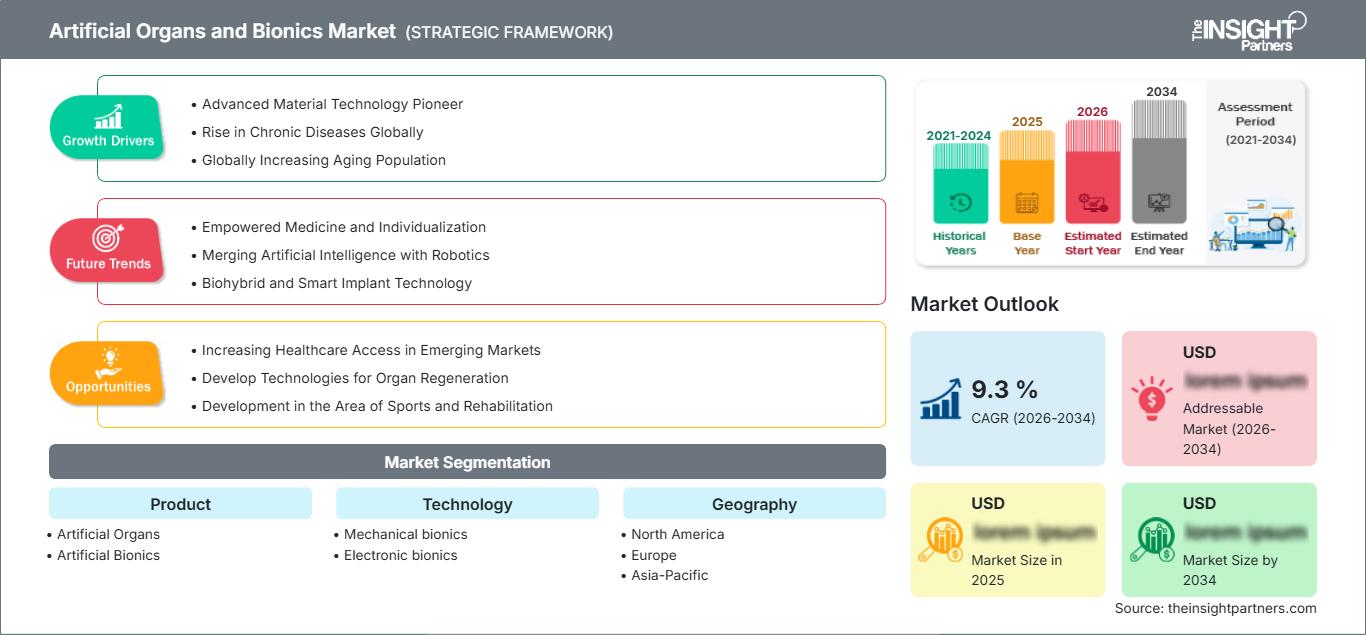
The artificial organs and bionics market is positioned at the intersection of organ replacement, circulatory support, sensory restoration, and mobility technologies. The market is valued at US$ 22.42 Billion in 2025 and is projected to reach US$ 50.00 Billion by 2034, reflecting a CAGR of 9.32% during 2026–2034. Demand is supported by organ failure, aging populations, disability, and continued development of implantable and wearable technologies.
North American demand is expected to remain structurally strong, with the artificial organs and bionics market size benefiting from advanced cardiac and orthopedic care, high procedure volumes, specialist centers, and established reimbursement pathways. The region is estimated to expand at a 8.7–9.5% CAGR from 2026–2034. Published industry benchmarks similarly identify North America as the leading regional market.
Artificial Organs and Bionics Market Assessment and Insights
- North America: North America is estimated to hold a 42–46% share in 2025 and grow at a 8.7–9.5% CAGR between 2026–2034, supported by advanced cardiovascular, orthopedic, and rehabilitation infrastructure and strong clinical adoption.
- US: The US represents 82–86% of North America in 2025 and is projected to grow at a 8.8–9.6% CAGR between 2026–2034, led by specialized hospitals, device innovation, and reimbursement depth.
- Europe: Europe is estimated at a 25–29% share in 2025 and a 9.0–9.8% CAGR between 2026–2034, with Germany, the UK, France, Italy, and Spain supporting demand through mature hospital systems and medical-device manufacturing.
- Asia Pacific: Asia Pacific is estimated at a 20–24% share in 2025 and a 10.5–11.5% CAGR between 2026–2034, with China, Japan, South Korea, India, and Australia benefiting from healthcare investment and expanding specialist capacity.
- Largest Segment: Artificial Organs holds an estimated 72–76% in 2025 and is expected to expand at an 8.6–9.4% CAGR during 2026–2034, reflecting established therapeutic applications.
- High Growth Segment: Electronic bionics holds an estimated 31–35% in 2025 and is projected to grow at a 10.5–11.5% CAGR during 2026–2034, supported by sensing and digital control.
- Key companies analyzed in detail: Medtronic; Zimmer Biomet Holdings, Inc.; Abbott; ABIOMED, Inc.; Biomet, Inc.; Berlin Heart GmbH; Edwards Lifesciences Corporation; Boston Scientific Corporation; Ekso Bionics, Inc.; SynCardia Systems, LLC.
Source: The Insight Partners' analysis based on proprietary research, government publications, company annual reports, investor presentations, industry databases, and expert interviews.
After the initial mechanical device replacement, the industry now utilizes both biocompatible materials as well as tiny sensors, electronic and digital monitoring equipment. This applies to cardiac assist devices, joint replacements, artificial valves, exoskeletons and sensory devices, all of which need advanced manufacturing techniques as well as clinical software. Reliability, miniaturization, sterilization and reproducibility are the focus of the manufacturing process.
In future, new health care systems in the Asia Pacific and chosen Middle East markets will facilitate access with more specialist facilities, insurance programs, and manufacturing capacity at hand. Money will most probably be directed toward those platforms that show robust performance, scalable manufacturing processes, and affordable lifecycle costs. Safety, security, interoperability, and post-market data will guide investment in implantable or electronically driven devices.
Artificial Organs and Bionics Market Report Scope
| Report Attribute | Details |
|---|---|
| Market size in 2025 | US$ 22.42 Billion |
| Market Size by 2034 | US$ 50.00 Billion |
| Global CAGR (2026 - 2034) | 9.32% |
| Historical Data | 2021-2024 |
| Forecast period | 2026-2034 |
Artificial Organs and Bionics Market Analysis
Demand for such a product is driven by the discrepancy between demand for organ replacement or restoration and the supply of donors. The artificial organs and bionics market trend is thus characterized by growth in durable implants, short-term circulation assistance, dialysis related solutions, prosthetics, and sensory technologies. The value chain consists of biomaterials, precision components, electronics, technology developer, hospital, rehabilitation, and reimbursement players.
The supply drivers have evolved towards specialty production rather than mass-production. Pumps, valves, implantable housing, actuators, electrodes, sensors are manufactured with controlled tolerances and in controlled environments. The hospitals impact choice based on results, training, cost of procedures and services. Integrated engineering and regulatory expertise could help in faster development, small specialties would leverage technologies.
Competitive positioning has become driven by portfolio depth, clinical evidence, and specialist distribution. The artificial organs and bionics market report suggests the following layers of competition. Major MedTech companies include their cardiovascular, orthopedic, and surgical portfolios, while specialist companies target specific solutions for artificial hearts, exoskeletons, or implants. Medtronic, Abbott, ABIOMED, Inc., Edwards Lifesciences Corporation, and Boston Scientific Corporation have a wide experience in clinical trials and commercial activities.
Zimmer Biomet Holdings, Inc. has additional competence in the field of orthopedic bionics and digital surgery, while Ekso Bionics, Inc. has a focus on rehabilitation solutions. Berlin Heart GmbH and SynCardia Systems, LLC keep specialized niches in the sphere of mechanical circulatory support. Biomet, Inc. still plays an important role in the history of the orthopedic portfolio. More investment will be devoted to miniaturization, robotics, intelligent sensing, and longevity of devices. Among all these types, differentiation is based on evidence, large-scale manufacturing, training clinicians, and integration of hardware with software.
● REPORT CUSTOMIZATION
Tailor This Report To Align With Your Specific Business Requirements
This report can be customized to align precisely with your business objectives, scope, and target markets. Customization options include tailored segmentation, geography, competitive analysis, and strategic insights to support informed decision-making.
Customize This Report →WHAT YOU CAN ADJUST
- ● Segmentations
- ● Geography
- ● Competitive Analysis
- ● Language Preferences
Artificial Organs and Bionics Market: Strategic Insights
Regional Insights
North America artificial organs and bionics market
North America represents 42–46% of 2025 artificial organs and bionics market share and is anticipated to grow at a CAGR of 8.7–9.5% till 2034. Market shares of artificial organs and bionics can be attributed to significant levels of cardiovascular procedures, orthopedic reconstructive surgery, rehabilitation therapies, and presence of specialized hospitals in the region. USA covers most of regional demand, with Canada represented by tertiary care facilities. According to existing benchmarks, North America represents the leading regional market.
Specialized nature of treatment centers enables development of high-value implantable systems due to ability to cover the needs for training, supervision, and servicing after operations. The presence of advanced regulatory and payment systems also benefits product developers in the region, though demands for evidence are still high. Collaboration between hospitals, universities, and manufacturers provides the basis for development of cardiac, prosthetic, and sensing technologies.
U.S. artificial organs and bionics market
The US represents an estimated 82–86% share of North American revenue in 2025 and is projected to grow at an 8.8–9.6% CAGR through 2034. The country combines high cardiovascular disease burden, orthopedic procedure volumes, specialist rehabilitation, and extensive implantable-technology adoption. Major companies maintain manufacturing, clinical research, distribution, and physician-training networks. The US remains a major innovation and commercialization center for artificial organs and bionics.
These range from ventricular assist devices to transcatheter valves, orthopedic implants, neurostimulators, prostheses, and exoskeletons. In terms of the competitive scenario, technologies which provide concrete evidence, are commercially feasible for hospitals, and have supporting post-marketing information fare better. The regulatory process has an effect on the time-to-market and financing, while reimbursement will dictate when complex technologies enter the clinical setting.
Europe artificial organs and bionics market
Europe has an approximate market share of 25-29% in 2025 and is forecast to grow at a 9.0-9.8% CAGR up to 2034. Germany is the leader, followed by the UK, France, Italy, and Spain. Health insurance, specialist hospitals, and investments in rehabilitation boost demand. Germany boasts advanced capabilities in medical-device manufacturing and tertiary care that promote complex implant usage in the cardiovascular and orthopedic areas.
In the UK, advanced cardiovascular and rehabilitation programs are ensured through centralized health purchasing, and in Germany, high-level medical-device manufacturing and tertiary-care capabilities go together. In France, there are developing programs for structural heart and implants, while Italy and Spain offer advanced orthopedic and cardiovascular services. Evidence-based medicine and health economics are increasingly important when buying products. EU Medical Device Regulation is favorable for established manufacturers.
APAC artificial organs and bionics market
Estimated Asia Pacific region holds a 20-24% market share in 2025 and it is expected to grow at a CAGR of 10.5-11.5% through 2034, to become the fastest growing region. Leading the way in terms of size is China and the other players include Japan, South Korea, India, and Australia with different growth paths. Published benchmarks have similarly recognized China and Japan as the key regional markets.
Investments in industrial sector, hospital development, aging population, and growing number of specialties drive the adoption. In China there are efforts being made to build local capability in terms of medical device development; in Japan, there is emphasis on advanced implants and elderly care needs; South Korea combines the electronics industry with healthcare; India offers tertiary care opportunities; and Australia offers sophisticated clinical infrastructure.
Middle East & Africa artificial organs and bionics market
Middle East and Africa is expected to expand at a 8.0–9.0% CAGR through 2034, with Saudi Arabia leading regional investment. The artificial organs and bionics market share remains smaller than developed regions because specialist infrastructure and reimbursement depth vary widely across countries.
In Saudi Arabia and the UAE, modern hospital infrastructure and medical tourism services are being developed, whereas South Africa continues to be a major clinical center for the rest of Sub-Saharan Africa. Other parts of MEA suffer from disparity in access to healthcare and hence the market will experience two speeds. Wealth generated from the energy industry will allow the development of expensive hospital projects in Gulf countries, although procurement cost, expertise, and maintenance will be crucial.
Segmentation Analysis
Product
Product segmentation is led by Artificial Organs, reflecting established clinical use across cardiovascular, renal, orthopedic, and other organ-support applications. Artificial Bionics is expanding faster as prosthetic, sensory, and mobility technologies become more integrated with electronics and digital control. Artificial Organs is expected to grow at an 8.6–9.4% CAGR, while Artificial Bionics is projected at 10.0–11.0% during 2026–2034. The artificial organs and bionics market scope increasingly includes both life-sustaining systems and functional restoration platforms.
- Artificial Organs: Established cardiac, renal, and tissue-replacement applications provide the largest installed clinical base. Demand is shaped by organ failure prevalence, procedure volumes, replacement cycles, and the need for durable alternatives when transplantation is unavailable.
- Artificial Bionics: Prosthetic, sensory, mobility, and neurotechnology applications increasingly combine mechanical structures with electronics. Adoption depends on functional improvement, rehabilitation capacity, clinician training, reimbursement, and the ability to personalize device performance.
Technology
Technology segmentation separates mechanical bionics from electronic bionics. Mechanical bionics remains important where load-bearing performance, actuation, and structural durability determine outcomes, while electronic bionics benefits from embedded sensors, microprocessors, wireless connectivity, and adaptive control. Mechanical bionics is expected to grow at an 8.0–9.0% CAGR, compared with 10.5–11.5% for Electronic bionics during 2026–2034.
- Mechanical bionics: Mechanical systems remain central to durable movement, structural replacement, and circulatory support. Their strategic importance lies in reliability, fatigue resistance, biocompatibility, and the ability to function predictably under demanding physiological loads.
- Electronic bionics: Electronic systems enable sensing, stimulation, adaptive control, and data capture. Demand is increasingly linked to personalization, connectivity, software updates, and improved functional feedback, creating opportunities for technology partnerships beyond conventional medical-device manufacturing.
Opportunity Snapshot
| Product | Revenue Contribution (High/Medium/Low) | Trend Tag (MAX 2 words) | Adoption Stage |
|---|---|---|---|
| Artificial Organs | High | Organ Support | Mature |
| Artificial Bionics | Medium | Smart Prosthetics | Scaling |
Artificial Organs and Bionics Market Growth Drivers and Impact Analysis
Rising burden of organ failure and functional disability
Increasing prevalence of cardiovascular disease, kidney failure, diabetes-related complications, musculoskeletal disorders, and disabling injuries expands the addressable population for artificial organs and bionic technologies. The impact is strongest where patients require long-term support, replacement, or restoration and where donor availability cannot satisfy clinical need. Aging populations further increase demand for orthopedic reconstruction and chronic disease management. For manufacturers, this driver supports investment in higher-durability implants, smaller support systems, and technologies that reduce complications. Hospitals are also more willing to adopt advanced devices when they can demonstrate lower readmission risk, shorter recovery, or improved functional outcomes. Consequently, suppliers with evidence-backed technologies can gain access to broader clinical pathways and create recurring demand through replacements, upgrades, monitoring, and service programs.
Miniaturization and integration of sensing with implantable systems
Device miniaturization is changing the engineering economics of artificial organs and bionics by allowing pumps, sensors, processors, batteries, and communication components to occupy less physical space. Smaller systems can improve implantation feasibility, patient mobility, comfort, and procedural efficiency. Integration also creates opportunities for continuous physiological monitoring and adaptive device behavior, particularly in electronically controlled prostheses and rehabilitation platforms. Manufacturers increasingly need expertise across mechanical engineering, electronics, software, materials science, and clinical validation. The commercial impact extends beyond hardware because connected devices can generate demand for software, analytics, maintenance, and clinical-support services. As these systems become more complex, cybersecurity, interoperability, battery safety, and lifecycle management will become important purchasing criteria alongside conventional measures such as durability and procedural performance.
Expansion of minimally invasive and robot-assisted interventions
Minimally invasive procedures are widening the use of sophisticated implants by reducing surgical trauma and enabling treatment of patients who may be poor candidates for conventional surgery. Transcatheter valves, catheter-delivered circulatory support, image-guided implants, and robotic orthopedic systems illustrate how procedural innovation can increase the addressable population for artificial organ and bionic technologies. The commercial effect is significant because hospitals can pursue higher-value interventions when clinical teams have appropriate training and procedural infrastructure. Device developers consequently compete not only on implant performance but also on delivery systems, imaging compatibility, workflow integration, and physician education. Evidence demonstrating reproducible outcomes can accelerate adoption across networks. This driver also encourages partnerships among device manufacturers, software developers, imaging companies, and hospitals seeking integrated procedural platforms.
Artificial Organs and Bionics Market Future Trends
Adaptive implants using closed-loop control
The next generation of bionic devices is likely to move toward closed-loop operation, where sensors continuously capture physiological or movement signals and algorithms adjust device behavior. Such systems can potentially provide more natural responses than fixed mechanical settings, particularly in prosthetics, neurostimulation, and circulatory support. Future development will emphasize low-power electronics, reliable signal processing, biocompatible sensor interfaces, and clinically interpretable algorithms. Manufacturers that establish robust validation frameworks could differentiate products through personalized performance rather than hardware specifications alone. Integration with remote monitoring may also create longitudinal datasets that improve device calibration and maintenance. However, clinical adoption will depend on demonstrating safety, predictable behavior, cybersecurity, and meaningful patient benefit. The artificial organs and bionics market trends are therefore likely to favor platforms where hardware, software, and clinical evidence evolve together.
Convergence of regenerative medicine and engineered replacement
A longer-term shift will involve combining engineered structures with biological materials, tissue integration, and regenerative approaches. Rather than treating artificial devices as permanently separate from the body, developers are exploring designs intended to improve tissue compatibility, reduce inflammation, encourage integration, or gradually restore biological function. Progress will be uneven because manufacturing, immunological response, long-term durability, and regulatory classification remain complex. Still, convergence could create new product categories between conventional implants and biological replacement. Commercial strategies may increasingly rely on partnerships among device companies, biomaterials specialists, cell-therapy developers, and academic laboratories. For investors, the most attractive opportunities may involve enabling technologies that improve implant longevity or integration without requiring an entirely new clinical workflow. This approach could expand the addressable value chain over time.
Artificial Organs and Bionics Market Opportunities
Localized manufacturing and specialist distribution in emerging markets
Emerging healthcare systems offer opportunities for manufacturers that can adapt product design, pricing, training, and service models to local conditions. India, China, Southeast Asia, the Gulf states, and selected Latin American markets are expanding tertiary-care capacity while seeking greater domestic medical-device resilience. Companies can capture this opportunity through local assembly, component sourcing, clinical partnerships, and technical distributors. Products designed for lower infrastructure requirements may achieve faster penetration. The artificial organs and bionics market Forecasts also support investment in regional regulatory expertise because approval and reimbursement requirements differ substantially. Strategic partnerships with hospitals and universities can accelerate clinical validation while improving physician familiarity, creating a practical route from imported specialist products toward localized commercialization.
Data-enabled lifecycle services for high-value implants
High-value implants and bionic systems create an opportunity to build recurring services around monitoring, maintenance, software, training, and outcome analytics. Connected devices can support earlier detection of performance changes and allow providers to manage patients more systematically after implantation. Manufacturers can use anonymized performance data to identify design improvements, support post-market evidence, and strengthen reimbursement discussions. Service models may also reduce the burden on hospitals by centralizing technical support and remote follow-up. Investment should prioritize secure data architectures, interoperability, clinician dashboards, and workflows that minimize additional administrative effort. Commercial success will depend on proving measurable clinical value. Companies that combine hardware reliability with measurable lifecycle value can develop stronger customer retention and differentiated economics.
Recent Developments
- August 2026: Zimmer Biomet Holdings, Inc. reported second-quarter 2026 sales of US$2.177 billion and highlighted the next-generation ROSA Shoulder System, full ROSA Knee with OptimiZe launch, and continued clinical progress for its autonomous mBôs robotic knee platform.
- July 2026: Edwards Lifesciences Corporation reported second-quarter sales of US$1.74 billion and continued expansion of SAPIEN M3, PASCAL, and EVOQUE structural-heart therapies. The company also highlighted ongoing clinical evidence and planned regulatory milestones supporting broader adoption of transcatheter replacement and repair technologies.
- October 2025: Medtronic plc presented five-year Evolut Low Risk trial outcomes showing durable clinical performance and valve results for its transcatheter aortic valve replacement system. The evidence strengthened the company’s structural-heart positioning and supports continued evaluation of transcatheter replacement in lower-risk aortic stenosis populations.
Frequently Asked Questions

- Comprehensive Market Sizing and Forecast Analysis
- Detailed Segmentation Analysis
- In-Depth Market Dynamics Assessment
- Regional and Country-Level Insights
- Competitive Landscape and Company Benchmarking
- Strategic Business Intelligence
Recent Reports
Testimonials

The Insight Partners' SCADA System Market report is comprehensive, with valuable insights on current trends and future forecasts. The team was highly professional, responsive, and supportive throughout. We are very satisfied and highly recommend their services.
RAN KEDEM Partner, Reali Technologies LTDs
I requested a report on a very specific software market and the team produced the report in a few days. The information was very relevant and well presented. I then requested some changes and additions to the report. The team was again very responsive and I got the final report in less than a week.
JEAN-HERVE JENN Chairman, Future Analytica
We worked with The Insight Partners for an important market study and forecast. They gave us clear insights into opportunities and risks, which helped shape our plans. Their research was easy to use and based on solid data. It helped us make smart, confident decisions. We highly recommend them.
PIYUSH NAGPAL Sr. Vice President, High Beam Global
The Insight Partners delivered insightful, well-structured market research with strong domain expertise. Their team was professional and responsive throughout. The user-friendly website made accessing industry reports seamless. We highly recommend them for reliable, high-quality research services
YUKIHIKO ADACHI CEO, Deep Blue, LLC.
This is the first time I have purchased a market report from The Insight Partners.While I was unsure at first, I visited their web site and felt more comfortable to take the risk and purchase a market report.I am completely satisfied with the quality of the report and customer service. I had several questions and comments with the initial report, but after a couple of dialogs over email with their analyst I believe I have a report that I can use as input to our strategic planning process.Thank you so much for taking the extra time and making this a positive experience.I will definitely recommend your service to others and you will be my first call when we need further market data.
JOHN SUZUKI President and Chief Executive Officer, Board Director, BK Technologies
I wish to appreciate your support and the professionalism you displayed in the course of attending to my request for information regarding to infectious disease IVD market in Nigeria. I appreciate your patience, your guidance, and the fact that you were willing to offer a discount, which eventually made it possible for us to close a deal. I look forward to engaging The Insight Partners in the future, all thanks to the impression you have created in me as a result of this first encounter.
DR CHIJIOKE ONYIA MANAGING DIRECTOR, PineCrest Healthcare Ltd.Reason to Buy
- Informed Decision-Making
- Understanding Market Dynamics
- Competitive Analysis
- Identifying Emerging Markets
- Customer Insights
- Market Forecasts
- Risk Mitigation
- Boosting Operational Efficiency
- Strategic Planning
- Investment Justification
- Tracking Industry Innovations
- Aligning with Regulatory Trends





 Get Free Sample for