
Artificial Tissue Heart Valve Market Demand, Size & Forecast by 2034
Coverage: By Type (Transcatheter Heart Valve, Surgical Heart Valve); Application (Aortic Stenosis, Aortic Regurgitation, Others), and Geography (North America, Europe, Asia Pacific, and South and Central America)
- Status : Data Released
- Report Code : TIPRE00013703
- Category : Life Sciences
- No. of Pages : 150
- Available Report Formats :


- Last update date : September 07, 2026


2025 Market Size
US$ 2.72 Bn
Base year value
2034 Forecast
US$ 5.23 Bn
Projected by 2034
CAGR 2026-2034
7.53 %
Growth rate
Addressable Market
US$ 35.81 Bn
(2026-2034)
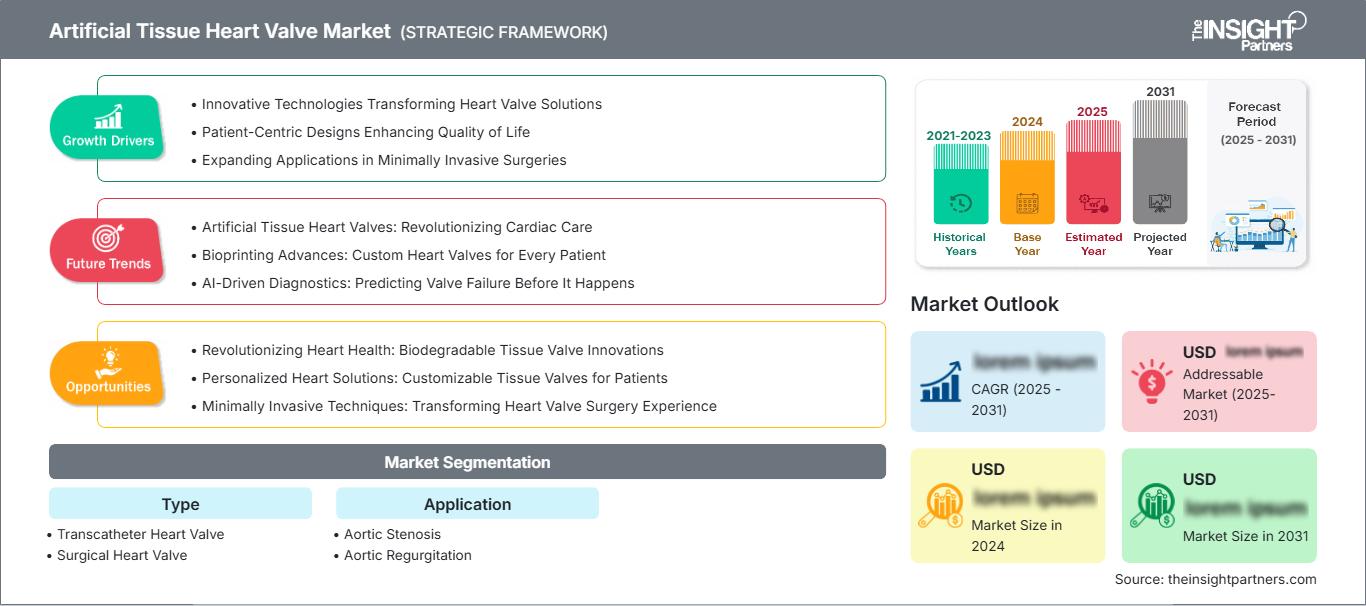
The artificial tissue heart valve market is projected to expand from US$ 2.72 Billion in 2025 to US$ 5.23 Billion by 2034, registering a CAGR of 7.53% during 2026–2034. The market includes transcatheter and surgical heart valve solutions that are predominantly used in cases of aortic stenosis and aortic insufficiency. Growth drivers include developments in the field of biomaterials for bioprosthesis, transcatheter delivery systems, valve durability, imaging and procedural solutions, as well as growing acceptance of less invasive solutions for valve replacements.
North America is forecasted to continue generating significant revenues due to a developed structural heart program, reimbursement opportunities, experience in multidisciplinary heart teams and rapid adoption of transcatheter interventions. The artificial tissue heart valve market size is also driven by clinical practice that favors early intervention, proper patient selection and development of durable solutions with coronary access.
Artificial Tissue Heart Valve Market Assessment and Insights
- North America: North America is expected to account for a 40–44% share in 2025 and expand at a CAGR of 7.0–7.8% during 2026–2034, supported by established TAVR infrastructure, reimbursement, specialist expertise, and strong technology adoption.
- US: The US is expected to represent 78–82% of North America's 2025 revenue, with a CAGR of 7.1–7.9% through 2034, driven by procedure expansion, evidence generation, and sophisticated cardiac centers.
- Europe: Europe is estimated to hold a 27–31% share in 2025 and grow at 6.8–7.6% during 2026–2034, with Germany, France, the UK, Italy, and Spain supporting adoption through mature cardiac-care systems.
- Asia Pacific: Asia Pacific is estimated to represent a 17–21% share in 2025 and record a CAGR of 8.4–9.2% during 2026–2034, led by China, Japan, South Korea, India, and Australia.
- Largest Segment: Transcatheter Heart Valve is estimated to hold a 58–62% market share in 2025 and grow at a CAGR of 8.0–8.8% during 2026–2034, reflecting procedural preference and technology maturity.
- High Growth Segment: Transcatheter Heart Valve is also the high-growth segment, with a 58–62% share in 2025 and a CAGR of 8.0–8.8%, supported by expanding indications and improving device performance.
- Key companies analyzed in detail: Edwards Lifesciences Corporation, MicroPort Scientific Corporation, Medtronic plc, LivaNova PLC, Boston Scientific Corporation, Abbott Laboratories, Labcor Laboratorios Ltda., Artivion, Inc., Braile Biomedica Industria, Comercio e Representações S.A., and Suzhou Jiecheng Medical Technology Co., Ltd.
Source: The Insight Partners' analysis based on proprietary research, government publications, company annual reports, investor presentations, industry databases, and expert interviews.
In artificial tissue valves for the heart market, there is a transformation from an environment dominated by open-heart surgery valve replacement to a broader Structural Heart market incorporating transcatheter delivery, delivery systems innovation, tissue processing methods innovation, and imaging guided placement. There have been developments in terms of consistent leaflet thickness, anticalcification, novel stent frame designs, seal skirts, and manufacturing. These developments have ensured procedural reliability as well as encouraging manufacturers to compete on performance, longevity, coronary access, and repositioning of the device.
Further artificial tissue heart valve market growth will rely more and more on access through geography, regulatory processes, and investment in cardiac infrastructure. New markets offer growth potential due to the unmet valvular disease population in those regions, while existing markets are shifting to earlier intervention and patient assessment. Regulatory demands are at the same time growing, making the development of clinical trial programs, durable device data, physician education, and manufacturing capacity all that much more essential.
Artificial Tissue Heart Valve Market Report Scope
| Report Attribute | Details |
|---|---|
| Market size in 2025 | US$ 2.72 Billion |
| Market Size by 2034 | US$ 5.23 Billion |
| Global CAGR (2026 - 2034) | 7.53% |
| Historical Data | 2021-2024 |
| Forecast period | 2026-2034 |
Artificial Tissue Heart Valve Market Analysis
The demand for artificial tissue heart valve market is affected by the process of demographic aging, higher prevalence of valvular disease, and increased usage of less-invasive methods. The chain starts from imaging diagnostics and heart team evaluation, then includes valve choice, planning and execution of the procedure, and subsequent monitoring. Providers of biological tissue, nitinol or cobalt-chromium frame, catheter used to deliver the valve, imaging system, and sterile package thus affect the entire value chain. Manufacturing costs are very sensitive to the processes of tissue treatment, precise assembly, quality assurance, and sterilization.
The supply side varies significantly depending on whether the valve is used via transcatheter approach or through surgery. In the case of transcatheter technology, there is an intensive catheter assembly and high-precision integration of components, whereas the surgical product requires tissue processing, sewing rings, stent design, etc. Manufacturers are thus dealing with the problem of production scale-up along with demanding validation procedures.
The artificial tissue heart valve market report suggests that there is a highly concentrated competitive structure in which Edwards Lifesciences Corporation and Medtronic plc have strong structural-heart offerings, while Abbott Laboratories, MicroPort Scientific Corporation, LivaNova PLC, and others use technological differentiation and regional availability as competitive means. Competitor positioning has been becoming more dependent on such factors as clinical evidence, usability of delivery systems, durability, hemodynamics, anatomy, and ability to help heart teams perform multiple procedures.
There is a trend towards investments into next generation valve platforms, better delivery systems, clinical evidence, and entering underpenetrated regions. The examples of how regulatory and clinical needs may impact portfolio strategy include those of Boston Scientific Corporation and international growth achieved by MicroPort Scientific Corporation via newer TAVI platforms. There are also Artivion, Inc., Labcor Laboratorios Ltda., Braile Biomedica Industria, Comercio e Representações S.A., and Suzhou Jiecheng Medical Technology Co., Ltd. as other competitive alternatives.
● REPORT CUSTOMIZATION
Tailor This Report To Align With Your Specific Business Requirements
This report can be customized to align precisely with your business objectives, scope, and target markets. Customization options include tailored segmentation, geography, competitive analysis, and strategic insights to support informed decision-making.
Customize This Report →WHAT YOU CAN ADJUST
- ● Segmentations
- ● Geography
- ● Competitive Analysis
- ● Language Preferences
Artificial Tissue Heart Valve Market: Strategic Insights
Regional Insights
North America Artificial tissue heart valve market
North America is estimated to represent a 40–44% share of the artificial tissue heart valve market in 2025 and expand at a CAGR of 7.0–7.8% through 2034. The region benefits from advanced cardiac centers, established reimbursement mechanisms, high physician expertise, and strong adoption of catheter-based valve replacement. The US remains the principal revenue contributor, while Canada provides a smaller but technologically mature market supported by specialized cardiovascular facilities.
The demand is becoming driven by patient selection, heart team approach to decision making, evidence of durability, and increased use of minimally invasive procedures. Edwards Lifesciences Corporation, Medtronic plc, Abbott Laboratories, and many other structural heart companies have strong market and clinical position. The technology innovation is geared toward low profile delivery, deployment predictability, coronary access, sealing ability, and future potential of intervention.
U.S. Artificial tissue heart valve Market
The US holds around 78-82% of the North America artificial tissue heart valves market in 2025 and is projected to expand with a CAGR of 7.1-7.9% during 2034. The region's prominence can be attributed to an advanced cardiac infrastructure, reimbursement, expertise in the field, and experience with TAVR. Key players in the industry have a strong presence in this region.
The most common procedure application is aortic stenosis, but there is a growing technological development focus on aortic regurgitation. Leading market players include Edwards Lifesciences Corporation and Medtronic plc, but Abbott Laboratories is increasing its portfolio of transcatheter devices.
Europe Artificial tissue heart valve Market
The European region is expected to account for 27–31% and have a CAGR of 6.8–7.6% during 2025 to 2034. The German market will be one of the leaders owing to its structural-heart centers and high volume of procedures. The UK, France, Italy, and Spain are other significant contributors, owing to their experience with cardiovascular procedures and increased use of transcatheter procedures.
Germany is one of the major markets in Europe due to its advanced cardiac technology, experience of doctors and TAVI procedures. In the case of the UK, the main focus is on evidence-based commissioning and clinical expertise, whereas in France, there is a combination of specializations and minimally invasive procedures. Italy and Spain are supported by older people, experience of heart centers and increased experience of doctors in transcatheter technologies.
APAC Artificial tissue heart valve Market
APAC is estimated to account for a 17–21% share in 2025 and grow at a CAGR of 8.4–9.2% through 2034. China is the leading market, followed by Japan, South Korea, India, and Australia. Expansion is supported by improving cardiac infrastructure, local manufacturing, physician training, and increasing access to catheter-based interventions.
There is an ample number of patients requiring medical attention along with development and investments in medical devices in China. Japan and South Korea both have advanced cardiovascular systems; India and Australia provide various opportunities according to their infrastructure and reimbursement. There has been growing interest of regional manufacturers in regulatory approval and commercialization, along with healthcare investments in structural heart procedures.
Middle East & Africa Artificial tissue heart valve Market
The Middle East and Africa is expected to expand at a CAGR of 7.2–8.0% during 2026–2034, with Saudi Arabia representing a leading market within the region. UAE and South Africa provide important specialist centers, while the rest of MEA remains more fragmented due to uneven infrastructure and affordability.
Both Saudi Arabia and UAE stand to gain by investing in better facilities such as hospitals, heart centers, and specialized services. South Africa stands as the center for the region for heart diseases. For MEA region, development of infrastructure and health care facilities, medical tourism, and government funding can help to increase accessibility to valve replacement surgeries.
Segmentation Analysis
Type
The Type segment in the artificial tissue heart valve market is divided into Transcatheter Heart Valve and Surgical Heart Valve. Transcatheter technologies are expected to maintain the stronger growth trajectory, with the segment projected to expand at a CAGR of 8.0–8.8% during 2026–2034. Adoption is supported by less invasive procedures, shorter recovery pathways, expanding clinical evidence, and improvements in delivery-system design.
- Transcatheter Heart Valve: This segment occupies the leading market position as hospitals increasingly incorporate catheter-based replacement into structural-heart programs. Device improvements emphasize controlled deployment, reduced paravalvular leakage, coronary access, repositionability, and compatibility with broader anatomical profiles.
- Surgical Heart Valve: Surgical valves remain strategically important for patients requiring open procedures, complex anatomy, concomitant surgery, or clinical situations where surgical replacement remains preferred. Tissue durability, established implantation techniques, and long-term familiarity sustain demand.
Application
The Application segment in the artificial tissue heart valve market comprises Aortic Stenosis and Aortic Regurgitation. Aortic stenosis remains the principal application, while technology developers increasingly address anatomies and procedural requirements associated with regurgitation. The segment is projected to grow at a CAGR of 7.2–8.0% during 2026–2034 as diagnosis and treatment pathways mature.
- Aortic Stenosis: Aortic stenosis represents the principal application because transcatheter and surgical replacement technologies have established clinical pathways. Continued diagnosis, ageing populations, and earlier intervention strategies support sustained procedure demand.
- Aortic Regurgitation: Aortic regurgitation presents a significant technology opportunity because anatomy and device anchoring requirements can differ from stenotic disease. Device developers are focusing on secure fixation and predictable positioning for broader applicability.
Opportunity Snapshot
| Application | Revenue Contribution | Trend Tag | Adoption Stage |
|---|---|---|---|
| Aortic Stenosis | High | Earlier Intervention | Mature |
| Aortic Regurgitation | Medium | Anchoring Innovation | Emerging |
Artificial Tissue Heart Valve Market Growth Drivers and Impact Analysis
Ageing Population and Rising Valvular Disease Burden
Ageing populations are increasing the pool of patients requiring evaluation for degenerative valve disease, particularly aortic stenosis. WHO identifies cardiovascular disease as the world's leading cause of death, while its rheumatic heart disease guidance highlights persistent valve-related burden in lower-resource settings. These patterns create demand across both replacement pathways and strengthen the importance of timely diagnosis. For manufacturers, the impact extends beyond procedure volumes because ageing patients can require individualized valve selection based on anatomy, life expectancy, comorbidities, and future intervention options. Hospitals consequently need multidisciplinary teams capable of integrating imaging, interventional cardiology, cardiac surgery, and post-procedure surveillance. The resulting ecosystem supports demand for technologically differentiated valves rather than simple unit-volume expansion.
Shift Toward Less Invasive Valve Replacement
The transition toward catheter-based intervention is altering procurement priorities across structural-heart centers. Transcatheter procedures can reduce surgical exposure and may offer attractive recovery characteristics for appropriately selected patients, strengthening their role within multidisciplinary treatment pathways. This shift encourages manufacturers to improve delivery-system flexibility, deployment accuracy, sealing, hemodynamics, and coronary accessibility. Hospitals are also evaluating technology based on procedural efficiency, training requirements, imaging compatibility, and downstream resource utilization rather than device price alone. As clinical evidence expands across patient risk categories, adoption can extend beyond traditional high-risk populations where appropriate. The commercial consequence is a competitive environment in which incremental design improvements can influence physician preference, hospital purchasing, and long-term platform loyalty. Manufacturers with broad clinical evidence and established training networks are therefore better positioned to translate technical innovation into sustained adoption.
Expansion of Structural-Heart Infrastructure
Investment in specialized cardiovascular infrastructure is expanding the addressable population for valve replacement, particularly in developing healthcare systems. New cardiac centers, advanced imaging capabilities, catheterization laboratories, and physician-training programs create the operational conditions required for transcatheter procedures. Regional manufacturers can benefit when regulatory authorities establish clearer device pathways and hospitals seek alternatives that balance performance with affordability. Infrastructure development also creates opportunities for localized manufacturing, distribution partnerships, and service networks, potentially lowering logistical barriers. In mature artificial tissue heart valve market forecast, the emphasis is shifting from infrastructure creation toward capacity optimization, procedural standardization, and long-term follow-up. These differences create distinct commercial strategies by geography. Companies must therefore align product positioning with local reimbursement, clinical expertise, procurement structures, and patient referral patterns rather than applying a uniform global market-entry model.
Artificial Tissue Heart Valve Market Future Trends
Long-Term Durability as a Core Product Differentiator
Future competition will increasingly center on demonstrated durability rather than procedural feasibility alone. As transcatheter replacement expands toward younger and lower-risk patients, physicians and health systems will require stronger evidence regarding structural valve deterioration, repeat intervention, coronary access, and lifetime treatment planning. Manufacturers are likely to invest in tissue-processing technologies, anti-calcification strategies, improved leaflet mechanics, and frame designs intended to preserve performance over longer periods. Clinical programs will increasingly incorporate extended follow-up, imaging endpoints, and reintervention considerations. This evolution can raise development costs while simultaneously increasing barriers to entry. Companies capable of generating credible long-term evidence may secure stronger physician confidence and reimbursement support. The competitive benchmark will therefore move from successful implantation toward durable patient management across increasingly long treatment horizons.
Personalized Valve Selection and Procedure Planning
Valve replacement is expected to become more personalized through advanced imaging, anatomical modelling, procedural simulation, and increasingly precise device sizing. Future platforms may integrate planning information more closely with delivery-system selection, deployment strategy, and post-implant assessment. The objective will be to reduce complications associated with patient-specific anatomy while improving hemodynamic outcomes and preserving future coronary or valve access. Digital planning can also support standardized decision-making across multidisciplinary heart teams, particularly as procedure eligibility broadens. Manufacturers may increasingly differentiate through integrated ecosystems combining imaging compatibility, planning tools, procedural guidance, and follow-up analytics. This artificial tissue heart valve market trend could shift competitive advantage from the valve itself toward a broader technology platform. Hospitals may consequently evaluate suppliers according to their ability to support the complete procedural pathway rather than providing an isolated implant.
Artificial Tissue Heart Valve Market Opportunities
Localized Manufacturing in Emerging Cardiac Markets
Localized production offers manufacturers an opportunity to improve market access where imported structural-heart devices face affordability, logistics, or procurement constraints. Partnerships with regional manufacturers can support technology transfer, component sourcing, regulatory navigation, and clinician training while reducing dependence on long international supply chains. China and India are particularly relevant because domestic device capabilities are developing alongside expanding cardiovascular infrastructure. Companies can also consider regional assembly or final-stage manufacturing while retaining centralized control over critical tissue processing and quality systems. Such approaches may improve tender competitiveness and accelerate market penetration without requiring immediate duplication of every manufacturing process locally. Strategic partnerships should nevertheless protect intellectual property, maintain validated quality standards, and establish clear responsibilities for post-market surveillance. Successful localization can therefore combine cost optimization with stronger regulatory and commercial positioning.
Platform Expansion Across Valve Anatomies
Expanding valve platforms beyond established stenosis applications can create attractive opportunities for manufacturers with strong engineering and clinical-development capabilities. Aortic regurgitation remains particularly relevant because conventional anchoring assumptions can differ from stenotic anatomy. Companies developing dedicated fixation, sealing, repositioning, or retrieval features may address patients who are not ideally served by existing platforms. Broader anatomical compatibility could also increase utilization within hospitals by allowing a single supplier relationship to cover more patient profiles. Commercial success will depend on evidence demonstrating safety, predictable deployment, and clinically meaningful outcomes. Manufacturers should therefore prioritize targeted clinical development, specialist-center partnerships, and regulatory strategies aligned with the intended anatomy. Platform expansion can strengthen portfolio economics when incremental technologies leverage existing delivery systems, manufacturing capabilities, and physician-training infrastructure.
Recent Developments
- July 2026: Edwards Lifesciences Corporation reported continued growth in transcatheter aortic valve replacement sales and highlighted new long-term clinical evidence supporting the durability and performance of its SAPIEN platform. The company also indicated that ongoing clinical developments are influencing treatment earlier in the aortic stenosis disease pathway, reinforcing the strategic importance of evidence-led TAVR expansion.
- February 2026: Medtronic plc issued an update on long-term reintervention observations from the Evolut Low-Risk Trial, incorporating extended follow-up of Evolut R and Evolut PRO valves. The communication emphasized continued patient-management guidance and provides additional long-term evidence relevant to durability and reintervention considerations for transcatheter valve technologies.
- February 2025: MicroPort Scientific Corporation announced that its VitaFlow Liberty transcatheter aortic valve and retrievable delivery system received marketing approval from India's Central Drugs Standard Control Organization. The approval expanded the company's commercial structural-heart presence in India and supported subsequent introduction of the platform through specialist cardiac centers.
Frequently Asked Questions

- Comprehensive Market Sizing and Forecast Analysis
- Detailed Segmentation Analysis
- In-Depth Market Dynamics Assessment
- Regional and Country-Level Insights
- Competitive Landscape and Company Benchmarking
- Strategic Business Intelligence
Recent Reports
Testimonials

The Insight Partners provided valuable market intelligence that supported our global go-to-market strategy. Their team was professional, responsive, and attentive to our feedback, providing thoughtful analysis and helpful methodological clarifications throughout the project.
Junmo Kim Chief Financial Officer (CFO), Enertech Co., Ltd.
The Insight Partners' SCADA System Market report is comprehensive, with valuable insights on current trends and future forecasts. The team was highly professional, responsive, and supportive throughout. We are very satisfied and highly recommend their services.
RAN KEDEM Partner, Reali Technologies LTDs
I requested a report on a very specific software market and the team produced the report in a few days. The information was very relevant and well presented. I then requested some changes and additions to the report. The team was again very responsive and I got the final report in less than a week.
JEAN-HERVE JENN Chairman, Future Analytica
We worked with The Insight Partners for an important market study and forecast. They gave us clear insights into opportunities and risks, which helped shape our plans. Their research was easy to use and based on solid data. It helped us make smart, confident decisions. We highly recommend them.
PIYUSH NAGPAL Sr. Vice President, High Beam Global
The Insight Partners delivered insightful, well-structured market research with strong domain expertise. Their team was professional and responsive throughout. The user-friendly website made accessing industry reports seamless. We highly recommend them for reliable, high-quality research services
YUKIHIKO ADACHI CEO, Deep Blue, LLC.
This is the first time I have purchased a market report from The Insight Partners.While I was unsure at first, I visited their web site and felt more comfortable to take the risk and purchase a market report.I am completely satisfied with the quality of the report and customer service. I had several questions and comments with the initial report, but after a couple of dialogs over email with their analyst I believe I have a report that I can use as input to our strategic planning process.Thank you so much for taking the extra time and making this a positive experience.I will definitely recommend your service to others and you will be my first call when we need further market data.
JOHN SUZUKI President and Chief Executive Officer, Board Director, BK Technologies
I wish to appreciate your support and the professionalism you displayed in the course of attending to my request for information regarding to infectious disease IVD market in Nigeria. I appreciate your patience, your guidance, and the fact that you were willing to offer a discount, which eventually made it possible for us to close a deal. I look forward to engaging The Insight Partners in the future, all thanks to the impression you have created in me as a result of this first encounter.
DR CHIJIOKE ONYIA MANAGING DIRECTOR, PineCrest Healthcare Ltd.Reason to Buy
- Informed Decision-Making
- Understanding Market Dynamics
- Competitive Analysis
- Identifying Emerging Markets
- Customer Insights
- Market Forecasts
- Risk Mitigation
- Boosting Operational Efficiency
- Strategic Planning
- Investment Justification
- Tracking Industry Innovations
- Aligning with Regulatory Trends





 Get Free Sample for