
Assisted Bath Tubs Market Trends, Demand & Growth by 2034
Coverage: By Type (Walk-In Tubs, Sitz Bath Tubs, Slide-In Bath Tubs); Application (Hospital and Clinics, Nursing Home, Home Care), and Geography (North America, Europe, Asia Pacific, and South and Central America)
- Status : Data Released
- Report Code : TIPRE00018025
- Category : Manufacturing and Construction
- No. of Pages : 150
- Available Report Formats :


- Last update date : July 16, 2026


2025 Market Size
US$ 1.26 Bn
Base year value
2034 Forecast
US$ 2.52 Bn
Projected by 2034
CAGR 2026-2034
8.00 %
Growth rate
Addressable Market
US$ 16.99 Bn
(2026-2034)
Assisted bath tubs market is expected to be valued at US$ 1.26 Billion in 2025, which is further forecast to reach US$ 2.52 Billion by 2034, exhibiting a CAGR of 8.00% from 2026 to 2034. Market dynamics include limitations due to mobility, ageing demographics, safety norms in institutions and upgrading of residential accessibility among others. Application base for the market is limited to walk-in tubs, sitz bath tubs and slide-in bath tubs used in hospitals & clinics, nursing homes and home healthcare settings.
North America continues to remain structurally significant, with assisted bath tubs market size influenced by ageing-in-place preference, clinical bathing safety regulations and residential renovations. Region’s growth rate is expected to be 7.4–8.0% CAGR between 2026 and 2034. Growth drivers for the region include higher assisted living adoption, post-acute care use and bathroom fall prevention spending among others.
Assisted Bath Tubs Market Assessment and Insights
- North America accounted for 38–42% share in 2025 and is expected to grow at a CAGR of 7.4–8.0% during 2026–2034, supported by senior housing upgrades and institutional care modernization.
- US represented 78–82% of North America in 2025 and is forecast to grow at a 7.5–8.1% CAGR during 2026–2034 through home care and long-term care adoption.
- Europe held 28–32% share in 2025 and is projected to expand at a 6.8–7.4% CAGR during 2026–2034, led by the UK, Germany, France, Italy, and Spain.
- Asia Pacific captured 18–22% share in 2025 and is anticipated to grow at an 8.9–9.6% CAGR during 2026–2034, led by China, Japan, South Korea, India, and Australia.
- Largest Segment Walk-In Tubs held 44–48% market share in 2025 and is expected to grow at a CAGR of 7.6–8.2% during 2026–2034.
- High Growth Segment Home Care held 30–34% market share in 2025 and is projected to grow at a 9.0–9.8% CAGR during 2026–2034.
- Key companies analyzed in detail: Aquassure Accessible Baths, Aquatic Bath, Gainsborough Specialist Bathrooms, Kingkraft Ltd., TR Equipment AB, Kohler Co., Jacuzzi Brands LLC, Reval Group, Astor Bannerman Ltd., BEKA Hospitec GmbH, Arjo AB.
Source: The Insight Partners' analysis based on proprietary research, government publications, company annual reports, investor presentations, industry databases, and expert interviews.
Product innovation will drive the assisted bathtub market from traditional low barrier entry bathtubs towards advanced systems that feature motorized seats, thermostatic controls, antibacterial coating, quick drain, and caregiver friendly adjustable heights. Production of these assisted bathtubs will be refined based on acrylic shells, stainless steel frame, modular panels, and medical grade joints in order to reduce the installation time. Healthcare facilities will take into consideration lifecycle costs, hygiene, transfer safety, and reduction in handling risks when choosing assisted bathtubs for their care centers.
The future demand for these products is anticipated to increase as new healthcare systems start investing in rehabilitation services, retirement homes, and home adaptations. Government regulations on accessibility, respect, infection control, and caregiver safety act as favorable factors for these products. The Asia-Pacific and selective Middle-East regions are likely to see distributor relationships, while Europe and North America will see replacement of their aged baths with advanced ones.
Assisted Bath Tubs Market Report Scope
| Report Attribute | Details |
|---|---|
| Market size in 2025 | US$ 1.26 Billion |
| Market Size by 2034 | US$ 2.52 Billion |
| Global CAGR (2026 - 2034) | 8.00% |
| Historical Data | 2021-2024 |
| Forecast period | 2026-2034 |
Assisted Bath Tubs Market Analysis
The growth in the assisted bathtubs segment is fueled by the combination of aging population trends, mobility problems and elevated demands on safety and personal hygiene. According to the WHO report, there will be about 1.4 billion individuals older than 60 years old by 2030, necessitating construction of more infrastructure for their care. Bathing ranks among the most assistance-requiring activities, hence, factors such as safety transfer, anti-slip features and accessibility for a caregiver play an important role.
The value chain consists of manufacturers of molded baths, actuators and lift systems, plumbing parts suppliers, companies providing infection control coating, distributors, installers and servicing companies. The supply chain environment is favorable to those businesses capable of offering customization of their products coupled with good after-sales services, since hospitals and nursing facilities look at other factors besides equipment costs.
Fragmented yet specialized competition characterizes the assisted bath tubs market. The players who offer consumer brands are Kohler Co. and Jacuzzi Brands LLC. On the other hand, Gainsborough Specialist Bathrooms, Kingkraft Ltd., TR Equipment AB, Reval Group, Astor Bannerman Ltd., BEKA Hospitec GmbH, and Arjo AB are focused on clinical and institutional applications. Aquassure Accessible Baths and Aquatic Bath compete in residential and institutional sectors using their accessibility range.
Modularity of installation, digital recording of service data, improvement in ergonomics for transfers, and energy savings become areas of investment. Strategy formulation becomes increasingly dependent on whether a firm is serving residential remodeling, high dependency care, or rehabilitation setting. Firms that have training, maintenance, and regional installer capabilities will find it easier to secure recurring orders than firms selling tubs as stand-alone products.
● REPORT CUSTOMIZATION
Tailor This Report To Align With Your Specific Business Requirements
This report can be customized to align precisely with your business objectives, scope, and target markets. Customization options include tailored segmentation, geography, competitive analysis, and strategic insights to support informed decision-making.
Customize This Report →WHAT YOU CAN ADJUST
- ● Segmentations
- ● Geography
- ● Competitive Analysis
- ● Language Preferences
Assisted Bath Tubs Market: Strategic Insights
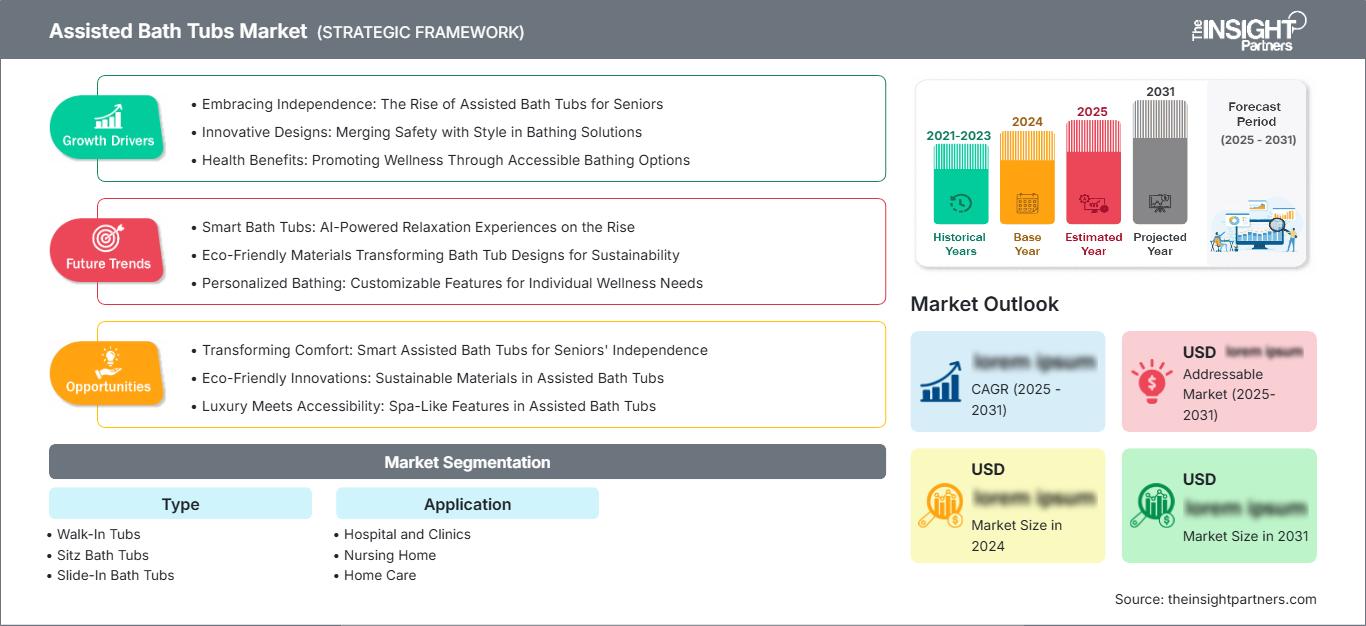
Regional Insights
North America Assisted Bath Tubs Market
The North America assisted bath tubs market share stood at 38–42% in 2025 and is projected to expand at a 7.4–8.0% CAGR through 2026–2034. The product demand is driven by aging-in-place modifications, skilled nursing facilities improvements, and residential care community renovations where assistance with bathing is prevalent. CDC statistics reveal that in 2022 75% of residents of residential care in the USA required assistance with bathing.
The strongest product adoption is seen in areas where home modification that allows reimbursement, privately paid senior care, and budgeted facilities improvement intersect. Walk-in bathtubs are leading product variants in residential settings, while slide-in and height-adjustable variants are preferred in care homes and rehabilitation centers. Manufacturers can leverage existing installer base, premium safety requirements, and a willingness to pay for fast drainage, wide doors, and handrails.
U.S. Assisted Bath Tubs Market
The U.S. made up 78% to 82% of North America in 2025 and is expected to grow at a CAGR of 7.5% to 8.1% over the period of 2026 to 2034. Factors driving the growth of this market include the existing healthcare infrastructure in the U.S., its large remodeling market, and the consumers' knowledge about preventing falls.
The distribution of the company is widespread, including Kohler Co., Jacuzzi Brands LLC, Aquatic Bath, and Aquassure Accessible Baths, which cater to residential segments, and institutional buyers may purchase imported specialty models. Market penetration is high among the home care and nursing home segments, where factors like privacy in bathing, labor saving, and reduction in risk of injury are important.
Europe Assisted Bath Tubs Market
The Europe market was valued at 28-32% in 2025 and is expected to register a CAGR of 6.8-7.4% between 2026-2034. United Kingdom dominates the region for its use of specialist assisted bathing owing to the presence of well-established care homes, suppliers and bathroom modification with a focus on accessibility.
Adoption is also seen in Germany through hospitals, rehabilitation facilities, and nursing homes focused on medical grade construction with emphasis on caregiver ergonomics. BEKA Hospitec GmbH and TR Equipment AB help improve the availability of clinical bathing systems in the region. Ageing population, investments in public/private elderly care and conventional bathing systems replacement drives the growth in France, Italy and Spain.
APAC Assisted Bath Tubs Market
The APAC region held 18-22% market share in 2025 and will experience growth at 8.9-9.6% CAGR over the forecast period 2026-2034. The region is led by Japan owing to ageing population, institutional aged care, and high preference for assisted bath solutions. China, South Korea, India, and Australia contribute through modern hospitals, aged care housing, and growing awareness of home accessibility.
The industrial drivers consist of wider distribution of medical devices, local manufacture of bathrooms, and rise in private healthcare providers. The policy emphasis on elderly care infrastructure and rehab facilities boosts the purchase of equipment within institutions. Nevertheless, the premium bathtub installation is relatively expensive for the developing countries and hence provides opportunity for innovation of durable modular designs.
Middle East & Africa Assisted Bath Tubs Market
Growth in Middle East & Africa is projected to be 7.2–7.9% CAGR for the forecast period of 2026–2034, with Saudi Arabia as a major adopter within the region. Investments in healthcare infrastructure, medical tourism, and premium hospital projects drive the demand for bathing in acute care settings and rehabilitation programs. The UAE is also another adopter via private hospitals, seniors' wellbeing clinics, and premium residential bathrooms.
Demand from South Africa and Rest of MEA is selective from private care homes and rehabilitation facilities. Investments in energy and infrastructure help in construction of hospitals and other health care facilities. Private buyers prefer importing bathing systems due to serviceability, anti-corrosion, and hygiene characteristics; however, cost continues to act as a restraining factor.
Segmentation Analysis
Type
The Type segment is projected to grow at a 7.8–8.4% CAGR during 2026–2034. The assisted bath tubs market scope is defined by mobility level, transfer method, bathroom footprint, and caregiver involvement. Walk-in systems dominate home settings, while sitz and slide-in models remain important in clinical and long-term care environments where transfer control, posture support, and hygiene efficiency determine product choice.
- Walk-In Tubs lead demand because low thresholds, doors, handrails, seating, and hydrotherapy options address independent bathing needs for older adults and mobility-limited users in residential environments.
- Sitz Bath Tubs serve targeted therapeutic and hygiene applications, especially where compact design, seated positioning, and controlled water use are required in clinics, rehabilitation, and post-treatment care.
- Slide-In Bath Tubs are strategically important for nursing homes and hospitals because lateral transfer, caregiver access, and patient support reduce manual handling risks in high-dependency bathing routines.
Application
The Application segment is expected to grow at an 8.2–8.8% CAGR during 2026–2034. Demand varies by care intensity, procurement budgets, and installation complexity. Hospitals and clinics focus on compliance and transfer safety, nursing homes emphasize durability and throughput, and home care increasingly reflects consumer preference for independence, comfort, and aging-in-place bathroom modifications.
- Hospital and Clinics adopt assisted bathing systems for rehabilitation, post-operative hygiene, mobility-impaired patients, and infection-control workflows where safe transfers and staff protection are procurement priorities.
- Nursing Home demand is supported by daily bathing assistance, resident dignity, caregiver safety, and the need for robust systems that withstand frequent use and structured maintenance schedules.
- Home Care is the fastest-growing application as families invest in bathroom accessibility, reduced fall risk, and independence-supporting fixtures that delay or complement institutional care.
Opportunity Snapshot
| Application | Revenue Contribution | Trend Tag | Adoption Stage |
| Hospital and Clinics | Medium | Transfer Safety | Scaling |
| Nursing Home | High | Care Efficiency | Mature |
| Home Care | High | Aging Place | Scaling |
Assisted Bath Tubs Market Growth Drivers and Impact Analysis
Ageing Population and Daily Living Assistance Needs
Population ageing directly expands the user base for assisted bath tubs because bathing is among the activities most affected by reduced balance, arthritis, frailty, and post-surgical mobility limitations. WHO estimates the global population aged 60 and above will increase from 1.0 billion in 2020 to 1.4 billion by 2030 and 2.1 billion by 2050. This shift changes bathrooms from discretionary comfort spaces into safety-critical care environments. In residential settings, families use accessible bathing to extend independent living. In nursing homes, operators use specialized tubs to reduce transfer risks, standardize hygiene routines, and improve resident dignity. The market impact is sustained replacement and first-time installation demand across both home and institutional channels.
Caregiver Safety and Manual Handling Risk Reduction
Caregiver injury prevention is becoming a measurable procurement driver as facilities reassess manual bathing, lifting, and transfer workflows. Slide-in, height-adjustable, and powered seat systems reduce bending, repositioning, and unsupported lifting during hygiene care. For nursing homes and hospitals, these features influence labor productivity, absenteeism risk, and compliance with occupational safety expectations. Assisted bathing equipment also helps standardize care delivery when staffing shortages pressure long-term care operators. The financial effect extends beyond equipment price because safer bathing routines can reduce training burden, incident reporting, and maintenance of multiple workaround devices. Suppliers offering ergonomic demonstrations, staff training, and service support therefore gain stronger institutional credibility.
Home Accessibility Remodeling and Private-Pay Demand
Home accessibility remodeling is accelerating as older adults prefer remaining at home while managing mobility limitations. Walk-in tubs, seated bathing designs, anti-slip flooring integration, and grab-bar-compatible layouts support this preference by reducing fall exposure in one of the highest-risk household areas. Private-pay buyers often evaluate comfort features alongside safety, creating demand for hydrotherapy, heated backrests, fast drainage, and low thresholds. The commercial impact is a wider channel mix involving bathroom remodelers, mobility retailers, senior care advisors, and direct-to-consumer brands. As households plan renovations earlier, assisted bath tubs move from emergency medical purchases toward proactive aging-in-place investments.
Assisted Bath Tubs Market Future Trends
Smart Safety Monitoring and Connected Service Models
The assisted bath tubs market trends will increasingly include connected diagnostics, service alerts, and usage monitoring designed for facilities managing multiple bathing rooms. Sensors can track water temperature consistency, door-seal status, fill cycles, drainage speed, and service intervals without intruding on user privacy. For care homes, this creates auditable maintenance records and supports preventive servicing before equipment downtime disrupts routines. Manufacturers may use connected platforms to differentiate aftersales contracts, optimize technician visits, and improve warranty analytics. Over time, connected service models can shift procurement from one-time equipment purchases toward lifecycle performance agreements that combine hardware, maintenance, training, and compliance documentation.
Water-Efficient and Infection-Control-Oriented Design
Future product development will place more emphasis on water efficiency, surface hygiene, and rapid cleaning between users. Facilities are under pressure to reduce utility consumption while maintaining infection-control standards, making tub geometry, antimicrobial materials, smooth seams, and controlled drainage more important. Water-saving design also matters in hospitals and care homes where bathing frequency creates cumulative operating costs. Suppliers that document cleaning protocols, material durability, and water-use advantages will be better positioned in tenders. This trend is likely to encourage collaboration between bath manufacturers, coating specialists, and healthcare facility planners focused on lower operating cost and safer hygiene workflows.
Assisted Bath Tubs Market Opportunities
Home Care Channel Expansion Through Installers and Care Advisors
Home Care offers the clearest assisted bath tubs market forecasts opportunity because purchasing decisions increasingly involve families, occupational therapists, remodelers, and senior care advisors. Manufacturers can expand by building certified installer networks, financing support, and assessment-led sales models that match tub type to mobility level and bathroom dimensions. Bundling installation, warranty, and maintenance can reduce buyer hesitation around cost and disruption. The opportunity is strongest in the U.S., Canada, the UK, Japan, Australia, and affluent urban markets in Asia where older homeowners have both need and payment capacity. Companies that simplify decision-making can convert latent accessibility demand into measurable revenue.
Institutional Replacement Programs in Long-Term Care
Long-term care facilities present an actionable opportunity through structured replacement of outdated, fixed-height, or difficult-to-clean bathing equipment. Operators can justify investment when new systems reduce caregiver strain, improve resident transfer safety, and shorten room turnaround time. Suppliers should target multi-site care groups with standardized product platforms, maintenance contracts, and training packages. This approach supports repeat orders and lowers procurement complexity. High-dependency bathing systems, slide-in designs, and antimicrobial surfaces are particularly relevant where resident acuity is rising. Companies that combine clinical evidence, total cost of ownership analysis, and reliable regional service can secure preferred vendor status.
Recent Developments
- Jan 2025: Arjo- presented Symbliss, an innovative assisted bathing system setting a new standard in the healthcare industry. Symbliss supports workflows that reduce caregiver injuries, optimize efficiencies in care settings and enables person-centered wellness experiences.
- May 2026: Abacus Specialist Bathroom Solutions presented its complete range of accessible bathing and bathroom solutions at the Kidz to Adultz South exhibition, highlighting its focus on improving safety, independence, and comfort for people with disabilities. The company demonstrated its specialist assisted bathing systems, including the Gemini MX and Libra baths, along with complete bathroom adaptation services covering design, installation, and accessibility solutions.
Frequently Asked Questions

- Comprehensive Market Sizing and Forecast Analysis
- Detailed Segmentation Analysis
- In-Depth Market Dynamics Assessment
- Regional and Country-Level Insights
- Competitive Landscape and Company Benchmarking
- Strategic Business Intelligence
Recent Reports
Testimonials

The Insight Partners' SCADA System Market report is comprehensive, with valuable insights on current trends and future forecasts. The team was highly professional, responsive, and supportive throughout. We are very satisfied and highly recommend their services.
RAN KEDEM Partner, Reali Technologies LTDs
I requested a report on a very specific software market and the team produced the report in a few days. The information was very relevant and well presented. I then requested some changes and additions to the report. The team was again very responsive and I got the final report in less than a week.
JEAN-HERVE JENN Chairman, Future Analytica
We worked with The Insight Partners for an important market study and forecast. They gave us clear insights into opportunities and risks, which helped shape our plans. Their research was easy to use and based on solid data. It helped us make smart, confident decisions. We highly recommend them.
PIYUSH NAGPAL Sr. Vice President, High Beam Global
The Insight Partners delivered insightful, well-structured market research with strong domain expertise. Their team was professional and responsive throughout. The user-friendly website made accessing industry reports seamless. We highly recommend them for reliable, high-quality research services
YUKIHIKO ADACHI CEO, Deep Blue, LLC.
This is the first time I have purchased a market report from The Insight Partners.While I was unsure at first, I visited their web site and felt more comfortable to take the risk and purchase a market report.I am completely satisfied with the quality of the report and customer service. I had several questions and comments with the initial report, but after a couple of dialogs over email with their analyst I believe I have a report that I can use as input to our strategic planning process.Thank you so much for taking the extra time and making this a positive experience.I will definitely recommend your service to others and you will be my first call when we need further market data.
JOHN SUZUKI President and Chief Executive Officer, Board Director, BK Technologies
I wish to appreciate your support and the professionalism you displayed in the course of attending to my request for information regarding to infectious disease IVD market in Nigeria. I appreciate your patience, your guidance, and the fact that you were willing to offer a discount, which eventually made it possible for us to close a deal. I look forward to engaging The Insight Partners in the future, all thanks to the impression you have created in me as a result of this first encounter.
DR CHIJIOKE ONYIA MANAGING DIRECTOR, PineCrest Healthcare Ltd.Reason to Buy
- Informed Decision-Making
- Understanding Market Dynamics
- Competitive Analysis
- Identifying Emerging Markets
- Customer Insights
- Market Forecasts
- Risk Mitigation
- Boosting Operational Efficiency
- Strategic Planning
- Investment Justification
- Tracking Industry Innovations
- Aligning with Regulatory Trends





 Get Free Sample for