
Atherosclerosis Drug Market Growth, Trends & Forecast by 2034
Coverage: by Drug Class (Cholesterol Lowering Medications, Angiotensin-Converting Enzyme (ACE) Inhibitors, Anti-platelet Medications, Fibric Acid and Omega-3 Fatty Acid Derivatives, Calcium Channel Blockers, Diuretics, Others); Distribution Channel (Hospital Pharmacies, Retail Pharmacies, Online-pharmacies) , and Geography (North America, Europe, Asia Pacific, and South and Central America)
- Status : Data Released
- Report Code : TIPRE00008225
- Category : Life Sciences
- No. of Pages : 150
- Available Report Formats :


- Last update date : September 07, 2026


2025 Market Size
US$ 41.56 Bn
Base year value
2034 Forecast
US$ 46.22 Bn
Projected by 2034
CAGR 2026-2034
1.19 %
Growth rate
Addressable Market
US$ 397.02 Bn
(2026-2034)
The atherosclerosis drug market is projected to expand from US$ 41.56 Billion in 2025 to US$ 46.22 Billion by 2034, registering a CAGR of 1.19% during 2026–2034. The market includes drugs that are prescribed to lower the risk of atherosclerotic heart disease, manage related ailments, and prevent the recurrence of cardiovascular episodes. Prescribing trends are being driven by class diversification, risk stratification, and increased focus on prolonged lipid management.
North America continues to be an important strategic market for atherosclerosis drugs due to existing cardiovascular management guidelines, advanced diagnostic capabilities, and growing use of combined lipid-lowering approaches. The atherosclerosis drug market size is projected to grow at a rate of 1.8 to 2.4% CAGR from 2026 to 2034.
Atherosclerosis Drug Market Assessment and Insights
- North America: North America is expected to account for a 38–42% share in 2025, with the market growing at a 1.8–2.4% CAGR between 2026–2034. Mature cardiovascular infrastructure and treatment intensification support regional resilience.
- US: The US represents 84–88% of North American demand in 2025 and is projected to grow at a 1.9–2.5% CAGR between 2026–2034, supported by broad treatment access and specialist prescribing.
- Europe: Europe is estimated to hold a 27–31% share in 2025 and grow at a 1.2–1.8% CAGR between 2026–2034. Germany, the UK, France, Italy, and Spain remain leading markets because of established cardiovascular screening and reimbursement systems.
- Asia Pacific: Asia Pacific is estimated at a 20–24% share in 2025 and is projected to register a 2.4–3.1% CAGR between 2026–2034. China, Japan, India, South Korea, and Australia provide the principal demand base.
- Largest Segment: Cholesterol Lowering Medications are estimated to represent a 46–50% market share in 2025 and expand at a 1.4–2.0% CAGR during 2026–2034, supported by foundational lipid management.
- High Growth Segment: Online-pharmacies are estimated to represent a 5–8% market share in 2025 and grow at a 4.0–5.2% CAGR during 2026–2034, driven by prescription digitization and refill convenience.
- Key companies analyzed in detail: B. Braun Melsungen AG, Koninklijke Philips N.V., Cardinal Health, Medtronic, Terumo Corporation, Becton, Dickinson and Company, Minnetronix Medical, Inc., Avinger, Biomerics, Abbott, AngioDynamics, Inc., and Boston Scientific Corporation.
Source: The Insight Partners' analysis based on proprietary research, government publications, company annual reports, investor presentations, industry databases, and expert interviews.
Atherosclerosis medications have progressed from being statin-dominated drugs to those that address risk factors with the help of non-statin lipid-modifying therapies, antiplatelet agents, antihypertensive therapy, and triglyceride-specific medication. Drug innovation now depends on the mode of action, frequency of use, tolerability, adherence to treatment, and proven results in terms of cardiovascular benefit. The manufacturing process includes small molecule generics, branded products, biologics, and emerging nucleic acid technologies.
The future development of atherosclerosis medication will be influenced by early risk detection, broad lipid testing, and growing concern about the remaining cardiovascular risk. Developing countries will bring a higher volume of opportunity because of improved diagnostic practices and treatment options, while developed countries will focus on optimizing treatment. Individualized risk assessment and early intervention are among the key focuses of regulatory authorities and professional societies, which makes adherence improvement a priority.
Atherosclerosis Drug Market Report Scope
| Report Attribute | Details |
|---|---|
| Market size in 2025 | US$ 41.56 Billion |
| Market Size by 2034 | US$ 46.22 Billion |
| Global CAGR (2026 - 2034) | 1.19% |
| Historical Data | 2021-2024 |
| Forecast period | 2026-2034 |
Atherosclerosis Drug Market Analysis
The atherosclerosis drug market growth is driven by the persistent prevalence of cardiovascular disease, increasing diagnosis rates of dyslipidemia, and the focus on primary and secondary prevention of the condition. According to the World Health Organization, cardiovascular diseases are the biggest killers worldwide, with about 19.8 million cases noted in 2022.
The treatment landscape covers primary care practitioners, cardiologists, vascular surgeons, hospitals, pharmacies, insurers, drug producers, and online prescription platforms. While generics of statins and antihypertensives serve as basic products of the category, branded non-statins target patients who need additional treatment beyond standard drugs and whose levels exceed the optimal range. Thus, the supply is determined by the factors like production volume, patents, reimbursement, purchasing, and availability of active substances.
There is an increasing trend towards positioning based on comprehensive cardiovascular portfolios rather than molecule dependency. Abbott, Medtronic, Terumo Corporation, Boston Scientific Corporation and Becton, Dickinson and Company derive their contributions through cardiovascular and vascular technology platforms rather than traditional drug portfolios. The contribution of Cardinal Health is through pharmaceutical distribution, whereas that of B. Braun Melsungen AG and Koninklijke Philips N.V. is in healthcare generally. Avinger, Biomerics, Minnetronix Medical Inc. and AngioDynamics Inc. focus more on interventional/enabling technologies.
The atherosclerosis drug market trends and forecast for 2021 – 2028 analysis reveals that there is an increasing strategy focus on therapies that can increase adherence or expand dosing schedule, or LDL-C lowering above statins. According to 2026 ACC/AHA dyslipidemia guidelines, statins remain a cornerstone of treatment, but ezetimibe, bempedoic acid, and PCSK9-targeted therapies represent alternative approaches for selected patients. As a result, competitive positioning increasingly shifts from mere molecule presence to clinical performance, patient segmentation, access and persistence.
● REPORT CUSTOMIZATION
Tailor This Report To Align With Your Specific Business Requirements
This report can be customized to align precisely with your business objectives, scope, and target markets. Customization options include tailored segmentation, geography, competitive analysis, and strategic insights to support informed decision-making.
Customize This Report →WHAT YOU CAN ADJUST
- ● Segmentations
- ● Geography
- ● Competitive Analysis
- ● Language Preferences
Atherosclerosis Drug Market: Strategic Insights
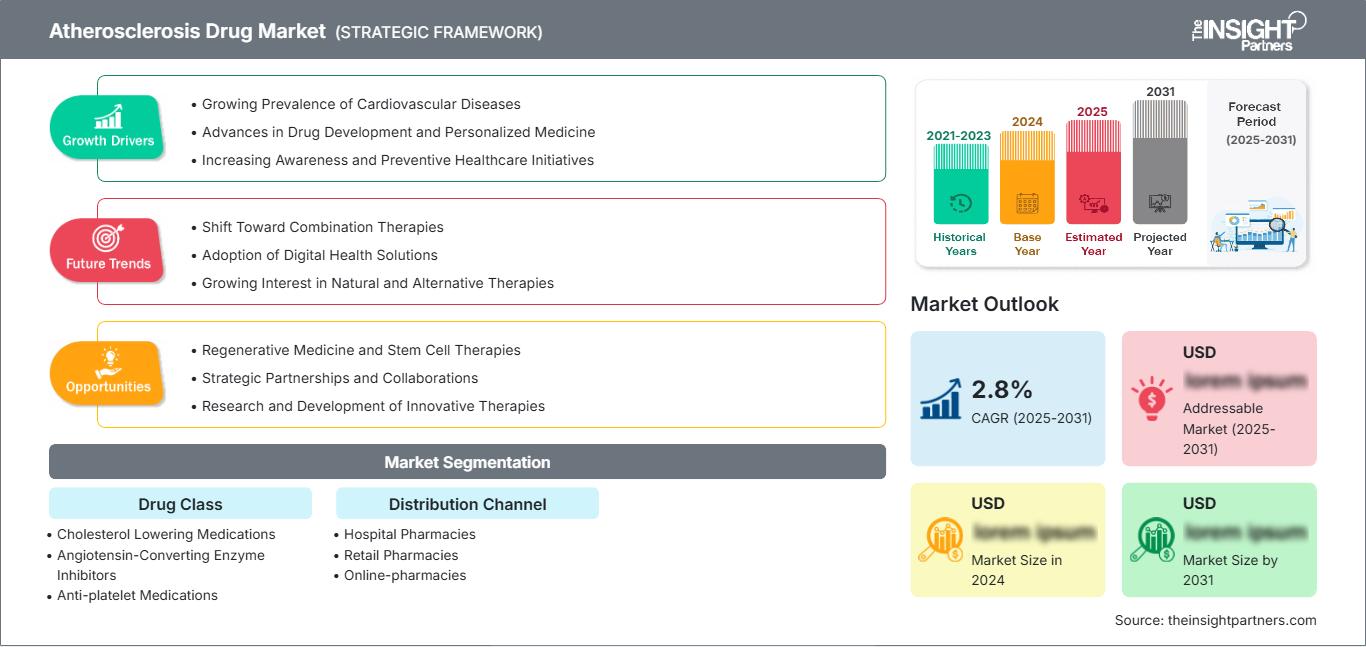
Regional Insights
North America atherosclerosis drug market
North America is anticipated to have 38–42% of the total global market demand by 2025 and will experience CAGR growth of 1.8–2.4% until 2034. Consumption in the region is led by the United States and complemented by public reimbursement systems of Canada along with its growing prevalence of chronic diseases.
A well-developed lipid testing infrastructure, pharmacy coverage, and rapid uptake of innovations after regulatory decision make the region promising for pharmaceutical use. Intensification of treatment is especially needed for patients whose low LDL-C levels are resistant to statins or who have familial hypercholesterolemia and higher cardiovascular risks. Innovation in the region is therefore forecasted to be moderate due to the focus on novel approaches without statins.
U.S. atherosclerosis drug Market
North America’s market will represent 84-88% of US atherosclerosis drug market share by 2025 and is forecast to post 1.9-2.5% CAGR between 2026 and 2034. Leadership here stems from high levels of cardiovascular screening, specialization, brand drugs presence, and widespread adoption of guideline-directed pharmacological therapy. Leading companies have diversified cardiovascular portfolio and distribution networks through hospitals, doctors, and retail pharmacies.
Trends in application show a rising tendency to differentiate based on personalized risk reduction that includes such areas as lipid reduction, blood pressure control, platelet inhibition, and risk related to triglycerides. ACC/AHA Guideline of 2026 considered a wider range of biomarkers including lipoprotein(a), apolipoprotein B, coronary artery calcium score, and treatment decision making. Hence, the business opportunities in addition to new molecules include patient identification and therapy sequencing.
Europe atherosclerosis drug Market
Europe is expected to constitute 27–31% of market share in 2025 and is expected to exhibit 1.2–1.8% CAGR, where Germany leads as the most dominant national market. The reimbursement, penetration of generics, and the national policy of prescribing practices lead to significant variability in the market. The decisions for treatment are increasingly influenced by formal risk assessment and long-term prevention goals.
There is consistent guideline-driven prescribing in the UK due to the NHS system, while Germany is characterized by specialist healthcare along with pharmaceutical distribution system. In contrast, France has an approach that focuses on prevention and chronic diseases, while there is increasing demand in Italy and Spain due to their elderly population. The commercial landscape is dominated by therapies backed by outcome evidence and health economics value.
APAC atherosclerosis drug Market
APAC is estimated to account for 20–24% of global demand in 2025 and is projected to grow at a 2.4–3.1% CAGR. China is the leading market, followed by Japan, South Korea, India, and Australia. Expanding healthcare access, urbanization, and increasing detection of dyslipidemia support treatment adoption.
China utilizes high patient volume combined with its developing pharmaceutical industry, while Japan focuses on the management of chronic diseases in an aging society. India is an emerging market that provides substantial growth potential from increasing access to diagnostics and pharmacies. South Korea and Australia are relatively mature treatment markets.
Middle East & Africa atherosclerosis drug Market
The Middle East & Africa region has comparatively low demand with Saudi Arabia and UAE being key players among other Gulf nations and South Africa dominating in the Sub-Saharan region. The market is forecasted to grow at a 1.7% to 2.4% CAGR over the period of 2026 to 2034 owing to improved healthcare infrastructure and chronic disease management programs.
Saudi Arabia & UAE have relatively high concentration of tertiary care infrastructure and growing expenditure on prevention of healthcare issues. South Africa provides the larger base for pharmaceuticals in the region while the remaining part of MEA faces limitations owing to availability and cost differences.
Segmentation Analysis
Drug Class
Cholesterol Lowering Medications remain the central therapeutic category because LDL-C reduction forms the foundation of atherosclerotic risk management. The segment is estimated to grow at a 1.4–2.0% CAGR during 2026–2034. Antiplatelet therapies, antihypertensive classes, and triglyceride-focused agents complement lipid reduction, while treatment selection increasingly reflects patient-specific cardiovascular risk, comorbidities, tolerance, and residual risk.
- Cholesterol Lowering Medications: This category maintains the strongest demand because statins and adjunctive therapies underpin long-term LDL-C management. Strategic importance increasingly comes from combination treatment and treatment escalation for patients not reaching targets.
- Angiotensin-Converting Enzyme Inhibitors: ACE inhibitors remain important for cardiovascular risk management where hypertension, diabetes, renal disease, or cardiac dysfunction coexist. Their established clinical role supports broad generic availability and consistent prescription volumes.
- Anti-platelet Medications: Antiplatelet therapy remains strategically important for selected patients with established cardiovascular disease. Demand is influenced by secondary prevention protocols, ischemic risk, bleeding considerations, and treatment duration decisions.
- Fibric Acid and Omega-3 Fatty Acid Derivatives: These therapies address selected patients with elevated triglycerides or mixed dyslipidemia. Their positioning depends increasingly on cardiovascular outcomes evidence, patient phenotype, and interaction with foundational lipid-lowering treatment.
- Calcium Channel Blockers: Calcium channel blockers contribute primarily through blood-pressure and angina management, complementing broader cardiovascular risk reduction. Their mature generic base supports widespread availability across hospital and retail channels.
- Diuretics: Diuretics remain established components of hypertension management, particularly where volume control is clinically relevant. Their low-cost generic positioning supports sustained utilization across developed and emerging healthcare systems.
Distribution Channel
Distribution channels influence treatment access, refill persistence, and payer economics. The segment is projected to expand at a 1.8–2.6% CAGR during 2026–2034, with hospital and retail pharmacies remaining dominant while online-pharmacies gain strategic relevance. The atherosclerosis drug market report increasingly encompasses digital prescribing, automated refills, specialty dispensing, and integrated medication-management services.
- Hospital Pharmacies: Hospital pharmacies remain critical for initiation of complex therapies, acute cardiovascular care, and discharge medication management. Their strategic value is strongest where prescribing decisions involve specialists and patients require coordinated follow-up.
- Retail Pharmacies: Retail pharmacies provide the principal recurring access point for chronic cardiovascular medicines. High geographic coverage, generic substitution, prescription synchronization, and pharmacist engagement support continued importance in long-term therapy.
- Online-pharmacies: Online-pharmacies are gaining relevance through digital prescriptions, home delivery, automated refills, and convenience. Adoption is strongest among digitally engaged patients and chronic-care populations requiring regular medication replenishment.
Opportunity Snapshot
| Segment Name | Revenue Contribution | Trend Tag | Adoption Stage |
|---|---|---|---|
| Hospital Pharmacies | High | Specialist Access | Mature |
| Retail Pharmacies | High | Refill Networks | Mature |
| Online-pharmacies | Low | Digital Refills | Scaling |
Atherosclerosis Drug Market Growth Drivers and Impact Analysis
Earlier Identification of Cardiovascular Risk
The increased recognition of high cardiovascular risk in patients early enough is increasing the eligible pool of people for preventive drug therapy. Increased lipid tests, better screening through primary care and personalized risk scores would shift drug administration from when a cardiovascular episode occurs to an earlier stage of administration. The 2026 guidance by ACC/AHA has focused on early treatment of carefully selected young people and has used PREVENT-ASCVD risk assessment, lipoprotein(a) test, apoB measurement, and targeted coronary artery calcium testing. Such changes are expected to raise the number of diagnostics to treatment transitions and hence higher need for drugs that can be taken for a longer period.
Persistent Residual Risk Despite Standard Therapy
A significant growth driver is the population that remains above recommended lipid or cardiovascular risk thresholds despite conventional treatment. Statins remain foundational, but intolerance, inadequate response, adherence challenges, and severe baseline dyslipidemia can require additional therapeutic approaches. This creates opportunities for non-statin medicines, combination regimens, and therapies with differentiated dosing schedules. Clinical practice is increasingly focused on the magnitude and duration of exposure to atherogenic lipoproteins rather than isolated laboratory measurements. Consequently, manufacturers can capture incremental value by demonstrating improved target attainment, tolerability, persistence, and cardiovascular outcomes. Payers, however, are likely to demand stronger evidence before accepting substantial price premiums, particularly where established generic alternatives remain widely available.
Expansion of Chronic Disease Management Infrastructure
Investment in chronic disease infrastructure is broadening access to cardiovascular prevention outside tertiary hospitals. Primary-care networks, pharmacy-based services, telemedicine, electronic prescribing, and integrated disease-management programs can improve continuity for patients requiring lifelong treatment. This infrastructure is especially relevant in Asia Pacific and selected Middle Eastern markets where healthcare capacity is expanding alongside cardiovascular risk factors. The impact is not limited to prescription volume; improved follow-up can also reduce treatment discontinuation and enable more frequent monitoring of lipid and blood-pressure targets. Manufacturers and distributors that align products with local reimbursement structures, physician education, and medication-access programs can improve market penetration. However, regional affordability, fragmented healthcare delivery, and uneven diagnostic capacity remain constraints that will moderate the pace of adoption.
Atherosclerosis Drug Market Future Trends
Precision Risk Stratification and Biomarker-Led Treatment
Future treatment models are likely to use more detailed cardiovascular risk profiles to determine when and how pharmacotherapy should intensify. Routine consideration of lipoprotein(a), apolipoprotein B, coronary artery calcium, triglyceride-rich particles, and longitudinal LDL-C exposure can create more differentiated patient pathways. Rather than applying identical treatment algorithms across broad risk categories, clinicians may increasingly sequence therapies according to biological risk, treatment response, comorbidities, and adherence behavior. This atherosclerosis drug market trend could increase demand for therapies supported by biomarker-defined populations and outcomes evidence. It may also strengthen the role of companion diagnostics, laboratory monitoring, and clinical decision-support software. Companies able to demonstrate measurable improvement in patient stratification and treatment persistence could gain stronger positions in value-based healthcare models.
Long-Interval Dosing and Adherence-Centered Therapies
Longer dosing intervals are likely to become increasingly important as cardiovascular prevention moves toward sustained risk reduction. Oral daily medicines remain essential, but injectable and other longer-interval approaches may address adherence challenges in selected populations. This trend is particularly relevant for patients who repeatedly fail to achieve targets because of missed doses, treatment fatigue, or complex medication schedules. The commercial model could gradually shift from unit-based prescribing toward measurable treatment persistence and outcomes. Manufacturers may therefore invest in delivery technologies, patient-support programs, digital reminders, and integrated specialty pharmacy services. Evidence demonstrating durable target attainment will remain important because longer-interval treatment carries greater expectations for clinical effectiveness, tolerability, administration convenience, and reimbursement value.
Atherosclerosis Drug Market Opportunities
Emerging-Market Cardiovascular Access Platforms
Emerging markets provide opportunities to build cardiovascular treatment platforms around diagnosis, affordability, distribution, and adherence rather than relying solely on premium branded medicines. India, China, Southeast Asia, Latin America, and selected Middle Eastern countries offer large populations with expanding healthcare access but uneven lipid screening and treatment continuity. Companies can pursue tiered pricing, local manufacturing, public-private procurement, physician education, and pharmacy partnerships to improve access. Digital health infrastructure can further support remote monitoring and prescription refills. Strategic investments should prioritize markets where cardiovascular screening capacity is expanding alongside reimbursement coverage. Local partnerships can reduce regulatory and distribution barriers while providing insight into treatment preferences. The strongest opportunities are likely to combine affordable foundational therapies with differentiated medicines for high-risk patients.
Combination Treatment and Treatment-Pathway Solutions
A second opportunity lies in integrated treatment pathways that combine lipid lowering with blood-pressure control, platelet management, and structured follow-up. Patients with established atherosclerotic disease frequently require multiple therapies, making adherence and treatment sequencing important commercial considerations. Companies can develop differentiated solutions around fixed-dose combinations, co-packaged therapies, digital adherence support, and pharmacist-led monitoring. Such approaches may improve persistence while reducing the operational burden associated with complex chronic regimens. Partnerships among pharmaceutical manufacturers, pharmacies, insurers, and healthcare providers could create scalable models that reward improved target attainment. The atherosclerosis drug market forecast opportunity is particularly relevant where healthcare systems are shifting toward outcome-oriented reimbursement. Evidence demonstrating lower treatment discontinuation and better cardiovascular risk control would strengthen the economic case.
Recent Developments
- August 2026: Novartis AG, the US FDA updated the LEQVIO label to recognize that lowering LDL-C reduces major adverse cardiovascular event risk in adults at increased cardiovascular risk. Novartis also highlighted its VictORION development program, which includes major cardiovascular outcomes studies expected to report in 2027.
- October 2025: Amgen Inc. reported positive Phase 3 VESALIUS-CV results for Repatha, showing significant reductions in major cardiovascular events among high-risk adults without previous myocardial infarction or stroke. The trial enrolled more than 12,000 patients and expanded evidence for intensive LDL-C lowering in primary prevention.
- July 2025: Novartis AG, the FDA approved a LEQVIO label update enabling inclisiran to be used alone, alongside diet and exercise, for LDL-C reduction in adults with hypercholesterolemia. The decision expanded the treatment positioning of a twice-yearly RNA-based lipid-lowering therapy.
Frequently Asked Questions

- Comprehensive Market Sizing and Forecast Analysis
- Detailed Segmentation Analysis
- In-Depth Market Dynamics Assessment
- Regional and Country-Level Insights
- Competitive Landscape and Company Benchmarking
- Strategic Business Intelligence
Recent Reports
Testimonials

The Insight Partners' SCADA System Market report is comprehensive, with valuable insights on current trends and future forecasts. The team was highly professional, responsive, and supportive throughout. We are very satisfied and highly recommend their services.
RAN KEDEM Partner, Reali Technologies LTDs
I requested a report on a very specific software market and the team produced the report in a few days. The information was very relevant and well presented. I then requested some changes and additions to the report. The team was again very responsive and I got the final report in less than a week.
JEAN-HERVE JENN Chairman, Future Analytica
We worked with The Insight Partners for an important market study and forecast. They gave us clear insights into opportunities and risks, which helped shape our plans. Their research was easy to use and based on solid data. It helped us make smart, confident decisions. We highly recommend them.
PIYUSH NAGPAL Sr. Vice President, High Beam Global
The Insight Partners delivered insightful, well-structured market research with strong domain expertise. Their team was professional and responsive throughout. The user-friendly website made accessing industry reports seamless. We highly recommend them for reliable, high-quality research services
YUKIHIKO ADACHI CEO, Deep Blue, LLC.
This is the first time I have purchased a market report from The Insight Partners.While I was unsure at first, I visited their web site and felt more comfortable to take the risk and purchase a market report.I am completely satisfied with the quality of the report and customer service. I had several questions and comments with the initial report, but after a couple of dialogs over email with their analyst I believe I have a report that I can use as input to our strategic planning process.Thank you so much for taking the extra time and making this a positive experience.I will definitely recommend your service to others and you will be my first call when we need further market data.
JOHN SUZUKI President and Chief Executive Officer, Board Director, BK Technologies
I wish to appreciate your support and the professionalism you displayed in the course of attending to my request for information regarding to infectious disease IVD market in Nigeria. I appreciate your patience, your guidance, and the fact that you were willing to offer a discount, which eventually made it possible for us to close a deal. I look forward to engaging The Insight Partners in the future, all thanks to the impression you have created in me as a result of this first encounter.
DR CHIJIOKE ONYIA MANAGING DIRECTOR, PineCrest Healthcare Ltd.Reason to Buy
- Informed Decision-Making
- Understanding Market Dynamics
- Competitive Analysis
- Identifying Emerging Markets
- Customer Insights
- Market Forecasts
- Risk Mitigation
- Boosting Operational Efficiency
- Strategic Planning
- Investment Justification
- Tracking Industry Innovations
- Aligning with Regulatory Trends





 Get Free Sample for