
Augmented Reality (AR) Shopping Market Growth, Share & Trends by 2034
Augmented Reality (AR) Shopping Market Size and Forecasts (2021 - 2034), Global and Regional Share, Trends, and Growth Opportunity Analysis Report Coverage : By Offerings (Hardware, Software, Services); Device Type (AR Head-Mounted Displays (HMD), Smart AR Mirror, Handheld Devices); Application (Try-on Solutions, Planning & Designing, Advertising & Marketing, Information Systems); Market Type (Apparel, Furniture & Lighting, Jewelry, Beauty & Cosmetics, Footwear, Groceries, Others); Geography (North America, Europe, Asia-Pacific, Middle East & Africa, South and Central America)
- Status : Data Released
- Report Code : TIPRE00039732
- Category : Electronics and Semiconductor
- No. of Pages : 150
- Available Report Formats :


- Last update date : July 17, 2026


2025 Market Size
US$ 5.85 Bn
Base year value
2034 Forecast
US$ 51.92 Bn
Projected by 2034
CAGR 2026-2034
27.44 %
Growth rate
Addressable Market
US$ 213.73 Bn
(2026-2034)
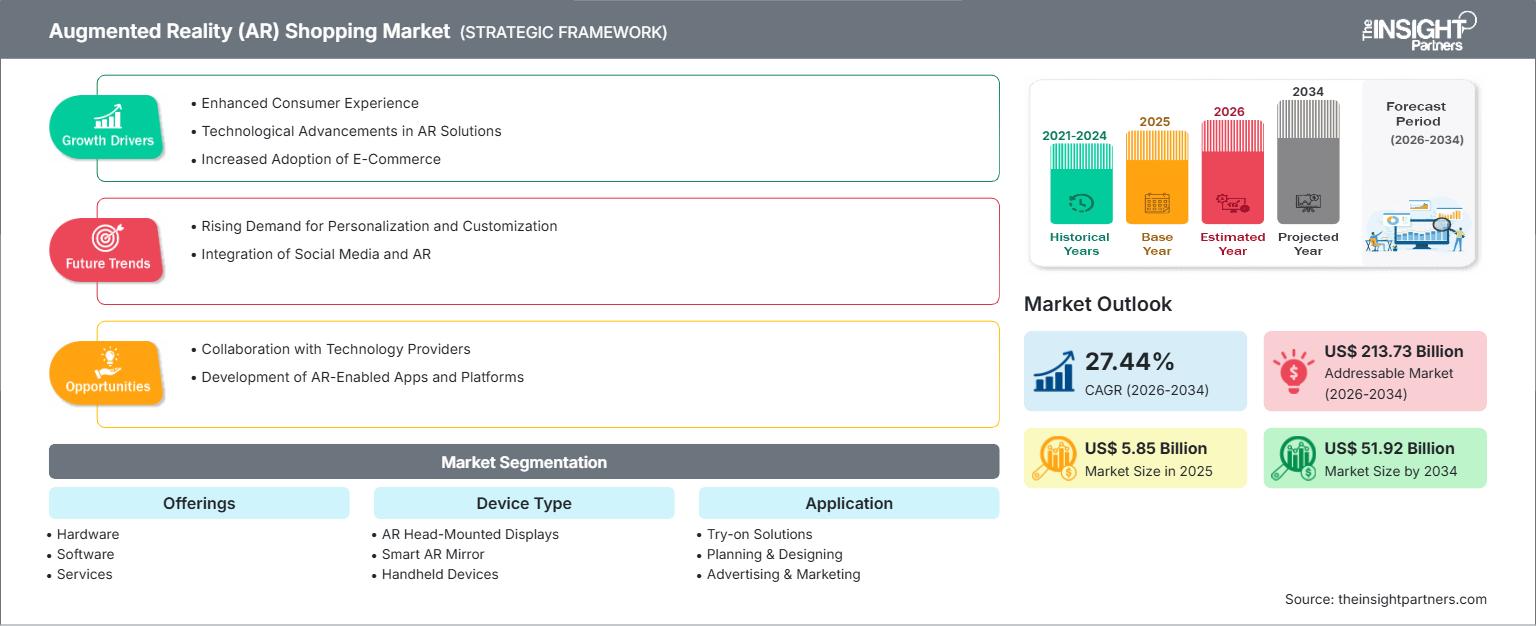
The Augmented Reality Shopping Market size was valued at US$ 5.85 billion in 2025 and is projected to reach US$ 51.92 billion by 2034, advancing at a CAGR of 27.44% from 2026 to 2034. The Augmented Reality Shopping Market reflects accelerating use of immersive retail tools that help shoppers visualize apparel, furniture, cosmetics, footwear, jewelry, groceries, and branded product information before purchase across mobile, mirror, and head-mounted interfaces.
North America remains an early commercialization hub, with the Augmented Reality Shopping Market size supported by high smartphone penetration, retail media investment, mature e-commerce, and brand experimentation with try-on and room-planning tools. Regional expansion is estimated at 25%–29% through 2034 as retailers integrate WebAR, product visualization, AI-guided personalization, and in-store smart mirror pilots to improve conversion confidence and reduce return-related friction.
Augmented Reality (AR) Shopping Market Assessment and Insights
- North America held an estimated 31%–36% share in 2025 and is projected to grow at a CAGR of 25%–29% between 2026–2034, supported by platform-led commerce, WebAR adoption, and advanced retail media ecosystems.
- US represented 78%–83% of North America in 2025 and is expected to grow at a CAGR of 25.5%–29.5% between 2026–2034, led by beauty, apparel, furniture, and footwear pilots.
- Europe accounted for 22%–27% share in 2025 and is forecast to grow at a CAGR of 24%–28% between 2026–2034, with the UK, Germany, France, Italy, and Spain leading adoption.
- Asia Pacific held 29%–34% share in 2025 and is projected to grow at a CAGR of 29%–33% between 2026–2034, supported by China, Japan, South Korea, India, and Australia.
- Largest Segment Software held a market share of 48%–54% in 2025 and is expected to grow at a CAGR of 27%–31% between 2026–2034.
- High Growth Segment Try-on Solutions held a market share of 34%–39% in 2025 and is expected to grow at a CAGR of 31%–35% between 2026–2034.
- Key companies analyzed in detail: Apple Inc., Augment, Blippar Ltd., Google LLC, Holition Ltd., Imaginate Technologies, Marxent Labs LLC, Microsoft Corporation, PTC Inc., ViewAR GmbH, Snap Inc., and IKEA Systems B.V.
Source: The Insight Partners' analysis based on proprietary research, government publications, company annual reports, investor presentations, industry databases, and expert interviews.
Augmented Reality Shopping Market has moved from campaign-led experimentation to scalable retail infrastructure as smartphone cameras, browser-based AR, 3D asset pipelines, and AI-assisted visualization mature. Production dynamics now center on reusable product models, accurate size mapping, lighting-aware rendering, and integration with commerce platforms. Retailers are shifting budgets from standalone novelty applications toward measurable tools that support product discovery, confidence, conversion, and return reduction across digital and physical channels.
Forward demand will be shaped by social commerce, omnichannel store upgrades, rising digital advertising costs, and retailer pressure to make product pages more interactive. Emerging geographies with mobile-first consumers will expand faster as brands adopt lighter WebAR deployments. Privacy rules, accessibility expectations, and platform governance will favor vendors that deliver secure data handling, consistent rendering, analytics, and content operations at enterprise scale.
Augmented Reality (AR) Shopping Market Report Scope
| Report Attribute | Details |
|---|---|
| Market size in 2025 | US$ 5.85 Billion |
| Market Size by 2034 | US$ 51.92 Billion |
| Global CAGR (2026 - 2034) | 27.44% |
| Historical Data | 2021-2024 |
| Forecast period | 2026-2034 |
Augmented Reality (AR) Shopping Market Analysis
Demand is rising because shoppers increasingly expect to evaluate products visually before paying, especially in categories where fit, color, scale, or style uncertainty drives hesitation. Augmented Reality Shopping Market growth is strongest where 3D visualization improves confidence and lowers return probability. Retailers also use AR to create richer product detail pages, social campaigns, guided store experiences, and immersive product education.
The value chain includes device makers, AR software platforms, 3D content studios, e-commerce integrators, computer vision developers, retail media teams, payment ecosystems, and store operations groups. Supply dynamics favor vendors that can simplify asset creation, maintain visual accuracy, protect consumer data, and support deployment across apps, mobile browsers, smart mirrors, and head-mounted displays without forcing retailers into fragmented workflows.
The competitive landscape blends large technology ecosystems and specialist AR providers. Apple Inc., Google LLC, Microsoft Corporation, PTC Inc., and Snap Inc. influence development tools, hardware interfaces, and platform reach. Blippar Ltd., Augment, Holition Ltd., Imaginate Technologies, Marxent Labs LLC, ViewAR GmbH, and IKEA Systems B.V. compete through retail visualization, branded experiences, furniture planning, and application-specific commerce deployments.
Investment priorities include WebAR, generative 3D asset workflows, body and room scanning, AI recommendations, analytics dashboards, and in-store digital mirrors. Augmented Reality Shopping Market analysis increasingly focuses on conversion lift, return avoidance, engagement time, and content reuse. Strategic positioning depends on reducing implementation friction while proving that immersive visualization improves both customer experience and retailer economics.
● REPORT CUSTOMIZATION
Tailor This Report To Align With Your Specific Business Requirements
This report can be customized to align precisely with your business objectives, scope, and target markets. Customization options include tailored segmentation, geography, competitive analysis, and strategic insights to support informed decision-making.
Customize This Report →WHAT YOU CAN ADJUST
- ● Segmentations
- ● Geography
- ● Competitive Analysis
- ● Language Preferences
Augmented Reality (AR) Shopping Market: Strategic Insights
Regional Insights
North America Augmented Reality Shopping Market
North America Augmented Reality Shopping Market has a market share of about 31%–36% in 2025 and is expected to grow by 25%–29%. North America is endowed with advanced retail technology budgets, established e-commerce, established cloud capabilities, and high adoption of camera-based product search. Brands in beauty, fashion, home furnishings, shoes, and jewelry categories are using AR to minimize uncertainty in considered purchase decisions.
Augmented Reality Shopping Market share is driven by platform ecosystems, specialist studios, and corporate retail companies with a focus on online commerce. American and Canadian companies are using virtual fitting rooms, room planning, product education, and interactive ads to increase engagement rates. The use of AR technology is more popular where there is a clear connection to conversions, customer lifetime value, and reverse logistics expenses.
U.S. Augmented Reality Shopping Market
The U.S. Augmented Reality Shopping Market represents 78%–83% of North American demand and is expected to expand at 25.5%–29.5%. Retailers deploy AR across cosmetics testing, eyewear and footwear try-on, furniture placement, jewelry visualization, and in-store mirrors. Company presence is broad through Apple Inc., Google LLC, Microsoft Corporation, Snap Inc., Marxent Labs LLC, and specialist content providers.
The application trends center on integrating WebAR, social commerce filters, product configuration, and AI-driven recommendations to minimize search friction. Retailers are also including AR results in their marketing and merchandising strategies. The most effective implementations integrate AR product experiences with inventory, loyalty information, and purchasing processes rather than treating it as an additional layer in their campaigns.
Europe Augmented Reality Shopping Market
Europe has a share of 22%–27% in 2025 and a growth rate of 24%–28%. The UK leads, as it has early adoption of online fashion, beauty, and luxury retail, which has a high demand for interactive applications. Germany is next, as furniture, automotive, lifestyle retail, and precise visualization applications require accurate sizing and product configurations.
France, Italy, and Spain contribute to luxury items, cosmetics, apparel, footwear, and tourism-related retail. Issues of privacy and digital services regulation make it necessary for vendors to develop data collection and analytical solutions based on user consent. There are various companies, such as Blippar Ltd, Holition Ltd., ViewAR GmbH, and global platform vendors offering branded applications and virtual showrooms.
APAC Augmented Reality Shopping Market
APAC holds 29%–34% share in 2025 and is forecast to grow at 29%–33%. China is leading in mobile commerce, livestream retail, beauty applications, and super apps. Japan and South Korea are known for their beauty, fashion, technology, and retail, among other things.
India and Australia will be growing with mobile-based commerce and virtual furniture. There will be policy backing for digital infrastructure, the urban retail environment, and international brand competition to create an environment in which augmented reality can drive differentiation and personalization while reducing returns.
Middle East & Africa Augmented Reality Shopping Market
The Middle East & Africa is expected to grow between 26% and 30%, driven by high mobile AR adoption in the UAE and the rollout in Saudi Arabia through the modernization of malls and luxury retail. The market is driven by heavy smartphone penetration.
In South Africa and the MEA region at large, there is selective adoption by grocers, fashion and cosmetics outlets, and home improvement shops, driven by the need for distinction in the digital age. Infrastructure development, premium retail hubs, and multi-channel loyalty campaigns create an avenue for interactive product discovery, but effective adoption requires affordability, content-generation capacity, and network capabilities.

Segmentation Analysis
Offerings
The Offerings segment is projected to grow at 26%–30% during 2026–2034. Augmented Reality Shopping Market scope is shaped by the balance between device capability, software platforms, and service support. Software leads because retailers need rendering engines, analytics, content management, and commerce integration, while hardware and services remain essential for premium in-store mirrors, headsets, and scalable 3D asset production.
- Hardware supports head-mounted displays, smart mirrors, sensors, and camera-enabled devices used in stores and premium showrooms where fidelity, guided assistance, and physical retail engagement matter.
- Software holds the strongest position because AR engines, product visualization tools, WebAR modules, tracking algorithms, and analytics dashboards determine scalability across e-commerce and omnichannel retail.
- Services are strategically important for 3D modeling, deployment integration, user testing, content maintenance, campaign operations, and measurement frameworks that convert AR pilots into repeatable programs.
Device Type
The Device Type segment is forecast to grow at 27%–31% during 2026–2034. Handheld devices dominate near-term deployment because smartphones and tablets remove hardware friction for shoppers. Smart mirrors expand in stores where retailers want guided fitting experiences, while AR head-mounted displays remain more selective for premium showrooms, staff assistance, and enterprise-style product consultation.
- AR Head-Mounted Displays serve premium demonstrations, assisted selling, complex product visualization, and enterprise retail pilots where immersion and hands-free interaction justify higher device cost.
- Smart AR Mirror adoption is strongest in apparel, beauty, eyewear, and footwear stores where interactive fitting helps increase dwell time and improve assisted sales productivity.
- Handheld Devices lead adoption because smartphones and tablets enable app-based and browser-based AR shopping at scale without requiring new consumer hardware purchases.
Application
The Application segment is expected to grow at 28%–32% during 2026–2034. Try-on solutions are the most visible use case because they address purchase uncertainty in apparel, footwear, cosmetics, eyewear, and jewelry. Planning and designing remain critical for furniture, lighting, and home categories, while advertising, marketing, and information systems extend AR into engagement, education, and store navigation.
- Try-on Solutions lead adoption because they help shoppers preview fit, shade, scale, and style before purchase, improving confidence in high-return categories.
- Planning & Designing supports furniture, lighting, home décor, and renovation decisions by placing true-to-scale products in real environments before checkout.
- Advertising & Marketing enables interactive campaigns, social lenses, product launches, and branded storytelling that encourage sharing, engagement, and measurable retail media outcomes.
- Information Systems support product education, store navigation, inventory-linked overlays, associate assistance, and contextual guidance across complex retail environments.
Market Type
The Market Type segment is projected to grow at 27%–31% during 2026–2034. Apparel, beauty, footwear, and jewelry rely on body-aware visualization, while furniture and lighting require scale accuracy and spatial context. Groceries remain earlier-stage but are gaining relevance for guided product information, recipe overlays, promotions, and shelf-based engagement in omnichannel food retail.
- Apparel benefits from virtual fitting, styling overlays, and size-confidence tools that reduce uncertainty in online and store-assisted fashion purchases.
- Furniture & Lighting depends on room-scale visualization, color matching, placement planning, and spatial accuracy before customers commit to bulky or high-value items.
- Jewelry uses AR to preview scale, shine, placement, and styling, supporting premium browsing without requiring every item to be physically displayed.
- Beauty & Cosmetics relies on shade matching, skin-tone visualization, and fast product experimentation, making AR valuable for conversion and brand discovery.
- Footwear applies try-on tools to style, color, and silhouette decisions, especially for sneaker drops, premium shoes, and mobile-first shopping journeys.
- Groceries use AR for product information, recipes, promotions, nutrition guidance, and shelf engagement, though adoption remains more experimental than fashion or beauty.
Opportunity Snapshot
| Application | Revenue Contribution | Trend Tag | Adoption Stage |
| Try-on Solutions | High | Virtual Fit | Scaling |
| Planning & Designing | High | Room Preview | Scaling |
| Advertising & Marketing | Medium | Social Lenses | Scaling |
| Information Systems | Medium | Guided Stores | Emerging |
Augmented Reality (AR) Shopping Market Growth Drivers and Impact Analysis
Visual Confidence Becomes Central to Digital Commerce
Purchase uncertainty is a direct cause of purchase abandonment when the size, color, fit, and style of an item cannot be determined from still photos. With augmented reality, the shopping experience is altered by allowing customers to view the item on themselves, at home, or even in a store setting before purchase. This will have a significant market impact in industries with high visual risk, such as cosmetics, clothing, shoes, jewelry, furniture, and lighting. Retailers gain a measurable way to convert browsing into purchase intent, while brands gain richer engagement data that can guide merchandising, creative content, and product assortment decisions.
WebAR Reduces Deployment Friction for Retailers
Browser-based AR technology will broaden the addressable market by eliminating the barrier posed by app downloads, which have prevented consumers from engaging in augmented reality activities. Companies will be able to implement AR on product web pages, in advertisements, on QR codes, on packaging, and in point-of-sale displays through a low-friction process. This particular driver is essential for medium-sized companies that cannot develop complex native apps yet still require immersive engagement with their products. The business significance of this driver is reduced costs, faster test cycles, and wider adoption of retail media. Vendors offering lightweight loading, accurate tracking, and analytics-ready deployment are well-positioned to capture recurring demand for platforms and services.
Return Reduction Strengthens the Business Case
Returns are an important expense for e-commerce operations, which is why AR is appealing in those cases where visualization will minimize the discrepancy between expectations and reality. Visualizing furniture placement will help customers grasp the measurements; beauty try-ons will increase certainty about shades; and visualizing shoes or jewelry will show customers how it will look without placing an order. It is not just cost savings that come with reduced returns; there are also customer satisfaction, fewer stock disruptions, lower markdown risk, and a reduced carbon footprint from returns.
Augmented Reality (AR) Shopping Market Future Trends
AI-Personalized AR Shopping Journeys
AI will make AR experiences more selective, contextual, and business-relevant. Rather than having consumers navigate extensive catalogs, AI will provide them with personalized product recommendations based on their body type, room size, consumer behavior, inventory availability, and fashion style. The future of the Augmented Reality Shopping Market trends is likely to merge visualization with conversations, outfitting, shade matching, and room design assistance. In terms of competition, relevance will matter as much as realism. If retailers can link AI-driven recommendations to precise 3D content and order information, AR could become an indispensable shopping tool.
Smart Mirrors Become Data-Rich Store Interfaces
Smart mirrors will shift from fun toys in dressing rooms to interactive shop windows that connect product research, associate help, loyalty data, inventory, and checkout suggestions. Fashion stores, cosmetics shops, optical stores, and shoe stores will deploy smart mirrors to speed up the dressing process, provide alternative options, and record preference cues. With hardware becoming cheaper and better software becoming available, smart mirrors can enable guided selling in high-end stores and busy malls. The future will see smart mirrors in action, enabled by privacy settings, fast rendering, lighting correction, and a proper staffing process.
Augmented Reality (AR) Shopping Market Opportunities
Retailers Can Scale WebAR Across Product Pages
Product page implementation offers enormous potential, as it allows for the placement of immersive visualization right where purchasing decisions are made. It is possible to prioritize product categories that offer the highest returns, premium goods, and those that require spatial context before scaling up, based on user interactions and conversions. Augmented Reality Shopping Market Forecasts point to rising demand for reusable 3D assets, browser compatibility, and analytics connectors, which would allow one to measure how much money different products and campaigns generate. Actionable investment should focus on content governance, asset compression, mobile performance, and integration with inventory and checkout systems so AR becomes part of everyday merchandising operations.
Category Specialists Can Monetize 3D Asset Libraries
There are opportunities for specialists to establish sustainable revenue streams by enabling retail brands to consistently create, manage, and reuse their 3D models across applications, marketplaces, advertisements, and stores. This approach will work best for brands in the apparel, furniture, footwear, beauty, and jewelry sectors that require ongoing updates and standardization of their product catalogs. The areas that call for investment include automation of model creation, validation, compression, tagging, and localization. Brands that can make 3D models portable for mobile browsers, apps, mirrors, and headsets will minimize duplication of efforts.
Recent Developments
- May 2025: Google LLC introduced shopping updates in AI Mode, including visual product discovery, AI-guided decision support, virtual try-on using users’ own photos, and agentic checkout features supported by Google’s Shopping Graph. The update strengthens AI and AR-enabled product evaluation for apparel and broader shopping journeys.
- March 2025: Snap Inc. reopened its AR Ramadan Mall for 2025, offering an immersive virtual retail village with participating brands and interactive boutiques. The company reported the 2024 edition reached over 16 million shoppers and stated that 85% of daily MENA Snapchatters interact with Lenses.
- February 2025: Apple Inc. announced Apple Intelligence for Apple Vision Pro with visionOS 2.4, adding productivity, creative, sharing, and discovery features that expand the platform’s spatial computing utility. The update supports broader developer and enterprise experimentation relevant to immersive commerce experiences.
Frequently Asked Questions

- Comprehensive Market Sizing and Forecast Analysis
- Detailed Segmentation Analysis
- In-Depth Market Dynamics Assessment
- Regional and Country-Level Insights
- Competitive Landscape and Company Benchmarking
- Strategic Business Intelligence
Recent Reports
Testimonials

The Insight Partners provided valuable market intelligence that supported our global go-to-market strategy. Their team was professional, responsive, and attentive to our feedback, providing thoughtful analysis and helpful methodological clarifications throughout the project.
Junmo Kim Chief Financial Officer (CFO), Enertech Co., Ltd.
The Insight Partners' SCADA System Market report is comprehensive, with valuable insights on current trends and future forecasts. The team was highly professional, responsive, and supportive throughout. We are very satisfied and highly recommend their services.
RAN KEDEM Partner, Reali Technologies LTDs
I requested a report on a very specific software market and the team produced the report in a few days. The information was very relevant and well presented. I then requested some changes and additions to the report. The team was again very responsive and I got the final report in less than a week.
JEAN-HERVE JENN Chairman, Future Analytica
We worked with The Insight Partners for an important market study and forecast. They gave us clear insights into opportunities and risks, which helped shape our plans. Their research was easy to use and based on solid data. It helped us make smart, confident decisions. We highly recommend them.
PIYUSH NAGPAL Sr. Vice President, High Beam Global
The Insight Partners delivered insightful, well-structured market research with strong domain expertise. Their team was professional and responsive throughout. The user-friendly website made accessing industry reports seamless. We highly recommend them for reliable, high-quality research services
YUKIHIKO ADACHI CEO, Deep Blue, LLC.
This is the first time I have purchased a market report from The Insight Partners.While I was unsure at first, I visited their web site and felt more comfortable to take the risk and purchase a market report.I am completely satisfied with the quality of the report and customer service. I had several questions and comments with the initial report, but after a couple of dialogs over email with their analyst I believe I have a report that I can use as input to our strategic planning process.Thank you so much for taking the extra time and making this a positive experience.I will definitely recommend your service to others and you will be my first call when we need further market data.
JOHN SUZUKI President and Chief Executive Officer, Board Director, BK Technologies
I wish to appreciate your support and the professionalism you displayed in the course of attending to my request for information regarding to infectious disease IVD market in Nigeria. I appreciate your patience, your guidance, and the fact that you were willing to offer a discount, which eventually made it possible for us to close a deal. I look forward to engaging The Insight Partners in the future, all thanks to the impression you have created in me as a result of this first encounter.
DR CHIJIOKE ONYIA MANAGING DIRECTOR, PineCrest Healthcare Ltd.Reason to Buy
- Informed Decision-Making
- Understanding Market Dynamics
- Competitive Analysis
- Identifying Emerging Markets
- Customer Insights
- Market Forecasts
- Risk Mitigation
- Boosting Operational Efficiency
- Strategic Planning
- Investment Justification
- Tracking Industry Innovations
- Aligning with Regulatory Trends





 Get Free Sample for