
Automated Material Handling Equipment Market Trends, Size & Growth by 2034
Coverage: by Product (Robots, Automated Storage & Retrieval System, Automated Conveyors & Sortation System, Automated Cranes, and Automated Guided Vehicles), System Type (Unit Load and Bulk Load), Component (Hardware, Software, and Services), Function (Storage, Transportation, Assembly, Packaging, Distribution, and Waste Handling), and Industry (Automotive, Electronics, Food & Beverages, E-Commerce, Aerospace, Logistics, Pharmaceuticals, and Others), and Geography (North America, Europe, Asia Pacific, and South and Central America)
- Status : Data Released
- Report Code : TIPTE100000628
- Category : Electronics and Semiconductor
- No. of Pages : 232
- Available Report Formats :


- Last update date : July 17, 2026


2025 Market Size
US$ 76.24 Bn
Base year value
2034 Forecast
US$ 173.20 Bn
Projected by 2034
CAGR 2026-2034
9.55 %
Growth rate
Addressable Market
US$ 1,112.92 Bn
(2026-2034)
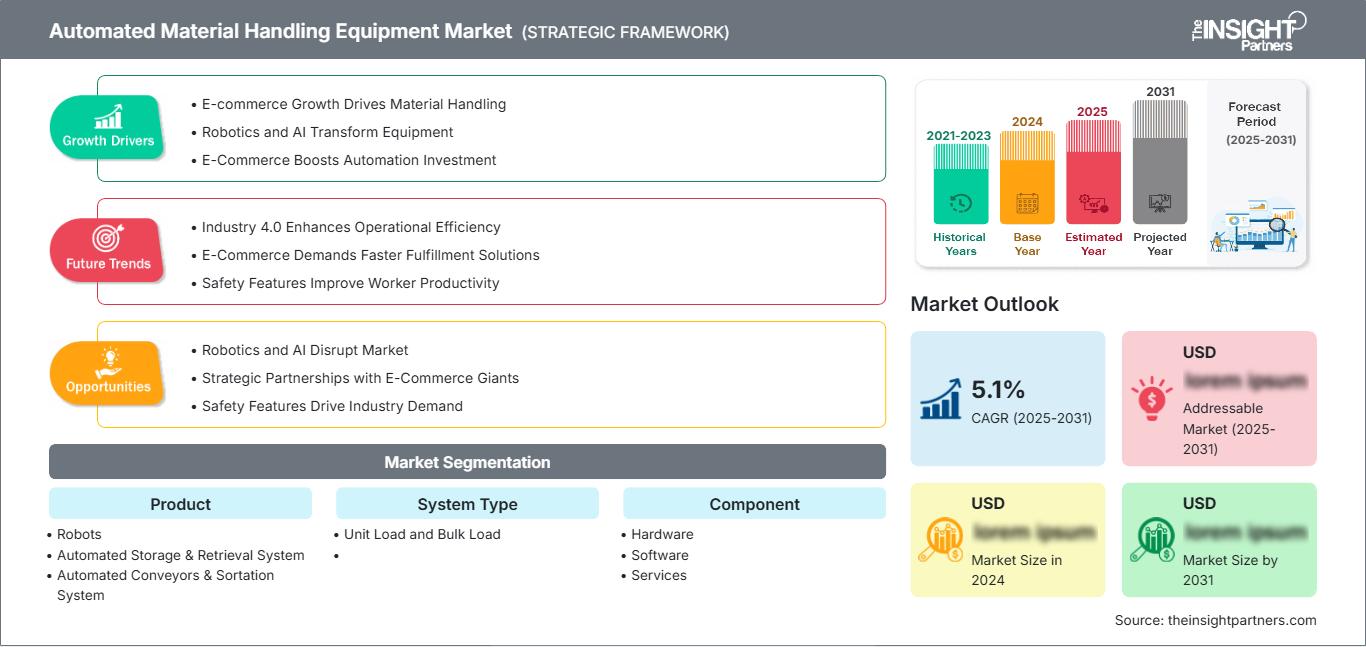
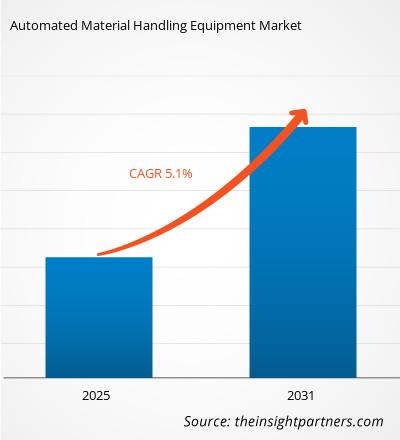
The Automated Material Handling Equipment Market size was valued at US$ 76.24 Billion in 2025 and is projected to reach US$ 173.20 Billion by 2034, advancing at a CAGR of 9.55% from 2026 to 2034. The market reflects rising automation across warehouses, factories, airports, ports, and distribution networks where speed, safety, traceability, and labor productivity increasingly shape capital expenditure decisions.
North America remains a mature automation region, with the Automated Material Handling Equipment Market size supported by reshoring, warehouse modernization, labor scarcity, and e-commerce fulfillment density. Regional expansion is estimated at 8.5%–10.5% through 2034 as manufacturers and logistics operators deploy automated storage, conveyors, sorters, robots, cranes, and guided vehicles to improve throughput, workplace safety, and order accuracy.
Automated Material Handling Equipment Market Assessment and Insights
- North America held an estimated 25%–29% share in 2025 and is projected to grow at a CAGR of 8.5%–10.5% between 2026–2034, supported by warehouse upgrades, reshoring, and labor constraints.
- US represented 78%–83% of North America in 2025 and is expected to grow at a CAGR of 8.8%–10.8% between 2026–2034, led by logistics, retail, food, and manufacturing automation.
- Europe accounted for 22%–26% share in 2025 and is forecast to grow at a CAGR of 7.8%–9.8% between 2026–2034, with Germany, the UK, France, Italy, and Spain leading deployments.
- Asia Pacific held 36%–40% share in 2025 and is projected to grow at a CAGR of 10.5%–12.5% between 2026–2034, supported by China, Japan, South Korea, India, and Australia.
- Largest Segment Automated Conveyors & Sortation System held a market share of 28%–32% in 2025 and is expected to grow at a CAGR of 8.5%–10.5% between 2026–2034.
- High Growth Segment Robots held a market share of 18%–22% in 2025 and is expected to grow at a CAGR of 11.5%–13.5% between 2026–2034.
- Key companies analyzed in detail: Fives, Jungheinrich AG, KION Group AG, KUKA AG, Daifuku Co., Ltd., Hyster-Yale Materials Handling, Inc., BEUMER Group GmbH & Co. KG, Hanwha Corporation, John Bean Technologies Corporation, and Toyota Industries Corporation.
Source: The Insight Partners' analysis based on proprietary research, government publications, company annual reports, investor presentations, industry databases, and expert interviews.
Automated Material Handling Equipment Market has evolved from fixed mechanized handling into connected, software-directed automation. Earlier conveyor and crane investments focused on moving materials faster, while current deployments combine robotics, sensors, fleet control, warehouse execution software, and predictive maintenance. Production dynamics are also changing as suppliers localize fabrication, modularize systems, and shorten commissioning cycles to meet demand from e-commerce, automotive, semiconductors, food processing, and pharmaceuticals.
Forward demand will be shaped by regional industrial policy, supply chain resilience, safety regulations, and investment in high-throughput logistics nodes. Emerging geographies are adopting scalable automation first, then adding analytics and autonomous mobility as labor costs rise. Energy efficiency, cyber-secure controls, and interoperability will become purchasing priorities as operators seek systems that improve productivity without locking facilities into inflexible architectures.
Automated Material Handling Equipment Market Report Scope
| Report Attribute | Details |
|---|---|
| Market size in 2025 | US$ 76.24 Billion |
| Market Size by 2034 | US$ 173.20 Billion |
| Global CAGR (2026 - 2034) | 9.55% |
| Historical Data | 2021-2024 |
| Forecast period | 2026-2034 |
Automated Material Handling Equipment Market Analysis
Demand is rising as companies redesign facilities around higher order frequency, SKU complexity, and tighter delivery windows. Automated Material Handling Equipment Market growth is strongest where automation reduces manual travel, improves picking accuracy, and stabilizes output despite labor volatility. E-commerce, grocery, automotive, electronics, airports, and pharmaceutical logistics require equipment that can handle varied loads while feeding real-time operational data into planning systems.
The value chain includes mechanical equipment manufacturers, robotics suppliers, control software developers, system integrators, sensor vendors, warehouse management providers, installation teams, and lifecycle service organizations. Supply dynamics favor modular platforms that reduce engineering time, support brownfield upgrades, and integrate with enterprise systems. Component availability, skilled commissioning labor, and local service networks remain decisive in project scheduling.
The competitive landscape blends global intralogistics leaders, industrial automation firms, and specialist equipment manufacturers. Daifuku Co., Ltd., KION Group AG, Toyota Industries Corporation, Jungheinrich AG, Fives, KUKA AG, BEUMER Group GmbH & Co. KG, Hyster-Yale Materials Handling, Inc., Hanwha Corporation, and John Bean Technologies Corporation compete through engineering depth, installed base, software capability, and service coverage.
Investment priorities include automated storage and retrieval, high-speed sortation, autonomous vehicles, palletizing robots, energy-efficient conveyors, and digital twins. Automated Material Handling Equipment Market analysis increasingly evaluates total cost of ownership, uptime, safety outcomes, spare-parts access, and integration risk. Strategic positioning depends on proving measurable throughput gains while giving customers phased automation paths rather than one-time infrastructure replacement.
● REPORT CUSTOMIZATION
Tailor This Report To Align With Your Specific Business Requirements
This report can be customized to align precisely with your business objectives, scope, and target markets. Customization options include tailored segmentation, geography, competitive analysis, and strategic insights to support informed decision-making.
Customize This Report →WHAT YOU CAN ADJUST
- ● Segmentations
- ● Geography
- ● Competitive Analysis
- ● Language Preferences
Automated Material Handling Equipment Market: Strategic Insights
Regional Insights
North America Automated Material Handling Equipment Market
North America Automated Material Handling Equipment Market holds an estimated 25%–29% share in 2025 and is projected to grow at 8.5%–10.5%. The region benefits from high warehouse labor costs, automated fulfillment investment, reshoring activity, and food, beverage, automotive, and healthcare distribution modernization. Operators prioritize conveyors, sorters, AS/RS, robotic palletizing, and guided vehicles where throughput consistency directly affects service levels.
The Automated Material Handling Equipment Market share is reinforced by large installed warehouse networks, third-party logistics expansion, and strong presence of system integrators. U.S. and Canadian buyers increasingly demand interoperable controls, energy management, and lifecycle services. Supplier capacity expansion and domestic manufacturing support shorter lead times for conveyors, sorters, and automated storage systems in high-volume logistics corridors.
U.S. Automated Material Handling Equipment Market
The U.S. represents 78%–83% of North American demand and is expected to expand at 8.8%–10.8%. Retail, parcel, grocery, automotive, aerospace, and pharmaceutical operators deploy automated conveyors, AS/RS, robotic cells, and AGVs to improve picking accuracy and reduce manual handling. Company presence is broad through Daifuku Co., Ltd., KION Group AG, Toyota Industries Corporation, Hyster-Yale Materials Handling, Inc., and Fives.
Emerging applications include brownfield automation, high-speed sorting, robotic depalletizing systems, battery-electric vehicles, and warehouse execution systems. Automation is employed by operators to fill gaps in the labor force, increase safety, and deal with seasonal surges in the workforce that are not directly proportional to the work. Approvals for capital involve decreasing time and cost in distribution and manufacturing processes.
Europe Automated Material Handling Equipment Market
Europe accounts for 22%–26% share in 2025 and is projected to grow at 7.8%–9.8%. The top countries in Europe include Germany, owing to the presence of the automotive, machinery, and chemicals industries, as well as export manufacturing, while the UK has investments in parcel, grocery, and retail fulfillment. In France, adoption is driven by food logistics, pharmaceuticals, airports, and luxury logistics automation, which require precision in handling.
In Italy and Spain, investment is driven by manufacturing clusters, ports, apparel logistics, and food processing industries that use conveyors, cranes, and automated guided vehicles. The customers in Europe focus on energy efficiency, machinery safety, and space optimization. Companies that provide support for projects in Europe include Jungheinrich AG, KION Group AG, Fives, BEUMER Group GmbH & Co. KG, and KUKA AG, which support regional projects through engineering and service networks.
APAC Automated Material Handling Equipment Market
APAC holds 36%–40% share in 2025 and is forecast to grow at 10.5%–12.5%. China dominates in manufacturing scale, e-commerce logistics, electronics, and electric-vehicle supply chain logistics. Japan and South Korea focus on robotics, precision manufacturing, semiconductor logistics, and factory automation.
India and Australia grow via warehousing, ports, food distribution, and mining logistics. Favorable government policies on industrial corridors, logistics parks, and digital manufacturing promote the adoption of AMR. Competition includes Daifuku Co., Ltd., Toyota Industries Corporation, KUKA AG, and Hanwha Corporation, among others.
Middle East & Africa Automated Material Handling Equipment Market
Middle East and Africa are forecast to register growth between 8.0% and 10.0%. UAE will dominate near-term adoption, whereas Saudi Arabia will adopt via its ports, airports, manufacturing facilities, and retail logistics. Projects within the energy, construction, and infrastructure sectors boost demand for crane, conveyor, and automated warehouse systems.
Other markets within the MEA region, like South Africa, have adopted selectively for mining assistance, food & beverages, pharmaceuticals, and third-party logistics services. The factors that contribute to selective adoption include project funding, maintenance facilities, and the availability of effective control system integration. Automated Material Handling Equipment market adoption is boosted by automation in customs clearance, cold chain management, and regional distribution centers.
Segmentation Analysis
Product
Product is projected to grow at 9.0%–11.0% during 2026–2034. Automated Material Handling Equipment Market scope spans equipment that stores, moves, sorts, lifts, and sequences materials across warehouses and production sites. Conveyors and sortation systems lead because they form the backbone of high-volume movement, while robots and automated guided vehicles add flexibility in facilities facing SKU volatility.
- Robots support picking, palletizing, depalletizing, assembly feed, and case handling where repetitive tasks require accuracy, speed, and safer human-machine collaboration.
- Automated Storage & Retrieval System improves density, inventory control, and retrieval speed in facilities constrained by floor space, labor availability, and demand for real-time stock visibility.
- Automated Conveyors & Sortation System remains strategically central because it links receiving, storage, picking, packing, and shipping in high-throughput warehouses and manufacturing lines.
- Automated Cranes serve heavy manufacturing, ports, metals, automotive, and bulk storage environments where safe lifting, repeatability, and remote operation reduce risk.
- Automated Guided Vehicles provide flexible transport between workstations, storage zones, and production cells without fixed conveyor infrastructure, supporting phased automation programs.
System Type
System Type is forecast to grow at 8.8%–10.8% during 2026–2034. Unit load systems dominate controlled handling of pallets, cartons, totes, and containers, while bulk load systems remain essential in mining, chemicals, food ingredients, cement, and energy-linked processes. Buyers evaluate system type based on material properties, safety requirements, throughput targets, and integration with upstream production or downstream distribution.
- Unit Load systems manage discrete pallets, cartons, containers, and totes, making them critical for retail fulfillment, manufacturing work-in-process, and finished goods distribution.
- Bulk Load systems handle loose materials such as grains, powders, minerals, and aggregates, requiring rugged conveyors, cranes, and controls adapted to material flow behavior.
Component
Component is expected to grow at 9.2%–11.2% during 2026–2034. Hardware generates large project value because equipment, drives, sensors, robots, cranes, and vehicles require capital deployment. Software is gaining strategic weight as facilities need orchestration, diagnostics, route optimization, and analytics. Services remain indispensable for design, installation, maintenance, training, upgrades, and performance tuning.
- Hardware includes mechanical, electrical, robotic, sensing, and control assets that define system capacity, durability, safety performance, and compatibility with facility layouts.
- Software coordinates equipment, data, routing, inventory visibility, predictive maintenance, and warehouse execution, making it increasingly important for scalable automation programs.
- Services cover consulting, integration, installation, maintenance, retrofits, and lifecycle support that keep complex systems running reliably after commissioning.
Function
Function is projected to grow at 9.0%–11.0% during 2026–2034. Storage and transportation remain core automation functions because they determine facility flow, labor requirements, and inventory accessibility. Assembly, packaging, distribution, and waste handling are gaining relevance as manufacturers and logistics operators connect material movement with production quality, sustainability, and customer delivery performance.
- Storage relies on AS/RS, shuttles, racks, and software to improve density, retrieval accuracy, inventory visibility, and space use in high-volume facilities.
- Transportation uses conveyors, AGVs, robots, and cranes to move materials between zones while reducing walking time, manual lifting, and bottlenecks.
- Assembly automation feeds parts, tools, and work-in-process to production lines, helping manufacturers synchronize material flow with takt time and quality control.
- Packaging benefits from automated case handling, palletizing, labeling, and sequencing that improve consistency, reduce damage, and support faster shipment preparation.
- Distribution depends on sortation, picking support, automated storage, and route planning to manage high order volumes and customer delivery expectations.
- Waste Handling uses conveyors, bins, lifts, and sorting systems to improve safety, cleanliness, recycling, and process continuity in industrial facilities.
Opportunity Snapshot
| Function | Revenue Contribution | Trend Tag | Adoption Stage |
| Storage | High | Dense Storage | Mature |
| Transportation | High | Autonomous Flow | Scaling |
| Assembly | Medium | Line Feeding | Scaling |
| Packaging | Medium | Robotic Packs | Scaling |
| Distribution | High | Fast Sortation | Mature |
| Waste Handling | Low | Safe Disposal | Emerging |
Automated Material Handling Equipment Market Growth Drivers and Impact Analysis
Warehouse Labor Constraints Accelerate Automation
Labor shortages and wage pressures are encouraging the use of automation for repetitive transportation, handling, sorting, and palletizing processes. This will have an even greater effect on fulfillment centers, cold-chain distribution, manufacturing plants, and parcel-sorting centers, where manual handling is the limiting factor for efficiency. Automation technology enables operations to work longer hours with reduced errors and safety issues. Automation will further enable companies to redeploy their employees to deal with exceptions, maintenance, quality assurance, and customer-related functions. With labor shortages becoming less predictable across regions, automation is a resilient choice rather than just an efficient one.
E-Commerce and Omnichannel Fulfillment Raise Throughput Needs
Omnichannel and online retailing require facilities capable of processing small batches of orders quickly and handling greater SKU variability. Conveyor systems, sortation, AS/RS, robots, and AGVs help achieve a quick turnaround from receipt of goods to packing and shipment. The business benefits include accurate order processing, reduced cycle time, and greater capacity during peak seasons. Automation data is used by retailers and logistics service companies to synchronize inventories, staffing requirements, and carrier cut-off times. Facilities that are unable to improve on either of these will experience a decline in service quality.
Industrial Safety and Traceability Improve Capital Justification
Growing safety, traceability, and quality considerations are strengthening the case for automation in controlled and hazardous environments. Automatic cranes reduce the need for heavy lifting, conveyors reduce the need for manual handling, and guided vehicles separate transportation paths from pedestrian paths. The ability to collect location, batch, and movement information on items across storage, manufacturing, packaging, and distribution becomes easier, with improved accuracy, reduced risks, and enhanced audit capability. This has significant commercial value in industries such as pharmaceuticals, food production, aerospace, automotive, chemicals, and airport logistics.
Automated Material Handling Equipment Market Future Trends
Physical AI and Digital Twins Move into Operations
Physical AI and digital twins will increase adaptability by integrating simulation, equipment data, and decision-making. In the Automated Material Handling Equipment Market Trends, there will be a move away from designing fixed systems towards continually optimizing routing, density, staffing, and service intervals. There will be virtual testing of any layout changes before moving equipment around, thus minimizing risk and disruption on projects. The trend will benefit those manufacturers capable of integrating physical systems with software. As more automation estates expand, digital twins can emerge as the control plane for better, more energy-efficient material movement.
Flexible Mobile Automation Expands Beyond Greenfield Sites
The concept of mobile automation will be applied more widely at brownfield sites where installing fixed assets is difficult to justify or overly disruptive. Autonomous guided vehicles, autonomous mobile robots, and hybrids can accommodate a phased approach, temporary spikes, and shifts in the process flow. In the future, the successful implementation of this strategy will depend on improved fleet management, safety detection, charging methods, and interaction with conveyor equipment, storage systems, and warehouse management systems. Such an approach allows mid-size organizations to automate their processes without renovating their premises.
Automated Material Handling Equipment Market Opportunities
Brownfield Modernization Creates Phased Investment Potential
However, many facilities cannot shut down operations for the entire redesign process, creating an opportunity for gradual upgrades. The suppliers have an opportunity to target modular conveyors, scalable AS/RS, plug-and-play sortation equipment, mobile robotics, and control and analysis upgrades that offer incremental gains. Automated material handling equipment market forecasts highlight the need for technology solutions that are compatible with existing infrastructure and deliver quantifiable returns on investment. The investments would be made in auditing tools, simulations, modular engineering, and service packages.
Lifecycle Services Can Capture Long-Term Value
Lifecycle Services represent a robust opportunity due to the need for maintenance, software upgrades, spare parts, operator training, and regular tuning of automated plants. Those vendors that track the condition of their equipment and provide proactive services will not only be able to minimize downtime but also establish long-term relationships with their clients. This opportunity is particularly relevant for mission-critical distribution, food, pharmaceuticals, automotive, and airport industries, where any interruption in work can become extremely costly. Vendors should invest in remote diagnostics, local technician networks, digital service portals, and upgrade pathways. Service-led models also improve resilience when capital cycles slow.
Recent Developments
- October 2025: KION Group AG showcased physical AI-powered warehouse automation at CeMAT Shanghai, deepening cooperation with NVIDIA and Accenture. The demonstration combined autonomous mobile robots, fleet management, warehouse management, digital twins, and real-time operational data to improve flow, safety, space utilization, and cost performance in automated logistics environments.
- October 2025: Toyota Industries Corporation, through Toyota Material Handling North America, announced a strategic investment in Advanced Charging Technologies to strengthen next-generation energy solutions for electric material handling equipment. The investment supports battery charging innovation, distribution access, and electrification strategy across Toyota and Raymond material handling customers.
- September 2025: Daifuku Co., Ltd. completed expansion of Daifuku Intralogistics America Corporation’s Hobart, Indiana manufacturing plant. The project doubled production capacity for conveyors, sorters, and other material handling systems, supporting North American logistics and manufacturing automation demand driven by labor shortages and rising costs.
Frequently Asked Questions

- Comprehensive Market Sizing and Forecast Analysis
- Detailed Segmentation Analysis
- In-Depth Market Dynamics Assessment
- Regional and Country-Level Insights
- Competitive Landscape and Company Benchmarking
- Strategic Business Intelligence
Recent Reports
Testimonials

The Insight Partners' SCADA System Market report is comprehensive, with valuable insights on current trends and future forecasts. The team was highly professional, responsive, and supportive throughout. We are very satisfied and highly recommend their services.
RAN KEDEM Partner, Reali Technologies LTDs
I requested a report on a very specific software market and the team produced the report in a few days. The information was very relevant and well presented. I then requested some changes and additions to the report. The team was again very responsive and I got the final report in less than a week.
JEAN-HERVE JENN Chairman, Future Analytica
We worked with The Insight Partners for an important market study and forecast. They gave us clear insights into opportunities and risks, which helped shape our plans. Their research was easy to use and based on solid data. It helped us make smart, confident decisions. We highly recommend them.
PIYUSH NAGPAL Sr. Vice President, High Beam Global
The Insight Partners delivered insightful, well-structured market research with strong domain expertise. Their team was professional and responsive throughout. The user-friendly website made accessing industry reports seamless. We highly recommend them for reliable, high-quality research services
YUKIHIKO ADACHI CEO, Deep Blue, LLC.
This is the first time I have purchased a market report from The Insight Partners.While I was unsure at first, I visited their web site and felt more comfortable to take the risk and purchase a market report.I am completely satisfied with the quality of the report and customer service. I had several questions and comments with the initial report, but after a couple of dialogs over email with their analyst I believe I have a report that I can use as input to our strategic planning process.Thank you so much for taking the extra time and making this a positive experience.I will definitely recommend your service to others and you will be my first call when we need further market data.
JOHN SUZUKI President and Chief Executive Officer, Board Director, BK Technologies
I wish to appreciate your support and the professionalism you displayed in the course of attending to my request for information regarding to infectious disease IVD market in Nigeria. I appreciate your patience, your guidance, and the fact that you were willing to offer a discount, which eventually made it possible for us to close a deal. I look forward to engaging The Insight Partners in the future, all thanks to the impression you have created in me as a result of this first encounter.
DR CHIJIOKE ONYIA MANAGING DIRECTOR, PineCrest Healthcare Ltd.Reason to Buy
- Informed Decision-Making
- Understanding Market Dynamics
- Competitive Analysis
- Identifying Emerging Markets
- Customer Insights
- Market Forecasts
- Risk Mitigation
- Boosting Operational Efficiency
- Strategic Planning
- Investment Justification
- Tracking Industry Innovations
- Aligning with Regulatory Trends





 Get Free Sample for