
Medium Voltage Cable Market Size, Demand & Growth by 2034
Coverage: By Type (Insulated, Non-Insulated), Voltage Range (1-5kV, 6-13kV, 23kV, 34kV, 45kV, 69kV), End User (Industrial, Infrastructure, Renewables), Conductor Material (Copper, Aluminum), Insulation Type (XLPE (Cross-Linked Polyethylene), TR-XLPE (Tree-Retardant Cross-Linked Polyethylene), EPR (Ethylene Propylene Rubber), Polypropylene (PP)), and Shielding (Inner Shielding, Non-Shielding), and Geography (North America, Europe, Asia Pacific, Middle East and Africa, and South and Central America)
- Status : Published
- Report Code : TIPTE100000470
- Category : Electronics and Semiconductor
- No. of Pages : 362
- Available Report Formats :


- Last update date : September 28, 2026


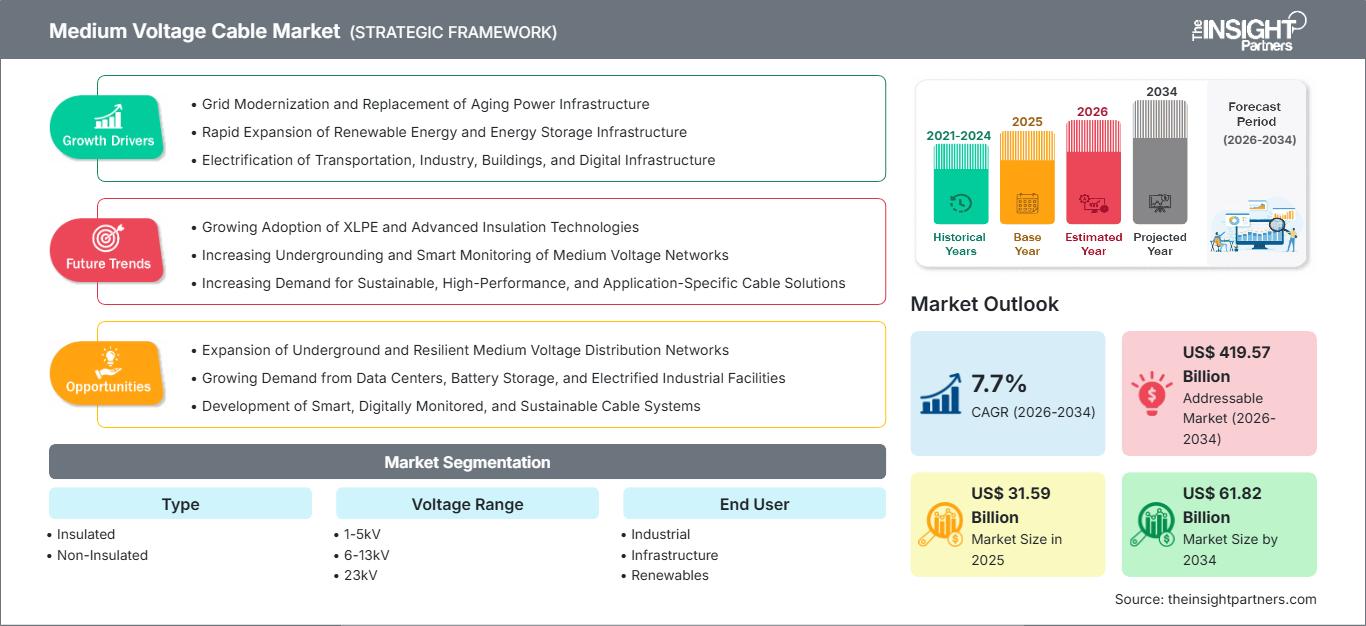
2025 Market Size
US$ 31.59 Bn
Base year value
2034 Forecast
US$ 61.82 Bn
Projected by 2034
CAGR 2026-2034
7.7 %
Growth rate
Addressable Market
US$ 419.57 Bn
(2026-2034)
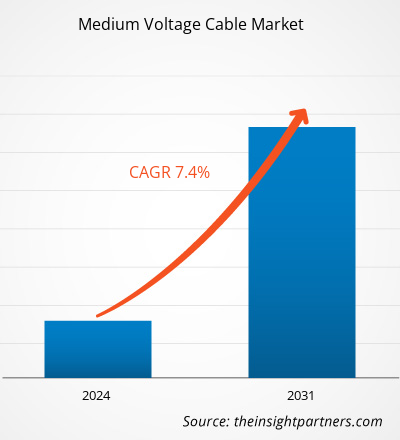
Medium Voltage Cable Market was valued at US$ 31.59 Billion in 2025 and is projected to reach US$ 61.82 Billion by 2034, expanding at a CAGR of 7.7% during 2026–2034. Demand reflects the essential role of medium-voltage circuits in utility distribution, industrial power systems, infrastructure networks, renewable-energy collection, and connections between substations, transformers, switchgear, motors, and distributed generation assets.
Across North America, the Medium Voltage Cable Market size is expected to advance at a 4.2–5.9% CAGR through 2034. Replacement of ageing distribution assets, undergrounding for resilience, data-center campuses, manufacturing reshoring, and renewable interconnections support demand. Utilities also require standardized, lower-loss cable systems that can accommodate load growth while reducing outage exposure and enabling phased upgrades within constrained urban corridors.
Medium Voltage Cable Market Assessment and Insights
- North America held 18.5–20.8% share in 2025 and is growing at a 4.2–5.9% CAGR during 2026–2034, supported by grid hardening, underground distribution, industrial electrification, and large-load interconnections.
- US represented 79.8–85.6% of North America in 2025 and is growing at a 4.5–5.8% CAGR during 2026–2034 as utility replacement cycles and data-center connections strengthen procurement.
- Europe accounted for 20.5–25.7% share in 2025 and is growing at a 6.3–7.4% CAGR during 2026–2034, led by Germany, the UK, France, Italy, and Spain.
- Asia Pacific captured 50.3–55.6% share in 2025 and is growing at an 8.6–9.5% CAGR during 2026–2034, with China, India, Japan, South Korea, and Australia supporting expansion.
- Largest Segment Insulated cable held 79.3–83.9% market share in 2025 and is growing at a 7.5–8.2% CAGR during 2026–2034.
- High Growth Segment Renewables held 16.0–19.0% market share in 2025 and is growing at a 8.3–10.6% CAGR during 2026–2034.
- Key companies analyzed in detail: TE Connectivity plc, Nexans S.A., ABB Ltd, Hellenic Cables S.A., Sumitomo Electric Industries, Ltd., Prysmian S.p.A., NKT A/S, The Okonite Company, Eland Cables Limited, and Tratos Cavi S.p.A.
Source: The Insight Partners' analysis based on proprietary research, government publications, company annual reports, investor presentations, industry databases, and expert interviews.
Cable design technology is transitioning from traditional polymer materials to cleaner, more predictable insulation extrusion, tree-deterrent technology, reusable polypropylene cable designs, and condition-dependent accessory materials. The producers are optimizing the balance between economics of the conductors and their capacity, installation radius, short circuit characteristics, and overall losses over the lifetime of the cable. Copper has continued relevance where size and terminations prevail, whereas aluminum becomes relevant in longer feeder and renewable energy cables.
Till 2034, investments for growth will move towards young Asian cities, Gulf region infrastructure projects, strengthening utilities in Africa, and renewables that need reliable collection systems. Investments in power grids, electrification of transport, hyperscale computing, and industrial decarbonization will lead to denser connections. The regulators will focus on fire performance, recyclability, technical losses, and resilience that will favor the suppliers with full qualifications of cables and accessories. The long-term agreements and local manufacture will become increasingly critical with metal price volatility and scarcity of installation skills.
Medium Voltage Cable Market Report Scope
| Report Attribute | Details |
|---|---|
| Market size in 2025 | US$ 31.59 Billion |
| Market Size by 2034 | US$ 61.82 Billion |
| Global CAGR (2026 - 2034) | 7.7% |
| Historical Data | 2021-2024 |
| Forecast period | 2026-2034 |
Medium Voltage Cable Market Analysis
The growth of Medium Voltage Cable will be driven by an increase in power consumption, renewal of existing feeders, connecting new renewable energy sources, and conversion of overhead lines into underground installations. Customers define cable systems together with associated switchgear and accessories; qualification experience and installation capabilities become key issues. The supply chain starts with copper rods and aluminum rods, plastics, semiconductors, screens and armor, through manufacturing, testing, distribution, joining and asset management.
Supply cost structures are still vulnerable to prices on conductors, polymer availability, energy costs, and plant capacity. Cable manufacturers have been relying more on indexed pricing, regional stock holding, and standardization to cope with volatility. Grid extension globally is reducing lead times, making early procurement and framework agreements more attractive. The International Energy Agency has identified planning and forward purchasing as pragmatic solutions to component shortages in grid infrastructure.
Medium Voltage Cable Market analysis shows competition divided between diversified global manufacturers and specialists with strong regional approvals. Prysmian S.p.A., Nexans S.A., and NKT A/S combine broad power-grid portfolios with manufacturing scale, while Sumitomo Electric Industries, Ltd., Hellenic Cables S.A., and ABB Ltd emphasize engineering depth and utility relationships. TE Connectivity plc competes strongly in connectivity, while The Okonite Company, Eland Cables Limited, and Tratos Cavi S.p.A. differentiate through specialized constructions and service responsiveness.
Investments are made in extrusion capacity, automation, renewable energy compounds, test labs, and distribution by regions. Positioning becomes more and more dependent on supplying the cable and associated joints and termination products together with technical services instead of the conductors only. The ability of suppliers to prove environmental sustainability, mitigate risks during installation, and keep short delivery times will safeguard margins. Joint ventures with the utilities and contractors will enable forecasting and design standardization of networks.
● REPORT CUSTOMIZATION
Tailor This Report To Align With Your Specific Business Requirements
This report can be customized to align precisely with your business objectives, scope, and target markets. Customization options include tailored segmentation, geography, competitive analysis, and strategic insights to support informed decision-making.
Customize This Report →WHAT YOU CAN ADJUST
- ● Segmentations
- ● Geography
- ● Competitive Analysis
- ● Language Preferences
Medium Voltage Cable Market: Strategic Insights
Regional Insights
North America Medium Voltage Cable Market
North America held 18.5–20.8% share in 2025 and is projected to expand at a 4.2–5.9% CAGR during 2026–2034. Medium Voltage Cable Market share is supported by utility capital programs, wildfire mitigation, storm resilience, undergrounding, and interconnections for data centers, electric-vehicle infrastructure, manufacturing campuses, and distributed generation. Replacement demand is especially durable because ageing feeders require coordinated cable, joint, and termination upgrades.
Favorable factors include qualified domestic or regional sources, consistent lead times, and accessories approved based on the chosen cable construction. Copper is still relevant for narrow urban duct work and heavy industrial applications; aluminum helps provide efficient reinforcing. Canada has an additional demand for renewables and mining applications; Mexico enjoys industrial proximity benefits. Utilities throughout the region have adopted multilateral structures that allow them to minimize risks associated with conductor prices and manufacturing constraints.
U.S. Medium Voltage Cable Market Market
The U.S. represented 79.8–85.6% of North American revenue in 2025 and is forecast to grow at a 4.5–5.8% CAGR through 2034. Utility replacement, storm hardening, wildfire-risk reduction, semiconductor plants, battery factories, and hyperscale computing create a broad project pipeline. Application demand spans underground residential distribution, commercial campuses, transit, petrochemicals, mining, water systems, and renewable collection grids.
Company presence is pervasive within the manufacturing, accessories, distribution, and support segments. Prysmian S.p.A., Nexans S.A., NKT A/S, TE Connectivity plc, and The Okonite Company serve the utility and industrial markets via unique product ranges. There is a growing focus on overall installation costs, performance in fault situations, partial discharge testing, availability in emergencies, and jointing assistance. Aluminum cables have an advantage in long routes, while copper cables dominate in constrained ducts.
Europe Medium Voltage Cable Market Market
Europe accounted for 20.5–25.7% share in 2025 and is expected to grow at a 6.3–7.4% CAGR through 2034. Germany leads through distribution-grid reinforcement, industrial electrification, and renewable integration. The UK combines offshore-wind connections, urban network replacement, and data-center demand, encouraging framework procurement and low-carbon cable specifications.
Modernized grids and connections of renewables help France; solar, wind, transportation, and industrial projects work in Italy and Spain. The emphasis lies on halogen-free materials, proven environmental characteristics, and accessory reliability. Regional producers such as Nexans S.A., Prysmian S.p.A., NKT A/S, Hellenic Cables S.A., and Tratos Cavi S.p.A. operate with approvals, geographic service, and optimal designs for dense grids.
APAC Medium Voltage Cable Market Market
Asia Pacific held 50.3–55.6% share in 2025 and should record an 8.6–9.5% CAGR during 2026–2034. China leads through grid reinforcement, renewables, transport, and industrial capacity. India combines distribution upgrades with manufacturing and solar expansion, while Japan and South Korea prioritize reliability, offshore wind, and resilient urban infrastructure.
Australia includes mining, renewable energy regions, and long-distance transmission systems. Government-sponsored electrification and urbanization support larger-scale aluminum technology, but copper is essential in small-scale substation and manufacturing plants. Local qualification, pricing, and delivery capabilities influence competition.
Middle East & Africa Medium Voltage Cable Market Market
Middle East and Africa is projected to expand at a 7.0–8.3% CAGR during 2026–2034. Saudi Arabia leads through utility reinforcement, industrial cities, renewables, and large construction programs. The UAE adds data centers, transit, desalination, and clean-energy projects, creating demand for heat-resistant, fire-performing cable systems.
South Africa needs network rehabilitation and renewable connectivity, whereas the rest of the region will provide selected utility, mining, and city infrastructure opportunities. Localisation, financing, performance under tough conditions, and installation skills are crucial for supplier access.
Segmentation Analysis
Type
Type is expected to grow at a 7.4–8.1% CAGR during 2026–2034. The Medium Voltage Cable Market scope is led by insulated designs because underground, industrial, and renewable circuits require controlled electric fields, mechanical protection, and dependable accessories. Non-insulated conductors retain targeted overhead and specialized applications where clearance, cost, and straightforward maintenance outweigh exposure concerns.
- Insulated cables dominate enclosed, underground, and high-contact-risk installations, offering predictable dielectric performance, moisture protection, compact routing, and compatibility with screened joints and terminations.
- Non-Insulated conductors serve selected overhead distribution and controlled industrial settings, maintaining strategic relevance where air clearance is available and installation simplicity outweighs environmental exposure.
Voltage Range
Voltage Range is forecast to grow at a 7.3–8.0% CAGR through 2034. Selection reflects feeder length, load density, fault duty, regulation, and regional standards. Lower bands serve plants and compact networks, while 23 kV to 45 kV systems support utility and renewable feeders. The 69 kV band addresses higher-capacity circuits near the upper medium-voltage boundary.
- 1-5kV supports large motors, industrial distribution, and legacy plant systems where short routes, equipment compatibility, and manageable fault levels guide specification.
- 6-13kV serves common utility and industrial feeders, balancing equipment availability, compact installation, standardized accessories, and efficient delivery across moderate distances.
- 23kV strengthens urban and renewable distribution by moving higher power through constrained corridors while retaining established installation practices and accessory ecosystems.
- 34kV is strategically important for wind and solar collection arrays, industrial campuses, and utility feeders requiring increased capacity over longer routes.
- 45kV addresses higher-capacity distribution and subtransmission applications where route economics favor elevated voltage without moving to complex high-voltage systems.
- 69kV supports demanding utility and industrial interconnections near the category boundary, emphasizing insulation quality, rigorous testing, and specialized accessories.
End User
End User demand is projected to expand at a 7.8–8.6% CAGR during 2026–2034. Industrial facilities require reliable motor, process, and campus distribution; infrastructure spans utilities, transport, buildings, water, and digital facilities; renewables need extensive collector systems. Renewable projects provide the fastest expansion as generation capacity increases and developers standardize array-cable architectures.
- Industrial users prioritize uptime, chemical and thermal resistance, compact routing, and predictable maintenance across manufacturing, mining, metals, oil and gas, and processing facilities.
- Infrastructure contributes broad recurring demand from utilities, rail, metros, airports, water systems, commercial campuses, data centers, and public construction programs.
- Renewables represents the high-growth application group, with wind, solar, storage, and hybrid plants requiring long collector routes, standardized accessories, and rapid installation.
Conductor Material
Conductor Material is expected to grow at a 7.5–8.2% CAGR through 2034. Copper offers excellent conductivity, compact cross sections, and strong terminations for densely packed installations in urban and industrial areas. Aluminum is lighter and offers better economy in routing, hence being preferred increasingly in utility feeders and renewable energy collectors, despite the problems of oxides and thermal expansion.
- Copper retains strategic value in space-constrained routes, high-load equipment connections, and installations requiring compact conductors, established termination practices, and strong mechanical reliability.
- Aluminum expands in long feeders and renewable arrays because lower weight and material economics reduce transport and installation burden across large projects.
Insulation Type
Insulation Type is forecast to grow at a 7.6–8.4% CAGR during 2026–2034. XLPE remains the established platform because of thermal capability, electrical strength, and manufacturing maturity. TR-XLPE addresses wet ageing, EPR supports flexibility, and polypropylene attracts interest in recyclability and operating-temperature potential. Qualification evidence and accessory compatibility will govern adoption.
- XLPE (Cross-Linked Polyethylene) remains the reference technology, combining thermal performance, dielectric strength, broad standards coverage, scalable manufacturing, and a mature accessory base.
- TR-XLPE (Tree-Retardant Cross-Linked Polyethylene) is favored in moisture-prone underground networks where resistance to water-tree degradation supports longer service life and reliability.
- EPR (Ethylene Propylene Rubber) serves flexible, industrial, mining, and mobile-duty designs, offering strong handling characteristics and tolerance for demanding operating environments.
- Polypropylene (PP) is emerging in recyclable and higher-temperature concepts, giving manufacturers a pathway to reduce cross-linking steps while improving circularity potential.
Shielding
Shielding is expected to grow at a 7.4–8.2% CAGR through 2034. Inner shielding supports uniform electric-field control and reduces stress concentrations around the conductor, making it central to insulated medium-voltage designs. Non-shielded constructions remain relevant in narrower applications where voltage, clearance, equipment design, and installation conditions permit simpler systems.
- Inner Shielding supports controlled electrical stress, smooth interfaces, partial-discharge performance, and reliable insulation behavior in utility, industrial, and renewable cable systems.
- Non-Shielding remains relevant for selected lower-stress or specialized installations where system geometry, clearances, and equipment interfaces allow reduced construction complexity.
Opportunity Snapshot
| End User | Revenue Contribution | Trend Tag | Adoption Stage |
| Industrial | High | Plant Electrification | Mature |
| Infrastructure | High | Grid Hardening | Scaling |
| Renewables | Medium | Collector Networks | Scaling |
Medium Voltage Cable Market Growth Drivers and Impact Analysis
Grid modernization and resilience spending
Electric utility companies are upgrading their aging feeders, upgrading circuit capacities, and burying certain overhead lines to reduce vulnerability to storms, tree contact, wildfires, and urban traffic conditions. Medium voltage cable contributes to a large extent to these initiatives owing to the proximity of distribution systems to growing load centers. The International Energy Agency suggests that grid extensions face constraints due to long lead times of components and calls for coordination in planning and procurement. This has the effect of favoring framework contracts, approved vendor lists, and regional inventory management. Cable manufacturers gain not only from volumes of cables but also from joints, terminations, engineering support, emergency service provision, and life cycle services. The biggest effect is seen when regulatory bodies allow rapid cost recovery and utilities combine replacement with monitoring and substation improvement projects.
Renewable generation and storage connections
Collector circuits connecting the generation units with transformers and substations for interconnection with the transmission grid are required for wind, solar, battery, and hybrid plants. Such systems lead to high cable density per site and standardization of reels, fittings, and installation processes. Renewable energy companies seek low electrical losses, fast installation, testability, and design solutions resilient to moisture, temperature or mechanical loading. Offshore wind developments also spur the growth of onshore medium-voltage connections at ports, substations, and servicing facilities. As the portfolio grows, developers are able to pool purchasing, which increases manufacturing visibility and encourages design specialization. The market effect is not confined to the addition of new generation capacity, since repowering, storage, and curtailment reduction projects add cables and interfaces.
Industrial electrification and high-density loads
Electrification of heat, transportation, equipment, and material handling is increasing power density at manufacturing, mining, logistics, and processing facilities. Data centers, semiconductor fab, battery factories, and automated distribution centers also require backup medium voltage distribution systems to interconnect utility services, substations, generators, and large equipment. Such end users value reliability, space-saving routing, fire performance, and cable accessory coordination. Engineering is often needed to assist with ampacity, short circuit current duty, harmonic loading, and installation constraints. This moves purchases from low-cost commodity units to total installed cost and risk management. Vendors that can customize, test, and provide field assistance will position themselves for higher margin deals, especially if phased campus expansions generate multi-year business.
Medium Voltage Cable Market Future Trends
Recyclable insulation and lower-carbon manufacturing
Medium Voltage Cable Market trends will be increasingly dictated by procurement criteria taking into account carbon content, recyclability, and energy consumption for production along with electrical characteristics. Thermoplastic polypropylene products might get selectively chosen as they do not require cross-linking and could facilitate easy end-of-life treatment, but long-term qualification testing and proper accessories are needed from the utility companies. In addition, producers will employ more renewable electricity, recycled metals, proper conductor size and EPDs. The uptake will likely take place first of all in framework agreements where utilities can specify criteria and assess the lifecycle impacts. Competitiveness will depend on proof rather than general sustainability claims as customers need to balance environmental goals with fire safety, ageing, reliability and installation techniques.
Condition-aware cable systems and digital traceability
The cable packages in the future would have improved traceability capabilities throughout its lifecycle, including raw materials and manufacturing test data, logistics on the drum level, installation, commissioning, and maintenance. Owners could make use of the serial numbers of the cables, the geolocation data, the thermal modeling, and other sensors’ data to detect overloading and degradation of the accessories. The business model could become oriented towards system assurance by combining cables, joints, terminations, commissioning evidence, and monitoring. This trend benefits the manufacturers and accessory providers that provide interoperability and longevity. The adoption process is going to be slow due to the necessity for cybersecurity, data governance, and maintenance benefits.
Medium Voltage Cable Market Opportunities
Localized capacity for constrained regional supply
Investors have the ability to locate their extrusion, stranding, testing, and accessories production capacity in areas close to rapidly expanding utility and renewable markets. Localization lowers freight costs, inventory, exchange risk, and emergency response times, while making domestic content more likely. The best projects combine assured demand with flexible lines capable of producing across multiple voltages and conductor constructions. Partnerships with utilities, engineering firms, and installation companies can help accelerate certification cycles and provide better forecasting. Opportunities in the Medium Voltage Cable Market exist in those areas where regional demand exists sufficient to assure utilization but where the existing supply chain is still import reliant.
Integrated cable-accessory-service packages
Suppliers are able to add further value through bundling the cable with engineered joints, installations, and condition assessments. Since many failures happen at the interface level or when installing the cable and not with the factory-made cable, the owners need a system that can hold accountable for their performance. This approach can help minimize specification issues, fast track contractors’ learning process, and simplify the warranty process. From a business perspective, this would mean service income and customer relationship building along with differentiation among suppliers compared to commoditized players. It is particularly appealing in renewable energy arrays, data center projects, metro applications, and industrial expansions where there is a need for shorter timelines and high impact outages.
Recent Developments
- February 2026: Nexans announces the signing of a €600 million framework agreement with Enedis for the supply of medium-voltage (HTA) cables to support the modernization and reinforcement of the network, the connection of electric vehicle charging infrastructure, the burial of lines, and the connection of renewable energy parks throughout France.
- May 2026: ABB announced that it is investing around $200 million in its medium-voltage manufacturing capabilities across Europe over the next three years to expand production capacity, accelerate the transition to next-generation technologies for power distribution and strengthen supply for customers that are modernizing their power infrastructure. This includes utilities, industry, and rapidly growing data center markets.
- February 2026: Prysmian has signed a contract worth up to €550 million to become the supplier of the full range of medium-voltage cables for Enedis, over a seven-year period (2026-2032), which includes three optional years. Prysmian has been a long-term partner to Enedis, and the signature reinforces French manufacturing excellence as Prysmian commits to supply cables from its Gron (Yonne) and Montereau-Fault-Yonne (Seine-et-Marne) sites.
Frequently Asked Questions

- Comprehensive Market Sizing and Forecast Analysis
- Detailed Segmentation Analysis
- In-Depth Market Dynamics Assessment
- Regional and Country-Level Insights
- Competitive Landscape and Company Benchmarking
- Strategic Business Intelligence
Recent Reports
Testimonials

The Insight Partners provided valuable market intelligence that supported our global go-to-market strategy. Their team was professional, responsive, and attentive to our feedback, providing thoughtful analysis and helpful methodological clarifications throughout the project.
Junmo Kim Chief Financial Officer (CFO), Enertech Co., Ltd.
The Insight Partners' SCADA System Market report is comprehensive, with valuable insights on current trends and future forecasts. The team was highly professional, responsive, and supportive throughout. We are very satisfied and highly recommend their services.
RAN KEDEM Partner, Reali Technologies LTDs
I requested a report on a very specific software market and the team produced the report in a few days. The information was very relevant and well presented. I then requested some changes and additions to the report. The team was again very responsive and I got the final report in less than a week.
JEAN-HERVE JENN Chairman, Future Analytica
We worked with The Insight Partners for an important market study and forecast. They gave us clear insights into opportunities and risks, which helped shape our plans. Their research was easy to use and based on solid data. It helped us make smart, confident decisions. We highly recommend them.
PIYUSH NAGPAL Sr. Vice President, High Beam Global
The Insight Partners delivered insightful, well-structured market research with strong domain expertise. Their team was professional and responsive throughout. The user-friendly website made accessing industry reports seamless. We highly recommend them for reliable, high-quality research services
YUKIHIKO ADACHI CEO, Deep Blue, LLC.
This is the first time I have purchased a market report from The Insight Partners.While I was unsure at first, I visited their web site and felt more comfortable to take the risk and purchase a market report.I am completely satisfied with the quality of the report and customer service. I had several questions and comments with the initial report, but after a couple of dialogs over email with their analyst I believe I have a report that I can use as input to our strategic planning process.Thank you so much for taking the extra time and making this a positive experience.I will definitely recommend your service to others and you will be my first call when we need further market data.
JOHN SUZUKI President and Chief Executive Officer, Board Director, BK Technologies
I wish to appreciate your support and the professionalism you displayed in the course of attending to my request for information regarding to infectious disease IVD market in Nigeria. I appreciate your patience, your guidance, and the fact that you were willing to offer a discount, which eventually made it possible for us to close a deal. I look forward to engaging The Insight Partners in the future, all thanks to the impression you have created in me as a result of this first encounter.
DR CHIJIOKE ONYIA MANAGING DIRECTOR, PineCrest Healthcare Ltd.Reason to Buy
- Informed Decision-Making
- Understanding Market Dynamics
- Competitive Analysis
- Identifying Emerging Markets
- Customer Insights
- Market Forecasts
- Risk Mitigation
- Boosting Operational Efficiency
- Strategic Planning
- Investment Justification
- Tracking Industry Innovations
- Aligning with Regulatory Trends






 Get Free Sample for