
Automatic and Smart Pet Feeder Market Trends, Size & Forecast by 2034
Coverage: By Product Type (Automatic Pet Feeder, Smart Pet Feeder); Feeder Type (Generic Feeder, Selective Feeder); End User (Dog, Cat, Others) , and Geography (North America, Europe, Asia Pacific, and South and Central America)
- Status : Data Released
- Report Code : TIPRE00005692
- Category : Electronics and Semiconductor
- No. of Pages : 150
- Available Report Formats :


- Last update date : July 20, 2026


2025 Market Size
US$ 2.74 Bn
Base year value
2034 Forecast
US$ 6.90 Bn
Projected by 2034
CAGR 2026-2034
10.80 %
Growth rate
Addressable Market
US$ 42.64 Bn
(2026-2034)
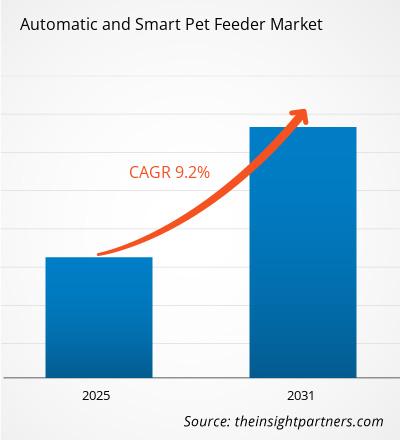
The Automatic and Smart Pet Feeder market was valued at US$ 2.74 Billion in 2025 and is projected to reach US$ 6.90 Billion by 2034, registering a CAGR of 10.8% during 2026–2034. Growth reflects rising pet humanization, scheduled nutrition management, portion control, and connected-home adoption across households seeking reliable feeding support for dogs, cats, and small companion animals.
Within North America, the Automatic and Smart Pet Feeder market size is expected to expand at a CAGR of 9.4–10.6% during 2026–2034 as multi-pet homes, e-commerce availability, and smart-home routines normalize connected feeding. Regional demand is reinforced by veterinary attention to obesity prevention, dual-income households, and higher spending on devices that combine convenience with measurable feeding discipline.
Automatic and Smart Pet Feeder Market Assessment and Insights
- North America: Held 31–35% share in 2025 and is projected to grow at a CAGR of 9.4–10.6% during 2026–2034, supported by smart-home adoption, pet wellness spending, and online replenishment models.
- US: Represented 82–86% of North American revenue in 2025 and is forecast to grow at a CAGR of 9.6–10.8% during 2026–2034, driven by premium feeders and app-based portion control.
- Europe: Accounted for 24–28% share in 2025 and is expected to grow at a CAGR of 8.7–9.8% during 2026–2034, led by the UK, Germany, France, Italy, and Spain.
- Asia Pacific: Held 27–31% share in 2025 and is projected to register a CAGR of 12.0–13.4% during 2026–2034, led by China, Japan, South Korea, India, and Australia through urban pet ownership.
- Largest Segment: Automatic Pet Feeder held 58–62% market share in 2025 and is expected to grow at a CAGR of 9.5–10.7% during 2026–2034, reflecting affordability and broad household penetration.
- High Growth Segment: Smart Pet Feeder represented 38–42% market share in 2025 and is forecast to grow at a CAGR of 12.4–13.8% during 2026–2034, supported by Wi-Fi, cameras, alerts, and diet tracking.
- Key companies analyzed in detail: Catspad, Catzenpup, DogSpot, Petnet, PetSafe Brands, PawsPik PortionPro Rx, Shenzhen Easething Technology Co. Ltd., SureFlap Ltd., Wireless Whiskers, WOPET.
Source: The Insight Partners' analysis based on proprietary research, government publications, company annual reports, investor presentations, industry databases, and expert interviews.
The category has moved from timer-based dispensers toward connected nutrition devices that manage meal timing, portion accuracy, freshness, and access control. Automatic and Smart Pet Feeder production increasingly combines food-grade plastics, anti-jam dispensing, stainless bowls, rechargeable or backup power, and mobile applications. Suppliers are improving dual-bowl formats, camera visibility, RFID access, and low-food alerts to reduce missed meals and support diet routines in busy households, helping manufacturers strengthen their Automatic and Smart Pet Feeder market share through enhanced functionality and user convenience.
Future demand would be influenced by city apartments, pet insurance and veterinary services, premium dry food, and growing direct-to-consumer pet care. Emerging markets in the Asia Pacific as well as the Middle East have started using connected feeders owing to the increasing disposable income of pet parents who require practical ways of scheduling feeding. The regulatory tailwinds would be indirect through food safety requirements, electrical regulations, and data privacy rules for connected home devices.
Automatic and Smart Pet Feeder Market Report Scope
| Report Attribute | Details |
|---|---|
| Market size in 2025 | US$ 2.74 Billion |
| Market Size by 2034 | US$ 6.90 Billion |
| Global CAGR (2026 - 2034) | 10.80% |
| Historical Data | 2021-2024 |
| Forecast period | 2026-2034 |
Automatic and Smart Pet Feeder Market Analysis
Demand is rising as pet owners seek consistent feeding schedules while managing work travel, hybrid routines, and multi-caregiver households. The Automatic and Smart Pet Feeder growth profile is reinforced by portion-control needs, particularly for pets at risk of obesity or diet inconsistency. The use of dispensing devices that provide small and measured meals, slow feeding, and application alerts is relevant because these transform daily activities into a repetitive process within the household.
The value chain consists of suppliers of parts, plastic processors, electronic assembly manufacturers, application developers, pet specialty stores, online marketplaces, veterinary channels, and end-users. The supply situation is influenced by motors, gears, sensors, Wi-Fi technology, battery power, cameras, and weighing systems. Automatic and Smart Pet Feeder suppliers prioritize anti-clog mechanisms, easy cleaning, accurate dosing, and secure lids because reliability directly affects owner trust and repeat purchasing, as highlighted in the Automatic and Smart Pet Feeder Market report.
Competitive intensity in the Automatic and Smart Pet Feeder analysis reflects a fragmented mix of specialist pet-tech brands and mass-market feeder suppliers. PetSafe Brands' competitive advantage lies in its extensive retail presence and feeder lines, while SureFlap Ltd.'s is its access to microchips and feeding behavior information. WOPET, Catspad, Catzenpup, DogSpot, Petnet, Wireless Whiskers, Shenzhen Easething Technology Co. Ltd., and PawsPik PortionPro Rx focus on various niches, from connectivity, budget, and selective feeders.
The investment trends are shifting toward camera-based feeders, app ecosystems, dual-bowls technology, pet identification technology, and fresh food-friendly feeders. Positioning requires reliable software, warranty, retail presence, and handling of all kibble sizes without any jams. Feeders combining feeding data, reminders, caregiver sharing features, and automatic order placement features will be able to maintain premium prices, while basic automatic feeders will be crucial for conversion.
● REPORT CUSTOMIZATION
Tailor This Report To Align With Your Specific Business Requirements
This report can be customized to align precisely with your business objectives, scope, and target markets. Customization options include tailored segmentation, geography, competitive analysis, and strategic insights to support informed decision-making.
Customize This Report →WHAT YOU CAN ADJUST
- ● Segmentations
- ● Geography
- ● Competitive Analysis
- ● Language Preferences
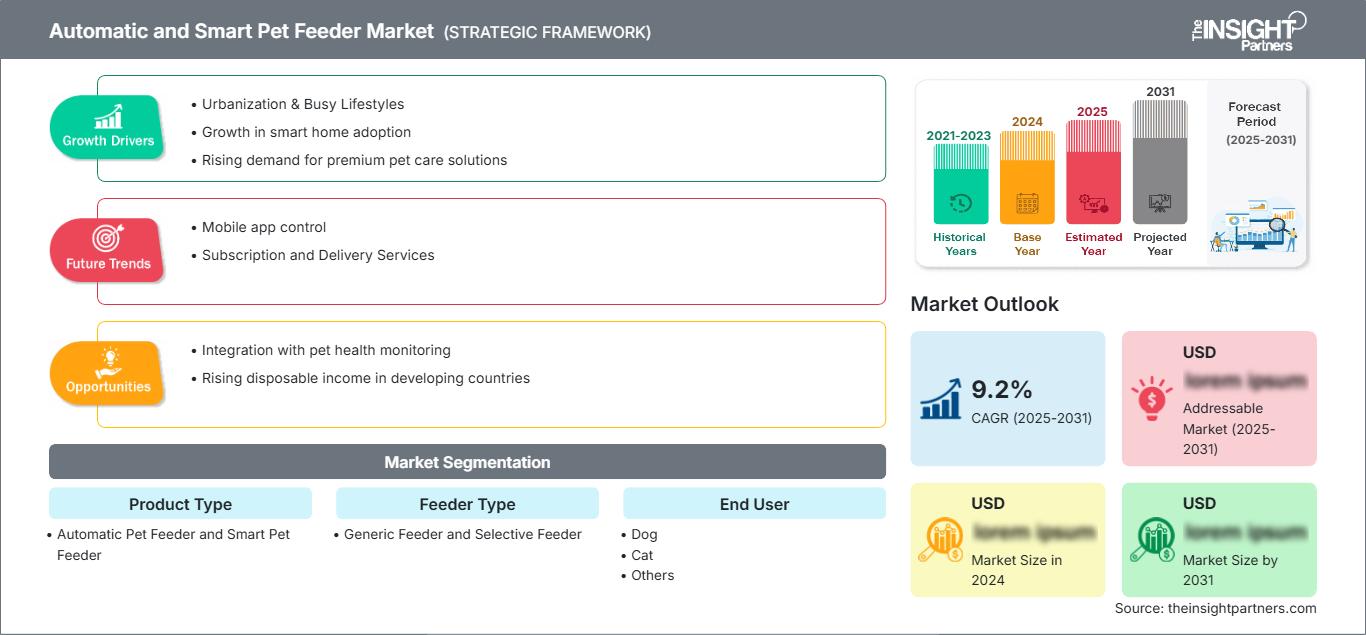
Automatic and Smart Pet Feeder Market: Strategic Insights
Regional Insights
North America Automatic and Smart Pet Feeder Market
North America accounted for 31–35% of the Automatic and Smart Pet Feeder share in 2025 and is projected to grow at a CAGR of 9.4–10.6% during 2026–2034. Adoption is supported by high pet ownership, smart-home familiarity, subscription pet food channels, and owner preference for devices that confirm meals during workdays or short trips. These factors contribute to a positive Automatic and Smart Pet Feeder Market forecast, driven by increasing demand for connected pet-care solutions and automated feeding technologies.
There is high product demand for robust dry food dispensers, those that can be Wi-Fi connected, and those that have low food alert or camera-viewing capabilities. Other features that are preferred by North American customers include being dishwasher-friendly, having backup power source capabilities, and allowing for family or pet sitter app sharing.
U.S. Automatic and Smart Pet Feeder Market
The U.S. represented 82–86% of North American revenue in 2025 and is expected to expand at a CAGR of 9.6–10.8% during 2026–2034. Households with cats and dogs use feeders for scheduled meals, diet adherence, slow feeding, and remote assurance when owners are commuting, traveling, or managing irregular hours. These factors reflect key Automatic and Smart Pet Feeder Market trends, including growing adoption of connected pet-care devices, app-based feeding management, portion-control technologies, and increasing demand for convenience-oriented pet wellness solutions.
The presence of the companies can be seen from PetSafe Brands, WOPET, PawsPik PortionPro Rx, SureFlap Ltd., and online-based sellers who compete based on their capability, video, ease of use on an application, and pricing. Trends within the application industry include multi-pet control, theft-feeding, and access by the caregiver to confirm portions for each pet.
Europe Automatic and Smart Pet Feeder Market
Europe held 24–28% share in 2025 and is forecast to grow at a CAGR of 8.7–9.8% during 2026–2034. The UK leads through strong cat ownership, online pet retail, and microchip-enabled feeder adoption. Germany supports premium hardware demand through high household purchasing power, while France emphasizes portion control and pet wellness routines across the Automatic and Smart Pet Feeder Market.
Italy and Spain contribute through urban pet ownership, apartment living, and growing interest in convenient feeding formats. European buyers are sensitive to product safety, data protection, warranty support, and ease of cleaning. SureFlap Ltd. has regional relevance in selective feeding, while WOPET, PetSafe Brands, Catspad, and Catzenpup address connected and automatic feeder use cases.
APAC Automatic and Smart Pet Feeder Market
Asia Pacific accounted for 27–31% share in 2025 and is projected to grow at a CAGR of 12.0–13.4% during 2026–2034. China dominates based on its vast electronics manufacturing capacity and rapid pet tech adoption in retail channels. At the same time, Japan and South Korea offer quality miniature devices suitable for apartment homes, thus boosting the growth dynamics of the Automatic and Smart Pet Feeder Market.
In India and Australia, there is expansion but on a lesser scale due to improvements in pet parenting, access to online shopping portals, and increasing disposable incomes. Some of the industrial factors driving this market are local electronics manufacturing, software development capabilities, and cost-effective assembly operations.
Middle East & Africa Automatic and Smart Pet Feeder Market
The Middle East & Africa market is projected to grow at a CAGR of 7.6–8.8% during 2026–2034. The leadership lies with Saudi Arabia, which utilizes premium retailing, foreign homes, and a growing pet service infrastructure for adoption. UAE comes second due to high penetration in smart home technology and e-commerce logistics. South Africa is the most developed Sub-Saharan region due to organized pet retail and veterinary networks.
The development in other regions of MEA is slow but growing in cases where online platforms provide reasonably priced feeders. Energy reliability makes backup energy a key feature.
Segmentation Analysis
Product Type
Product Type is projected to grow at a CAGR of 10.4–11.7% during 2026–2034. The Automatic and Smart Pet Feeder Market scope spans simple programmable dispensers and connected devices with apps, cameras, alerts, and feeding logs. Automatic units lead on affordability, while smart feeders expand through remote monitoring and personalized care routines.
- Automatic Pet Feeder remains the volume leader because it provides scheduled dispensing, portion settings, and backup feeding support at accessible prices for routine household use.
- Smart Pet Feeder is strategically important as Wi-Fi control, camera monitoring, low-food alerts, shared app access, and feeding history increase perceived value.
Feeder Type
Feeder Type is forecast to grow at a CAGR of 10.1–11.4% during 2026–2034. Generic feeders dominate because they serve most single-pet and flexible household needs. Selective feeders are gaining importance in multi-pet homes where different diets and prescription food are required. Product Type is projected to grow at a CAGR of 10.4–11.7% during 2026–2034. The Automatic and Smart Pet Feeder Market scope spans simple programmable dispensers and connected devices with apps, cameras, alerts, and feeding logs. Automatic units lead on affordability, while smart feeders expand through remote monitoring and personalized care routines.
Overeating prevention or food theft control requires identity-based access.
- Generic Feeder holds a broad market position because it fits standard dry-food scheduling, routine portioning, and everyday convenience across cats and dogs without identity recognition.
- Selective Feeder addresses strategic diet control needs by using RFID, microchip, or access logic to restrict food to a designated pet in shared households.
End User
End User is projected to grow at a CAGR of 10.6–12.0% during 2026–2034. Within the Automatic and Smart Pet Feeder Market, dog and cat owners remain the primary buyers, but use cases differ by feeding frequency, kibble size, household routine, and dietary control. Growth is strongest where owners combine convenience with health-oriented portion management.
- Dog demand is supported by larger hopper capacity, slow-feed modes, and predictable meal scheduling for working owners managing weight, travel, or multi-caregiver routines.
- Cat demand is reinforced by frequent small meals, wet-and-dry feeding interest, anti-theft feeding, and microchip access needs in multi-cat households.
Opportunity Snapshot
| Segment Name | Revenue Contribution | Trend Tag | Adoption Stage |
| Dog | High | Slow Feed | Scaling |
| Cat | High | Microchip Access | Mature |
| Others | Low | Small Pets | Emerging |
Automatic and Smart Pet Feeder Market Growth Drivers and Impact Analysis
Busy households increasing need for reliable scheduled feeding
The increasing urban working trends, traveling, and multicare giving practices have made it necessary to use products that will help in sustaining a regular schedule for their feeding without any interference from the owner daily. The Automatic and Smart Pet Feeder ensures that there is no skipped meal, provides controlled portions, and also provides owners satisfaction using the timers or the apps. The product will be effective in the market, especially in apartments, double-income families, and those with pets having controlled diet regimes.
Pet obesity and diet management supporting portion control
Feeding and nutrition are practical motivators due to the fact that unrestricted feeding and irregular portions may cause excess consumption among both cats and dogs. Feeders with portioned food, gradual dispensing and restricted access allow pet owners to synchronize the meal time with the veterinarian's advice and their own schedule. Moreover, selective feeders do not allow one pet to eat the food of another one, and it is important, especially in cases when some pets should follow a special prescription diet or consume a different number of calories.
Smart-home ecosystems expanding connected pet care adoption
Pet care is also catching up in connected homes since people will become more used to controlling their locks, cameras, thermostats, and appliances via mobile apps. The concept is evident in smart feeders, which allow users to remotely feed pets, track their activity, watch videos, listen to their voice messages, and get notifications when their food is getting low. The outcome is an increased propensity to pay for app-based gadgets when performance and privacy issues are guaranteed.
Automatic and Smart Pet Feeder Market Future Trends
Feeding data moving toward preventive pet wellness
Automatic and Smart Pet Feeder trends are shifting from convenience-only scheduling toward feeding data that supports preventive wellness. Connected feeders will increasingly record meal frequency, intake timing, unfinished food, and caregiver actions, giving owners early signals when appetite changes. This is especially relevant for cats, senior pets, and animals on controlled diets. Over the forecast period, value will move toward software interpretation, shareable summaries, and integration with broader pet health applications.
Fresh-food compatible feeders expanding premium use cases
Product development for the future will be about new products, such as fresh foods, semi-moist diets, and refrigerated diets. This new development calls for improvements in sealing technology, cooling systems, tray systems, washability, and food safety communications. High-end feeders that can maintain freshness without requiring intensive maintenance will cater to those owners who use therapy diets, raw diets, and mixed feeding diets. It is a challenging task, but one that broadens the market addressability and helps fetch premium average selling prices.
Automatic and Smart Pet Feeder Market Opportunities
Selective feeding for multi-pet and prescription diet households
Automatic and Smart Pet Feeder Forecasts highlight selective feeding as an attractive investment area because multi-pet households often face food stealing, different diet plans, and portion conflicts. Companies can build value through RFID tags, microchip reading, bowl-level sealing, and app-based consumption logs. The most actionable route is a partnership with veterinary clinics, prescription diet brands, and specialty retailers, where buyers already understand the importance of controlled intake and are less price-sensitive.
Retail bundles linking feeders, food, and replenishment services
Value for retailers and brands can be increased with the bundling of feeder subscription, replacement bowls, desiccants, batteries, and after-sales services together with the dry food subscription. This not only increases customer convenience but also brings in a stream of revenue other than that earned from selling the hardware. Different bundle offerings can be targeted at dogs by breed sizes, cats, pet owners who are always traveling, or those who want to manage their pets' weight.
Recent Developments
- June 2026: Automatic feeders are no longer just about convenience; they're becoming one of the most valuable daily touchpoints for understanding pet well-being. Petlibro, America's leading automatic feeder brand, is driving that shift with the launch of its Granary 2 series, a next-generation smart feeding lineup designed to transform feeding into understanding. Building on the brand's bestselling Granary line, the lineup features four new models that combine behavioral insight, personalized feeding schedules, and health-minded tracking to give pet parents a clearer view of daily mealtime patterns and changes over time.
- August 2025: PETKIT hosted a Global Product Launch on August 18th, 2025(GMT+8) in Wuxi, bringing together pet lovers, industry experts, and media to share the latest innovations in smart pet care. Among the many new products unveiled at the event, one groundbreaking innovation stood out: Yumshare Daily Feast, the world’s first fully automatic AI wet food feeder, transforming cat feeding with fresh, perfectly portioned meals while advancing urinary health care.
- May 2025: KRAIBURG TPE, a global manufacturer of thermoplastic elastomers, offers advanced thermoplastic elastomer solutions that are able to meet these features by combining superior material performance with sustainable manufacturing advantages—enabling next-generation smart pet feeders that excel in both functionality and design. KRAIBURG TPE’s FC/AD1 series meets strict safety standards for food-contact applications, including Regulation (EU) No 10/2011, US FDA CFR 21, EN71-3, and is halogen-free (according to IEC 61249-2-21).
Frequently Asked Questions

- Comprehensive Market Sizing and Forecast Analysis
- Detailed Segmentation Analysis
- In-Depth Market Dynamics Assessment
- Regional and Country-Level Insights
- Competitive Landscape and Company Benchmarking
- Strategic Business Intelligence
Recent Reports
Testimonials

The Insight Partners' SCADA System Market report is comprehensive, with valuable insights on current trends and future forecasts. The team was highly professional, responsive, and supportive throughout. We are very satisfied and highly recommend their services.
RAN KEDEM Partner, Reali Technologies LTDs
I requested a report on a very specific software market and the team produced the report in a few days. The information was very relevant and well presented. I then requested some changes and additions to the report. The team was again very responsive and I got the final report in less than a week.
JEAN-HERVE JENN Chairman, Future Analytica
We worked with The Insight Partners for an important market study and forecast. They gave us clear insights into opportunities and risks, which helped shape our plans. Their research was easy to use and based on solid data. It helped us make smart, confident decisions. We highly recommend them.
PIYUSH NAGPAL Sr. Vice President, High Beam Global
The Insight Partners delivered insightful, well-structured market research with strong domain expertise. Their team was professional and responsive throughout. The user-friendly website made accessing industry reports seamless. We highly recommend them for reliable, high-quality research services
YUKIHIKO ADACHI CEO, Deep Blue, LLC.
This is the first time I have purchased a market report from The Insight Partners.While I was unsure at first, I visited their web site and felt more comfortable to take the risk and purchase a market report.I am completely satisfied with the quality of the report and customer service. I had several questions and comments with the initial report, but after a couple of dialogs over email with their analyst I believe I have a report that I can use as input to our strategic planning process.Thank you so much for taking the extra time and making this a positive experience.I will definitely recommend your service to others and you will be my first call when we need further market data.
JOHN SUZUKI President and Chief Executive Officer, Board Director, BK Technologies
I wish to appreciate your support and the professionalism you displayed in the course of attending to my request for information regarding to infectious disease IVD market in Nigeria. I appreciate your patience, your guidance, and the fact that you were willing to offer a discount, which eventually made it possible for us to close a deal. I look forward to engaging The Insight Partners in the future, all thanks to the impression you have created in me as a result of this first encounter.
DR CHIJIOKE ONYIA MANAGING DIRECTOR, PineCrest Healthcare Ltd.Reason to Buy
- Informed Decision-Making
- Understanding Market Dynamics
- Competitive Analysis
- Identifying Emerging Markets
- Customer Insights
- Market Forecasts
- Risk Mitigation
- Boosting Operational Efficiency
- Strategic Planning
- Investment Justification
- Tracking Industry Innovations
- Aligning with Regulatory Trends





 Get Free Sample for