
Automatic Dental Autoclave Market Size, Growth & Demand by 2034
Coverage: By Type (Less than 5 L, 5-10 L, 10-15 L, 15-20 L, Above 20 L); Application (Hospitals, Clinics); , and Geography (North America, Europe, Asia Pacific, and South and Central America)
- Status : Data Released
- Report Code : TIPRE00020474
- Category : Life Sciences
- No. of Pages : 150
- Available Report Formats :


- Last update date : November 09, 2026


2025 Market Size
US$ 252.08 Mn
Base year value
2034 Forecast
US$ 372.26 Mn
Projected by 2034
CAGR 2026-2034
4.43 %
Growth rate
Addressable Market
US$ 2,835.46 Mn
(2026-2034)
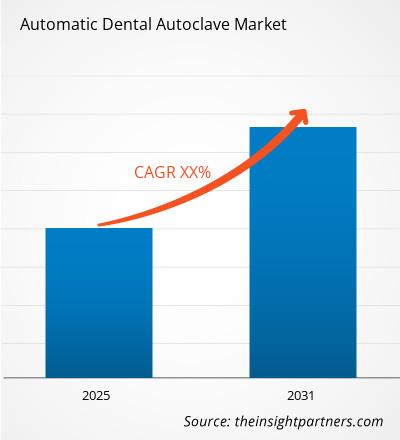
The automatic dental autoclave market was valued at US$ 252.08 Million in 2025 and is projected to reach US$ 372.26 Million by 2034, expanding at a CAGR of 4.43% during 2026–2034. Market expansion is supported by infection prevention requirements, rising dental procedure volumes, modernization of clinical equipment, and demand for consistent instrument reprocessing. Manufacturers are increasingly differentiating products through cycle automation, digital documentation, energy efficiency, and chamber designs that balance throughput with limited clinical workspace.
North America represents an important commercial market for automatic dental autoclave market size assessments because established dental networks, replacement demand, and emphasis on documented sterilization processes support equipment purchases. A modeled CAGR of ~4% through 2034 reflects a relatively mature installed base, continued replacement of aging devices, and investment in standardized instrument-processing workflows. Purchasing decisions increasingly consider total ownership cost, service availability, cycle reliability, and integration with practice operations, alongside initial equipment price.
Automatic Dental Autoclave Market Assessment and Insights
Regional Outlook
- North America: ~34% of the global market in 2025 | ~4% CAGR through 2034. Market position: North America is modeled as the largest regional market, supported by established dental infrastructure, replacement purchases, infection-control procedures, and organized dental service networks. Product reliability and service coverage remain important procurement considerations.
- US: ~84% of North American market revenue in 2025 | ~4% CAGR through 2034. Market position: The US is the principal national market within North America. Dental group purchasing, equipment replacement, and demand for standardized sterilization documentation support sales, while distributors and service networks influence brand selection.
- Europe: ~29% of the global market in 2025 | ~4% CAGR through 2034. Market position: Europe is a mature market with established dental equipment manufacturers and structured medical-device requirements. Germany, the UK, France, Italy, and Spain provide demand through private practices, hospital dentistry, and equipment renewal.
- Asia Pacific: ~28% of the global market in 2025 | ~6% CAGR through 2034. Market position: Asia Pacific is modeled as the fastest-growing region, reflecting expanding dental access, clinic development, domestic equipment production, and increasing investment in infection-control infrastructure. China, Japan, India, South Korea, and Australia represent distinct demand and distribution environments.
Segment Outlook
- Clinics: ~64% share in 2025 | ~4% CAGR through 2034. Market position: Clinics are modeled as the largest application sub-segment because dental practices require routine instrument sterilization close to treatment areas. Equipment selection depends on daily patient throughput, usable workspace, cycle turnaround, and traceable processing records.
- 5-10 L: ~24% share in 2025 | ~5% CAGR through 2034. Market position: This capacity category is positioned for comparatively strong growth among smaller practices seeking greater loading flexibility without allocating substantial space to sterilization. Its outlook depends on chamber usability, compatible instrument loads, and the economics of replacing older units.
Competitive Coverage
Tuttnauer, Runyes Medical, W&H Dentalwerk, MELAG Medizintechnik GmbH & Co. KG, Getinge AB, SHINVA MEDICAL INSTRUMENT CO., LTD., Mocom, Midmark Corporation, COLTENE Group, Sirona Hygiene Private Limited, Jinggong-medical, SciCan, Straumann AG, 3M, Antonio Matachana S.A., Systec GmbH, FONA Dental, S.R.O., Thermo Fisher Scientific Inc., Priorclave Ltd., Trident Dental.
Methodology
The Insight Partners follows Data Collection & Secondary Research, Primary Research, Data Analysis, and Data Triangulation & Final Review to validate market estimates and insights.
Source: The Insight Partners' analysis based on proprietary research, government publications, company annual reports, investor presentations, industry databases, and expert interviews.
Dental sterilization devices have progressed from rudimentary steam sterilizing machines to advanced automatic dental sterilizers, which combine controlled processes, user assistance, and record keeping. The automatic dental autoclave market represents an increasing significance of the need for reproducibility of instrument reprocessing in regular dental clinic operations. Improvements in the design of the chamber, efficiency of the vacuum, drying, cycle monitoring, and interface allow clinics to operate under various types of instruments more effectively. The competitive features also include ease of maintenance, water treatment, serviceability, and the possibility to place the device in a compact sterilization room.
In the future, the demand is expected to vary depending on the structure of dental care systems, purchasing power, and the organizational specifics of clinical practice in the regions. Emerging markets may provide opportunities due to expansion of independent clinics and investments into standardization of equipment by established companies. In mature markets, replacement of older devices and optimization of processes are likely to be important. Compliance with regulatory standards concerning reprocessing validation, procedural documentation, and proper usage of equipment may serve as motivation for purchasing appropriate devices, though the implementation varies from region to region.
Automatic Dental Autoclave Market Report Scope
| Report Attribute | Details |
|---|---|
| Market size in 2025 | US$ 252.08 Million |
| Market Size by 2034 | US$ 372.26 Million |
| Global CAGR (2026 - 2034) | 4.43% |
| Historical Data | 2021-2024 |
| Forecast period | 2026-2034 |
Automatic Dental Autoclave Market Analysis
Market development has a connection with the repetitive need to clean the same set of instruments used several times in between the treatment sessions. The market develops because of the requirement of clinics, hospitals, dental institutions, and other professional organizations, which require equipment for cleaning a specific set of instruments repetitively. Buyers can be dentists, equipment sellers, infection control specialists, and other relevant people. Suppliers convert the specifications of the sterilizers into a range of differentiating products. Factors that determine the cost of the finished product include raw material, manufacture, control system design, validation, distribution, installation, and maintenance.
Supplier availability is determined by reliable components, quality manufacturing, regulatory compliance, and regional distribution capabilities. Components such as stainless-steel chamber, heater assembly, pump, seals, sensors, control electronics, and safety system affect production cost and durability of sterilizers. Known suppliers can capitalize on their existing services and customer network, whereas regional companies could rely on lower price and easier availability. Customer evaluation should include a possibility to purchase replacement parts, receive service and training. Disruption of component supply and logistics could affect delivery time.
Competition for the automatic dental autoclave market report involves existing sterilization specialists, dental equipment providers, diversified healthcare companies, and regional competitors. Tuttnauer, MELAG Medizintechnik GmbH & Co. KG, W&H Dentalwerk, SciCan, and Mocom specialize in instrument processing equipment. Midmark Corporation competes by means of dental practice equipment and relationships, while Getinge AB, SHINVA MEDICAL INSTRUMENT CO., LTD., and Antonio Matachana S.A. offer sterilization systems with wider functionality. Other companies from the list compete in dental equipment, laboratory systems, medical devices, or clinical supply categories as well, according to their particular product lines.
Key areas of investments are related to cycle efficiency, better user interface design, electronic documentation, miniaturization, and service network. Reprocessing systems with integrated solutions can make coordination easier in terms of cleaning, care, sterilization, and documentation processes, but depend on the compatibility with clinical processes and space availability. Product development should be balanced with the cost-sensitive environment, certification cost, channel cost, and after-sales requirements. Competition is not only about frequency of launch, but about reliable performance, cost visibility, availability of the products, training, and lifecycle management.
● REPORT CUSTOMIZATION
Tailor This Report To Align With Your Specific Business Requirements
This report can be customized to align precisely with your business objectives, scope, and target markets. Customization options include tailored segmentation, geography, competitive analysis, and strategic insights to support informed decision-making.
Customize This Report →WHAT YOU CAN ADJUST
- ● Segmentations
- ● Geography
- ● Competitive Analysis
- ● Language Preferences
Automatic Dental Autoclave Market: Strategic Insights
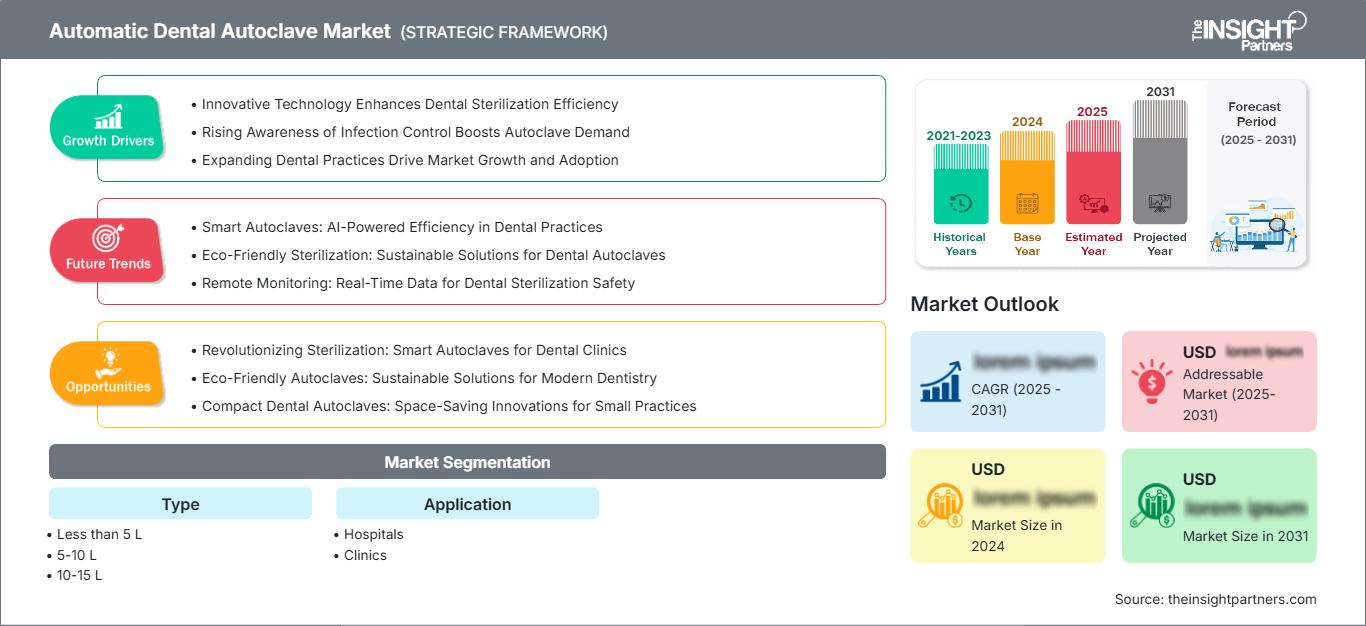
Regional Insights
North America Automatic Dental Autoclave Market
North America presents an already well-established automatic dental autoclave market due to organized delivery of dental care services, needs for infection control, and continuous investments into clinical equipment. Equipment purchases are driven by replacement of obsolete sterilizers, growing dental clinics' capacity, and the need to ensure proper reprocessing of instruments. Hospital and independent dental clinics' purchasing criteria include cycle reliability, documentation, maintenance needs, and the compatibility with the instrument workflow in the clinics.
The prospects of the regional market development involve the need to maintain proper sterilization system and meet the changing needs of dental care practices. Customers will be increasingly looking for automated cycle controls, ease of use of equipment, and traceability of sterilization results when purchasing the equipment. Competitiveness of equipment suppliers will be ensured by the equipment reliability, service coverage, training of equipment operators and lifecycle costs management, rather than by equipment pricing alone.
U.S. Automatic Dental Autoclave Market
One advantage the market in the United States enjoys is the large number of private dental care facilities, well-established dental equipment distribution channels, and infection control culture. Healthcare providers including hospitals, dental service organizations, and independent clinics need sterilization machines that can accommodate their instrument volume, space, and operational needs. Purchasing considerations include cycle uniformity, user-friendliness, accessibility for maintenance, and capacity to handle documentable reprocessing. Such criteria favor vendors whose products are reliable and backed up with support services.
The automatic dental autoclave market demand is also driven by consolidations and equipment renewal. Large groups of dental care providers may standardize sterilization equipment in all their facilities to ease training, maintenance, and operations. Small clinics would prefer compact units and low cost of ownership. Some manufacturers like Midmark Corporation, Tuttnauer, SciCan, and W&H Dentalwerk participate in the general industry of professional sterilization equipment. Their success would be more dependent on the suitability of their products, market coverage, after sales services, and process considerations as opposed to just machine specifications.
Europe Automatic Dental Autoclave Market
Europe has an established dental equipment market supported by professional infection prevention practices, clinical quality requirements, and a developed network of dental clinics and hospitals. Germany is an important market within Europe because of its medical technology manufacturing base and established dental care infrastructure. The UK and France also contribute through organized dental services and continuing investment in clinical equipment. Italy and Spain provide additional demand through independent dental practices, private clinic networks, and ongoing equipment replacement.
Purchasing behavior in Europe depends on the need for reliable sterilization cycle performance, validated procedures, maintenance of equipment, and compliance with standards related to medical devices and sterilization processes. Besides, clinics evaluate installation issues, capacity of instruments, serviceability, and total cost of ownership. These trends open the way to companies offering smaller-sized equipment, user-friendly controls, and proven performance results.
The regional market environment is influenced by the need for replacements and the specifics of health care systems and procurement in different countries. In developed countries, the emphasis lies on reliability and quality of service, while growing number of private dentists provides an additional reason for new installations. Companies should take into consideration distribution aspects, language, technical documentation, and other country-specific factors while preparing their commercial plans.
APAC Automatic Dental Autoclave Market
There is the potential for automatic dental autoclave vendors in the Asia Pacific region with increasing capabilities in providing dental services and healthcare institutions investing in modern technology for their facilities. China represents an important market in the region owing to local manufacturing of medical equipment and well-developed healthcare infrastructure. Japan and South Korea provide opportunity with the dental care services system and the need for reliable equipment. Opportunities in India exist owing to the development of private clinics as well as increased access to dental services. Australia offers potential due to demand from established facilities for professional services and healthcare.
There are many variations in purchasing behavior among buyers in the region depending on the facility and its purchasing process. It might be cost, local support, usability, or cycle management. The domestic vendors can attract clients with low cost and easy distribution, whereas foreign vendors with the reliability and support that comes along with their product. Investing in dental infrastructure and more emphasis on infection control would help the market develop.
Middle East & Africa Automatic Dental Autoclave Market
The Middle East and Africa market takes into account the variations in investments in healthcare facilities, availability of dental services, and equipment procurement capabilities. The countries like Saudi Arabia and UAE provide business opportunities related to healthcare facilities construction and investment in private clinical practices. In addition, South Africa represents an important market in Africa owing to the existence of a developed private healthcare sector and demand for professional dental equipment. Other markets in the Middle East and Africa region offer different opportunities based on public investments in healthcare, activity of private clinics, and equipment distribution capabilities.
Factors such as climate, transport capabilities, reliability of infrastructure, and availability of technical servicing may affect installation and life-cycle management of equipment. Customers evaluate not only sterilization capabilities of equipment but also its maintenance, spare parts availability, and training capabilities. Distributors can facilitate market access providing effective regional servicing and equipment that would meet specific constraints of local facilities. Variations in budget and investments in healthcare facilities make it necessary to tailor business approach to each country individually.
Segmentation Analysis
Type
Type segment in the automatic dental autoclave market It is a key purchasing dimension because chamber capacity affects instrument throughput, loading flexibility, installation requirements, and the cost of operating a sterilization workflow. The automatic dental autoclave market scope includes products differentiated by chamber volume, allowing practices to match equipment configuration with their instrument-processing needs. Adoption reflects workload, instrument compatibility, available counter space, and replacement budgets. The 5-10 L category is modeled to expand at a CAGR of ~5% during 2026–2034, supported by demand for compact equipment that accommodates routine clinical workloads without requiring a large installation footprint.
- Less than 5 L: This category addresses settings with limited instrument volumes and severe space constraints. Its appeal depends on whether the intended instruments and required cycle configurations are compatible with the equipment, making validated capacity and workflow suitability more important than compactness alone.
- 5-10 L: This category suits practices seeking a balance between chamber size and installation flexibility. Buyers may value manageable loading, relatively compact placement, and straightforward daily operation, particularly where a dedicated sterilization room is unavailable.
- 10-15 L: This capacity range serves practices that need greater loading flexibility while retaining a relatively compact equipment footprint. It can support more varied daily instrument-processing requirements, subject to validated load limits, cycle specifications, and available utility connections.
- 15-20 L: Larger chamber capacity can benefit clinics with heavier instrument turnover and more demanding scheduling requirements. Purchasing decisions depend on tray configuration, drying performance, cycle duration, and whether the additional capacity can be used consistently without unnecessary resource consumption.
- Above 20 L: This category addresses higher-volume operations and settings that require substantial loading capacity. Its commercial relevance depends on utilization, installation space, equipment handling, and the ability to maintain consistent processing workflows as clinical throughput increases.
Application
The application segment in the automatic dental autoclave market influences equipment configuration, procurement processes, installation requirements, and service expectations. Demand reflects the volume and variety of instruments processed, the organizational structure of the care provider, and the need to maintain dependable availability between procedures. Clinics are modeled as the largest application sub-segment because sterilization is a recurring requirement within routine dental practice. Hospitals can have more complex procurement procedures and broader clinical support requirements. Buyers in both settings evaluate the suitability of equipment for intended loads, processing documentation, maintenance, and operator training, but their operating models can produce different purchasing priorities.
- Hospitals: Hospital buyers may require equipment that fits centralized or department-level reprocessing arrangements, institutional maintenance programs, and formal procurement procedures. Selection depends on validated capacity, integration with existing workflows, technical support, and alignment with facility-specific infection-prevention policies.
- Clinics: Clinics generally need equipment that can be incorporated into daily patient schedules and available workspace. Buyers evaluate ease of operation, loading convenience, maintenance costs, instrument compatibility, and the ability to document completed cycles without adding unnecessary administrative work.
Opportunity Snapshot
| Application | Revenue Contribution | Trend Tag | Adoption Stage |
| Hospitals | Medium | Workflow Integration | Scaling |
| Clinics | High | Compact Automation | Mature |
Automatic Dental Autoclave Market Growth Drivers and Impact Analysis
Increasing Emphasis on Dental Instrument Infection Prevention
Infection prevention remains a central consideration in dental practice because reusable instruments must undergo appropriate cleaning, preparation, sterilization, and storage procedures. Automatic autoclaves support controlled sterilization cycles and can help practices standardize routine operations. Their practical value depends on correct loading, compatible packaging, maintenance, monitoring, and adherence to applicable professional guidance. As clinics review their reprocessing procedures, equipment decisions increasingly involve the complete sterilization workflow rather than the purchase price alone. Suppliers that provide clear operating instructions, maintenance support, and staff training can address these requirements more effectively. The resulting commercial impact includes replacement purchases, upgrades to equipment with improved controls, and demand for dependable service arrangements. Adoption still depends on budgets, available space, and the ability of facilities to integrate new equipment into existing workflows.
Expansion of Dental Clinics and Organized Care Networks
Growth in organized dental services can increase demand for sterilization equipment by adding treatment rooms, instruments, and operating locations that require reliable reprocessing capacity. Multi-location dental groups may favor standardized equipment platforms to simplify procurement, training, maintenance, and operating procedures. Independent clinics often approach purchasing differently, balancing throughput requirements against floor space and available capital. Both buyer groups need equipment that supports their clinical schedules without introducing unnecessary operational complexity. For manufacturers, the opportunity extends beyond initial installations to servicing, replacement components, operator training, and equipment upgrades. Distributor relationships are particularly important in markets where practices rely on local suppliers for installation and maintenance. Commercial performance therefore depends on matching equipment capacity and service coverage to the operational needs of each facility type.
Automation and Workflow Efficiency in Sterilization Rooms
Dental practices in the automatic dental autoclave market trends must coordinate instrument reprocessing with appointment schedules, staff availability, and instrument inventory. Automatic sterilization systems can support more consistent cycle execution and reduce the need for repeated manual intervention, provided that staff follow the manufacturer's instructions and established infection prevention procedures. Workflow benefits are particularly relevant where multiple clinicians share instruments or where limited space constrains the sterilization area. Buyers increasingly evaluate controls, cycle visibility, maintenance access, and ease of staff training alongside basic sterilization performance. For manufacturers, improvements in usability can provide a basis for differentiation in a competitive equipment category. However, automation does not eliminate the need for appropriate cleaning, loading, monitoring, and documentation. Suppliers must communicate the role of the equipment within the full reprocessing process to avoid unrealistic expectations.
Automatic Dental Autoclave Market Future Trends
Greater Integration of Cycle Records and Digital Monitoring
Future equipment development may place greater emphasis on electronic cycle records, clearer status indicators, and easier access to operating information. These functions can help clinics organize maintenance activities, review sterilization records, and establish more consistent operating procedures across staff shifts. Larger dental groups may value standardized information management across locations, while independent practices may prefer straightforward interfaces that minimize training demands. Manufacturers will need to balance additional functionality with reliability, affordability, and ease of use. Digital features will be commercially useful when they address a specific operational problem, such as missing records or inconsistent maintenance tracking, rather than simply adding complexity. The longer-term direction of automatic dental autoclave market trends will therefore depend on whether digital capabilities demonstrably improve usability and documentation without increasing ownership costs disproportionately.
Equipment Design Focused on Space and Resource Efficiency
Dental clinics increasingly need equipment that fits compact treatment facilities and supports predictable daily operations. Future product development may prioritize efficient chamber layouts, accessible maintenance components, and cycle options suited to different instrument loads. Manufacturers may also focus on energy and water consumption where these affect operating costs or facility sustainability goals. The practical value of such improvements will depend on validated performance, compatibility with required sterilization procedures, and transparent product specifications. Buyers are unlikely to accept lower reliability in exchange for modest resource savings. Instead, procurement decisions will favor designs that combine appropriate capacity, manageable maintenance, and efficient use of clinical space. Vendors that substantiate lifecycle benefits through clear technical documentation may be better positioned to differentiate products across both established and developing dental equipment markets.
Automatic Dental Autoclave Market Opportunities
Developing Service and Distribution Networks in Emerging Markets
Suppliers can pursue expansion opportunities in the automatic dental autoclave market forecast by strengthening distribution, installation, maintenance, and operator training in markets where dental infrastructure is developing. Equipment performance alone may not secure adoption if clinics cannot obtain spare parts or timely technical assistance. Partnerships with regional distributors can improve market access, while structured service agreements can reduce uncertainty for healthcare providers managing limited budgets. Manufacturers should assess local purchasing preferences, import requirements, technician availability, and demand across public and private dental facilities before selecting target markets. A staged approach can limit commercial risk by prioritizing areas with established dental demand and realistic service coverage. Automatic dental autoclave market Forecasts can help companies frame investment scenarios, but decisions should also reflect local procurement conditions, replacement needs, and the cost of maintaining an effective service network.
Product Differentiation Through Capacity and Lifecycle Value
Manufacturers have an opportunity to differentiate equipment by matching chamber capacity, control features, maintenance access, and operating costs to specific facility requirements. Smaller clinics may value compact installation and simple operation, whereas hospitals and larger dental networks may require equipment that accommodates heavier workloads and standardized procedures. A clear product portfolio can address these differences without forcing buyers into unnecessary features. Suppliers can strengthen their positioning by documenting cycle performance, simplifying staff training, and offering predictable maintenance arrangements. Lifecycle value is particularly relevant where procurement teams compare products with different initial prices and service requirements. Investment in usability, durability, and technical support can create defensible differentiation, provided the improvements are supported by validated performance and do not compromise compliance with applicable sterilization requirements.
Recent Developments
- September 2026: W&H Dentalwerk announced the next generation of its Lisa sterilizer, featuring a redesigned interface and a 5-inch touch display. The company also highlighted integration with its ioDent digital ecosystem for cycle reporting, maintenance information, and device management. The announcement illustrates continued product differentiation through usability and documentation capabilities in professional dental reprocessing.
- January 2026: Midmark Corporation reported that its next-generation M9 and M11 steam sterilizers received a GOOD DESIGN Award. The recognition cited product design qualities spanning function, aesthetics, usability, and sustainability. The development reinforces the commercial relevance of ergonomic interfaces and equipment design alongside sterilization performance. It is a product recognition rather than evidence of a quantified change in market share or sales.
- February 2025: Tuttnauer announced a sterilization and infection-control solutions agreement with Premier, Inc., alongside a Technology Breakthrough designation for its T-Top autoclave line. Effective January 17, 2025, the arrangement gave eligible Premier members access to the solutions under pre-negotiated terms. The development illustrates how purchasing networks and contracting arrangements can influence equipment access in institutional healthcare markets.
Frequently Asked Questions

- Comprehensive Market Sizing and Forecast Analysis
- Detailed Segmentation Analysis
- In-Depth Market Dynamics Assessment
- Regional and Country-Level Insights
- Competitive Landscape and Company Benchmarking
- Strategic Business Intelligence
Recent Reports
Testimonials

The Insight Partners provided valuable market intelligence that supported our global go-to-market strategy. Their team was professional, responsive, and attentive to our feedback, providing thoughtful analysis and helpful methodological clarifications throughout the project.
Junmo Kim Chief Financial Officer (CFO), Enertech Co., Ltd.
The Insight Partners' SCADA System Market report is comprehensive, with valuable insights on current trends and future forecasts. The team was highly professional, responsive, and supportive throughout. We are very satisfied and highly recommend their services.
RAN KEDEM Partner, Reali Technologies LTDs
I requested a report on a very specific software market and the team produced the report in a few days. The information was very relevant and well presented. I then requested some changes and additions to the report. The team was again very responsive and I got the final report in less than a week.
JEAN-HERVE JENN Chairman, Future Analytica
We worked with The Insight Partners for an important market study and forecast. They gave us clear insights into opportunities and risks, which helped shape our plans. Their research was easy to use and based on solid data. It helped us make smart, confident decisions. We highly recommend them.
PIYUSH NAGPAL Sr. Vice President, High Beam Global
The Insight Partners delivered insightful, well-structured market research with strong domain expertise. Their team was professional and responsive throughout. The user-friendly website made accessing industry reports seamless. We highly recommend them for reliable, high-quality research services
YUKIHIKO ADACHI CEO, Deep Blue, LLC.
This is the first time I have purchased a market report from The Insight Partners.While I was unsure at first, I visited their web site and felt more comfortable to take the risk and purchase a market report.I am completely satisfied with the quality of the report and customer service. I had several questions and comments with the initial report, but after a couple of dialogs over email with their analyst I believe I have a report that I can use as input to our strategic planning process.Thank you so much for taking the extra time and making this a positive experience.I will definitely recommend your service to others and you will be my first call when we need further market data.
JOHN SUZUKI President and Chief Executive Officer, Board Director, BK Technologies
I wish to appreciate your support and the professionalism you displayed in the course of attending to my request for information regarding to infectious disease IVD market in Nigeria. I appreciate your patience, your guidance, and the fact that you were willing to offer a discount, which eventually made it possible for us to close a deal. I look forward to engaging The Insight Partners in the future, all thanks to the impression you have created in me as a result of this first encounter.
DR CHIJIOKE ONYIA MANAGING DIRECTOR, PineCrest Healthcare Ltd.Reason to Buy
- Informed Decision-Making
- Understanding Market Dynamics
- Competitive Analysis
- Identifying Emerging Markets
- Customer Insights
- Market Forecasts
- Risk Mitigation
- Boosting Operational Efficiency
- Strategic Planning
- Investment Justification
- Tracking Industry Innovations
- Aligning with Regulatory Trends





 Get Free Sample for