
Automotive Artificial Intelligence Market Analysis and Forecast by Size, Share, Growth, Trends 2034
Coverage: By Offering (Hardware, Software); Application (ADAS, Autonomous Vehicles, Manufacturing, Others) , and Geography (North America, Europe, Asia Pacific, and South and Central America)
- Status : Data Released
- Report Code : TIPAT00002404
- Category : Technology, Media and Telecommunications
- No. of Pages : 150
- Available Report Formats :


- Last update date : August 12, 2026


2025 Market Size
US$ 9.21 Bn
Base year value
2034 Forecast
US$ 45.44 Bn
Projected by 2034
CAGR 2026-2034
19.4 %
Growth rate
Addressable Market
US$ 222.89 Bn
(2026-2034)
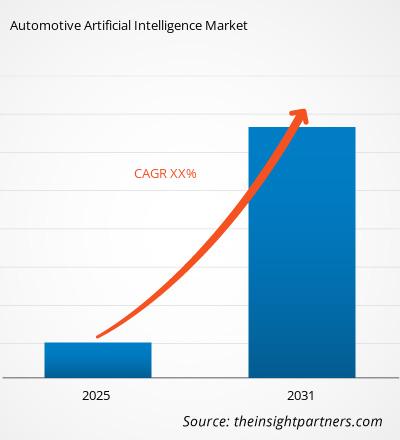
The automotive artificial intelligence market size was valued at US$ 9.21 Billion in 2025 and will reach a market value of US$ 45.44 Billion by 2034, exhibiting a CAGR of 19.4% between 2026-2034. Demand for the technology is shifting from experimentation in autonomous driving to actual production of ADAS, software defined vehicle architectures, cockpit AI applications and manufacturing intelligence.
North America continues to be an important demand hub with auto manufacturers, robotaxi companies, semiconductor companies and cloud based mobility services scaling up adoption of automotive artificial intelligence. The automotive artificial intelligence market size in North America is driven by advanced levels of ADAS implementation, a robust chip design ecosystem and autonomous public road tests. Growth in the region is forecast to be at a CAGR of 18.6–20.2% through 2034.
Automotive Artificial Intelligence Market Assessment and Insights
- North America: Held an estimated 34–37% automotive artificial intelligence market share in 2025 and is projected to grow at a CAGR of 18.6–20.2% from 2026–2034, supported by robotaxi deployment, AI chip innovation, and software-defined vehicle investments.
- US: Accounted for 78–82% of North America in 2025 and is expected to grow at a CAGR of 18.8–20.4%, led by ADAS adoption and autonomous mobility pilots.
- Europe: Represented 24–27% share in 2025 and is forecast to grow at a CAGR of 17.8–19.2%, with Germany, France, and the UK leading safety-driven AI deployment.
- Asia Pacific: Captured 29–32% share in 2025 and is expected to grow at a CAGR of 20.5–22.3%, led by China, Japan, South Korea, and India.
- Largest Segment: Software held a 56–60% market share in 2025 and is projected to grow at a CAGR of 19.8–21.5% as perception, planning, and cockpit AI stacks expand.
- High Growth Segment: Autonomous Vehicles held 24–28% share in 2025 and is expected to grow at a CAGR of 22.0–24.2% due to robotaxi, logistics, and L3/L4 programs.
- Key companies analyzed in detail: Argo AI, Automotive Artificial Intelligence GmbH, BrainChip Holdings Ltd, International Business Machines Corporation, Intel Corporation, Microsoft Corporation, NVIDIA Corporation, Intellias Ltd, Tesla Inc, Waymo LLC.
Source: The Insight Partners' analysis based on proprietary research, government publications, company annual reports, investor presentations, industry databases, and expert interviews.
The evolution of automobile intelligence has moved from individual driver-assist capabilities to an AI-based architecture that includes cameras, radars, lidars, GPUs, NPUs, domain controllers, and training models in the cloud. Automotive AI technology growth is associated with the shift from rule-based to learning-based systems that increase perception, prediction, personalization, and production efficiency. Programs for production are currently focused on validated datasets, simulation, cybersecurity, and updates via the airwaves.
According to the Automotive Artificial Intelligence Market report, the future of the industry demand will depend on the regulatory acceptance of more automation, reduced cost of AI computing, and regional investments in smart mobility infrastructure. Developing countries will adopt the technology first through the use of ADAS, fleet analytics, and manufacturing automation, whereas developed countries will concentrate on autonomous driving, intelligent cockpits, and software monetization.
Automotive Artificial Intelligence Market Report Scope
| Report Attribute | Details |
|---|---|
| Market size in 2025 | US$ 9.21 Billion |
| Market Size by 2034 | US$ 45.44 Billion |
| Global CAGR (2026 - 2034) | 19.4% |
| Historical Data | 2021-2024 |
| Forecast period | 2026-2034 |
Automotive Artificial Intelligence Market Analysis
The factors driving demand include vehicle safety regulations, increasing ADAS content per vehicle, and OEMs' competition on the software platform front. Car makers are integrating AI capabilities in perception, driver monitoring systems, predictive maintenance, battery management, and personalization cockpit. The supply chain also includes semiconductor manufacturers, simulation companies, mapping companies, cloud computing providers, and Tier-1 suppliers that facilitate conversion of sensor data into actionable intelligence.
Supply is increasingly influenced by the availability of high-performance compute and scalability of validation processes. The move towards centralized architecture cuts down hardware complexity but increases software complexity. With growing complexity of AI models, the auto makers are focusing on inference efficiency, thermal management, cybersecurity, and continuous model updates.
The automotive artificial intelligence market analysis shows intense competition between technology-first automakers, semiconductor companies, and mobility service providers. NVIDIA Corporation, Intel Corporation, Tesla Inc, Waymo LLC, International Business Machines Corporation, Microsoft Corporation, BrainChip Holdings Ltd, Intellias Ltd, Automotive Artificial Intelligence GmbH, and Argo AI represent different layers of the value chain, from compute and cloud to embedded AI and autonomous driving software.
The automotive artificial intelligence market forecasts indicate that investment is moving toward production-ready autonomy, AI-assisted manufacturing, and simulation-based validation. Partnerships between OEMs, chip vendors, and cloud providers are becoming essential because no single participant controls the entire stack. Strategic positioning increasingly depends on access to driving data, model-training capability, safety certification, and the ability to scale software features across multiple vehicle platforms.
● REPORT CUSTOMIZATION
Tailor This Report To Align With Your Specific Business Requirements
This report can be customized to align precisely with your business objectives, scope, and target markets. Customization options include tailored segmentation, geography, competitive analysis, and strategic insights to support informed decision-making.
Customize This Report →WHAT YOU CAN ADJUST
- ● Segmentations
- ● Geography
- ● Competitive Analysis
- ● Language Preferences
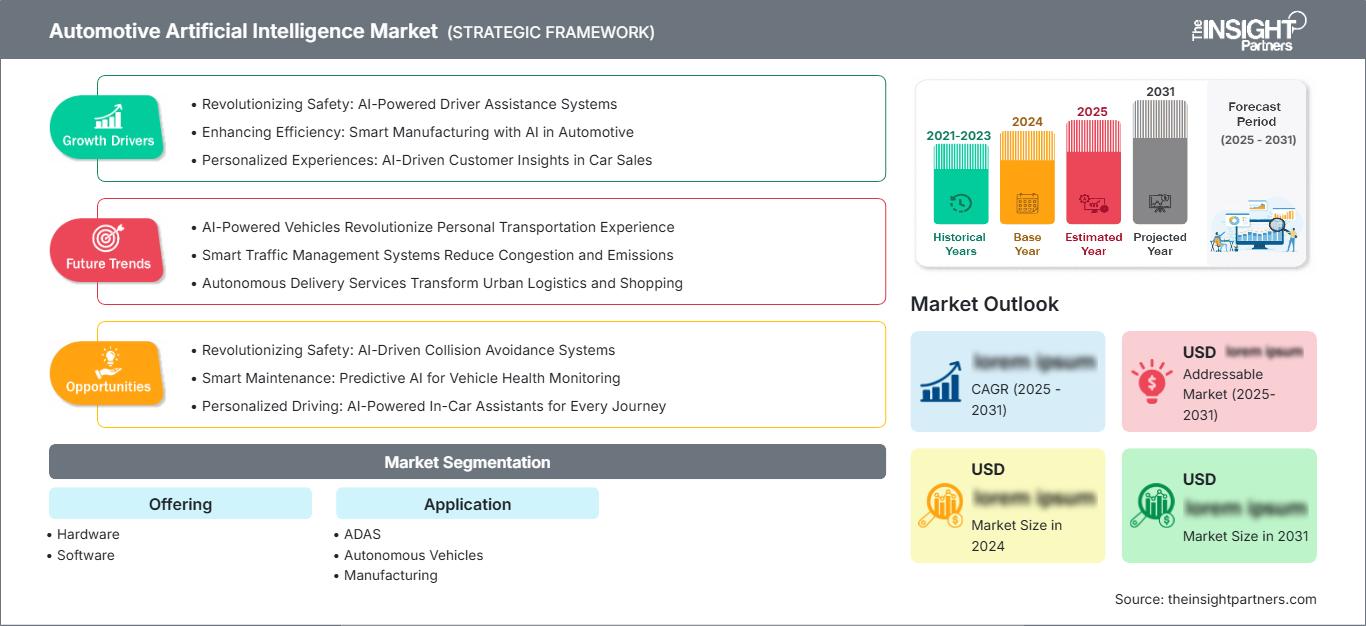
Automotive Artificial Intelligence Market: Strategic Insights
Regional Insights
North America automotive artificial intelligence market
North America accounted for a 34–37% market share of automotive artificial intelligence in 2025 backed by high penetration of ADAS, autonomous mobility trials, and semiconductor and cloud infrastructure. North America is projected to grow at a CAGR of 18.6–20.2% during 2026–2034 owing to the deployment of centralized computing, fleet learning, and cockpit intelligence systems on premium and mass-market vehicles.
The United States is the key innovation center in the region, whereas Canada is adding value through AI development, automotive software, and mobility data analysis. The demand is driven by driver assistance regulations, safe driving habits among consumers, and scale of robotaxi trials. Investments are going into perception software, simulations, data pipeline and validation environment developments.
U.S. automotive artificial intelligence Market
The US accounted for 78–82% of North America in 2025 and is projected to grow at a CAGR of 18.8–20.4%. Strong company presence across autonomous driving, AI compute, EV platforms, and cloud services makes the country central to commercialization. ADAS, supervised autonomy, and fleet intelligence are the leading application areas.
Waymo LLC, Tesla Inc, NVIDIA Corporation, Intel Corporation, International Business Machines Corporation, and Microsoft Corporation strengthen the US ecosystem through AI software, onboard compute, mapping, cloud infrastructure, and simulation. The country’s testing environment supports rapid iteration, although state-level rules, safety reporting, and liability frameworks influence deployment speed.
Europe automotive artificial intelligence Market
Europe accounted for 24–27% in 2025 and will see a CAGR growth of 17.8–19.2% from 2026 to 2034. Germany dominates due to its strong engineering capabilities in premium OEMs, application of ADAS, and ecosystem of suppliers. France, the UK, Italy, and Spain contribute in the use of AI for mobility, manufacturing, and connected cars.
The importance of safety certifications, data management, and cybersecurity may delay the deployment process but increases the level of trust in vehicle intelligence. Automakers in Europe are implementing AI technologies in their vehicles for driver monitoring, automated driving functionalities, predictive diagnostics, and factories. Regulations regarding automated driving affect L3 & L4 deployment.
APAC automotive artificial intelligence Market
APAC held a 29–32% share in 2025 and is projected to grow at a CAGR of 20.5–22.3%. China leads regional adoption through electric vehicle scale, autonomous driving pilots, and domestic AI chip initiatives. Japan and South Korea contribute advanced electronics, vehicle platforms, and robotics-led manufacturing expertise.
India and Australia add growth through connected mobility, fleet analytics, and safety feature adoption. Policy support for smart transportation, strong electronics supply chains, and rising consumer demand for intelligent vehicles position APAC as the fastest-growing regional market through 2034.
Middle East & Africa automotive artificial intelligence Market
The Middle East and Africa market is projected to grow at a CAGR of 16.2–18.0% from 2026–2034. Saudi Arabia and the UAE lead adoption through smart city mobility, autonomous shuttle pilots, and infrastructure modernization, while South Africa supports fleet telematics, safety analytics, and commercial vehicle intelligence.
Regional demand is less mature than North America, Europe, and APAC, but investment in connected roads, logistics corridors, and digital public transport creates long-term opportunity. Adoption is expected to focus first on ADAS, fleet monitoring, driver behavior analytics, and AI-based predictive maintenance.
Segmentation Analysis
Offering
Offering is expected to grow at a CAGR of 19.0–20.8% from 2026–2034 as vehicle programs require both AI-ready processors and software stacks. The automotive artificial intelligence market scope is widening from individual features to full compute platforms that support perception, planning, personalization, diagnostics, and manufacturing intelligence.
- Hardware remains essential for sensor processing, onboard inference, and real-time decision-making, with demand centered on GPUs, NPUs, memory, domain controllers, and automotive-grade embedded systems.
- Software leads revenue contribution as perception models, middleware, cockpit AI, validation tools, mapping, simulation, and lifecycle updates become central to vehicle differentiation.
Application
Application is forecast to grow at a CAGR of 19.5–21.4% from 2026–2034 as AI moves across safety, autonomy, and production environments. ADAS remains the largest near-term use case, while autonomous driving and manufacturing intelligence create higher-value opportunities for model training, data management, and operational optimization.
- ADAS benefits from regulatory safety pressure and consumer demand for lane assistance, emergency braking, adaptive cruise control, driver monitoring, and parking automation.
- Autonomous Vehicles represent the fastest-growing application due to robotaxi programs, logistics pilots, simulation-led validation, and higher automation stacks requiring perception, prediction, and planning AI.
- Manufacturing uses AI for defect detection, predictive maintenance, robotics optimization, digital twins, and supply chain visibility, helping automakers improve quality and throughput.
Opportunity Snapshot
| Application | Revenue Contribution | Trend Tag | Adoption Stage |
| ADAS | High | Safety AI | Mature |
| Autonomous Vehicles | Medium | Robotaxi Scale | Scaling |
| Manufacturing | Medium | Smart Factory | Scaling |
Automotive Artificial Intelligence Market Growth Drivers and Impact Analysis
ADAS Standardization Across Vehicle Classes
ADAS systems are becoming essential rather than premium features, since the priority lies with avoiding crashes and monitoring the driver. Artificial intelligence is making it possible to detect objects and understand lanes, as well as pedestrians, and make decisions based on the current driving conditions. This particular driver creates a wider scope of demand due to the inclusion of features in entry-level and mid-sized cars which were previously exclusive to premium segments. In terms of volume production, vendors get to leverage their software modules and reduce per-unit cost.
Shift Toward Software-Defined Vehicles
The rise in demand for software-defined vehicle architecture means there is more need for central computing, OTA updates, and AI features that enhance after the sale process. The automakers are restructuring their electricity and electronics to have less fragmentation and better computing capacity. AI becomes critical in this transition because it is the engine of perception, cockpit personalization, predictive maintenance, and fleet learning. However, the effects are felt even beyond car sales because it allows subscription-based services and after-sale updates and services. The firms with good middleware, cloud connectivity, cybersecurity, and model lifecycle management are poised to benefit from these recurring revenues.
Autonomous Mobility Commercialization
Robotaxis, delivery vehicles, and highway automation systems are generating a need for AI technologies that are capable of perceiving, reasoning, and acting in an environment in a safe way. The commercialization of such a product involves the use of large training datasets, simulation platforms, redundancy of sensors, and validation processes. The market significance of such a driver is high since autonomous systems require costly computing, software, mapping, and safety engineering services. However, while deployment is still limited geographically, successful pilot projects boost investor confidence and speed up cooperation among OEMs, technology companies, and fleets.
Automotive Artificial Intelligence Market Future Trends
Reasoning-Based Vehicle AI
automotive artificial intelligence market trends are moving toward reasoning-based models that can interpret rare driving scenarios, explain decisions, and improve safety validation. These systems combine vision, language, action modeling, simulation, and sensor fusion to address long-tail edge cases. As vehicles adopt larger AI models, suppliers will focus on efficient inference, explainability, and testing frameworks that satisfy regulators. The trend will influence autonomous vehicles first, then expand into ADAS, cockpit assistants, and service diagnostics as automakers seek systems that are more adaptive than rule-based software.
AI-Enabled Smart Manufacturing
AI adoption in automotive plants will accelerate as manufacturers pursue higher quality, flexible production, and lower downtime. Computer vision inspection, predictive maintenance, robotic path optimization, and digital twins will support faster model launches and more complex vehicle configurations. This trend is especially relevant for electric and software-defined vehicles, where electronics quality and traceability are critical. Over time, factory AI will connect with vehicle lifecycle data, helping OEMs improve design, warranty management, and supplier performance through closed-loop intelligence.
Automotive Artificial Intelligence Market Opportunities
Validation Platforms for Scalable Autonomy
Autonomous driving requires proof that AI systems can operate safely across rare, unpredictable, and region-specific scenarios. This creates opportunity for simulation providers, synthetic data companies, cloud platforms, and verification specialists. Automakers and mobility operators need tools that reduce physical testing cost while improving confidence in edge-case handling. Vendors that offer auditable validation workflows, scenario libraries, and regulatory documentation can become strategic partners. The opportunity is particularly attractive because validation remains a persistent requirement throughout software updates, new vehicle launches, and geographic expansion.
AI Cockpit and Driver Personalization
Intelligent cockpit systems create opportunity beyond safety and autonomy by improving user experience, voice interaction, navigation, comfort, and in-vehicle commerce. Natural language interfaces, driver monitoring, recommendation engines, and context-aware personalization can help OEMs differentiate vehicles while building recurring digital revenue. The opportunity is strongest where automakers integrate AI with infotainment, telematics, and connected services. Suppliers that combine privacy-aware data processing, low-latency inference, and multilingual interaction capabilities can address global platforms across premium and mass-market vehicle segments.
Frequently Asked Questions

- Comprehensive Market Sizing and Forecast Analysis
- Detailed Segmentation Analysis
- In-Depth Market Dynamics Assessment
- Regional and Country-Level Insights
- Competitive Landscape and Company Benchmarking
- Strategic Business Intelligence
Recent Reports
Testimonials

The Insight Partners' SCADA System Market report is comprehensive, with valuable insights on current trends and future forecasts. The team was highly professional, responsive, and supportive throughout. We are very satisfied and highly recommend their services.
RAN KEDEM Partner, Reali Technologies LTDs
I requested a report on a very specific software market and the team produced the report in a few days. The information was very relevant and well presented. I then requested some changes and additions to the report. The team was again very responsive and I got the final report in less than a week.
JEAN-HERVE JENN Chairman, Future Analytica
We worked with The Insight Partners for an important market study and forecast. They gave us clear insights into opportunities and risks, which helped shape our plans. Their research was easy to use and based on solid data. It helped us make smart, confident decisions. We highly recommend them.
PIYUSH NAGPAL Sr. Vice President, High Beam Global
The Insight Partners delivered insightful, well-structured market research with strong domain expertise. Their team was professional and responsive throughout. The user-friendly website made accessing industry reports seamless. We highly recommend them for reliable, high-quality research services
YUKIHIKO ADACHI CEO, Deep Blue, LLC.
This is the first time I have purchased a market report from The Insight Partners.While I was unsure at first, I visited their web site and felt more comfortable to take the risk and purchase a market report.I am completely satisfied with the quality of the report and customer service. I had several questions and comments with the initial report, but after a couple of dialogs over email with their analyst I believe I have a report that I can use as input to our strategic planning process.Thank you so much for taking the extra time and making this a positive experience.I will definitely recommend your service to others and you will be my first call when we need further market data.
JOHN SUZUKI President and Chief Executive Officer, Board Director, BK Technologies
I wish to appreciate your support and the professionalism you displayed in the course of attending to my request for information regarding to infectious disease IVD market in Nigeria. I appreciate your patience, your guidance, and the fact that you were willing to offer a discount, which eventually made it possible for us to close a deal. I look forward to engaging The Insight Partners in the future, all thanks to the impression you have created in me as a result of this first encounter.
DR CHIJIOKE ONYIA MANAGING DIRECTOR, PineCrest Healthcare Ltd.Reason to Buy
- Informed Decision-Making
- Understanding Market Dynamics
- Competitive Analysis
- Identifying Emerging Markets
- Customer Insights
- Market Forecasts
- Risk Mitigation
- Boosting Operational Efficiency
- Strategic Planning
- Investment Justification
- Tracking Industry Innovations
- Aligning with Regulatory Trends





 Get Free Sample for