
Automotive Biometrics Market Size, Trends & Demand by 2034
Coverage: By Authentication Type (Fingerprint, Voice, IRIS, Others); Vehicle Type (Passenger Vehicles, Commercial Vehicles); Application (Vehicle Security System, Driver Safety System, Infotainment, Others), and Geography
- Status : Data Released
- Report Code : TIPTE100000669
- Category : Electronics and Semiconductor
- No. of Pages : 150
- Available Report Formats :


- Last update date : July 17, 2026


2025 Market Size
US$ 1.72 Bn
Base year value
2034 Forecast
US$ 6.56 Bn
Projected by 2034
CAGR 2026-2034
16.02 %
Growth rate
Addressable Market
US$ 34.99 Bn
(2026-2034)
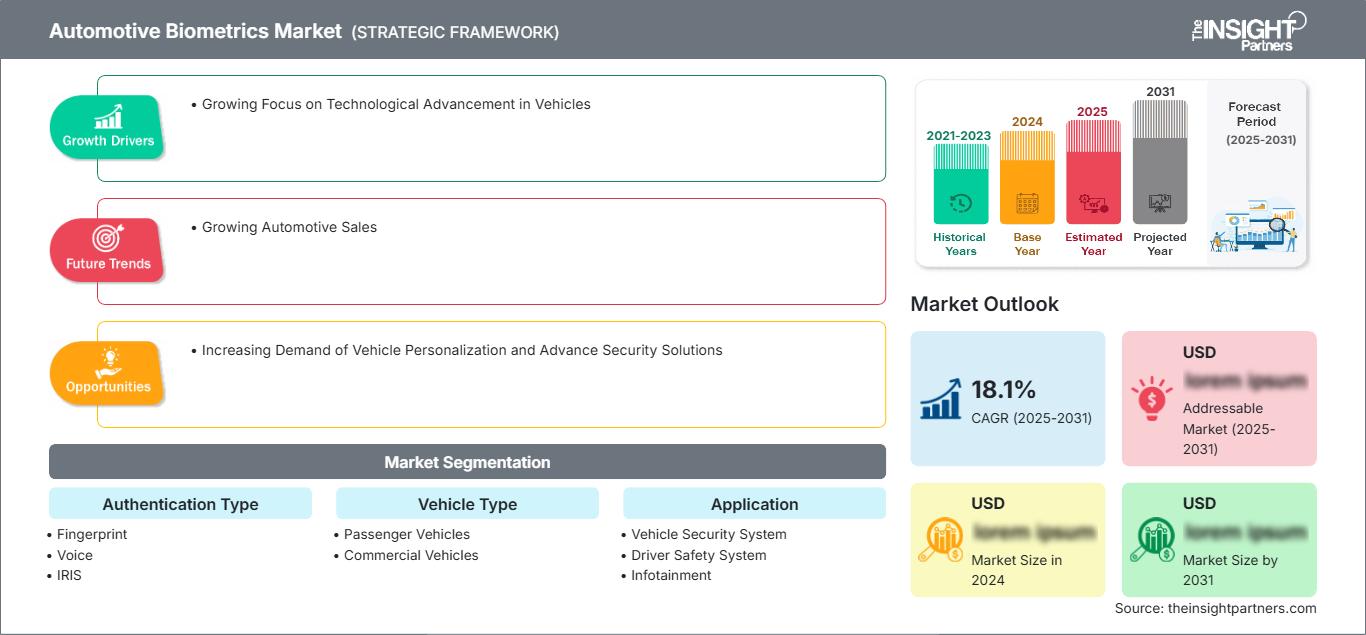
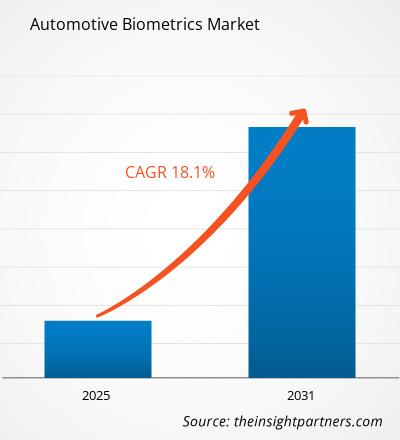
The Automotive Biometric Market size was worth US$ 1.72 billion in 2025 and is projected to reach US$ 6.56 billion by 2034. It is estimated to grow at a CAGR of 16.02% during 2026-2034 due to the widespread use of biometric technologies such as fingerprinting, voice, iris, and multimodal identity technologies in automotive security, safety, infotainment, and cockpit personalization applications.
In North America, the market is shifting from pilot projects in premium vehicles to full-scale factory-fitted solutions due to increased demands for secure identities with the arrival of connected cars. The North American market is forecasted to register growth at a 14.5-16.5% CAGR during 2026-2034 driven by cybersecurity regulations, increased investments in software-defined vehicles, and driver monitoring needs.
Automotive Biometrics Market Assessment and Insights
- North America: North America held a 27–31% share in 2025 and is growing at a 14.5–16.5% CAGR between 2026–2034, led by connected-car security, premium cabin personalization, and fleet safety adoption.
- US: The US represented 76–80% of North America in 2025 and is growing at a 14.0–16.0% CAGR between 2026–2034, supported by OEM software programs and supplier presence.
- Europe: Europe accounted for a 23–27% share in 2025 and is growing at a 13.5–15.5% CAGR between 2026–2034, with Germany, France, the UK, Italy, and Spain leading safety-led deployment.
- Asia Pacific: Asia Pacific held a 34–38% share in 2025 and is growing at a 17.0–19.5% CAGR between 2026–2034, driven by China, Japan, South Korea, India, and Australia.
- Largest Segment: Fingerprint led with a 38–42% market share in 2025 and a 14.0–16.0% CAGR between 2026–2034 because sensor cost, reliability, and access use cases remain favorable.
- High Growth Segment: IRIS held a 10–14% market share in 2025 and is growing at an 18.5–21.0% CAGR between 2026–2034 as higher-security cabin and fleet applications expand.
- Key companies analyzed in detail: Fingerprint Cards AB, Fujitsu Limited, HID Global Corporation, ASSA ABLOY AB, Hitachi, Ltd., IDEMIA Group, Methode Electronics, Inc., Nuance Communications, Inc., Safran S.A., Synaptics Incorporated, and Continental AG.
Source: The Insight Partners' analysis based on proprietary research, government publications, company annual reports, investor presentations, industry databases, and expert interviews.
Automotive identity solutions have developed from standalone access control functionalities into integrated software solutions that provide driver authentication, personalized cabin configurations, and safety monitoring. The manufacturing environment is changing with camera, microphone, fingerprint sensors, and IRIS sensor manufacturers qualifying their products for automotive environmental conditions as well as cybersecurity standards. Quality of integration between hardware and software becomes increasingly important for the Automotive Biometric Market.
Future development will be driven by Asian mass production of components, software-defined cars in North America, and increased safety regulations in Europe. Cybersecurity regulations set by UNECE, attention to driver monitoring by Euro NCAP and high penetration rates of connected cars will increase the demand for trusted in-cabin identity. Component suppliers who can prove low false rejection rate and low costs of integration into mid-level cars should prosper.
Automotive Biometrics Market Report Scope
| Report Attribute | Details |
|---|---|
| Market size in 2025 | US$ 1.72 Billion |
| Market Size by 2034 | US$ 6.56 Billion |
| Global CAGR (2026 - 2034) | 16.02% |
| Historical Data | 2021-2024 |
| Forecast period | 2026-2034 |
Automotive Biometrics Market Analysis
The Automotive Biometrics Market will grow due to the desire to limit access, enhance personalization of digital services, and validate the fitness of the driver within connected cars. The passenger vehicles market will be the biggest contributor to volume in the near future since the end-users demand smartphone-type experience, whereas the commercial segment requires identity-based access, accountability of the driver, and vehicle usage control.
The supply chain includes biometric algorithms, sensors, microcontrollers, secure elements, cockpit electronics, human machine interface, and cloud identity services. Supply conditions are getting better due to adoption of mobile device sensors and speech engines from AI companies, but there are still issues with privacy compliance, validation against anti-spoofing techniques, different lighting conditions, ambient noises, and reliability under different glasses and accents.
Analysis of Automotive Biometric Market shows a competitive environment dominated by players involved in components, identity platform, and tier-one integrator services. Fingerprint Cards AB and Synaptics Incorporated enhance fingerprint and touch interface, while Fujitsu Limited, Hitachi, Ltd., IDEMIA Group, Safran S.A., and HID Global Corporation provide experience in identity, security, and authentication. Methode Electronics, Inc. and Continental AG help with integrating solutions into car electronics and interiors.
Money is being invested in development of multimodal authentication, liveness detection, on-device processing, and secure enrollment workflows. Nuance Communications, Inc. is still relevant due to its work in automotive voice biometrics and conversational interfaces. Positioning of companies becomes more strategic due to the need for cooperation with original equipment manufacturers, cockpit domain controllers providers, and cybersecurity teams since biometric processes will run within the regulated software-based car architecture.
● REPORT CUSTOMIZATION
Tailor This Report To Align With Your Specific Business Requirements
This report can be customized to align precisely with your business objectives, scope, and target markets. Customization options include tailored segmentation, geography, competitive analysis, and strategic insights to support informed decision-making.
Customize This Report →WHAT YOU CAN ADJUST
- ● Segmentations
- ● Geography
- ● Competitive Analysis
- ● Language Preferences
Automotive Biometrics Market: Strategic Insights
Regional Insights
North America Automotive Biometric Market
North America accounted for a 27–31% share in 2025 and is expected to grow at a 14.5–16.5% CAGR during 2026–2034. The Automotive Biometric Market share in the region is supported by connected-car cybersecurity programs, luxury vehicle demand, and early adoption of driver monitoring linked to advanced driver-assistance systems. Automakers are evaluating biometric authentication to secure digital keys, infotainment profiles, and subscription services.
Regional deployments are strongest in premium passenger vehicles, electric vehicles, and fleet platforms that need identity-based access control. The US Department of Transportation’s emphasis on safer road systems and rising insurer interest in driver behavior data reinforce safety-oriented use cases. Canadian and Mexican vehicle production also supports supplier integration opportunities for sensors, cockpit electronics, and software validation.
U.S. Automotive Biometric Market
The US accounted for 76–80% of North America in 2025 and grows at a 14.0–16.0% CAGR from 2026 to 2034. The market will be driven by significant OEM software solutions, connectivity services, shared vehicle technology, and consumers' familiarity with biometrics in mobile devices. Security systems will continue to lead as the primary commercial application, followed by driver safety systems and infotainment personalization.
The company's presence is widespread in identity software, electronics, and cockpit interface. Synaptics Incorporated, HID Global Corporation, Methode Electronics, Inc., Nuance Communications, Inc., and Continental AG drive adoption through the use of sensors, authentication, voice interface, and automotive electronics. Application trends include secured access, driver profile identification, handsfree voice commands, and fleet management restrictions on unauthorized usage of vehicles.
Europe Automotive Biometric Market
In 2025, Europe’s market share stood at 23–27%, and it is projected that its growth rate will be at a 13.5-15.5% CAGR between 2026 and 2034. Germany is the dominant country in Europe due to the presence of high-end OEMs, a sophisticated supplier ecosystem, and safety engineering initiatives driving initial uptake of fingerprint recognition, voice and camera-driven biometric identification.
In the UK, there is software and insurance, as well as fleet-security trials, and in France, biometrics is associated with digital identity and connected mobility initiatives. Italy and Spain are increasing adoption through commercial vehicle fleets, aftermarket security products, and connected cars. The European consumers need transparent consent, local data processing, and adherence to GDPR before full-scale deployment.
APAC Automotive Biometric Market
In 2025, APAC was responsible for 34-38% and expected to grow with a 17.0-19.5% CAGR from 2026 to 2034. China dominates the region’s volume through electric cars, cockpit connectivity, and fast adoption of features, with Japan and South Korea adding high-end electronics, sensors, and software. India contributes to the scale because of growing number of connected passenger cars and fleet automation.
Australia contributes to mining, logistics, and commercial application with an emphasis on safety. Government policies promote electronics manufacturing, 5G, and intelligent vehicles, which improves local ecosystem. APAC is also driven by acceptance of biometrics such as face, fingerprint, and voice for payment through mobile devices.
Middle East & Africa Automotive Biometric Market
Growth rates for the Middle East & Africa are projected to be at 12.5–15.0% CAGR in 2026-2034. In the region, Saudi Arabia leads market demand, driven by connected-vehicle security for smart-city mobility, premium cars, and fleet renewal. UAE provides luxury mobility and digital ID readiness along with logistics application, while South Africa brings interest for vehicle security and vehicle insurance.
Fleets of energy providers, governmental entities, and infrastructures can utilize biometric access to limit vehicle access and enhance driver responsibility. The adoption varies due to differences in fleet compositions, retrofit cost effectiveness, and maturity in data management. Companies that provide access solutions combined with fleet management and services are likely to gain market traction.
Segmentation Analysis
Authentication Type
The Authentication Type segment is forecast to grow at a 15.0–17.5% CAGR during 2026–2034. Automotive Biometric Market scope across this segment is widening as OEMs combine fingerprint, voice, IRIS, and multimodal authentication to balance security, convenience, and operating conditions. The segment’s outlook depends on sensor reliability, enrollment simplicity, anti-spoofing, and privacy safeguards.
- Fingerprint: Fingerprint remains the leading modality because it offers familiar use, compact hardware, and strong suitability for door handles, start buttons, infotainment profiles, and secure driver authorization.
- Voice: Voice authentication supports hands-free identification and personalization, especially where drivers interact with infotainment, navigation, climate, and digital assistant functions in noisy cabin environments.
- IRIS: IRIS authentication is strategically important for premium and fleet vehicles requiring high-security recognition, low contact, and reliable identity confirmation under supervised cabin camera conditions.
Vehicle Type
The Vehicle Type segment is projected to grow at a 14.5–17.0% CAGR during 2026–2034 as passenger vehicles create scale and commercial vehicles add operational value. Passenger vehicles adopt biometrics for comfort, theft prevention, and personalization, while fleets use identity-based access to manage driver assignment, liability, cargo security, and compliance.
- Passenger Vehicles: Passenger vehicles dominate demand because OEMs can package biometric access, driver profiles, infotainment settings, and safety monitoring into connected cockpit experiences for premium and mid-range buyers.
- Commercial Vehicles: Commercial vehicles show rising strategic importance as logistics, rental, construction, and public-service fleets seek authorized access, driver accountability, fatigue alerts, and asset protection.
Application
The Application segment is expected to grow at a 15.5–18.0% CAGR during 2026–2034. Vehicle security systems lead revenue because keyless entry and ignition require trusted authentication, while driver safety systems are gaining weight as regulations and fleet operators focus on fatigue, distraction, and occupancy awareness.
- Vehicle Security System: Vehicle security systems hold the strongest position because biometric access, immobilization, and driver authorization directly address theft risk, shared-use control, and digital-key vulnerability.
- Driver Safety System: Driver safety systems are gaining importance as biometric cues, gaze tracking, voice state, and physiological signals help identify fatigue, distraction, or medical risk during operation.
- Infotainment: Infotainment uses biometrics to load profiles, media preferences, navigation history, payment authorization, and voice settings, making the cockpit more personalized without compromising access control.
Opportunity Snapshot
| Application | Revenue Contribution | Trend Tag | Adoption Stage |
| Vehicle Security System | High | Secure Access | Scaling |
| Driver Safety System | Medium | Fatigue Sensing | Scaling |
| Infotainment | Medium | Profile Sync | Emerging |
| Others | Low | Fleet Rules | Emerging |
Automotive Biometrics Market Growth Drivers and Impact Analysis
Connected Vehicles Need Stronger Identity Assurance
With the shift toward making cars software-defined products, the identity verification is expanding from door locks and keyless ignitions. Digital keys, in-car payments, subscriptions, and mobility will all need to verify the car's user identity. Biometrics can help minimize the use of transferable tokens and password authentication while providing individual profile access to safety and performance parameters. The business value for the OEM becomes more pronounced if they generate money through the connected features as the driver identity can facilitate the activation of such features and secure payments.
Driver Monitoring Expands from Compliance to Value Creation
Driver monitoring is no longer just a safety feature; it has become a broader value proposition for insurers, fleets, and driver assistance systems. Biometrics can aid in detecting driver fatigue, identifying distractions, signaling preparedness for driver changeovers, and activating emergency responses. In commercial fleets, where monitoring would be tied to identity, there would be greater accountability and less abuse of vehicles in sectors such as logistics, construction, and public services. This will affect even the vehicle design because biometrics cameras and microphones will be incorporated in cockpit domain controllers.
Lower Sensor Costs Improve Mid-Range Vehicle Feasibility
Automotive biometrics were initially associated with luxury models because sensor cost, environmental validation, and integration work limited scale. Cost curves are improving as fingerprint modules, microphones, cameras, secure chips, and AI accelerators benefit from consumer electronics volumes. This allows OEMs to consider biometric features in mid-range passenger vehicles and light commercial platforms. The market impact is a larger addressable base, but also stronger price pressure on suppliers. Companies that can provide automotive-grade modules, software updates, and simple integration toolkits will be better placed than firms offering premium-only custom solutions.
Automotive Biometrics Market Future Trends
Multimodal Authentication Becomes the Standard Architecture
Automotive Biometric Market trends are moving toward multimodal systems that combine fingerprint, voice, IRIS, face, and behavioral cues to improve confidence under real driving conditions. A single modality can be affected by gloves, lighting, noise, or user posture, while layered authentication can adjust security thresholds dynamically. Future systems are likely to authenticate before entry, revalidate during driving, and personalize digital services continuously. This direction favors suppliers that can fuse signals locally, minimize biometric data exposure, and provide flexible policies for private owners, families, fleets, and shared vehicles.
Biometrics Integrate with Software-Defined Cockpits
Next-generation cockpits will treat biometric identity as an input layer for displays, driver assistance, payments, climate, media, and navigation. Instead of separate access features, OEMs will connect authentication to cloud profiles and vehicle operating systems. Over-the-air updates will improve algorithms and add use cases after sale, making lifecycle management essential. This trend increases demand for cybersecurity certification, consent dashboards, and explainable user controls. Suppliers that work with cockpit-domain controllers and digital experience teams can capture higher value than standalone hardware vendors.
Automotive Biometrics Market Opportunities
Fleet Security and Usage Governance Platforms
Automotive Biometric Market Forecasts point to attractive opportunities in commercial fleets where unauthorized access, driver substitution, cargo theft, and compliance gaps create measurable costs. Providers can package biometric vehicle access with fleet software, telematics, and driver logs to support logistics, rental, municipal, mining, and construction operators. The strongest models will combine hardware authentication, cloud policy management, audit trails, and mobile enrollment. Partnerships with fleet management vendors and insurers can shorten sales cycles because the value proposition links security to asset utilization, claims control, and operational accountability.
Privacy-Preserving In-Cabin Personalization
Personalization creates opportunity when it is delivered without undermining user trust. OEMs can use biometric identity to load seats, mirrors, climate, infotainment, and navigation preferences while processing templates locally and giving drivers clear consent controls. This approach is relevant for family vehicles, shared mobility, premium cars, and subscription services. Suppliers should invest in edge processing, encrypted template storage, opt-in workflows, and transparent deletion options. The commercial upside is higher customer satisfaction, stronger connected-service adoption, and differentiated cockpit experiences that do not rely only on screen size or entertainment content.
Recent Developments
- March 2026: Smart Eye AB and Fingerprint Cards AB (announced a new multi-modal biometric authentication capability that combines Smart Eye’s facial authentication with FPC’s iris recognition technology. By verifying identity using two independent biometric signals captured by the same camera, the functionality significantly strengthens authentication while maintaining a natural and seamless user experience.
- March 2025: IDEMIA Secure Transactions, and Infineon Technologies AG announced a first-of-its-kind strategic partnership to tackle the challenges of the new era of car access. This partnership represents a key milestone in the advancement of Software-Defined Vehicles (SDVs).
- December 2025: trinamiX annpunced launch of in-car biometric tech at CES 2026. Paired with trinamiX’s proprietary software and a near-infrared camera, the system delivers secure face authentication, remote vital signs tracking, 3D distance mapping for optimized airbag deployment, and advanced seatbelt recognition — all from a single sensor.
Frequently Asked Questions

- Comprehensive Market Sizing and Forecast Analysis
- Detailed Segmentation Analysis
- In-Depth Market Dynamics Assessment
- Regional and Country-Level Insights
- Competitive Landscape and Company Benchmarking
- Strategic Business Intelligence
Recent Reports
Testimonials

The Insight Partners provided valuable market intelligence that supported our global go-to-market strategy. Their team was professional, responsive, and attentive to our feedback, providing thoughtful analysis and helpful methodological clarifications throughout the project.
Junmo Kim Chief Financial Officer (CFO), Enertech Co., Ltd.
The Insight Partners' SCADA System Market report is comprehensive, with valuable insights on current trends and future forecasts. The team was highly professional, responsive, and supportive throughout. We are very satisfied and highly recommend their services.
RAN KEDEM Partner, Reali Technologies LTDs
I requested a report on a very specific software market and the team produced the report in a few days. The information was very relevant and well presented. I then requested some changes and additions to the report. The team was again very responsive and I got the final report in less than a week.
JEAN-HERVE JENN Chairman, Future Analytica
We worked with The Insight Partners for an important market study and forecast. They gave us clear insights into opportunities and risks, which helped shape our plans. Their research was easy to use and based on solid data. It helped us make smart, confident decisions. We highly recommend them.
PIYUSH NAGPAL Sr. Vice President, High Beam Global
The Insight Partners delivered insightful, well-structured market research with strong domain expertise. Their team was professional and responsive throughout. The user-friendly website made accessing industry reports seamless. We highly recommend them for reliable, high-quality research services
YUKIHIKO ADACHI CEO, Deep Blue, LLC.
This is the first time I have purchased a market report from The Insight Partners.While I was unsure at first, I visited their web site and felt more comfortable to take the risk and purchase a market report.I am completely satisfied with the quality of the report and customer service. I had several questions and comments with the initial report, but after a couple of dialogs over email with their analyst I believe I have a report that I can use as input to our strategic planning process.Thank you so much for taking the extra time and making this a positive experience.I will definitely recommend your service to others and you will be my first call when we need further market data.
JOHN SUZUKI President and Chief Executive Officer, Board Director, BK Technologies
I wish to appreciate your support and the professionalism you displayed in the course of attending to my request for information regarding to infectious disease IVD market in Nigeria. I appreciate your patience, your guidance, and the fact that you were willing to offer a discount, which eventually made it possible for us to close a deal. I look forward to engaging The Insight Partners in the future, all thanks to the impression you have created in me as a result of this first encounter.
DR CHIJIOKE ONYIA MANAGING DIRECTOR, PineCrest Healthcare Ltd.Reason to Buy
- Informed Decision-Making
- Understanding Market Dynamics
- Competitive Analysis
- Identifying Emerging Markets
- Customer Insights
- Market Forecasts
- Risk Mitigation
- Boosting Operational Efficiency
- Strategic Planning
- Investment Justification
- Tracking Industry Innovations
- Aligning with Regulatory Trends





 Get Free Sample for