
Automotive Chip Market Size, Share & Trends by 2034
Coverage: By Product (Logic ICs, Analog ICs, Microcontrollers and Microprocessors, Memory); Vehicle Type (Passenger Cars, Commercial Vehicles); Application (Chassis, Powertrain, Safety System, Body Electronics, Telematics and Infotainment) , and Geography (North America, Europe, Asia Pacific, and South and Central America)
- Status : Data Released
- Report Code : TIPRE00008368
- Category : Electronics and Semiconductor
- No. of Pages : 150
- Available Report Formats :


- Last update date : July 17, 2026


2025 Market Size
US$ 51.89 Bn
Base year value
2034 Forecast
US$ 134.77 Bn
Projected by 2034
CAGR 2026-2034
11.19 %
Growth rate
Addressable Market
US$ 823.79 Bn
(2026-2034)
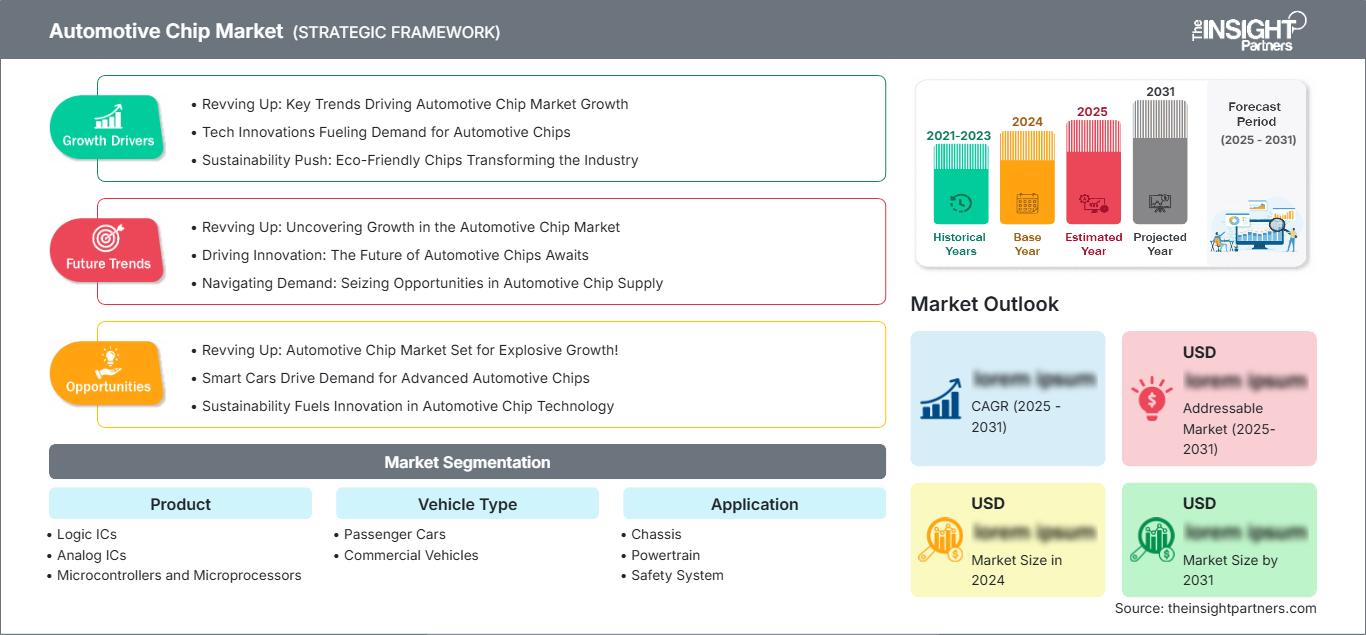
The automotive chip market size was US$ 51.89 Billion in 2025 and will likely be US$ 134.77 Billion by 2034 with a CAGR of 11.19% from 2026 to 2034, primarily based on factors such as electrification, advanced driver assistance, digital cockpit, zonal architecture, connected mobility, and greater usage of semiconductors in both passenger and commercial vehicles.
In the North American region, the size of the automotive chip industry is backed by efforts for software-defined vehicle programs, increased domestic capabilities for semiconductors, and more rapid adoption of electric powertrains. It is forecasted that the North American region will grow with a CAGR of 10.0% – 11.0% in the period of 2026 – 2034.
Automotive Chip Market Assessment and Insights
- North America held 24%–28% automotive chip market share in 2025 and is expected to grow at a CAGR of 10.0%–11.0% between 2026–2034, supported by EV platforms, ADAS, and local chip policy.
- US represented 78%–83% of North America in 2025 and is projected to grow at a CAGR of 10.1%–11.1% between 2026–2034.
- Europe accounted for 22%–26% share in 2025 and is forecast to grow at a CAGR of 9.8%–10.8% between 2026–2034, led by Germany, France, the UK, Italy, and Spain.
- Asia Pacific held 42%–46% share in 2025 and is projected to grow at a CAGR of 11.8%–12.8% between 2026–2034, supported by China, Japan, South Korea, India, and Australia.
- Largest Segment Microcontrollers and Microprocessors held a market share of 31%–35% in 2025, with CAGR range of 10.6%–11.6% between 2026–2034.
- High Growth Segment Safety System held a market share of 18%–22% in 2025, with CAGR range of 12.4%–13.4% between 2026–2034.
- Key companies analyzed in detail: Infineon Technologies AG, Analog Devices, Inc., Microchip Technology Inc., NVIDIA Corporation, NXP Semiconductors N.V., ROHM Co., Ltd., Renesas Electronics Corporation, Robert Bosch GmbH, STMicroelectronics N.V., and Texas Instruments Incorporated.
Source: The Insight Partners' analysis based on proprietary research, government publications, company annual reports, investor presentations, industry databases, and expert interviews.
From a distributed control unit structure, automotive electronics have moved to a domain and zonal computing framework, thus making the demand for automotive-grade logic, analog, memory, and microcontrollers even greater. In automotive planning and production, one has to take care of the foundry capacity planning, automotive qualification, longevity of sources, and software tools chain. Additionally, the automotive chip industry must also cater to automotive manufacturers requiring a direct relationship with the suppliers because of semiconductor shortage experiences in the past.
Future growth will mainly depend on sectors where the penetration of electric cars, regulations around safety, and connected cockpit solutions intersect. The manufacturing economy in Asia Pacific, electrification regulations in Europe, and localization benefits in North America will guarantee continued investments. High silicon value per car may allow the automotive chip industry to make the most out of it. Still, capacity management, automotive qualification, security, and costs must be sorted.
Automotive Chip Market Report Scope
| Report Attribute | Details |
|---|---|
| Market size in 2025 | US$ 51.89 Billion |
| Market Size by 2034 | US$ 134.77 Billion |
| Global CAGR (2026 - 2034) | 11.19% |
| Historical Data | 2021-2024 |
| Forecast period | 2026-2034 |
Automotive Chip Market Analysis
Demand is supported by electrified powertrains, increased ADAS features, digital dashboards, battery management, and secure connectivity. Growth in the automotive semiconductor market is directly tied to the transition from simple control units to powerful computing, radar processing, inverter control, and OTS architecture. Every new vehicle program needs chips that are designed with automotive quality, thermal requirements, safety, and lifecycle in mind.
Supply chain participants include wafer foundry operators, outsourced assembly and test services, integrated device manufacturers, Tier 1 module makers, software tools vendors, and OEMs. The supply side will reward companies with qualified nodes, excellent packaging, secure design flow, and long-term contracts with customers. With vehicles being produced for years at a time, consistency and control of change may be as valuable as semiconductor performance.
Competitive positioning is dominated by suppliers with extensive automotive offerings and substantial OEM qualification experience. These include Infineon Technologies AG, NXP Semiconductors N.V., STMicroelectronics N.V., Renesas Electronics Corporation, Texas Instruments Incorporated, Analog Devices, Inc., Microchip Technology Inc., NVIDIA Corporation, ROHM Co., Ltd., and Robert Bosch GmbH who compete using MCUs, analog semiconductors, power semiconductors, memory interface solutions, and compute systems.
Key investment themes focus on software-defined vehicle networking technology, silicon carbide-based power modules, radar and vision processing, automotive Ethernet, and microcontroller families. The automotive chip market analysis is increasingly focused on evaluating the supplier’s sustainability, manufacturing footprint geographically, and ability to deliver solutions for centralized computing. Positioning requires managing the balance between cutting-edge node compute for ADAS and mature nodes for analog, power, and body electronics.
● REPORT CUSTOMIZATION
Tailor This Report To Align With Your Specific Business Requirements
This report can be customized to align precisely with your business objectives, scope, and target markets. Customization options include tailored segmentation, geography, competitive analysis, and strategic insights to support informed decision-making.
Customize This Report →WHAT YOU CAN ADJUST
- ● Segmentations
- ● Geography
- ● Competitive Analysis
- ● Language Preferences
Automotive Chip Market: Strategic Insights
Regional Insights
North America automotive chip market
North America's share was 24%-28% in 2025 and is forecast to expand by 10.0%-11.0% from 2026 to 2034. The market share of automotive semiconductors is influenced by the USA's leadership in advanced compute, analog design, memory infrastructure, and automotive platforms. Demand is strengthened by electric trucks, commercial fleet telematics, battery management, and Level 2+ driving assistance capabilities.
Regional consumers prefer security of supply, engineering support in their country, and adherence to cybersecurity guidelines for connected vehicles. Some vendors offering solutions for such applications include NVIDIA Corporation, Texas Instruments Incorporated, Analog Devices, Inc., Microchip Technology Inc., and NXP Semiconductors N.V. More and more original equipment manufacturers are demanding allocation visibility for several years since electronic content per car grows faster than cars themselves.
U.S. automotive chip Market
The U.S. accounted for 78%-83% of North America market in 2025 and is forecasted to grow by 10.1%-11.1%. The application categories include ADAS processors, automotive Ethernet, battery sensing, infotainment SoCs, and PMICs. The importance of semiconductor technology design capabilities and vehicle software development makes the country key for future electronic architecture.
Presence of the companies is significant, including NVIDIA Corporation, which provides automotive artificial intelligence platforms, Texas Instruments Incorporated and Analog Devices, Inc., providing analog and power semiconductor devices, and Microchip Technology Inc., delivering MCUs and connectivity products. Car manufacturers are involved in dealing with semiconductors directly in order to guarantee the supply chain, safety, and software requirements of vehicles.
Europe automotive chip Market
Europe has 22% to 26% market share in 2025 and is forecasted to grow at 9.8% to 10.8%. In Europe, Germany dominates due to premium cars, EV power electronics, safety and automotive semiconductor design. France has contribution in electric vehicle platforms, while the UK focuses on propulsion systems, connectivity, and specialized design.
Italy and Spain have contribution in vehicles production and industrial electronics. Infineon Technologies AG, STMicroelectronics N.V., NXP Semiconductors N.V., Robert Bosch GmbH, and ROHM Co., Ltd. cater to powertrain, chassis, body electronics, and safety applications. Emissions regulations and vehicle safety in Europe drives demand for automotive semiconductor.
APAC automotive chip Market
APAC captured 42%–46% market share in 2025 and is anticipated to grow 11.8%–12.8%. Dominance of China in terms of EV size, semiconductor policies, and intelligent cockpits adoption contributes greatly. Japan and South Korea contribute through MCUs, memories, sensors, and power semiconductors, whereas India and Australia contribute to the increase in vehicle electronics demand.
Regional drivers include industrial policy, battery supply chain, and export-oriented vehicle manufacturing. Competitors of Renesas Electronics Corporation, ROHM Co., Ltd., Infineon Technologies AG, STMicroelectronics N.V., and NXP Semiconductors N.V. are emerging local manufacturers. Power train, safety, body electronics, and telematics platforms with focus on high volume passenger vehicles attract most demand.
Middle East & Africa automotive chip Market
Projected growth for Middle East & Africa will be 8.6%–9.6%. The UAE will lead near-term adoption via connected mobility, importation of premium vehicles, and smart infrastructure. Saudi Arabia is focusing on the establishment of local automotive manufacturing and EV development, while South Africa is still the main vehicle assembly hub.
The rest of MEA demand is tied to commercial fleets, telematics, body electronics, and vehicle replacement modernization. Energy countries are analyzing the options of EV charging, fleet electrification, and ITS systems that boost semiconductor usage. This adoption will vary because of varying local electronics manufacturing capabilities and vehicle manufacturing scale.
Segmentation Analysis
Product
Product is projected to grow at 10.7%–11.7% during 2026–2034. automotive chip market scope spans logic ICs, analog ICs, microcontrollers and microprocessors, and memory. Growth is shaped by centralized compute, power conversion, real-time control, and data storage needs as vehicles become software-defined electronic platforms.
- Logic ICs support high-speed processing for ADAS, cockpit displays, networking gateways, and domain controllers, making them strategically important as vehicles consolidate multiple electronic control functions.
- Analog ICs remain essential for sensing, power management, signal conditioning, and interface control, creating resilient demand across combustion, hybrid, and electric vehicle architectures.
- Microcontrollers and Microprocessors represent the largest product position because real-time control, safety supervision, body electronics, and powertrain management require reliable automotive-grade computing.
- Memory gains importance as infotainment, ADAS logs, over-the-air updates, and software-defined vehicle functions require higher storage density, endurance, and data integrity.
Vehicle Type
Vehicle Type is forecast to grow at 10.4%–11.4% during 2026–2034. Passenger cars dominate semiconductor consumption due to infotainment, ADAS, electrification, and comfort electronics. Commercial vehicles add momentum through fleet telematics, safety mandates, energy management, and increasingly connected logistics operations.
- Passenger Cars drive the largest demand base because mass-market and premium models increasingly include ADAS, digital cockpit, battery management, body control, and connectivity electronics.
- Commercial Vehicles show rising strategic relevance as fleet operators adopt telematics, driver assistance, electrified drivetrains, predictive maintenance, and safety electronics for operating efficiency.
Application
Application is expected to grow at 11.2%–12.2% during 2026–2034. Demand is distributed across chassis, powertrain, safety system, body electronics, and telematics and infotainment. Safety system applications show the fastest momentum as cameras, radar, domain controllers, and braking supervision expand across vehicle classes.
- Chassis applications use semiconductors for stability control, steering, suspension, braking interfaces, and sensor fusion, supporting safer handling and higher vehicle dynamics performance.
- Powertrain demand is rising through engine control, inverter management, battery monitoring, onboard charging, and thermal systems across internal combustion, hybrid, and electric vehicles.
- Safety System applications are strategically important as ADAS, radar, camera processing, airbag control, and braking supervision move from premium vehicles into broader production platforms.
- Body Electronics provide steady demand through lighting, windows, climate control, seat modules, access systems, and comfort features that require cost-efficient, reliable microcontrollers and analog devices.
- Telematics and Infotainment chips support connectivity, navigation, displays, audio, vehicle data services, and over-the-air updates, making the cockpit a major semiconductor value center.
Opportunity Snapshot
| Application | Revenue Contribution | Trend Tag | Adoption Stage |
| Chassis | Medium | Brake Control | Scaling |
| Powertrain | High | EV Inverter | Scaling |
| Safety System | High | ADAS Compute | Scaling |
| Body Electronics | Medium | Smart Comfort | Mature |
| Telematics and Infotainment | High | Connected Cockpit | Scaling |
Automotive Chip Market Growth Drivers and Impact Analysis
Electrification Raises Semiconductor Value Per Vehicle
Electric and hybrid vehicles require substantially more semiconductor control than conventional models because traction inverters, battery management systems, onboard chargers, thermal controls, and DC-DC converters all depend on automotive-grade chips. The impact is visible across powertrain and safety electronics, where suppliers must support high voltage operation, functional safety, and long qualification cycles. Infineon Technologies AG, STMicroelectronics N.V., ROHM Co., Ltd., and Texas Instruments Incorporated benefit from power and analog demand, while automakers seek resilient supply for multi-year EV platforms. This driver expands both unit demand and average semiconductor value per vehicle.
ADAS Penetration Expands Compute and Sensor Requirements
Safety regulation, consumer ratings, and OEM differentiation are moving driver assistance functions into more vehicle categories. Cameras, radar, ultrasonic sensors, braking controllers, and domain processors require logic ICs, microcontrollers, memory, and analog interfaces that can process data reliably in real time. NVIDIA Corporation, NXP Semiconductors N.V., Renesas Electronics Corporation, and Microchip Technology Inc. are positioned around compute, networking, and control requirements. The market impact includes higher design complexity, longer software validation, and stronger demand for chips meeting functional safety and cybersecurity requirements.
Software-Defined Vehicles Reshape In-Vehicle Networks
Automakers are replacing fragmented electronic control units with domain and zonal architectures that rely on high-bandwidth communication, centralized compute, and secure gateway functions. This shift increases demand for automotive Ethernet, microcontrollers, memory, analog power management, and embedded security chips. Infineon Technologies AG’s planned acquisition of Marvell’s automotive Ethernet business shows how suppliers are repositioning for software-defined vehicle networks. The commercial impact extends beyond hardware, as chip vendors must support software stacks, reference designs, update pathways, and long-term platform compatibility.
Automotive Chip Market Future Trends
Centralized Compute Platforms Move into Mainstream Vehicles
Automotive chip market trends will increasingly center on centralized compute platforms that consolidate infotainment, ADAS, body control, and connectivity workloads. Mainstream vehicles will adopt scalable processors and mixed-criticality software environments once cost, safety, and thermal constraints are resolved. This trend favors suppliers that combine silicon, development tools, security capability, and ecosystem partnerships. It also shifts purchasing from component-by-component sourcing toward platform roadmaps that support multiple models, software updates, and regional feature variations.
Automotive RISC-V and Open Architectures Gain Attention
Open instruction set architectures are gaining attention as automakers and semiconductor suppliers seek flexibility, software portability, and reduced dependency on proprietary ecosystems. Infineon Technologies AG announced an automotive RISC-V microcontroller family in 2025, signaling a path toward broader ecosystem development. Adoption will be gradual because automotive safety cases, compiler maturity, cybersecurity, and software validation remain demanding. Over time, open architectures could strengthen supplier diversity and enable more customized control solutions for body, powertrain, and safety applications.
Automotive Chip Market Opportunities
Long-Term Supply Agreements for EV and ADAS Platforms
Automakers are willing to enter longer semiconductor supply arrangements where platform risk is high, especially for EV power electronics, ADAS processors, and safety-critical microcontrollers. automotive chip market Forecasts support investment in dedicated capacity planning, automotive packaging, and co-development agreements that improve allocation visibility. Suppliers can differentiate by offering design support, second-source strategies, lifecycle commitments, and transparent qualification roadmaps. The opportunity is most attractive where a single chip family can serve multiple vehicle models across regions and model years.
Cybersecure Connectivity and Telematics Silicon
Connected vehicles require chips that support secure gateways, telematics control units, encrypted communication, and remote diagnostics without compromising functional safety. Regulatory scrutiny of connected vehicle data flows increases the value of secure hardware roots of trust, automotive Ethernet, and update-capable architectures. NXP Semiconductors N.V., Microchip Technology Inc., Analog Devices, Inc., and Texas Instruments Incorporated can address secure communication, power, and interface needs. Suppliers that combine silicon, security documentation, and software enablement can capture value as connectivity becomes standard in both passenger and commercial vehicles.
Recent Developments
- June 2026: NXP Semiconductors N.V. announced its latest single-chip radar solution for on-sensor L2/L2+ ADAS processing, targeting mainstream vehicle platforms and reducing system complexity for safety applications.
- April 2025: Infineon Technologies AG agreed to acquire Marvell Technology’s automotive Ethernet business for US$2.5 billion, strengthening microcontroller and high-bandwidth networking capabilities for software-defined vehicles.
- March 2025: Infineon Technologies AG announced an automotive RISC-V microcontroller family under AURIX, extending its portfolio for real-time, safe, secure, and scalable software-defined vehicle control applications.
Frequently Asked Questions

- Comprehensive Market Sizing and Forecast Analysis
- Detailed Segmentation Analysis
- In-Depth Market Dynamics Assessment
- Regional and Country-Level Insights
- Competitive Landscape and Company Benchmarking
- Strategic Business Intelligence
Recent Reports
Testimonials

The Insight Partners' SCADA System Market report is comprehensive, with valuable insights on current trends and future forecasts. The team was highly professional, responsive, and supportive throughout. We are very satisfied and highly recommend their services.
RAN KEDEM Partner, Reali Technologies LTDs
I requested a report on a very specific software market and the team produced the report in a few days. The information was very relevant and well presented. I then requested some changes and additions to the report. The team was again very responsive and I got the final report in less than a week.
JEAN-HERVE JENN Chairman, Future Analytica
We worked with The Insight Partners for an important market study and forecast. They gave us clear insights into opportunities and risks, which helped shape our plans. Their research was easy to use and based on solid data. It helped us make smart, confident decisions. We highly recommend them.
PIYUSH NAGPAL Sr. Vice President, High Beam Global
The Insight Partners delivered insightful, well-structured market research with strong domain expertise. Their team was professional and responsive throughout. The user-friendly website made accessing industry reports seamless. We highly recommend them for reliable, high-quality research services
YUKIHIKO ADACHI CEO, Deep Blue, LLC.
This is the first time I have purchased a market report from The Insight Partners.While I was unsure at first, I visited their web site and felt more comfortable to take the risk and purchase a market report.I am completely satisfied with the quality of the report and customer service. I had several questions and comments with the initial report, but after a couple of dialogs over email with their analyst I believe I have a report that I can use as input to our strategic planning process.Thank you so much for taking the extra time and making this a positive experience.I will definitely recommend your service to others and you will be my first call when we need further market data.
JOHN SUZUKI President and Chief Executive Officer, Board Director, BK Technologies
I wish to appreciate your support and the professionalism you displayed in the course of attending to my request for information regarding to infectious disease IVD market in Nigeria. I appreciate your patience, your guidance, and the fact that you were willing to offer a discount, which eventually made it possible for us to close a deal. I look forward to engaging The Insight Partners in the future, all thanks to the impression you have created in me as a result of this first encounter.
DR CHIJIOKE ONYIA MANAGING DIRECTOR, PineCrest Healthcare Ltd.Reason to Buy
- Informed Decision-Making
- Understanding Market Dynamics
- Competitive Analysis
- Identifying Emerging Markets
- Customer Insights
- Market Forecasts
- Risk Mitigation
- Boosting Operational Efficiency
- Strategic Planning
- Investment Justification
- Tracking Industry Innovations
- Aligning with Regulatory Trends





 Get Free Sample for