
Automotive Door Handle Market Demand, Size & Forecast by 2034
Coverage: By Handle Type (Mechanical, and Automatic), Deployment (Passenger Vehicle, and Commercial Vehicle), Sales Channel (OEMs, and Aftermarket), and Geography (North America, Europe, Asia Pacific, and South and Central America)
- Status : Data Released
- Report Code : TIPRE00003368
- Category : Automotive and Transportation
- No. of Pages : 150
- Available Report Formats :


- Last update date : August 12, 2026


2025 Market Size
US$ 5.25 Bn
Base year value
2034 Forecast
US$ 7.41 Bn
Projected by 2034
CAGR 2026-2034
3.90 %
Growth rate
Addressable Market
US$ 57.49 Bn
(2026-2034)
The automotive door handle market size was reported to be US$ 5.25 Billion in 2025 and is expected to increase to US$ 7.41 Billion in 2034, growing at a CAGR of 3.90 % between 2026–2034. This growth is driven by the improvement in vehicle production, exterior design changes, weight reduction in materials, and shift from mechanical handles to integrated access modules in both passenger cars and commercial vehicles.
North America continues to remain an area of focus for growth in the automotive door handle market due to premium vehicle production, production of pickups and SUVs, and increasing use of exterior handles that have keyless entry functionality. The market in North America is expected to exhibit a growth rate between 3.6–4.2% between 2026–2034.
Automotive Door Handle Market Assessment and Insights
- North America accounted for 24–27% share in 2025 and is expected to grow at a CAGR range of 3.6–4.2% between 2026–2034, supported by pickups, SUVs, aftermarket replacement, and premium exterior trim upgrades.
- US represented 78–82% of North America in 2025 and is expected to grow at a CAGR range of 3.7–4.3% between 2026–2034, led by OEM installations and collision-replacement demand.
- Europe held 22–25% share in 2025 and is projected to grow at a CAGR range of 3.2–3.8% between 2026–2034, with Germany, the UK, France, Italy, and Spain leading adoption through premium and EV platforms.
- Asia Pacific captured 38–42% share in 2025 and is forecast to grow at a CAGR range of 4.0–4.6% between 2026–2034, led by China, Japan, South Korea, India, and Australia.
- Largest Segment Mechanical handles held 68–72% market share in 2025 and are expected to grow at a CAGR range of 3.1–3.7% during 2026–2034 because cost-efficient systems dominate mass-market production.
- High Growth Segment Automatic handles held 28–32% market share in 2025 and are expected to grow at a CAGR range of 5.1–5.7% during 2026–2034 as flush, powered, and sensor-integrated designs scale.
- Key companies analyzed in detail: Continental AG, FORVIA HELLA GmbH & Co. KGaA, Huf Hülsbeck & Fürst GmbH & Co. KG, CAR International Pvt. Ltd., Sandhar Technologies Limited, Hu Shan Auto Parts Inc., ITW Automotive Products GmbH, Sakae Riken Kogyo Co., Ltd., Ruian Maohua Automobile Parts Co., Ltd., Kakihara Industries Co., Ltd.
Source: The Insight Partners' analysis based on proprietary research, government publications, company annual reports, investor presentations, industry databases, and expert interviews.
Product evolution is evolving from plain molded pull handles into modules incorporating bracketry, lock cylinders, lighting, capacitive sensors, paint and emergency egress capability. EV programs and premium cars will drive flush and automatic handle technology due to the effects of the exterior surface on aerodynamics, brand image and perceived quality.
Future demand trends will be driven by common platforms, regionalized car manufacturing, and safety considerations related to reliable emergency egress. Those suppliers who can combine actuator durability, paint quality, lightweighting and electronic integration will be able to capture programs as automakers move advanced handles from their luxury vehicles to volume cars.
Automotive Door Handle Market Report Scope
| Report Attribute | Details |
|---|---|
| Market size in 2025 | US$ 5.25 Billion |
| Market Size by 2034 | US$ 7.41 Billion |
| Global CAGR (2026 - 2034) | 3.90% |
| Historical Data | 2021-2024 |
| Forecast period | 2026-2034 |
Automotive Door Handle Market Analysis
Market growth in the automotive door handle industry depends on worldwide vehicle production, replacement, and increased use of the part per car. The door handle cannot be regarded as a cheap accessory anymore since the design features, security, and electronics for the convenience of access have been incorporated into the component's manufacturing process. The OEMs require suppliers that can handle polymers, metal inserts, painting, testing, and electronics.
The supply chain remains regional since the door handles have to be matched with colors and models and the vehicle launches are also closely connected with this factor. This makes manufacturers with tooling, painting, and assembling capacity in the region preferable for the task. On the other hand, the increasing use of automatic door handles adds value to the component.
The automotive door handle market analysis indicates the rivalry between the global leaders in access solutions and regional providers of exterior components. Huf Hülsbeck & Fürst GmbH & Co. KG highlights extensive door handle systems and flush handle technology, and Sandhar Technologies Limited produces door handles at multiple locations in India. Continental AG, FORVIA HELLA GmbH & Co. KGaA, ITW Automotive Products GmbH, and Sakae Riken Kogyo Co., Ltd. provide diversity to the supply chain due to their competence in electronics, trim, and modules.
Strategic investments will go into development of reliable automatic systems, lightweight components, and even surfaces. Supplier should be able to satisfy OEM costs and increase durability in rain, dust, varying temperatures, washing, and repair from collisions. Winning strategy includes the combination of mechanical and electronics competence.
● REPORT CUSTOMIZATION
Tailor This Report To Align With Your Specific Business Requirements
This report can be customized to align precisely with your business objectives, scope, and target markets. Customization options include tailored segmentation, geography, competitive analysis, and strategic insights to support informed decision-making.
Customize This Report →WHAT YOU CAN ADJUST
- ● Segmentations
- ● Geography
- ● Competitive Analysis
- ● Language Preferences
Automotive Door Handle Market: Strategic Insights
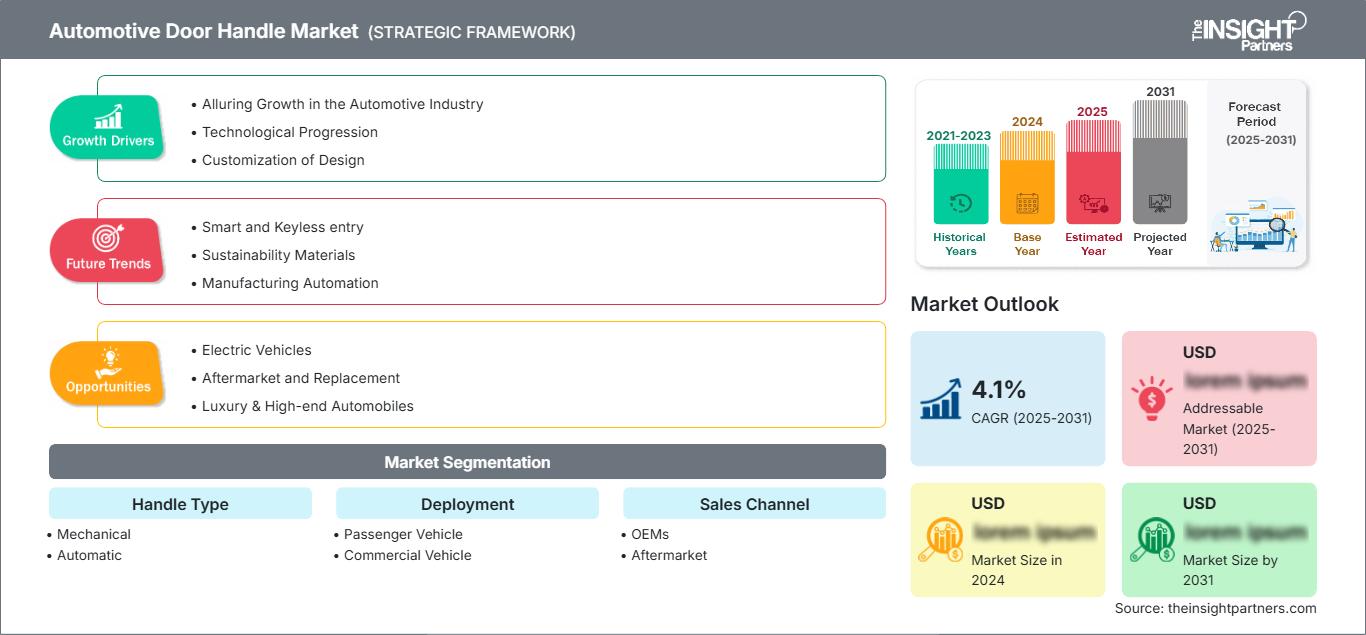
Regional Insights
North America automotive door handle market
North America accounted for 24–27% automotive door handle market share in 2025 and is expected to grow at a CAGR range of 3.6–4.2% through 2034. The region benefits from strong SUV and pickup production, high exterior trim value, and steady replacement demand from collision repair channels.
OEMs in the region increasingly specify painted, illuminated, and keyless-entry-compatible handles for premium and upper-mid vehicles. Automatic handles remain concentrated in luxury EVs and advanced SUVs, but broader adoption will depend on reliability in winter conditions, emergency release design, and repair cost acceptance.
U.S. automotive door handle Market
According to the automotive door handle Market report, the U.S. represented 78–82% of North America in 2025 and is projected to grow at a CAGR range of 3.7–4.3% during 2026–2034. Domestic demand is supported by light trucks, SUVs, and a large parc that sustains aftermarket replacement for damaged exterior handles.
Company presence is strengthened by Tier 1 suppliers, trim specialists, plastics processors, and electronics integrators supporting OEM programs. Application trends point toward flush handles on EVs, illuminated grips on premium trims, and robust mechanical solutions for commercial vans and work trucks.
Europe automotive door handle Market
The region has an estimated share of 22-25% for the year 2025, which is expected to grow at a CAGR rate between 3.2-3.8% from 2026-2034. Germany dominates regional market adoption through premium OEMs, EV development initiatives, and access systems suppliers having excellent engineering capabilities.
The UK drives demand through premium and sports cars production, while France, Italy, and Spain generate demand through compact cars and vans along with local access system suppliers. Europeans prefer excellent exterior design; however, safety requirements and regulations also necessitate emergency access, serviceability, and winter performance.
APAC automotive door handle Market
APAC accounted for 38–42% share in 2025 and is forecast to grow at a CAGR range of 4.0–4.6% through 2034. China leads because of large vehicle production, EV launches, and fast adoption of flush exterior styling. Japan and South Korea support advanced quality standards.
India is scaling demand through passenger vehicle localization and supplier investments, while Australia remains a replacement-driven market with premium import influence. Regional growth is reinforced by cost-efficient molding, painting, and assembly networks.
Middle East & Africa automotive door handle Market
Middle East & Africa is expected to grow at a CAGR range of 3.0–3.6% during 2026–2034. Saudi Arabia and the UAE lead demand through premium imports, SUV ownership, and hot-climate durability requirements for exterior components.
South Africa and the Rest of MEA depend more on replacement channels and commercial vehicle use. Growth will be shaped by vehicle parc expansion, dealership service networks, and availability of cost-effective aftermarket door handle assemblies.
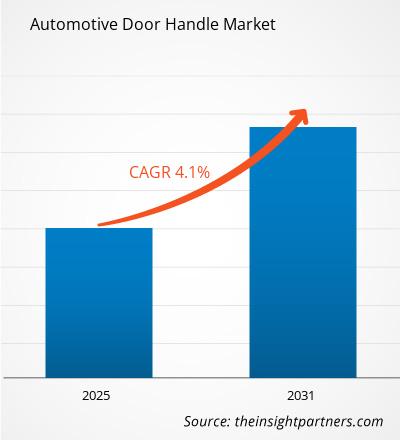
Segmentation Analysis
Handle Type
Handle Type is expected to grow at a CAGR range of 3.6–4.2% during 2026–2034. The automotive door handle market scope is expanding as mechanical pull handles remain essential for low-cost platforms, while automatic and flush handles increase the value of premium and electric vehicle exterior systems.
- Mechanical handles remain the volume base because they offer low cost, proven durability, simple serviceability, and compatibility with passenger cars, vans, trucks, and entry-level vehicles.
- Automatic handles are gaining strategic importance as EVs and premium models use flush surfaces, powered extension, illumination, and sensor integration to improve aerodynamics and brand differentiation.
Deployment
Deployment is expected to grow at a CAGR range of 3.7–4.3% during 2026–2034 as passenger vehicles account for higher trim variation and commercial vehicles sustain durable, serviceable handle demand across fleets, vans, and light trucks.
- Passenger Vehicle deployment dominates because higher production volumes, styling differentiation, EV launches, and consumer preference for keyless entry create sustained demand for upgraded exterior access components.
- Commercial Vehicle deployment focuses on durability, repair cost, handle strength, and replacement availability because fleets prioritize uptime, frequent use, and reliable access in demanding operating conditions.
Sales Channel
Sales Channel is expected to grow at a CAGR range of 3.5–4.1% during 2026–2034. OEMs dominate because handles are integrated into vehicle styling, paint matching, crash repair planning, and locking architecture, while aftermarket demand supports replacements and upgrades.
- OEMs lead because automakers need model-specific handles that match body color, security architecture, aerodynamic objectives, and launch schedules across global and regional platforms.
- Aftermarket channels serve collision repair, wear replacement, and retrofit demand, especially where older vehicles need affordable mechanical handles or owners seek illuminated and automatic upgrades.
Opportunity Snapshot
| Handle Type | Revenue Contribution | Trend Tag | Adoption Stage |
| Mechanical | High | Cost Control | Mature |
| Automatic | Medium | Flush Access | Scaling |
Automotive Door Handle Market Growth Drivers and Impact Analysis
Vehicle Design Premiumization Increases Handle Content
Car manufacturers are taking advantage of door handles as an obvious element on the exterior of a vehicle that affects the perceived quality, aerodynamic performance, and brand image. Thus, the part is transformed from an off-the-shelf component into a module connected to the design. Painting, chrome, lighting, touch capabilities, and flush fit add to the cost of the component. The effect is most noticeable in electric cars, SUVs, and luxury cars, where the exterior has to satisfy both aesthetic and technical demands.
Keyless Entry and Smart Access Expand Module Complexity
Access systems increasingly connect door handles with keyless entry, passive entry, digital keys, and vehicle electronics. This raises demand for sensors, switches, wiring, anti-pinch protection, and emergency release mechanisms inside compact assemblies. The market impact is a shift toward higher engineering intensity and closer collaboration between body, electronics, and security teams. Conventional suppliers must add mechatronic capabilities, while electronics companies gain opportunities in capacitive sensing, illumination, and control modules. Reliability remains essential because access failure affects safety and user trust.
Aftermarket Replacement Sustains Stable Baseline Demand
Door handles face frequent exposure to pulling force, weather, UV radiation, washing chemicals, and collision damage. This creates recurring aftermarket demand even when new vehicle production slows. Mechanical handles are especially important in replacement channels because they are affordable, widely available, and easy to install. The impact is a resilient revenue base for regional suppliers, distributors, and repair networks. As automatic handles enter more vehicles, replacement value may rise, but repair complexity and insurance acceptance will influence adoption speed.
Automotive Door Handle Market Future Trends
Flush Handles Move Beyond Luxury EVs
automotive door handle market trends indicate that flush and automatic handles will move from premium EVs into broader upper-mid vehicle segments. Automakers value their aerodynamic contribution, smooth exterior appearance, and compatibility with digital access systems. Adoption will accelerate where suppliers reduce actuator cost, improve ice-breaking reliability, and include emergency release functions. Wider use will also require standardized testing for water ingress, temperature extremes, hand-force durability, and service replacement. As costs decline, flush handles can become a mainstream exterior differentiator rather than a luxury-only feature.
Integrated Access Surfaces Replace Standalone Handles
Future vehicle access may shift from protruding handles toward integrated surfaces on doors, pillars, and trim panels. Capacitive pads, illuminated icons, biometric inputs, and phone-based authorization can reduce visible hardware while giving designers more freedom. This trend will not eliminate mechanical redundancy because safety rules and emergency access remain essential. Instead, suppliers will develop hybrid systems that hide mechanisms while preserving physical release capability. The result will be a more complex, higher-value access module combining exterior trim, electronics, lighting, and security logic.
Automotive Door Handle Market Opportunities
Standardized Automatic Handle Platforms
The strongest opportunity lies in modular automatic handle platforms that can be adapted across multiple vehicle models with limited redesign. Standardized actuators, sensors, brackets, and emergency release designs can reduce tooling cost and shorten OEM validation timelines. automotive door handle market Forecasts remain favorable where suppliers can offer scalable systems for EVs, SUVs, and premium trims. This approach helps automakers introduce flush styling without excessive program risk, while suppliers improve margins through shared components, localized assembly, and consistent testing procedures across regions.
Localized Aftermarket and Repair Networks
Aftermarket expansion offers a practical opportunity because door handles are frequently damaged, color-specific, and model-dependent. Suppliers that build regional inventories, paint-matching capability, and installer support can capture recurring replacement demand. Automatic handles create additional opportunity for diagnostic tools, actuator replacement, and sensor calibration services. The opportunity is strongest in markets with large vehicle parcs, high collision repair volumes, and growing consumer interest in upgraded exterior features. Reliable fitment data and warranty support will be decisive differentiators for aftermarket participants.
Frequently Asked Questions

- Comprehensive Market Sizing and Forecast Analysis
- Detailed Segmentation Analysis
- In-Depth Market Dynamics Assessment
- Regional and Country-Level Insights
- Competitive Landscape and Company Benchmarking
- Strategic Business Intelligence
Recent Reports
Testimonials

The Insight Partners provided valuable market intelligence that supported our global go-to-market strategy. Their team was professional, responsive, and attentive to our feedback, providing thoughtful analysis and helpful methodological clarifications throughout the project.
Junmo Kim Chief Financial Officer (CFO), Enertech Co., Ltd.
The Insight Partners' SCADA System Market report is comprehensive, with valuable insights on current trends and future forecasts. The team was highly professional, responsive, and supportive throughout. We are very satisfied and highly recommend their services.
RAN KEDEM Partner, Reali Technologies LTDs
I requested a report on a very specific software market and the team produced the report in a few days. The information was very relevant and well presented. I then requested some changes and additions to the report. The team was again very responsive and I got the final report in less than a week.
JEAN-HERVE JENN Chairman, Future Analytica
We worked with The Insight Partners for an important market study and forecast. They gave us clear insights into opportunities and risks, which helped shape our plans. Their research was easy to use and based on solid data. It helped us make smart, confident decisions. We highly recommend them.
PIYUSH NAGPAL Sr. Vice President, High Beam Global
The Insight Partners delivered insightful, well-structured market research with strong domain expertise. Their team was professional and responsive throughout. The user-friendly website made accessing industry reports seamless. We highly recommend them for reliable, high-quality research services
YUKIHIKO ADACHI CEO, Deep Blue, LLC.
This is the first time I have purchased a market report from The Insight Partners.While I was unsure at first, I visited their web site and felt more comfortable to take the risk and purchase a market report.I am completely satisfied with the quality of the report and customer service. I had several questions and comments with the initial report, but after a couple of dialogs over email with their analyst I believe I have a report that I can use as input to our strategic planning process.Thank you so much for taking the extra time and making this a positive experience.I will definitely recommend your service to others and you will be my first call when we need further market data.
JOHN SUZUKI President and Chief Executive Officer, Board Director, BK Technologies
I wish to appreciate your support and the professionalism you displayed in the course of attending to my request for information regarding to infectious disease IVD market in Nigeria. I appreciate your patience, your guidance, and the fact that you were willing to offer a discount, which eventually made it possible for us to close a deal. I look forward to engaging The Insight Partners in the future, all thanks to the impression you have created in me as a result of this first encounter.
DR CHIJIOKE ONYIA MANAGING DIRECTOR, PineCrest Healthcare Ltd.Reason to Buy
- Informed Decision-Making
- Understanding Market Dynamics
- Competitive Analysis
- Identifying Emerging Markets
- Customer Insights
- Market Forecasts
- Risk Mitigation
- Boosting Operational Efficiency
- Strategic Planning
- Investment Justification
- Tracking Industry Innovations
- Aligning with Regulatory Trends





 Get Free Sample for