
Automotive Lead Acid Batteries Market Growth, Trends & Forecast by 2034
Coverage: By Product (SLI, Micro Hybrid Batteries); Type (Flooded, Enhanced Flooded, VRLA); End-user (Passenger Car, LCV, MCV and HCV) , and Geography (North America, Europe, Asia Pacific, and South and Central America)
- Status : Data Released
- Report Code : TIPRE00021969
- Category : Energy and Power
- No. of Pages : 150
- Available Report Formats :


- Last update date : November 03, 2026


2025 Market Size
US$ 30.36 Bn
Base year value
2034 Forecast
US$ 38.41 Bn
Projected by 2034
CAGR 2026-2034
2.65 %
Growth rate
Addressable Market
US$ 312.13 Bn
(2026-2034)
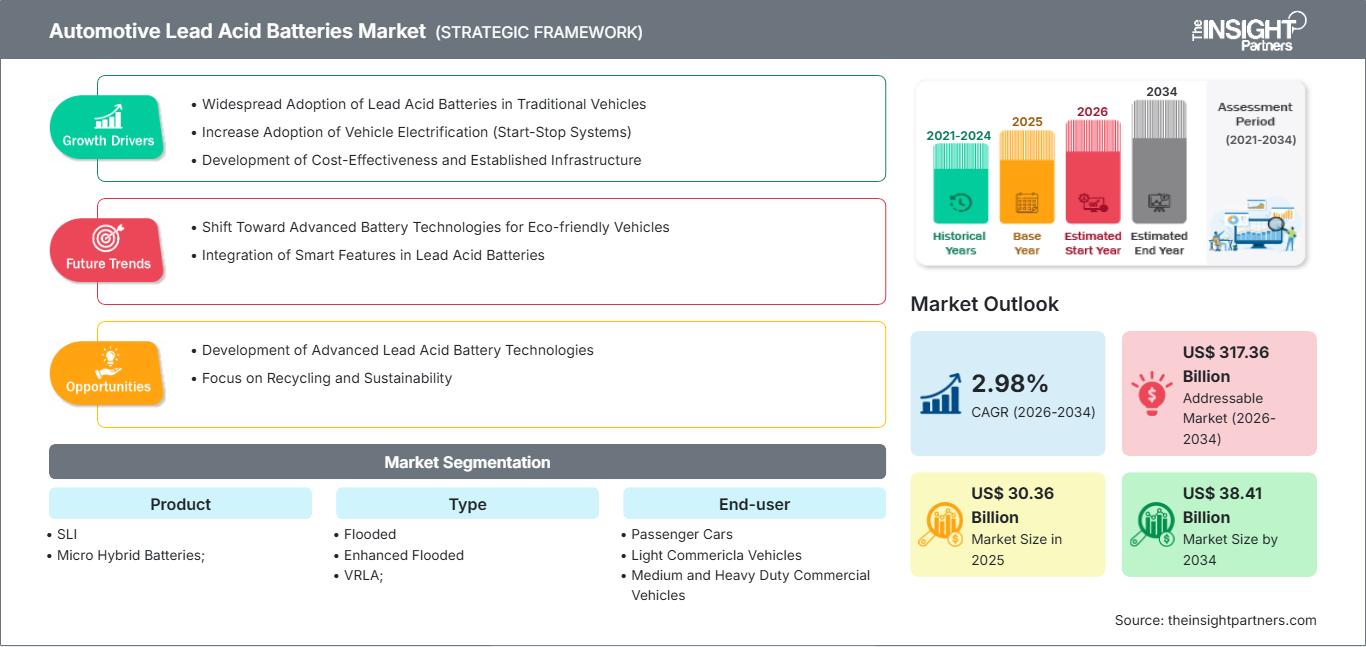
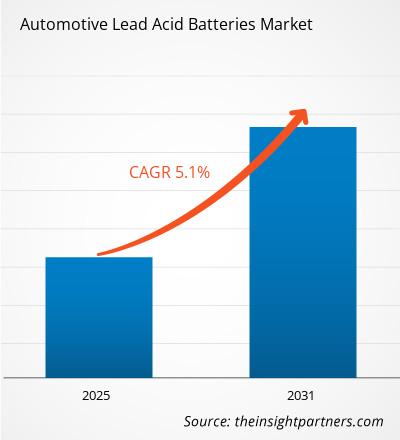
The automotive lead acid batteries market was valued at US$ 30.36 Billion in 2025 and is projected to reach US$ 38.41 Billion by 2034, registering a CAGR of 2.65% during 2026–2034. Demand is supported by vehicle parc expansion, replacement cycles, start-stop functionality, rising electrical loads, and the continuing role of lead-acid systems in low-voltage automotive architectures.
As vehicle electrification increases, the automotive lead acid batteries market remains relevant because most vehicle platforms continue to require dependable low-voltage power for starting, control, safety, connectivity, lighting, and auxiliary systems. North America is expected to expand at a modeled CAGR of ~2% through 2034, supported by a large installed vehicle base, replacement demand, higher electrical content, and continued adoption of advanced low-voltage battery technologies.
Automotive Lead Acid Batteries Market Assessment and Insights
Regional Outlook
- North America: ~21% of the global market in 2025 | ~2% CAGR through 2034. Market position: North America holds a major established position, supported by a large installed vehicle fleet, strong replacement demand, commercial vehicle utilization, and OEM adoption of higher-performance AGM and EFB technologies.
- US: ~78% of North American market revenue in 2025 | ~2% CAGR through 2034. Market position: The US represents the core North American demand center, with extensive passenger and commercial vehicle fleets, sophisticated aftermarket distribution, high electrical loads, and established manufacturing and recycling infrastructure.
- Europe: ~18% of the global market in 2025 | ~2% CAGR through 2034. Market position: Europe is a mature market with substantial replacement demand and strong advanced-battery adoption. Germany leads Europe, while the UK, France, Italy, and Spain provide significant OEM and aftermarket demand across passenger and commercial vehicles.
- Asia Pacific: ~43% of the global market in 2025 | ~3% CAGR through 2034. Market position: Asia Pacific is the largest and fastest-growing regional market, supported by vehicle production, expanding ownership, replacement demand, commercial mobility, and manufacturing concentration. China is the leading country in Asia Pacific.
Segment Outlook
- SLI: ~74% Share in 2025 | ~2% CAGR through 2034. Market position: SLI remains the largest product segment because conventional starting, lighting, and ignition requirements span a very broad installed vehicle base. Replacement cycles and cost competitiveness reinforce its position across passenger and commercial applications.
- Micro Hybrid Batteries: ~26% Share in 2025 | ~4% CAGR through 2034. Market position: Micro hybrid batteries have the stronger growth outlook as start-stop systems, regenerative charging, and higher electrical loads increase requirements for cycling performance and charge acceptance in modern vehicles.
Competitive Coverage
Clarios, CSB Energy Technology Co., Ltd., EnerSys, East Penn Manufacturing Co., Exide Technologies, Exide Industries Limited, GS Yuasa Corporation, Leoch International Technology Limited, Panasonic Corporation, Furukawa Battery Co., Ltd.
Methodology
The Insight Partners follows Data Collection & Secondary Research, Primary Research, Data Analysis, and Data Triangulation & Final Review to validate market estimates and insights.
Source: The Insight Partners' analysis based on proprietary research, government publications, company annual reports, investor presentations, industry databases, and expert interviews.
There has been a transformation of the automotive lead acid batteries market from the traditional flooded batteries to more durable and chargeable batteries that can sustain more electronics-based vehicle architecture. There are more operating needs imposed on low-voltage batteries from start-stop systems, regenerative braking, driver assistance systems, infotainment systems, connectivity, and electric auxiliary systems. Thus, there has been an increasing trend towards producing more EFB and AGM batteries for cycling and charge accepting applications, while traditional flooded batteries continue to play a role due to their lower cost and widespread presence.
Demand will be driven by the production of vehicles in the Asia Pacific region, by the replacement market in the mature automobile markets and by the use of hybrid/electrified vehicle architecture which will need a reliable low voltage power system. The growing focus on battery recycling and materials recovery also means that it becomes increasingly strategically important to implement closed-loop collection systems and lead recycling. There is also incremental demand coming from emerging automotive production centers in India and Southeast Asia.
Automotive Lead Acid Batteries Market Report Scope
| Report Attribute | Details |
|---|---|
| Market size in 2025 | US$ 30.36 Billion |
| Market Size by 2034 | US$ 38.41 Billion |
| Global CAGR (2026 - 2034) | 2.65% |
| Historical Data | 2021-2024 |
| Forecast period | 2026-2034 |
Automotive Lead Acid Batteries Market Analysis
The automotive lead acid batteries market is primarily driven by the size and age of the global vehicle parc. Every replacement cycle creates recurring demand, while new vehicle production adds original-equipment requirements. Passenger cars account for a broad base of applications, but light commercial and medium and heavy-duty vehicles increase battery requirements because of higher electrical loads, longer operating hours, and demanding duty cycles. Start-stop systems further raise cycling requirements, encouraging movement toward EFB and AGM designs.
The value chain involves the lead and alloys supply, manufacture of battery components, formation of plates, assembling and testing of batteries, logistics, OEM incorporation, aftermarket sales, and recycling. The supply of raw materials, therefore, is dependent on the presence of lead, energy costs, logistics, manufacturing capacity, and reuse of used batteries. Lead Acid batteries have the benefit of being supplied in a recycling environment where the recovered lead can be recycled back to make batteries, thereby making use of less primary material.
The competition in the automotive lead acid batteries market includes global lead acid battery manufactures and regional battery manufacturers and aftermarket players. Clarios covers the low-voltage segment extensively via its automotive brands and is expanding its AGM batteries capacity. GS Yuasa is improving its offerings in the start-stop and conventional automotive applications. Exide Industries and Exide Technologies have wide automotive portfolio. East Penn Manufacturing, EnerSys, CSB Energy Technology, Leoch International Technology, Furukawa Battery and Panasonic offer batteries to different markets like OEM, Replacement, Commercial, etc.
Technology differentiation, economies of scale, aftermarket presence, and management of recyclable resources have become key factors in strategic positioning. Funds are flowing into more advanced batteries, automation, telemetry, resource efficiency, and local supply chain systems. Companies that already have networks in place to collect their products can recover expensive lead while insulating themselves from material cost fluctuations. Such companies will gain a competitive edge due to vertical integration and the ability to combine battery making with recycling.
● REPORT CUSTOMIZATION
Tailor This Report To Align With Your Specific Business Requirements
This report can be customized to align precisely with your business objectives, scope, and target markets. Customization options include tailored segmentation, geography, competitive analysis, and strategic insights to support informed decision-making.
Customize This Report →WHAT YOU CAN ADJUST
- ● Segmentations
- ● Geography
- ● Competitive Analysis
- ● Language Preferences
Automotive Lead Acid Batteries Market: Strategic Insights
Regional Insights
North America automotive lead acid batteries market
North America represents an established demand center with a large installed vehicle base and recurring replacement requirements. The regional automotive lead acid batteries market is expected to expand at a CAGR of ~2% through 2034. Passenger cars will serve general replacement purposes, and pick-up trucks, fleet services, RVs, and other heavy duty applications will have greater capacity needs for their batteries. The region will have matured aftermarket network and battery service/collection infrastructures.
The use of technology has changed the market dynamics in favor of EFB and AGM types due to increased complexity in vehicle electrical systems. Start-stop operations and increasing auxiliary demands will need higher cycle performances that cannot be achieved by conventional technologies. Localized manufacturing and recycling are also factors affecting supply in the region. It will be expected that investments in advanced AGM manufacturing, clean carbon lead procurement, and localized manufacturing will boost the regional environment.
U.S. automotive lead acid batteries market
The U.S. accounts for ~78% of North American automotive lead acid batteries market revenue and is expected to record a CAGR of ~2% through 2034. Its position reflects the scale and age of the vehicle fleet, extensive aftermarket networks, high commercial vehicle utilization, and broad requirements for dependable starting and auxiliary power. Replacement batteries remain an important source of recurring demand.
There are also increasing levels of electrical sophistication in relation to traditional cars, hybrids, and BEVs. The relevance of AGM technology is becoming more prevalent in situations where there is a need for high cycling capability and stable power. The production, distribution, and recycling facilities for major players remain in place throughout the country, and fleet managers are increasingly favoring battery monitoring and preventative replacements.
Europe automotive lead acid batteries market
Europe represented ~18% of the automotive lead acid batteries market in 2025 and is expected to grow at a CAGR of ~2% through 2034. Germany is the leading country in Europe, supported by its substantial automotive manufacturing base, large vehicle fleet, established supplier ecosystem, and extensive aftermarket activity. The UK, France, Italy, and Spain also contribute materially through passenger vehicle ownership, commercial transportation, and replacement demand.
Germany combines OEM concentration with demand for advanced low-voltage systems in premium and mainstream vehicles. The UK has a sizeable replacement market supported by an established vehicle parc, while France and Italy benefit from large passenger vehicle populations and commercial mobility. Spain adds demand through vehicle production and aftermarket channels. Across the region, higher electronic content and start-stop functionality favor advanced battery technologies capable of frequent cycling.
European battery policy is reinforcing recycling efficiency, material recovery, and traceability. This favors manufacturers with established collection and processing relationships and increases the strategic value of recovered lead. Advanced AGM and EFB products are positioned to gain from increasingly demanding vehicle electrical architectures, while conventional batteries retain relevance in older vehicles and cost-sensitive replacement applications.
APAC automotive lead acid batteries market
Asia Pacific held ~43% of the automotive lead acid batteries market in 2025 and is expected to expand at a CAGR of ~3% through 2034, making it the fastest-growing region. China is the leading country in Asia Pacific, supported by its extensive automotive manufacturing base and large installed fleet. India is also becoming an important demand center as passenger and commercial vehicle ownership expands.
Japan and South Korea contribute through advanced vehicle manufacturing and established battery technology capabilities, while Australia generates replacement demand across a geographically dispersed vehicle fleet. Regional growth is supported by manufacturing localization, commercial mobility, replacement cycles, and continued use of low-voltage batteries in electrified vehicles. Policy measures supporting automotive production and industrial investment further reinforce regional supply capacity.
Middle East & Africa automotive lead acid batteries market
The Middle East and Africa automotive lead acid batteries market is expected to grow at a CAGR of ~2% through 2034. Saudi Arabia and the UAE provide important demand centers in the Middle East because of vehicle ownership, logistics activity, infrastructure investment, and high utilization of passenger and commercial vehicles. South Africa remains a significant automotive and aftermarket hub within Africa.
Demand is closely linked to transportation infrastructure, fleet activity, construction, mining, and replacement requirements. Hot operating conditions increase the importance of battery durability and thermal performance, while commercial fleets require dependable starting power under intensive utilization. Regional distributors and service networks therefore remain important to market access. Local assembly, recycling, and inventory management can also reduce supply-chain exposure and improve availability in markets with long logistics routes.
Segmentation Analysis
Product
The Product segment defines the principal battery configurations serving automotive low-voltage requirements. It remains central to market structure because buyers balance initial cost, starting performance, cycling capability, service life, and vehicle electrical requirements. Advanced product adoption is increasing as vehicles incorporate start-stop functions and larger auxiliary loads. Within this segment, Micro Hybrid Batteries are expected to record a CAGR of ~4% through 2034 as charge acceptance and cycling requirements increase.
- SLI: SLI batteries remain the principal solution for conventional starting, lighting, and ignition requirements, benefiting from broad compatibility, established manufacturing processes, competitive pricing, and a large replacement base across passenger and commercial vehicles.
- Micro Hybrid Batteries: Micro hybrid batteries support vehicles with start-stop and energy-management functions, where frequent engine cycling and regenerative charging require stronger cycling performance and more effective charge acceptance.
Type
The Type segment reflects differences in electrolyte management, construction, maintenance requirements, and cycling performance. Conventional products retain substantial demand because of their installed base and cost advantages, while more advanced constructions are gaining share where vehicles require higher durability and charge acceptance. Enhanced Flooded Batteries are expected to post a CAGR of ~4% through 2034 as start-stop penetration increases across mainstream vehicle platforms.
- Flooded: Flooded batteries remain important in cost-sensitive passenger vehicles, older vehicle fleets, and applications where conventional starting performance provides adequate functionality without advanced cycling requirements.
- Enhanced Flooded: Enhanced flooded batteries provide improved cycling and charge acceptance compared with conventional flooded designs, making them suitable for vehicles equipped with moderate start-stop functionality and higher electrical loads.
- VRLA: VRLA batteries provide controlled electrolyte management and maintenance advantages, supporting applications where installation flexibility, reduced maintenance, and dependable power delivery are prioritized.
End-user
The End-user segment captures differences in battery demand arising from vehicle size, usage intensity, electrical requirements, and replacement frequency. Passenger cars provide the broadest installed base, while commercial vehicles generate specialized requirements because of longer operating periods and heavier accessory loads. Medium and Heavy Duty Commercial Vehicles are expected to achieve a CAGR of ~3% through 2034 as logistics, fleet modernization, and vehicle electrification increase low-voltage system requirements.
- Passenger Cars: Passenger cars represent the broadest application base, with demand spanning original equipment and replacement channels. Vehicle ownership, electrical content, start-stop functionality, and replacement cycles shape purchasing decisions.
- Light Commercial Vehicles: Light commercial vehicles require dependable starting and auxiliary power across delivery, service, and small-business fleets. Frequent utilization and growing onboard electronics support demand for durable battery designs.
- Medium and Heavy Duty Commercial Vehicles: Medium and heavy-duty vehicles place greater demands on battery durability because of long operating hours, multiple electrical systems, fleet utilization, and demanding environmental conditions.
Opportunity Snapshot
| End-user | Revenue Contribution | Trend Tag | Adoption Stage |
|---|---|---|---|
| Passenger Cars | High | Start-Stop Systems | Mature |
| Light Commercial Vehicles | Medium | Fleet Electrification | Scaling |
| Medium and Heavy Duty Commercial Vehicles | Medium | Fleet Power Management | Scaling |
Automotive Lead Acid Batteries Market Growth Drivers and Impact Analysis
Increasing Vehicle Electrical Loads and Start-Stop Adoption
Modern vehicles increasingly rely on electrical systems for safety, connectivity, infotainment, driver assistance, thermal management, sensors, and other auxiliary functions. This increases the importance of dependable low-voltage power even when propulsion is increasingly electrified. Start-stop operation adds another requirement because batteries must tolerate repeated engine restarts and frequent charge-discharge cycles. The resulting demand favors EFB and AGM technologies where conventional flooded products cannot provide sufficient cycling performance. For battery manufacturers, this shift supports higher-value product mixes rather than relying solely on unit-volume expansion. For OEMs, battery selection becomes increasingly integrated with vehicle energy management and charging strategies. The market impact is therefore a gradual movement from basic replacement batteries toward application-specific products with stronger durability, charge acceptance, and electrical performance.
Large Installed Vehicle Parc Sustains Replacement Demand
Replacement demand provides a structural foundation for the automotive lead acid batteries market because batteries have finite service lives and are replaced throughout the operating life of vehicles. A large installed base of passenger cars, commercial vehicles, and other road vehicles therefore creates recurring demand independently of annual new-vehicle production. Aging fleets can increase replacement volumes even when new registrations soften, while commercial operators prioritize dependable batteries to avoid downtime. The aftermarket also creates opportunities for premium products because consumers and fleet operators can select higher-performance technologies when replacement is required. Manufacturers with strong distributor networks, service coverage, warranty capabilities, and recycling channels are better positioned to capture this recurring demand. The resulting market structure provides resilience and reduces dependence on a single vehicle production cycle.
Recycling and Circular Lead Supply Strengthen Industry Economics
Lead-acid batteries have a well-established collection and recycling ecosystem, allowing manufacturers to recover lead and other materials from used batteries and feed recovered inputs back into production. This circular structure supports resource efficiency while reducing exposure to primary lead supply constraints. Regulatory requirements are further increasing attention on recycling efficiency and material recovery, particularly in Europe. The commercial impact extends beyond environmental compliance because recycling can become an important component of procurement, cost management, and supply security. Battery companies with integrated collection relationships, processing capabilities, and manufacturing operations can improve control over material flows. As sustainability requirements become more prominent in automotive supply chains, recycled-content strategies and lower-carbon lead procurement can increasingly influence OEM sourcing decisions and differentiate suppliers.
Automotive Lead Acid Batteries Market Future Trends
Advanced Low-Voltage Architectures Will Broaden Battery Technology Requirements
Future vehicle platforms are likely to require increasingly sophisticated low-voltage energy management as electronic architectures become more centralized and software-defined. This will increase the need for batteries that can support frequent cycling, rapid recharge, stable voltage delivery, and high auxiliary loads. AGM and EFB technologies are positioned to benefit where lead-acid chemistry remains appropriate, while emerging low-voltage chemistries will compete in selected premium applications. The important change will be greater application segmentation rather than a uniform replacement of conventional batteries. Battery suppliers will increasingly need to match chemistry and construction to specific vehicle electrical architectures. Diagnostic systems, intelligent battery sensors, and energy-management software can also become more closely integrated with battery maintenance and replacement decisions.
Circularity Will Become a Stronger Differentiator in Battery Procurement
Circularity is expected to move from a recycling requirement toward a broader supply-chain consideration. Automakers and battery producers are likely to place greater emphasis on recycled materials, carbon intensity, traceability, collection efficiency, and recovery yields. This can favor suppliers with established closed-loop systems and access to recovered lead. European regulatory developments provide a particularly strong signal because recycling efficiency and material recovery requirements are becoming more structured. Over time, procurement teams may assess battery suppliers not only on product performance and price but also on the resilience and environmental characteristics of their material supply. Manufacturers capable of combining battery production, recycling, low-carbon material sourcing, and transparent reporting could therefore gain strategic advantages in long-term OEM and aftermarket relationships.
Automotive Lead Acid Batteries Market Opportunities
Expand Advanced Battery Production for Commercial and Premium Vehicles
Battery manufacturers can increase value capture by expanding EFB and AGM production for applications with high cycling and electrical-load requirements. Commercial vehicles are particularly attractive because fleet operators place significant value on uptime, durability, and predictable maintenance. Premium passenger vehicles provide another opportunity because advanced electrical architectures require stronger low-voltage performance. Investments should prioritize flexible production lines, improved charge-acceptance characteristics, thermal durability, quality control, and battery-management compatibility. Regional manufacturing can also shorten supply chains and improve responsiveness to OEM requirements. Suppliers that combine advanced product capabilities with technical validation, fleet support, warranty analytics, and aftermarket availability can strengthen customer retention. This opportunity is less dependent on overall vehicle volume because higher-value batteries can increase revenue per installed vehicle.
Build Integrated Recycling and Low-Carbon Lead Supply Networks
A second opportunity lies in strengthening the circular supply chain from battery collection through lead recovery and new battery manufacturing. Integrated networks can improve access to recovered material, reduce exposure to commodity volatility, and support sustainability requirements from automotive customers. Manufacturers can invest in collection partnerships, recycling capacity, traceability systems, and lower-carbon lead procurement while maintaining reliable battery output. Emerging regulatory requirements make these capabilities increasingly relevant to supplier qualification, particularly for companies serving European OEMs. In developing automotive markets, organized collection networks can also formalize aftermarket channels and increase recovery rates. Companies that treat recycling as a strategic supply asset rather than a downstream disposal activity can strengthen material security while developing additional competitive differentiation.
Frequently Asked Questions

- Comprehensive Market Sizing and Forecast Analysis
- Detailed Segmentation Analysis
- In-Depth Market Dynamics Assessment
- Regional and Country-Level Insights
- Competitive Landscape and Company Benchmarking
- Strategic Business Intelligence
Recent Reports
Testimonials

The Insight Partners provided valuable market intelligence that supported our global go-to-market strategy. Their team was professional, responsive, and attentive to our feedback, providing thoughtful analysis and helpful methodological clarifications throughout the project.
Junmo Kim Chief Financial Officer (CFO), Enertech Co., Ltd.
The Insight Partners' SCADA System Market report is comprehensive, with valuable insights on current trends and future forecasts. The team was highly professional, responsive, and supportive throughout. We are very satisfied and highly recommend their services.
RAN KEDEM Partner, Reali Technologies LTDs
I requested a report on a very specific software market and the team produced the report in a few days. The information was very relevant and well presented. I then requested some changes and additions to the report. The team was again very responsive and I got the final report in less than a week.
JEAN-HERVE JENN Chairman, Future Analytica
We worked with The Insight Partners for an important market study and forecast. They gave us clear insights into opportunities and risks, which helped shape our plans. Their research was easy to use and based on solid data. It helped us make smart, confident decisions. We highly recommend them.
PIYUSH NAGPAL Sr. Vice President, High Beam Global
The Insight Partners delivered insightful, well-structured market research with strong domain expertise. Their team was professional and responsive throughout. The user-friendly website made accessing industry reports seamless. We highly recommend them for reliable, high-quality research services
YUKIHIKO ADACHI CEO, Deep Blue, LLC.
This is the first time I have purchased a market report from The Insight Partners.While I was unsure at first, I visited their web site and felt more comfortable to take the risk and purchase a market report.I am completely satisfied with the quality of the report and customer service. I had several questions and comments with the initial report, but after a couple of dialogs over email with their analyst I believe I have a report that I can use as input to our strategic planning process.Thank you so much for taking the extra time and making this a positive experience.I will definitely recommend your service to others and you will be my first call when we need further market data.
JOHN SUZUKI President and Chief Executive Officer, Board Director, BK Technologies
I wish to appreciate your support and the professionalism you displayed in the course of attending to my request for information regarding to infectious disease IVD market in Nigeria. I appreciate your patience, your guidance, and the fact that you were willing to offer a discount, which eventually made it possible for us to close a deal. I look forward to engaging The Insight Partners in the future, all thanks to the impression you have created in me as a result of this first encounter.
DR CHIJIOKE ONYIA MANAGING DIRECTOR, PineCrest Healthcare Ltd.Reason to Buy
- Informed Decision-Making
- Understanding Market Dynamics
- Competitive Analysis
- Identifying Emerging Markets
- Customer Insights
- Market Forecasts
- Risk Mitigation
- Boosting Operational Efficiency
- Strategic Planning
- Investment Justification
- Tracking Industry Innovations
- Aligning with Regulatory Trends





 Get Free Sample for