
Automotive Lubricants Market Size, Share and Forecast to 2031
Coverage: By Type (Mineral Oil, Synthetic Oil, and Bio-Based Oil), Product Type (Engine Oil, Hydraulic Oil, Gear Oil, Grease, and Others), By Vehicle Type (Passenger Cars, Light Commercial Vehicles, Heavy Commercial Vehicles, and Others), and Geography (North America, Europe, Asia Pacific, Middle East and Africa, and South and Central America)
- Status : Published
- Report Code : TIPRE00007137
- Category : Chemicals and Materials
- No. of Pages : 339
- Available Report Formats :


- Last update date : December 12, 2025


2024 Market Size
US$ 86.15 Bn
Base year value
2031 Forecast
US$ 122.93 Bn
Projected by 2031
CAGR 2025-2031
5.4 %
Growth rate
Addressable Market
US$ 748.37 Bn
(2025-2031)
The automotive lubricants market size is projected to reach US$ 122.93 billion by 2031 from US$ 86.15 billion in 2024. The market is expected to register a CAGR of 5.4% from 2025 to 2031.
Automotive Lubricants Market Analysis
There is a rise in global vehicle ownership, industrialization, and transportation activity, especially in developing economies. The need to expand passenger and commercial vehicle fleets boosts the number of routine maintenance operations, which contributes to the demand for engine oils, transmissions, and greases. The use of high-performance synthetic lubricants is driven by technological changes in engines, which are aimed at increased efficiency, reduced emissions, and higher heat tolerance. The rapid development of logistics, e-commerce, and long-haul transportation increases the consumption of lubricants, as more fleets are used. Increased emission standards favor the need for modern, low-viscosity lubricants that improve fuel efficiency and lower carbon emissions. Also, increased consumer sensitivity to engine health and increased intervals between oil changes bolster the move toward high-quality lubricants.
Automotive Lubricants Market Overview
Automotive lubricants are fluids that have been dedicated to reducing friction, minimizing wear, and protecting engines and other vehicle components against heat, oxidation, and corrosion. These are engine oils, transmission fluids, gear oils, greases, and coolants- all of which are designed to play a particular role toward performance. These lubricants are a mixture of base oil (mineral, synthetic, or bio-based) and well-designed additive packages that improve viscosity stability, detergency, anti-wear protection, and thermal performance. With the development of vehicle technologies, the formulations are getting more advanced, and low-viscosity and high-performance synthetics are gaining popularity due to their capability to enhance fuel efficiency and promote cleaner combustion. The increasing popularity of electric vehicles drives the need for e-transmission fluids and thermal management fluids. Stricter environmental regulations hasten the need to develop environmentally friendly and bio-based lubricants. Increased digitalization promotes the development of smart and condition-monitoring lubricants.
Market Research Highlights
- Asia Pacific dominated the market with 42.9% share in 2024.
- Asia Pacific is poised to grow at a CAGR of 6.3% over the forecast period.
- United States market is projected to grow at a CAGR of 4.4% over the forecast period.
- By Type, the Mineral Oil segment accounted for the largest market share of 70.7% in 2024.
- By Product Type, the Engine Oil segment is anticipated to witness the fastest growth, registering a CAGR of 5.8% over the forecast period
- By Vehicle Type, the Light Commercial Vehicles segment accounted for the largest market share of 36.4% in 2024.
- The report profiles key industry players such as Exxon Mobil Corp, TotalEnergies SE, Shell Plc, Chevron Corp, BP Plc, China Petroleum & Chemical Corp (Sinopec), Valvoline Inc, Idemitsu Kosan Co Ltd, Gulf Oil International Ltd, China National Petroleum Corporation (CNPC), while also analyzing key developments in novel ideas, disruptive products, and innovative services that could reshape the future market and reveal emerging themes across the industry.
Source: The Insight Partners' analysis based on proprietary research, government publications, company annual reports, investor presentations, industry databases, and expert interviews.
● REPORT CUSTOMIZATION
Tailor This Report To Align With Your Specific Business Requirements
This report can be customized to align precisely with your business objectives, scope, and target markets. Customization options include tailored segmentation, geography, competitive analysis, and strategic insights to support informed decision-making.
Customize This Report →WHAT YOU CAN ADJUST
- ● Segmentations
- ● Geography
- ● Competitive Analysis
- ● Language Preferences
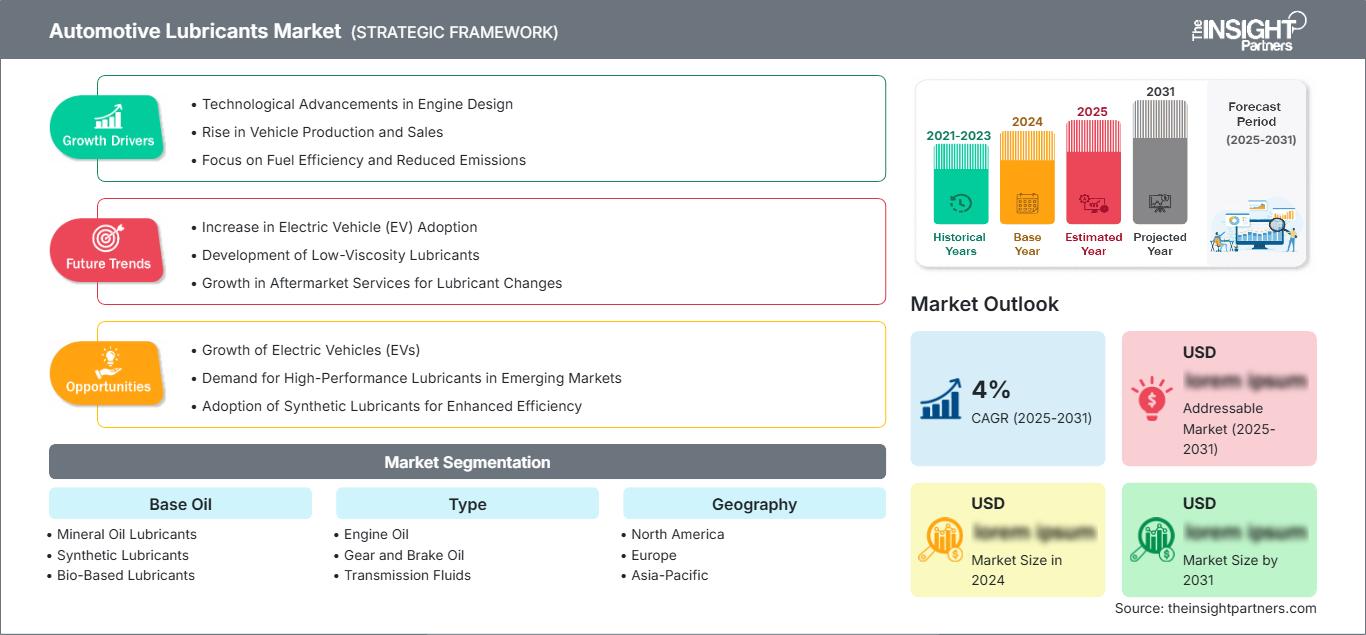
Automotive Lubricants Market: Strategic Insights
-
Get Top Key Market Trends of this report.This FREE sample will include data analysis, ranging from market trends to estimates and forecasts.
Automotive Lubricants Market: Drivers and Opportunities
Market Drivers:
- Growing Vehicle Ownership: Growing the number of passenger and commercial vehicles increases the consumption of engine oils, gear oils, and transmission fluids to maintain proper functioning and performance.
- Advancements in Engine Technology: The contemporary engines work at increased temperatures and margins, and more high-performance synthetic lubricants are required that are of high thermal stability, oxidation resistance, and wear protection to satisfy the fuel-efficiency and emission requirements.
- Expansion in Logistics, E-Commerce, and Fleet Activities: The heavy-duty trucks, delivery fleets, and long-haul transport working long hours drive demand for long-drain lubricants that are durable and offer long-component life, especially in adverse conditions.
- Focus on Fuel Efficiency: Stringent regulations drive demand for low-viscosity, high-performance formulations that minimize friction and improve engine efficiency.
- Shift Toward Premium Maintenance Practices: The rising consumer consciousness on engine wellness, coupled with the OEM suggestions, is influencing the demand for synthetic and semi-synthetic car lubricants that have a long service life and better protection.
Market Opportunities:
- Advanced Synthetic and Semi-Synthetic Lubricants: High-performance lubricants that are engineered with better thermal stability, anti-wear ability, and oxidation stability offer opportunities in the automotive sector.
- Lubricants for Hybrid and Electric Vehicles: EV powertrains and battery system thermal management fluids, e-gear oils, and specialty greases are a developing segment with the accelerated global electrification.
- Adoption in Emerging Markets: The increase in vehicle ownership, the growth of road networks, and industrialization in Asia Pacific, Africa, and South and Central America drive market growth.
- Development of Advanced Eco-Friendly Formulations: The increasing sustainability stimulates research on the development of biodegradable, low-toxicity, and energy-efficient lubricants in accordance with the regulations of green mobility and the environment.
Automotive Lubricants Market Report Segmentation Analysis
The automotive lubricants market is divided into different segments to give a clearer view of how they work, their growth potential, and the latest trends. Below is the standard segmentation approach used in industry reports:
By Type
- Mineral Oil: Mineral oils are used in automotive lubrication products as they are a popular base oil that provides good service in normal operating conditions and economical lubrication.
- Synthetic Oil: Synthetic oils have high thermal stability, oxidation resistance, and performance under extreme conditions and heavy loads, and hence are best suited to high-demand automotive applications.
- Bio-Based Oils: Bio-based oils are environmentally friendly and biodegradable with low toxicity. They are derived from renewable sources and contribute to sustainability in automotive lubrication.
By Product Type
- Engine Oil: The engine oils lubricate and protect the internal combustion engines installed in vehicles and improve durability and performance in extreme operating environments.
- Hydraulic Oil: They are applied to hydraulic systems in brakes and power steering, which offer smooth operation, corrosion resistance, and constant viscosity under pressure.
- Gear Oil: Special oils protect transmissions, differentials, and gearboxes by lowering friction and wear and by sustaining extremely high pressure and temperature conditions.
- Grease: Semi-solid lubricants are applied on the chassis, bearings, and joints to offer long-lasting protection against moisture, dust, and heavy loads.
- Others: This segment includes coolants, brake fluids, and others designed for specific automotive components or niche applications.
By Vehicle Type
- Passenger Cars: Lubricants that are developed to be in line with the performance and emission requirements of personal vehicles, with more emphasis on engine protection, fuel economy, and extended oil change intervals.
- Light Commercial Vehicles: These lubricants suit vans and light trucks that are engaged in urban delivery and small-scale logistics, and provide a compromise between performance and durability in moderate load environments.
- Heavy Commercial Vehicles: Super-performance lubricants formulated for truck, bus, and heavy-duty vehicles working in harsh conditions with heavy loads, with a focus on wear resistance and long drain time.
- Others: This segment includes two-wheelers, off-highway vehicles, and specialty automotive machinery.
By Geography:
- North America
- Europe
- Asia Pacific
- South and Central America
- Middle East & Africa
Automotive Lubricants Market Report Scope
| Report Attribute | Details |
|---|---|
| Market size in 2024 | US$ 86.15 Billion |
| Market Size by 2031 | US$ 122.93 Billion |
| Global CAGR (2025 - 2031) | 5.4% |
| Historical Data | 2021-2023 |
| Forecast period | 2025-2031 |
| Segments Covered |
By Type
|
| Regions and Countries Covered |
North America
|
| Market leaders and key company profiles |
|
Automotive Lubricants Market Players Density: Understanding Its Impact on Business Dynamics
The Automotive Lubricants Market is growing rapidly, driven by increasing end-user demand due to factors such as evolving consumer preferences, technological advancements, and greater awareness of the product's benefits. As demand rises, businesses are expanding their offerings, innovating to meet consumer needs, and capitalizing on emerging trends, which further fuels market growth.
Automotive Lubricants Market Share Analysis by Geography
Asia Pacific dominated the market due to rising vehicle ownership across the region. Emerging markets in South and Central America, the Middle East, and Africa have untapped opportunities for automotive lubricant providers to expand.
The growth of the automotive lubricants market varies by region. The demand for high-performing lubricants in the automotive sector continues to grow, positioning automotive lubricants in an evolving consumer landscape. Below is a summary of market share and trends by region:
1. North America
- Market Share: Holds a significant market share
- Key Drivers: Strong presence of the automotive manufacturing sector.
- Trends: A Growing number of electric and hybrid vehicles.
2. Europe
- Market Share: Holds a significant market share
- Key Drivers: Stringent environmental regulations drive the demand for synthetic lubricants in the automotive industry.
- Trends: Increasing preference for bio-based lubricants contributes to the market growth.
3. Asia Pacific
- Market Share dominated the market, with a rising market share every year
- Key Drivers: Rising disposable income and vehicle ownership.
- Trends: Adoption of high-performing lubricants from the automotive sector.
4. South and Central America
- Market Share: Although small, it is growing quickly
- Key Drivers: Rapid growth in the commercial transportation sector.
- Trends: Shift in consumer preference for maintenance-optimization lubricants.
5. Middle East and Africa
- Market Share: Rapidly growing market, with a rising market share every year
- Key Drivers: Growing demand for electric vehicles.
- Trends: Rising investments in specialized high-performance lubricants.
Automotive Lubricants Market Players: Density: Understanding Its Impact on Business Dynamics
High Market Density and Competition
Competition is intense due to the presence of established players such as China Petroleum & Chemical Corp (Sinopec), Exxon Mobil Corp, TotalEnergies SE, Gulf Oil International, Idemitsu Kosan Co Ltd, China National Petroleum Corporation (CNPC), and others.
This high level of competition urges companies to stand out by offering:
- Diverse product offering
- Sustainable and ethical sourcing
- Competitive pricing models
- Strong customer support and easy integration
Opportunities and Strategic Moves
- Focusing on research and development activities to distinguish themselves in the market
- Expanding global footprint and capabilities through acquisitions of value-added lubricant companies.
- Expanding product portfolio with the launch of sustainable products
Other companies analyzed during the course of research:
- AMSOIL Inc
- Phillips 66
- Fuchs SE
- Repsol SA
- Savita Oil Technologies Ltd
- Perstorp
- BP Plc
- Shell plc
- Chevron Corp
- Valvoline Inc
Automotive Lubricants Market: News and Recent Developments
- Shell U.K. Limited – Product Launch: In June 2025, Shell launched Shell EV-Plus Thermal Fluid, a specialized thermal management fluid designed for EV powertrains. This innovative fluid enables cooling of batteries, inverters, and electric motors using a single-circuit system, helping to simplify EV architecture and improve thermal performance, durability, and energy efficiency.
- ExxonMobil – Expansion: In March 2024, ExxonMobil announced the expansion of its lubricant blending and packaging facility in Singapore to increase capacity for synthetic automotive lubricants. This expansion aims to meet growing demand in APAC for high-performance synthetic engine oils and transmission fluids, supporting the region's shift toward more fuel-efficient and emission-compliant vehicles.
Automotive Lubricants Market Report Coverage and Deliverables
The "Automotive Lubricants Market Size and Forecast (2021–2031)" report provides a detailed analysis of the market covering the following areas:
- Automotive lubricants market size and forecast at global, regional, and country levels for all the key market segments covered under the scope
- Automotive lubricants market trends, as well as market dynamics such as drivers, restraints, and key opportunities
- Detailed Porter's five forces and SWOT analysis
- Automotive lubricants market analysis covering key market trends, global and regional framework, major players, regulations, and recent market developments
- Industry landscape and competition analysis covering market concentration, heat map analysis, prominent players, and recent developments for the automotive lubricants market
- Detailed company profiles
Frequently Asked Questions

- Comprehensive Market Sizing and Forecast Analysis
- Detailed Segmentation Analysis
- In-Depth Market Dynamics Assessment
- Regional and Country-Level Insights
- Competitive Landscape and Company Benchmarking
- Strategic Business Intelligence
Recent Reports
Testimonials

The Insight Partners provided valuable market intelligence that supported our global go-to-market strategy. Their team was professional, responsive, and attentive to our feedback, providing thoughtful analysis and helpful methodological clarifications throughout the project.
Junmo Kim Chief Financial Officer (CFO), Enertech Co., Ltd.
The Insight Partners' SCADA System Market report is comprehensive, with valuable insights on current trends and future forecasts. The team was highly professional, responsive, and supportive throughout. We are very satisfied and highly recommend their services.
RAN KEDEM Partner, Reali Technologies LTDs
I requested a report on a very specific software market and the team produced the report in a few days. The information was very relevant and well presented. I then requested some changes and additions to the report. The team was again very responsive and I got the final report in less than a week.
JEAN-HERVE JENN Chairman, Future Analytica
We worked with The Insight Partners for an important market study and forecast. They gave us clear insights into opportunities and risks, which helped shape our plans. Their research was easy to use and based on solid data. It helped us make smart, confident decisions. We highly recommend them.
PIYUSH NAGPAL Sr. Vice President, High Beam Global
The Insight Partners delivered insightful, well-structured market research with strong domain expertise. Their team was professional and responsive throughout. The user-friendly website made accessing industry reports seamless. We highly recommend them for reliable, high-quality research services
YUKIHIKO ADACHI CEO, Deep Blue, LLC.
This is the first time I have purchased a market report from The Insight Partners.While I was unsure at first, I visited their web site and felt more comfortable to take the risk and purchase a market report.I am completely satisfied with the quality of the report and customer service. I had several questions and comments with the initial report, but after a couple of dialogs over email with their analyst I believe I have a report that I can use as input to our strategic planning process.Thank you so much for taking the extra time and making this a positive experience.I will definitely recommend your service to others and you will be my first call when we need further market data.
JOHN SUZUKI President and Chief Executive Officer, Board Director, BK Technologies
I wish to appreciate your support and the professionalism you displayed in the course of attending to my request for information regarding to infectious disease IVD market in Nigeria. I appreciate your patience, your guidance, and the fact that you were willing to offer a discount, which eventually made it possible for us to close a deal. I look forward to engaging The Insight Partners in the future, all thanks to the impression you have created in me as a result of this first encounter.
DR CHIJIOKE ONYIA MANAGING DIRECTOR, PineCrest Healthcare Ltd.Reason to Buy
- Informed Decision-Making
- Understanding Market Dynamics
- Competitive Analysis
- Identifying Emerging Markets
- Customer Insights
- Market Forecasts
- Risk Mitigation
- Boosting Operational Efficiency
- Strategic Planning
- Investment Justification
- Tracking Industry Innovations
- Aligning with Regulatory Trends





 Get Free Sample for