
Drilling Fluids Market Demand, Size & Forecast by 2034
Drilling Fluids Market Size and Forecasts (2021 - 2034), Global and Regional Share, Trend, and Growth Opportunity Analysis By Type (Water-Based, Oil-Based, and Synthetic) Application (Onshore, and Offshore)
- Status : Data Released
- Report Code : TIPRE00003564
- Category : Chemicals and Materials
- No. of Pages : 150
- Available Report Formats :


- Last update date : July 28, 2026


2025 Market Size
US$ 9.27 Bn
Base year value
2034 Forecast
US$ 13.12 Bn
Projected by 2034
CAGR 2026-2034
3.93 %
Growth rate
Addressable Market
US$ 101.67 Bn
(2026-2034)
The Drilling Fluids Market held a value of US$ 9.27 billion in 2025 and is anticipated to reach US$ 13.12 billion by 2034, marking a CAGR of 3.93% during the period 2026-2034. The market is expected to experience a boost from the consistent growth of well construction activities, deeper reservoir depths, and an increasing need for fluids ensuring wellbore stabilization, pressure management, cooling, lubrication, and transportation of cuttings.
North America is technologically advanced among the demand regions and has seen strong market size in the Drilling Fluids Market owing to the development of shale resources, operations in the Gulf of Mexico, and replacement drilling activities. The regional demand is forecasted to increase at a CAGR of 3.4–4.4% due to horizontal wells, pressure management considerations, and usage of water and synthetic based products reducing non-productive time.
Drilling Fluids Market Assessment and Insights
- North America: Share in 2025 of 29–32% and CAGR between 3.4–4.4%. Shale drilling, offshore redevelopment, and strong service-company presence support leadership in the Drilling Fluids Market.
- US: Share in 2025 of 82–86% of North America and CAGR between 3.5–4.5%. Unconventional wells and Gulf projects sustain advanced fluid demand.
- Europe: Share in 2025 of 13–16% and CAGR between 2.6–3.6%. Norway, the UK, and Germany lead activity through offshore maintenance, North Sea redevelopment, and specialty chemical demand.
- Asia Pacific: Share in 2025 of 23–27% and CAGR between 4.5–5.5%. China, India, Australia, and Indonesia drive regional momentum through exploration programs, gas development, and energy-security investment.
- Largest Segment: Water-Based fluids with market share of 48–52% in 2025 and CAGR of 3.5–4.5% during 2026–2034. Lower cost and environmental acceptability support broad use.
- High Growth Segment: Synthetic fluids with market share of 15–19% in 2025 and CAGR of 4.8–5.8% during 2026–2034, benefiting from offshore and HPHT wells.
- Key companies analyzed in detail: Clariant AG, Gumpro Drilling Fluids Pvt. Ltd., Mazrui International LLC, NOV Inc., Newpark Resources, Inc., NuGeneration Technologies, LLC, Oren Hydrocarbons Private Limited, SLB, Solvay SA, Weatherford International plc.
Source: The Insight Partners' analysis based on proprietary research, government publications, company annual reports, investor presentations, industry databases, and expert interviews.
Evolution in the market will be driven by the move from basic mud systems to fluids made specifically to drill long lateral wells in depleted reservoirs and complicated pressure windows. Formulations are needed which provide increased rate of penetration, reduced probability of getting stuck pipe, stabilization of reactive shale and decreased volume of waste. These factors will increase the need for additives, digitized monitoring and customized mud programs in the Drilling Fluids Market. Additionally, purchasing behavior will change in that drilling programs will consider well cost, execution in the field and speed of service provision more than simply the cost of products.
During the forecast period, development of new gas basins, offshore tieback wells and energy security initiatives will drive selected drilling activity. Government mandates will encourage the use of lower toxicity chemistries, cuttings management and closed-loop fluid systems. Service companies with local blending capabilities, technical assistance in the field and a range of sustainable formulations will be better able to assist operators with balancing cost effectiveness and well integrity/ reliability. Customization will remain necessary since the geology, water chemistry, temperature and pressure conditions will vary from basin to basin.
Drilling Fluids Market Report Scope
| Report Attribute | Details |
|---|---|
| Market size in 2025 | US$ 9.27 Billion |
| Market Size by 2034 | US$ 13.12 Billion |
| Global CAGR (2026 - 2034) | 3.93% |
| Historical Data | 2021-2024 |
| Forecast period | 2026-2034 |
Drilling Fluids Market Analysis
Drilling Fluids Market growth prospects are associated with upstream capital investment, reserves replenishment, and technical difficulty of drilled wells. Drilling fluids make up a minor proportion of total drilling costs yet affect well control, borehole integrity, and drilling efficiency. Increased demand occurs with the need to drill deep wells, extend laterals, and drill in unstable formations where rheological parameters, filtration control, and inhibition properties are important.
Supply factors include availability of base oils, barites, polymers, and blending infrastructure in particular regions. Water-based drilling fluids are most popular because they are inexpensive and easier to manage environmentally. Oil- and synthetic-based systems are favored in high temperature and highly deviated or offshore wells. Chemicals providers, mud engineers, equipment providers, waste management companies, and integrated oilfield services companies form the market ecosystem. Inventories are important due to the risk of drilling schedule delays related to delays in delivering weighting materials, brines, or special polymers.
According to the current analysis of the Drilling Fluids Market, competition is mainly based on performance assurance, service field coverage, environmental compliance, and procurement integration. The key competitors providing the integrated solution include SLB and Weatherford International plc, while the remaining companies compete through their specialized solutions, processes, and tools, including Newpark Resources, Inc. and NOV Inc. Solvay SA and Clariant AG help enhance the capabilities in additive chemistry.
The regional players in the market are Gumpro Drilling Fluids Pvt. Ltd., Oren Hydrocarbons Private Limited, Mazrui International LLC, and NuGeneration Technologies, LLC. Trends in investment relate to the automation of fluid monitoring, low-toxicity synthetic fluids, lost-circulation materials, and shale inhibitors. The strategy will increasingly depend on reducing non-productive time and demonstrating the benefits of drilling performance. The companies which have training for rig crews, fast lab tests, and performance evaluation after each well can increase customer retention.
● REPORT CUSTOMIZATION
Tailor This Report To Align With Your Specific Business Requirements
This report can be customized to align precisely with your business objectives, scope, and target markets. Customization options include tailored segmentation, geography, competitive analysis, and strategic insights to support informed decision-making.
Customize This Report →WHAT YOU CAN ADJUST
- ● Segmentations
- ● Geography
- ● Competitive Analysis
- ● Language Preferences
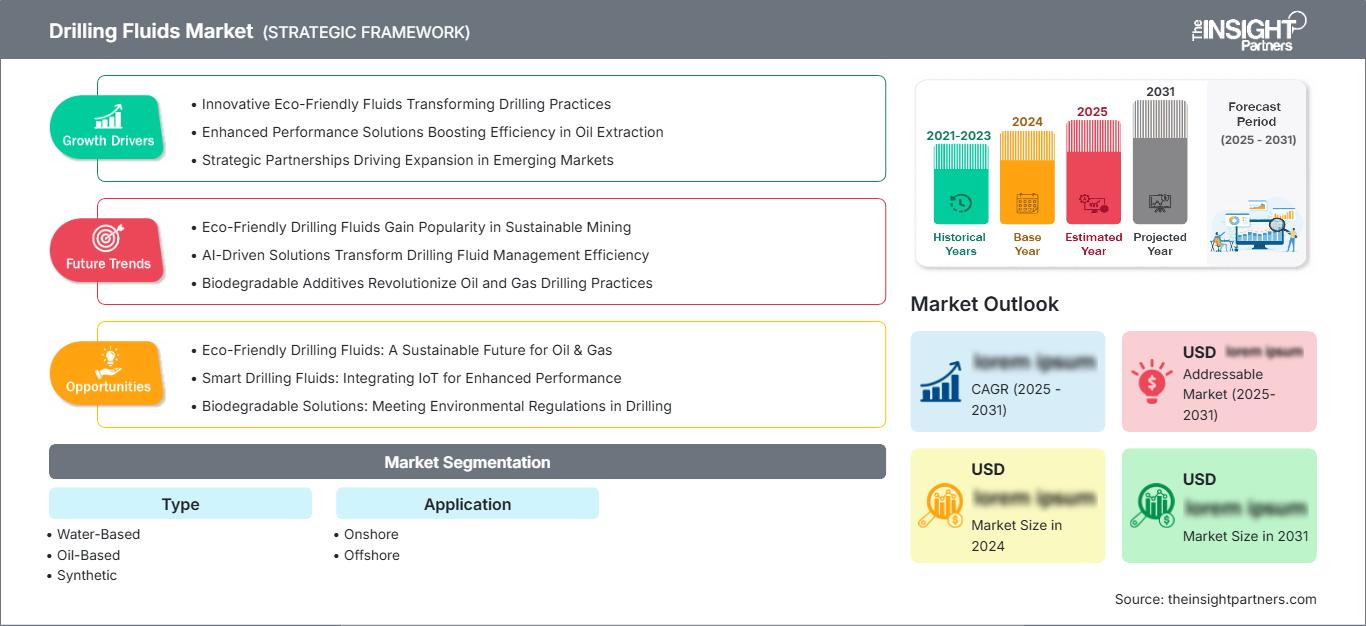
Drilling Fluids Market: Strategic Insights
Regional Insights
North America Drilling Fluids Market
North America accounted for 29–32% of global revenue in 2025, and is estimated to grow at a CAGR of 3.4–4.4%. The share of Drilling Fluids Market in North America region is driven by shale wells, recompletion and offshore Gulf deepwater drilling which need superior inhibition, lubrication and solids control technologies.
The region is characterized by the presence of oilfield service infrastructure and well-established technical laboratories. For shale development, fluids that address torque, drag, cuttings movement and wellbore stability in horizontal wells are needed. In the case of offshore drilling, fluids used should be synthetic in nature along with being in compliance with environmental regulations. Digital fluid testing becomes increasingly important for quick decisions in the field. North American consumers pay attention to supply chain reliability since their drilling activities tend to switch quickly between pads and regions.
U.S. Drilling Fluids Market Market
The U.S. generated 82–86% of North American revenues in 2025 and is expected to grow at 3.5–4.5% CAGR. Drilling operations in Permian, Eagle Ford, Bakken, and Haynesville fields continue to dictate fluid requirements. Long laterals drive higher consumption of lubricants, shale inhibitors, and fluid loss control additives that enable drilling windows.
The company portfolio includes SLB, Weatherford International plc, NOV Inc., Newpark Resources, Inc., and NuGeneration Technologies, LLC with operations in formulation, engineering, processing, and field services. Trends in applications remain biased towards onshore unconventional drilling, while offshore Gulf of Mexico projects continue to demand synthetic and high-performance systems. Environmental permits continue to affect disposal procedures and fluid selection. In the U.S., short innovation cycles work in favor of the industry since field experience in one basin may be easily transferred to another.
Europe Drilling Fluids Market Market
In 2025, Europe made up 13-16% of global revenues and is estimated to experience 2.6-3.6% CAGR. Norway is a regional leader due to drilling offshore, development of fields, and maintenance of mature basins. The United Kingdom remains an essential market, as North Sea fields require complex fluid applications for sidetracking, infill drilling, and decommissioning activities. Germany provides its contribution via specialty chemical solutions; France, Italy, and Spain have service centers, Mediterranean offshore activities, and imported chemicals.
Environmental regulations, waste treatment practices, and offshore discharge are the main factors impacting the European purchases. The companies with less toxic additives, recycling containers, and compliance process are expected to achieve competitive advantage in the Drilling Fluids Market. Technical differentiation is especially important for mature fields where sidetracking and depleted reservoirs require strict control of fluid loss and wellbore stability.
APAC Drilling Fluids Market Market
Asia Pacific had 23–27% of worldwide revenues in 2025 and is expected to grow at a rate of 4.5–5.5% CAGR. China leads Asia Pacific due to unconventional gas, offshore exploration, and domestic energy security initiatives. India, Australia, Indonesia, Japan, and South Korea participate via gas production, offshore operations, and refinery-linked upstream investments.
Growth in industrialization and policies favoring domestic hydrocarbon production create favorable conditions for fluid consumption. There is growing preference towards the use of cost-effective water-based fluids for onshore drilling and more advanced synthetic fluids for offshore operations. Competitiveness depends on local manufacturing capacity, availability of additives, and responsive service capabilities. Local content initiatives among national oil companies and regional independents offer further opportunities for blending facilities and technical services providers.
Middle East & Africa Drilling Fluids Market Market
The CAGR of the Middle East and Africa region is estimated between 3.8 and 4.8%. Saudi Arabia will be the largest country for fluid demand due to the presence of huge oil fields, gas developments, and long term upstream capacity development programs, which would constantly need drilling fluids services. Other GCC members, UAE, Oman, Kuwait, and Qatar, provide sour gas and offshore drilling needs and consequently continue to require specialty drilling fluids.
In South Africa and other parts of MEA there is some strategically important fluid demand associated with exploration efforts, infrastructure and security of energy supply. High temperatures, carbonates, loss of circulation, and HPHT conditions stimulate the application of engineered additives. Buyers from this region prefer good logistics, local stock, and field engineering, which help to minimize downtime at remote drilling sites.
Segmentation Analysis
Type
The Type segment is expected to grow at a 3.8–4.8% CAGR during 2026–2034. The Drilling Fluids Market scope spans economical water-based systems, high-lubricity oil-based muds, and synthetic fluids designed for offshore compliance. Selection depends on well depth, temperature, formation reactivity, disposal rules, and operator tolerance for nonproductive-time risk. Product portfolios are also evolving around hybrid chemistries that improve inhibition and lubrication while maintaining manageable waste profiles.
- Water-Based: Water-based systems remain the largest category because they balance cost, operational flexibility, and environmental acceptability. They are widely used in onshore wells and increasingly enhanced with inhibitors and lubricants.
- Oil-Based: Oil-based fluids retain strategic importance in demanding formations where lubricity, shale stability, and temperature tolerance are critical. Disposal limitations and environmental scrutiny influence adoption patterns.
- Synthetic: Synthetic fluids are gaining preference in offshore and complex wells because they combine strong drilling performance with improved environmental profiles compared with conventional oil-based systems.
Application
The Application segment is projected to register a 3.7–4.7% CAGR through 2034. Onshore wells dominate volume because of shale, conventional oil, and gas activity, while offshore applications generate higher-value demand per well. Fluid programs are tailored to formation pressure, water depth, well geometry, logistics, and compliance requirements. Application strategy increasingly links mud design with solids control, cuttings treatment, and post-well performance review to reduce repeat operational issues.
- Onshore: Onshore applications generate the largest volume base due to unconventional drilling, workovers, and conventional field development. Cost efficiency and fast logistics strongly influence product selection.
- Offshore: Offshore applications require technically advanced fluids for HPHT wells, deepwater drilling, and strict discharge controls. Higher well complexity supports premium synthetic and specialized additive demand.
Opportunity Snapshot
| Segment Name | Revenue Contribution | Trend Tag | Adoption Stage |
| Onshore | High | Shale Wells | Mature |
| Offshore | Medium | Deepwater Fluids | Scaling |
Drilling Fluids Market Growth Drivers and Impact Analysis
Sustained Upstream Investment and Reserve Replacement
Reserve replacement continues to be a pragmatic impetus since there would always be natural declines in the field and it will need consistent drilling to ensure continued production. The International Energy Agency has stressed the significance of upstream spending to counteract production losses, further bolstering the need for a dependable fluid system. There is a constant need for drilling products which help in controlling the formation pressures, clean up the hole, cool down the drilling machines and stabilize the reactive formations. The significance for the suppliers lies in the fact that there is recurring demand for the products depending on the degree of drilling activities.
Growth in Complex Wells and Offshore Projects
Well complexity is rising as operators drill deeper reservoirs, longer laterals, and technically challenging offshore targets. These wells need fluids with stable rheology, strong lubricity, low fluid loss, and high-temperature tolerance. Offshore programs also require careful environmental management, cuttings handling, and predictable performance under demanding logistics. The commercial impact is a shift from commodity mud supply toward engineered service models. Suppliers able to combine chemistry, field engineering, and real-time monitoring can capture higher-value work. This trend supports synthetic systems, specialty additives, and integrated fluid management services across the Drilling Fluids Market. It also raises the importance of pre-well planning, offset-well learning, and rapid troubleshooting during active drilling campaigns.
Environmental Compliance and Waste Reduction Pressure
Environmental regulation is changing how operators evaluate drilling fluids, especially in offshore and sensitive onshore areas. Buyers increasingly require lower-toxicity additives, improved biodegradability, reduced discharge impact, and better waste-handling compatibility. This creates market impact through reformulation, documentation requirements, and higher demand for closed-loop systems. Suppliers that demonstrate lifecycle benefits can improve acceptance with operators and regulators. Compliance also influences logistics because waste transport, treatment, and disposal costs affect total well economics. As a result, environmentally aligned fluid programs are becoming a competitive requirement rather than a secondary product feature. This favors companies that can provide transparent product data, disposal guidance, and auditable field procedures.
Drilling Fluids Market Future Trends
Real-Time Fluid Monitoring and Automated Treatment Advice
Future Drilling Fluids Market trends will increasingly involve real-time mud-property measurement, automated alerts, and remote engineering support. Digital tools can help operators identify density drift, rheology changes, contamination, and fluid-stability risks before they create operational delays. The next phase of adoption will connect rig sensors, laboratory models, and treatment recommendations into faster decision workflows. This shift can reduce manual sampling dependency and improve consistency across multiwell drilling programs. Suppliers that combine chemistry with data services may create stronger customer retention and measurable performance accountability. Automated analytics will also help standardize decisions across crews, reducing variability between shifts and locations.
Lower-Toxicity Synthetic and High-Performance Water-Based Systems
Product development is expected to focus on fluids that deliver oil-based performance with improved environmental profiles. High-performance water-based systems will gain attention where operators want shale inhibition, lubricity, and stability without higher disposal burdens. Lower-toxicity synthetic fluids will remain important in offshore wells where technical reliability and discharge compliance matter. Innovation will likely center on biodegradable base fluids, advanced polymers, micronized weighting agents, and additives that maintain performance under HPHT conditions. This trend favors companies with formulation science, field validation, and regulatory documentation capabilities. Commercial adoption will depend on proving performance equivalence in demanding wells while keeping total fluid and waste costs predictable.
Drilling Fluids Market Opportunities
Gas Development and Energy-Security Drilling Programs
Natural gas development offers a clear opportunity because several countries are investing in domestic supply, LNG-linked projects, and unconventional resources. These wells require reliable inhibition, cuttings transport, and lost-circulation control, especially where shale, tight gas, or HPHT formations are present. Investment strategies aligned with long-term Drilling Fluids Market Forecasts should prioritize basin-specific formulations, local blending capacity, and technical service teams. Suppliers that can reduce well delivery risk while meeting environmental requirements will be well positioned to capture recurring demand from gas-focused drilling programs. Partnerships with national oil companies and regional service firms can accelerate qualification, inventory planning, and field adoption.
Offshore Redevelopment and Mature-Field Optimization
Offshore redevelopment creates an opportunity for premium fluid programs because mature fields often require sidetracks, infill wells, and complex pressure management. These projects demand fluids that maintain stability in depleted formations while limiting losses and protecting reservoirs. Suppliers can target operators with integrated packages combining synthetic systems, bridging materials, waste management, and remote support. The value proposition is strongest where drilling windows are narrow and rig time is expensive. Companies able to prove reduced nonproductive time and predictable wellbore quality can secure higher-margin work in offshore basins. Redevelopment campaigns also provide repeat-well learning, enabling suppliers to refine formulations over successive wells and improve operational confidence.
Recent Developments
- July 2026: Halliburton has secured significant contracts for integrated well construction at the GranMorgu deepwater development in Suriname, managed by TotalEnergies. The contract encompasses drilling and completion services as part of a long-term initiative. Halliburton plans to implement a comprehensive digital and automation approach that integrates planning, engineering, and operations, aiming to enhance performance, speed up learning, and reduce overall costs in well construction.
- July 2026: SLB has acquired Sulzer’s Vessel Internal Electrostatic Coalescer (VIEC) technology, enhancing its production technologies portfolio. VIEC improves oil-water separation efficiency, aiding operators in managing water volumes and maintaining performance. Patrick Bauer emphasized the acquisition as a strategic move to bolster production and recovery capabilities, catering to customers focused on maximizing output from existing assets.
Frequently Asked Questions

- Comprehensive Market Sizing and Forecast Analysis
- Detailed Segmentation Analysis
- In-Depth Market Dynamics Assessment
- Regional and Country-Level Insights
- Competitive Landscape and Company Benchmarking
- Strategic Business Intelligence
Recent Reports
Testimonials

The Insight Partners provided valuable market intelligence that supported our global go-to-market strategy. Their team was professional, responsive, and attentive to our feedback, providing thoughtful analysis and helpful methodological clarifications throughout the project.
Junmo Kim Chief Financial Officer (CFO), Enertech Co., Ltd.
The Insight Partners' SCADA System Market report is comprehensive, with valuable insights on current trends and future forecasts. The team was highly professional, responsive, and supportive throughout. We are very satisfied and highly recommend their services.
RAN KEDEM Partner, Reali Technologies LTDs
I requested a report on a very specific software market and the team produced the report in a few days. The information was very relevant and well presented. I then requested some changes and additions to the report. The team was again very responsive and I got the final report in less than a week.
JEAN-HERVE JENN Chairman, Future Analytica
We worked with The Insight Partners for an important market study and forecast. They gave us clear insights into opportunities and risks, which helped shape our plans. Their research was easy to use and based on solid data. It helped us make smart, confident decisions. We highly recommend them.
PIYUSH NAGPAL Sr. Vice President, High Beam Global
The Insight Partners delivered insightful, well-structured market research with strong domain expertise. Their team was professional and responsive throughout. The user-friendly website made accessing industry reports seamless. We highly recommend them for reliable, high-quality research services
YUKIHIKO ADACHI CEO, Deep Blue, LLC.
This is the first time I have purchased a market report from The Insight Partners.While I was unsure at first, I visited their web site and felt more comfortable to take the risk and purchase a market report.I am completely satisfied with the quality of the report and customer service. I had several questions and comments with the initial report, but after a couple of dialogs over email with their analyst I believe I have a report that I can use as input to our strategic planning process.Thank you so much for taking the extra time and making this a positive experience.I will definitely recommend your service to others and you will be my first call when we need further market data.
JOHN SUZUKI President and Chief Executive Officer, Board Director, BK Technologies
I wish to appreciate your support and the professionalism you displayed in the course of attending to my request for information regarding to infectious disease IVD market in Nigeria. I appreciate your patience, your guidance, and the fact that you were willing to offer a discount, which eventually made it possible for us to close a deal. I look forward to engaging The Insight Partners in the future, all thanks to the impression you have created in me as a result of this first encounter.
DR CHIJIOKE ONYIA MANAGING DIRECTOR, PineCrest Healthcare Ltd.Reason to Buy
- Informed Decision-Making
- Understanding Market Dynamics
- Competitive Analysis
- Identifying Emerging Markets
- Customer Insights
- Market Forecasts
- Risk Mitigation
- Boosting Operational Efficiency
- Strategic Planning
- Investment Justification
- Tracking Industry Innovations
- Aligning with Regulatory Trends





 Get Free Sample for