
Automotive Smart Display Market Size, Growth & Trends by 2034
Coverage: By Application (Center Stack, Digital Instrument Cluster, Head-up Display (HUD), Rear Seat Entertainment); Display Size (< 5 inches, 5-10 inches, > 10 inches); Display Technology (LCD, TFT-LCD, OLED, Others); Vehicle Type (Passenger Car, Light Commercial Vehicle, Heavy Commercial Vehicle) , and Geography (North America, Europe, Asia Pacific, and South and Central America)
- Status : Data Released
- Report Code : TIPEL00002629
- Category : Electronics and Semiconductor
- No. of Pages : 150
- Available Report Formats :


- Last update date : July 17, 2026


2025 Market Size
US$ 17.39 Bn
Base year value
2034 Forecast
US$ 30.97 Bn
Projected by 2034
CAGR 2026-2034
6.62 %
Growth rate
Addressable Market
US$ 218.61 Bn
(2026-2034)
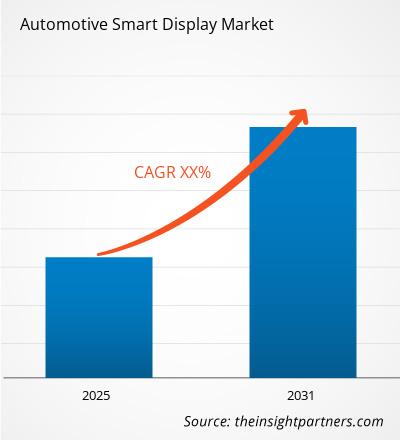
The Automotive Smart Display Market was valued at US$ 17.39 Billion in 2025 and is projected to reach US$ 30.97 Billion by 2034, growing at a CAGR of 6.62% from 2026 to 2034. Demand for these products will be driven by advanced cockpit designs, large infotainment displays, digital instrument clusters, heads-up displays, rear entertainment systems, and improved display technology for better visibility, personalization, and software interaction in the vehicle.
The North American cockpit electronics market is a valuable market where the Automotive Smart Display Market size is projected to grow at 5.7%–6.7% during 2026–2034. Growth drivers include premium light trucks, EV dashboards, visualization in driver assistance, and display integration for safety reasons. There is an increasing focus from automakers and Tier 1s on larger center displays, customizable clusters, and HUD use.
Automotive Smart Display Market Assessment and Insights
- North America held 23%–27% share in 2025 and is expected to grow at a CAGR between 5.7%–6.7% during 2026–2034, driven by connected cockpit adoption, premium vehicle penetration, and HUD integration.
- US represented 78%–83% of North America in 2025 and is projected to grow at a CAGR between 5.8%–6.8% during 2026–2034.
- Europe accounted for 25%–29% share in 2025 and is forecast to grow at a CAGR between 5.5%–6.5% during 2026–2034, led by Germany, France, the UK, Italy, and Spain.
- Asia Pacific held 39%–43% share in 2025 and is projected to grow at a CAGR between 7.4%–8.4% during 2026–2034, supported by China, Japan, South Korea, India, and Australia.
- Largest Segment Center Stack held a market share of 38%–42% in 2025, with CAGR range of 5.9%–6.9% between 2026–2034.
- High Growth Segment Head-up Display held a market share of 12%–16% in 2025, with CAGR range of 8.6%–9.6% between 2026–2034.
- Key companies analyzed in detail: Robert Bosch GmbH, Continental AG, DENSO Corporation, Visteon Corporation, Nippon Seiki Co., Ltd., Panasonic Automotive Systems Co., Ltd., Pioneer India Electronics Private Limited, Yazaki Corporation, Gentex Corporation, and LG Display Co., Ltd.
Source: The Insight Partners' analysis based on proprietary research, government publications, company annual reports, investor presentations, industry databases, and expert interviews.
From simple infotainment units, displays in the car are becoming software-based cockpits, which help with navigation, entertainment, ADAS notifications, energy consumption details, and customization. It is clear that panel manufacturers are transitioning from simple LCD technology towards TFT-LCD, LTPS, and OLED technologies as the criteria for brightness, touch sensitivity, power consumption, and curvature now determine vehicle differentiation. In this way, the Automotive Smart Display Market has evolved to meet these demands by focusing on integrated dashboards and multi-display cockpits.
The future demand will be driven by electric vehicle architectures, software-defined vehicles, and regulation around driver distraction and safety issues. Asia Pacific will continue to drive economies of scale, whereas North America and Europe will continue to be premium markets. According to OICA vehicle production statistics and display shipments, the automotive industry continues to increase the digital content per vehicle.
Automotive Smart Display Market Report Scope
| Report Attribute | Details |
|---|---|
| Market size in 2025 | US$ 17.39 Billion |
| Market Size by 2034 | US$ 30.97 Billion |
| Global CAGR (2026 - 2034) | 6.62% |
| Historical Data | 2021-2024 |
| Forecast period | 2026-2034 |
Automotive Smart Display Market Analysis
Drivers for demand include cockpit digitalization, EV UI design, visualization of navigation systems, and transition from analog instruments to configurable screens. The market development is boosted by consumers' demands for smartphone-like performance as well as OEMs' need to communicate battery, ADAS, charging, and safety information clearly.
Glass suppliers, panel suppliers, touch module manufacturers, backlight suppliers, OLED manufacturers, cockpit domain controller manufacturers, Tier 1 system integrators, automakers, and software platforms form the supply chain. The supply market supports those firms that have the capability to meet the automotive-grade demands of temperature, vibration, light intensity, longevity, and cybersecurity.
The industry structure consists of Tier 1 cockpit integrators and display specialists in terms of center stack, digital cluster, head-up display (HUD), and rear entertainment. Robert Bosch GmbH, Continental AG, DENSO Corporation, Visteon Corporation, Nippon Seiki Co., Ltd., Panasonic Automotive Systems Co., Ltd., Pioneer India Electronics Private Limited, Yazaki Corporation, Gentex Corporation, and LG Display Co., Ltd. will compete in terms of optics, software capabilities, screen reliability, and OEM qualifications. In the Automotive Smart Display Market report, ecosystem depth analysis becomes more significant in comparison with the panel analysis.
The investments are made for development of curved displays, high-brightness HUD display, OLED cockpit displays, privacy displays, and cockpit domain controller compatibility. The positioning strategy is different from the point of view of the involved parties, where Tier 1 suppliers are focused on functional safety and integration into vehicles, whereas panel makers look at contrast, thinness, yield, and cost-effectiveness.
● REPORT CUSTOMIZATION
Tailor This Report To Align With Your Specific Business Requirements
This report can be customized to align precisely with your business objectives, scope, and target markets. Customization options include tailored segmentation, geography, competitive analysis, and strategic insights to support informed decision-making.
Customize This Report →WHAT YOU CAN ADJUST
- ● Segmentations
- ● Geography
- ● Competitive Analysis
- ● Language Preferences
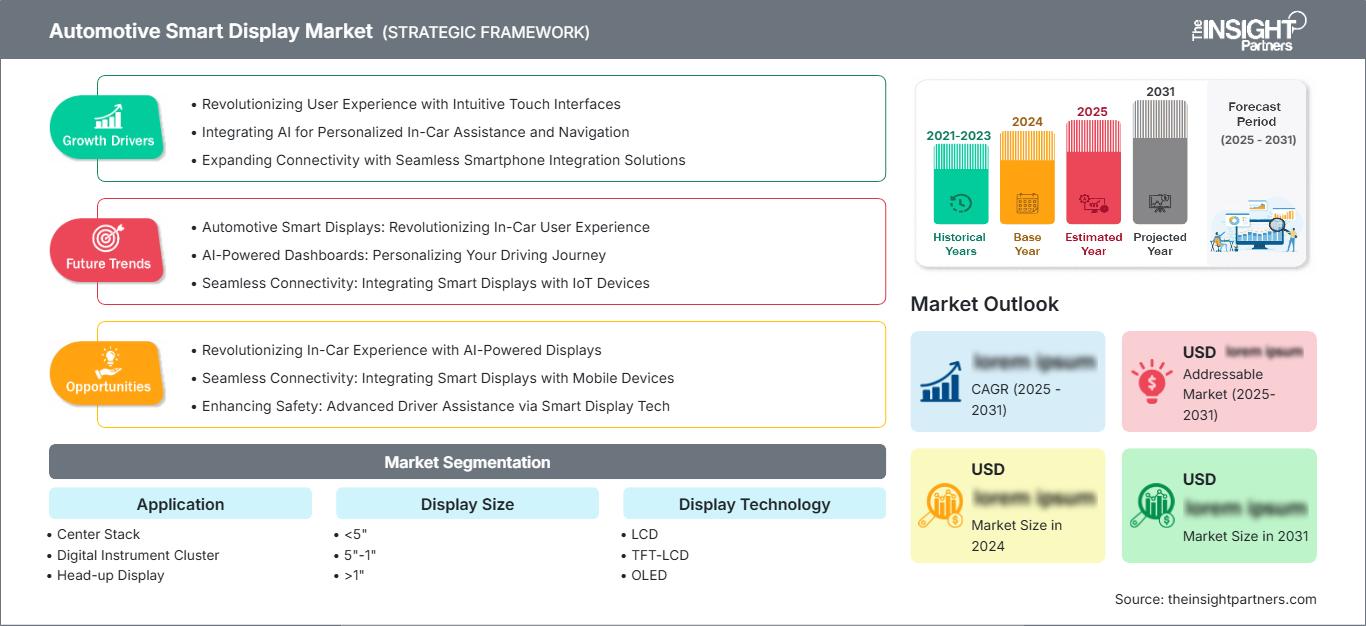
Automotive Smart Display Market: Strategic Insights
Regional Insights
North America Automotive Smart Display Market
North America held 23%–27% share in 2025 and is expected to expand at 5.7%–6.7% through 2034. The Automotive Smart Display Market share is supported by high average transaction prices, premium pickups, SUVs, electric vehicles, and early adoption of large infotainment displays. Safety visualization, navigation, and driver-assistance content are becoming central to cockpit design.
Regional suppliers benefit from strong OEM engineering centers, software partnerships, and demand for configurable clusters and HUDs. Robert Bosch GmbH, Continental AG, DENSO Corporation, Visteon Corporation, Panasonic Automotive Systems Co., Ltd., and Gentex Corporation support smart cockpit programs across passenger vehicles and light commercial models. Adoption is strongest where display-rich interiors support safety, convenience, and brand differentiation.
U.S. Automotive Smart Display Market Market
The U.S. represented 78%–83% of North American demand in 2025 and is projected to grow at 5.8%–6.8%. Large SUVs, pickups, premium sedans, and electric vehicles are key applications, with center stacks and digital instrument clusters absorbing most display value. HUD penetration is rising as ADAS messages require safer forward visibility.
Company presence is reinforced by Tier 1 cockpit engineering, display module sourcing, and automaker demand for integrated user experiences. Visteon Corporation, Gentex Corporation, Panasonic Automotive Systems Co., Ltd., Continental AG, and Robert Bosch GmbH support display programs involving infotainment, camera monitoring, cluster graphics, and windshield projection. Software-defined vehicle roadmaps keep display architecture strategically important.
Europe Automotive Smart Display Market Market
Europe accounted for 25%–29% share in 2025 and is expected to grow at 5.5%–6.5%. Germany leads through premium OEM platforms, high digital cockpit content, and Tier 1 display engineering. The UK supports demand through premium imports, connected infotainment, and safety visualization, while France focuses on compact electric and hybrid dashboards.
Italy and Spain contribute through vehicle assembly, light commercial platforms, and mid-segment infotainment adoption. Continental AG, Robert Bosch GmbH, DENSO Corporation, Visteon Corporation, Nippon Seiki Co., Ltd., and LG Display Co., Ltd. address European needs for high-brightness clusters, HUD optics, and durable cockpit screens. Regulation on driver distraction encourages clearer information hierarchy.
APAC Automotive Smart Display Market Market
APAC held 39%–43% share in 2025 and is projected to grow at 7.4%–8.4%. China leads through electric vehicle scale, multi-screen cockpit adoption, and local display supply. Japan and South Korea support HUD, cluster, and OLED engineering, while India and Australia add demand through connected passenger vehicles.
Industrial policy, localized electronics manufacturing, and fast EV launches strengthen regional momentum. DENSO Corporation, Nippon Seiki Co., Ltd., Panasonic Automotive Systems Co., Ltd., Yazaki Corporation, LG Display Co., Ltd., and Pioneer India Electronics Private Limited support cockpit display supply chains. APAC growth is amplified by compact EVs adopting digital clusters and large center displays.
Middle East & Africa Automotive Smart Display Market Market
Middle East & Africa is projected to grow at 4.8%–5.8%, with Saudi Arabia and the UAE supported by premium imports, connected SUVs, and fleet modernization. South Africa remains the leading assembly and service base, while Rest of MEA demand follows urban mobility, infrastructure spending, and vehicle import flows.
Energy, logistics, tourism, and public infrastructure activity sustain higher-specification vehicles that include larger center displays and navigation interfaces. Heat, glare, and dust increase requirements for brightness, sealing, and thermal reliability. Adoption remains uneven because premium vehicle concentration, dealer service capability, and infotainment localization vary across the region.
Segmentation Analysis
Application
Application is projected to grow at 6.4%–7.4% during 2026–2034. Automotive Smart Display Market forecast spans center stack, digital instrument cluster, head-up display, and rear seat entertainment applications. Center stack screens remain the cockpit hub, clusters handle regulated vehicle information, HUDs improve forward awareness, and rear screens support passenger personalization in premium and family vehicles.
- Center Stack remains the largest application because infotainment, navigation, climate interaction, smartphone integration, and vehicle settings increasingly converge on central touchscreen interfaces across passenger cars and light commercial vehicles.
- Digital Instrument Cluster supports configurable speed, energy, ADAS, and warning information, making it strategically important as automakers replace analog gauges with software-updatable visual interfaces.
- Head-up Display is a high-growth application because navigation cues, speed, and safety alerts can be projected closer to the driver’s forward view, reducing glance time.
- Rear Seat Entertainment benefits from premium SUVs, MPVs, and long-distance mobility use cases where passenger streaming, gaming, and connected services improve cabin experience.
Display Size
Display Size is forecast to grow at 6.2%–7.2% during 2026–2034. Smaller displays serve compact clusters and secondary controls, while mid-size screens dominate mainstream center stacks. Larger displays are gaining strategic value in electric and premium vehicles, where panoramic dashboards, passenger screens, and integrated infotainment zones help automakers differentiate interiors.
- <5" displays serve compact instrument readouts, control panels, and secondary information zones where low cost, packaging flexibility, and basic visibility are more important than immersive interaction.
- 5"-1" displays address mainstream infotainment and cluster needs, balancing usable screen area, dashboard packaging, touch functionality, brightness, and cost for high-volume vehicle platforms.
- >1" displays are expanding in premium and electric vehicles as automakers deploy large center screens, passenger displays, and integrated cockpit layouts for differentiated digital experiences.
Display Technology
Display Technology is projected to grow at 6.5%–7.5% during 2026–2034. LCD remains relevant for cost-sensitive vehicles, TFT-LCD supports higher brightness and touch integration, and OLED is expanding in premium cockpits because it enables high contrast, thin modules, curved design, and energy-efficient visual performance.
- LCD remains important in entry and mid-range vehicles where proven reliability, established supply chains, and controlled cost outweigh the need for premium contrast or curved integration.
- TFT-LCD supports higher resolution, brightness, touch integration, and broader automotive use, making it a preferred technology for center stacks, clusters, and HUD-related display modules.
- OLED is gaining premium relevance because thinness, high contrast, flexible form factors, and lower power consumption support curved dashboards and advanced passenger display concepts.
Vehicle Type
Vehicle Type is forecast to grow at 6.1%–7.1% during 2026–2034. Passenger cars dominate because infotainment, digital clusters, and EV dashboards are high-volume fitments. Light commercial vehicles adopt connected displays for navigation and fleet productivity, while heavy commercial vehicles require durable, readable interfaces for safety and route information.
- Passenger Car generates the largest demand because private vehicles increasingly include infotainment screens, digital clusters, EV energy displays, navigation, and connected services as standard or optional features.
- Light Commercial Vehicle adoption is scaling as fleets need navigation, telematics visualization, rear camera displays, and route information to improve driver productivity and operational safety.
- Heavy Commercial Vehicle demand centers on rugged displays for long-haul visibility, ADAS warnings, fleet management, camera monitoring, and driver information in harsh operating environments.
Opportunity Snapshot
| Application | Revenue Contribution | Trend Tag | Adoption Stage |
| Center Stack | High | Cockpit Hub | Mature |
| Digital Instrument Cluster | High | Configurable UI | Scaling |
| Head-up Display | Medium | Forward Vision | Scaling |
| Rear Seat Entertainment | Medium | Passenger Media | Emerging |
Automotive Smart Display Market Growth Drivers and Impact Analysis
Software-Defined Cockpits Increase Display Content
There is an increasing need for more information to be displayed within the passenger compartment due to the software defined platforms for the vehicles. Displays are used by automakers for navigating, ADAS warnings, charging, personalization, entertainment and over the air updates. The displays have become more than hardware accessories in the modern day, as it becomes part of the core interface for delivering value through the vehicle. The commercial implications of this trend include the increase in content per vehicle, software support needs, and more cooperation between the panel manufacturers, cockpit domain controller manufacturers and the Human Machine Interface software developers.
Electric Vehicles Reshape Dashboard Architecture
Smart displays get propelled by electric vehicles due to the need for visualization of the battery range, charging process, regeneration, thermal management, and even energy consumption during route navigation. There is no traditional engine system and therefore, the cockpit has become the most significant point of information transfer. The electric vehicles also use massive displays and small dashboards to showcase their digital orientation, thus, putting pressure on competing brands to increase display sizes and resolutions. It is felt strongly on the center stack displays, digital clusters, and passenger displays since they can be upgraded via software updates. The benefits for display makers include high brightness, lower power consumption, curved modules, and system compatibility with EVs.
Safety Visualization Drives HUD and Cluster Demand
Driver assistance systems lead to the necessity for visual information to be timely and easy to understand. Speeding, lane guidance, collision detection, navigation directions, and blind spots must be communicated without overloading the driver with too much information. Head-up displays and digital clusters fulfill this need by making useful information closer to the normal field of vision and adjusting information priorities depending on driving situations. From a business perspective, increased demand will be made for bright projector lamps, cluster graphics, and interface validation of human machine interface. Optical, electronic, and logical solution providers can help OEMs make their cars safer and more luxurious.
Automotive Smart Display Market Future Trends
OLED and Curved Cockpit Surfaces Move Mainstream
The Automotive Smart Display Market trends will be characterized by the dominance of OLED technology, curved displays, and integrated dashboard surfaces. Premium cars are already using the wide and pillar-to-pillar solution to integrate information zones for drivers, center console and passengers. In the forecasted timeframe, reductions in cost and automotive lifecycle performance gains will make this concept applicable for upper mid-segment automobiles. This trend rewards display manufacturers able to provide high contrast, non-reflecting, bright, and form-factor adaptable solutions that comply with thermal and vibration requirements. Additionally, it impacts the processes in the interior design due to the transformation of display modules into structural visual parts.
AR-HUD Expands from Premium Models to Broader Platforms
In terms of AR-HUD technology, we can expect the development to move away from luxury applications due to advances in the miniaturization of optics, higher brightness of projection units, and increased collaboration with ADAS. In the future, the system will project navigation, lane guidance, warnings about obstacles, and adaptive cruise control on the driver’s field of vision in more depth and alignment with his eyesight. The adoption of the technology will be driven by decreasing costs, adaptation to windshields, eye box, and regulator acceptance of projected guidance.
Automotive Smart Display Market Opportunities
Localized Display Module Production in Asia Pacific
Investment in Asia Pacific is an attractive prospect to manufacture localized display modules in proximity to electric vehicles and cockpit electronics centers. Forecasts for the Automotive Smart Display Market are indicative of capacity building when China, Japan, South Korea, and India work in combination with their vehicle manufacturing, electronics ecosystem, and localization policies. Investment will be focused on services such as bonding, touch, cover glass, backlight, OLED module, and validation services in proximity to the OEM programs. Local manufacturing will minimize risks from logistics and help suppliers cope with model refresh cycles. This will be a favorable option for companies with both reliability and low-cost manufacturing capability.
HUD Integration for ADAS and Navigation Platforms
The combination of HUD offers suppliers a viable opportunity to develop systems which combine optics, software, and messaging on safety. With increasing use of ADAS features, there is a need for automakers to display lane guidance, speed limit, warnings, and navigation in the form of messages in the center displays of the car in an intuitive manner. Suppliers can develop projectors, combiners, calibration systems for windshields, graphic processors and validation systems that work for different types of cars. There is an excellent opportunity in developing HUDs as they increase the cockpit value and differentiation from the display size alone.
Recent Developments
- June 2025: LG Display Co., Ltd. showcased automotive OLED cockpit concepts at SID 2025, including a 57-inch pillar-to-pillar OLED and an 18-inch sliding OLED for rear-seat applications. The demonstrations highlighted flexible, high-contrast, space-efficient display designs for premium vehicles and software-defined cabins.
- July 2025: Omdia reported that LTPS TFT-LCD and OLED technologies would exceed 50% of automotive display panel revenue in 2025, reflecting a shift toward higher-value cockpit displays used in center stack, instrument cluster, HUD, and passenger display applications.
- April 2025: Tianma Microelectronics is looking to expand its already strong business in automotive displays with some new products: tandem-stack curved OLED dashboard displays, a 3D instrument cluster, and a 3D head-up display (HUD).
Frequently Asked Questions

- Comprehensive Market Sizing and Forecast Analysis
- Detailed Segmentation Analysis
- In-Depth Market Dynamics Assessment
- Regional and Country-Level Insights
- Competitive Landscape and Company Benchmarking
- Strategic Business Intelligence
Recent Reports
Testimonials

The Insight Partners' SCADA System Market report is comprehensive, with valuable insights on current trends and future forecasts. The team was highly professional, responsive, and supportive throughout. We are very satisfied and highly recommend their services.
RAN KEDEM Partner, Reali Technologies LTDs
I requested a report on a very specific software market and the team produced the report in a few days. The information was very relevant and well presented. I then requested some changes and additions to the report. The team was again very responsive and I got the final report in less than a week.
JEAN-HERVE JENN Chairman, Future Analytica
We worked with The Insight Partners for an important market study and forecast. They gave us clear insights into opportunities and risks, which helped shape our plans. Their research was easy to use and based on solid data. It helped us make smart, confident decisions. We highly recommend them.
PIYUSH NAGPAL Sr. Vice President, High Beam Global
The Insight Partners delivered insightful, well-structured market research with strong domain expertise. Their team was professional and responsive throughout. The user-friendly website made accessing industry reports seamless. We highly recommend them for reliable, high-quality research services
YUKIHIKO ADACHI CEO, Deep Blue, LLC.
This is the first time I have purchased a market report from The Insight Partners.While I was unsure at first, I visited their web site and felt more comfortable to take the risk and purchase a market report.I am completely satisfied with the quality of the report and customer service. I had several questions and comments with the initial report, but after a couple of dialogs over email with their analyst I believe I have a report that I can use as input to our strategic planning process.Thank you so much for taking the extra time and making this a positive experience.I will definitely recommend your service to others and you will be my first call when we need further market data.
JOHN SUZUKI President and Chief Executive Officer, Board Director, BK Technologies
I wish to appreciate your support and the professionalism you displayed in the course of attending to my request for information regarding to infectious disease IVD market in Nigeria. I appreciate your patience, your guidance, and the fact that you were willing to offer a discount, which eventually made it possible for us to close a deal. I look forward to engaging The Insight Partners in the future, all thanks to the impression you have created in me as a result of this first encounter.
DR CHIJIOKE ONYIA MANAGING DIRECTOR, PineCrest Healthcare Ltd.Reason to Buy
- Informed Decision-Making
- Understanding Market Dynamics
- Competitive Analysis
- Identifying Emerging Markets
- Customer Insights
- Market Forecasts
- Risk Mitigation
- Boosting Operational Efficiency
- Strategic Planning
- Investment Justification
- Tracking Industry Innovations
- Aligning with Regulatory Trends





 Get Free Sample for