
Automotive Speakers Market Growth, Analysis, and Forecast by 2034
Automotive Speakers Market Size and Forecasts (2021 - 2034), Global and Regional Share, Trends, and Growth Opportunity Analysis Report Coverage : By Type (Component, Coaxial, Subwoofer), Vehicle (Passenger, Commercial, Two- wheeler), Installation (Door, Dashboard, Rear Deck), Technology (Bluetooth & Wireless Connectivity, Smart Speakers, Multi-zone)
- Status : Data Released
- Report Code : TIPRE00039741
- Category : Electronics and Semiconductor
- No. of Pages : 150
- Available Report Formats :


- Last update date : July 20, 2026


2025 Market Size
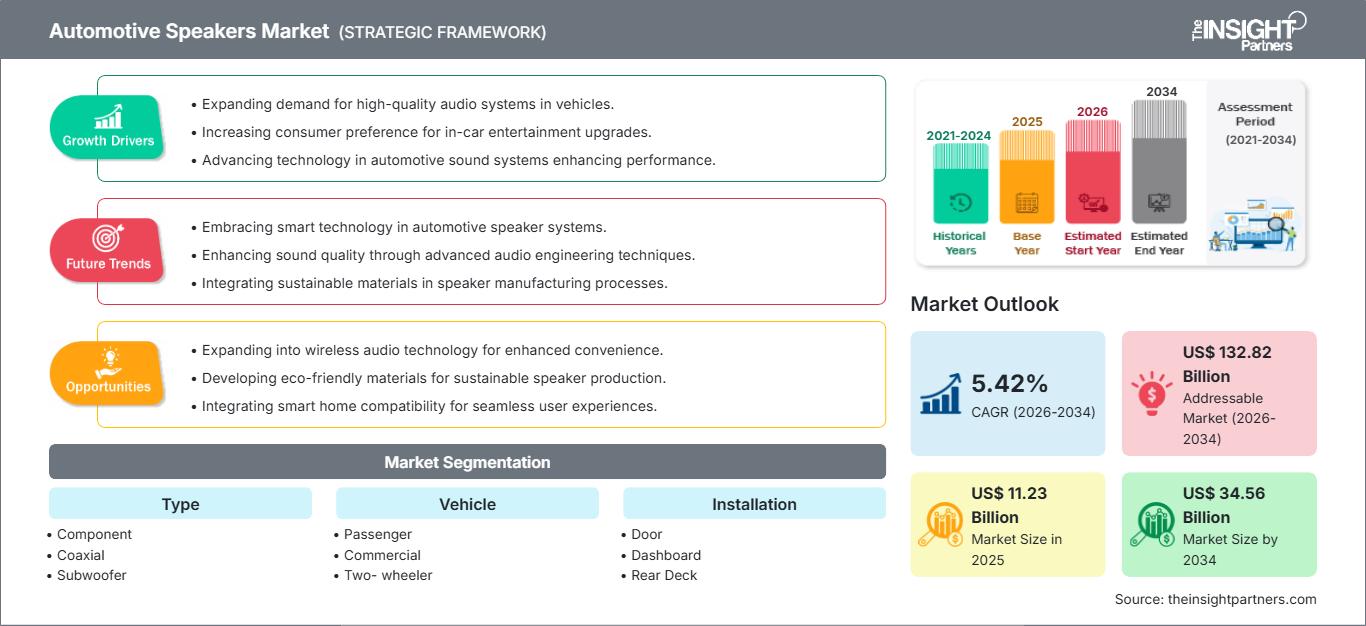
US$ 11.23 Bn
Base year value
2034 Forecast
US$ 34.56 Bn
Projected by 2034
CAGR 2026-2034
5.42 %
Growth rate
Addressable Market
US$ 132.82 Bn
(2026-2034)
The Automotive Speakers market was valued at US$ 11.23 Billion in 2025 and is projected to reach US$ 34.56 Billion by 2034, registering a CAGR of 5.42% during 2026–2034. Automotive Speakers are becoming central to cabin experience, infotainment differentiation, connected mobility, and electric vehicle comfort as automakers integrate richer sound reproduction across mainstream, premium, and aftermarket vehicle platforms.
North America is positioned for steady Automotive Speakers market size expansion, with regional demand expected to grow at a CAGR of 4.7–5.5% during 2026–2034. Structural drivers include higher speaker counts in pickup and SUV trims, rapid adoption of wireless infotainment, and EV cabins that make audio quality more noticeable because powertrain noise is lower than in combustion vehicles.
Automotive Speakers Market Assessment and Insights
- North America accounted for 26–30% share in 2025 and is growing at a CAGR of 4.7–5.5% during 2026–2034, supported by premium trims, EV launches, and aftermarket upgrades.
- US represented 78–82% of North American revenue in 2025 and is growing at a CAGR of 4.9–5.7% during 2026–2034, driven by pickup, SUV, and luxury vehicle audio packages.
- Europe held 21–25% share in 2025 and is growing at a CAGR of 4.4–5.2% during 2026–2034, led by Germany, France, the UK, Italy, and Spain.
- Asia Pacific held 39–43% share in 2025 and is growing at a CAGR of 6.1–6.9% during 2026–2034, with China, Japan, South Korea, and India leading vehicle output and electronics localization.
- Largest Segment: Passenger vehicles held 58–62% market share in 2025 and are growing at a CAGR of 5.0–5.8% during 2026–2034, reflecting high speaker fitment per model.
- High Growth Segment Smart Speakers represented 14–18% market share in 2025 and are growing at a CAGR of 7.1–7.9% during 2026–2034, supported by voice, software, and personalized cabin audio.
- Key companies analyzed in detail: Pioneer Corporation; HARMAN International Industries, Incorporated; Sony Group Corporation; JVCKENWOOD Corporation; JL Audio, Inc.; Stillwater Designs, Inc.; Elettromedia S.p.A.; Bose Corporation; Alpine Electronics, Inc.; Focal-JMlab SAS.
Source: The Insight Partners' analysis based on proprietary research, government publications, company annual reports, investor presentations, industry databases, and expert interviews.
Automotive audio has moved from basic two-speaker radio systems to multi-driver architectures linked with infotainment software, amplifiers, digital signal processing, and vehicle noise management. Production dynamics now depend on platform-level acoustic engineering, lightweight cone materials, component standardization, and factory calibration. OICA data showing global vehicle production at 96.4 million units in 2025 reinforces the scale of addressable installations across passenger and commercial vehicles.
Forward demand will be shaped by EV penetration, premiumization in emerging markets, and regulation that favors safer, quieter, and better-connected cabins. The IEA reported electric car sales above 17 million units in 2024 and expected more than 20 million in 2025, creating a larger base for audio tuning, active noise management, and software-defined entertainment features across regional vehicle programs.
Automotive Speakers Market Report Scope
| Report Attribute | Details |
|---|---|
| Market size in 2025 | US$ 11.23 Billion |
| Market Size by 2034 | US$ 34.56 Billion |
| Global CAGR (2026 - 2034) | 5.42% |
| Historical Data | 2021-2024 |
| Forecast period | 2026-2034 |
Automotive Speakers Market Analysis
Automotive Speakers market growth is being driven by rising consumer expectations for immersive sound, smartphone mirroring, streaming services, and cleaner EV cabin acoustics. Speaker systems are no longer standalone hardware because they interact with infotainment processors, amplifiers, microphones, and cabin materials. Demand also benefits from higher trims in SUVs, luxury cars, and long-distance commercial vehicles where occupants expect entertainment quality comparable with home audio environments.
The value chain includes magnet suppliers, diaphragm material producers, voice-coil and basket manufacturers, acoustic engineers, Tier 1 infotainment integrators, OEM purchasing teams, distributors, and installers. Supply dynamics depend on neodymium pricing, automated assembly, vibration testing, moisture resistance, weight control, and regional logistics. Buyers increasingly evaluate sensitivity, impedance, power handling, heat tolerance, distortion, and compatibility with Bluetooth, wireless connectivity, and software calibration tools.
Automotive Speakers market analysis shows a competitive landscape where brand equity, OEM relationships, acoustic engineering, installation simplicity, and amplifier integration define positioning. Pioneer Corporation, JVCKENWOOD Corporation, Sony Group Corporation, and Alpine Electronics, Inc. maintain strong aftermarket reach, while HARMAN International Industries, Incorporated, Bose Corporation, and Focal-JMlab SAS compete through premium OEM systems, branded sound signatures, and cabin-specific tuning.
Investment is moving toward lightweight components, lower-profile speakers, smart tuning, multi-zone architectures, and high-efficiency transducers that reduce power draw without sacrificing output. JL Audio, Inc., Stillwater Designs, Inc., and Elettromedia S.p.A. remain influential in specialist and enthusiast channels. Suppliers that combine reliable hardware with software-ready acoustic support can defend margins as automakers consolidate electronics platforms and reduce mechanical complexity.
● REPORT CUSTOMIZATION
Tailor This Report To Align With Your Specific Business Requirements
This report can be customized to align precisely with your business objectives, scope, and target markets. Customization options include tailored segmentation, geography, competitive analysis, and strategic insights to support informed decision-making.
Customize This Report →WHAT YOU CAN ADJUST
- ● Segmentations
- ● Geography
- ● Competitive Analysis
- ● Language Preferences
Automotive Speakers Market: Strategic Insights
Regional Insights
North America Automotive Speakers Market
North America held 26–30% of the Automotive Speakers market share in 2025 and is projected to grow at a CAGR of 4.7–5.5% during 2026–2034. Demand is strongest in SUVs, pickups, premium trims, and aftermarket upgrades where consumers add component speakers, subwoofers, and amplifier-supported systems to improve bass response, clarity, and streaming playback quality.
Regional suppliers benefit from established retail installers, vehicle-specific kits, and OEM demand for branded audio. EV adoption also supports acoustic upgrades because quiet cabins reveal distortion, rattles, and poor staging more clearly. Mexico and Canada contribute through assembly networks, while US consumers sustain high aftermarket spending on door speakers, dashboard tweeters, rear deck systems, and powered subwoofer packages.
U.S. Automotive Speakers Market
The U.S. represented 78–82% of North American revenue in 2025 and is expected to grow at a CAGR of 4.9–5.7% during 2026–2034. Company presence is broad through HARMAN International Industries, Incorporated, Bose Corporation, Pioneer Corporation, JL Audio, Inc., Stillwater Designs, Inc., and specialist installer networks serving factory replacement and performance audio demand.
Application trends include pickup-specific subwoofers, speaker improvements in SUV doors, premium sound packages for electric vehicles (EVs), and component sets for installation in original equipment manufacturer (OEM) mounting positions without panel cutting. Signal processing and connectivity have become essential for integrating a consumer’s smartphone into the vehicle. Sound systems are an effective way for OEMs to differentiate trims.
Europe Automotive Speakers Market
Europe held 21–25% share in 2025 and is forecast to grow at a CAGR of 4.4–5.2% during 2026–2034. Germany is the leading country because premium OEM platforms, advanced interiors, and high-end branded systems drive demand for tuned door, dashboard, and rear deck speakers. The UK supports demand through luxury models, aftermarket channels, and motorsport-influenced audio customization.
France, Italy, and Spain increase volumes through passenger car production, EV uptake in cities, and retail replacement demand. Europe focuses on the use of appropriate materials, recycling, lightweight design, and low distortion. The right speaker and cone manufacturers, along with software calibration suppliers, stand to benefit as automakers strive for premium sound quality without increasing battery load.
APAC Automotive Speakers Market
APAC Automotive Speakers market accounted for 39–43% share in 2025 and is projected to grow at a CAGR of 6.1–6.9% during 2026–2034. China leads through 2025 vehicle production scale, EV adoption, and speaker-count expansion in smart cabins.
Japan and South Korea have a strong presence in acoustic technology and high-end electronics, whereas India is seeing increasing demand driven by passenger car production and infotainment manufacturing. Australia will contribute to demand from after-market and commercial vehicle fleets. Supportive policies for EVs, local electronics, and connected cars will drive the region.
Middle East & Africa Automotive Speakers Market
Middle East & Africa Automotive Speakers Market is projected to grow at a CAGR of 4.4-5.2% between 2026 and 2034. Saudi Arabia drives growth through the expansion of vehicle retail, premium SUV sales, and investments in mobility infrastructure.
South Africa is relevant due to assembly activities, mining fleets, and replacements, whereas the rest of MEA will be growing due to public transportation, logistics, and imports of used vehicles. Harsh conditions increase the need for heat resistance, corrosion resistance, strong mounting, and serviceability of speakers.
Segmentation Analysis
Type
Type is projected to grow at a CAGR of 5.0–5.8% during 2026–2034. The Automotive Speakers market scope covers component systems for high-fidelity separation, coaxial units for factory replacement, and subwoofers for low-frequency performance. Demand depends on installation skill, vehicle architecture, amplifier matching, and the consumer’s willingness to trade cost and space for acoustic quality.
- Component systems appeal to enthusiasts and premium OEM programs because separated tweeters and woofers improve staging, imaging, and tonal balance when paired with proper crossovers.
- Coaxial speakers retain broad demand in factory replacement and value upgrades because integrated tweeter layouts simplify installation while improving clarity over aging stock systems.
- Subwoofer products are strategically important for bass performance in SUVs, pickups, and custom builds, especially where compact powered enclosures solve space and wiring constraints.
Vehicle
Vehicle is expected to grow at a CAGR of 5.2–6.0% during 2026–2034. Passenger vehicles dominate revenue because higher speaker counts are common across compact SUVs, sedans, EVs, and luxury models. Commercial vehicles are improving cabin comfort for drivers, while two-wheelers create smaller but growing demand for weather-resistant audio in touring and premium recreation categories.
- Passenger vehicles hold the largest position because infotainment screens, premium trims, connected services, and quieter EV cabins make speaker quality a visible purchase differentiator.
- Commercial vehicles require durable, serviceable speakers for driver comfort, hands-free communication, navigation prompts, and infotainment continuity across vans, buses, and long-haul trucks.
- Two-wheeler demand is selective but strategically relevant in touring motorcycles, scooters, and recreation platforms where compact weather-resistant speakers support navigation and entertainment.
Installation
Installation is forecast to grow at a CAGR of 4.9–5.7% during 2026–2034. Door locations remain the largest mounting area because they suit midbass drivers and factory harness routing. Dashboard speakers support voice and treble clarity, while rear deck placements reinforce spatial fill. Design decisions depend on cabin volume, trim packaging, panel vibration, and service access.
- Door installations dominate because front and rear doors provide practical locations for midbass drivers, factory wiring, and high-volume replacement in passenger vehicles.
- Dashboard installations are important for tweeters, center channels, and voice clarity, especially where navigation, calls, and driver alerts require precise frontal sound placement.
- Rear Deck placements support spatial fill and stronger rear cabin output, making them relevant in sedans, premium trims, and aftermarket systems seeking fuller staging.
Technology
Technology is projected to grow at a CAGR of 6.3–7.1% during 2026–2034. Wireless integration, smart speaker functions, and multi-zone control are reshaping audio design from hardware replacement toward software-coordinated cabin experiences. Growth is strongest where vehicles combine microphones, voice assistants, DSP tuning, and independent passenger zones for entertainment, calls, navigation, and alerts.
- Bluetooth & Wireless Connectivity supports mainstream adoption by enabling phone-based streaming, calls, and app integration without complex wiring or source-unit replacement.
- Smart Speakers are gaining strategic relevance as voice control, personalization, and software updates turn audio hardware into part of the connected cabin interface.
- Multi-zone systems address premium EVs, family vehicles, and ride-hailing cabins by allowing different occupants to receive targeted entertainment, calls, or alerts.
Opportunity Snapshot
| Technology | Revenue Contribution | Trend Tag | Adoption Stage |
| Bluetooth & Wireless Connectivity | High | Wireless Streaming | Mature |
| Smart Speakers | Medium | Voice Control | Scaling |
| Multi-zone | Medium | Cabin Zones | Emerging |
Automotive Speakers Market Growth Drivers and Impact Analysis
EV cabin quietness raises expectations for premium sound
Electric cars produce lower cabin noise levels, which makes subpar speaker response, distortion, panel vibrations, and a lack of bass much more audible to the driver and other occupants. It makes a difference in market effects, since audio quality is now a product feature rather than just an option. It allows car manufacturers to diversify their electric-vehicle range using speaker technology without changing any drivetrain components. It helps equipment suppliers if they manufacture small speakers and magnets and tune them for particular cabins.
Factory premium trims increase speaker content per vehicle
Mainstream cars are now integrating technologies that were previously reserved for high-end cabins, such as branded audio systems, larger infotainment displays, phone connectivity, and additional speakers around the car’s doors, dashboard, and rear. The effect is increased content per vehicle despite the low growth rate of vehicle production. Original equipment manufacturers leverage audio improvements to aid price laddering, while the aftermarket industry benefits from opportunities where manufacturers fail to integrate new technology into existing car lines. The author likes firms that can reliably supply parts in large quantities, mount them in cars, and maintain tonal consistency worldwide.
Aftermarket upgrades remain resilient across aging vehicle fleets
Car owners keep replacing their old speakers and upgrading their basic audio systems, especially in countries where many vehicles are older than average. Old speaker cones, low-quality bass, poor Bluetooth connectivity, and a lack of power make a replacement obvious. The market influence lies in the constant demand through retail stores, specialists, Internet shops, and customized solutions. Being resilient to market changes is useful because it provides an alternative source of income outside the new-vehicle sales cycle.
Automotive Speakers Market Future Trends
Software-defined audio will reshape cabin sound architecture
Automotive Speakers market trends point toward software-based audio systems that update calibrations, equalization, noise control, and passenger preferences via vehicle electronics, which are on the horizon. Future speaker designs will require more coordination among speakers, microphones, amplifiers, and processors instead of hardware improvements alone. Such an approach opens doors for suppliers who can accommodate acoustic modeling, firmware compatibility, and security. The market trend favors speakers that behave predictably after software tuning, take up little space in the car interior, and consume low power.
Immersive spatial playback will move into mainstream vehicles
The development of spatial audio has moved beyond being exclusive to luxury brands due to advancements in processing power efficiency, allowing for the showcasing of their capabilities with regular front/rear loudspeaker placement. This is important so auto manufacturers can offer unique features without equipping their vehicles with expensive roof or headlining hardware. The future would see a focus on realistic four-channel or multi-zone systems, tunable systems, and compatibility with streaming media. Those suppliers that can assist car manufacturers and upfitters in creating spatial audio effects with minimal hardware will gain the upper hand.
Automotive Speakers Market Opportunities
Vehicle-specific kits for pickups, SUVs, and EVs
Automotive Speakers Market Forecasts support an opportunity for manufacturers who offer custom-made kits including brackets, wiring harnesses, crossover units, and enclosure dimensions. Pickup trucks, SUVs, and electric cars often have dedicated customer communities and recurring installation procedures. Brands can capitalize on this opportunity by identifying high-demand platform designs, collaborating with certified installers, and providing proven kits for installations indoors, dashboards, rear decks, and subwoofers. Such a strategy will minimize installation risk, provide consumers with greater confidence, and enable brands to charge higher prices than for replacement speakers.
OEM partnerships for smart and multi-zone sound packages
The OEM collaboration represents an interesting option as car manufacturers look to incorporate audio branding into their vehicles that can be controlled by voice assistants, personalized for passengers, alert the driver, and updated over the air. Suppliers could address mid-premium cars rather than just flagship models with scalable speaker modules that range from simple wireless speakers to multi-zoned systems. Investments should be made in collaborative R&D, acoustic simulation, low-power transducers, and validation across multiple platforms. The key success factor will be providing a measurable cabin sound that aligns with the brand identity.
Recent Developments
- January 2026: Building on decades of audio innovation, Pioneer, a global leader in in-vehicle sound and aftermarket car electronics, introduces SPHERA, the world’s first aftermarket spatial audio in-dash receiver to feature Dolby Atmos playback in Apple CarPlay. To date, in-vehicle Dolby Atmos has been available only in models equipped with Dolby Atmos-enabled sound systems. With SPHERA, Pioneer expands access to Dolby Atmos through an aftermarket solution that can be installed in millions of existing vehicles, delivering an immersive sound experience leveraging speakers already in the vehicle.
- November 2025: Antolin, a global supplier of technological solutions for vehicle interiors, and Mobility Audio Innovations (MAI), a subsidiary of Bongiovi Media & Technology (BMT), are proud to announce the global launch of their next-generation automotive audio systems. This milestone follows the strategic collaboration announced in Q1 2025 and marks a significant step forward in redefining in-vehicle infotainment, communication, and acoustic design.
- January 2025: Pioneer showcases an immersive in-vehicle listening experience that combines Apple CarPlay, which now includes support for Spatial Audio and Dolby Atmos, with a 4-channel solution applicable to many vehicles, including the majority of automobiles on the road today. Installed in a late-model mid-size sedan for demonstrations during CES 2025, this immersive listening experience focuses on hearing what is possible using only speakers installed in the vehicle’s original front and rear locations and utilizing only 4 discrete amplifier channels, demonstrating a potential solution for adding Dolby Atmos playback capability to both aftermarket in-dash receivers and OEM vehicle applications.
Frequently Asked Questions

- Comprehensive Market Sizing and Forecast Analysis
- Detailed Segmentation Analysis
- In-Depth Market Dynamics Assessment
- Regional and Country-Level Insights
- Competitive Landscape and Company Benchmarking
- Strategic Business Intelligence
Recent Reports
Testimonials

The Insight Partners' SCADA System Market report is comprehensive, with valuable insights on current trends and future forecasts. The team was highly professional, responsive, and supportive throughout. We are very satisfied and highly recommend their services.
RAN KEDEM Partner, Reali Technologies LTDs
I requested a report on a very specific software market and the team produced the report in a few days. The information was very relevant and well presented. I then requested some changes and additions to the report. The team was again very responsive and I got the final report in less than a week.
JEAN-HERVE JENN Chairman, Future Analytica
We worked with The Insight Partners for an important market study and forecast. They gave us clear insights into opportunities and risks, which helped shape our plans. Their research was easy to use and based on solid data. It helped us make smart, confident decisions. We highly recommend them.
PIYUSH NAGPAL Sr. Vice President, High Beam Global
The Insight Partners delivered insightful, well-structured market research with strong domain expertise. Their team was professional and responsive throughout. The user-friendly website made accessing industry reports seamless. We highly recommend them for reliable, high-quality research services
YUKIHIKO ADACHI CEO, Deep Blue, LLC.
This is the first time I have purchased a market report from The Insight Partners.While I was unsure at first, I visited their web site and felt more comfortable to take the risk and purchase a market report.I am completely satisfied with the quality of the report and customer service. I had several questions and comments with the initial report, but after a couple of dialogs over email with their analyst I believe I have a report that I can use as input to our strategic planning process.Thank you so much for taking the extra time and making this a positive experience.I will definitely recommend your service to others and you will be my first call when we need further market data.
JOHN SUZUKI President and Chief Executive Officer, Board Director, BK Technologies
I wish to appreciate your support and the professionalism you displayed in the course of attending to my request for information regarding to infectious disease IVD market in Nigeria. I appreciate your patience, your guidance, and the fact that you were willing to offer a discount, which eventually made it possible for us to close a deal. I look forward to engaging The Insight Partners in the future, all thanks to the impression you have created in me as a result of this first encounter.
DR CHIJIOKE ONYIA MANAGING DIRECTOR, PineCrest Healthcare Ltd.Reason to Buy
- Informed Decision-Making
- Understanding Market Dynamics
- Competitive Analysis
- Identifying Emerging Markets
- Customer Insights
- Market Forecasts
- Risk Mitigation
- Boosting Operational Efficiency
- Strategic Planning
- Investment Justification
- Tracking Industry Innovations
- Aligning with Regulatory Trends





 Get Free Sample for