
Automotive Wheel Coating Market Trends, Share & Demand by 2034
Coverage: By Coating Product (Primer, Electro coat, Basecoat and Clear coat); Technology (waterborne Coating, Solvent-borne, Powder Coating and UV-Curved);Texture (Metallic and Solid); and End-user (Light Vehicle OEM, Commercial OEM and Automotive Refinish), and Geography (North America, Europe, Asia Pacific, and South and Central America)
- Status : Data Released
- Report Code : TIPTE100000645
- Category : Chemicals and Materials
- No. of Pages : 150
- Available Report Formats :


- Last update date : August 13, 2026


2025 Market Size
US$ 6.16 Bn
Base year value
2034 Forecast
US$ 7.98 Bn
Projected by 2034
CAGR 2026-2034
2.92 %
Growth rate
Addressable Market
US$ 64.20 Bn
(2026-2034)
The Automotive Wheel Coating market was valued at US$ 6.16 Billion in 2025 and is projected to reach US$ 7.98 Billion by 2034, registering a CAGR of 2.92% from 2026 to 2034. The market growth is supported by increasing vehicle production, rising demand for corrosion protection, and growing adoption of advanced coating technologies that enhance wheel durability, appearance, and resistance against environmental conditions across automotive applications.
North America is expected to remain a significant contributor to the Automotive Wheel Coating Market size landscape, supported by established vehicle manufacturing capabilities, increasing aluminum wheel adoption, and demand for premium finishing solutions. The regional market is anticipated to expand at an estimated CAGR range of 2.5–3.5% during 2026–2034, driven by OEM coating upgrades, refinishing activities, and regulatory emphasis on lower-emission coating technologies.
Automotive Wheel Coating Market Assessment and Insights
- North America: North America accounted for an estimated 28–32% share in 2025 and is expected to grow at a 2.5–3.5% CAGR during 2026–2034. The region benefits from strong OEM production, advanced refinishing infrastructure, and the adoption of sustainable coating solutions.
- U.S.: The U.S. represented approximately 22–26% share in 2025 and is projected to register a 2.5–3.5% CAGR during 2026–2034. Vehicle manufacturing, aftermarket refinishing, and premium wheel demand support market expansion.
- Europe: Europe held nearly 24–28% share in 2025 and is expected to grow at a 2.0–3.0% CAGR during 2026–2034. Germany, France, Italy, and the UK contribute through premium vehicle production and sustainable coating adoption.
- Asia Pacific: Asia Pacific captured around 32–36% share in 2025 and is forecast to expand at a 3.0–4.0% CAGR during 2026–2034. China, Japan, South Korea, and India drive demand through automotive manufacturing growth.
- Largest Segment: Basecoat accounted for approximately 30–34% market share in 2025 and is expected to grow at a 2.5–3.5% CAGR during 2026–2034 due to its importance in wheel appearance and finishing processes.
- High Growth Segment: Powder Coating represented nearly 18–22% market share in 2025 and is projected to expand at a 3.5–4.5% CAGR during 2026–2034 due to efficient application and reduced emission advantages.
- Key companies analyzed in detail: PPG Industries, Inc., BASF SE, Akzo Nobel N.V., Axalta Coating Systems LLC, The Eastwood Company, Kansai Paint Co., Ltd., Mile High Powder Coating, Inc., Nordson Corporation, The Sherwin-Williams Company, Valspar Corporation, Jotun A/S, and Nippon Paint Holdings Co., Ltd.
Source: The Insight Partners' analysis based on proprietary research, government publications, company annual reports, investor presentations, industry databases, and expert interviews.
The development of the Automotive Wheel Coating Market industry has progressed from conventional protective finishes toward advanced multi-layer coating systems designed for improved durability and aesthetics. There is a trend towards the use of primer, electrocoat, basecoat, and clear coat to offer protection from rust, road dust, ultraviolet rays, and abrasions. The automation of the process, the curing process, and powder coatings will have an impact on production efficiency and coating performance.
The future market growth will result from the investments made in the manufacture of electric vehicles, lightweight parts, and sustainable automotive components. The rise of automotive clusters in the Asia Pacific region will contribute to the rise of demand for coatings due to increased production capabilities. Meanwhile, low-emission coating remains a focus in North America and Europe.
Automotive Wheel Coating Market Report Scope
| Report Attribute | Details |
|---|---|
| Market size in 2025 | US$ 6.16 Billion |
| Market Size by 2034 | US$ 7.98 Billion |
| Global CAGR (2026 - 2034) | 2.92% |
| Historical Data | 2021-2024 |
| Forecast period | 2026-2034 |
Automotive Wheel Coating Market Analysis
The Automotive Wheel Coating Market growth is closely linked with vehicle manufacturing trends, increasing alloy wheel penetration, and rising demand for long-lasting surface protection. The value chain consists of coating manufacturers, resin and pigment suppliers, equipment suppliers, wheel manufacturers, original equipment manufacturers (OEMs), and aftermarkets. The coating suppliers design specific formulas that consider the temperatures, adhesiveness, appearance, and regulations. The rise in the number of vehicles, coupled with an increased need for replacement wheels, promotes the use of refinishing.
There is a rising trend among automotive wheel manufacturers to employ coating processes that are automated and more efficient in increasing production and minimizing wastage of materials. The value chain is evolving into coating methods that are efficient, emit fewer amounts of volatile organic compounds (VOCs), and produce high-quality finishes. There is a continued demand for powder and waterborne coatings.
The Automotive Wheel Coating Market analysis indicates a competitive environment shaped by global coating producers, specialty formulators, and application technology providers. Companies such as PPG Industries, Inc., BASF SE, Akzo Nobel N.V., Axalta Coating Systems LLC, Kansai Paint Co., Ltd., and The Sherwin-Williams Company focus on developing advanced coating systems for OEM and refinish applications. Such tactics include innovative formulations, geographical expansion, and collaboration with automotive firms.
The investment trend is oriented towards sustainable paints, innovative curing systems, and greater application efficiency. Nordson Corporation is involved through coating applicator systems, while specialized companies such as The Eastwood Company and Mile High Powder Coating, Inc., cater to refinishing and powder coating needs. Competitive advantage depends on product effectiveness, compliance with regulations, product customization, and meeting automotive manufacturing needs.
● REPORT CUSTOMIZATION
Tailor This Report To Align With Your Specific Business Requirements
This report can be customized to align precisely with your business objectives, scope, and target markets. Customization options include tailored segmentation, geography, competitive analysis, and strategic insights to support informed decision-making.
Customize This Report →WHAT YOU CAN ADJUST
- ● Segmentations
- ● Geography
- ● Competitive Analysis
- ● Language Preferences
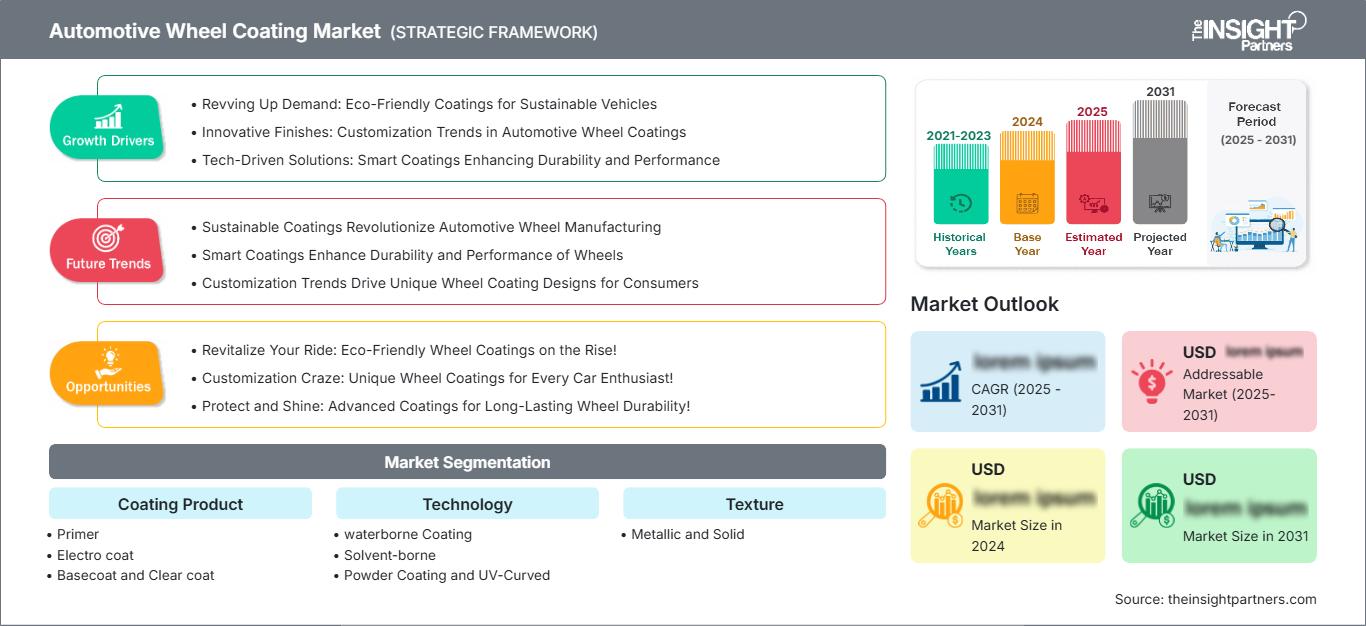
Automotive Wheel Coating Market: Strategic Insights
Regional Insights
North America Automotive Wheel Coating Market
North America represented an estimated 28–32% share of the Automotive Wheel Coating market in 2025 and is projected to grow at a 2.5–3.5% CAGR during 2026–2034. The region benefits from established automotive manufacturing, strong aftermarket networks, and increasing adoption of aluminum and alloy wheels. Demand is supported by vehicle customization trends, premium vehicle production, and investments in sustainable coating technologies.
The US remains the leading contributor within North America due to the presence of major automotive manufacturers, coating suppliers, and refinishing service providers. Companies are focusing on low-VOC formulations, powder coating systems, and advanced application technologies to meet environmental requirements. Increasing electric vehicle production is also encouraging demand for lightweight wheels with enhanced surface protection. The regional Automotive Wheel Coating Market share is expected to remain significant as OEMs and aftermarket providers continue adopting durable coating solutions.
U.S. Automotive Wheel Coating Market
The U.S. accounted for approximately 22–26% share of North America Automotive Wheel Coating Market in 2025 and is anticipated to expand at a 2.5–3.5% CAGR during 2026–2034. The country maintains strong demand due to vehicle manufacturing capacity, extensive automotive supply chains, and increasing requirements for premium wheel finishes. Passenger vehicle production and aftermarket refinishing activities continue to support market development.
The presence of companies such as PPG Industries, Inc., Axalta Coating Systems LLC, The Sherwin-Williams Company, and The Eastwood Company strengthens domestic capabilities. Automotive manufacturers are adopting advanced coating technologies to improve corrosion protection, appearance, and durability. Increasing demand for customized finishes and restoration services is also influencing product development. The U.S. market is expected to benefit from continuous investments in sustainable automotive manufacturing and advanced coating processes.
Europe Automotive Wheel Coating Market
Europe accounted for an estimated 24–28% Automotive Wheel Coating Market share in 2025 and is forecast to register a 2.0–3.0% CAGR during 2026–2034. Germany holds the first position because of its presence of an automotive manufacturing industry, the manufacture of premium vehicles, and the presence of automotive component suppliers. This area stresses advanced coating performance and sustainability.
The UK market has a contribution from aftermarket refinishing services, luxury vehicles, and automotive service operations. Germany continues to take the first position owing to the use of advanced manufacturing techniques and innovations among the suppliers. The other contributors in this area include France, Italy, and Spain, which contribute from passenger vehicle manufacturing, commercial vehicle applications, and automotive component manufacturing, respectively. Waterborne and powder coatings are becoming prevalent among automotive coating technologies to minimize emissions.
APAC Automotive Wheel Coating Market
APAC accounted for approximately 32–36% Automotive Wheel Coating Market share in 2025 and is expected to grow at a 3.0–4.0% CAGR during 2026–2034. The dominant market will be China owing to mass automobile manufacturing, wheel manufacturing capability build-up, and an increase in the number of electric vehicles produced.
Countries such as Japan, South Korea, and India are contributing to the growth in the region owing to advancements in automotive technology, increased manufacturing capabilities, and an increase in automobile ownership levels. Australia is contributing to the industry through its aftermarket and vehicle maintenance activities.
Middle East & Africa Automotive Wheel Coating Market
The Middle East & Africa is projected to expand at a 2.0–3.0% CAGR during 2026–2034, supported by increasing vehicle ownership, infrastructure development, and aftermarket service expansion. Saudi Arabia represents a leading country due to automotive investments, industrial diversification programs, and growing transportation activities.
The UAE and South Africa contribute through vehicle maintenance networks, commercial transportation demand, and imported vehicle servicing. Harsh climatic conditions across the region increase the requirement for coatings with improved resistance against heat, corrosion, and environmental exposure. Growing automotive infrastructure development and expanding service networks are expected to support regional coating demand.
Segmentation Analysis
Coating Product
The Coating Product segment is expected to register a 2.5–3.5% CAGR during 2026–2034. The segment forms the foundation of wheel finishing systems by providing protection, color enhancement, and surface durability. Automotive manufacturers increasingly rely on integrated coating layers to improve performance, reduce defects, and maintain appearance throughout vehicle operation. The Automotive Wheel Coating Market scope covers multiple product layers designed for different functional requirements.
- Primer provides initial surface preparation and improves adhesion between wheel substrates and additional coating layers. It plays an important role in corrosion prevention and supports long-term coating durability under demanding automotive operating conditions.
- Electrocoat enables uniform protective coverage through electrically applied coating processes. It is widely used in automotive manufacturing environments where consistent corrosion protection and efficient material utilization are essential for high-volume production.
- Basecoat delivers color, styling effects, and visual differentiation for automotive wheels. Increasing demand for customized finishes, premium vehicle designs, and attractive alloy wheel appearances supports continued adoption across OEM applications.
- Clear coat provides the final protective layer by improving resistance against scratches, chemicals, ultraviolet exposure, and weather conditions. It helps maintain wheel appearance and extends coating service performance.
Technology
The Technology segment is projected to grow at a 3.0–4.0% CAGR during 2026–2034. Automotive manufacturers are increasingly adopting coating technologies that improve efficiency, reduce environmental impact, and provide consistent performance. Advances in application methods, curing systems, and material formulations are influencing technology selection across OEM and aftermarket applications.
- Waterborne Coating technologies are gaining acceptance due to lower VOC emissions and alignment with sustainability requirements. They provide manufacturers with environmentally compliant solutions while maintaining appearance and protective performance.
- Solvent-borne coatings continue to maintain demand due to established application processes and proven durability. They remain relevant for specific automotive finishing applications requiring flexibility and strong surface performance.
- Powder Coating technology supports efficient material utilization, reduced waste, and durable finishes. Increasing adoption is linked with sustainability goals and suitability for automated wheel manufacturing operations.
- UV-Cured coatings provide rapid curing capabilities and improved production efficiency. They are being evaluated for applications requiring faster processing and enhanced surface characteristics.
Texture
The Texture segment is expected to grow at a 2.5–3.5% CAGR during 2026–2034. Texture selection is influenced by vehicle styling preferences, premium automotive demand, and customization requirements. Manufacturers use different finishes to enhance appearance while maintaining protective performance and durability.
- Metallic finishes remain preferred for premium and performance vehicles due to their reflective appearance and compatibility with modern automotive designs. They support differentiation strategies across passenger vehicle categories.
- Solid finishes provide reliable appearance, cost efficiency, and broad application flexibility. They remain important for standard passenger vehicles, commercial applications, and markets where functional performance is prioritized.
End-user
The End-user segment is expected to expand at a 2.5–3.5% CAGR during 2026–2034. Different user categories require coating solutions based on production volume, durability requirements, and finishing expectations. OEM manufacturing and refinishing activities continue to influence demand patterns across automotive applications.
- Light Vehicle OEM applications represent a major demand area due to passenger vehicle production and increasing alloy wheel usage. Manufacturers require coatings that deliver appearance quality, durability, and design flexibility.
- Commercial OEM users require robust coating systems capable of withstanding heavy-duty conditions. Corrosion resistance, long service life, and operational durability remain key factors influencing adoption.
- Automotive Refinish applications are supported by repair activities, wheel restoration, and customization demand. Refinish providers require flexible coatings that restore appearance and improve wheel protection.
Opportunity Snapshot
| End Users | Revenue Contribution (High/Medium/Low) | Trend Tag (MAX 2 words, specific) | Adoption Stage (Emerging/Scaling/Mature) |
| Light Vehicle OEM | High | EV Wheel Finishes | Mature |
| Commercial OEM | Medium | Heavy Duty Protection | Scaling |
| Automotive Refinish | Medium | Custom Restoration | Mature |
Automotive Wheel Coating Market Growth Drivers and Impact Analysis
Increasing adoption of alloy wheels across passenger vehicles
Increased incorporation of alloy wheels into passenger cars has created a need for high-tech coatings that are able to safeguard the surface yet still be aesthetically pleasing. Alloy wheels offer advantages in design and lightweighting, yet need coatings that are capable of withstanding corrosion, wear, chemicals found on roads, and the elements. The use of multiple layers of coatings has become more common within the industry as a way of increasing the life of the wheel as well as improving its appearance. The growth in the luxury segment has been another factor contributing to the demand for better coatings, which will have superior aesthetic qualities.
Rising focus on low-emission automotive manufacturing processes
There is an increasing demand for coatings that conform to environmental regulations due to the increasing trend of moving towards sustainable manufacturing processes in the automotive industry. Manufacturers have turned to the use of waterborne and powder coatings in order to minimize their emissions of VOCs and become more efficient during the manufacturing process. Environmental regulatory efforts in major automotive markets are prompting manufacturers to change their coating processes without compromising performance. Coatings producers are engaging in R&D efforts that seek to increase efficiency in the curing process, efficiency in material usage, and efficiency in the application process.
Expansion of vehicle customization and aftermarket refinishing demand
Growing consumer preferences towards the customization and refurbishment of their vehicles have driven the adoption of auto refinishing applications. Vehicle users desire the customization of wheels through coloring and finishing in order to add more value and extend their service life. Aftermarket service companies have been applying coating technology to offer a wide range of choices according to consumers' demands and provide quality restoration services. The growing vehicle ownership rate in developing countries has provided new avenues in addition to OEM for the provision of repair and maintenance services. Coating manufacturers are offering product ranges that cater to both professional refinishing operations and small-scale customization shops.
Automotive Wheel Coating Market Future Trends
Development of advanced multifunctional coating technologies
Future Automotive Wheel Coating Market trends are expected to focus on multifunctional solutions that combine protection, appearance enhancement, and improved operational performance. The producers of coatings are developing innovative methods that offer protection from scratches, chemicals, corrosion, and environmental effects while retaining premium quality finishes. Innovative materials, along with innovative coating formulations, would play an important role in the manufacture of coatings that last longer and perform better. There would be greater collaboration between the automotive manufacturers and coating manufacturers in producing coatings that cater to the specific needs of electric automobiles, luxury automobiles, and high-performance vehicles. Integration of smart manufacturing techniques with advanced coating techniques is anticipated to result in improved quality assurance and efficiency of the production process.
Increasing integration of digital technologies in coating operations
Digitization is forecasted to revolutionize automotive wheel coating applications by improving process monitoring, automation, and quality management. Companies are using modern sensors, data analysis tools, and automated application technologies to deliver uniform coating thickness while limiting the loss of material. With digitization, companies can monitor their production processes in real time, making it possible for them to optimize performance and eliminate errors. Intelligent systems that will be used to optimize the application processes and conduct predictive maintenance will probably be part of future coating plants. Such systems will offer benefits to big automotive companies in terms of increased efficiency and cost savings.
Automotive Wheel Coating Market Opportunities
Expansion of EV-specific wheel protection solutions
The increasing production of electric vehicles creates opportunities for coating suppliers to develop specialized solutions designed for lightweight wheels and premium vehicle designs. EV manufacturers are emphasizing efficiency, aesthetics, and durability, creating demand for coatings that provide long-term protection under different operating conditions. Companies can invest in formulations offering enhanced corrosion resistance, thermal stability, and sustainable characteristics. Collaboration between coating developers, wheel manufacturers, and EV producers can accelerate innovation and market adoption. The growing focus on sustainable mobility also supports investment in environmentally responsible coating systems. Automotive Wheel Coating Market Forecasts indicate that technology providers focusing on EV applications can access emerging opportunities as global vehicle electrification expands.
Growth potential in emerging automotive service markets
There are many possibilities that exist for coatings companies within emerging economies due to the rising number of vehicle fleets, aftermarket needs, and maintenance. The growing need for repair, restoration, and customization of cars creates new possibilities for coatings for the refinishing process. The manufacturers will be able to increase their presence in the market through the creation of cost-effective products which would be appropriate for the climatic conditions of the region, as well as various other application needs. Cooperation with the local aftermarket service providers and distributors will be helpful in increasing the market presence.
Recent Developments
- October 2025: PPG Industries, Inc. — PPG launched PPG ENVIROCRON® Extreme Protection Edge Plus, a patent-pending powder coating innovation designed to improve edge protection, corrosion resistance, and finish quality. The one-coat technology reduces powder retraction during curing, enabling more complete coverage on complex metal geometries while minimizing surface defects. The development highlights the industry's shift toward durable, efficient, and environmentally compliant powder coating solutions.
- March 2026: Accuride Corporation — Accuride introduced ProShield XGT™, a patent-pending aluminum wheel surface technology, at the Technology & Maintenance Council (TMC) Annual Meeting. The coating process is designed to combat filiform corrosion, improve resistance against harsh road chemicals, maintain wheel gloss, and provide easier cleaning through a hydrophobic surface. The technology targets commercial vehicle wheel protection and extended service performance.
Frequently Asked Questions

- Comprehensive Market Sizing and Forecast Analysis
- Detailed Segmentation Analysis
- In-Depth Market Dynamics Assessment
- Regional and Country-Level Insights
- Competitive Landscape and Company Benchmarking
- Strategic Business Intelligence
Recent Reports
Testimonials

The Insight Partners provided valuable market intelligence that supported our global go-to-market strategy. Their team was professional, responsive, and attentive to our feedback, providing thoughtful analysis and helpful methodological clarifications throughout the project.
Junmo Kim Chief Financial Officer (CFO), Enertech Co., Ltd.
The Insight Partners' SCADA System Market report is comprehensive, with valuable insights on current trends and future forecasts. The team was highly professional, responsive, and supportive throughout. We are very satisfied and highly recommend their services.
RAN KEDEM Partner, Reali Technologies LTDs
I requested a report on a very specific software market and the team produced the report in a few days. The information was very relevant and well presented. I then requested some changes and additions to the report. The team was again very responsive and I got the final report in less than a week.
JEAN-HERVE JENN Chairman, Future Analytica
We worked with The Insight Partners for an important market study and forecast. They gave us clear insights into opportunities and risks, which helped shape our plans. Their research was easy to use and based on solid data. It helped us make smart, confident decisions. We highly recommend them.
PIYUSH NAGPAL Sr. Vice President, High Beam Global
The Insight Partners delivered insightful, well-structured market research with strong domain expertise. Their team was professional and responsive throughout. The user-friendly website made accessing industry reports seamless. We highly recommend them for reliable, high-quality research services
YUKIHIKO ADACHI CEO, Deep Blue, LLC.
This is the first time I have purchased a market report from The Insight Partners.While I was unsure at first, I visited their web site and felt more comfortable to take the risk and purchase a market report.I am completely satisfied with the quality of the report and customer service. I had several questions and comments with the initial report, but after a couple of dialogs over email with their analyst I believe I have a report that I can use as input to our strategic planning process.Thank you so much for taking the extra time and making this a positive experience.I will definitely recommend your service to others and you will be my first call when we need further market data.
JOHN SUZUKI President and Chief Executive Officer, Board Director, BK Technologies
I wish to appreciate your support and the professionalism you displayed in the course of attending to my request for information regarding to infectious disease IVD market in Nigeria. I appreciate your patience, your guidance, and the fact that you were willing to offer a discount, which eventually made it possible for us to close a deal. I look forward to engaging The Insight Partners in the future, all thanks to the impression you have created in me as a result of this first encounter.
DR CHIJIOKE ONYIA MANAGING DIRECTOR, PineCrest Healthcare Ltd.Reason to Buy
- Informed Decision-Making
- Understanding Market Dynamics
- Competitive Analysis
- Identifying Emerging Markets
- Customer Insights
- Market Forecasts
- Risk Mitigation
- Boosting Operational Efficiency
- Strategic Planning
- Investment Justification
- Tracking Industry Innovations
- Aligning with Regulatory Trends





 Get Free Sample for