
Autonomous Cranes Market Size, Growth & Demand by 2034
Coverage: By Technology (Internet of Things (IoT), Computer Vision, Machine Learning, Natural Language Processing, Others); End User (Building and Construction, Mining and Excavation, Marine and Offshore, Transportation, Oil and Gas, Others), and Geography (North America, Europe, Asia Pacific, and South and Central America)
- Status : Data Released
- Report Code : TIPRE00014075
- Category : Manufacturing and Construction
- No. of Pages : 150
- Available Report Formats :


- Last update date : August 26, 2026


2025 Market Size
US$ 8.07 Bn
Base year value
2034 Forecast
US$ 53.49 Bn
Projected by 2034
CAGR 2026-2034
23.39 %
Growth rate
Addressable Market
US$ 239.68 Bn
(2026-2034)
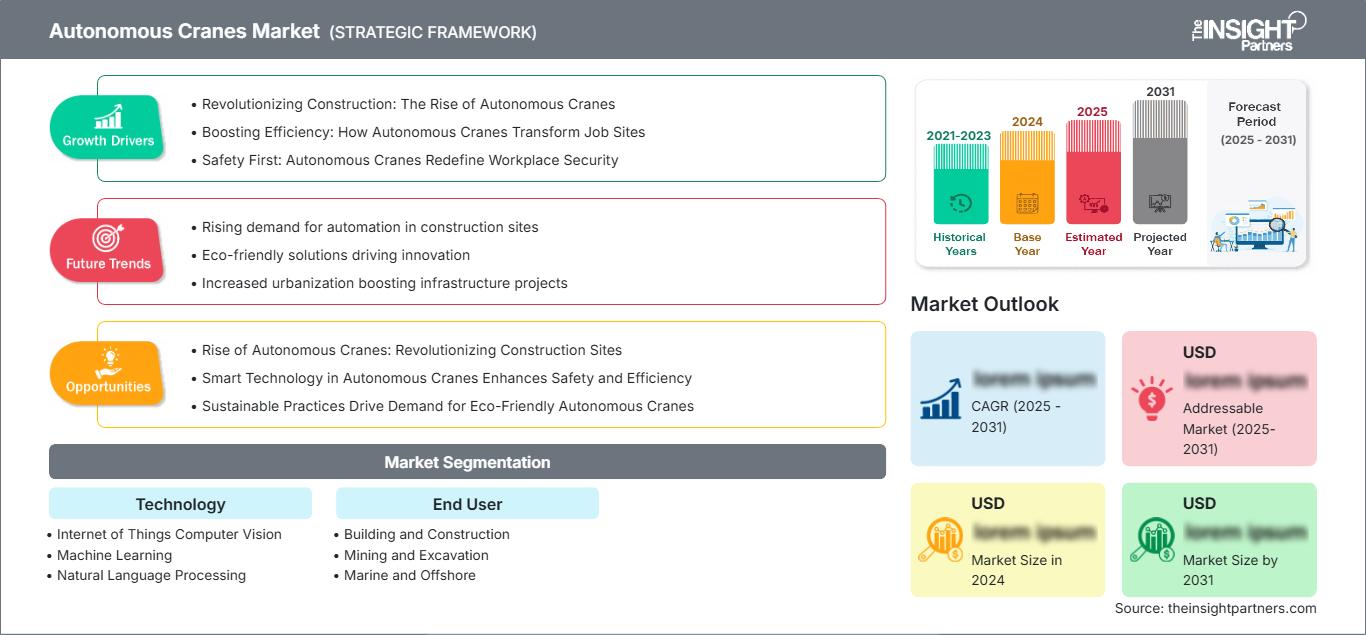
The autonomous cranes market is projected to expand from US$ 8.07 Billion in 2025 to US$ 53.49 Billion by 2034, registering a CAGR of 23.39% during 2026–2034. This trajectory reflects accelerating deployment of cranes that combine sensing, machine vision, artificial intelligence, remote supervision, and automated motion control. Adoption is broadening across construction, extraction, ports, transport infrastructure, and energy operations where lifting precision, operating continuity, and reduced exposure to hazardous work zones are increasingly important.
Within North America, the autonomous cranes market size is supported by an estimated 21–23% CAGR through 2034. Persistent skilled-operator shortages, extensive transport and energy infrastructure renewal, and stronger demand for traceable safety controls are encouraging fleet owners to digitize lifting workflows. Retrofit control packages lower the adoption barrier for installed fleets, while private 5G networks and cloud-based maintenance platforms improve equipment availability across dispersed construction, mining, port, and oilfield sites.
Autonomous Cranes Market Assessment and Insights
- North America accounted for an estimated 33–35% autonomous cranes market share in 2025 and is expected to grow at a 21–23% CAGR between 2026–2034, supported by infrastructure renewal, labor constraints, and digital fleet management.
- US represented 76–80% of North American revenue in 2025 and is projected to advance at a 21–23% CAGR between 2026–2034.
- Europe held an estimated 24–26% share in 2025, with a 22–24% CAGR between 2026–2034. Germany, the UK, and France lead adoption through industrial automation and offshore wind investment.
- Asia Pacific captured an estimated 29–31% share in 2025 and is forecast to post a 25–27% CAGR between 2026–2034, led by China, Japan, South Korea, and India.
- Largest Segment Mobile Crane represented an estimated 61–65% market share in 2025 and is expected to record a 23–25% CAGR between 2026–2034.
- High Growth Segment Marine and Offshore held an estimated 14–18% market share in 2025 and is projected to deliver a 25–27% CAGR between 2026–2034.
- Key companies analyzed in detail: Konecranes Plc, Liebherr-International AG, Sany Heavy Industry Co., Ltd., The Manitowoc Company, Inc., XCMG Construction Machinery Co., Ltd., Zoomlion Heavy Industry Science and Technology Co., Ltd., Shanghai Zhenhua Heavy Industries Co., Ltd., Tadano Ltd., Eilbeck Cranes Pty Ltd, and Henan Mine Crane Co., Ltd.
Source: The Insight Partners' analysis based on proprietary research, government publications, company annual reports, investor presentations, industry databases, and expert interviews.
Cranes have moved from remote control via radio and overload protection to more advanced systems using sensors which can help perform path-planning, collision avoidance, load stabilization and positioning. Digital twins, telematics, edge computing and modular actuators are increasingly integrated into existing crane machinery platforms. Safety-certified electronics, precision drives and specialized software integration continue to be the constraining factors on production volumes. However, scalable architectures are driving cost efficiency and enabling the industry move from isolated crane purchases to integrated crane systems including software and services for their lifecycle.
Over the coming ten years, investments will move out from well-established ports and automated plants to include Indian infrastructure corridors, Gulf building projects, mining operations in Africa and logistics facilities in Southeast Asia. Infrastructure investments from governments for the development of bridges, railways, renewables and port facilities will expand the install base, while the occupational health and safety considerations will increase the justification for remote crane controls. Service, cybersecurity and operator training are key differentiators for vendors who will capitalize on proof-of-concepts and turn them into multiple-site orders and ongoing software revenues.
Autonomous Cranes Market Report Scope
| Report Attribute | Details |
|---|---|
| Market size in 2025 | US$ 8.07 Billion |
| Market Size by 2034 | US$ 53.49 Billion |
| Global CAGR (2026 - 2034) | 23.39% |
| Historical Data | 2021-2024 |
| Forecast period | 2026-2034 |
Autonomous Cranes Market Analysis
Autonomous cranes market growth will be fueled by the requirement to carry out repeatable lifts that involve fewer personnel working near suspended loads, unstable ground conditions, bad weather, and dangerous industrial environments. Schedule reliability is essential for construction firms, port operations must maintain constant container flow, and mining applications favor remote control when dust, heat, or blasting make manual control dangerous.
The industry ecosystem consists of crane manufacturers, sensor and controller suppliers, telecommunications companies, safety system integrators, rental companies, engineering firms, and software providers. Availability of supply relies on reliable components, localization capability, robust communication channels, and tailored commissioning processes. Refitting existing fleets increases the install base, although interoperability is inconsistent at present. Companies that offer standardized interfaces and regional parts stocking have the potential to speed up commissioning and work with mixed fleets without upgrading existing equipment.
The autonomous cranes market report shows that the autonomous cranes market is characterized by competition involving full line mobile crane makers, industrial and port cranes companies, as well as regional manufacturers. Konecranes Plc focuses on connected industrial lifting technology, while Shanghai Zhenhua Heavy Industries Co., Ltd. profits from port system integration. Liebherr-International AG, Sany Heavy Industry Co., Ltd., XCMG Construction Machinery Co., Ltd., and Zoomlion Heavy Industry Science and Technology Co., Ltd. compete using platform capabilities and manufacturing capabilities.
Capital in the autonomous cranes market is shifting to perception systems, control redundancy, simulation, electrification, and service networks instead of mechanical improvements. The Manitowoc Company, Inc. and Tadano Ltd. benefit from their dealer networks and installed bases, while Eilbeck Cranes Pty Ltd and Henan Mine Crane Co., Ltd. cater to customized industrial applications. The strategic challenge for the autonomous cranes market will be showing safe autonomous operation in duty cycles and marketing hardware, software, training, and uptime guarantees as financing packages.
● REPORT CUSTOMIZATION
Tailor This Report To Align With Your Specific Business Requirements
This report can be customized to align precisely with your business objectives, scope, and target markets. Customization options include tailored segmentation, geography, competitive analysis, and strategic insights to support informed decision-making.
Customize This Report →WHAT YOU CAN ADJUST
- ● Segmentations
- ● Geography
- ● Competitive Analysis
- ● Language Preferences
Autonomous Cranes Market: Strategic Insights
Regional Insights
North America autonomous cranes market
Estimated autonomous crane market share in North America in 2025 stands at 33–35%, with regional revenue expected to grow by 21–23% CAGR to 2034. Massive construction projects, deteriorated infrastructure, utilities modernization, ports' automation, and lack of qualified operators ensure business justification for mechanized lifting. The US represents the biggest fleet of installed autonomous cranes, while Canada offers mining, energy, and remote operations use cases that need teleoperation capabilities.
Adoption of autonomous cranes will transition from being safety features to being supervised autonomy, especially in cases where there are repetitive pathways and a controlled environment that makes verification easier. Rental firms will spread out technology amongst contractors, but the economics of use necessitate control compatibility and technicians who can work with fleets. Private networks, digital lift planning, and operationally proven data will help with confidence on the part of insurers and owners. Adoption of autonomous cranes will increasingly favor technologies that maintain manual backups, cybersecurity controls, and decreased downtime and near misses.
U.S. Autonomous Cranes Market
The US represented an estimated 76–80% of North American revenue in 2025 and is projected to expand at a 21–23% CAGR during 2026–2034. The strongest demand exists for construction of data centers, rehabilitation of interstates and bridges, petrochemical facilities, ports, utilities, and wind farms. Telematics, lift planning tools, cameras, collision prevention systems, and remote management are becoming common among contractors prior to further automations.
The major OEMs operate in the United States, having sales, leasing, or service operations here, which provides clients with access to mobile, crawler, tower, and industrial crane systems. The business challenge here is not connectivity per se, but demonstrating reliability in relation to loads, weather conditions, terrain, and unionized environments. Thus, the first buying considerations will be for bounded tasks such as repetitive material handling and pre-programmed lifts.
Europe Autonomous Cranes Market
Europe accounted for an estimated 24–26% share in 2025 and is expected to grow at a 22–24% CAGR through 2034. The German advantage is due to the advanced manufacturing, industrial cranes, and engineering capabilities. The German customers focus on safety, energy efficiency, interoperability, and the auditable performance of automation and controls, which pushes the manufacturers to design their products to integrate automation and electric drives along with diagnostics throughout the entire life cycle.
The UK autonomous crane market gains from offshore wind, port, nuclear construction, and tight urban areas where remote control will allow improving the visibility and minimize the personnel presence. The French market is related to transportation infrastructure, energy, industry, and ports. The Italian expertise in machinery and Spanish renewables generate additional demand, while fragmented contractor fleets are a factor in favor of retrofit-capable products.
APAC Autonomous Cranes Market
Asia Pacific held an estimated 29–31% share in 2025 and is forecast to record a 25–27% CAGR through 2034. China dominates in terms of crane manufacturing capacity, smart ports, industrial automation, renewable energy, and infrastructure. The robotics technology from Japan and South Korea along with shipbuilding and precision components contribute significantly.
The transport and urban construction development plans in India increase mobile crane demands, whereas Australia's mining and distant energy operations require teleoperation capabilities. Favorable policy support for smart manufacturing, locally produced equipment, and digital infrastructure speeds up testing programs. Competitiveness in pricing will drive more applications, but the quality of service and safety certification will make the difference.
Middle East & Africa Autonomous Cranes Market
Middle East and Africa revenue is expected to rise at a 22–24% CAGR through 2034. Saudi Arabia dominates via mega city, tourism, transportation, industrial, and energy projects. UAE adds ports, logistics, high-rise buildings, and off-shore projects where coordination of lifting can speed up project implementation.
South Africa provides mining and infrastructure needs, while the rest of the area is project-based and lacks services. Remote sensing is highly useful for dispersed locations, but extreme conditions need robust sensors and robust communication system. Collaboration with local suppliers for equipment rental and maintenance will be crucial.
Segmentation Analysis
Type
The Type segment is projected to expand at a 23–25% CAGR during 2026–2034. Within the autonomous cranes market scope, mobility, setup frequency, duty cycle, and operating environment determine automation architecture. Mobile platforms prioritize navigation, stabilization, and variable-site perception, while fixed systems benefit from mapped work envelopes and repeatable paths. Both categories increasingly use digital twins, anti-collision logic, predictive maintenance, and supervised remote control.
- Mobile Crane holds the leading position because construction, mining, transport, and wind projects require flexible deployment. Autonomous setup verification and motion assistance can improve utilization across changing sites.
- Fixed Crane remains strategically important in factories, ports, warehouses, shipyards, and process plants. Defined travel paths support earlier automation, while integration with production systems enables synchronized material flow.
End User
The End User segment is forecast to grow at a 23–25% CAGR during 2026–2034. Adoption varies with lift repetition, hazard exposure, project duration, and tolerance for downtime. Construction generates broad volume, whereas ports and mines offer controlled, high-utilization operations suited to advanced automation. Transportation and oil and gas projects demand rigorous certification, environmental resilience, and coordination with broader asset-management systems.
- Building and Construction contributes the largest demand base through high-rise, industrial, data-center, and infrastructure projects. Schedule pressure and operator scarcity support assisted lifting, remote supervision, and automated safety checks.
- Mining and Excavation prioritizes remote control in hazardous, dusty, or isolated environments. High equipment utilization supports investment in rugged sensors, predictive maintenance, and integration with autonomous haulage workflows.
- Marine and Offshore is the high-growth segment as ports, vessels, offshore wind, and energy installations require precise load handling. Controlled work zones and costly downtime favor advanced automation.
- Transportation demand arises from bridges, railways, airports, roadworks, and logistics terminals. Digital lift planning and collision avoidance help coordinate cranes around live assets and constrained work windows.
- Oil and Gas requires certified, corrosion-resistant systems for refineries, pipelines, terminals, and offshore platforms. Remote operation can reduce personnel exposure while maintenance analytics protect production continuity.
Opportunity Snapshot
| End User | Revenue Contribution | Trend Tag | Adoption Stage |
| Building and Construction | High | Site Autonomy | Scaling |
| Mining and Excavation | Medium | Remote Mining | Scaling |
| Marine and Offshore | Medium | Port Automation | Scaling |
| Transportation | Medium | Digital Lifts | Emerging |
| Oil and Gas | Low | Hazard Control | Emerging |
Autonomous Cranes Market Growth Drivers and Impact Analysis
Persistent shortage of skilled crane operators
Competency in crane operation involves training, certification, knowledge of the work site, and constant attentiveness, thus making workforce availability a structural limitation instead of a fleeting procurement challenge. With assisted setup, automatic load path control, remote monitoring, and exception-based intervention, competent operators are able to manage more productive crane hours without taking humans out of the picture altogether. The greatest effect is seen at remote mining operations, offshore plants, ports, and large-scale infrastructure projects where travel, shift work, or difficult environments drive up the cost of labor. Automation means that the knowledge of operations becomes embedded in software, thus eliminating reliance on any particular approach.
Safety economics and traceable compliance
Crane incidents can cause severe injury, asset damage, project stoppage, and regulatory investigation, so prevention has measurable financial value. Sensor fusion, geofencing, overload protection, anti-collision logic, automated stabilization, and recorded lift data reduce reliance on visual judgment alone. Traceable logs help contractors demonstrate that configured limits, inspection checks, and approved paths were followed. This is particularly relevant in dense construction sites, live ports, refineries, and transport corridors where multiple assets share restricted space. Insurers and project owners may not mandate full autonomy, but they increasingly reward demonstrable controls. Consequently, suppliers that quantify risk reduction and preserve secure audit trails can compete on total project exposure rather than equipment price.
Infrastructure, energy, and logistics capital programs
Large bridges, rail systems, data centers, factories, ports, renewable installations, and energy facilities require thousands of coordinated lifts under schedule pressure. As projects become larger and components heavier, contractors need repeatability, digital planning, and equipment availability rather than simply greater lifting capacity. Autonomous functions can connect crane execution with building information models, yard-management systems, and project-control platforms, making each lift a measurable production step. Wind turbines and modular construction are especially influential because standardized components create repeatable workflows across sites. The resulting demand favors platform-based cranes that combine electrification, automation, and telematics, while generating aftermarket revenue from commissioning, software, connectivity, and fleet optimization during long capital-program cycles.
Autonomous Cranes Market Future Trends
Edge intelligence and multimodal perception
The autonomous cranes market trends will increasingly center on edge systems that combine cameras, radar, lidar, load sensors, and equipment telemetry to interpret dynamic work zones in real time. Processing safety-critical data locally reduces dependence on cloud connectivity, while fleet platforms retain performance history for model improvement. Multimodal perception should expand automation beyond repetitive fixed paths toward variable outdoor lifts, but vendors must prove reliability across dust, rain, glare, vibration, and occlusion. Future differentiation will depend on validated perception envelopes, explainable alerts, secure software updates, and graceful transfer to remote or cabin control when confidence falls below defined operating thresholds.
Orchestrated fleets and digital lift execution
Future deployments will move from isolated smart cranes toward coordinated fleets linked to project schedules, digital twins, robots, vehicles, and inventory systems. A lift plan will become an executable data package containing load geometry, approved routes, exclusion zones, weather limits, and handoff rules. Cranes can then sequence movements with autonomous transporters and material-tracking platforms while supervisors monitor exceptions. This model improves throughput in ports, modular construction yards, factories, and large energy projects. Commercially, it shifts value toward interoperable software, common data models, cybersecurity, and orchestration services, rewarding suppliers that can integrate equipment from multiple brands without weakening functional safety.
Autonomous Cranes Market Opportunities
Retrofit autonomy for installed crane fleets
Retrofit packages offer the fastest route to scale because most customers cannot replace mechanically serviceable fleets solely to obtain automation. Investors and suppliers can target modular camera kits, load and position sensors, control gateways, remote-operation stations, and software that adds bounded functionality while preserving certified manual control. The autonomous cranes market forecasts support recurring revenue from subscriptions, condition monitoring, and phased upgrades rather than one-time equipment sales. Successful offerings require model-specific engineering, cybersecurity, and an approval pathway that clearly assigns responsibility among OEM, integrator, fleet owner, and operator. Rental companies are attractive channel partners because standardized retrofits can be deployed repeatedly and utilization data can demonstrate payback.
Autonomy-as-a-service for controlled work zones
Ports, mines, factories, fabrication yards, and offshore bases provide defined operating areas where suppliers can control connectivity, mapping, maintenance, and process interfaces. These environments are well suited to performance-based commercial models that charge by operating hour, lift, or availability rather than requiring customers to purchase complex technology outright. Providers can bundle equipment, commissioning, software, remote supervision, maintenance, and operator development under a single service-level agreement. The opportunity is especially strong in emerging markets where capital budgets are constrained but infrastructure throughput is rising. Financing partners should prioritize repeatable duty cycles, measurable downtime costs, and multi-year contracts that support asset redeployment.
Recent Developments
- May 2026: ABB introduces Waterside Automation solution which enables quay cranes to perform a larger share of container handling operations automatically. By automating operations over the vessel and reducing the need for continuous manual control, the solution addresses a key bottleneck in container terminal efficiency and enables a gradual transition toward autonomous quay crane operations. A key feature is that the solution enables decoupling of the operator from individual quay cranes. Instead of directly controlling challenging activities like picking up and setting down containers over the vessel, operators will be able to supervise the process and manage multiple cranes from an office environment, allowing terminals to introduce quay crane pooling.
- January 2025: Areke, a leading provider of industrial lifting and automation solutions, announces the launch of its new smart crane system, designed to significantly enhance operational efficiency and safety across manufacturing and logistics industries. The new system integrates advanced sensing technologies, automation controls, and real-time data monitoring, enabling higher precision in operations while minimizing human errors and ensuring safe operations. The innovative crane system incorporates state-of-the-art load sensing technology, automatically adjusting operating parameters based on specific job requirements, ensuring optimal material handling accuracy and speed.
Frequently Asked Questions

- Comprehensive Market Sizing and Forecast Analysis
- Detailed Segmentation Analysis
- In-Depth Market Dynamics Assessment
- Regional and Country-Level Insights
- Competitive Landscape and Company Benchmarking
- Strategic Business Intelligence
Recent Reports
Testimonials

The Insight Partners provided valuable market intelligence that supported our global go-to-market strategy. Their team was professional, responsive, and attentive to our feedback, providing thoughtful analysis and helpful methodological clarifications throughout the project.
Junmo Kim Chief Financial Officer (CFO), Enertech Co., Ltd.
The Insight Partners' SCADA System Market report is comprehensive, with valuable insights on current trends and future forecasts. The team was highly professional, responsive, and supportive throughout. We are very satisfied and highly recommend their services.
RAN KEDEM Partner, Reali Technologies LTDs
I requested a report on a very specific software market and the team produced the report in a few days. The information was very relevant and well presented. I then requested some changes and additions to the report. The team was again very responsive and I got the final report in less than a week.
JEAN-HERVE JENN Chairman, Future Analytica
We worked with The Insight Partners for an important market study and forecast. They gave us clear insights into opportunities and risks, which helped shape our plans. Their research was easy to use and based on solid data. It helped us make smart, confident decisions. We highly recommend them.
PIYUSH NAGPAL Sr. Vice President, High Beam Global
The Insight Partners delivered insightful, well-structured market research with strong domain expertise. Their team was professional and responsive throughout. The user-friendly website made accessing industry reports seamless. We highly recommend them for reliable, high-quality research services
YUKIHIKO ADACHI CEO, Deep Blue, LLC.
This is the first time I have purchased a market report from The Insight Partners.While I was unsure at first, I visited their web site and felt more comfortable to take the risk and purchase a market report.I am completely satisfied with the quality of the report and customer service. I had several questions and comments with the initial report, but after a couple of dialogs over email with their analyst I believe I have a report that I can use as input to our strategic planning process.Thank you so much for taking the extra time and making this a positive experience.I will definitely recommend your service to others and you will be my first call when we need further market data.
JOHN SUZUKI President and Chief Executive Officer, Board Director, BK Technologies
I wish to appreciate your support and the professionalism you displayed in the course of attending to my request for information regarding to infectious disease IVD market in Nigeria. I appreciate your patience, your guidance, and the fact that you were willing to offer a discount, which eventually made it possible for us to close a deal. I look forward to engaging The Insight Partners in the future, all thanks to the impression you have created in me as a result of this first encounter.
DR CHIJIOKE ONYIA MANAGING DIRECTOR, PineCrest Healthcare Ltd.Reason to Buy
- Informed Decision-Making
- Understanding Market Dynamics
- Competitive Analysis
- Identifying Emerging Markets
- Customer Insights
- Market Forecasts
- Risk Mitigation
- Boosting Operational Efficiency
- Strategic Planning
- Investment Justification
- Tracking Industry Innovations
- Aligning with Regulatory Trends





 Get Free Sample for