
Baby Monitor Market Share, Growth & Forecast by 2034
Coverage: By Product Type (Audio Monitor, Video Monitor, Movement Monitor); Connectivity Type (Wired, Wireless) , and Geography (North America, Europe, Asia Pacific, and South and Central America)
- Status : Data Released
- Report Code : TIPRE00006148
- Category : Electronics and Semiconductor
- No. of Pages : 150
- Available Report Formats :


- Last update date : July 20, 2026


2025 Market Size
US$ 2.38 Bn
Base year value
2034 Forecast
US$ 4.87 Bn
Projected by 2034
CAGR 2026-2034
9.37 %
Growth rate
Addressable Market
US$ 34.42 Bn
(2026-2034)
The Baby Monitor Market was valued at US$ 2.38 Billion in 2025 and is projected to reach US$ 4.87 Billion by 2034, registering a CAGR of 9.37% during 2026–2034. Growth is supported by connected childcare adoption, rising dual-income households, and expanding use of video, wireless, and movement-tracking systems that help caregivers monitor infants with greater continuity, convenience, and confidence.
Across North America, the Baby Monitor Market size is supported by high broadband penetration, widespread smartphone use, and strong spending on premium nursery electronics. The region is estimated to grow at a 7.8–8.6% CAGR during 2026–2034 as parents prioritize app-enabled video monitoring, secure wireless connectivity, and sleep-related alerts amid sustained demand from working households.
Baby Monitor Market Assessment and Insights
- North America accounted for 34–37% share in 2025 and is expected to grow at a CAGR of 7.8–8.6% during 2026–2034, led by premium video monitors, Wi-Fi-enabled devices, and safety-focused buying behavior.
- US represented 78–82% of North America in 2025 and is projected to grow at a CAGR of 7.9–8.7% during 2026–2034, supported by smart-home integration.
- Europe held 24–27% share in 2025 and is forecast to expand at a CAGR of 7.1–7.9% during 2026–2034, with Germany, the UK, France, Italy, and Spain leading demand.
- Asia Pacific captured 25–28% share in 2025 and is expected to grow at a CAGR of 10.8–11.8% during 2026–2034, driven by China, Japan, South Korea, India, and Australia.
- Largest Segment Video Monitor held 48–52% market share in 2025 and is projected to grow at a CAGR of 8.8–9.6% during 2026–2034 due to visual verification needs.
- High Growth Segment Wireless connectivity held 82–86% market share in 2025 and is estimated to grow at a CAGR of 10.1–11.2% during 2026–2034 as smartphone pairing becomes standard.
- Key companies analyzed in detail: Angelcare Monitor Inc.; Dorel Industries Inc.; Teledyne FLIR LLC; Koninklijke Philips N.V.; Motorola Solutions, Inc.; Samsung Electronics Co., Ltd.; Sony Corporation; Summer Infant, Inc.; VTech Holdings Limited; Withings S.A.
Source: The Insight Partners' analysis based on proprietary research, government publications, company annual reports, investor presentations, industry databases, and expert interviews.
Technology migration is transforming the industry from simple unidirectional audio gadgets to more advanced platforms integrating HD video, motion detection, temperature warnings, two-way communication, and mobile apps. The production process is moving towards more modular camera modules, low power chips, wireless encryption protocols, and firmware updates via cloud. Retailers increasingly differentiate products by camera quality, app experience, battery life, and cybersecurity assurance rather than by basic monitoring functionality alone, influencing competitive positioning and Baby Monitor Market share among leading manufacturers.
Momentum will be generated from new urban families, online sales for baby care products, and increased investment in high-end connected nursery ecosystems. Compliance with regulations regarding device security and radio-frequency performance should result in an advantage for those firms that have already tested devices. This market is becoming more important in daycare centers and neonatal support centers due to increased monitoring and better communication through these devices.
Baby Monitor Market Report Scope
| Report Attribute | Details |
|---|---|
| Market size in 2025 | US$ 2.38 Billion |
| Market Size by 2034 | US$ 4.87 Billion |
| Global CAGR (2026 - 2034) | 9.37% |
| Historical Data | 2021-2024 |
| Forecast period | 2026-2034 |
Baby Monitor Market Analysis
The Baby Monitor Market growth is driven by parents seeking continuous infant visibility while managing work, household tasks, and nighttime care. Demand is strongest where broadband access, smartphone ownership, and online retail channels are mature. Suppliers rely on camera modules, microphones, wireless chipsets, rechargeable batteries, displays, and companion apps, making semiconductor availability and software reliability critical parts of the value chain.
Supply conditions are more favorable for brands that can offer hardware and firmware in conjunction with cloud storage and technical support services. Systems are installed by hospitals and daycares for monitoring, while private residence usage represents the primary demand stream. Cycles of renewal in the market are useful for families who move from old audio-based systems to new wireless systems with video and better range and night vision.
Market analysis provides an overview of a competitive market involving infant-care specialists, consumer electronics firms, and connected health brands. These include Koninklijke Philips N.V., VTech Holdings Limited, Motorola Solutions, Inc., Samsung Electronics Co., Ltd., Withings S.A., and Angelcare Monitor Inc. Firms compete on product reliability and application features, as well as distribution channels and branding. However, there is some pricing competition among budget products.
The investments include AI-based alerts, secure connectivity, multiple camera capabilities, and sleep insights through subscriptions. Proper strategic positioning involves a balance between the credibility of safety for infants and the usability of consumer electronics. The imaging aspect is enhanced by Teledyne FLIR LLC and Sony Corporation, while the retail nursery access is improved by Dorel Industries Inc. and Summer Infant, Inc.
● REPORT CUSTOMIZATION
Tailor This Report To Align With Your Specific Business Requirements
This report can be customized to align precisely with your business objectives, scope, and target markets. Customization options include tailored segmentation, geography, competitive analysis, and strategic insights to support informed decision-making.
Customize This Report →WHAT YOU CAN ADJUST
- ● Segmentations
- ● Geography
- ● Competitive Analysis
- ● Language Preferences
Baby Monitor Market: Strategic Insights
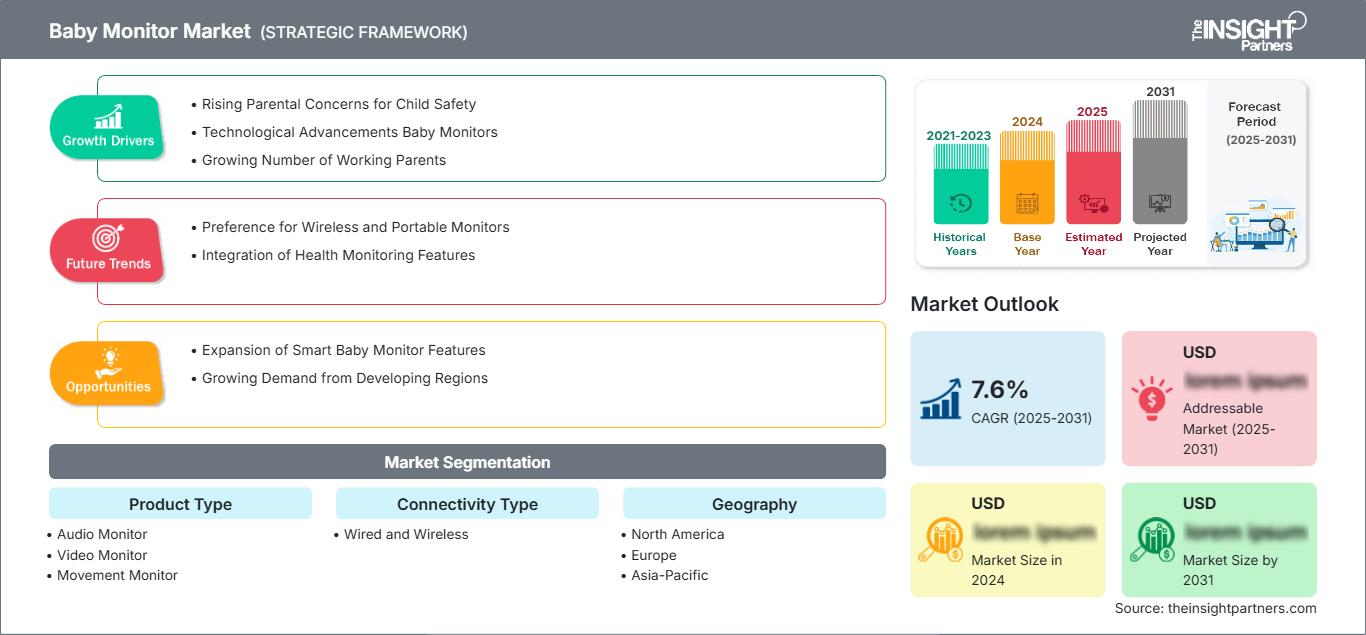
Regional Insights
North America Baby Monitor Market
North America held 34–37% market share in 2025 and is projected to record a 7.8–8.6% CAGR during 2026–2034. The demand stems from high disposable income, a developed system of e-commerce, and the use of Internet-connected infant monitoring devices. Video and wireless infant monitors offering features such as night vision, two-way audio recording, temperature notifications, and access via a secured app have become more popular among parents.
This area has the advantage of good representation by companies such as Motorola Solutions, Inc., Angelcare Monitor Inc., Koninklijke Philips N.V., VTech Holdings Limited, and Withings S.A. It is notable that vendors pay particular attention to packages including a camera and a parent unit, as well as paid analysis services. Requirements in cybersecurity keep increasing.
U.S. Baby Monitor Market
The U.S. represented 78–82% of North America in 2025 and is forecast to expand at a 7.9–8.7% CAGR during 2026–2034. The demand side is bolstered by widespread uptake of smart home technology, purchasing over the Internet, and user preference for application-linked video monitors. Many premium products will have multiple camera capabilities, breathing alerts, and room condition monitoring features.
Market participants are numerous, including VTech Holdings Limited, Motorola Solutions, Inc., Samsung Electronics Co., Ltd., and Withings S.A. Applications are dominated by home environments, but daycare centers and some healthcare facilities deploy monitors to help in observation processes. There is an advantage for the industry owing to parents’ upgrades of their old audio monitors to wireless technology.
Europe Baby Monitor Market
Europe accounted for 24–27% share in 2025 and is expected to grow at a 7.1–7.9% CAGR during 2026–2034. Germany dominates owing to its high standards of consumer electronics, effective nursery retailing, and need for secure wireless technology in line with privacy-conscious buying behavior.
The UK exhibits consistent consumer behavior via its online baby care shopping sites and use of expensive video monitors. Germany likes robust devices, reliable connectivity, and quality after-sales services. France, Italy, and Spain make their contributions through urban apartment consumers, increasing penetration of digital retailing, and multi-functional monitors combining video and sound capabilities.
APAC Baby Monitor Market
APAC held 25–28% share in 2025 and is projected to grow at a 10.8–11.8% CAGR during 2026–2034. China is the leading country, supported by e-commerce scale, urban parenting trends, and rapid adoption of connected home devices.
Japan and South Korea favor high-quality electronics and compact monitors, while India and Australia add growth through rising middle-income households and digital retail. Policy emphasis on infant care, expanding maternity products, and smartphone-led purchasing create favorable conditions for the market.
Middle East & Africa Baby Monitor Market
The Middle East & Africa is forecast to grow at a 6.6–7.4% CAGR during 2026–2034. Saudi Arabia and the UAE lead regional demand as premium retail, smart housing, and young family demographics support connected nursery product adoption.
South Africa and the rest of MEA show a gradual uptake through organized retail and online marketplaces. Infrastructure improvements, broadband expansion, and higher spending on child safety products are supporting demand, although affordability and distribution reach still influence adoption across the market.
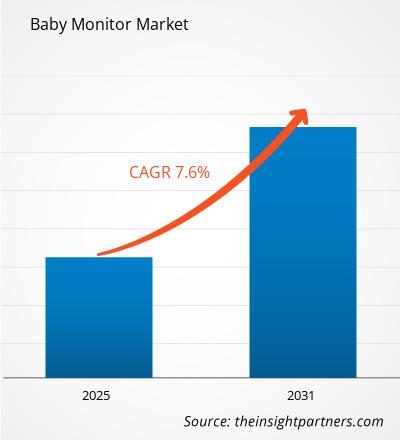
Segmentation Analysis
Product Type
Product Type is expected to witness growth at a CAGR of 8.6–9.5% for the forecast period of 2026–2034. The scope of the market in terms of products has expanded, with buyers shifting from basic audio surveillance solutions to video surveillance and motion detection systems. The distinction of products depends on camera quality, sensors, alerts, and mobile app integration.
- Audio Monitor remains relevant for price-sensitive households and travel use, offering simple sound alerts, low power consumption, and dependable operation where video or app-based functions are not required.
- Video Monitor is the largest product category, supported by visual verification, night vision, two-way audio, and the growing use of high-resolution cameras for home-based infant supervision.
- Movement Monitor is strategically important in premium care, addressing demand for breathing-related alerts, sleep movement tracking, and added reassurance among parents seeking advanced monitoring functions.
Connectivity Type
The Connectivity Type segment is expected to grow at a 9.8–10.8% CAGR during 2026–2034. Wireless connectivity is reshaping purchasing decisions because parents value portability, smartphone access, and remote alerts. Wired devices retain a role in reliability-focused settings, but app-linked systems are expanding faster as households adopt connected speakers, routers, and smart-home platforms.
- Wired monitors appeal to users prioritizing stable local connections, limited interference, and predictable performance, particularly in fixed-room setups where mobility and smartphone access are less important.
- Wireless monitors dominate adoption because they support flexible placement, mobile viewing, multi-room coverage, and integration with app-based notifications that fit modern parenting routines.
Opportunity Snapshot
| Product Type | Revenue Contribution | Trend Tag | Adoption Stage |
| Audio Monitor | Medium | Basic Alert | Mature |
| Video Monitor | High | HD Viewing | Scaling |
| Movement Monitor | Medium | Sleep Sensing | Emerging |
Baby Monitor Market Growth Drivers and Impact Analysis
Rising Preference for Connected Infant Safety Devices
There are increasing expectations from parents for monitoring products to offer constant visibility, immediate notification, and accessibility via smartphones or portable parent units. This trend is particularly relevant for dual-income and hybrid-work family structures, as parents feel the need for additional assurance while balancing multiple obligations. The effects are noticeable in the rise of the average price point of monitoring products, expansion of the assortment of premium products on offer, and shorter life span of the products due to the desire for better quality and functionality. Companies that develop reliable hardware and secure software will be able to capitalize on repeat purchases since people see monitoring reliability as an essential factor for child safety. Moreover, increased understanding of the importance of cybersecurity, data privacy, and security of the remote access channels is becoming a decisive factor for purchasing products, which makes companies focus their resources on encryption technology and regular updates of the firmware. Inclusion of integration into smart-home platforms and health monitoring apps is making the products even more attractive by giving customers an opportunity to control the process of monitoring.
Expansion of E-Commerce and Digital Baby-Care Retail
Online retail improves product visibility, comparisons, and access to high-quality baby-care electronics in developed and developing countries. Parents investigate monitoring systems prior to childbirth, compare cameras and applications, and buy package deals online. This contributes to faster adoption of wireless and video devices beyond specialty stores. The market benefits from increased selection of merchandise, consumer feedback, and brand launches for direct-to-customer sales that decrease dependence on physical shelf space. Online shopping allows for smaller specialists to compete with established electronics brands thanks to their ability to demonstrate unique capabilities like sleep analysis, compatibility with multiple cameras, and encryption of data transmission, thus making online discoveries an identifiable driver of growth. Moreover, e-commerce provides an opportunity for manufacturers to inform consumers about their products through demonstration, comparison, feedback from users, and professional reviews that improve the buying experience and speed up the adoption of advanced devices. Online retail also allows for subscription models, warranties, and recommendations of particular products, which adds to potential revenue streams. Given the increasing popularity of smartphones and online shopping worldwide, e-commerce is expected to remain an important catalyst for innovation and growth of the market.
Premiumization Through Video, Motion, and App Features
Premiumization in products is driving buying criteria from audio communication towards intelligent healthcare. Premium video, infrared nighttime vision, motion detectors, temperature measurement, and mobile notifications generate a more compelling proposition for buyers who demand more than just viewing their children in real time. Differentiation can be achieved by offering improved battery capacity, security in pairing, low latency video streaming, and improved sensor technology, improving profit margins at midrange and premium levels. Accessory sales, additional cameras, and subscription software services contribute to market growth. In line with the development of consumer trust in home automation systems, products that integrate well into such environments stand better chances on the shelves and have a higher repeat purchase probability. Also, compatibility with voice assistants, smartphone integration, and monitoring systems that rely on cloud storage becomes more relevant in a technology-savvy household. Parents find great value in activity monitoring, customized notifications, user access, and remote monitoring features. Such developments will support higher average selling prices and drive constant innovation in the products in order to build customer loyalty and increase market share in premium segments.
Baby Monitor Market Future Trends
AI-Enabled Sleep and Behavior Insights
Baby Monitor Market trends point toward monitors that interpret sleep routines, crying patterns, and movement signals rather than simply transmitting audio or video. Future systems are expected to use on-device processing and cloud analytics to reduce false alerts, summarize sleep quality, and provide actionable notifications. This transition will require careful positioning because parents want helpful insights without unnecessary medical claims. Brands that explain data use clearly and maintain privacy controls can build trust. The trend may also create subscription opportunities, particularly for premium users seeking sleep summaries, growth-stage recommendations, and multi-child profile management within connected parenting applications.
Security-Certified Connected Nursery Ecosystems
As monitors connect to home networks and mobile apps, cybersecurity will become a visible purchase criterion. Future devices are likely to emphasize encrypted transmission, secure onboarding, routine firmware updates, and transparent data policies. Retailers may increasingly highlight security labels or third-party certifications beside camera resolution and battery life. This trend favors companies with software engineering depth and long-term update commitments. It can also reshape procurement in daycare and healthcare-adjacent environments where device reliability and privacy are important. The Baby Monitor Market will therefore move toward integrated ecosystems that combine convenience, safety, and digital trust.
Baby Monitor Market Opportunities
Localized Smart Monitoring for Emerging Urban Families
Emerging cities offer a practical opportunity for brands that can balance affordability, connectivity, and trusted infant-care features. Baby Monitor Market Forecasts indicate stronger growth potential where smartphone adoption and online baby-care shopping are expanding rapidly. Companies can invest in localized apps, multilingual support, compact designs for apartments, and value-priced video bundles. Partnerships with maternity hospitals, parenting platforms, and e-commerce retailers can improve consumer education before childbirth. The opportunity is not only volume-driven; it also supports brand loyalty as families upgrade from basic devices to advanced wireless systems. Effective localization can reduce returns and strengthen after-sales confidence.
Daycare and Healthcare-Adjacent Monitoring Use Cases
Beyond home use, selected daycare centers, infant rooms, and neonatal support environments create opportunities for reliable multi-camera monitoring systems. These buyers need stable connectivity, clear audio, secure access controls, and simple maintenance rather than consumer novelty. Vendors can develop professional bundles with centralized viewing, role-based permissions, and durable hardware suited to higher daily usage. The Baby Monitor Market can capture incremental revenue by serving institutional buyers without overstating medical capability. Training, warranty support, and compliance documentation will be important differentiators. This opportunity also supports premium positioning because reliability and accountability matter more than entry-level pricing.
Recent Developments
- July 2026: Owlet expanded its baby monitoring portfolio in Australia and New Zealand with the launch of Dream Sight and Dream Duo 3. The new products combine HD video monitoring with Owlet's smart health tracking technology, giving parents a more comprehensive solution to monitor their baby's sleep, safety, and well-being.
- July 2025: Simyke introduced the E50P Hybrid Monitoring PTZ Baby Monitor, featuring a large parent display alongside app-based remote access. The system combines pan-tilt-zoom functionality, HD video, and hybrid connectivity to provide flexible and reliable baby monitoring at home.
- October 2024: Philips Avent launched its Connected Baby Monitor, integrating HD video, Cry Translation, SenseIQ technology, and the Baby Monitor+ app. The AI-enabled system helps parents better understand their baby's needs while enabling secure remote monitoring and greater peace of mind.
Frequently Asked Questions

- Comprehensive Market Sizing and Forecast Analysis
- Detailed Segmentation Analysis
- In-Depth Market Dynamics Assessment
- Regional and Country-Level Insights
- Competitive Landscape and Company Benchmarking
- Strategic Business Intelligence
Recent Reports
Testimonials

The Insight Partners' SCADA System Market report is comprehensive, with valuable insights on current trends and future forecasts. The team was highly professional, responsive, and supportive throughout. We are very satisfied and highly recommend their services.
RAN KEDEM Partner, Reali Technologies LTDs
I requested a report on a very specific software market and the team produced the report in a few days. The information was very relevant and well presented. I then requested some changes and additions to the report. The team was again very responsive and I got the final report in less than a week.
JEAN-HERVE JENN Chairman, Future Analytica
We worked with The Insight Partners for an important market study and forecast. They gave us clear insights into opportunities and risks, which helped shape our plans. Their research was easy to use and based on solid data. It helped us make smart, confident decisions. We highly recommend them.
PIYUSH NAGPAL Sr. Vice President, High Beam Global
The Insight Partners delivered insightful, well-structured market research with strong domain expertise. Their team was professional and responsive throughout. The user-friendly website made accessing industry reports seamless. We highly recommend them for reliable, high-quality research services
YUKIHIKO ADACHI CEO, Deep Blue, LLC.
This is the first time I have purchased a market report from The Insight Partners.While I was unsure at first, I visited their web site and felt more comfortable to take the risk and purchase a market report.I am completely satisfied with the quality of the report and customer service. I had several questions and comments with the initial report, but after a couple of dialogs over email with their analyst I believe I have a report that I can use as input to our strategic planning process.Thank you so much for taking the extra time and making this a positive experience.I will definitely recommend your service to others and you will be my first call when we need further market data.
JOHN SUZUKI President and Chief Executive Officer, Board Director, BK Technologies
I wish to appreciate your support and the professionalism you displayed in the course of attending to my request for information regarding to infectious disease IVD market in Nigeria. I appreciate your patience, your guidance, and the fact that you were willing to offer a discount, which eventually made it possible for us to close a deal. I look forward to engaging The Insight Partners in the future, all thanks to the impression you have created in me as a result of this first encounter.
DR CHIJIOKE ONYIA MANAGING DIRECTOR, PineCrest Healthcare Ltd.Reason to Buy
- Informed Decision-Making
- Understanding Market Dynamics
- Competitive Analysis
- Identifying Emerging Markets
- Customer Insights
- Market Forecasts
- Risk Mitigation
- Boosting Operational Efficiency
- Strategic Planning
- Investment Justification
- Tracking Industry Innovations
- Aligning with Regulatory Trends





 Get Free Sample for