
Backlit Displays Market Share, Size & Demand by 2034
Coverage: by Type (Flat Screen, Curved Screen); Size (Small, Medium, Large); Application (Trade Shows, Events, Shopping Malls, Theatres, Airports, Retail Outlets, Others), and Geography (North America, Europe, Asia Pacific, and South and Central America)
- Status : Data Released
- Report Code : TIPRE00013133
- Category : Electronics and Semiconductor
- No. of Pages : 150
- Available Report Formats :


- Last update date : July 20, 2026


2025 Market Size
US$ 39.95 Bn
Base year value
2034 Forecast
US$ 75.63 Bn
Projected by 2034
CAGR 2026-2034
7.35 %
Growth rate
Addressable Market
US$ 521.23 Bn
(2026-2034)
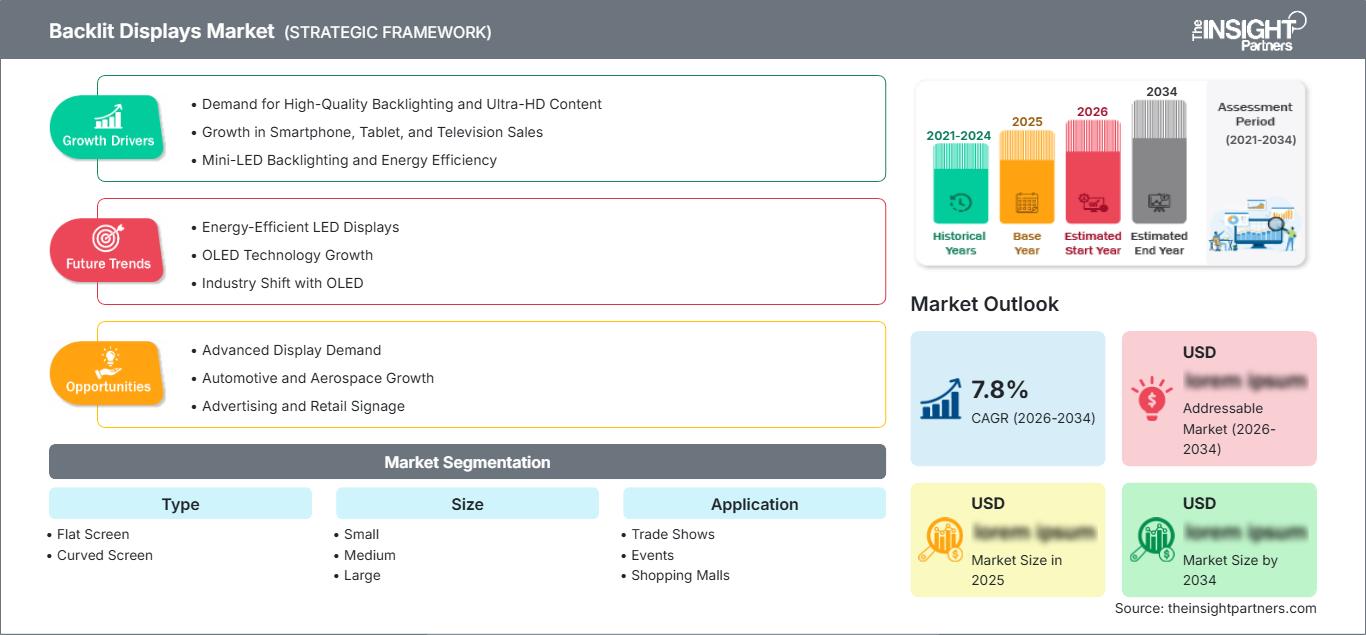
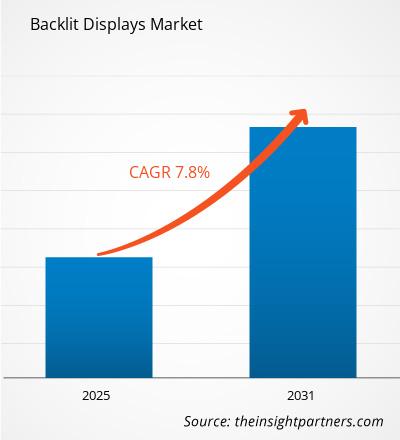
The Backlit Displays market was valued at US$ 39.95 Billion in 2025 and is projected to reach US$ 75.63 Billion by 2034, registering a CAGR of 7.35% during 2026–2034. Backlit Displays are advancing as high-visibility communication assets for retail, transport, exhibitions, entertainment venues, and public environments that require brighter, sharper, and more energy-efficient visual messaging.
North America remains a structurally attractive demand center for Backlit Displays market size expansion, with regional growth modeled at a CAGR of 6.5–7.3% during 2026–2034. Replacement of static signs, stronger mall media networks, higher airport passenger throughput, and tighter energy-efficiency expectations are accelerating LED-backed lightboxes, fabric frames, and commercial display panels across professional environments.
Backlit Displays Market Assessment and Insights
- North America accounted for 28–32% share in 2025 and is growing at a CAGR of 6.5–7.3% during 2026–2034, supported by airport media, retail refurbishments, events, and commercial signage modernization.
- US represented 74–78% of North American revenue in 2025 and is growing at a CAGR of 6.6–7.4% during 2026–2034, led by retail, airport, theatre, and convention demand.
- Europe held 22–26% share in 2025 and is growing at a CAGR of 6.1–6.9% during 2026–2034, with Germany, the UK, France, Italy, and Spain leading structured commercial deployment.
- Asia Pacific held 34–38% share in 2025 and is growing at a CAGR of 8.0–8.8% during 2026–2034, with China, Japan, South Korea, India, and Australia leading venue expansion.
- Largest Segment Flat Screen held 64–68% market share in 2025 and is growing at a CAGR of 6.8–7.6% during 2026–2034, reflecting standard installation economics.
- High Growth Segment Curved Screen represented 32–36% market share in 2025 and is growing at a CAGR of 8.4–9.2% during 2026–2034, driven by immersive retail and venue formats.
- Key companies analyzed in detail: Abex Displays; AUO Corporation; Barco NV; Featherlite Exhibits; The Godfrey Group; LG Electronics Inc.; NEC Corporation; Nomadic Display; PosterGarden; Samsung Electronics Co., Ltd.
Source: The Insight Partners' analysis based on proprietary research, government publications, company annual reports, investor presentations, industry databases, and expert interviews.
Display buyers have moved from basic illuminated poster frames toward modular fabric graphics, edge-lit LED panels, higher-brightness LCD systems, and integrated content management. Production dynamics now emphasize uniform light diffusion, slimmer frames, color consistency, repairable modules, and power efficiency. Supplier competitiveness depends on engineering repeatable luminance, reducing hot spots, and matching graphics substrates with lighting systems that remain visually stable through frequent event cycles and public-space operating hours.
Forward demand will be shaped by airport recovery, premium retail formats, public venue refurbishment, and regulation favoring lower-energy commercial installations. IATA reported 2025 air passenger demand growth of 5.3%, while ACI forecast 9.8 billion airport passengers in 2025, reinforcing traffic-based media demand. IMF projections of 3.0% global growth in 2025 support measured capital spending, especially in Asia Pacific and the Middle East.
Backlit Displays Market Report Scope
| Report Attribute | Details |
|---|---|
| Market size in 2025 | US$ 39.95 Billion |
| Market Size by 2034 | US$ 75.63 Billion |
| Global CAGR (2026 - 2034) | 7.35% |
| Historical Data | 2021-2024 |
| Forecast period | 2026-2034 |
Backlit Displays Market Analysis
Backlit Displays market growth is being driven by the convergence of location-based advertising, experiential retail, transport media, and event branding. Demand is strongest where operators need high luminance, low maintenance, and rapid graphic changeovers. The ecosystem includes LED module suppliers, LCD panel makers, fabric printers, aluminum extrusion vendors, diffuser manufacturers, content system providers, installers, and venue owners that balance visibility, durability, and energy cost.
Supply conditions are improving as LED efficiency, optical films, and modular frame systems become more standardized. However, buyers still evaluate total ownership cost across power use, installation labor, graphic replacement, warranty service, and mounting flexibility. The IEA noted global electricity consumption rose 4.3% in 2024 and is expected to grow strongly through 2027, making efficient commercial displays strategically important for high-footfall assets.
Backlit Displays market analysis shows a competitive landscape split between electronics leaders, professional visualization specialists, and exhibit-focused suppliers. Samsung Electronics Co., Ltd., LG Electronics Inc., AUO Corporation, NEC Corporation, and Barco NV compete through panel technology, signage platforms, and display engineering. Abex Displays, Featherlite Exhibits, The Godfrey Group, Nomadic Display, and PosterGarden address portable, modular, fabric, and trade show requirements.
Investment priorities are shifting toward curved formats, seamless fabric systems, brighter airport panels, micro-LED-influenced premium displays, and software-enabled signage management. Strategic positioning depends on channel access, installation support, product reliability, and the ability to serve both permanent venues and mobile event environments. Companies with standardized modules and tailored graphics workflows can capture repeat replacement revenue without relying only on one-time hardware sales.
● REPORT CUSTOMIZATION
Tailor This Report To Align With Your Specific Business Requirements
This report can be customized to align precisely with your business objectives, scope, and target markets. Customization options include tailored segmentation, geography, competitive analysis, and strategic insights to support informed decision-making.
Customize This Report →WHAT YOU CAN ADJUST
- ● Segmentations
- ● Geography
- ● Competitive Analysis
- ● Language Preferences
Backlit Displays Market: Strategic Insights
Regional Insights
North America Backlit Displays Market
North America held 28–32% of the Backlit Displays market share in 2025 and is projected to grow at a CAGR of 6.5–7.3% during 2026–2034. Demand is anchored in airports, malls, cinemas, convention centers, and retail outlets, replacing fluorescent or static signage with LED-backed systems that improve brightness, operating life, and campaign flexibility.
Structural drivers include high digital out-of-home spending, mall redevelopment, brand pop-up activity, and transportation media programs tied to passenger recovery. U.S. operators lead regional adoption, while Canada and Mexico add demand through retail modernization and venue expansion. Buyers increasingly require field-serviceable frames, consistent color temperature, and power-saving controls to support long operating schedules.
U.S. Backlit Displays Market
The U.S. market accounted for 74–78% of North American revenue in 2025 and is forecast to grow at a CAGR of 6.6–7.4% during 2026–2034. Company presence spans Samsung Electronics Co., Ltd., LG Electronics Inc., NEC Corporation, Abex Displays, Featherlite Exhibits, The Godfrey Group, Nomadic Display, and PosterGarden through signage, exhibit, and display channels.
Application trends center on large retail chains, airport concourses, theatre lobbies, shopping centers, and trade show booths that need vivid visuals under strong ambient lighting. Convention activity supports portable fabric backlit systems, while airports favor durable large-format installations. U.S. buyers also emphasize warranty support, easy graphic replacement, and integration with content workflows used by national advertisers.
Europe Backlit Displays Market
Europe held 22–26% share in 2025 and is expected to grow at a CAGR of 6.1–6.9% during 2026–2034. Germany is at the forefront due to its investment in manufacturing expos, transportation infrastructure, and luxury retail, with durable, regulation-compliant, and highly visible display solutions. The UK fosters adoption via its retail in London, theaters, transportation media, and exhibition spaces.
France, Italy, and Spain help out through their tourism-driven shopping areas, airport projects, movie theaters, and fashion-based retail. Buyers in Europe require energy-efficient, recyclable displays, improved mounting, and electrical components that comply with all regulations. Visualization skills help Barco NV and the local integrators stand out while international manufacturers target retailers across countries.
APAC Backlit Displays Market
APAC Backlit Displays market accounted for 34–38% share in 2025 and is projected to grow at a CAGR of 8.0–8.8% during 2026–2034. China is the leading country due to large retail footprints, transit advertising, domestic panel supply, and smart-city commercial infrastructure.
Japan and South Korea advance premium signage and display engineering, while India adds demand through mall construction, airport expansion, multiplex growth, and organized retail. Australia contributes through events, theatres, and retail chains. Policy support for domestic electronics, tourism infrastructure, and urban transit creates a stronger base for efficient illuminated display procurement.
Middle East & Africa Backlit Displays Market
Middle East & Africa are estimated to have a CAGR of 6.0–6.8% from 2026 to 2034. Saudi Arabia tops the list in terms of needs for giga-projects, malls, airports, and entertainment places because of high-impact visual needs in the commercial space.
South Africa will remain vital for shopping malls, cinema circuits, and event promotions, but the rest of the MEA will offer better prospects due to retail formalization and transport development. For energy and infrastructural projects, brightness and durability are key.
Segmentation Analysis
Type
Type is projected to grow at a CAGR of 7.0–7.8% during 2026–2034. The Backlit Displays market scope under type is defined by flat formats used for standardized installation and curved formats used for immersive environments. Procurement decisions depend on viewing distance, wall geometry, transportability, brand impact, and maintenance access.
- Flat Screen formats remain the default choice for malls, airports, retail outlets, and theatres because they provide predictable mounting, lower fabrication complexity, and broad compatibility with printed graphics.
- Curved Screen formats are strategically important in premium stores, event entrances, and experiential zones where wraparound visuals, higher dwell time, and stronger spatial branding justify higher engineering complexity.
Size
Size is expected to grow at a CAGR of 6.9–7.7% during 2026–2034. Size selection reflects message distance, available wall area, budget, and content refresh requirements. Small displays suit counters and wayfinding, medium systems serve retail and theatre lobbies, and large displays support airports, malls, events, and high-traffic promotional spaces.
- Small displays support point-of-sale messaging, wayfinding, menu boards, and compact brand activations where fast installation, low power draw, and close-viewing clarity are commercially important.
- Medium displays hold strong demand in retail outlets, theatres, and event booths because they balance visibility, transport cost, graphic replacement frequency, and installation flexibility.
- Large displays are preferred for airports, shopping malls, trade shows, and public venues where long viewing distances, higher luminance, and premium brand visibility drive spending decisions.
Application
Application is forecast to grow at a CAGR of 7.2–8.0% during 2026–2034. Application demand is influenced by footfall, campaign frequency, ambient lighting, dwell time, and the need for visual consistency across multiple sites. Commercial buyers increasingly compare backlit formats against static posters and fully digital signage to optimize cost and impact.
- Trade Shows use portable backlit systems to raise booth visibility, simplify reconfiguration, and create consistent branding across repeated exhibition calendars without fully custom fabrication each time.
- Events adopt lightweight illuminated frames for entrances, sponsor walls, stages, and pop-up activations where rapid setup, strong photography impact, and reusable hardware are valuable.
- Shopping Malls deploy backlit visuals in corridors, atriums, food courts, and tenant zones where long operating hours require even illumination, serviceability, and low ownership cost.
- Theatres use illuminated poster cases and lobby displays to promote films, performances, concessions, and premium experiences where color fidelity and easy content rotation support revenue.
- Airports require durable large-format backlit systems for advertising, wayfinding, retail offers, and airline messaging under high ambient light and extended operating schedules.
- Retail Outlets use window-facing and in-store illuminated displays to improve product visibility, seasonal campaign execution, and shopper engagement without replacing entire store fixtures.
Opportunity Snapshot
| Application | Revenue Contribution | Trend Tag | Adoption Stage |
| Trade Shows | High | Modular Booths | Mature |
| Events | Medium | Pop-up Branding | Scaling |
| Shopping Malls | High | Retail Media | Mature |
| Theatres | Medium | Lobby Promotion | Mature |
| Airports | High | Transit Media | Scaling |
| Retail Outlets | High | Window Visibility | Mature |
Backlit Displays Market Growth Drivers and Impact Analysis
Retail media networks increase illuminated in-store inventory
Physical stores are being transformed into quantifiable media spaces, and backlighting offers brand owners an inexpensive way to boost visibility without incurring the full cost of moving images. This effect is more pronounced in malls, supermarkets, luxury boutiques, and convenience stores, where campaigns change frequently, and shelf space is highly competitive. The backlighting frames provide an even distribution of light over the entire product, display windows, and campaign walls. It helps retailers make full use of their valuable advertisement spots while using minimal energy. This approach benefits suppliers who have standardized products with easy installation.
Airport and transit recovery strengthens high-footfall media demand
Increasing passenger numbers are increasing the importance of visual inventory in airports, metro stations, and retail sites associated with the transportation sector. According to ACI, the number of passengers at airports worldwide in 2025 will be 9.8 billion. IATA estimated full-year passenger demand growth at 5.3%, thereby creating larger crowds to target through wayfinding, advertising, and informational communications. Backlit signage is preferable because it remains legible in brightly lit concourses, supports high-rate advertising, and operates without interruption with minimal maintenance compared to display walls.
Energy efficiency pushes upgrades from fluorescent lightboxes
Many installed lightboxes use traditional lamps, uneven diffusers, and maintenance-intensive electrical mechanisms. LED-based units help reduce heat generation, enhance even lighting, and prolong unit lifespan, which is essential for malls, theaters, airports, and retail shop windows that operate their displays for extended periods each day. The IEA report on electricity trends shows the continuing growth in demand, thus putting efficiency gains in commercial electricity consumption on the management boards' agendas. The resulting market effect will be a cycle of replacing older units with those featuring efficient LED elements, stable color temperature, safe wiring, and an easily assembled frame.
Backlit Displays Market Future Trends
Hybrid static-digital installations will expand in retail venues
Backlit Displays market trends point toward hybrid displays that use printed illumination alongside digital screens, developed for purposes such as pricing, QR codes, motion, or localized content. By doing so, the color permanence and low costs associated with backlit graphic displays will be maintained by integrating them with real-time information display systems. Such solutions would work well for fashion windows, food courts, campaign walls, and pop-up displays where not all areas need to be displayed in videos. Suppliers who offer frame sizes, cable routing, diffuser solutions, and insertion slots for content will be helpful for phased upgrades.
Curved and architectural displays will shape premium environments
Curved displays and shaped backlit frames will shift from exclusive use to more mainstream applications in premium retail, events, and airports. Curved shapes are being used for movement guidance, to wrap around columns, to create entrances, and to make branded environments photogenic. This is enabled by advances in flexible substrates, LED uniformity, lightweight frame structures, and fabrication techniques that minimize distortion in larger graphics. Their application will be limited by the need for accurate measurements and professional installation, but their business case is evident at experiential locations where unique graphics cannot be replicated with simple wall-mounted posters.
Backlit Displays Market Opportunities
Retrofit programs for malls, cinemas, and transport hubs
Backlit Displays Market Forecasts support a focused opportunity in retrofit solutions that involve replacing old fluorescent lightboxes and inconsistent poster boxes with LED backlighting systems. Portfolio owners such as malls, theaters, airports, and transit companies may reduce maintenance costs and create consistent visuals across all locations. Manufacturers of the products must develop retrofit kits with standardized power supplies, diffusers, adaptors, and manuals. The solution will be implemented first on the most active portfolio locations and campaigns that require repeated changeovers to demonstrate profitability in reduced service calls, energy consumption, and graphic updates.
Portable premium systems for exhibitions and brand activations
Illuminated structures that appear premium but are easy to transport from show to show are required by exhibitors and show organizers. This opens up potential for backlit walls that can be assembled, curved fabric frames, counter displays, and tool light assemblies that can be reassembled repeatedly. Lighter boxes, numbered for easy assembly, tension fabric, and graphics assistance are some areas suppliers may find opportunities for differentiation. The most appealing target market will be organizations that participate in several industry-specific events annually, where reuse reduces overall campaign expenses.
Recent Developments
- March 2026: Apple announced a new family of displays engineered to pair beautifully with Mac and meet the needs of everyone, from everyday users to the world’s top pros. The new Studio Display features a 12MP Center Stage camera, now with improved image quality and support for Desk View; a studio-quality three-microphone array; and an immersive six-speaker sound system with Spatial Audio. It also now includes powerful Thunderbolt 5 connectivity, providing more downstream connectivity for high-speed accessories or daisy-chaining displays. The all-new Studio Display XDR takes the pro display experience to the next level. Its 27-inch 5K Retina XDR display features an advanced mini-LED backlight with over 2,000 local dimming zones, up to 1000 nits of SDR brightness, and 2000 nits of peak HDR brightness, in addition to a wider color gamut, so content jumps off the screen with breathtaking contrast, vibrancy, and accuracy.
- June 2025: Visualization technology expert Barco has allied with BOE, a world player in display manufacturing. Together, they will leverage Barco's European-engineered InfinipixTM Gen2 LED image processing platform to deliver unprecedented visual experiences across global markets. For Barco, this means a big expansion of both market reach and product portfolio. Barco brings over two decades of image processing mastery to this partnership. Having spearheaded LED implementations across entertainment venues, control rooms, retail spaces, and outdoor installations, the company has developed unparalleled insight into processing complexities and operational excellence. This deep understanding positions Barco's technology as the ideal foundation for next-generation LED applications.
- April 2025: Smartkem (Nasdaq: SMTK), which is seeking to change the world of electronics with a new class of transistor technology, has unveiled at the Touch Taiwan 2025 conference a demonstration of a MicroLED Smart Backlight that has the potential to drive a new generation of Liquid Crystal Displays (LCDs) that could transform display technology in the automotive industry.
Frequently Asked Questions

- Comprehensive Market Sizing and Forecast Analysis
- Detailed Segmentation Analysis
- In-Depth Market Dynamics Assessment
- Regional and Country-Level Insights
- Competitive Landscape and Company Benchmarking
- Strategic Business Intelligence
Recent Reports
Testimonials

The Insight Partners provided valuable market intelligence that supported our global go-to-market strategy. Their team was professional, responsive, and attentive to our feedback, providing thoughtful analysis and helpful methodological clarifications throughout the project.
Junmo Kim Chief Financial Officer (CFO), Enertech Co., Ltd.
The Insight Partners' SCADA System Market report is comprehensive, with valuable insights on current trends and future forecasts. The team was highly professional, responsive, and supportive throughout. We are very satisfied and highly recommend their services.
RAN KEDEM Partner, Reali Technologies LTDs
I requested a report on a very specific software market and the team produced the report in a few days. The information was very relevant and well presented. I then requested some changes and additions to the report. The team was again very responsive and I got the final report in less than a week.
JEAN-HERVE JENN Chairman, Future Analytica
We worked with The Insight Partners for an important market study and forecast. They gave us clear insights into opportunities and risks, which helped shape our plans. Their research was easy to use and based on solid data. It helped us make smart, confident decisions. We highly recommend them.
PIYUSH NAGPAL Sr. Vice President, High Beam Global
The Insight Partners delivered insightful, well-structured market research with strong domain expertise. Their team was professional and responsive throughout. The user-friendly website made accessing industry reports seamless. We highly recommend them for reliable, high-quality research services
YUKIHIKO ADACHI CEO, Deep Blue, LLC.
This is the first time I have purchased a market report from The Insight Partners.While I was unsure at first, I visited their web site and felt more comfortable to take the risk and purchase a market report.I am completely satisfied with the quality of the report and customer service. I had several questions and comments with the initial report, but after a couple of dialogs over email with their analyst I believe I have a report that I can use as input to our strategic planning process.Thank you so much for taking the extra time and making this a positive experience.I will definitely recommend your service to others and you will be my first call when we need further market data.
JOHN SUZUKI President and Chief Executive Officer, Board Director, BK Technologies
I wish to appreciate your support and the professionalism you displayed in the course of attending to my request for information regarding to infectious disease IVD market in Nigeria. I appreciate your patience, your guidance, and the fact that you were willing to offer a discount, which eventually made it possible for us to close a deal. I look forward to engaging The Insight Partners in the future, all thanks to the impression you have created in me as a result of this first encounter.
DR CHIJIOKE ONYIA MANAGING DIRECTOR, PineCrest Healthcare Ltd.Reason to Buy
- Informed Decision-Making
- Understanding Market Dynamics
- Competitive Analysis
- Identifying Emerging Markets
- Customer Insights
- Market Forecasts
- Risk Mitigation
- Boosting Operational Efficiency
- Strategic Planning
- Investment Justification
- Tracking Industry Innovations
- Aligning with Regulatory Trends





 Get Free Sample for