
Ball Grid Array (BGA) Packaging Market Size, Growth & Trends by 2034
Coverage: By Type (Molded Array Process BGA, Thermally Enhanced BGA, Package on Package (PoP) BGA, Micro BGA); Material Type (Ceramic, Plastic, Tape); Industry Vertical (IT and Telecommunication, Consumer Electronics, Aerospace and Defence, Industrial, Automotive, Healthcare, Others) , and Geography (North America, Europe, Asia Pacific, and South and Central America)
- Status : Data Released
- Report Code : TIPRE00019002
- Category : Electronics and Semiconductor
- No. of Pages : 150
- Available Report Formats :


- Last update date : July 20, 2026


2025 Market Size
US$ 1.75 Bn
Base year value
2034 Forecast
US$ 2.61 Bn
Projected by 2034
CAGR 2026-2034
4.54 %
Growth rate
Addressable Market
US$ 19.79 Bn
(2026-2034)
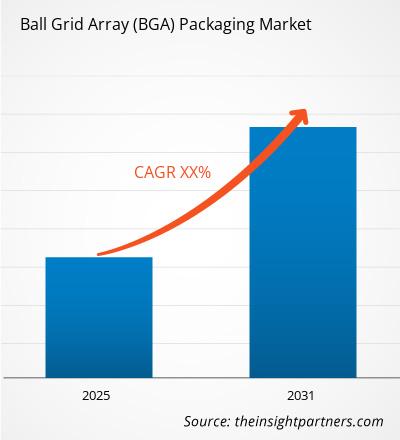
The global Ball Grid Array (BGA) Packaging market was valued at US$ 1.75 billion in 2025 and is expected to reach US$ 2.61 billion by 2034; it is estimated to record a CAGR of 4.54% during 2026-2034.
Ball Grid Array (BGA) Packaging Market Assessment and Insights
- North America: North America holds 25–29% share in 2025 and grows at a CAGR range of 4.6–5.2% during 2026–2034, supported by semiconductor reshoring, aerospace electronics, cloud infrastructure, and automotive controller packaging.
- US: The US represents 82–86% of North America in 2025 and grows at a CAGR range of 4.7–5.3% during 2026–2034, led by advanced packaging investments and defense-grade electronics.
- Europe: Europe accounts for 18–22% share in 2025 and grows at a CAGR range of 4.1–4.8% during 2026–2034, with Germany, the UK, France, Italy, and Spain leading automotive, industrial, and aerospace electronics demand.
- Asia Pacific: Asia Pacific holds 43–47% share in 2025 and grows at a CAGR range of 5.6–6.3% during 2026–2034, led by China, Taiwan, South Korea, Japan, India, and Southeast Asian assembly clusters.
- Largest Segment: Plastic material type holds 58–62% market share in 2025 and grows at a CAGR range of 5.0–5.6% during 2026–2034 due to cost efficiency and broad consumer electronics use.
- High Growth Segment: Package on Package BGA holds 18–22% market share in 2025 and grows at a CAGR range of 6.0–6.7% during 2026–2034 as mobile, AI edge, and compact system designs intensify.
- Key companies analyzed in detail: Amkor Technology, Inc.; Qorvo, Inc.; JCET Group Co., Ltd.; Corintech Ltd.; STATS ChipPAC Pte. Ltd.; ASE Technology Holding Co., Ltd.; Integrated Circuit Engineering Corporation; Infineon Technologies AG; NXP Semiconductors N.V.; Cypress Semiconductor Corporation.
Source: The Insight Partners' analysis based on proprietary research, government publications, company annual reports, investor presentations, industry databases, and expert interviews.
Packaging technologies have shifted from traditional leaded surface mount packages to array interconnect solutions that save board area, provide shorter electrical paths, and yield better assembly. The Ball Grid Array (BGA) Packaging Market is driven by substrate architecture, solder ball metallurgy, mold compound reliability, warpage control, and test coverage. Manufacturing trends have increasingly favored contract semiconductor assembly and testing companies with the ability to qualify numerous package types for applications in consumer, communication, automotive, industrial, and medical devices markets.
Future demand drivers include volume manufacturing in Asia, localizing of supply chain in the United States and Europe, as well as qualifications of safety-critical electronics. Investments will flow into fine pitch substrates, molded flip chip packages, package-on-package configurations, and thermal enhancements. Supportive policies regarding semiconductor capacities, growth of automotive semiconductors, and edge AI hardware should drive procurements.
Ball Grid Array (BGA) Packaging Market Report Scope
| Report Attribute | Details |
|---|---|
| Market size in 2025 | US$ 1.75 Billion |
| Market Size by 2034 | US$ 2.61 Billion |
| Global CAGR (2026 - 2034) | 4.54% |
| Historical Data | 2021-2024 |
| Forecast period | 2026-2034 |
Ball Grid Array (BGA) Packaging Market Analysis
Growth in Ball Grid Array (BGA) Packaging market stems from greater pin density, reduced printed circuit board footprint, and heat dissipation needs that surpass many older packaging technologies. Semiconductor manufacturers utilize BGA designs to enhance signal performance for CPUs, memory devices, power devices, RF front-end devices, and microcontrollers in automobiles, balancing yield and costs.
Ecosystem involves laminated substrate, ceramic substrates, solder balls, mold compound manufacturers, wafer bumping, die attach, wire bonding, flip chip assembly, package testing, and board-level reliability. Market dynamics favor vendors who have qualified material, automotive grade quality system and multi-site production due to need for stability in supply capacity after shortages in semiconductors.
Ball Grid Array (BGA) Packaging Industry Analysis shows that there exists a competitive environment that consists of global OSAT companies and packaging firms. Amkor Technology, Inc., ASE Technology Holding Co., Ltd., JCET Group Co., Ltd., and STATS ChipPAC Pte. Ltd. compete in terms of size, range of products, and qualification of customers. Corintech Ltd. and Integrated Circuit Engineering Corporation provide engineering services and prototyping solutions.
In addition, the strategic positioning of firms is connected with the ownership of semiconductor designs. Infineon Technologies AG, NXP Semiconductors N.V., Cypress Semiconductor Corporation, and Qorvo, Inc. determine package requirements because of automotive, industrial, embedded, and RF segments. Investments should be concentrated on thermal modeling, substrate miniaturization, low warpage molding, and automated inspection.
● REPORT CUSTOMIZATION
Tailor This Report To Align With Your Specific Business Requirements
This report can be customized to align precisely with your business objectives, scope, and target markets. Customization options include tailored segmentation, geography, competitive analysis, and strategic insights to support informed decision-making.
Customize This Report →WHAT YOU CAN ADJUST
- ● Segmentations
- ● Geography
- ● Competitive Analysis
- ● Language Preferences
Ball Grid Array (BGA) Packaging Market: Strategic Insights

Regional Insights
North America Ball Grid Array (BGA) Packaging Market
North America accounts for 25–29% share in 2025 and is projected to grow at a CAGR range of 4.6–5.2% during 2026–2034. The Ball Grid Array (BGA) Packaging Market share is supported by semiconductor reshoring, aerospace electronics, medical devices, and data-center hardware. Regional demand favors high-reliability BGA formats for processors, RF modules, FPGAs, microcontrollers, and ruggedized industrial electronics.
The region benefits from U.S. CHIPS Act funding, advanced packaging campus investments, and customer preference for traceable supply chains. Amkor Technology, Inc. is expanding domestic advanced packaging capacity, while fabless chip designers and defense suppliers require qualified outsourced assembly and test partners. Procurement emphasizes reliability testing, export compliance, and long product life cycles.
U.S. Ball Grid Array (BGA) Packaging Market
The U.S. represents 82–86% of North America in 2025 and is expected to grow at a CAGR range of 4.7–5.3% during 2026–2034. The key application areas in demand include defense electronics, cloud computing infrastructure, automotive electronics, medical electronics, and high-performance computing. The industry players in this market include Amkor Technology, Inc., Qorvo, Inc., NXP Semiconductors N.V., Infineon Technologies AG, and Cypress Semiconductor Corporation.
Key application trends revolve around molded array packages, thermally enhanced BGAs, and package-on-package technologies to provide smaller boards and enhanced processing capabilities. The purchasing considerations of consumers include board-level reliability, thermal cycling, moisture sensitivity, and qualified secondary sources. Domestic packaging provides additional assurances to aerospace, communication, and national security electronics applications.
Europe Ball Grid Array (BGA) Packaging Market
Europe holds 18–22% share in 2025 and is forecast to grow at a CAGR range of 4.1–4.8% during 2026–2034. Germany leads because automotive electronics, industrial automation, and power semiconductor ecosystems require reliable BGA packages. The UK supports aerospace, defense, and specialist electronics design, while France contributes to avionics, medical systems, and communication infrastructure demand.
Italy and Spain add demand through industrial control, automotive suppliers, and renewable-energy electronics. European buyers emphasize traceability, RoHS compliance, automotive qualification, and long-term component availability. Infineon Technologies AG and NXP Semiconductors N.V. shape regional requirements through microcontrollers, power devices, connectivity chips, and safety-critical electronics used by vehicle and industrial OEMs.
APAC Ball Grid Array (BGA) Packaging Market
Asia Pacific holds 43–47% share in 2025 and is projected to grow at a CAGR range of 5.6–6.3% during 2026–2034. China is the leading country because the OSAT scale, consumer electronics assembly, telecom equipment, and automotive electronics create broad BGA demand. Taiwan, South Korea, and Japan strengthen substrates, memory, and high-volume packaging capabilities.
India and Australia add demand through electronics manufacturing incentives, defense electronics, medical devices, and industrial IoT. Policy support for semiconductor localization, export diversification, and electronics manufacturing clusters is expanding packaging capacity. Regional buyers value price competitiveness, rapid engineering support, and qualified supply near printed circuit board assembly hubs.
Middle East & Africa Ball Grid Array (BGA) Packaging Market
The Middle East & Africa market is expected to grow at a CAGR range of 3.5–4.2% during 2026–2034. Saudi Arabia leads regional adoption through smart infrastructure, defense modernization, energy automation, and electronics localization programs. The UAE supports data-center hardware, aerospace services, and advanced communications projects requiring reliable semiconductor packages.
South Africa contributes through industrial automation, mining electronics, automotive components, and medical equipment repair ecosystems. The rest of MEA demand remains project-led and import-dependent, tied to telecommunications, power infrastructure, and public-sector digitization. Buyers prioritize package reliability under heat, supply continuity, and access to qualified replacement components.
Segmentation Analysis
Type
Type is projected to grow at a CAGR range of 5.2–5.9% during 2026–2034. The Ball Grid Array (BGA) Packaging Market scope by type reflects different balances of thermal performance, footprint, vertical integration, and manufacturing cost. Molded array process BGA remains common in mainstream ICs, while thermally enhanced and package-on-package formats support higher-density computing and mobile designs.
- Molded Array Process BGA: Molded array process BGA supports mainstream IC packaging because mold compound protection, stable solder ball geometry, and scalable assembly flow fit consumer, industrial, and communication device volumes.
- Thermally Enhanced BGA: Thermally enhanced BGA is strategically important where processors, power management ICs, and networking chips need improved heat spreading without excessive board space or package complexity.
- Package on Package BGA: Package on package BGA supports compact mobile and edge devices by stacking logic and memory, reducing board footprint, shortening interconnect paths, and enabling flexible product configurations.
- Micro BGA: Micro BGA serves space-constrained electronics where fine pitch, low profile, and short signal paths are critical, especially in wearables, portable medical devices, and compact modules.
Material Type
Material Type is expected to grow at a CAGR range of 4.9–5.5% during 2026–2034. Material selection determines cost, thermal behavior, dielectric stability, moisture sensitivity, and mechanical reliability. Plastic dominates high-volume applications, ceramic remains important for harsh environments, and tape-based formats support thin, flexible, and miniaturized assemblies where package profile is a design constraint.
- Ceramic: Ceramic materials remain preferred in aerospace, defense, RF, and high-temperature electronics because dimensional stability, thermal endurance, and hermetic performance support long-life mission-critical devices.
- Plastic: Plastic material leads volume demand due to lower cost, mature molding processes, broad substrate availability, and suitability for consumer, computing, telecom, and automotive electronic control units.
- Tape: Tape-based BGA formats address thin and lightweight assemblies where flexible interconnect structures, low profile, and miniaturized layouts are valuable for portable and specialized electronics.
Industry Vertical
Industry Vertical is projected to grow at a CAGR range of 5.0–5.8% during 2026–2034. Demand differs by qualification burden, product life, and performance density. IT and telecommunication drives high pin-count packages, consumer electronics sustains volume, automotive and aerospace demand reliability, healthcare requires traceability, and industrial applications prioritize long-term availability and harsh-environment operation.
- IT and Telecommunication: IT and telecommunication demand is driven by routers, switches, servers, RF modules, and edge computing systems, where BGA packaging supports bandwidth, miniaturization, and thermal management.
- Consumer Electronics: Consumer electronics remain a volume anchor as smartphones, wearables, laptops, gaming devices, and smart home products require compact packages with predictable assembly yields.
- Aerospace and Defense: Aerospace and Defense applications prioritize ceramic and high-reliability BGA packages that withstand vibration, temperature cycling, long service life, and stringent documentation requirements.
- Industrial: Industrial equipment uses BGA packages in controllers, drives, sensors, robotics, and automation hardware where long availability, board reliability, and stable thermal performance are essential.
- Automotive: Automotive adoption is increasing with ADAS, infotainment, powertrain control, EV systems, and connectivity modules that require qualified packages able to survive thermal cycling and vibration.
- Healthcare: Healthcare electronics use BGA formats in imaging, diagnostics, monitoring, and portable devices where compact boards, traceability, and reliability support regulated product performance.
Opportunity Snapshot
| Industry Vertical | Revenue Contribution | Trend Tag | Adoption Stage |
| IT and Telecommunication | High | Edge Compute | Mature |
| Consumer Electronics | High | Mini Devices | Mature |
| Aerospace and Defence | Medium | Rugged Chips | Scaling |
| Industrial | Medium | Factory Control | Scaling |
| Automotive | High | ADAS ECUs | Scaling |
| Healthcare | Medium | Portable Diagnostics | Scaling |
Ball Grid Array (BGA) Packaging Market Growth Drivers and Impact Analysis
Higher I/O Density in Compact Electronics
The electronic devices are increasingly requiring more input/output connections, but without increasing the board real estate. In the case of the BGA packages, the solder balls are evenly distributed on the bottom of the package, allowing for much greater interconnect density compared to most peripheral leaded devices. The effect is felt greatly in the processors, memories, RF devices, and microcontrollers found in smartphones, network applications, industrial controllers, and medical electronics. The manufacturers gain an advantage in terms of reduced electrical path length, better signal integrity, and improved assembly yield, provided process control is well developed.
Thermal Management Needs in Automotive and Computing Hardware
The increased processing requirements in cars, server applications, edge computing AI modules, and communication devices are increasing the demand for thermal dissipation at the package level in the Ball Grid Array (BGA) Packaging Market. Thermal enhanced BGA package forms can help to distribute the heat, but remain compact enough to be useful for power management ICs, networking processors, microcontrollers, and high-performance logic. The increased electrical power consumption by data centers, according to the International Energy Agency, underlines the importance of semiconductors and packaging that consume less energy. In automotive electronics, there are high requirements for the thermal cycling resistance of EV powertrains, ADAS, and infotainment system applications.
Supply Chain Localization and OSAT Capacity Expansion
The shortage of semiconductors made buyers pay more attention to robust packaging and testing. Governments from the U.S., Europe, Japan, India, and Southeast Asia are backing up semiconductor ecosystems, and OSATs are growing their advanced packaging capacities close to key customers. With regards to BGA packaging, localization helps mitigate logistical risks, improve engineering capabilities, and ensure the secure availability of semiconductors for defense, automotive, and medical electronics. It is not just the capacity issue but also the qualification of suppliers, dual sourcing, and higher documentation requirements that will have an effect. Packaging companies that are able to balance global presence and quality systems in the region will have an advantage with long-term programs.
Ball Grid Array (BGA) Packaging Market Future Trends
Finer Pitch and Warpage-Controlled Substrates
Ball Grid Array (BGA) Packaging Market trends will increasingly center on finer pitch layouts that support denser routing while maintaining board-level reliability. As package dimensions shrink and I/O counts rise, substrate flatness, coefficient-of-thermal-expansion matching, and mold compound behavior become decisive. Suppliers will invest in simulation-led substrate design, advanced inspection, and material sets that reduce solder joint stress. The trend should favor packaging partners with strong design-for-manufacturing teams because customers will need early guidance on pad layout, reflow windows, and reliability risks. Differentiation will shift from basic assembly scale to predictive engineering capability.
Package Stacking for Edge AI and Mobile Systems
Package-on-package form factors should see increasing importance as device manufacturers continue to put memory close to their processors in mobile, wearable, industrial gateway, and edge AI devices. It offers smaller footprint benefits along with possible electrical performance benefits, but at the same time, it places higher expectations on the ability of suppliers to align packages and manage heat. The manufacturers would need well-developed stacking technology, KGD management, and co-design work with semiconductor and board design engineers. It is also likely that there would be growing interest in micro BGA and thin substrate solutions.
Ball Grid Array (BGA) Packaging Market Opportunities
Automotive-Grade BGA Qualification Programs
AEC qualified packaging technology presents itself as an excellent business case for the automotive market segment, as Electric Vehicles (EV), Advanced Driver Assistance Systems (ADAS), battery management systems, connectivity modules, and zonal architecture need robust microcontrollers, processors, sensors, and power devices. Ball Grid Array (BGA) Packaging Market forecast provides a business case for capacity to cater to the demands of AEC-qualified packaging products, thermal cycle testing, vibration testing, and traceability. Packaging technology vendors will have a competitive advantage by providing customers with design rule expertise, package simulation capability, moisture sensitivity controls, and production plans related to the vehicle platform. The business case is compelling, as automotive projects usually last for many years and favor suppliers with reliability proof.
Regional Advanced Packaging Hubs for Secure Electronics
Secure electronics programs represent an opening for OSATs and specialized packaging houses to develop regional BGA expertise close to their defense, aerospace, medical, and critical infrastructure customers. The local centers will be able to deliver engineering security, secure logistics, validated supplier documentation, and quicker reaction times to changes in designs. Investments must concentrate on flexible manufacturing processes for ceramic, plastic, and thermally enhanced BGA products, not just one high-volume product alone. The governments seeking to bolster their semiconductor capability will spur adoption via grant funding, procurement policies, and regional content requirements.
Recent Developments
- April 2025: LG Innotek has unveiled a dedicated production facility for Flip Chip Ball Grid Array (FC-BGA) semiconductor substrates, and announced plans to grow its FC-BGA business into a US$700 million annual revenue business by 2030. The facility represents the company's strategic investment in advanced semiconductor packaging technologies to meet rising demand from AI, data center and high-performance computing markets. The Dream Factory, located in Gumi, South Korea, spans approximately 26,000 square meters and is designed as a fully integrated smart manufacturing facility. It incorporates artificial intelligence, deep learning, robotics, autonomous mobile robots (AMRs) and digital twin technologies to automate every stage of FC-BGA production and logistics, significantly improving manufacturing efficiency, quality control and operational transparency.
- January 2025: LG Innotek has begun mass production of its Flip Chip Ball Grid Array (FC-BGA) semiconductor substrates for major U.S. technology customers, marking a significant milestone in the company's expansion into the advanced semiconductor packaging market. The company said it has commenced commercial production of FC-BGA substrates for North American big-tech customers and is actively pursuing development partnerships with multiple global technology companies.
Frequently Asked Questions

- Comprehensive Market Sizing and Forecast Analysis
- Detailed Segmentation Analysis
- In-Depth Market Dynamics Assessment
- Regional and Country-Level Insights
- Competitive Landscape and Company Benchmarking
- Strategic Business Intelligence
Recent Reports
Testimonials

The Insight Partners' SCADA System Market report is comprehensive, with valuable insights on current trends and future forecasts. The team was highly professional, responsive, and supportive throughout. We are very satisfied and highly recommend their services.
RAN KEDEM Partner, Reali Technologies LTDs
I requested a report on a very specific software market and the team produced the report in a few days. The information was very relevant and well presented. I then requested some changes and additions to the report. The team was again very responsive and I got the final report in less than a week.
JEAN-HERVE JENN Chairman, Future Analytica
We worked with The Insight Partners for an important market study and forecast. They gave us clear insights into opportunities and risks, which helped shape our plans. Their research was easy to use and based on solid data. It helped us make smart, confident decisions. We highly recommend them.
PIYUSH NAGPAL Sr. Vice President, High Beam Global
The Insight Partners delivered insightful, well-structured market research with strong domain expertise. Their team was professional and responsive throughout. The user-friendly website made accessing industry reports seamless. We highly recommend them for reliable, high-quality research services
YUKIHIKO ADACHI CEO, Deep Blue, LLC.
This is the first time I have purchased a market report from The Insight Partners.While I was unsure at first, I visited their web site and felt more comfortable to take the risk and purchase a market report.I am completely satisfied with the quality of the report and customer service. I had several questions and comments with the initial report, but after a couple of dialogs over email with their analyst I believe I have a report that I can use as input to our strategic planning process.Thank you so much for taking the extra time and making this a positive experience.I will definitely recommend your service to others and you will be my first call when we need further market data.
JOHN SUZUKI President and Chief Executive Officer, Board Director, BK Technologies
I wish to appreciate your support and the professionalism you displayed in the course of attending to my request for information regarding to infectious disease IVD market in Nigeria. I appreciate your patience, your guidance, and the fact that you were willing to offer a discount, which eventually made it possible for us to close a deal. I look forward to engaging The Insight Partners in the future, all thanks to the impression you have created in me as a result of this first encounter.
DR CHIJIOKE ONYIA MANAGING DIRECTOR, PineCrest Healthcare Ltd.Reason to Buy
- Informed Decision-Making
- Understanding Market Dynamics
- Competitive Analysis
- Identifying Emerging Markets
- Customer Insights
- Market Forecasts
- Risk Mitigation
- Boosting Operational Efficiency
- Strategic Planning
- Investment Justification
- Tracking Industry Innovations
- Aligning with Regulatory Trends





 Get Free Sample for