
Battery Separators Market Demand, Size & Forecast by 2034
Coverage: by Battery Type (Lithium-Ion Battery, Lead Acid Battery, Alkaline Battery, and Others), Material (Polypropylene, Polyethylene, Polyolefin, and Others), End-Use Industry (Automotive, Consumer Electronics, Industrial, and Others), and Geography (North America, Europe, Asia Pacific, and South and Central America)
- Status : Data Released
- Report Code : TIPRE00005066
- Category : Chemicals and Materials
- No. of Pages : 150
- Available Report Formats :


- Last update date : August 19, 2026


2025 Market Size
US$ 6.84 Bn
Base year value
2034 Forecast
US$ 24.22 Bn
Projected by 2034
CAGR 2026-2034
15.08 %
Growth rate
Addressable Market
US$ 132.58 Bn
(2026-2034)
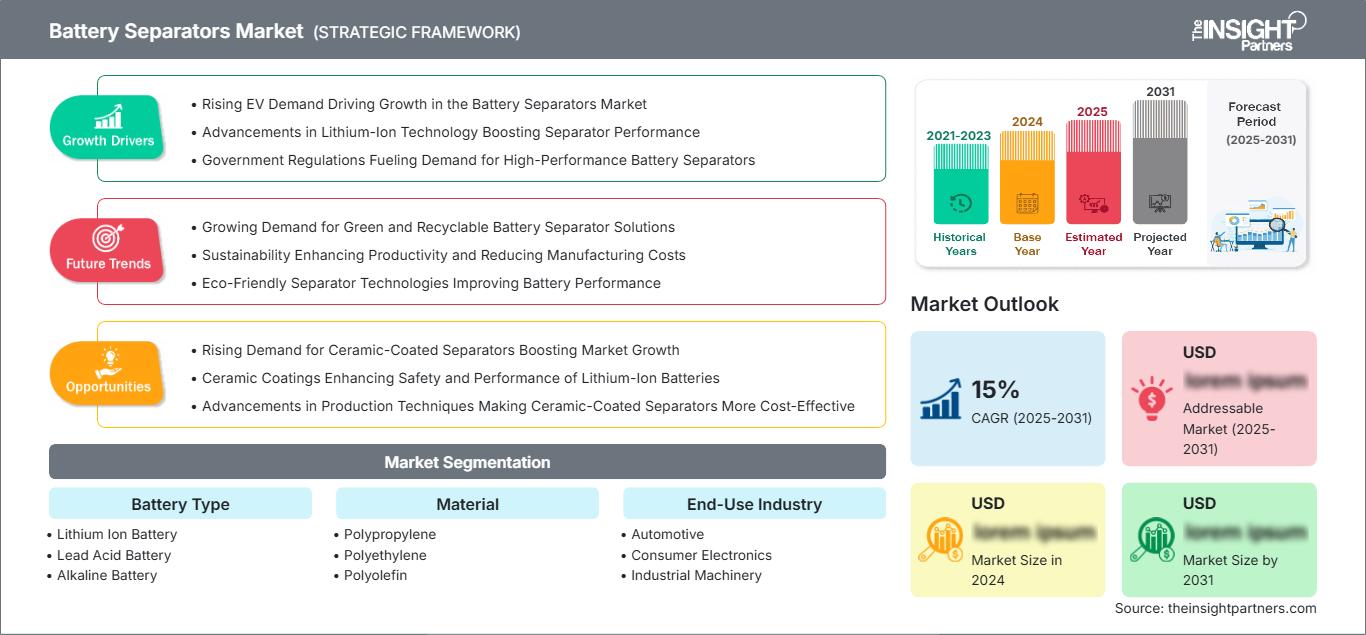
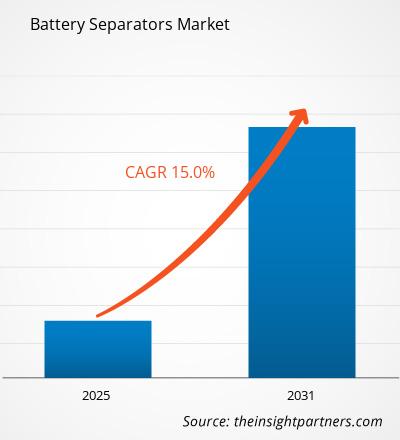
The Battery Separators market achieved a market size of US$ 6.84 Billion in 2025 and is forecast to achieve US$ 24.22 Billion by 2034, growing at a CAGR of 15.08% in the period 2026-2034. Battery Separators are critical microporous material that separates electrodes electronically while permitting ion flow. The quality of the product influences battery safety, energy density, cycle life, thermal resistance, and charging characteristics.
The North American region is becoming an important manufacturing hub, leading to a positive outlook for Battery Separators Market size in the coming years up to 2034. The battery cell investments within the domestic economy, production of electric vehicles, use of stationary energy storage solutions, and localization of supply chains is driving the demand for separators.
Battery Separators Market Assessment and Insights
- North America: North America represented a 22–26% share in 2025 and is expected to expand at a CAGR of 13.5–15.5% between 2026 and 2034, supported by localized cell manufacturing and EV investment.
- U.S.: U.S. demand represented 17–20% of North America's 2025 market and is projected to grow at a CAGR of 14.0–16.0% between 2026 and 2034, supported by domestic battery production.
- Europe: Europe accounted for a 20–24% share in 2025 and is forecast to register a CAGR of 13.0–15.0% between 2026 and 2034, led by Germany, France, Italy, Spain, and the UK.
- Asia Pacific: Asia Pacific held a 45–49% share in 2025 and is projected to register a CAGR of 16.0–18.0% between 2026 and 2034, led by China, Japan, South Korea, and India.
- Largest Segment: Lithium-ion battery held a 70–74% market share in 2025 and is projected to grow at a CAGR of 15.5–17.5% during 2026–2034, reflecting rechargeable battery dominance.
- High Growth Segment: Automotive represented a 43–47% market share in 2025 and is expected to expand at a CAGR of 16.0–18.0% during 2026–2034, driven by EV production.
- Key companies analyzed in detail: Asahi Kasei Corporation, Bernard Dumas, Dreamweaver International, Inc., ENTEK International LLC, Freudenberg SE, SK IE Technology Co., Ltd., Sumitomo Chemical Co., Ltd., Toray Industries, Inc., UBE Corporation, W-SCOPE Corporation.
Source: The Insight Partners' analysis based on proprietary research, government publications, company annual reports, investor presentations, industry databases, and expert interviews.
Nowadays, Battery Separators have progressed from simple insulating films to advanced membranes, where factors like pore structure, film thickness, mechanical strength, thermal shrinkage, and coating efficiency play a role in cell reliability. Both wet-process and dry-process technologies continue to be relevant, but ceramic coatings and polymer coatings will gain more attention due to the need for thermal stability. Meanwhile, there has been a trend toward establishing battery separators plants closer to battery manufacturing facilities because of the need for reliable local supply, reduced qualification time, and control of strategically important materials.
In the future, innovations in battery separators will likely focus on thin films, high-quality coatings, automation in inspection, and manufacturing processes with higher efficiency of material use. Attractiveness of the North America and European markets will increase due to diversification of supplies by battery manufacturers; APAC will continue to capitalize on its existing cell production ecosystem.
Battery Separators Market Report Scope
| Report Attribute | Details |
|---|---|
| Market size in 2025 | US$ 6.84 Billion |
| Market Size by 2034 | US$ 24.22 Billion |
| Global CAGR (2026 - 2034) | 15.08% |
| Historical Data | 2021-2024 |
| Forecast period | 2026-2034 |
Battery Separators Market Analysis
Growth prospects of the market are getting better with higher manufacturing of batteries, adoption of EVs, consumer electronics, and stationary storage. The demand for separators increases in proportion to production of battery cells since each battery cell uses a membrane that is ion-permeable but electrically-insulating. Polypropylene and polyethylene are still relevant due to their pore structure, chemical resistance, mechanical characteristics, and compatibility with the manufacture of lithium-ion batteries. Increasing demand is more oriented on differentiated products.
The value chain encompasses raw material providers, film manufacturers, coating providers, battery cell manufacturers, module makers, automotive OEMs, electronic manufacturers, and energy storage solution providers. The dynamics of the supply chain depends on polymer supplies, yields, coating capabilities, qualification needs, and concentration of buyers. Long qualification processes are favorable for well-established manufacturers while local production can help with improving supply chain reliability and collaboration with separator manufacturers and battery cell makers.
Competitive positioning will depend more than ever on the differentiation of technology, regional production, customer qualification, coating ability, and consistency of production, which highlights the relevance of Battery Separators Market analysis in the assessment of supplier capabilities and investment decisions. Asahi Kasei Corporation, ENTEK International LLC, SK IE Technology Co., Ltd., Toray Industries, Inc., and W-SCOPE Corporation possess critical abilities in separator technology. Additional technologies are represented by UBE Corporation, Sumitomo Chemical Co., Ltd., and Freudenberg SE.
Investment strategies will be characterized by emphasis on regional capacity, coating ability, production efficiency, and customization for customers. The projects in North America will be aimed at building localized battery manufacturing capabilities, while the Asian suppliers will continue to benefit from high volume of cell manufacturing. The suppliers that are able to produce films, apply coatings, and develop the application engineering capabilities can create better relationships with customers.
● REPORT CUSTOMIZATION
Tailor This Report To Align With Your Specific Business Requirements
This report can be customized to align precisely with your business objectives, scope, and target markets. Customization options include tailored segmentation, geography, competitive analysis, and strategic insights to support informed decision-making.
Customize This Report →WHAT YOU CAN ADJUST
- ● Segmentations
- ● Geography
- ● Competitive Analysis
- ● Language Preferences
Battery Separators Market: Strategic Insights
Regional Insights
North America Battery Separators Market
The Battery Separators Market Share in North America was recorded at 22–26% in 2025, and the region is anticipated to see a CAGR of 13.5–15.5% from 2026 to 2034. In terms of the regional landscape, the United States is the prominent market, backed by battery cell initiatives, production of electric vehicles, energy storage deployments, and localization of battery materials. Canada is improving its market standing via battery and automotive synergies. There is an increasing emphasis on supply chain security, product quality, and proximity to manufacturing facilities among regional consumers.
There is strong demand for separators in lithium-ion batteries in the automobile industry and stationary energy storage applications. Manufacturing facilities are being established regionally by suppliers to minimize risks and ensure close cooperation during qualifications. Advanced films that have better thermal stability and mechanical strength have gained significance with the need for greater battery energy density and fast-charging applications.
U.S. Battery Separators Market
The US comprised 17–20% of North America’s share of the Battery Separators market in 2025 and is expected to grow at a CAGR of 14.0–16.0% over 2026-2034. Growing demand for domestic battery production, EV manufacture, energy storage systems, and localization of the supply chain could contribute to market growth. Local battery separators production can help reduce distances in logistics and improve coordination in technology between separators producers and cell producers.
Application in automotive industry dominates the market, grid storage, industrial batteries, and consumer applications are also driving forces. The companies working on their North American potential include Asahi Kasei Corporation and ENTEK International LLC. Growing demand focuses on thinner separators, thermal properties improvement, coating quality improvement, and higher manufacturing reliability.
Europe Battery Separators Market
Europe represented a 20–24% Battery Separators share in 2025 and is expected to grow at a CAGR of 13.0–15.0% during 2026–2034. Germany is the leading country because of its strong automotive base, battery investments, chemical industry, and advanced manufacturing ecosystem.
The United Kingdom is building up battery production and electrification capabilities, driving demand in automotive and stationary storage segments. Germany boasts the most comprehensive regional ecosystem, featuring automotive OEMs, cell production initiatives, industrial players, and advanced materials know-how. Such environment fosters localization and technical cooperation.
France, Italy, and Spain contribute via automotive electrification, battery production, industrial production, and renewable energy installation. France takes advantage of cell production initiatives, Italy of automotive and industrial capacities, and Spain of battery production and renewable energy infrastructure. Increasingly more European customers value safety, traceability, environmental footprint, and supply security.
APAC Battery Separators Market
APAC held a 45–49% Battery Separators share in 2025 and is projected to grow at a CAGR of 16.0–18.0% during 2026–2034. China remains the leading country because of its extensive EV, battery-cell, electronics, and energy-storage manufacturing base.
Japan and South Korea retain strong technological positions, while India is expanding domestic battery manufacturing. Australia contributes through stationary storage and renewable-energy projects. Industrial policy, EV adoption, electronics production, and expanding energy-storage requirements continue supporting regional demand and separator manufacturing investment.
Middle East & Africa Battery Separators Market
The Middle East & Africa are projected to register a CAGR of 9.0–11.0% during 2026–2034, with Saudi Arabia emerging as the leading market. UAE investment in clean transportation and energy storage is increasing battery-related opportunities, while South Africa benefits from automotive manufacturing and renewable-energy projects.
Saudi Arabia's industrial diversification and energy-storage initiatives provide a developing demand base. UAE projects emphasize electrification and grid flexibility, while South Africa's automotive and renewable-energy infrastructure supports battery adoption. The rest of MEA remains comparatively smaller, but telecommunications backup, industrial batteries, renewable integration, and infrastructure modernization should support gradual separator demand.
Segmentation Analysis
Battery Type
Battery Type is projected to register a CAGR of 14.5–16.5% during 2026–2034. Lithium-ion battery represents the principal demand source because EVs, electronics, and energy-storage systems depend heavily on rechargeable cells. Lead Acid Battery remains important for starting, backup, and industrial applications, while Alkaline Battery continues serving primary-cell applications. Battery chemistry, operating conditions, safety requirements, and production economics determine separator requirements.
- Lithium-ion battery remains the dominant application because EV, electronics, and energy-storage cell production requires microporous separators with controlled porosity, mechanical strength, thermal stability, and electrolyte compatibility.
- Lead Acid Battery continues generating separator demand across automotive starting batteries, telecommunications, backup systems, and industrial applications where reliability, established recycling networks, and cost efficiency remain important.
- Alkaline Battery maintains a specialized separator requirement for primary cells used in household equipment, portable devices, industrial instruments, and applications requiring dependable shelf life and stable operation.
Material
Material is expected to grow at a CAGR of 13.5–15.5% during 2026–2034. Polypropylene, Polyethylene, and Polyolefin remain central material platforms because they offer established processing routes, chemical resistance, mechanical strength, and controlled pore structures. Development is increasingly focused on thinner films, improved thermal stability, and compatibility with advanced coatings. Material selection depends on chemistry, cell format, manufacturing route, and safety specifications.
- Polypropylene remains important for separator structures requiring dimensional stability, chemical resistance, and controlled thermal behavior across multilayer and dry-process battery architectures.
- Polyethylene provides important shutdown functionality because its pore structure can close under elevated temperature, supporting a passive safety mechanism within lithium-ion battery cells.
- Polyolefin remains the principal material family because polypropylene and polyethylene combine scalable processing, mechanical strength, electrolyte compatibility, and established qualification across major battery applications.
End-Use Industry
End-Use Industry is projected to register a CAGR of 15.0–17.0% during 2026–2034. Automotive provides the largest demand base as EV and hybrid production expands. Consumer electronics require increasingly thin and reliable separator structures, while Industrial Machinery applications benefit from batteries used in robotics, automated equipment, backup systems, and stationary storage. The Battery Separators Market scope, therefore, spans multiple demand environments with distinct performance requirements.
- Automotive represents the leading demand center, supported by EVs, plug-in hybrids, and hybrid vehicles requiring safe, durable, high-energy-density battery systems.
- Consumer Electronics generates demand for compact separators balancing thickness, energy density, thermal stability, and mechanical integrity across smartphones, computers, wearables, and portable devices.
- Industrial Machinery benefits from battery deployment in robotics, automated guided vehicles, material-handling equipment, backup systems, and stationary storage requiring repeated charging and dependable operation.
Opportunity Snapshot
| End-Use Industry | Revenue Contribution | Trend Tag | Adoption Stage |
| Automotive | High | EV Cells | Scaling |
| Consumer Electronics | Medium | Thin Cells | Mature |
| Industrial Machinery | Medium | Grid Storage | Scaling |
Battery Separators Market Growth Drivers and Impact Analysis
Accelerating electric vehicle battery production
The production of electric vehicles will drive up demand for lithium-ion batteries which will raise the demand for separators and coatings. The amount of battery capacity in the vehicle will affect the amount of separators that will be needed since more battery capacity means more batteries which need bigger cells. Customers are beginning to demand that materials retain their dimensions, have high mechanical and thermal strength during the charging process. This is driving the development of thinner films, multi-layered products, ceramic coating and process control. Battery localization will enhance the opportunity as each battery manufacturing cluster needs their own sources of materials. Established suppliers of separators in the automotive industry will have an advantage over others due to repeated qualification programs while new suppliers will have a long way to go.
Expansion of stationary energy-storage systems
Stationary storage is becoming an important complementary demand source as renewable-energy deployment increases requirements for grid balancing, peak management, backup power, and electricity flexibility. Utility-scale systems require large cell volumes, generating incremental separator consumption outside automotive applications. Commercial storage, telecommunications backup, and industrial energy systems provide additional demand diversification. Suppliers can address this opportunity through cost-efficient separators designed for large-format cells and long operating cycles. Diversification into stationary storage can also reduce dependence on automotive production cycles and create relationships with utilities, system integrators, and industrial battery manufacturers. Separator specifications for these applications may differ from automotive requirements, creating opportunities for manufacturers that can customize film properties, coating structures, and manufacturing economics while maintaining high safety and reliability.
Increasing battery safety requirements
Higher energy density and faster charging are increasing technical requirements for separator materials. Separators must prevent electrode contact while allowing efficient ionic transport and maintaining dimensional stability at elevated temperatures. Ceramic-coated, aramid-coated, and other heat-resistant structures are therefore becoming increasingly relevant. Improved pore control and thickness uniformity are also important as battery manufacturers seek greater active-material loading. These requirements raise entry barriers because separator performance must be demonstrated through extensive cell-level validation. Manufacturers with integrated film production, coating, inspection, and application-engineering capabilities can differentiate their products through measurable safety and performance improvements. The market impact extends beyond material volume because premium separator designs can increase value per unit area and strengthen supplier relationships with automotive and energy-storage customers.
Battery Separators Market Future Trends
Development of multifunctional separator architectures
The Battery Separators Market trends toward multifunctional architectures are expected to accelerate as manufacturers seek thinner structures that simultaneously provide ionic permeability, mechanical strength, thermal resistance, and shutdown functionality. Manufacturers are developing solutions that balance ionic permeability, mechanical strength, thermal resistance, shutdown behavior, and coating compatibility. Ceramic and advanced polymer coatings can improve heat resistance without requiring a complete redesign of the underlying membrane. Automated inspection and process analytics are likely to become more important as thickness decreases and acceptable defect tolerances narrow. Suppliers are expected to customize pore structures and surface characteristics according to battery chemistry, cell format, and charging profile. These developments can improve energy density and safety simultaneously. Multifunctional architectures should therefore gain importance in premium automotive cells, fast-charging systems, and large-format storage batteries where performance requirements increasingly exceed those of conventional separator structures.
Geographic diversification of manufacturing capacity
Separator manufacturing is expected to become more geographically distributed as battery producers seek resilient and localized supply chains. APAC will remain a major production center, while North America and Europe are attracting investments connected with domestic cell manufacturing and vehicle electrification. Regional facilities can reduce transportation exposure, shorten technical feedback cycles, and improve supply assurance. Partnerships between separator producers and battery-cell manufacturers are likely to become more important as local qualification gains strategic value. Investment decisions will increasingly consider proximity to gigafactories, polymer availability, energy costs, labor, environmental requirements, and customer concentration. This regionalization should create a more diversified manufacturing ecosystem while intensifying competition for long-term supply contracts.
Battery Separators Market Opportunities
Localized production for North American battery ecosystems
North America's expanding battery ecosystem creates an opportunity for separator manufacturers to establish production close to cell and automotive clusters. Local capacity can improve supply reliability while enabling closer technical collaboration during qualification. Producers can target automotive lithium-ion cells alongside stationary-storage applications, allowing capacity to serve several customer groups. Partnerships with battery manufacturers and automotive companies can improve demand visibility and reduce commercialization risk. Flexible facilities capable of manufacturing different film structures and coating configurations can provide stronger differentiation than commodity capacity. Battery Separators Market Forecasts indicate that regionalization should remain strategically important as battery producers seek supply security. Suppliers combining regional manufacturing, advanced process engineering, and application support can capture opportunities created by localized battery supply chains.
Expansion of advanced separator coating technologies
Advanced coatings create opportunities to increase separator value in high-energy-density and fast-charging cells. Ceramic and heat-resistant polymer coatings can improve thermal stability, dimensional control, and safety while maintaining compatibility with established base films. Investment opportunities extend across coating equipment, dispersion systems, binders, surface treatment, automated inspection, and process control. Suppliers can develop customer-specific coating structures for different chemistries and manufacturing processes. Demand is particularly relevant for automotive and large stationary-storage systems where thermal performance is a critical purchasing factor. Manufacturers capable of demonstrating measurable cell-level improvements while maintaining competitive production economics can capture higher-value applications. Coating expertise can also strengthen customer relationships by enabling joint development and differentiated separator specifications.
Recent Developments
- June 2026: UBE Corporation — UBE MAXELL announced construction of a new lithium-ion battery separator base-film production facility at its Sakai Works. The company stated that the first phase will begin in fiscal 2026 and the second phase is scheduled for fiscal 2029. Combined investments are expected to increase UBE MAXELL separator base-film capacity by approximately 50% from its current level.
- November 2025: Sumitomo Chemical Co., Ltd. — Sumitomo Chemical announced restructuring of its PERVIO lithium-ion secondary-battery separator business. Production at its Ohe Works in Japan was scheduled to cease by March 2026, with manufacturing and related functions consolidated at SSLM in Daegu, South Korea, while Japan focuses on next-generation material research.
Frequently Asked Questions

- Comprehensive Market Sizing and Forecast Analysis
- Detailed Segmentation Analysis
- In-Depth Market Dynamics Assessment
- Regional and Country-Level Insights
- Competitive Landscape and Company Benchmarking
- Strategic Business Intelligence
Recent Reports
Testimonials

The Insight Partners' SCADA System Market report is comprehensive, with valuable insights on current trends and future forecasts. The team was highly professional, responsive, and supportive throughout. We are very satisfied and highly recommend their services.
RAN KEDEM Partner, Reali Technologies LTDs
I requested a report on a very specific software market and the team produced the report in a few days. The information was very relevant and well presented. I then requested some changes and additions to the report. The team was again very responsive and I got the final report in less than a week.
JEAN-HERVE JENN Chairman, Future Analytica
We worked with The Insight Partners for an important market study and forecast. They gave us clear insights into opportunities and risks, which helped shape our plans. Their research was easy to use and based on solid data. It helped us make smart, confident decisions. We highly recommend them.
PIYUSH NAGPAL Sr. Vice President, High Beam Global
The Insight Partners delivered insightful, well-structured market research with strong domain expertise. Their team was professional and responsive throughout. The user-friendly website made accessing industry reports seamless. We highly recommend them for reliable, high-quality research services
YUKIHIKO ADACHI CEO, Deep Blue, LLC.
This is the first time I have purchased a market report from The Insight Partners.While I was unsure at first, I visited their web site and felt more comfortable to take the risk and purchase a market report.I am completely satisfied with the quality of the report and customer service. I had several questions and comments with the initial report, but after a couple of dialogs over email with their analyst I believe I have a report that I can use as input to our strategic planning process.Thank you so much for taking the extra time and making this a positive experience.I will definitely recommend your service to others and you will be my first call when we need further market data.
JOHN SUZUKI President and Chief Executive Officer, Board Director, BK Technologies
I wish to appreciate your support and the professionalism you displayed in the course of attending to my request for information regarding to infectious disease IVD market in Nigeria. I appreciate your patience, your guidance, and the fact that you were willing to offer a discount, which eventually made it possible for us to close a deal. I look forward to engaging The Insight Partners in the future, all thanks to the impression you have created in me as a result of this first encounter.
DR CHIJIOKE ONYIA MANAGING DIRECTOR, PineCrest Healthcare Ltd.Reason to Buy
- Informed Decision-Making
- Understanding Market Dynamics
- Competitive Analysis
- Identifying Emerging Markets
- Customer Insights
- Market Forecasts
- Risk Mitigation
- Boosting Operational Efficiency
- Strategic Planning
- Investment Justification
- Tracking Industry Innovations
- Aligning with Regulatory Trends





 Get Free Sample for