
Beneficial Insects Market Size, Growth & Demand by 2034
Beneficial Insects Market Size and Forecasts (2021 - 2034), Global and Regional Share, Trends, and Growth Opportunity Analysis Report Coverage : by Type (Predators, Parasitoids, Pathogens, Pollinators); Application (Crop protection and Crop production); Crop Type (Fruits and Vegetables, Flowers and Ornamentals, Grains and Pulses); and Geography (North America, Europe, Asia Pacific, and South and Central America)
- Status : Data Released
- Report Code : TIPRE00040378
- Category : Chemicals and Materials
- No. of Pages : 150
- Available Report Formats :


- Last update date : August 26, 2026


2025 Market Size
US$ 484.24 Mn
Base year value
2034 Forecast
US$ 964.29 Mn
Projected by 2034
CAGR 2026-2034
7.95 %
Growth rate
Addressable Market
US$ 6,514.10 Mn
(2026-2034)
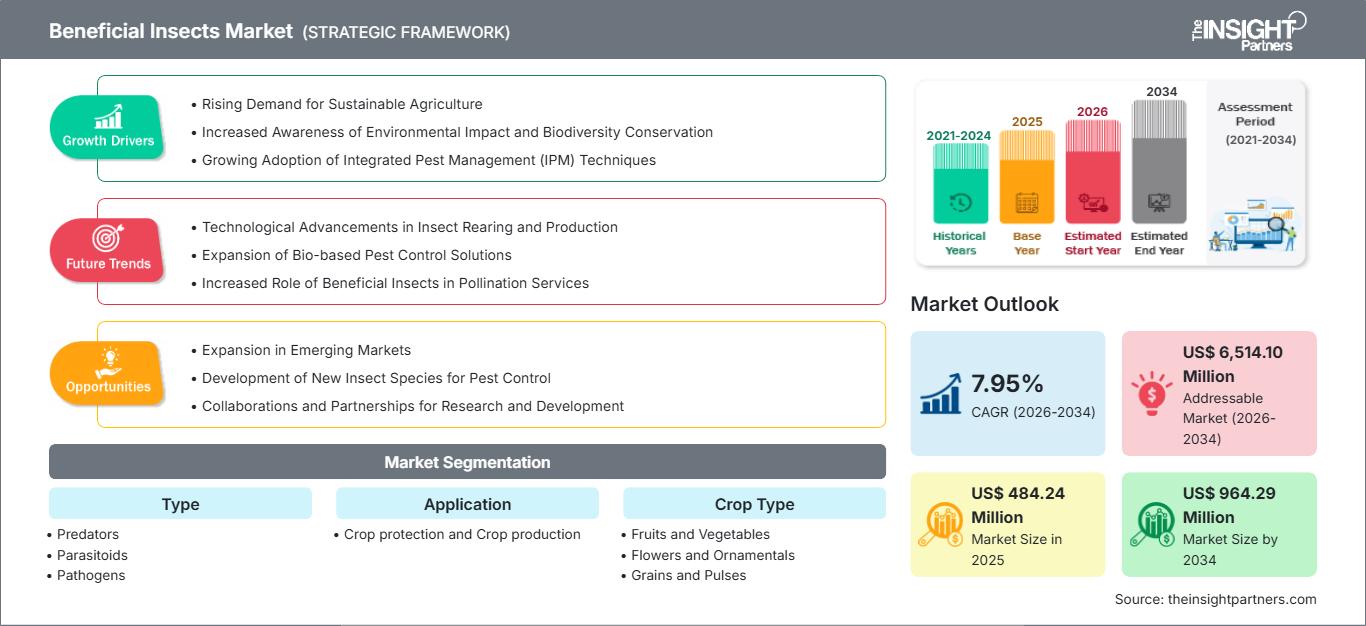
The Beneficial Insects Market was valued at US$ 484.24 Million in 2025 and is projected to reach US$ 964.29 Million by 2034, registering a CAGR of 7.95% during 2026–2034. Expansion is supported by increasing integration of biological control into commercial agriculture, particularly horticulture, protected cultivation, and integrated pest management programs requiring targeted pest suppression and managed pollination.
North America remains a strategically important market, with the Beneficial Insects Market size supported by established insectary infrastructure, extensive greenhouse cultivation, and increasing use of integrated pest management. The regional market is estimated to expand at a CAGR of 8.10–8.60% during 2026–2034, supported by specialty-crop production and increasing emphasis on resistance management.
Beneficial Insects Market Assessment and Insights
- North America: North America is estimated to represent a 34–38% Beneficial Insects Market share in 2025 and grow at a CAGR of 8.10–8.60% during 2026–2034, supported by greenhouse horticulture, specialist suppliers, and established biological-control practices.
- U.S.: The U.S. is estimated to represent 65–70% of North America in 2025 and grow at a CAGR of 8.00–8.50%, supported by commercial horticulture and integrated pest management adoption.
- Europe: Europe is estimated to hold a 30–34% share in 2025 and expand at a CAGR of 7.30–7.80%, led by the Netherlands, Spain, Germany, France, Italy, and the UK.
- Asia Pacific: Asia Pacific is estimated to account for a 20–24% share in 2025 and grow at a CAGR of 8.70–9.30%, led by China, Japan, India, South Korea, and Australia.
- Largest Segment: Predators are estimated to hold a 42–46% market share in 2025 and expand at a CAGR of 7.60–8.10%, reflecting broad pest-control applicability.
- High Growth Segment: Crop protection is estimated to hold a 58–62% market share in 2025 and grow at a CAGR of 8.20–8.70%, supported by IPM adoption.
- Key companies analyzed in detail: Applied Bio-nomics Ltd., BioFirst Group - Biobest Group NV, Bioline AgroSciences Ltd., Fargro Limited, Andermatt Group AG, Arizona Biological Control, Inc., BioBee Ltd., Bionema Group Limited, Koppert Biological Systems B.V., Tip Top Bio-Control.
Source: The Insight Partners' analysis based on proprietary research, government publications, company annual reports, investor presentations, industry databases, and expert interviews.
Commercial activities have been transformed to focus on more controlled production, quality standardization, customized packaging, and release systems. The producers of beneficial organisms now take control of their living inventory through environmental conditions that guarantee stability in performance and product quality. Scouting, monitoring, and synchronization between the production and crop cycles are also advancing the efficiency of biological deployment. This advancement is especially pertinent in terms of greenhouse vegetables, berries, flowers, and ornamental crops where there is more pressure from pests and the value of crops justifies multiple biological applications.
Future growth will be seen in developing horticulture markets, local production, and greater alignment with the IPM goals. North America and Europe will serve as established commercial platforms, whereas the Asia Pacific will represent regions with great room for expansion through protected cultivation and agricultural advancements. Climate-controlled production and technology distribution may solve logistics problems of transporting live organisms and facilitate regional production and services networks.
Beneficial Insects Market Report Scope
| Report Attribute | Details |
|---|---|
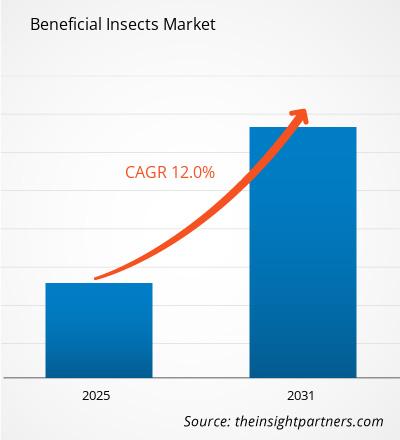
| Market size in 2025 | US$ 484.24 Million |
| Market Size by 2034 | US$ 964.29 Million |
| Global CAGR (2026 - 2034) | 7.95% |
| Historical Data | 2021-2024 |
| Forecast period | 2026-2034 |
Beneficial Insects Market Analysis
The Beneficial Insects Market development will be fueled by increasing need for integrated pest-management programs involving natural enemies along with monitoring, cultural practices, and select chemical applications. Valuable fruits, vegetables, berries, flowers, and ornamentals offer positive economics since damage caused by pests reduces yield for sale. The ecological system consists of insectaries, producers of biological input products, distributors, crop consultants, greenhouse operators, and farmers. It is important to coordinate efforts of all parties involved due to the nature of beneficial insects requiring proper handling and application timing.
The dynamics of supply of products is more complicated compared to traditional crop-protection inputs as live organisms may be influenced by temperature, humidity, host plant quality, contamination, and transport duration. Therefore, controlled production, quality assurance, inventory management, and geographic distribution are key issues for suppliers. Predatory and parasitic organisms require specialized knowledge, and pollination programs require dependable biological activity. Diversified product portfolio helps to cope with different pest complexes and crops' stages.
The Beneficial Insects Market report shows that competition is rising among the international biological input companies and the insectaries. Koppert Biological Systems B.V. produces predators, mites, parasitoids, beneficial microbes, plant protection, and pollination. BioFirst Group – Biobest Group NV has capacity for biological crop protection and pollination, whereas Andermatt Group AG has a broad biological platform in crop production and specialty biological applications.
Specialized suppliers remain significant due to the role of biological performance that is based on the choice of species, application time, and agronomic situations. These specialized firms include Applied Bio-nomics Ltd., Bioline AgroSciences Ltd., BioBee Ltd., Fargro Limited, Arizona Biological Control, Inc., Bionema Group Limited, and Tip Top Bio-Control. The competitive advantage of the firms is based on reliability, service delivery, biological performance, and integration of the products in complete IPM program.
● REPORT CUSTOMIZATION
Tailor This Report To Align With Your Specific Business Requirements
This report can be customized to align precisely with your business objectives, scope, and target markets. Customization options include tailored segmentation, geography, competitive analysis, and strategic insights to support informed decision-making.
Customize This Report →WHAT YOU CAN ADJUST
- ● Segmentations
- ● Geography
- ● Competitive Analysis
- ● Language Preferences
Beneficial Insects Market: Strategic Insights
Regional Insights
North America Beneficial Insects Market
North America accounts for around 34-38% share of the total global market in 2025 and is forecasted to witness growth at a CAGR of 8.10-8.60% till 2034. The United States continues to lead the demand due to greenhouse vegetables, berries, ornamentals, and specialized crops. Canada makes its contribution through greenhouse horticulture and commercial fruit growing. Insectary programs are developed as an aid to local supply.
Adoption will be driven by the use of well-planned IPM strategies that incorporate biological organisms along with monitoring of pests and application of targeted solutions. Farmers have started assessing biological release based on pest levels, value of the crop, residual factors, and requirements related to resistance management. Technical barriers are minimized by the availability of biological control suppliers. Commercial greenhouses are highly appropriate due to their controllability.
U.S. Beneficial Insects Market
The U.S. is estimated to constitute 65%–70% of the North American market share in 2025 and to register CAGR growth of 8.00%–8.50% between 2026 and 2034. Commercial application markets will be dominated by greenhouse vegetables, berries, herbs, ornamental plants, and other specialty crops. Valuable crops enable users to cover the cost of monitoring and biological releases, where pest presence can impact their marketable yields.
Applied Bio-nomics Ltd. and Arizona Biological Control, Inc. provide examples of specialists' ability to deliver products, whereas international suppliers ensure a wider distribution network. New application practices will involve predators, parasitoids, pollinators, monitoring, and selective traditional controls. This strategy helps manage pest resistance and protect beneficial insects. Finally, the U.S. offers a good testing ground for the introduction of new technologies since users require a reliable performance of the biological control technology.
Europe Beneficial Insects Market
It is expected that the Europe Beneficial Insects Market will have a market share of 30-34% in 2025 growing at a CAGR of 7.30-7.80%. The top country in Europe is the Netherlands due to highly developed greenhouse horticulture and biological control techniques. Spain, Germany, France, Italy, and the United Kingdom offer diverse demand for biological control solutions in vegetables, fruits, flowers, and ornamentals. IPM strategy in the region enhances structural base for biological adoption.
The United Kingdom generates demand for protected horticulture and ornamental production. Germany is a combination of demand for greenhouse vegetables and biological inputs. Fruit and vegetable production provides demand in France and Italy. Spain is important due to high greenhouse production making biological releases recurrent.
APAC Beneficial Insects Market
The APAC region is expected to hold 20-24% market share by 2025 and exhibit a CAGR of 8.70-9.30%, with China leading in the market. While Japan and South Korea have developed high-end horticulture applications, the regions of India and Australia provide more prospects for growth owing to agricultural advancements and biological control studies.
In case of China, there is a strong combination of agricultural produce along with increased biological input applications. While Japan focuses on controlled horticulture applications, the region of South Korea is developing in terms of protected cultivation. India provides huge opportunities owing to its large-scale agriculture and research facilities, while Australia has IPM expertise.
Middle East & Africa Beneficial Insects Market
The Middle East and Africa market is projected to grow at a CAGR of 6.20–6.80%, led by Saudi Arabia and the UAE. Protected horticulture, irrigation investment, and food-security programs support biological adoption in controlled environments. South Africa remains an important market because of commercial fruit and vegetable production, while other MEA countries remain comparatively emerging.
Energy availability and greenhouse infrastructure influence the economics of biological programs. Saudi Arabia and the UAE are investing in controlled agricultural production where biological releases can be monitored closely. South Africa provides established commercial agriculture and biological expertise. In other MEA markets, affordability, technical training, local production, and distribution access are expected to determine adoption rates.
Segmentation Analysis
Type
Type represents a diverse biological-control ecosystem covering Predators, Parasitoids, Pathogens, and Pollinators. The segment is projected to grow at a CAGR of 7.70–8.20% during 2026–2034. Predators and parasitoids remain central to pest suppression, while pathogens expand biological intervention options. Pollinators add a complementary production function, particularly in greenhouse crops where fruit set and yield consistency are economically important. The Beneficial Insects Market scope, therefore, extends from direct pest suppression to broader biological crop-management services.
- Predators: Predators maintain the strongest commercial position because predatory mites, ladybirds, lacewings, and predatory bugs address recurring pests and can be incorporated into structured greenhouse release programs.
- Parasitoids: Parasitoids provide targeted control against whiteflies, aphids, moths, and other pests, making host-specific biological interactions important within monitoring-led IPM programs.
- Pathogens: Pathogens broaden biological control through microbial and entomopathogenic mechanisms, giving growers additional options for pest suppression and resistance-management strategies.
- Pollinators: Pollinators support fruit set and crop quality in controlled environments, where managed pollination can improve production consistency and crop economics.
Application
The application comprises Crop protection and Crop production and is projected to grow at a CAGR of 8.10–8.70% during 2026–2034. Crop protection remains the dominant commercial use because beneficial organisms directly suppress pests. Crop production applications increasingly incorporate pollination and related biological services, particularly in controlled environments. Demand is closely linked to greenhouse expansion, specialty crops, and grower requirements for integrated biological programs.
- Crop protection: Crop protection represents the principal application because predators and parasitoids can be integrated with monitoring and selective interventions to reduce pest populations while preserving compatible beneficial species.
- Crop production: Crop production applications emphasize pollination and production consistency, particularly where controlled environments allow biological services to influence fruit set, quality, and harvesting performance.
Crop Type
Crop Type includes Fruits and Vegetables, Flowers and Ornamentals, Grains and Pulses, and is projected to grow at a CAGR of 7.50–8.00% during 2026–2034. High-value horticultural crops provide the strongest commercial economics because pest damage can substantially affect marketability. Broader-acreage crops represent longer-term opportunities as biological technologies become more scalable and cost-efficient.
- Fruits and Vegetables: Fruits and vegetables represent a major demand base because crop value, pest pressure, residue requirements, and protected cultivation support recurring biological releases.
- Flowers and Ornamentals: Flowers and ornamentals require precise pest management because cosmetic damage affects marketability, encouraging biological programs against thrips, whiteflies, aphids, and mites.
- Grains and Pulses: Grains and pulses offer broader-acreage opportunities where biological control can complement integrated programs addressing regionally important pests and resistance challenges.
Opportunity Snapshot
| Application | Revenue Contribution (High/Medium/Low) | Trend Tag (MAX 2 words) | Adoption Stage (Emerging/Scaling/Mature) |
| Crop protection | High | Pest suppression | Mature |
| Crop production | Medium | Managed pollination | Scaling |
Beneficial Insects Market Growth Drivers and Impact Analysis
Expansion of Integrated Pest Management Adoption
The approach of integrated pest management is also promoting the commercial utilization of biological entities by motivating farmers to integrate the use of monitoring, biological, cultural practices, and selective chemicals. This shifts the purchasing process from single purchases of pest control items into organized programs that require successive applications and technical support. The commercial relevance is more pronounced in high-value horticulture because the threshold for pests can be monitored, and the performance of biological agents can be evaluated through the entire growing cycle. This way, suppliers can create sustained relationships instead of just making occasional purchases of their products. Farmers will also benefit from the existence of an organized framework to minimize disturbance to the helpful population in the case of conventional management practices.
Rising Need for Pesticide Resistance Management
Increasing resistance pressure is strengthening the strategic role of biological organisms within crop-protection programs. Growers seeking to preserve chemical efficacy can rotate modes of action and integrate natural enemies that operate through different biological mechanisms. This creates recurring demand for predators, parasitoids, and compatible monitoring services. The impact extends beyond direct substitution because biological control can reduce dependence on repeated applications of individual chemical products without requiring complete elimination of conventional inputs. Suppliers offering species-specific recommendations can capture additional value because successful deployment depends on pest density, timing, environmental conditions, and compatibility. Resistance-management requirements, therefore, support biological adoption as part of diversified crop-protection strategies.
Expansion of High-Value Protected Horticulture
Protected horticulture provides favorable operating conditions for beneficial organisms because growers can control temperature, humidity, crop density, and release timing. High-value vegetables, berries, flowers, and ornamentals can support recurring biological programs when crop quality and residue requirements influence returns. Greenhouse expansion also creates demand for monitoring, environmental sensors, precision release systems, and technical advisory services. The commercial impact is consequently broader than organism sales. Suppliers can develop integrated relationships involving pest monitoring, scheduled releases, pollination, and crop-management guidance. Expansion of controlled agriculture in water-constrained and food-security-focused regions may further increase demand because biological programs can operate within tightly managed production environments.
Beneficial Insects Market Future Trends
Digital Monitoring and Precision Release Systems
The Beneficial Insects Market trends are expected to increasingly involve computer vision, automated pest identification, environmental sensors, digital scouting, and precision release systems. These technologies can shift biological control from calendar-based deployment toward decisions based on actual pest populations and crop conditions. Suppliers are likely to connect monitoring platforms with release recommendations, intervention thresholds, and environmental data. Automated dispensing may also reduce labor requirements in large greenhouse operations. Accumulated data can improve species-selection models and production planning by linking pest patterns with biological performance. The trend is particularly relevant to controlled environments where temperature, humidity, crop stage, and pest density can be measured continuously and incorporated into operational decisions.
Climate-Controlled Biological Production
Future production systems are likely to emphasize climate-controlled rearing, automated colony management, improved diets, quality assurance, and packaging designed to protect living organisms during distribution. Such technologies can reduce mortality and improve consistency between insectary production and grower deployment. Longer viable handling periods could allow suppliers to serve geographically distant markets without establishing full production operations in every region. Koppert Biological Systems B.V. is developing a 3,500-square-meter climate-controlled flour-moth breeding facility with Certhon, illustrating how controlled-environment engineering can be applied to biological production. The broader direction suggests that production technology will become an increasingly important competitive factor alongside organism efficacy and species diversity.
Beneficial Insects Market Opportunities
Localization of Biological Production Capacity
The Beneficial Insects Market Forecasts support opportunities for regional insectaries and propagation facilities located closer to emerging agricultural customers. Local production can shorten transport times, improve organism viability, and allow suppliers to select species suited to regional pest complexes and climates. Investment models can combine international production protocols with local partnerships involving agricultural universities, extension organizations, greenhouse operators, distributors, and growers. Asia Pacific and selected African markets offer particularly relevant opportunities because agricultural modernization is occurring alongside growing interest in biological inputs. Companies that combine local production with technical teams can address operational barriers more effectively than suppliers relying solely on distant shipments. Regional facilities can also improve inventory planning around crop cycles.
Integration With Digital Crop-Service Platforms
A second opportunity involves moving beyond organism sales toward bundled crop-management services. Suppliers can combine beneficial organisms with scouting, monitoring, pollination, advisory support, digital decision tools, and application planning. Such models can increase customer retention because biological performance depends on species selection, release timing, environmental management, and compatibility with other interventions. Partnerships with greenhouse technology providers, crop consultants, irrigation companies, and food producers can embed biological programs into standardized cultivation protocols. Investment in service platforms can also provide recurring revenue opportunities and generate operational data useful for product development. Companies with established grower relationships and strong technical teams may therefore capture greater value than organizations focused solely on organism production.
Recent Developments
- June 2026: Red Fox Ethiopia PLC inaugurated Ethiopia's first dedicated beneficial-insect production facility at its flower farm southeast of Addis Ababa. The US$50-million-birr facility will produce predatory Swirskii and Californicus mites for greenhouse crops, reducing reliance on imported biological-control agents. The initiative is also intended to lower air-freight requirements, pesticide use, and associated carbon emissions while supporting export-oriented floriculture.
- April 2025: Agragene Inc. and Associates Insectary announced a partnership to scale Agragene's KNOCKOUT SWD technology for spotted wing drosophila control. Associates Insectary will rear sterile male insects at its Santa Paula, California, facility. The gene-edited sterile-insect approach is designed to complement conventional control methods, with field trials planned subject to regulatory approval and potential commercial availability targeted for 2027.
- November 2025: Terravata expanded the use of drones to distribute beneficial insects for agricultural pest management in Idaho and California. The company uses drones to release predatory mites against spider mites and can map approximately 10 acres per load, with reported daily treatment capacity ranging from 2 to 300 acres per drone. The approach demonstrates increasing integration of aerial automation with biological pest-control deployment.
Frequently Asked Questions

- Comprehensive Market Sizing and Forecast Analysis
- Detailed Segmentation Analysis
- In-Depth Market Dynamics Assessment
- Regional and Country-Level Insights
- Competitive Landscape and Company Benchmarking
- Strategic Business Intelligence
Recent Reports
Testimonials

The Insight Partners' SCADA System Market report is comprehensive, with valuable insights on current trends and future forecasts. The team was highly professional, responsive, and supportive throughout. We are very satisfied and highly recommend their services.
RAN KEDEM Partner, Reali Technologies LTDs
I requested a report on a very specific software market and the team produced the report in a few days. The information was very relevant and well presented. I then requested some changes and additions to the report. The team was again very responsive and I got the final report in less than a week.
JEAN-HERVE JENN Chairman, Future Analytica
We worked with The Insight Partners for an important market study and forecast. They gave us clear insights into opportunities and risks, which helped shape our plans. Their research was easy to use and based on solid data. It helped us make smart, confident decisions. We highly recommend them.
PIYUSH NAGPAL Sr. Vice President, High Beam Global
The Insight Partners delivered insightful, well-structured market research with strong domain expertise. Their team was professional and responsive throughout. The user-friendly website made accessing industry reports seamless. We highly recommend them for reliable, high-quality research services
YUKIHIKO ADACHI CEO, Deep Blue, LLC.
This is the first time I have purchased a market report from The Insight Partners.While I was unsure at first, I visited their web site and felt more comfortable to take the risk and purchase a market report.I am completely satisfied with the quality of the report and customer service. I had several questions and comments with the initial report, but after a couple of dialogs over email with their analyst I believe I have a report that I can use as input to our strategic planning process.Thank you so much for taking the extra time and making this a positive experience.I will definitely recommend your service to others and you will be my first call when we need further market data.
JOHN SUZUKI President and Chief Executive Officer, Board Director, BK Technologies
I wish to appreciate your support and the professionalism you displayed in the course of attending to my request for information regarding to infectious disease IVD market in Nigeria. I appreciate your patience, your guidance, and the fact that you were willing to offer a discount, which eventually made it possible for us to close a deal. I look forward to engaging The Insight Partners in the future, all thanks to the impression you have created in me as a result of this first encounter.
DR CHIJIOKE ONYIA MANAGING DIRECTOR, PineCrest Healthcare Ltd.Reason to Buy
- Informed Decision-Making
- Understanding Market Dynamics
- Competitive Analysis
- Identifying Emerging Markets
- Customer Insights
- Market Forecasts
- Risk Mitigation
- Boosting Operational Efficiency
- Strategic Planning
- Investment Justification
- Tracking Industry Innovations
- Aligning with Regulatory Trends





 Get Free Sample for