
Benomyl Market Size, Growth & Demand by 2034
Coverage: by Type (WP, Mixed Product); Application (Crops, Fruits, Vegetables) , and Geography (North America, Europe, Asia Pacific, and South and Central America)
- Status : Data Released
- Report Code : TIPRE00011601
- Category : Chemicals and Materials
- No. of Pages : 150
- Available Report Formats :


- Last update date : August 19, 2026


2025 Market Size
US$ 1.33 Bn
Base year value
2034 Forecast
US$ 1.75 Bn
Projected by 2034
CAGR 2026-2034
3.1 %
Growth rate
Addressable Market
US$ 13.99 Bn
(2026-2034)
The global Benomyl market was valued at US$ 1.33 billion in 2025 and is expected to reach US$ 1.75 billion by 2034; it is estimated to record a CAGR of 3.1% during 2026-2034.
Benomyl Market Assessment and Insights
- North America: Accounted for an 18–22% Benomyl Market share in 2025 and is projected to grow at a CAGR of 2.7–3.2% during 2026–2034, reflecting restricted but persistent use in registered specialty crop programs.
- U.S.: Represented 76–80% of North American revenue in 2025 and is anticipated to expand at a CAGR of 2.6–3.1% during 2026–2034, supported by disease management in high-value horticulture.
- Europe: Held 12–16% share in 2025 and is expected to grow at a CAGR of 1.4–1.9% during 2026–2034, led by Germany, France, Italy, Spain, and the UK.
- Asia Pacific: Accounted for a 43–47% share in 2025 and is forecast to register a CAGR of 4.1–4.7% during 2026–2034, led by China and India through broad crop acreage and active formulation supply.
- Largest Segment: WP accounted for 62–66% market share in 2025 and is expected to expand at a CAGR of 3.1–3.6% during 2026–2034, supported by established farmer familiarity.
- High Growth Segment: Vegetables represented 24–28% market share in 2025 and are projected to register a CAGR of 4.0–4.6% during 2026–2034, reflecting disease pressure in intensive cultivation.
- Key companies analyzed in detail: BASF SE, Corteva Agriscience LLC, UPL Limited, ADAMA Ltd., Sinon Corporation, Taicang City Pesticide Factory Co., Ltd., Villa Crop Protection (Pty) Ltd., Jiangsu LongXingchem Technology Co., Ltd., Jiangsu Yangnong Chemical Co., Ltd., Indofil Industries Limited.
Source: The Insight Partners' analysis based on proprietary research, government publications, company annual reports, investor presentations, industry databases, and expert interviews.
Systemic benzimidazoles revolutionized disease management by moving beyond just contact activity and allowing for curative action against many types of fungi. Benomyl is a specialty chemistry, narrow in application, but commercially viable based on registration, residue, and resistance management considerations. Market drivers include production by a few active ingredient producers and formulators, with multinational portfolios shifting to novel chemistries and stewardship-based mixes.
Future demand will come out of Asia Pacific, Africa, and some selected Latin American horticultural areas due to disease pressure, wet conditions, and increased cropping practices, which continue to drive fungicide use. Regulatory drivers are not strong, but clear residue testing and private label formulation capabilities, along with integrated pest management programs, can help with compliant use. Investments will center on lower dust WP handling and mixing with other pesticides.
Benomyl Market Report Scope
| Report Attribute | Details |
|---|---|
| Market size in 2025 | US$ 1.33 Billion |
| Market Size by 2034 | US$ 1.75 Billion |
| Global CAGR (2026 - 2034) | 3.1% |
| Historical Data | 2021-2024 |
| Forecast period | 2026-2034 |
Benomyl Market Analysis
Benomyl's market growth will be facilitated by continuous pressure from fungal diseases on cereals, fruits, vegetables, ornamental, and plantation crops, for which regular spraying is required. Benomyl belongs to the group of benzimidazole fungicides, and its mode of action consists in beta-tubulin inhibition and is considered high-risk for developing resistance according to FRAC. This leads to stable volume growth and demand from crop advisors using rotations correctly.
The supply chain is comprised of technical producers, formulation facilities, distributors, cooperatives, agronomists, and residue testing laboratories. The largest supply can be found in Asia where the active substance production and wettable powder formulation are still cost-effective. Also, the demand is influenced by regulation divergence as benomyl usage is prohibited in some regions and permitted in others.
Benomyl market analysis reveals that this is a highly competitive industry with generic agricultural chemical companies dominating the scene and not patents. BASF SE and ADAMA Ltd. stand out in fungicide innovation compared to UPL Limited, Indofil Industries Limited, Sinon Corporation, and Chinese players who rely on their formulation capabilities, regional sales channels, and efficient purchasing strategies.
Positioning is dependent on regulatory compliance, labeling support, and resistance management ability. Villa Crop Protection (Pty) Ltd.'s Benomyl 500 WP labeling indicates continued commercial registration of the product in South Africa. Benomyl technical and 50% WP appear in the pesticide lineup of Taicang City Pesticide Factory Co., Ltd. Those suppliers with sound stewardship practices, residue management, and product availability are positioned better.
● REPORT CUSTOMIZATION
Tailor This Report To Align With Your Specific Business Requirements
This report can be customized to align precisely with your business objectives, scope, and target markets. Customization options include tailored segmentation, geography, competitive analysis, and strategic insights to support informed decision-making.
Customize This Report →WHAT YOU CAN ADJUST
- ● Segmentations
- ● Geography
- ● Competitive Analysis
- ● Language Preferences
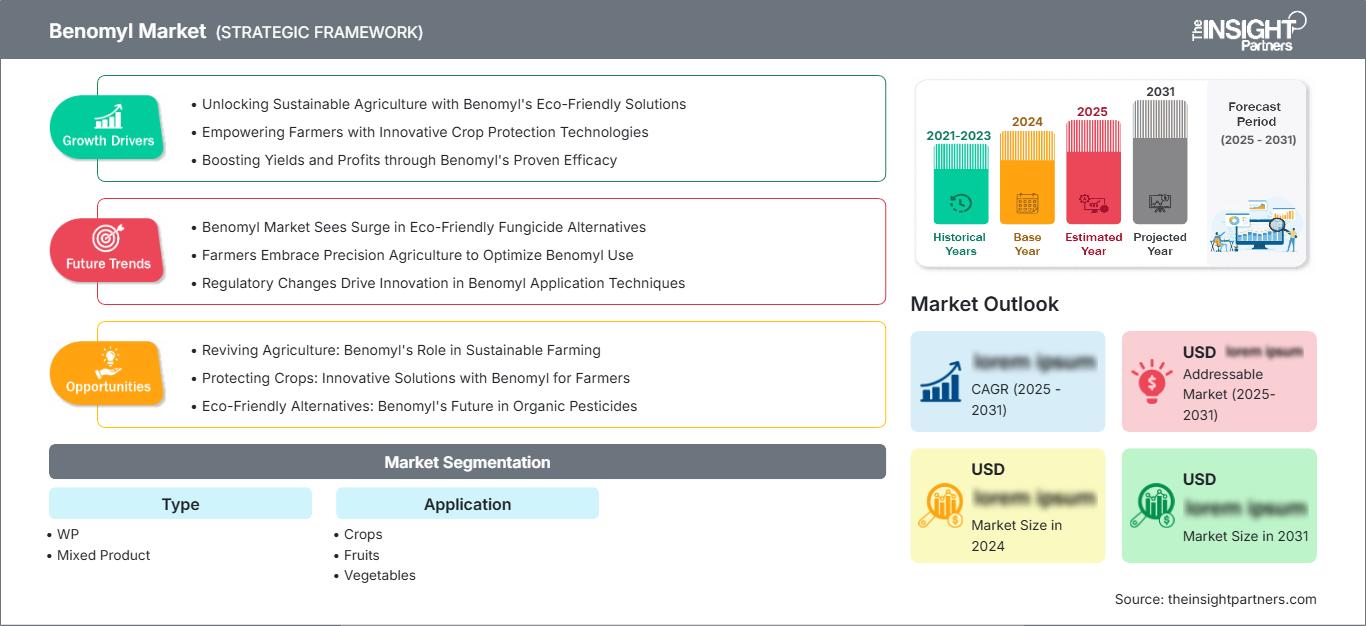
Benomyl Market: Strategic Insights
Regional Insights
North America Benomyl Market
North America holds 18-22% share of Benomyl market in 2025 and is expected to witness a growth rate of 2.7-3.2% over the period of 2026-2034. Demand in the region is relatively selective owing to regulations, the issue of resistance and residues that require caution when using the product. Applications in specialty crops diseases, nurseries and old applications keep the demand steady as labeling and risk assessment is deemed appropriate.
The chemistry is increasingly used as a part of rotation rather than a sole disease control measure. U.S. EPA categorizes benomyl as conventional pesticide registered since 1965 which demonstrates its extensive history in regulations. Replacement by new chemicals, biological fungicides and residues limit the volume growth but maintain its applications.
U.S. Benomyl Market
The U.S. accounted for 76-80% of the North America fungicides market in 2025 and is forecast to grow at a CAGR of 2.6-3.1% between 2026 and 2034. Usage is focused on valuable horticulture crops, channels associated with seed treatments and specialty applications in which diseases require well-managed fungicide rotations. Companies have a greater presence in distributors of generic fungicides.
Usage is influenced by factors like export compliance, greenhouse cultivation and integrated disease management. Farmers look for reliable control of powdery mildew, scab and fruit spot diseases but are under growing pressure to demonstrate responsible rotation of fungicides. There is a commercially significant market, although it is experiencing slower growth compared to new fungicide classes.
Europe Benomyl Market
The Europe segment had a 12-16% market share in 2025 and is predicted to have a CAGR of 1.4-1.9% during 2026-2034. Germany continues to be the foremost compliance reference market since regulatory testing and importer regulations impact trade. The UK focuses on retailer residue standards, limited authorizations, and alternative fungicide regimes. Hence, business opportunities can be attributed to imported produce testing and past technical expertise.
France, Italy, and Spain possess indirect market relevance through fruit and vegetable and wine grapes trade corridors in which maximum residue levels play a role in the selection of suppliers. The EU has established benomyl maximum residue levels at the limit of determination level in the majority of products, severely limiting direct agricultural application. Hence, the demand will be driven by compliance solutions, export plans, and residual demand.
APAC Benomyl Market
Asia Pacific is responsible for 43-47% of the total global market value in 2025, and the region is predicted to exhibit a CAGR of 4.1-4.7% between 2026-2034. Asia Pacific has the largest contribution to regional supply by technical producers and formulators for both domestic and export markets. The regional market is driven by demand generated from the use of vegetables, fruits, and field crops in India that require efficient fungal disease control.
Japan, South Korea, and Australia focus on residue regulations and stewardship, while Southeast Asia continues to utilize cost-effective fungicide rotation due to humid conditions. Food security, production of local agrochemicals, and farmer access schemes are the policy drivers of the market growth.
Middle East & Africa Benomyl Market
The Middle East & Africa market is projected to grow at a CAGR of 3.3–3.9% during 2026–2034. South Africa leads regional adoption through registered Benomyl 500 WP use on crops and orchards. Saudi Arabia and the UAE show demand through protected cultivation, landscaping, and imported horticulture supply chains.
The rest of the MEA demand is influenced by food security investment, irrigation expansion, and fungal disease pressure in vegetables and fruits. Energy-funded infrastructure supports greenhouse projects, but regulatory controls and export-market residue expectations limit indiscriminate use. Suppliers with label support and stewardship training can capture selective opportunities.
Segmentation Analysis
Type
Type is projected to grow at a CAGR of 3.0–3.6% during 2026–2034. Benomyl market scope by formulation is led by wettable powder because it remains familiar, storable, and suitable for broad farm distribution. Mixed products are gaining relevance where growers seek resistance management, wider disease coverage, and operational convenience across fruit and vegetable spray programs.
- WP remains the dominant format because 50% wettable powder products are widely recognized, cost-effective, and compatible with established spray equipment in registered markets.
- Mixed Product formulations support broader fungal control and stewardship objectives by combining benzimidazole activity with complementary chemistries, helping growers manage resistance and simplify spray schedules.
Application
Application is expected to register a CAGR of 3.5–4.1% during 2026–2034, driven by diversified crop protection needs across field crops, fruits, and vegetables. Disease incidence, humidity, crop value, and harvest timing influence product selection. Vegetable growers show faster adoption because intensive production cycles and frequent disease pressure increase the need for reliable fungicide rotation options.
- Crops represent steady demand where fungal diseases affect yield formation, seed quality, and crop stand health, particularly in regions with established broad-acre fungicide spray programs.
- Fruits require careful disease control because scab, rots, and post-harvest decay can reduce marketable output, making residue-compliant fungicide planning strategically important.
- Vegetables show strong demand in humid and protected cultivation systems, where rapid crop cycles, high disease pressure, and quality specifications support frequent fungicide rotation.
Opportunity Snapshot
| Application | Revenue Contribution | Trend Tag | Adoption Stage |
| Crops | High | Yield Shield | Mature |
| Fruits | Medium | Residue Control | Scaling |
| Vegetables | Medium | Protected Farms | Scaling |
Benomyl Market Growth Drivers and Impact Analysis
Persistent fungal pressure in intensive crop systems
The ongoing high rate of fungal diseases in areas that have a lot of humidity, protected crops, orchards, and field crop rotations has ensured the continued demand for systemic fungicide products. Benomyl can assist farmers in controlling powdery mildew, scab, fruit spots, blights, and postharvest decay wherever permitted by labeling. The effect in the marketplace will be felt most where farmers must have an affordable chemistry for their production and cannot depend on new expensive fungicides alone. But because of the development of resistance, there must always be rotation with different modes of action, which becomes an important purchasing factor. Providers of good label information, tank mix suggestions, and residue management help ensure demand even as regulation tightens.
Cost-efficient generic formulation availability
Generic supply continues to be a key factor since mature chemical structures for the active ingredient can be produced and formulated at reasonable prices. Benomyl technicals and WP formulations can be sourced from specialty manufacturers and regional distributors, which gives price-sensitive farmers access to systemic disease management. This is especially applicable in developing economies, where slim profit margins of crops may be jeopardized by outbreaks of diseases. This influence becomes apparent in the selection process, whereby distributors prefer products with consistent sources of supply, good stability on shelves, and easy-to-follow application guidelines. Price competition motivates the development of mixed products under stewardship programs, which require a broad range of disease management. Nonetheless, suppliers need to make efforts in quality assurance due to impurities, uneven particle size, and poor suspensibility.
Residue compliance reshaping purchasing discipline
Residue rules are increasingly shaping how growers, exporters, and distributors evaluate benzimidazole fungicides. The EU decision to move benomyl maximum residue levels toward the limit of determination illustrates how export destinations can influence farm-level product choices beyond local registration. This creates a disciplined market in which users prioritize verified labels, pre-harvest intervals, and traceability documentation. The commercial impact is two-sided: direct use may decline in restrictive export chains, but demand remains viable among suppliers that help growers manage compliance. Testing laboratories, agronomy advisors, and distributors become part of the value proposition. Companies that are able to support residue planning can protect market access while reducing the risk of shipment rejection.
Benomyl Market Future Trends
Stewardship-led use of legacy benzimidazole chemistry
Benomyl market trends will increasingly reflect disciplined stewardship rather than broad expansion. Growers are expected to use benzimidazole chemistry in narrower windows, rotational programs, and disease situations where historical efficacy remains documented. Fungicide Resistance Action Committee guidance identifies benzimidazoles as high-risk for resistance, so future purchasing will favor products accompanied by rotation advice and residue planning. This trend supports professionalized distribution, smaller but better-controlled demand pools, and stronger differentiation for suppliers that combine low-cost chemistry with agronomic support.
Shift toward mixed products and residue-aware formulations
Future formulation strategy is likely to emphasize mixed products, improved WP handling, and lower-dust packaging that supports safer farm operations. Buyers will increasingly prefer solutions that combine established disease control with practical stewardship benefits, particularly in fruits and vegetables facing strict residue audits. Manufacturers may position benomyl as part of broader disease-management programs rather than a stand-alone fungicide. This trend should improve value retention for compliant suppliers while reducing exposure to markets where active ingredient restrictions are tightening.
Benomyl Market Opportunities
Export-compliant vegetable disease programs
Benomyl market Forecasts indicate that vegetables offer one of the clearest investment opportunities because intensive cultivation, protected farming, and short production cycles create recurring disease-control needs. Suppliers can build value by designing programs that combine product availability, residue interval guidance, resistance rotation, and distributor training. Export-oriented growers need fungicide decisions that protect yield without jeopardizing shipment acceptance. Companies that invest in local trials, residue testing partnerships, and multilingual label support can convert a legacy molecule into a compliance-led solution. The opportunity is strongest in Asia Pacific and Africa, where vegetable production is expanding, and disease pressure remains high.
Regional supply partnerships for WP and mixed products
Manufacturers and distributors can pursue partnerships that improve access to quality-assured WP and mixed product formulations in registered markets. Local packaging, predictable delivery, and technical support can reduce stockout risk during disease outbreaks. This approach is practical for South Africa, parts of Asia, and selected Latin American countries where growers still need affordable systemic fungicides. Investment should focus on formulation quality, stewardship materials, and compliance monitoring rather than volume-only expansion. Companies that combine low-cost sourcing with disciplined market development can defend margins, reduce regulatory risk, and strengthen distributor loyalty.
Recent Developments
- June 2025: FMC Corporation and Corteva Agriscience announced a collaboration to provide fluindapyr fungicide technology to more U.S. growers. The agreement expands access to a newer succinate dehydrogenase inhibitor platform and reflects how major crop protection companies are strengthening portfolio options as resistance management and disease-control reliability become more important in fungicide purchasing.
- December 2025: BASF SE and ADAMA Ltd. — signed an agreement to co-develop Gilboa fungicide technology, a cereal disease-control platform targeting European markets. The collaboration highlights continued investment by established suppliers in novel fungicide modes and differentiated disease-control systems, reinforcing the competitive shift from legacy chemistry toward stewardship-focused innovation.
- January 2025: Dhanuka Agritech Limited — finalized the acquisition of key fungicide brands from Bayer, strengthening its crop protection portfolio in India. The transaction shows how regional companies are expanding branded fungicide assets to capture demand from growers seeking reliable disease-management products across field crops, fruits, and vegetables.
Frequently Asked Questions

- Comprehensive Market Sizing and Forecast Analysis
- Detailed Segmentation Analysis
- In-Depth Market Dynamics Assessment
- Regional and Country-Level Insights
- Competitive Landscape and Company Benchmarking
- Strategic Business Intelligence
Recent Reports
Testimonials

The Insight Partners' SCADA System Market report is comprehensive, with valuable insights on current trends and future forecasts. The team was highly professional, responsive, and supportive throughout. We are very satisfied and highly recommend their services.
RAN KEDEM Partner, Reali Technologies LTDs
I requested a report on a very specific software market and the team produced the report in a few days. The information was very relevant and well presented. I then requested some changes and additions to the report. The team was again very responsive and I got the final report in less than a week.
JEAN-HERVE JENN Chairman, Future Analytica
We worked with The Insight Partners for an important market study and forecast. They gave us clear insights into opportunities and risks, which helped shape our plans. Their research was easy to use and based on solid data. It helped us make smart, confident decisions. We highly recommend them.
PIYUSH NAGPAL Sr. Vice President, High Beam Global
The Insight Partners delivered insightful, well-structured market research with strong domain expertise. Their team was professional and responsive throughout. The user-friendly website made accessing industry reports seamless. We highly recommend them for reliable, high-quality research services
YUKIHIKO ADACHI CEO, Deep Blue, LLC.
This is the first time I have purchased a market report from The Insight Partners.While I was unsure at first, I visited their web site and felt more comfortable to take the risk and purchase a market report.I am completely satisfied with the quality of the report and customer service. I had several questions and comments with the initial report, but after a couple of dialogs over email with their analyst I believe I have a report that I can use as input to our strategic planning process.Thank you so much for taking the extra time and making this a positive experience.I will definitely recommend your service to others and you will be my first call when we need further market data.
JOHN SUZUKI President and Chief Executive Officer, Board Director, BK Technologies
I wish to appreciate your support and the professionalism you displayed in the course of attending to my request for information regarding to infectious disease IVD market in Nigeria. I appreciate your patience, your guidance, and the fact that you were willing to offer a discount, which eventually made it possible for us to close a deal. I look forward to engaging The Insight Partners in the future, all thanks to the impression you have created in me as a result of this first encounter.
DR CHIJIOKE ONYIA MANAGING DIRECTOR, PineCrest Healthcare Ltd.Reason to Buy
- Informed Decision-Making
- Understanding Market Dynamics
- Competitive Analysis
- Identifying Emerging Markets
- Customer Insights
- Market Forecasts
- Risk Mitigation
- Boosting Operational Efficiency
- Strategic Planning
- Investment Justification
- Tracking Industry Innovations
- Aligning with Regulatory Trends





 Get Free Sample for