
Beverage Cans Market Share, Demand & Growth by 2034
Coverage: By Material Type (Aluminum and Steel), By Beverage Type (Alcoholic beverages [Beer, RTD Cocktails, Hard Seltzers, RTD Wine, Ciders, and Others] and Non-alcoholic beverages [Carbonated Soft Drinks, Energy and Sports Drinks, RTD Juices, RTD Tea and Coffee, and Others]), By Structure (2-piece cans and 3-piece cans), By Can Size (Below 250 ml, 250–330 ml, 330–500 ml, and Above 500 ml), and Geography (North America, Europe, Asia Pacific, the Middle East and Africa, and South and Central America)
- Status : Published
- Report Code : TIPRE00040524
- Category : Chemicals and Materials
- No. of Pages : 305
- Available Report Formats :


- Last update date : August 12, 2026


2025 Market Size
US$ 48.66 Bn
Base year value
2034 Forecast
US$ 72.66 Bn
Projected by 2034
CAGR 2026-2034
4.6 %
Growth rate
Addressable Market
US$ 552.07 Bn
(2026-2034)
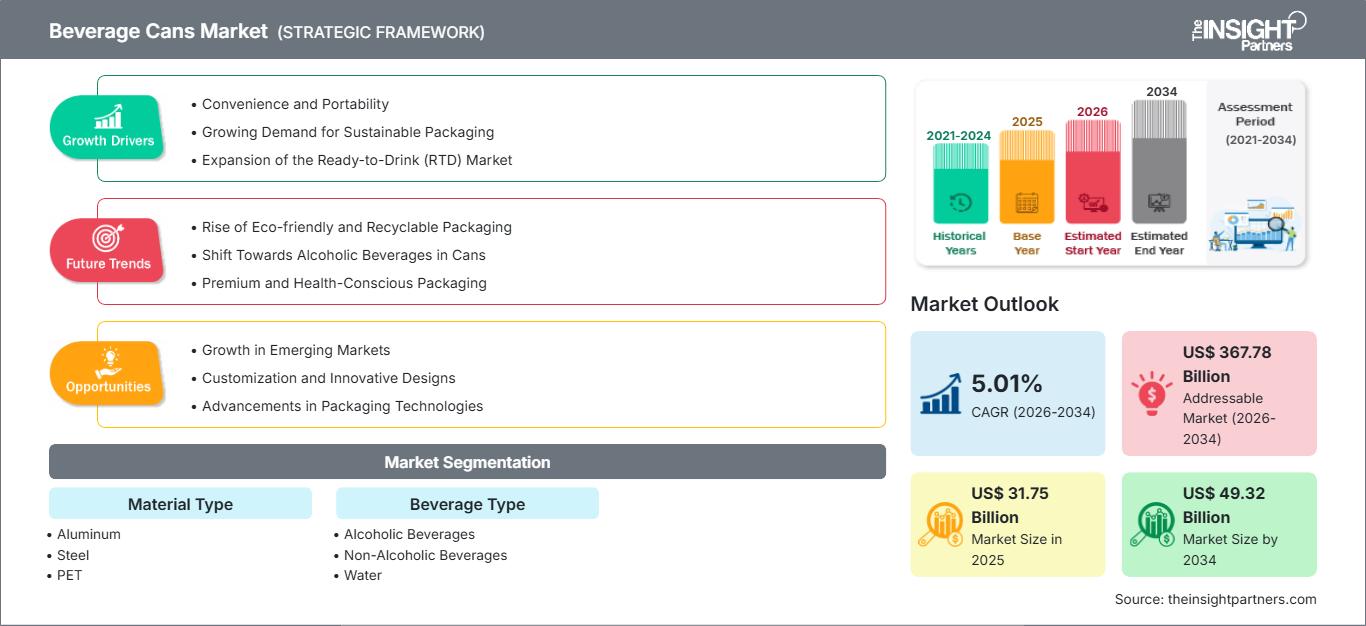
The beverage cans market was valued at US$ 48.66 Billion in 2025 and is projected to reach US$ 72.66 Billion by 2034, registering a CAGR of 4.6% during 2026–2034. Increased use of packed drinks, increased demand for infinitely recyclable metallic packaging, and increased investment in high-speed can production line technology will continue to bolster market growth. Drink companies have become more inclined towards the use of lightweight and sustainable packaging options.
Across North America, manufacturers continue to benefit from strong demand for canned soft drinks, beer, ready-to-drink beverages, and functional drinks. The beverage cans market size in the region is supported by extensive recycling infrastructure, premium beverage innovation, and continued investments in aluminum can manufacturing capacity. North America is expected to expand at a CAGR ranging between 3.5% through 2034, supported by sustainability initiatives and growing consumption of portable beverage packaging.
Beverage Cans Market Assessment and Insights
- North America: The region remains a mature yet steadily expanding market owing to high beverage consumption, advanced recycling infrastructure, and continuous investments in aluminum can production. Share in 2025: 24.60%; CAGR between 2026–2034: 3.5%.
- U.S.: The country dominates regional demand through strong consumption of carbonated beverages, beer, and ready-to-drink products supported by large domestic production facilities. Share in 2025: 77.56% of North America; CAGR between 2026–2034: 3.4%.
- Europe: Sustainability regulations, high recycling rates, and growing demand for premium beverages continue to support the regional market. Germany, the UK, France, Italy, and Spain remain leading contributors. Share in 2025: 27.56%; CAGR between 2026–2034: 4.2%.
- Asia Pacific: Rapid urbanization, increasing disposable incomes, and expanding packaged beverage consumption across China, India, Japan, South Korea, and Southeast Asia continue driving regional expansion. Share in 2025: 35.12%; CAGR between 2026–2034: 5.4%.
- Largest Segment: Aluminum remains the leading material because of lightweight characteristics, superior recyclability, and compatibility with high-speed filling operations. Market share in 2025: 79.84%; CAGR between 2026–2034: 4.6%.
- High Growth Segment: Non-Alcoholic Beverages continue recording the fastest expansion owing to rising demand for energy drinks, sparkling water, RTD coffee, and functional beverages. Market share in 2025: 43.18%; CAGR between 2026–2034: 5.0%.
- Key companies analyzed in detail: Ball Corporation, Crown Holdings, Inc., Ardagh Metal Packaging S.A., CANPACK S.A., Toyo Seikan Group Holdings, Ltd., Silgan Holdings Inc., Orora Packaging Australia Pty Ltd, Hainan Hiuier Industrial Co., Ltd., Visy Industries Holdings Pty Ltd, Can-One Berhad.
Source: The Insight Partners' analysis based on proprietary research, government publications, company annual reports, investor presentations, industry databases, and expert interviews.
The packaging of beverages in metal is shifting from a traditional container to a high-performing package that places special focus on sustainability, weight reduction, and efficiency of manufacturing. Ongoing innovations in the design of the aluminum alloys, digital printing techniques, necking methods, and manufacturing machinery have resulted in material saving and increase in productivity of manufacturing operations. Investments in recycling facilities will ensure additional supply security due to an increase in available secondary metal and decrease in dependency on the primary metal production process.
For the future, one can expect investments by manufacturers to be oriented towards emerging markets where the consumption of packaged beverages grows along with the urbanization and development of modern retail networks. The implementation of circular economy principles, extended producer responsibility legislation, and sustainability policies of companies are going to boost the need for recycling containers made of metal.
Beverage Cans Market Report Scope
| Report Attribute | Details |
|---|---|
| Market size in 2025 | US$ 48.66 Billion |
| Market Size by 2034 | US$ 72.66 Billion |
| Global CAGR (2026 - 2034) | 4.6% |
| Historical Data | 2021-2024 |
| Forecast period | 2026-2034 |
Beverage Cans Market Analysis
Growing environmental awareness, consumer preference for recyclable packaging, and expanding consumption of ready-to-drink beverages continue to accelerate beverage cans market growth worldwide. There is an increasing tendency of beverage companies to use aluminum and steel cans owing to their ability to keep the product fresh and allow for better shelf-life and transportation. Increased demand for energy drinks, flavored sparkling water, canned cocktails, and premium beer will increase the production volumes of cans in both developed and developing countries.
The value chain of the beverage can industry keeps changing due to cooperation between producers of aluminum and coils, beverage can manufacturers, beverage makers, and recycling companies. Closed-loop recycling makes it possible to reduce dependency on raw materials and allows producers to control their costs of production regardless of the price of metal.The competitive landscape within the beverage cans market analysis reflects continuous investments in production expansion, digital printing capabilities, and sustainability initiatives. Top manufacturers such as Ball Corporation, Crown Holdings, Inc., Ardagh Metal Packaging S.A., CANPACK S.A., and Toyo Seikan Group Holdings, Ltd. keep enhancing their manufacturing capacity by making strategic investments close to beverage production centers. Top manufacturers have increasingly been engaging in light-weight can technology, greater use of recycled materials, and decorative abilities in order to distinguish their product lines.
More investment activities have been witnessed among regional manufacturers who wish to develop strong domestic supply chain and minimize their logistics cost. Manufacturers like Silgan Holdings Inc., Orora Packaging Australia Pty Ltd, Hainan Hiuier Industrial Co., Ltd., Visy Industries Holdings Pty Ltd, and Can-One Berhad continue enhancing manufacturing efficiency and sustainability performance while catering to increased beverage production within their regions. Strategic collaborations between packaging manufacturers and beverage producers will continue to be one of the competitive strengths during the forecast period.
● REPORT CUSTOMIZATION
Tailor This Report To Align With Your Specific Business Requirements
This report can be customized to align precisely with your business objectives, scope, and target markets. Customization options include tailored segmentation, geography, competitive analysis, and strategic insights to support informed decision-making.
Customize This Report →WHAT YOU CAN ADJUST
- ● Segmentations
- ● Geography
- ● Competitive Analysis
- ● Language Preferences
Beverage Cans Market: Strategic Insights
Regional Insights
North America Beverage Cans Market
North America accounted for 24.60% of the beverage cans market share in 2025 and is projected to register a CAGR of 3.5% during 2026–2034. The strength of consumer inclination towards recyclable packaging, advanced infrastructure for recycling aluminum, and ongoing demand for packaged alcoholic and non-alcoholic beverages provide favorable conditions for region growth. Beverage producers increase the level of investments in the use of lightweight packaging and high-speed filling equipment in order to enhance efficiency and decrease the amount of materials consumed and transport-related carbon emissions.
The US and Canada represent the key drivers of the regional demand owing to the well-developed sectors of beverage production and used beverage cans collection infrastructure. Growing demand for ready-to-drink coffee, energy drinks, sparkling water, and premium alcoholic beverages encourages manufacturers to develop capacities for the domestic production of cans.
U.S. Beverage Cans Market
The U.S. represented approximately 77.56% of the North American market in 2025 and is anticipated to expand at a CAGR of 3.4% through 2034. The nation reaps the advantage of having a large number of consumers, advanced manufacturing capabilities and having the top producers of cans in place which have many manufacturing plants within the nation. The increasing demands for functional beverages, flavored alcoholic beverages and premium soft drinks continue to drive investments in further production capabilities.
The top manufacturers, such as Ball Corporation, Crown Holdings, Inc. and Ardagh Metal Packaging S.A., have large manufacturing presence in the nation that allows them to supply the nation's best beverage makers effectively. Innovations in light weight aluminum containers, digital print technology and high recycle content cans improve competitiveness of products and also aid in achieving sustainability goals of the nation. High demand from beer, carbonated soft drinks and ready-to-drink beverages is anticipated to ensure market growth.
Europe Beverage Cans Market
Europe captured 27.56% of the global market in 2025 and is forecast to grow at a CAGR of 4.2% through 2034. The demand in the region will continue to be driven by Germany due to the presence of large beverage manufacturing industries along with highly advanced recycling facilities in the country. UK represents significant consumption of canned soft drinks, craft beverages, and ready to drink beverages among others, backed by rising consumer preference for recyclable packaging.
Demand in the region is substantially contributed by countries like France, Italy, and Spain, owing to rising packaged beverage consumption and sustainability efforts in the region. France is making use of circular economic policies promoting greater recycled content in packaging. On the other hand, the country of Italy is helped by its strong sparkling beverages industry. While Spain is continuing to register rising demand on account of tourist spending on beverages and increasing exports of canned beverages.
APAC Beverage Cans Market
Asia Pacific accounted for 35.12% of the global market in 2025 and is projected to register the highest regional CAGR of 5.4% between 2026 and 2034. China remains the leading market owing to its extensive beverage production capacity, followed by Japan and India, where premium beverage consumption continues expanding.
South Korea and Australia also contribute to regional growth through technological advancements and high packaged beverage consumption. Increasing urbanization, expanding middle-class populations, supportive manufacturing investments, and government initiatives promoting recyclable packaging continue to accelerate demand across Asia Pacific.
Middle East & Africa Beverage Cans Market
The Middle East & Africa is expected to witness steady expansion at a CAGR of 4.9% during the forecast period. Despite all the changes, Saudi Arabia still leads in terms of the market size due to the growth of investments in beverages manufacturing and beverage consumption. The UAE takes advantage of the growing demand for high-end beverages because of tourism and hospitality sectors.
The country leading the beverage cans market demand in Sub-Saharan Africa is South Africa due to the developed beverages manufacturing industry in the region. However, there is a steady introduction of recyclable containers in other countries of the region.
Segmentation Analysis
Material Type
Material Type is projected to grow at a CAGR of 4.5–5.0% during 2026–2034. The beverage cans market scope continues to expand as manufacturers prioritize lightweight, recyclable, and durable materials that improve transportation efficiency while supporting sustainability commitments. Continuous innovation in alloy technology and lightweight designs is expected to reinforce long-term adoption across beverage categories.
- Aluminum – The dominant material owing to excellent recyclability, corrosion resistance, lightweight properties, and compatibility with high-speed beverage filling operations. Aluminum remains the preferred choice for carbonated drinks, energy beverages, beer, and premium packaging applications.
- Steel – Steel cans continue serving selected beverage applications where durability, strength, and cost efficiency remain important. Manufacturers are improving coatings and production technologies to enhance performance while supporting circular economy objectives.
Beverage Type
Beverage Type is anticipated to register a CAGR of 4.8–5.3% between 2026 and 2034. Product innovation across alcoholic and functional beverages, together with rising consumer preference for portable and sustainable packaging, continues to create favorable opportunities for can manufacturers across developed and emerging markets.
- Alcoholic Beverages – Beer, ready-to-drink cocktails, hard seltzers, and flavored alcoholic beverages continue generating significant demand for premium printed cans, lightweight packaging, and sustainable metal containers.
- Non-Alcoholic Beverages – Increasing consumption of carbonated soft drinks, bottled water, juices, ready-to-drink tea, coffee, sports drinks, and energy beverages continues strengthening demand across global beverage manufacturing operations.
Structure
Structure is expected to expand at a CAGR of 4.2–4.7% during the forecast period. Manufacturers increasingly favor advanced can designs that improve production efficiency, reduce material usage, and enhance structural integrity while supporting large-scale beverage manufacturing requirements.
- 2-Piece Cans – Widely adopted because of lightweight construction, lower material consumption, faster manufacturing, and excellent compatibility with carbonated and non-carbonated beverage filling operations.
- 3-Piece Cans – Continue serving specialized beverage applications requiring greater flexibility in production, different container dimensions, and selected regional packaging preferences.
Can Size
Can Size is projected to grow at a CAGR of 4.6–5.1% during 2026–2034. Beverage manufacturers increasingly diversify product portfolios through multiple packaging sizes that address convenience, portion control, premiumization, and family consumption trends across retail and foodservice channels.
- Below 250 ml – Commonly used for energy shots, premium mixers, children's beverages, and sampling packs where portability and controlled serving sizes are important purchasing considerations.
- 250–330 ml – Represents one of the most widely consumed packaging formats for carbonated soft drinks, beer, sparkling beverages, and functional drinks across supermarkets, convenience stores, and vending channels.
- 330–500 ml – Strong demand is supported by premium beer, energy drinks, iced tea, ready-to-drink coffee, and sports beverages requiring convenient single-serve packaging.
- Above 500 ml – Increasingly utilized for value-oriented beverages, family consumption occasions, and selected foodservice applications where larger serving volumes improve consumer affordability and convenience.
Opportunity Snapshot
| Beverage Type | Revenue Contribution | Trend Tag | Adoption Stage |
|---|---|---|---|
| Alcoholic Beverages | High | Premium Cans | Mature |
| Non-Alcoholic Beverages | High | Functional Drinks | Scaling |
Beverage Cans Market Growth Drivers and Impact Analysis
Growing demand for sustainable and infinitely recyclable packaging
The increasing awareness about environmental issues among consumers, beverage makers, and governments is promoting the shift towards recyclable metal packaging solutions around the globe. Aluminum beverage cans can be used indefinitely without losing any of their properties; hence, they become an integral part of the implementation of circular economy strategy in leading countries. The governments keep implementing extended producer responsibility systems, recycled content rules, and waste reduction policies that favor greater usage of metal packaging. At the same time, beverage giants become more committed to achieving sustainable development goals through using recyclable packaging in their production. Ongoing improvements in collection systems and recycling processes ensure the availability of secondary aluminum and help manufacturers cut down carbon emissions along with securing sources of raw materials.
Expansion of ready-to-drink beverage consumption worldwide
Ready-to-drink beverages continue to grow in mature and emerging markets as consumers look for convenient, portable, and premium beverages. Functional drinks, flavored sparkling waters, ready-to-drink coffee, tea, sports beverages, and canned cocktails are witnessing rapid growth via supermarkets, convenience stores, e-commerce sites, and food service distribution channels. Beverages in cans provide excellent protection from light, oxygen, and contamination along with great branding through modern decoration technology. Multiple pack sizes and new designs are being introduced by beverage producers, which enhance shelf appeal and consumer convenience. Increasing population in urban areas, lifestyle changes, and disposable income are driving the demand for packaged beverages even further, leading beverage producers to invest in more can filling capacity and secure supply agreements from packaging firms.
Manufacturing innovation improves efficiency and production flexibility
The continuous development of technology in the processes of manufacturing cans greatly enhances the production efficiency, minimizes material usage and increases product quality. Modern fast body builders, digital printing facilities, light weight alloys, automated inspection and energy efficient production lines allow beverage producers to raise their throughput levels while minimizing the cost of operation. At the same time, flexible manufacturing systems help beverage producers quickly switch production to various can sizes and unique graphics, making it possible to introduce seasonal or promotional products. Such innovations increase profits through the entire value chain and allow meeting the rising demands for sustainable beverage packaging globally.
Beverage Cans Market Future Trends
Higher recycled-content aluminum becomes an industry standard
The beverage cans market trends increasingly indicate a transition toward cans manufactured with higher recycled aluminum content as beverage producers strengthen sustainability commitments and governments introduce stricter environmental regulations. Packaging manufacturers continue investing in closed-loop recycling partnerships, advanced sorting technologies, and low-carbon production processes to improve recycled material availability. Higher recycled content not only reduces greenhouse gas emissions but also decreases dependence on primary aluminum production, improving long-term supply resilience. Beverage brands are expected to use recycled-content packaging as a key differentiator while responding to growing consumer preference for environmentally responsible products.
Digital printing enables premium packaging differentiation
New advancements in digital printing technology are likely to revolutionize the world of beverage packaging through shorter production runs, personalized graphics, and quick introductions into the market. More and more beverage producers are interested in getting personalized packaging for their products for such purposes as seasonal campaigns, regional marketing efforts, sports events, and special editions without losing production efficiency. Advances in digital printing technologies result in reduced time required for preparation and allow for quality graphics as well as improved brand visibility. With the continued globalization of premium beverages, digital printing is becoming a key competitive edge for packaging providers.
Beverage Cans Market Opportunities
Capacity expansion across high-growth Asian economies
Rapid urbanization, rising disposable incomes, and increasing packaged beverage consumption create significant investment opportunities across China, India, Indonesia, Vietnam, and other Southeast Asian economies. International and regional can manufacturers continue establishing new production facilities close to beverage filling plants to reduce transportation costs and improve supply reliability. Investments in automated manufacturing, lightweight aluminum technologies, and recycling infrastructure further strengthen long-term competitiveness. Companies capable of forming strategic partnerships with rapidly expanding beverage producers are expected to benefit from sustained production growth while improving regional supply chain resilience throughout the forecast period.
Premium beverage packaging creates value-added opportunities
Growing consumer demand for premium alcoholic beverages, energy drinks, functional beverages, and specialty sparkling drinks continues creating opportunities for advanced can manufacturing technologies. Premium decoration, embossing, tactile finishes, matte coatings, and customized packaging designs allow beverage companies to strengthen brand differentiation while supporting premium pricing strategies. Manufacturers investing in advanced printing technologies, lightweight alloys, and flexible production systems will be well positioned to capture high-value contracts from global beverage producers seeking innovative packaging solutions. Increasing product diversification is expected to generate attractive long-term investment opportunities across premium packaging segments.
Recent Developments
- April 2026: Crown Holdings Inc announced plans to establish a state-of-the-art beverage can manufacturing facility in Northern India. The two-line facility is expected to commence operations during the second half of 2027 and, at full capacity, will produce approximately 2.2 billion cans annually.
- March 2025: Visy announced the production of a new sustainable beverage can containing an average of 83% recycled aluminum content. The can is manufactured at its Yatala facility in Queensland under a pilot project involving partners such as Stone & Wood, Lion, Novelis, and Rio Tinto. The initiative uses a mix of recycled and low-carbon primary aluminum and is designed to reduce carbon emissions while increasing circular use of materials.
Frequently Asked Questions

- Comprehensive Market Sizing and Forecast Analysis
- Detailed Segmentation Analysis
- In-Depth Market Dynamics Assessment
- Regional and Country-Level Insights
- Competitive Landscape and Company Benchmarking
- Strategic Business Intelligence
Recent Reports
Testimonials

The Insight Partners provided valuable market intelligence that supported our global go-to-market strategy. Their team was professional, responsive, and attentive to our feedback, providing thoughtful analysis and helpful methodological clarifications throughout the project.
Junmo Kim Chief Financial Officer (CFO), Enertech Co., Ltd.
The Insight Partners' SCADA System Market report is comprehensive, with valuable insights on current trends and future forecasts. The team was highly professional, responsive, and supportive throughout. We are very satisfied and highly recommend their services.
RAN KEDEM Partner, Reali Technologies LTDs
I requested a report on a very specific software market and the team produced the report in a few days. The information was very relevant and well presented. I then requested some changes and additions to the report. The team was again very responsive and I got the final report in less than a week.
JEAN-HERVE JENN Chairman, Future Analytica
We worked with The Insight Partners for an important market study and forecast. They gave us clear insights into opportunities and risks, which helped shape our plans. Their research was easy to use and based on solid data. It helped us make smart, confident decisions. We highly recommend them.
PIYUSH NAGPAL Sr. Vice President, High Beam Global
The Insight Partners delivered insightful, well-structured market research with strong domain expertise. Their team was professional and responsive throughout. The user-friendly website made accessing industry reports seamless. We highly recommend them for reliable, high-quality research services
YUKIHIKO ADACHI CEO, Deep Blue, LLC.
This is the first time I have purchased a market report from The Insight Partners.While I was unsure at first, I visited their web site and felt more comfortable to take the risk and purchase a market report.I am completely satisfied with the quality of the report and customer service. I had several questions and comments with the initial report, but after a couple of dialogs over email with their analyst I believe I have a report that I can use as input to our strategic planning process.Thank you so much for taking the extra time and making this a positive experience.I will definitely recommend your service to others and you will be my first call when we need further market data.
JOHN SUZUKI President and Chief Executive Officer, Board Director, BK Technologies
I wish to appreciate your support and the professionalism you displayed in the course of attending to my request for information regarding to infectious disease IVD market in Nigeria. I appreciate your patience, your guidance, and the fact that you were willing to offer a discount, which eventually made it possible for us to close a deal. I look forward to engaging The Insight Partners in the future, all thanks to the impression you have created in me as a result of this first encounter.
DR CHIJIOKE ONYIA MANAGING DIRECTOR, PineCrest Healthcare Ltd.Reason to Buy
- Informed Decision-Making
- Understanding Market Dynamics
- Competitive Analysis
- Identifying Emerging Markets
- Customer Insights
- Market Forecasts
- Risk Mitigation
- Boosting Operational Efficiency
- Strategic Planning
- Investment Justification
- Tracking Industry Innovations
- Aligning with Regulatory Trends





 Get Free Sample for