
Bio based and Low VOC Paints Market Size, Growth & Trends by 2034
Coverage: By Type (Low VOC, Natural Paints, Zero VOC, VOC Absorbing, Other); Application (Building and construction, Industrial and domestic cleaning, Printing inks, Adhesives and sealants, Automotive, Pharmaceutical, Others), and Geography (North America, Europe, Asia Pacific, and South and Central America)
- Status : Data Released
- Report Code : TIPRE00015605
- Category : Chemicals and Materials
- No. of Pages : 150
- Available Report Formats :


- Last update date : August 27, 2026


2025 Market Size
US$ 20.81 Bn
Base year value
2034 Forecast
US$ 41.71 Bn
Projected by 2034
CAGR 2026-2034
8.03 %
Growth rate
Addressable Market
US$ 281.09 Bn
(2026-2034)
The Bio-Based and Low VOC Paints market is valued at US$ 20.81 Billion in 2025 and is projected to reach US$ 41.71 Billion by 2034, expanding at a CAGR of 8.03% during 2026–2034. Demand is supported by healthier indoor-environment requirements, sustainable construction practices, and reformulation of architectural and industrial coatings. Bio-based and low-VOC paints represent a transition toward coating formulations that reduce reliance on conventional fossil-derived inputs and limit volatile organic compound emissions.
North America remains an important demand center as building owners, contractors, and consumers increasingly prioritize low-emission products and environmental certifications. The Bio-Based and Low VOC Paints Market size is supported by renovation activity, green-building specifications, and tighter controls on solvent emissions. The region is expected to expand at a modeled 7.4–8.2% CAGR during 2026–2034, with product differentiation increasingly based on VOC performance, renewable content, durability, and certification.
Bio based and Low VOC Paints Market Assessment and Insights
- North America: North America is estimated to hold a 28–32% share in 2025 and expand at a 7.4–8.2% CAGR between 2026–2034, supported by green-building standards, renovation spending, indoor-air-quality priorities, and established waterborne coating technologies.
- U.S.: The U.S. represents approximately 82–86% of North American demand in 2025, with a modeled 7.3–8.1% CAGR during 2026–2034, supported by architectural repainting and low-emission product adoption.
- Europe: Europe is estimated at a 24–28% share in 2025 and is projected to grow at a 7.7–8.5% CAGR between 2026 and 2034, led by Germany, the UK, France, Italy, and Spain through decarbonization requirements and sustainable construction.
- Asia Pacific: Asia Pacific is estimated to account for a 27–31% share in 2025 and expand at an 8.5–9.3% CAGR during 2026–2034, with China, Japan, South Korea, India, and Australia driving demand through urban construction and industrial modernization.
- Largest Segment: Low VOC is estimated to command a 44–49% market share in 2025, expanding at a 7.6–8.3% CAGR during 2026–2034, supported by broad applicability and regulatory compatibility.
- High Growth Segment: Zero VOC is estimated at a 16–20% market share in 2025 and is projected to grow at 8.6–9.4% CAGR during 2026–2034, reflecting indoor-air-quality priorities and premium green-building specifications.
- Key companies analyzed in detail: BASF SE, Benjamin Moore & Co., BioShield, DuluxGroup Limited, EcoProCote, Mythic Paint, Pflanzenchemie AG, Sheldon & Sons, The Freshaire Choice, PPG Industries, Inc.
Source: The Insight Partners' analysis based on proprietary research, government publications, company annual reports, investor presentations, industry databases, and expert interviews.
There is also an evolution in formulation technology from mere solvent reduction to one of sustainability, which includes the utilization of waterborne chemistry, renewable feedstock, bio-based polymers, natural pigments, and advanced curing systems. There is growing consideration for formulators to have both low-emission characteristics along with scrub resistance, adhesion properties, weather resistance, colorfastness, and efficient application in architectural coatings.
For industrial applications, there is a growing consideration of carbon intensity and life-cycle analysis along with traditional technical considerations.
The next wave of innovation will be focused on renewable material traceability, carbon lifecycle consideration, and formulations that will enable the performance required without adding to the complexity of application. Emerging countries offer volume growth opportunities in line with increased construction activity and local production by manufacturers.
Bio based and Low VOC Paints Market Report Scope
| Report Attribute | Details |
|---|---|
| Market size in 2025 | US$ 20.81 Billion |
| Market Size by 2034 | US$ 41.71 Billion |
| Global CAGR (2026 - 2034) | 8.03% |
| Historical Data | 2021-2024 |
| Forecast period | 2026-2034 |
Bio based and Low VOC Paints Market Analysis
Demand is increasingly influenced by the combined requirements of indoor-air quality, environmental compliance, and lower lifecycle emissions. The Bio-Based and Low VOC Paints Market growth ecosystem includes resin suppliers, pigment and additive producers, formulators, coating manufacturers, distributors, contractors, and building owners. Water-based acrylic, polyurethane, alkyd, and combination systems permit manufacturers to decrease dependency on solvents and still preserve properties during application. Supply is susceptible to the supply of resins, pigments, additives, and renewable raw materials.
The architectural market creates large volumes, as the end-users have the opportunity to use low-VOC products without having to change their equipment. The industrial segment uses a stricter choice criterion due to requirements for anticorrosive properties, resistance to chemicals, fast drying, and good adhesion. In other words, manufacturers are competing not only on low-VOCs but also through formulating.
Positioning is dependent on the breadth of the portfolio and specialization in formulation. BASF SE operates mainly from its advanced chemical and raw material technologies, while Benjamin Moore & Co competes aggressively in architectural coatings with low and zero-VOC products. PPG Industries, Inc. is a combination of architectural, industrial, automotive and protective coatings, whereas DuluxGroup Limited has a presence in decorative coatings, while specialist brands rely on natural substances and bio-based formulations.
Investments are being made increasingly in formulation labs, sustainable feedstocks, waterborne technologies, and production flexibility. Companies that have wide networks for their raw materials find it easier to incorporate renewable content, while specialist brands focus on premium residential and designer coatings. Competitive advantage, therefore, depends on achieving measurable environmental improvements without sacrificing durability, color consistency, drying behavior, or contractor productivity. The Bio-Based and Low VOC Paints Market analysis increasingly centers on total formulation performance rather than VOC reduction as a standalone specification.
● REPORT CUSTOMIZATION
Tailor This Report To Align With Your Specific Business Requirements
This report can be customized to align precisely with your business objectives, scope, and target markets. Customization options include tailored segmentation, geography, competitive analysis, and strategic insights to support informed decision-making.
Customize This Report →WHAT YOU CAN ADJUST
- ● Segmentations
- ● Geography
- ● Competitive Analysis
- ● Language Preferences
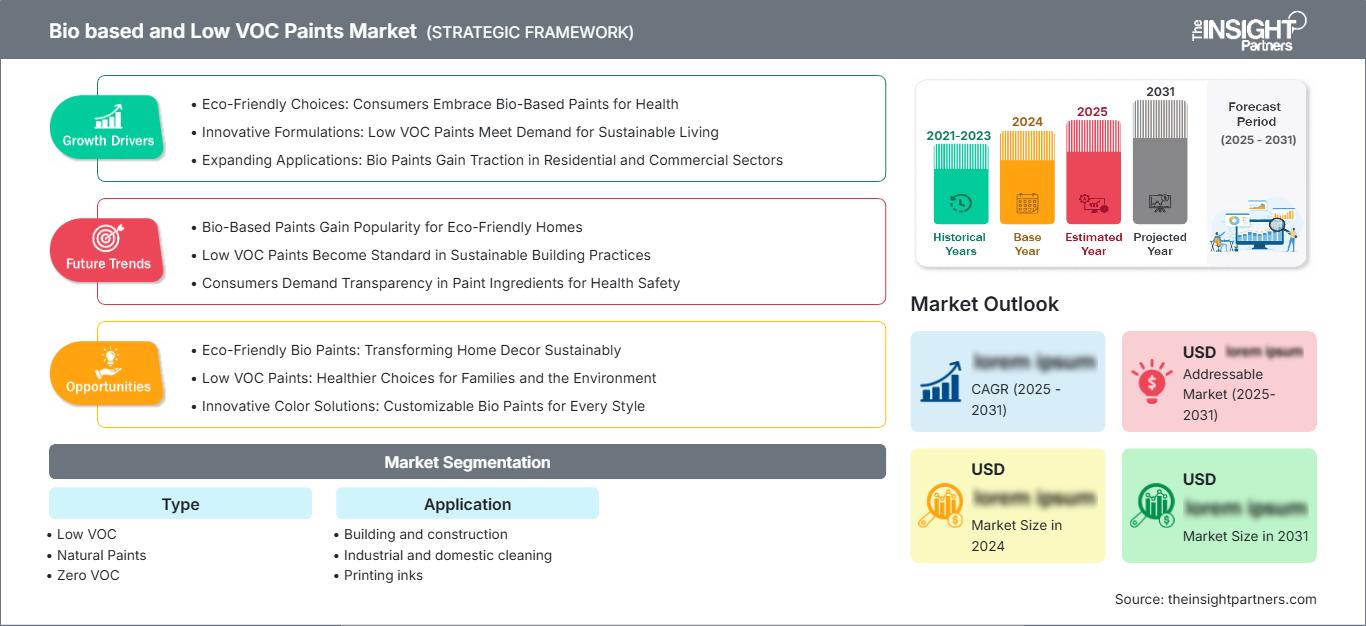
Bio based and Low VOC Paints Market: Strategic Insights
Regional Insights
North America Bio-Based and Low VOC Paints Market
North America is estimated to hold a 28–32% of Bio-Based and Low VOC Paints market share in 2025 and record a 7.4–8.2% CAGR through 2034. The U.S. dominates regional consumption because of established waterborne coating infrastructure, large repainting activity, green-building specifications, and consumer awareness of indoor-air quality. Canada adds demand through sustainable construction and environmentally oriented procurement.
Building applications continue to serve as the primary market for the region, while industrial buyers are starting to look at emissions, durability, and other lifecycle properties together. Suppliers are increasing their range of zero-VOC and renewable products while retaining the performance standards that have become expected from their products. Third-party certification and information on the use of renewables are also becoming an increasingly important part of regional buying decisions.
U.S. Bio-Based and Low VOC Paints Market
The U.S. accounts for approximately 82–86% of North American Bio-Based and Low VOC Paints Market demand in 2025 and is projected to expand at a 7.3–8.1% CAGR during 2026–2034. Architectural repainting, commercial construction, healthcare facilities, schools, and environmentally certified buildings create sustained demand. Benjamin Moore & Co. and PPG Industries, Inc. maintain extensive product exposure.
Odor, VOC level, indoor air quality, durability, and certification have become key factors in product selection. Zero-VOC formulas have become significant in sensitive environments, while bio-based formulas have been formulated for premium architecture and protection. Environmental regulations at the state level also affect formulation strategy, especially when there are stringent rules on solvent emission. The industry is very competitive, with established brands safeguarding their market position through formulation, distribution, and color systems.
Europe Bio-Based and Low VOC Paints Market
Europe is estimated to hold a 24–28% share of the Bio-Based and Low VOC Paints Market in 2025 and grow at a 7.7–8.5% CAGR through 2034, with Germany representing a leading market. The UK, Germany, France, Italy, and Spain collectively provide substantial demand through renovation, sustainable construction, and stricter environmental expectations.
The UK is characterized by high levels of both maturity and increasing demand for interior coatings that emit little or no volatile organic compounds into the atmosphere. Germany is concerned more with environmentally friendly features, efficient use of resources, and sustainable buildings, providing the impetus for the development of bio-based and VOC-free formulas. France, Italy, and Spain benefit from renovations, refurbishments, and architectural coating demands. Increasingly, European manufacturers pay attention to their raw materials and sustainability credentials.
APAC Bio-Based and Low VOC Paints Market
APAC is estimated to account for a 27–31% share of the Bio-Based and Low VOC Paints Market in 2025 and expand at an 8.5–9.3% CAGR through 2034, with China leading regional volume. Japan and South Korea emphasize advanced formulation technology, while India and Australia contribute through construction, renovation, and sustainability-focused product adoption.
Industrial modernization and urban development remain major demand factors. China provides manufacturing scale, while India offers strong long-term construction potential. Japan emphasizes product performance and environmental quality, and Australia benefits from sustainable-building requirements. Regional producers increasingly localize waterborne and low-emission technologies to serve domestic demand while improving export competitiveness.
Middle East & Africa Bio Based and Low VOC Paints Market
The Middle East and Africa Bio-Based and Low VOC Paints Market are expected to expand at a modeled 6.5–7.4% CAGR through 2034, led by Saudi Arabia and the UAE. South Africa represents an important African market, while the Rest of MEA remains supported by infrastructure and urban development.
The diversification of the construction industry within Gulf countries is contributing to the requirement of environmentally-friendly architectural and protective coatings. Large scale commercial and infrastructural projects are under development in Saudi Arabia and the United Arab Emirates, while South Africa already offers a base for industrial and decorative coating requirements. Premium projects in particular become more and more demanding on environmentally-friendly coating products.
Segmentation Analysis
Type
The Type segment defines the Bio-Based and Low VOC Paints Market scope through Low VOC, Natural Paints, Zero VOC, and VOC Absorbing formulations. Adoption varies according to regulatory requirements, application performance, raw material availability, and customer preference for lower-emission coating technologies. The Type segment is projected to expand broadly in line with overall demand, with a 7.8–8.5% CAGR during 2026–2034. Low-VOC products retain the largest commercial base because they offer a practical transition from conventional coatings, while zero-VOC and natural formulations increasingly target premium applications. VOC-absorbing technologies provide a differentiated route for indoor-air-quality applications.
- Low VOC: Low-VOC coatings remain commercially dominant because they provide reduced solvent emissions while preserving established application and performance characteristics. Their compatibility with residential, commercial, and industrial requirements supports broad procurement acceptance.
- Natural Paints: Natural paints use plant-derived, mineral, clay, casein, or other renewable ingredients. Their strategic relevance is strongest in premium residential, wellness-oriented, heritage, and environmentally conscious projects where ingredient transparency influences purchasing.
- Zero VOC: Zero-VOC products address applications where indoor-air quality and emissions restrictions are especially important. Their adoption is strongest in healthcare, education, residential interiors, and green-certified buildings requiring stringent environmental specifications.
- VOC Absorbing: VOC-absorbing paints provide differentiated indoor-air-quality functionality by targeting pollutants after application. Their strategic value lies in premium interiors where air purification and multifunctional surface performance can justify higher formulation complexity.
Application
Application demand of the Bio-Based and Low VOC Paints Market is expected to increase at a 7.9–8.6% CAGR during 2026–2034, supported by building activity and sustainability requirements. Building and construction remains the largest application because decorative and architectural coatings offer the broadest immediate route for low-emission adoption across residential and commercial structures.
- Building and construction: This application represents the broadest demand base, encompassing residential, commercial, institutional, and infrastructure projects. Green-building specifications and indoor-air-quality priorities strengthen adoption of low- and zero-VOC coatings.
- Industrial and domestic cleaning: Cleaning-related applications increasingly require coatings and finishes compatible with hygiene, odor control, and low-emission environments. Demand is strongest where facility operators prioritize worker comfort and environmental compliance.
- Printing inks: Bio-based and low-emission ink technologies support sustainable packaging and printed-material objectives. Producers increasingly evaluate renewable feedstocks, curing efficiency, migration performance, and regulatory compatibility when selecting alternative formulations.
- Adhesives and sealants: Low-emission formulations support construction and industrial assembly where solvent exposure and indoor-air quality matter. Bio-based inputs provide additional differentiation where customers seek reduced fossil-resource dependence.
- Automotive: Automotive applications prioritize coating durability, appearance, corrosion protection, and process efficiency. Waterborne and low-emission systems support manufacturers seeking lower shop-floor emissions without compromising finish quality.
- Pharmaceutical: Pharmaceutical facilities require controlled environments and strict contamination management. Low-emission coatings can support walls, floors, and specialized surfaces where odor, chemical resistance, cleanability, and indoor environmental quality are important.
Opportunity Snapshot
| Application | Revenue Contribution | Trend Tag | Adoption Stage |
| Building and construction | High | Green Building | Mature |
| Industrial and domestic cleaning | Medium | Low Emission | Scaling |
| Printing inks | Medium | Bio Feedstock | Scaling |
| Adhesives and sealants | Medium | Renewable Resin | Scaling |
| Automotive | Medium | Waterborne Systems | Scaling |
| Pharmaceutical | Low | Clean Surfaces | Emerging |
Bio based and Low VOC Paints Market Growth Drivers and Impact Analysis
Stricter Indoor-Air-Quality and VOC Requirements
The need to consider indoor air quality is leading the selection of coatings to become more based on emissions and formulation than just pricing. Increasingly, schools, hospitals, offices, hotels, and housing projects are concerned about the odor and VOC performance since people stay in the area where the coating is applied for longer periods of time. There is therefore a need for water-based coatings with low or no VOCs at all to meet performance requirements and reduce solvent content. Suppliers have started to reformulate binders, pigments, coalescing agents and additives. Commercial implications go beyond decorative paint since institutional customers are now applying environmental standards to their purchasing process.
Growth of Green Building and Sustainable Construction
Sustainable building is broadening the specification environment for coatings. Owners and developers are assessing materials based on energy performance, emissions, renewables content, indoor air quality, and life cycle thinking. Paint offers an opportunity to reformulate because water-borne formulations can be incorporated without having to radically change the application technology. Bio-based components offer another avenue for differentiation through substituting part of the petroleum-based feedstock. The implications will affect resin makers, additives companies, paint makers, applicators, and certifiers. The market effect will be more pronounced in premium commercial and institutional buildings, where the environmental specification can drive material selection prior to purchase. With increasing documentation demands, the suppliers who have chain-of-custody documentation and product-level environmental data should benefit from the specification environment.
Expansion of Waterborne and Renewable Formulation Technology
Formulation science is allowing manufacturers to lower their emissions without compromising the functional properties of the coatings. The use of water-borne acrylics, polyurethane dispersions, hybrid polymers, biologically sourced materials, natural resins, and renewable additives has increased the number of technologies that formulators can work with. It means that there is less reliance on one formulation technology and enables the manufacturers to formulate products specifically for different applications and substrates. The effect is especially valuable for formulations where the end user cannot tolerate reduced durability, slower drying rate, poor adhesion, or decreased resistance to chemicals. Further development of formulations can also make sustainable coatings less expensive through increasing manufacturing scale and improving the efficiency of material usage.
Bio based and Low VOC Paints Market Future Trends
Greater Use of Traceable Bio-Based Feedstocks
The Bio-Based and Low VOC Paints Market trends landscape is moving toward traceable renewable feedstocks rather than broad claims of natural content. The paint industry needs to have information regarding the origin of the renewable raw material, how it enters the value chain, and its benefits to the environment. Mass balance systems, carbon footprint calculations, supplier certification, and chain of custody systems are increasingly important. The trend will mean that suppliers of the raw material will be able to give information on the feedstock, just like they do for technical specifications. The development may make paint producers work closely with chemical producers because formulating sustainability requires good raw materials upstream. In the end, buyers will evaluate products based on VOC performance and certified renewable/carbon credentials.
Convergence of Low VOC Performance and Multifunctional Coatings
The next generation of products will probably incorporate low-emission properties along with other functions instead of competing solely based on their VOC content. Companies are developing coatings with odor management, pollutant capture, antimicrobial properties, improved cleanability, better durability, and reduced energy requirements for curing. Multifunctional coating can add significant value to sustainable formulas in applications such as health care, hospitality, education, automotive, and commercial buildings. The task for developers is to keep all functions stable while all functional additives work together in the same formula. Products with such combinations of functions will be dependent on advanced binder chemistry, additive interaction, surface modification, and application tests. The final portfolio must shift the industry toward high-value coatings that incorporate environmental performance into the technical specification.
Bio based and Low VOC Paints Market Opportunities
Premium Architectural Products Using Renewable Inputs
The Bio-Based and Low VOC Paints Market Forecasts indicate opportunities for premium architectural products that combine renewable content with established requirements for coverage, color retention, washability, and durability. Manufacturers can target healthcare, hospitality, education, residential wellness, and green-certified commercial buildings where environmental attributes influence material selection. Investment opportunities extend beyond finished paint into bio-based binders, renewable additives, natural pigments, and low-emission colorant systems. Companies with strong distribution networks can also use certification and transparent ingredient documentation to differentiate premium products. The strongest opportunities are likely to emerge where renewable content can be incorporated without creating significant application changes or performance compromises. This creates room for both multinational coating producers and specialized formulation companies.
Localized Sustainable Coating Production in Emerging Markets
Emerging markets offer an opportunity to localize production of sustainable coatings close to construction demand and renewable raw material sources. Regional manufacturing can reduce logistics exposure, improve responsiveness to local regulations, and enable formulations tailored to climate conditions. India, Southeast Asia, Latin America, and selected Middle Eastern markets provide opportunities because urbanization and construction investment are expanding while sustainability requirements are becoming more relevant. Producers can establish partnerships with local resin suppliers, agricultural feedstock processors, distributors, and construction companies to develop cost-effective products. The strategic opportunity lies in adapting sustainable formulations to local purchasing power rather than directly replicating premium products developed for mature markets. Localized sourcing can also improve supply resilience for selected bio-based inputs.
Recent Developments
- September 2025: Asian Paints Limited — Asian Paints announced an investment of approximately EUR 217 million to establish a greenfield water-based coatings plant in Indore, Madhya Pradesh. The facility is planned to add 400 million liters of annual water-based paint capacity, increasing the company’s total installed capacity to 2.6 billion liters. The investment reflects rising demand for water-based and lower-emission coating technologies in India.
- April 2025: Arkema, AkzoNobel and Omya — The companies collaborated on lower-carbon decorative paint formulations designed for mass-market adoption. Their formulations achieved a 30% or greater reduction in carbon footprint, while incorporating raw materials with up to 40% circular content. The collaboration combines Arkema’s bio-based and bio-attributed binders and additives, Omya’s mineral technologies, and AkzoNobel’s formulation expertise.
- February 2025: AkzoNobel — AkzoNobel launched a new wood coating containing 20% bio-based content, using renewable feedstocks including rapeseed and pine-based materials. The development demonstrates continued movement toward replacing fossil-derived raw materials in coating formulations while maintaining application performance. It supports the industry's shift toward bio-based content as manufacturers address carbon reduction requirements and increasing demand for more sustainable coating solutions.
Frequently Asked Questions

- Comprehensive Market Sizing and Forecast Analysis
- Detailed Segmentation Analysis
- In-Depth Market Dynamics Assessment
- Regional and Country-Level Insights
- Competitive Landscape and Company Benchmarking
- Strategic Business Intelligence
Recent Reports
Testimonials

The Insight Partners provided valuable market intelligence that supported our global go-to-market strategy. Their team was professional, responsive, and attentive to our feedback, providing thoughtful analysis and helpful methodological clarifications throughout the project.
Junmo Kim Chief Financial Officer (CFO), Enertech Co., Ltd.
The Insight Partners' SCADA System Market report is comprehensive, with valuable insights on current trends and future forecasts. The team was highly professional, responsive, and supportive throughout. We are very satisfied and highly recommend their services.
RAN KEDEM Partner, Reali Technologies LTDs
I requested a report on a very specific software market and the team produced the report in a few days. The information was very relevant and well presented. I then requested some changes and additions to the report. The team was again very responsive and I got the final report in less than a week.
JEAN-HERVE JENN Chairman, Future Analytica
We worked with The Insight Partners for an important market study and forecast. They gave us clear insights into opportunities and risks, which helped shape our plans. Their research was easy to use and based on solid data. It helped us make smart, confident decisions. We highly recommend them.
PIYUSH NAGPAL Sr. Vice President, High Beam Global
The Insight Partners delivered insightful, well-structured market research with strong domain expertise. Their team was professional and responsive throughout. The user-friendly website made accessing industry reports seamless. We highly recommend them for reliable, high-quality research services
YUKIHIKO ADACHI CEO, Deep Blue, LLC.
This is the first time I have purchased a market report from The Insight Partners.While I was unsure at first, I visited their web site and felt more comfortable to take the risk and purchase a market report.I am completely satisfied with the quality of the report and customer service. I had several questions and comments with the initial report, but after a couple of dialogs over email with their analyst I believe I have a report that I can use as input to our strategic planning process.Thank you so much for taking the extra time and making this a positive experience.I will definitely recommend your service to others and you will be my first call when we need further market data.
JOHN SUZUKI President and Chief Executive Officer, Board Director, BK Technologies
I wish to appreciate your support and the professionalism you displayed in the course of attending to my request for information regarding to infectious disease IVD market in Nigeria. I appreciate your patience, your guidance, and the fact that you were willing to offer a discount, which eventually made it possible for us to close a deal. I look forward to engaging The Insight Partners in the future, all thanks to the impression you have created in me as a result of this first encounter.
DR CHIJIOKE ONYIA MANAGING DIRECTOR, PineCrest Healthcare Ltd.Reason to Buy
- Informed Decision-Making
- Understanding Market Dynamics
- Competitive Analysis
- Identifying Emerging Markets
- Customer Insights
- Market Forecasts
- Risk Mitigation
- Boosting Operational Efficiency
- Strategic Planning
- Investment Justification
- Tracking Industry Innovations
- Aligning with Regulatory Trends





 Get Free Sample for