
Bio-Polylactic Acid (PLA) Films Market Share, Growth & Forecast by 2034
Coverage: By Technology (Sol-Gel, Atomic Layer Deposition, Multilayer); End-user Industry (Home and Personal Care, Food and Beverages, Pharmaceuticals, Agriculture, Others) , and Geography (North America, Europe, Asia Pacific, and South and Central America)
- Status : Data Released
- Report Code : TIPRE00005974
- Category : Chemicals and Materials
- No. of Pages : 150
- Available Report Formats :


- Last update date : August 28, 2026


2025 Market Size
US$ 1.24 Bn
Base year value
2034 Forecast
US$ 3.04 Bn
Projected by 2034
CAGR 2026-2034
10.46 %
Growth rate
Addressable Market
US$ 18.96 Bn
(2026-2034)
The Bio-Polylactic Acid Films market was valued at US$ 1.24 Billion in 2025 and is projected to reach US$ 3.04 Billion by 2034, registering a CAGR of 10.46% from 2026 to 2034. Growth is supported by increasing interest in renewable polymer feedstocks, compostable packaging formats, and higher-performance film structures. Technology development is progressively improving barrier performance, processing stability, printability, and compatibility with established converting equipment.
The region of North America is anticipated to continue as a key regional market due to sustainable packaging solutions, use in the food and beverages industry, and need for feedstocks from renewables. The Bio-Polylactic Acid Films Market size is anticipated to experience growth at a rate of 8.9–9.8% CAGR between 2026 and 2034.
Bio-Polylactic Acid (PLA) Films Market Assessment and Insights
- North America: North America is expected to account for a 23–27% share in 2025 and grow at a 9.0–9.8% CAGR between 2026 and 2034, supported by sustainable packaging adoption, food applications, and investment in bio-based material conversion technologies.
- U.S.: The U.S. is expected to represent 74–78% of North America's 2025 market and grow at a 9.1–9.9% CAGR between 2026 and 2034, driven by packaging reformulation and compostable-material adoption.
- Europe: Europe is projected to hold a 27–31% share in 2025 and register a 9.5–10.3% CAGR between 2026 and 2034. Germany, France, Italy, Spain, and the UK remain important markets because of packaging sustainability policies and established converting capabilities.
- Asia Pacific: Asia Pacific is estimated to hold a 34–38% share in 2025 and expand at a 11.0–11.8% CAGR between 2026 and 2034. China, Japan, South Korea, and India provide a strong manufacturing and packaging base.
- Largest Segment: Food and Beverages is expected to remain the leading application segment, representing a 38–42% market share in 2025 and expanding at a 10.6–11.4% CAGR from 2026 to 2034.
- High Growth Segment: Agriculture is expected to be the fastest-growing end-user segment, with a 12–15% market share in 2025 and a 11.5–12.4% CAGR from 2026 to 2034, supported by sustainable agricultural-film requirements.
- Key companies analyzed in detail: Amcor plc, Avery Dennison Corporation, Futerro S.A., Hiusan Biosciences, NatureWorks LLC, Taghleef Industries S.p.A., Tate & Lyle PLC, Toray Industries, Inc., TotalEnergies Corbion, and Toyobo Co., Ltd.
Source: The Insight Partners' analysis based on proprietary research, government publications, company annual reports, investor presentations, industry databases, and expert interviews.
Bio-PolyLactic Acid Films have moved from the basic films with renewable content into engineered films intended for challenging packaging applications. Development in the polymerization, orientation, coating, and lamination process in PLA films is helping to overcome issues related to moisture barrier, thermal barrier, and oxygen barrier properties. Film manufacturers are incorporating functionalities in films for easy processing while maintaining the renewable and compostable nature of PLA films in contrast to conventional fossil-fuel based films.
Future investments are expected to focus on high barrier structures, speciality packaging, and regional manufacturing capacity. Plastic waste reduction regulations would favor substitution when there is appropriate end-of-life management available. Manufacturing centers in Asia would gain significance in future due to the integration of resin manufacture, film manufacture, and packaging demands in regions.
Bio-Polylactic Acid (PLA) Films Market Report Scope
| Report Attribute | Details |
|---|---|
| Market size in 2025 | US$ 1.24 Billion |
| Market Size by 2034 | US$ 3.04 Billion |
| Global CAGR (2026 - 2034) | 10.46% |
| Historical Data | 2021-2024 |
| Forecast period | 2026-2034 |
Bio-Polylactic Acid (PLA) Films Market Analysis
Sustainability of packaging materials is one of the key drivers behind the growth in the Bio-Poly-Lactic Acid Films Market, especially in cases where brand owners look for renewable-content raw materials for flexible packaging and labeling purposes. This is further augmented due to regulations or policies targeting certain traditional plastic types. Food and beverages continue to be among important applications as they can be made transparent, printable, and functional if the films are designed properly for their specific application needs.
The supply chain goes from agricultural feedstock to the production of the lactic acid to polymerization, resin mixing, film extrusion, orientation, coating, printing, and converting. The availability of the feedstock and polymer quality will affect manufacturing costs, and film manufacturers need to balance the needs for barriers against thickness, machineability, and end of life specifications.
Differentiation is growing more and more important through polymer formulation, film manufacturing, coating processes, and performance attributes in use conditions. A comprehensive examination of the Bio-Polylactic Acid Films Market Report must hence take into account both integrated materials manufacturers and downstream film specialists. NatureWorks LLC, TotalEnergies Corbion, Futerro S.A., and Taghleef Industries S.p.A. operate at various points in the value chain, but diversified companies offer a range of converting, packaging, and polymer competences.
Amcor plc and Avery Dennison Corporation offer downstream packaging and labeling services, whereas Toray Industries, Inc. and Toyobo Co., Ltd. bring in film and materials competences. Investment focus is shifting toward better barriers, processability, recyclable or biodegradable structures, and qualified applications. The key to success in terms of competitive positioning will be in linking material consistency with volume capacity and application expertise.
● REPORT CUSTOMIZATION
Tailor This Report To Align With Your Specific Business Requirements
This report can be customized to align precisely with your business objectives, scope, and target markets. Customization options include tailored segmentation, geography, competitive analysis, and strategic insights to support informed decision-making.
Customize This Report →WHAT YOU CAN ADJUST
- ● Segmentations
- ● Geography
- ● Competitive Analysis
- ● Language Preferences
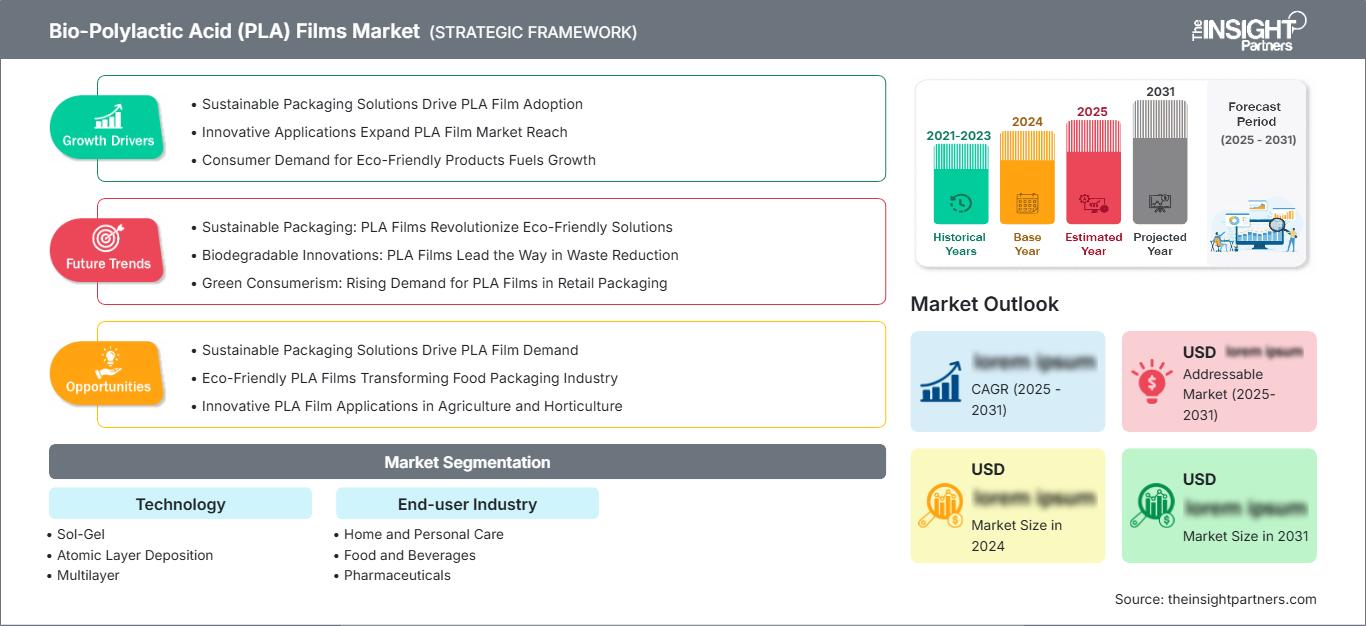
Bio-Polylactic Acid (PLA) Films Market: Strategic Insights
Regional Insights
North America Bio-Polylactic Acid Films Market
North America is expected to hold a 23–27% of Bio-Polylactic Acid Films Market share in 2025 and register a 9.0–9.8% CAGR from 2026 to 2034. The U.S. represents the principal regional demand center, supported by food packaging, labeling, personal care packaging, and corporate sustainability programs. Canada contributes through specialty packaging and bio-based material adoption.
Demand in the region depends on the level of investment made in compostable packaging, renewable materials, and high-performance PLA films. Converter interest in multilayer constructions and barrier technologies is increasing to widen the range of applications. The existing packaging industry infrastructure in the region enables fast commercialization of films provided that processing and performance parameters are met. Integration within the supply chain is still critical since manufacturers have to synchronize production of resins, film conversion, certification, and claim regarding end-of-life options.
U.S. Bio-Polylactic Acid Films Market
The U.S. is estimated to account for 74–78% of North America's 2025 market and grow at a 9.1–9.9% CAGR through 2034. Demand is concentrated in flexible packaging, labels, food service formats, and consumer products requiring renewable-material positioning. Amcor plc and Avery Dennison Corporation provide relevant downstream market capabilities.
Food & beverages packaging also continues to be an important application area since transparent films can offer good visibility for the packaged goods as well as help in creating brand equity. Other applications that are likely to be considered include personal care product packaging, which is driven more by aesthetics and sustainability considerations than renewable content itself. Consequently, converters in the U.S. are considering multilayer and coated PLA structures with better barrier properties.
Europe Bio-Polylactic Acid Films Market
Europe is forecasted to have a 27-31% share in 2025 and grow at a 9.5-10.3% CAGR between 2026 and 2034. The major markets include Germany, France, Italy, Spain, and the UK due to packaging regulations and a developed sustainability-converting industry.
The UK market is driven by retailers' programs, packaging waste-reduction campaigns, and interest in compostable or bio-based packaging solutions. The largest demand is observed in applications when PLA films can satisfy the required barrier, sealing, and printability requirements. Increasingly, converters evaluate the overall material performance, not the content of renewables.
Germany boasts a large base of packaging manufacturers and engineering skills. The demand is facilitated by sustainability and material efficiency programs of companies. The producers of film materials develop innovative structures that increase functionality and reduce the material consumption, thus providing an opportunity for the development of advanced PLA films in applications in food, personal care, and specialty packaging.
France, Italy, and Spain offer the additional demand through food packaging, consumer goods, agriculture, and specialty applications. With a well-developed flexible packaging industry, there is also the opportunity to convert film materials. Sustainability requirements will lead to evaluating new renewable polymer materials.
APAC Bio-Polylactic Acid Films Market
APAC is estimated to hold a 34–38% share in 2025 and expand at an 11.0–11.8% CAGR through 2034. China is the leading market, while Japan, South Korea, India, and Australia contribute through packaging manufacturing, polymer innovation, and sustainability initiatives.
China benefits from large packaging capacity, while Japan and South Korea emphasize advanced material engineering. India offers expanding food and consumer packaging demand, and Australia supports compostable-material adoption. Industrial scale, domestic polymer capacity, and policy attention to plastic waste strengthen regional prospects.
Middle East & Africa Bio-Polylactic Acid Films Market
The Middle East and Africa demand is developing from a smaller base, supported by packaging modernization and sustainability initiatives. Saudi Arabia and the UAE are leading Gulf markets, while South Africa represents an important African demand center. The regional market is expected to expand alongside packaging and infrastructure investment.
Energy-intensive conventional plastics remain highly established, creating cost challenges for PLA films. However, diversification programs, food-packaging demand, and sustainability objectives can support selective adoption. The UAE and Saudi Arabia are particularly relevant for advanced packaging investments, while South Africa provides opportunities in consumer packaging and agricultural applications.
Segmentation Analysis
Technology
Technology selection determines barrier performance, surface functionality, processing efficiency, and suitability for demanding applications. The segment is expected to expand at a 10.2–11.0% CAGR from 2026 to 2034. Bio-Polylactic Acid Films Market scope increasingly includes advanced coating and multilayer approaches designed to overcome conventional PLA performance limitations.
- Sol-Gel: Sol-Gel technology supports functional surface treatment and barrier enhancement, making it relevant for films requiring improved resistance while maintaining lightweight structures. Its strategic value increases where coating precision and material efficiency are priorities.
- Atomic Layer Deposition: Atomic Layer Deposition offers highly controlled thin-film functionalization and can improve barrier performance through precise deposition. Its importance is strongest in specialty applications where advanced performance can justify higher processing complexity.
- Multilayer: Multilayer structures combine PLA with functional layers to address moisture, oxygen, sealing, and mechanical requirements. Their flexibility makes them strategically important for expanding PLA films into demanding food, personal care, and pharmaceutical packaging formats.
End-user Industry
End-user demand is diversified across packaging-intensive industries, with Food and Beverages representing the largest application base. The segment is expected to expand at a 10.6–11.4% CAGR from 2026 to 2034, supported by sustainability requirements and greater use of engineered PLA films.
- Home and Personal Care: Personal care brands increasingly evaluate renewable-content films for packaging and labels where appearance, printability, and sustainability positioning influence material selection.
- Food and Beverages: Food and beverage packaging represents the largest demand center because transparent, printable, and engineered PLA films can support flexible packaging applications requiring renewable-material attributes.
- Pharmaceuticals: Pharmaceutical applications require stringent functional and quality requirements. PLA films can gain relevance in selected formats where controlled barrier performance and material specifications satisfy packaging requirements.
- Agriculture: Agricultural applications offer emerging opportunities for biodegradable and bio-based film formats. Demand is influenced by efforts to reduce persistent plastic residues and develop more sustainable crop-production materials.
Opportunity Snapshot
| End-user Industry | Revenue Contribution | Trend Tag | Adoption Stage |
|---|---|---|---|
| Home and Personal Care | Medium | Sustainable Labels | Scaling |
| Food and Beverages | High | Compostable Packaging | Mature |
| Pharmaceuticals | Medium | Barrier Films | Emerging |
| Agriculture | Medium | Biodegradable Films | Scaling |
Bio-Polylactic Acid (PLA) Films Market Growth Drivers and Impact Analysis
Expansion of Compostable and Renewable Packaging Formats
Growing attention to plastic waste is encouraging packaging producers to evaluate renewable and compostable materials for selected applications. This shift creates demand for PLA films where required mechanical and barrier properties can be achieved through coatings, multilayer structures, or material engineering. Brand owners are increasingly incorporating sustainability criteria into packaging procurement, influencing converters to qualify alternatives alongside conventional films. The commercial impact is strongest in food service, flexible packaging, labels, and specialty consumer products. However, adoption remains dependent on certification, disposal infrastructure, processing compatibility, and economics. Film suppliers that can demonstrate consistent performance under industrial converting conditions are better positioned to convert sustainability interest into recurring commercial volumes across regional packaging markets.
Improving Barrier and Processing Performance
Technical limitations associated with moisture sensitivity, thermal resistance, and barrier performance have historically restricted some PLA film applications. Advances in coating, multilayer construction, orientation, and surface treatment are expanding the range of feasible uses. Improved functionality allows converters to consider PLA films for packaging formats that previously relied predominantly on conventional polymers. These developments can increase material utilization while supporting thinner structures and application-specific engineering. The market impact extends beyond simple substitution because higher-performance films can enter premium packaging categories where functionality and sustainability are evaluated together. Continued research into processing stability and compatibility with printing, sealing, and lamination equipment should further reduce qualification barriers and support broader adoption among converters.
Increasing Corporate Focus on Bio-based Material Procurement
Large consumer-goods and packaging companies are increasingly integrating renewable-material targets into procurement and product-development strategies. This creates a commercial pathway for PLA film suppliers that can provide traceability, consistent quality, certifications, and reliable supply. Procurement decisions increasingly consider lifecycle attributes alongside price and functional performance, encouraging suppliers to strengthen feedstock transparency and production controls. The resulting market impact is particularly relevant for multinational brands operating across several regions, where consistent material specifications are required. Suppliers with scalable manufacturing and technical support can improve customer qualification rates by offering standardized grades and application-specific solutions. As sustainability targets become embedded in packaging specifications, material selection can shift from project-based experimentation toward recurring procurement programs.
Bio-Polylactic Acid (PLA) Films Market Future Trends
Development of High-Barrier PLA Film Structures
Future Bio-Polylactic Acid Films Market trends will increasingly center on high-barrier structures designed to extend PLA use into applications requiring stronger protection against oxygen, moisture, aromas, and other environmental factors. Coatings, multilayer configurations, and advanced deposition technologies can improve functional performance without eliminating the renewable-material foundation of the film. This development is important because packaging buyers increasingly expect sustainable materials to provide performance comparable with established petroleum-based films. Suppliers are therefore likely to prioritize thinner functional layers, improved sealing behavior, better thermal stability, and compatibility with high-speed converting. Commercial success will depend on demonstrating that enhanced functionality does not create unacceptable recycling, compostability, cost, or processing trade-offs across targeted applications and regional packaging systems.
Greater Integration of Sustainable Feedstock and Film Manufacturing
Manufacturers are likely to place greater emphasis on traceable feedstocks, energy-efficient processing, and integrated production pathways. This shift can improve supply visibility while strengthening the environmental credentials required by packaging customers. Producers may increasingly coordinate polymer sourcing, film extrusion, coating, and conversion to reduce variability and improve application qualification. Regional manufacturing strategies could become more important as customers seek shorter supply chains and greater resilience. Technology providers are also likely to develop processing solutions that reduce material consumption while preserving film performance. Over time, procurement teams may evaluate PLA films using broader criteria covering feedstock origin, production efficiency, functional performance, certification, and end-of-life compatibility rather than relying on renewable content as the primary purchasing consideration.
Bio-Polylactic Acid (PLA) Films Market Opportunities
Investment in Advanced Barrier and Coating Technologies
Investment in advanced barrier technologies presents an opportunity to expand PLA films into higher-value packaging applications. Sol-Gel treatments, Atomic Layer Deposition, and engineered multilayer structures can address functional limitations while preserving lightweight film formats. Investors and manufacturers can prioritize technologies that improve oxygen and moisture resistance without compromising conversion efficiency or targeted end-of-life characteristics. Partnerships between resin producers, coating specialists, and packaging converters can shorten qualification cycles and provide application-specific validation. The strongest opportunities are likely to emerge where improved performance creates measurable value for food, personal care, and pharmaceutical packaging. Companies that develop scalable processes rather than laboratory-scale solutions can establish stronger commercial positions as customers transition from pilot testing toward larger procurement programs.
Expansion into Sustainable Agricultural and Specialty Film Applications
Agricultural and specialty applications offer an avenue for diversification beyond conventional consumer packaging. Biodegradable or compostable film formats can address selected applications where persistent plastic residues create disposal concerns. Manufacturers can evaluate crop-protection films, specialty covers, labels, and controlled-use structures where PLA performance is technically appropriate. Bio-Polylactic Acid Films Market Forecasts indicate that opportunities can develop alongside investments in agricultural sustainability and material-efficiency programs. Commercial strategies should focus on application-specific validation, field performance, end-of-life pathways, and cost competitiveness rather than treating biodegradability as a standalone value proposition. Collaboration with agricultural-material converters and users can help identify applications where PLA's mechanical and degradation characteristics provide a practical advantage over conventional film materials.
Recent Developments
- May 2026: GAIA BioMaterials — GAIA BioMaterials received final approval for a European patent covering PLA-free film extrusion materials. The patented compounds replace traditional PLA with a blend of biodegradable polymers and minerals and are already being used in carrier bags, fruit and vegetable bags, waste bags, and medical aprons. The development expands the range of biodegradable film technologies available for sustainable packaging applications.
- January 2026: Futerro S.A. — Futerro advanced its planned lactic acid, lactide, and PLA production facility at Port-Jérôme in Normandy, France, by submitting environmental authorization and building permit applications. The planned facility is designed for 75,000 tonnes per year of production. Following geotechnical studies and additional administrative requirements, Futerro adjusted the expected production start to no later than early 2029.
Frequently Asked Questions

- Comprehensive Market Sizing and Forecast Analysis
- Detailed Segmentation Analysis
- In-Depth Market Dynamics Assessment
- Regional and Country-Level Insights
- Competitive Landscape and Company Benchmarking
- Strategic Business Intelligence
Recent Reports
Testimonials

The Insight Partners provided valuable market intelligence that supported our global go-to-market strategy. Their team was professional, responsive, and attentive to our feedback, providing thoughtful analysis and helpful methodological clarifications throughout the project.
Junmo Kim Chief Financial Officer (CFO), Enertech Co., Ltd.
The Insight Partners' SCADA System Market report is comprehensive, with valuable insights on current trends and future forecasts. The team was highly professional, responsive, and supportive throughout. We are very satisfied and highly recommend their services.
RAN KEDEM Partner, Reali Technologies LTDs
I requested a report on a very specific software market and the team produced the report in a few days. The information was very relevant and well presented. I then requested some changes and additions to the report. The team was again very responsive and I got the final report in less than a week.
JEAN-HERVE JENN Chairman, Future Analytica
We worked with The Insight Partners for an important market study and forecast. They gave us clear insights into opportunities and risks, which helped shape our plans. Their research was easy to use and based on solid data. It helped us make smart, confident decisions. We highly recommend them.
PIYUSH NAGPAL Sr. Vice President, High Beam Global
The Insight Partners delivered insightful, well-structured market research with strong domain expertise. Their team was professional and responsive throughout. The user-friendly website made accessing industry reports seamless. We highly recommend them for reliable, high-quality research services
YUKIHIKO ADACHI CEO, Deep Blue, LLC.
This is the first time I have purchased a market report from The Insight Partners.While I was unsure at first, I visited their web site and felt more comfortable to take the risk and purchase a market report.I am completely satisfied with the quality of the report and customer service. I had several questions and comments with the initial report, but after a couple of dialogs over email with their analyst I believe I have a report that I can use as input to our strategic planning process.Thank you so much for taking the extra time and making this a positive experience.I will definitely recommend your service to others and you will be my first call when we need further market data.
JOHN SUZUKI President and Chief Executive Officer, Board Director, BK Technologies
I wish to appreciate your support and the professionalism you displayed in the course of attending to my request for information regarding to infectious disease IVD market in Nigeria. I appreciate your patience, your guidance, and the fact that you were willing to offer a discount, which eventually made it possible for us to close a deal. I look forward to engaging The Insight Partners in the future, all thanks to the impression you have created in me as a result of this first encounter.
DR CHIJIOKE ONYIA MANAGING DIRECTOR, PineCrest Healthcare Ltd.Reason to Buy
- Informed Decision-Making
- Understanding Market Dynamics
- Competitive Analysis
- Identifying Emerging Markets
- Customer Insights
- Market Forecasts
- Risk Mitigation
- Boosting Operational Efficiency
- Strategic Planning
- Investment Justification
- Tracking Industry Innovations
- Aligning with Regulatory Trends





 Get Free Sample for