
Biomethane Market Trends, Size & Growth by 2034
Coverage: By Feedstock (Industrial Waste, Agricultural Waste, Sewage Sludge, Energy Crops, Municipal Waste, Others); Application (Electricity generation, Heat generation, Others) , and Geography (North America, Europe, Asia Pacific, and South and Central America)
- Status : Data Released
- Report Code : TIPRE00022222
- Category : Chemicals and Materials
- No. of Pages : 150
- Available Report Formats :


- Last update date : July 09, 2026


2025 Market Size
US$ 7.30 Bn
Base year value
2034 Forecast
US$ 10.90 Bn
Projected by 2034
CAGR 2026-2034
4.56 %
Growth rate
Addressable Market
US$ 82.65 Bn
(2026-2034)
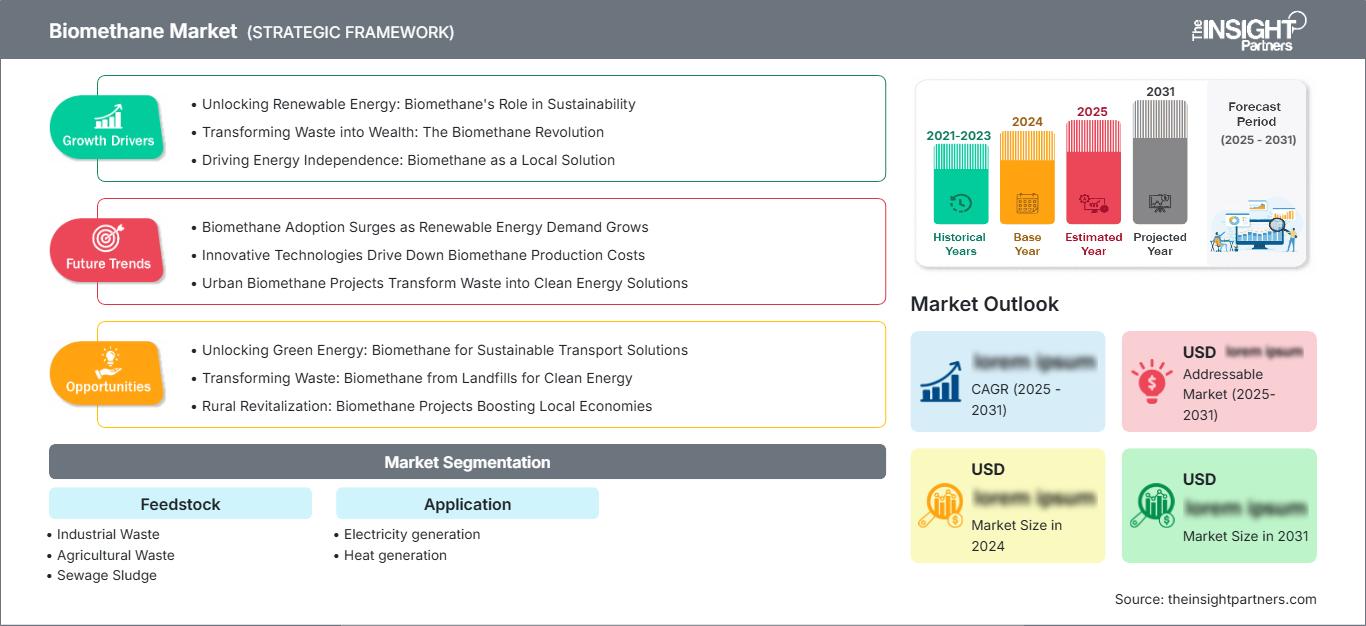
The biomethane market is gaining strategic importance as a renewable gaseous fuel that supports decarbonization across power generation, industrial heating, and energy-intensive sectors. The Biomethane Market was valued at US$ 7.30 billion in 2025 and is projected to reach US$ 10.90 billion by 2034, registering a CAGR of 4.56% during 2026–2034. Expanding investments in waste-to-energy infrastructure, supportive renewable gas policies, and increasing demand for low-carbon fuel alternatives continue to strengthen commercial deployment across developed and emerging economies.
North America is expected to keep growing steadily during the forecast period, supported by renewable natural gas programs, landfill gas use, and agricultural waste conversion efforts. The regional biomethane market is projected to register a CAGR between 4.2% and 4.8% through 2034. Increasing corporate commitments to reduce carbon emissions, upgrades to gas distribution networks, and favorable environmental regulations are driving biomethane production and long-term infrastructure investments across the United States and Canada.
Biomethane Market Assessment and Insights
- North America: Accounted for a 31–34% share in 2025 and is projected to expand at a CAGR of 4.2–4.8% during 2026–2034. Strong renewable natural gas incentives, landfill gas recovery projects, and agricultural biogas investments continue supporting long-term regional biomethane market expansion.
- U.S.: Represented 74–78% of the North American biomethane market size in 2025 and is expected to record a CAGR of 4.3–4.9% during 2026–2034, driven by renewable fuel standards, transportation fuel demand, and expanding pipeline injection infrastructure.
- Europe: Held 36–39% share in 2025 and is forecast to grow at a CAGR of 4.7–5.3% during 2026–2034. Germany, France, Italy, the UK, and Denmark continue leading production through supportive renewable energy frameworks and mature anaerobic digestion ecosystems.
- Asia Pacific: Captured 18–21% share in 2025 and is anticipated to register the fastest CAGR of 5.4–6.0% during 2026–2034. China, India, Japan, South Korea, and Australia are accelerating investments in waste valorization and low-carbon energy infrastructure.
- Largest Segment – Agricultural Waste: Agricultural Waste accounted for 28–32% of the biomethane market share in 2025 and is expected to grow at a CAGR of 4.5–5.0% during 2026–2034. Abundant feedstock availability, strong support for agricultural residue utilization, and expanding farm-based anaerobic digestion facilities continue to strengthen its market position.
- High Growth Segment – Municipal Waste: Municipal Waste is projected to register the fastest growth with a 2025 market share of 18–22% and a CAGR of 4.8–5.4% during 2026–2034. Increasing investments in integrated waste management, landfill diversion initiatives, and urban organic waste processing are accelerating commercial biomethane production.
- Key companies analyzed in detail: Malmberg BioMethane AB, VERBIO SE, Green Elephant Biotech GmbH, Southern California Gas Company, ETW Energietechnik GmbH, Gazasia Ltd., JV Energen Pvt. Ltd., GPS Renewables Private Limited, Carbon Loops SAS, Quantum Green Energy Private Limited.
Source: The Insight Partners' analysis based on proprietary research, government publications, company annual reports, investor presentations, industry databases, and expert interviews.
Continuous improvements in anaerobic digestion efficiency, gas upgrading technologies, and digital plant monitoring have made biomethane production a more reliable source of renewable energy. Producers are using membrane separation, pressure swing adsorption, and biological methanation systems to enhance methane purity and lower operating costs. At the same time, governments are promoting circular economy models that turn agricultural residues, municipal waste, sewage sludge, and industrial organic waste into renewable gas. This effort supports the long-term growth of the biomethane market and broadens its overall scope.
Future growth is likely to be influenced by new investments in the Asia Pacific, Latin America, and certain Middle Eastern countries where renewable gas infrastructure is still developing. Increasing carbon pricing, renewable gas blending requirements, and industrial decarbonization programs should also improve project economics in the coming years. Rising collaboration among utilities, technology providers, and waste management firms is expected to boost commercialization opportunities and support long-term expansion of the biomethane market.
Biomethane Market Report Scope
| Report Attribute | Details |
|---|---|
| Market size in 2025 | US$ 7.30 Billion |
| Market Size by 2034 | US$ 10.90 Billion |
| Global CAGR (2026 - 2034) | 4.56% |
| Historical Data | 2021-2024 |
| Forecast period | 2026-2034 |
Biomethane Market Analysis
The growing focus on reducing greenhouse gas emissions has led to a noticeable rise in interest in renewable gaseous fuels made from organic waste. Biomethane provides a practical alternative to conventional natural gas because it can use existing gas infrastructure while lowering emissions over its lifecycle. Increasing efforts in municipal waste management, utilizing agricultural leftovers, and recycling industrial waste are creating a steady supply of feedstock for large-scale biomethane production.
The biomethane market report includes feedstock suppliers, anaerobic digestion technology providers, manufacturers of gas upgrading equipment, pipeline operators, utilities, industrial users, and power producers. Improvements in purification technology have raised methane recovery rates and gas quality. This has enabled greater injection into pipelines and more use as transportation fuel. These advancements are boosting the Biomethane Market share in electricity generation and industrial heating.
Competition is increasingly focused on technology differences, project execution skills, and long-term feedstock security. Companies like VERBIO SE, Malmberg BioMethane AB, GPS Renewables Private Limited, ETW Energietechnik GmbH, and Southern California Gas Company continue to invest in improving production, building infrastructure partnerships, and developing renewable gas systems. Collaborations with cities and farmers are enhancing the availability of raw materials while supporting commercial growth.
Investment is shifting toward integrated waste-to-energy facilities that can produce renewable gas, digestate, and other valuable by-products. Technology developers are focusing on modular plant designs that cut construction times and enhance operational flexibility. As funding options for low-carbon infrastructure expand, market players are expected to pursue acquisitions, expand regionally, and enter into joint development agreements to strengthen their competitive position while adapting to evolving trends in the Biomethane Market across both developed and emerging economies.
● REPORT CUSTOMIZATION
Tailor This Report To Align With Your Specific Business Requirements
This report can be customized to align precisely with your business objectives, scope, and target markets. Customization options include tailored segmentation, geography, competitive analysis, and strategic insights to support informed decision-making.
Customize This Report →WHAT YOU CAN ADJUST
- ● Segmentations
- ● Geography
- ● Competitive Analysis
- ● Language Preferences
Biomethane Market: Strategic Insights
Regional Insights
North America Biomethane
North America accounted for 31-34% of the global biomethane market in 2025. It is expected to see a compound annual growth rate (CAGR) of 4.2 to 4.8% from 2026 to 2034. The growth in the region is driven by renewable natural gas policies, landfill gas recovery projects, and increased use of livestock and agricultural waste. Utilities are investing in pipeline connections. Transportation remains an important sector due to incentives for renewable fuel. The area also benefits from established waste collection systems and favorable financing options for anaerobic digestion facilities. These factors are improving project finances and encouraging larger investments. Recent policy changes have boosted the use of renewable gas in municipal and industrial settings.
There is increasing collaboration between energy utilities, farmers, and technology providers. This teamwork is improving feedstock supply and accelerating commercial deployment. The growing interest in reducing carbon emissions from industrial heat and expanding programs for blending renewable gas is likely to support long-term investment. Digital monitoring tools and better gas upgrading technologies are also improving efficiency and helping the market grow in the region.
U.S. Biomethane Market
The United States accounted for 74-78% of the North American biomethane market in 2025. It is expected to grow at a rate of 4.3 to 4.9% from 2026 to 2034. The country remains the world's largest producer of renewable natural gas. This growth is backed by the Renewable Fuel Standard, California's Low Carbon Fuel Standard, and more voluntary corporate efforts to reduce carbon emissions. Transportation still accounts for the largest share of renewable natural gas use, but industrial and utility applications are rising as pipeline injection capacity increases.
Key biomethane market players are developing waste-to-energy projects that use landfill gas, dairy waste, municipal organic waste, and agricultural leftovers. More involvement from gas utilities, engineering companies, and infrastructure investors is boosting domestic production capacity. The rising use of renewable gas certificates and long-term contracts is likely to provide steady investment returns and wider commercialization over the coming years.
Europe Biomethane Market
Europe held 36 to 39% of the global biomethane market in 2025 and is expected to see a CAGR of 4.7 to 5.3% from 2026 to 2034. Germany leads the regional market due to its established anaerobic digestion infrastructure, large agricultural feedstock base, and strong renewable energy policies. France, Italy, Denmark, and the Netherlands are expanding grid-injection projects with supportive regulations and investment incentives.
The United Kingdom is boosting renewable gas deployment through waste valorization projects and increasing utility involvement—national efforts to enhance energy security while cutting emissions are prompting more investments in biomethane infrastructure. Ongoing upgrades to gas distribution systems should help with long-term commercial use.
France, Italy, and Spain are increasing biomethane production capacity by using agricultural waste, treating municipal organic waste, and launching renewable gas blending initiatives. Government-supported incentives and rising industrial demand for low-carbon fuels are likely to sustain regional growth and strengthen Europe's role as the top destination for biomethane investment.
APAC Biomethane Market
Asia Pacific accounted for 18-21% of the global biomethane market in 2025 and is expected to have the fastest growth rate, at 5.4-6.0%, from 2026 to 2034. China leads this region in production with large-scale bio-natural gas projects, while India is increasing its compressed biogas facilities through national waste-to-energy programs.
Japan and South Korea continue to invest in circular economy projects that focus on using municipal waste and reducing industrial emissions. Australia is moving forward with renewable gas demonstration projects that support industrial users and integrate with existing gas infrastructure. Policy support, urban waste generation, and rising investments in renewable energy infrastructure are likely to make the Asia Pacific the fastest-growing regional biomethane market during the forecast period.
Middle East & Africa Biomethane Market
The Middle East and Africa biomethane market is expected to grow at a rate of 4.0 to 4.6% from 2026 to 2034. Saudi Arabia and the United Arab Emirates are exploring waste-to-energy investments that support circular economy and energy diversification strategies.
Meanwhile, South Africa continues to use organic waste to produce decentralized renewable energy. Modernizing infrastructure and improving municipal waste management are gradually making projects more feasible in several countries. International technology partnerships are helping with knowledge transfer and project development.
Although the regional biomethane market is still smaller than that of Europe and North America, growing sustainability commitments and investments in renewable infrastructure are likely to boost long-term business opportunities for biomethane production.
Segmentation Analysis
Feedstock
- Industrial Waste: Organic residues from food processing, beverage manufacturing, pulp and paper, and agro-processing industries provide a steady supply of feedstock year-round. A stable supply and centralized collection improve plant use while supporting ongoing biomethane production.
- Agricultural Waste: Livestock manure, crop leftovers, and agricultural by-products are among the most commonly used feedstocks due to their plentiful availability. Government incentives that promote sustainable farming and manure management are helping rural economies adopt these practices over the long term.
- Sewage Sludge: Municipal wastewater treatment plants are increasingly using anaerobic digestion systems to recover energy from sewage sludge. The existing infrastructure and constant generation of feedstock allow municipalities to enhance energy efficiency, reduce operational costs, and cut greenhouse gas emissions.
- Energy Crops: Crops grown specifically for anaerobic digestion deliver reliable methane yields, especially where agricultural land is available, and supportive policies enable commercial farming. Their use is mostly found in some European countries with established renewable gas programs.
- Municipal Waste: Collecting separated organic municipal waste has significant long-term potential as urban populations grow. Ongoing investments in waste sorting, collection systems, and advanced treatment facilities are improving feedstock quality and supporting circular waste management strategies.
Application
- Electricity Generation: Biomethane-fueled combined heat and power plants provide reliable renewable electricity and improve overall energy efficiency. Utilities are increasingly using these systems to support intermittent renewable energy sources and enhance grid resilience.
- Heat Generation: Industrial facilities, commercial buildings, and district heating networks are adopting biomethane as a lower-carbon option compared to traditional natural gas. Growing decarbonization targets and carbon reduction commitments are driving demand for renewable thermal energy solutions.
Opportunity Snapshot
| Segment Name | Revenue Contribution | Trend Tag | Adoption Stage |
| Electricity Generation | High | Grid Injection | Mature |
| Heat Generation | Medium | Industrial Heat | Scaling |
Biomethane Market Growth Drivers and Impact Analysis
Expansion of Renewable Natural Gas Policies and Carbon Reduction Targets
National governments are strengthening renewable energy strategies. They are introducing targets for blending renewable gas, setting low-carbon fuel standards, and making commitments to reduce emissions. These policy measures improve project finances by providing production incentives, renewable fuel credits, and carbon pricing mechanisms. These elements make biomethane more competitive with fossil natural gas. Utilities are also increasing their sourcing of renewable gas to meet sustainability goals and lower greenhouse gas emissions over their lifecycles.
The mix of regulatory certainty and long-term climate commitments encourages investment in infrastructure for feedstock collection, anaerobic digestion, gas upgrading, and pipeline injection. As more countries include renewable gases in their energy transition plans, investment confidence is likely to increase. This will support more commercial-scale projects and boost global production capacity in the coming years.
Increasing Utilization of Organic Waste for Circular Economy Development
Growing amounts of municipal solid waste, agricultural leftovers, industrial organic by-products, and sewage sludge are creating significant opportunities for renewable gas production. Governments are promoting circular economy models that convert waste into valuable energy while reducing landfill disposal and methane emissions. Biomethane facilities help manage waste and generate renewable energy, improving overall environmental performance.
Modern anaerobic digestion technologies boost methane recovery rates and increase plant efficiency, allowing producers to get the most out of available resources. Working together, waste management authorities, agricultural cooperatives, and industrial facilities strengthen feedstock security, lower operational risks, and support long-term commercial success for biomethane production projects in both developed and emerging economies.
Advancements in Gas Upgrading and Digital Plant Optimization
Continuous innovation in membrane separation, pressure swing adsorption, biological methanation, and digital process monitoring improves biomethane production efficiency and lowers lifecycle operating costs. Automation helps operators optimize feedstock use, improve methane recovery, and reduce energy consumption during purification.
Predictive maintenance systems powered by artificial intelligence decrease equipment downtime and increase operational reliability in commercial plants. These technological improvements boost the economic competitiveness of renewable gas projects and encourage investment in larger production facilities. Equipment manufacturers also offer modular upgrading systems that make deployment easier for small and medium-scale installations. This enables wider adoption in agricultural, industrial, and municipal applications worldwide.
Biomethane Market Future Trends
Integration of Biomethane into National Gas Infrastructure
An increasing number of countries are upgrading their natural gas infrastructure to support renewable gases. Reflecting biomethane market trends, they are introducing standardized quality specifications, expanding pipeline injection capacity, and establishing certification systems. Utilities are investing in modernizing their gas grids to enable greater biomethane integration while maintaining system reliability. Cross-border renewable gas trading frameworks and guarantees of origin should improve market transparency and encourage investment.
As industrial consumers seek low-carbon fuel options without replacing existing equipment, biomethane is likely to become an increasingly appealing solution. Continued alignment of technical standards will speed up commercial deployment and strengthen international renewable gas markets.
Growing Investments in Large-Scale Waste-to-Energy Ecosystems
Future investments are likely to place greater emphasis on waste-to-energy facilities that integrate waste collection, anaerobic digestion, biomethane upgrading, digestate utilization, and carbon capture technologies into a single operational system. These integrated facilities boost resource efficiency and generate revenue from renewable gas, organic fertilizers, and carbon credits.
Public-private partnerships are expected to be crucial to funding these projects, especially in fast-growing urban areas where municipal waste volumes continue to rise. These changes are likely to enhance commercial scalability and strengthen long-term competitiveness within the global biomethane industry.
Biomethane Market Opportunities
Expansion of Industrial Renewable Gas Adoption
Industrial sectors such as chemicals, food processing, cement, pulp and paper, ceramics, and steel face growing pressure to cut carbon emissions while maintaining operational efficiency. Supporting the biomethane market forecast, biomethane offers a viable solution by replacing conventional natural gas in existing industrial systems with minimal modifications. Long-term renewable gas purchase agreements, carbon pricing systems, and corporate net-zero goals should accelerate industrial adoption over the next decade.
Equipment manufacturers, gas utilities, and project developers can create integrated renewable gas supply chains backed by reliable feedstock sourcing and modern upgrading technologies. Investment in industrial clusters that link waste generation with renewable gas production can improve project economics, boost energy security, and generate extra revenue through renewable energy certificates and carbon credit markets.
Development of Emerging Biomethane Production Hubs
Rapid urbanization, growing municipal solid waste generation, and increasing agricultural activities are creating conditions for biomethane production in emerging economies. Countries in the Asia Pacific, Latin America, and parts of the Middle East are improving renewable energy strategies while updating waste management infrastructure. Investors have opportunities to set up commercial anaerobic digestion facilities, gas upgrading plants, and renewable gas distribution networks ahead of the market.
Partnerships between municipalities, agricultural cooperatives, engineering firms, and utility companies should lower project risks while ensuring a steady supply of feedstock. Early investments in these areas may also leverage government incentives, affordable financing, and international climate funding programs to accelerate low-carbon energy development.
Recent Developments
- March 2026: VERBIO SE announced the expansion of its renewable natural gas production strategy through additional investments in biomethane capacity and strengthened feedstock sourcing initiatives to support growing demand for industrial and transportation fuels in Europe. The expansion is intended to improve the availability of renewable gas while supporting regional decarbonization objectives.
- January 2026: GPS Renewables Private Limited announced the commissioning of an additional compressed biogas project under India's Sustainable Alternative Towards Affordable Transportation (SATAT) initiative. The facility is designed to convert agricultural residues into renewable gas while supporting cleaner transportation fuels and improved rural waste management practices.
- September 2025: Southern California Gas Company continued to expand its renewable natural gas procurement and infrastructure investments to increase the integration of renewable gas into its distribution network. The initiative supports California's long-term decarbonization objectives while strengthening renewable energy supply for residential, commercial, and industrial consumers.
Frequently Asked Questions

- Comprehensive Market Sizing and Forecast Analysis
- Detailed Segmentation Analysis
- In-Depth Market Dynamics Assessment
- Regional and Country-Level Insights
- Competitive Landscape and Company Benchmarking
- Strategic Business Intelligence
Recent Reports
Testimonials

The Insight Partners' SCADA System Market report is comprehensive, with valuable insights on current trends and future forecasts. The team was highly professional, responsive, and supportive throughout. We are very satisfied and highly recommend their services.
RAN KEDEM Partner, Reali Technologies LTDs
I requested a report on a very specific software market and the team produced the report in a few days. The information was very relevant and well presented. I then requested some changes and additions to the report. The team was again very responsive and I got the final report in less than a week.
JEAN-HERVE JENN Chairman, Future Analytica
We worked with The Insight Partners for an important market study and forecast. They gave us clear insights into opportunities and risks, which helped shape our plans. Their research was easy to use and based on solid data. It helped us make smart, confident decisions. We highly recommend them.
PIYUSH NAGPAL Sr. Vice President, High Beam Global
The Insight Partners delivered insightful, well-structured market research with strong domain expertise. Their team was professional and responsive throughout. The user-friendly website made accessing industry reports seamless. We highly recommend them for reliable, high-quality research services
YUKIHIKO ADACHI CEO, Deep Blue, LLC.
This is the first time I have purchased a market report from The Insight Partners.While I was unsure at first, I visited their web site and felt more comfortable to take the risk and purchase a market report.I am completely satisfied with the quality of the report and customer service. I had several questions and comments with the initial report, but after a couple of dialogs over email with their analyst I believe I have a report that I can use as input to our strategic planning process.Thank you so much for taking the extra time and making this a positive experience.I will definitely recommend your service to others and you will be my first call when we need further market data.
JOHN SUZUKI President and Chief Executive Officer, Board Director, BK Technologies
I wish to appreciate your support and the professionalism you displayed in the course of attending to my request for information regarding to infectious disease IVD market in Nigeria. I appreciate your patience, your guidance, and the fact that you were willing to offer a discount, which eventually made it possible for us to close a deal. I look forward to engaging The Insight Partners in the future, all thanks to the impression you have created in me as a result of this first encounter.
DR CHIJIOKE ONYIA MANAGING DIRECTOR, PineCrest Healthcare Ltd.Reason to Buy
- Informed Decision-Making
- Understanding Market Dynamics
- Competitive Analysis
- Identifying Emerging Markets
- Customer Insights
- Market Forecasts
- Risk Mitigation
- Boosting Operational Efficiency
- Strategic Planning
- Investment Justification
- Tracking Industry Innovations
- Aligning with Regulatory Trends





 Get Free Sample for