
Bionematicides Market Size, Trends & Demand by 2034
Coverage: by Type (Microbials, Biochemical); Form (Dry, Liquid); Crop Type (Cereals and Grains, Oilseeds and Pulses, Fruits and Vegetables, Others); Application (Seed treatment, Soil treatment, Foliar sprays, Others); Infestation (Root knot, Cyst nematodes, Lesion nematodes, Others) , and Geography (North America, Europe, Asia Pacific, and South and Central America)
- Status : Data Released
- Report Code : TIPRE00010417
- Category : Chemicals and Materials
- No. of Pages : 150
- Available Report Formats :


- Last update date : July 09, 2026


2025 Market Size
US$ 613.05 Mn
Base year value
2034 Forecast
US$ 2,382.08 Mn
Projected by 2034
CAGR 2026-2034
16.28 %
Growth rate
Addressable Market
US$ 12,638.63 Mn
(2026-2034)
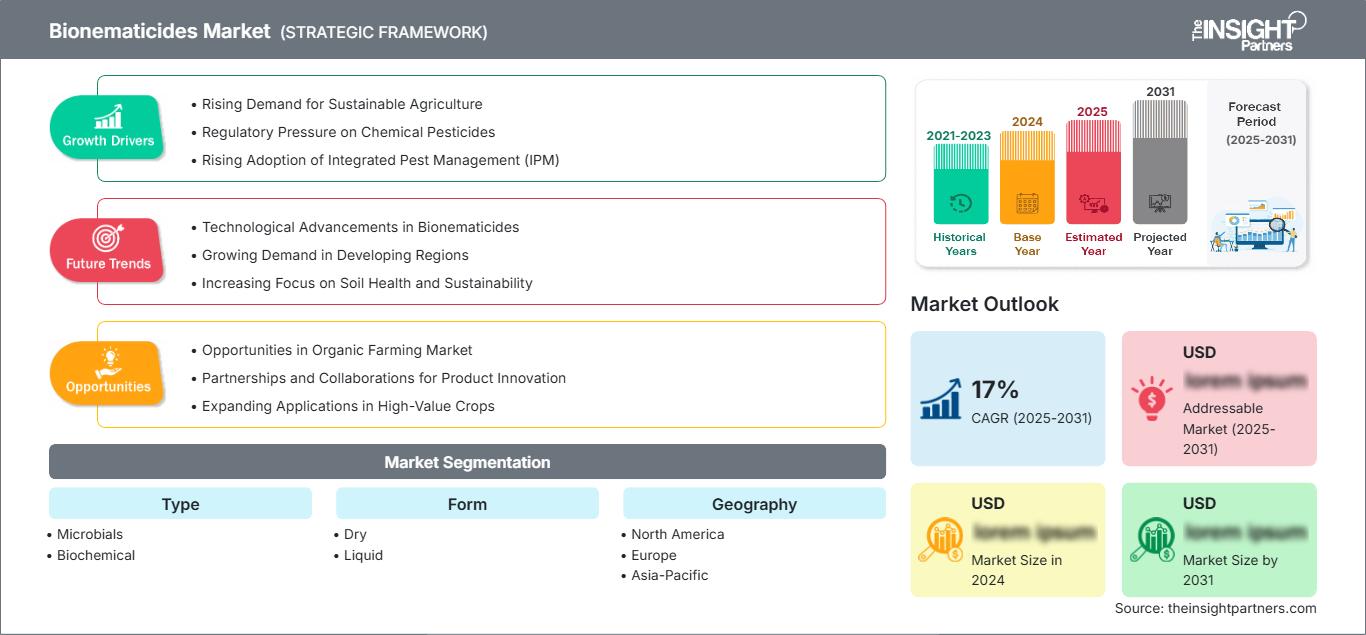
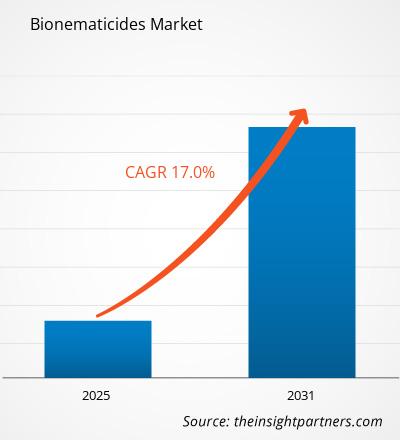
The Bionematicides Market was valued at US$ 613.05 million in 2025 and is projected to reach US$ 2,382.08 million by 2034, expanding at a CAGR of 16.28% during 2026–2034. The market is benefiting from the transition toward biological crop protection, increasing restrictions on conventional chemical nematicides, and greater adoption of sustainable agricultural practices. Rising investments in microbial technologies, improved formulation stability, and expanding integrated pest management programs continue to strengthen commercial adoption across high-value crop cultivation.
North America is a leading bionematicides market for biological crop protection. It benefits from clear regulations for biopesticides, strong research capabilities, and a wide use of integrated pest management. The bionematicides market is projected to grow rapidly through the forecast period, as farmers increasingly use eco-friendly nematode management solutions in fruit, vegetable, and specialty crop production. Investments from both public and private sectors in sustainable agriculture also support long-term business opportunities.
Bionematicides Market Assessment and Insights
- North America: Accounted for an estimated 18–22% of the bionematicides market share in 2025 and is expected to expand at a CAGR of 14.5–15.8% between 2026 and 2034. Growth is supported by EPA biopesticide registrations, the adoption of precision agriculture, and the increasing demand for residue-free crop protection.
- U.S.: Represented approximately 72–76% of the North American bionematicides market size in 2025 and is projected to register a CAGR of 14.8–16.0% during 2026–2034, driven by commercial horticulture, biological product innovation, and advanced agricultural distribution networks.
- Europe: Held an estimated 22–26% of the bionematicides market share in 2025 and is anticipated to grow at a CAGR of 15.2–16.5% during 2026–2034. Germany, France, Italy, Spain, and the UK continue to lead in adoption owing to stringent pesticide regulations and the expansion of organic farming.
- Asia Pacific: Accounted for approximately 32–36% share in 2025 and is expected to record the fastest regional expansion at a CAGR of 17.0–18.5% during 2026–2034. China, India, Japan, and Australia remain key growth centers due to the expanding adoption of biological inputs and government support for sustainable agriculture.
- Largest Segment: Microbials represented an estimated 66–70% of the market share in 2025 and are forecast to grow at a CAGR of 16.0–17.2% during 2026–2034, supported by the proven efficacy of beneficial bacteria and fungi against economically significant nematode species.
- High Growth Segment: Seed treatment accounted for an estimated 18–22% market share in 2025 and is expected to expand at a CAGR of 17.5–18.8% between 2026 and 2034, reflecting an increasing emphasis on preventive crop protection and reduced field-application costs.
- Key companies analyzed in detail: AgriLife (India) Private Limited, Bayer CropScience AG, Huma, Inc., Certis USA LLC, Horizon Agrotech Private Limited, Marrone Bio Innovations, Inc., Syngenta AG, T. Stanes and Company Limited, The Real IPM Company Ltd, Valent BioSciences LLC.
Source: The Insight Partners' analysis based on proprietary research, government publications, company annual reports, investor presentations, industry databases, and expert interviews.
The bionematicides market report has shifted from niche biological options to commercially viable crop protection technologies. This change is driven by advances in microbial discovery, better fermentation efficiency, and improved formulation science. Improvements in shelf life, compatibility with pest management programs, and wider distribution through agricultural suppliers have sped up product acceptance among growers. Manufacturers are investing in strain optimization, precision application technologies, and strategic partnerships to enhance field performance across various climates while navigating increased regulatory scrutiny of traditional nematicides.
Looking ahead, investment is expected to grow in Asia Pacific, Latin America, and select Middle Eastern agricultural markets as sustainable farming initiatives expand. Government incentives that promote biological crop inputs, along with a rise in organic farming and greater awareness of soil health, are likely to boost commercial adoption. Collaborations among biotechnology developers, agricultural distributors, and research institutions are expected to accelerate innovation, product registrations, and market growth throughout the forecast period.
Bionematicides Market Report Scope
| Report Attribute | Details |
|---|---|
| Market size in 2025 | US$ 613.05 Million |
| Market Size by 2034 | US$ 2,382.08 Million |
| Global CAGR (2026 - 2034) | 16.28% |
| Historical Data | 2021-2024 |
| Forecast period | 2026-2034 |
Bionematicides Market Analysis
Concerns about crop losses from plant-parasitic nematodes are driving up demand for biological nematode management solutions. The Food and Agriculture Organization (FAO) highlights that sustainable crop protection practices are becoming more crucial as governments promote reduced use of synthetic pesticides and encourage environmentally friendly agricultural inputs. Biological nematicides fit well in integrated pest management (IPM) programs because they provide targeted control, protect beneficial soil microorganisms, and support long-term soil health. The increasing cultivation of high-value fruits, vegetables, and horticultural crops has boosted commercial adoption, as growers seek residue-free production methods to meet tougher food safety regulations.
The industry value chain has become more integrated. It begins with the discovery of microbial strains and the conduct of biochemical research. This is followed by laboratory validation, large-scale fermentation, formulation development, regulatory approvals, commercial manufacturing, and agricultural distribution. Improvements in fermentation technology, encapsulation methods, and liquid formulation stability have enhanced product shelf life and field effectiveness. This progress has allowed for broader commercialization across various climates. Distribution partnerships with agricultural retailers, cooperatives, and crop advisory networks are raising farmer awareness and helping reach emerging agricultural markets.
Competition in the Bionematicides Market includes multinational crop protection companies and specialized biological input manufacturers. These companies are heavily investing in research, building strategic partnerships, and expanding their product lines. Bayer CropScience AG, Syngenta AG, and Valent BioSciences LLC are enhancing their biological crop protection offerings through innovation and strategic collaborations. At the same time, Certis USA LLC, AgriLife (India) Private Limited, The Real IPM Company Ltd, and T. Stanes and Company Limited are increasing their presence with region-specific biological formulations tailored to local cropping systems. Product differentiation is now more focused on microbial effectiveness, formulation stability, compatibility with IPM programs, and regulatory approvals than on price.
Investment has increased as governments and private investors see biological crop protection as vital for sustainable agriculture. Companies are investing in microbial discovery platforms, expanding fermentation capacity, and developing digital agronomy solutions that make product application more efficient. Strategic collaborations among biotech firms, research institutes, and agricultural distributors are likely to accelerate commercialization while expanding global product availability. As environmental regulations tighten and the demand for residue-free agricultural production grows, companies with diverse biological portfolios, strong regulatory knowledge, and scalable manufacturing capabilities are expected to strengthen their competitive position in the coming years.
● REPORT CUSTOMIZATION
Tailor This Report To Align With Your Specific Business Requirements
This report can be customized to align precisely with your business objectives, scope, and target markets. Customization options include tailored segmentation, geography, competitive analysis, and strategic insights to support informed decision-making.
Customize This Report →WHAT YOU CAN ADJUST
- ● Segmentations
- ● Geography
- ● Competitive Analysis
- ● Language Preferences
Bionematicides Market: Strategic Insights
Regional Insights
North America Bionematicides
North America held an estimated 18-22% share of the global bionematicides market in 2025 and is expected to grow at 14.5-15.8% from 2026 to 2034. The region benefits from modern farming practices, established regulations for biological crop protection products, and growing investment in sustainable farming technologies. The strong use of integrated pest management (IPM) strategies in commercial fruit, vegetable, and specialty crop farming increases the demand for microbial and biochemical nematicides.
Growing awareness of soil health and the environmental effects of traditional nematicides has led farmers to incorporate biological options into their crop management plans. Research institutions, biotech companies, and agricultural input manufacturers are working together to boost the effectiveness of microbial strains, improve formulation stability, and enhance field performance. Government backing for sustainable farming, along with increasing organic farmland and rising consumer interest in residue-free food, will likely support long-term growth in the bionematicides market.
U.S. Bionematicides Market
The United States accounted for about 72% to 76% of the North American bionematicides market in 2025. It is expected to have a compound annual growth rate (CAGR) of 14.8% to 16.0% from 2026 to 2034. The widespread cultivation of vegetables, fruits, nuts, and specialty crops creates a steady need for effective nematode management solutions. The country also benefits from a strong agricultural biotechnology sector that allows for quicker commercialization of new biological products and encourages investment in sustainable crop protection methods.
Major players in the bionematicides market, like Bayer CropScience AG, Valent BioSciences LLC, Certis USA LLC, and Syngenta AG, are expanding their biological product lines through research partnerships, licensing agreements, and distribution deals. More growers are accepting preventive seed treatments and biological soil applications. In addition, federal and state initiatives promote sustainable farming, which is likely to boost future bionematicides market demand. Precision agriculture technologies and digital crop advisory services further enhance the efficiency of application and product use in commercial farming.
Europe Bionematicides Market
Europe accounted for an estimated 22-26% share of the global bionematicides market in 2025. It is expected to grow at a compound annual growth rate of 15.2 to 16.5% from 2026 to 2034. Strict environmental regulations on chemical pesticide use and the growth of organic farming have accelerated the adoption of biological crop protection products in major agricultural countries.
The United Kingdom and Germany are among the leading bionematicides markets in the region due to strong agricultural research, developed biological crop protection industries, and increasing use of integrated pest management practices. Germany has a robust biotechnology manufacturing sector, while the United Kingdom is investing in sustainable agricultural innovation and eco-friendly crop production systems.
France, Italy, and Spain together represent significant demand due to their large cultivation of fruits, vegetables, vineyards, and high-value horticultural crops. Growing support for biological alternatives, along with farmer awareness of soil health and sustainable production practices, continues to create positive conditions for long-term growth in Southern and Western Europe.
APAC Bionematicides Market
Asia Pacific accounted for about 32-36% of the global bionematicides market in 2025. It is expected to grow the fastest, with an annual growth rate of 17.0 to 18.5% from 2026 to 2034. China is the largest bionematicides market due to its vast agricultural production and higher use of biological inputs. India, Japan, South Korea, and Australia are also pushing for biological crop protection. They are doing this through government-supported sustainable farming programs, improvements in microbial manufacturing, and increased awareness of integrated pest management.
More investments in agricultural biotechnology, a rise in export-oriented crop production, and expanding education programs for farmers are likely to support long-term growth in the region.
Middle East & Africa Bionematicides Market
The Middle East and Africa bionematicides market is expected to grow at a rate of 15.5-16.8% from 2026 to 2034. Saudi Arabia and the United Arab Emirates are actively promoting sustainable agriculture to boost food security in areas with limited water resources.
South Africa is the top agricultural producer in the region for high-value horticultural crops. This growth supports the increasing use of biological nematode management technologies in commercial farming. Rising investment in irrigation infrastructure, protected cultivation, and environmentally friendly farming practices across the rest of the Middle East and Africa is likely to open new opportunities for manufacturers of biological crop protection during the forecast period.
Segmentation Analysis
Type
- Microbials: Microbial bionematicides are the leading product category due to their proven effectiveness against many plant-parasitic nematodes. Beneficial bacteria and fungi are gaining popularity because they improve soil health and help control pests over the long term.
- Biochemical: Biochemical products use naturally occurring compounds and metabolites to reduce nematode populations while minimizing environmental impact. The rising interest in residue-free crop protection and compatibility with organic farming standards is driving commercial adoption across various crop categories.
Form
- Dry: Dry formulations have a longer shelf life, are easier to transport, and offer better storage characteristics. They are commonly used where long-term inventory management and compatibility with seed treatment or soil incorporation methods are key concerns. Liquid:
- Liquid formulations allow for quick mixing and even application. They also work well with drip irrigation and precision spraying systems. Greater mechanization and the adoption of modern farming equipment are increasing demand for liquid biological crop protection products.
Crop Type
- Cereals and Grains: Biological nematicides are increasingly used in cereal and grain production to protect root growth and ensure stable yields. A growing awareness of sustainable soil management and preventive crop protection methods drives this trend.
- Oilseeds and Pulses: Farmers are using biological nematode management solutions to improve root health and boost crop resilience. As cultivation areas expand and the focus on environmentally friendly agricultural inputs increases, demand in this area continues to grow.
- Fruits and Vegetables: This category is very attractive commercially because high-value horticultural production needs effective nematode control while meeting strict food safety and export standards. Growers are increasingly turning to biological alternatives to support high-quality production.
Mode of Application
- Seed treatment: Seed treatment is becoming more popular because it offers early protection against nematode infestation and reduces overall product use. This preventive approach also improves efficiency and helps with crop management strategies.
- Soil treatment: It remains a common method because it delivers biological agents directly into the root zone, where nematodes are most active. This method helps establish microbes and suppress soil-borne pests in the long run.
- Foliar sprays: While not as common as seed or soil treatments, foliar spray formulations are being added to crop protection programs. Compatibility with other biological products and flexible application schedules are key factors for this method.
Opportunity Snapshot
| Segment Name | Revenue Contribution | Trend Tag | Adoption Stage |
| Seed treatment | High | Early Protection | Scaling |
| Soil treatment | High | Root Health | Mature |
| Foliar sprays | Medium | Integrated IPM | Emerging |
| Others | Low | Specialty Uses | Emerging |
Bionematicides Market Growth Drivers and Impact Analysis
Stringent Environmental Regulations Accelerating Biological Crop Protection Adoption
The tightening of environmental regulations on synthetic pesticides is a major driver of growth in the Bionematicides Market. Regulatory agencies in Europe, North America, and various Asia-Pacific countries are introducing stricter registration requirements and limits on chemical crop protection products that could harm the environment or human health. As growers respond to evolving compliance requirements, biological nematicides are increasingly seen as sustainable options that support integrated pest management (IPM) strategies while maintaining high crop productivity. Their positive environmental profile, low-residue concerns, and alignment with organic farming standards have led to wider commercial acceptance in horticulture and row-crop production.
Manufacturers are stepping up by increasing microbial research, strengthening regulatory portfolios, and accelerating the commercialization of new biological formulations. These steps improve product availability and boost farmer confidence in biological solutions. As sustainability goals become key to agricultural policy and food production systems, regulatory support is likely to continue driving bionematicides market growth and product innovation globally.
Growing Focus on Soil Health and Sustainable Agricultural Productivity
More people recognize soil health as an important factor in agricultural productivity. This awareness is changing crop protection practices around the globe. Farmers are increasingly using biological inputs to protect crops. These inputs help maintain beneficial soil microorganisms, improve nutrient cycling, and boost long-term field productivity. Plant-parasitic nematodes still reduce yields in cereals, vegetables, fruits, and plantation crops. This results in significant economic losses and drives the need for preventive management strategies. Biological nematicides offer effective control without harming soil ecology. This makes them a good option for farmers seeking sustainable yield improvements.
Growing consumer demand for residue-free food, increased organic farming, and stricter export quality standards support this shift in commercial agriculture. Government extension programs and agricultural advisory services are teaching growers about biological crop protection. This education raises awareness and strengthens the bionematicides market penetration. These changes are likely to keep up strong demand in the coming years while promoting ongoing innovation in biological crop management technologies.
Technological Advancements in Microbial Discovery and Formulation Science
Continuous progress in microbial biotechnology is significantly improving the performance and reliability of biological nematicides. Researchers are identifying new bacterial and fungal strains that more effectively suppress nematodes while also refining formulation methods to boost product stability, storage life, and field effectiveness. Modern fermentation systems, precise encapsulation techniques, and improved carrier materials have allowed manufacturers to create biological products that are more consistent and compatible with standard farming equipment.
Digital agriculture tools are helping to optimize application timing and dosage recommendations, enhancing performance across various environmental conditions. These advancements reduce the variability that previously made growers hesitant about biological crop protection products. At the same time, investments in biotechnology research, production automation, and quality control are lowering costs and increasing scalability. Together, these innovations enhance commercial competitiveness and encourage broader use of biological nematicides in both developed and emerging agricultural markets.
Bionematicides Market Future Trends
Expansion of Integrated Biological Crop Protection Programs
Biological nematicides are increasingly being integrated into crop protection strategies rather than serving as standalone pest management solutions. In line with bionematicides market trends, growers are combining microbial solutions with biological fungicides, biofertilizers, biostimulants, and precision agronomy practices to improve crop resilience and soil productivity. This approach helps manage multiple crop stresses and supports sustainable farming goals.
Future product development is expected to focus on compatibility between biological inputs. This will allow manufacturers to offer integrated crop management solutions that improve agronomic performance and increase operational efficiency. Such integration is likely to strengthen customer loyalty and create opportunities for premium biological product offerings.
Expansion into Emerging Agricultural Markets
The rapid modernization of farming methods in Asia-Pacific, Latin America, the Middle East, and parts of Africa is likely to create significant opportunities for biological crop protection products. Government sustainability programs, a rise in export-oriented crop production, and increasing awareness of environmentally friendly farming practices are promoting wider use of biological technologies.
Companies are expected to set up regional manufacturing plants, build local distribution partnerships, and invest in farmer education programs to strengthen their market presence. Tailoring products to local needs, working with regulators, and forming strategic partnerships with agricultural cooperatives will probably become important competitive strategies as emerging economies continue to grow their biological agriculture sectors.
Bionematicides Market Opportunities
Commercial Expansion Through Strategic Distribution Partnerships
Distribution is a key factor affecting commercial success in biological crop protection markets. Supporting the bionematicides market forecast, manufacturers have significant opportunities to expand market presence through partnerships with agricultural cooperatives, regional distributors, digital agronomy platforms, and crop advisory organizations. These collaborations improve access to products and offer farmers technical support in biological application methods and pest management practices.
Expanding local distribution networks allows companies to better meet specific crop needs and regulatory requirements in different regions. Organizations that blend technical know-how with broad commercial distribution are likely to build stronger customer relationships, see better product adoption, and achieve steady revenue growth in both established and emerging agricultural markets.
Investment in Next-Generation Biological Technologies
Future competitive advantage will increasingly rely on innovation instead of just production scale. Investment opportunities are growing in microbial genomics, artificial intelligence-assisted strain discovery, precision fermentation, and formulation technologies that improve product stability and field performance. Companies that can accelerate the commercialization of research while reducing production costs will be in a stronger position to meet the rising demand for sustainable crop protection solutions.
Partnerships involving biotechnology firms, agricultural research institutions, and public-sector innovation programs are expected to create new biologically active ingredients and increase formulation efficiency. These changes are likely to boost long-term profitability and support wider adoption in global agricultural markets.
Recent Developments
- March 2025: Certis Biologicals announced the commercial launch of NemaClean, a biological nematicide formulated with Purpureocillium lilacinum, through its collaboration with Certis Belchim. The product was introduced to strengthen integrated nematode management programs across specialty crops and row crops by providing effective biological control while supporting sustainable agricultural production and improving soil health. The launch further expanded the company's biological crop protection portfolio and reinforced its strategic focus on environmentally compatible pest management solutions.
- January 2025: Bayer CropScience AG entered into an exclusive distribution agreement with Ecospray to commercialize a garlic-derived biological nematicide across Europe, the Middle East, and selected African markets. The collaboration aims to strengthen Bayer's biological crop protection portfolio while providing growers with an alternative nematode management solution compatible with integrated pest management programs. The agreement reflects Bayer's continued investment in expanding sustainable agricultural technologies and biological crop protection offerings.
- October 2025: DPH Biologicals expanded its international biological crop protection portfolio through the commercial introduction of Companion Maxx in Brazil. The product launch supports sustainable crop production by improving plant health and enhancing biological disease management programs. The expansion also strengthens the company's presence in one of the world's largest agricultural markets while reinforcing growing global investment in biological crop protection technologies.
Frequently Asked Questions

- Comprehensive Market Sizing and Forecast Analysis
- Detailed Segmentation Analysis
- In-Depth Market Dynamics Assessment
- Regional and Country-Level Insights
- Competitive Landscape and Company Benchmarking
- Strategic Business Intelligence
Recent Reports
Testimonials

The Insight Partners' SCADA System Market report is comprehensive, with valuable insights on current trends and future forecasts. The team was highly professional, responsive, and supportive throughout. We are very satisfied and highly recommend their services.
RAN KEDEM Partner, Reali Technologies LTDs
I requested a report on a very specific software market and the team produced the report in a few days. The information was very relevant and well presented. I then requested some changes and additions to the report. The team was again very responsive and I got the final report in less than a week.
JEAN-HERVE JENN Chairman, Future Analytica
We worked with The Insight Partners for an important market study and forecast. They gave us clear insights into opportunities and risks, which helped shape our plans. Their research was easy to use and based on solid data. It helped us make smart, confident decisions. We highly recommend them.
PIYUSH NAGPAL Sr. Vice President, High Beam Global
The Insight Partners delivered insightful, well-structured market research with strong domain expertise. Their team was professional and responsive throughout. The user-friendly website made accessing industry reports seamless. We highly recommend them for reliable, high-quality research services
YUKIHIKO ADACHI CEO, Deep Blue, LLC.
This is the first time I have purchased a market report from The Insight Partners.While I was unsure at first, I visited their web site and felt more comfortable to take the risk and purchase a market report.I am completely satisfied with the quality of the report and customer service. I had several questions and comments with the initial report, but after a couple of dialogs over email with their analyst I believe I have a report that I can use as input to our strategic planning process.Thank you so much for taking the extra time and making this a positive experience.I will definitely recommend your service to others and you will be my first call when we need further market data.
JOHN SUZUKI President and Chief Executive Officer, Board Director, BK Technologies
I wish to appreciate your support and the professionalism you displayed in the course of attending to my request for information regarding to infectious disease IVD market in Nigeria. I appreciate your patience, your guidance, and the fact that you were willing to offer a discount, which eventually made it possible for us to close a deal. I look forward to engaging The Insight Partners in the future, all thanks to the impression you have created in me as a result of this first encounter.
DR CHIJIOKE ONYIA MANAGING DIRECTOR, PineCrest Healthcare Ltd.Reason to Buy
- Informed Decision-Making
- Understanding Market Dynamics
- Competitive Analysis
- Identifying Emerging Markets
- Customer Insights
- Market Forecasts
- Risk Mitigation
- Boosting Operational Efficiency
- Strategic Planning
- Investment Justification
- Tracking Industry Innovations
- Aligning with Regulatory Trends





 Get Free Sample for