
NPK fertilizers Market Size, Share & Demand by 2034
NPK fertilizers Market Size and Forecasts (2021–2034), Global and Regional Share, Trends, and Growth Opportunity Analysis Report Coverage : by Crop Type (Cereals & Grains, Oilseeds & Pulses); Mode of Application (Fertigation, Foliar); Form (Dry, Liquid); and Geography (North America, Europe, Asia Pacific, and South and Central America)
- Status : Data Released
- Report Code : TIPRE00040471
- Category : Chemicals and Materials
- No. of Pages : 150
- Available Report Formats :


- Last update date : September 22, 2026


2025 Market Size
US$ 102.2 Bn
Base year value
2034 Forecast
US$ 131.84 Bn
Projected by 2034
CAGR 2026-2034
2.87 %
Growth rate
Addressable Market
US$ 1,062.42 Bn
(2026-2034)
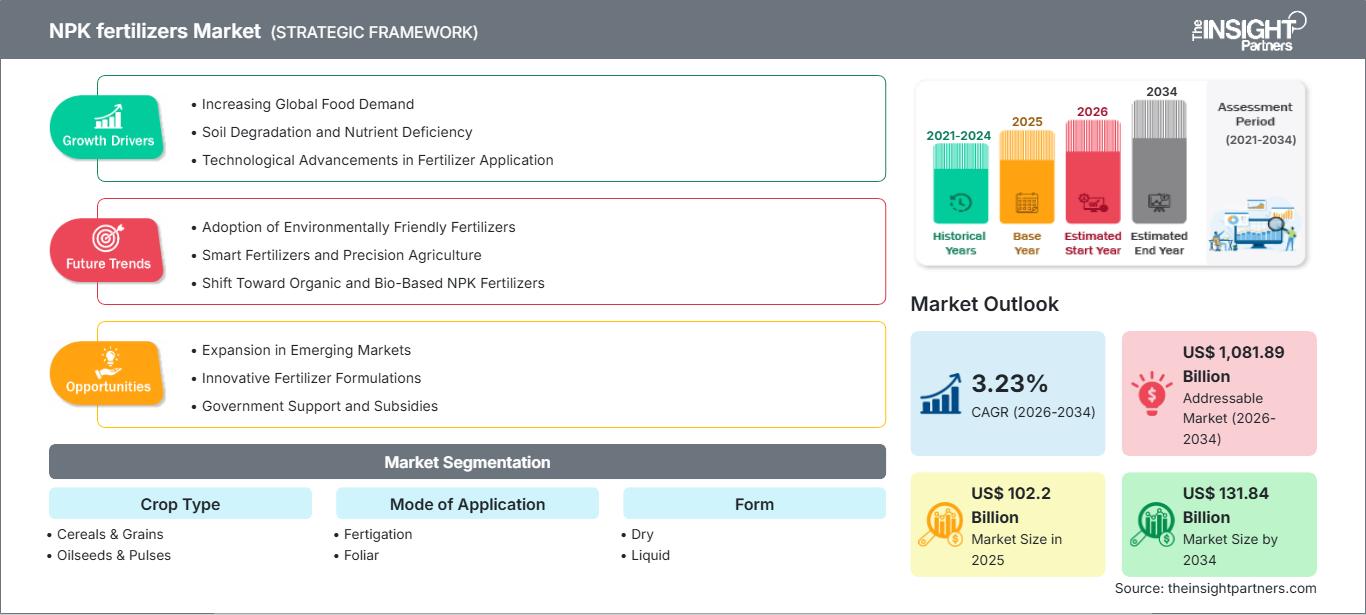
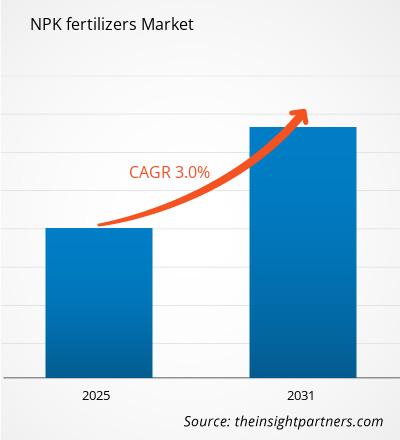
The Npk Fertilizers market was valued at US$ 102.2 billion in 2025 and is expected to reach US$ 131.84 billion by 2034; it is estimated to record a CAGR of 2.87% during 2026-2034.
NPK fertilizers Market Assessment and Insights
- North America: North America maintains a mature fertilizer ecosystem supported by large-scale cereal and oilseed cultivation, established distribution infrastructure, and precision agriculture adoption. Its 2025 share is estimated at 18–22%, with 2.8–3.5% CAGR between 2026–2034.
- US: The US represents the dominant North American market, supported by intensive corn, wheat, and soybean production. Its 2025 share is estimated at 78–83% of North America, growing at 2.7–3.4% CAGR during 2026–2034.
- Europe: Europe remains a significant market, led by Germany, France, Spain, Italy, and the UK, with demand shaped by nutrient-efficiency requirements and environmental policy. Its 2025 share is estimated at 17–21%, with 2.5–3.2% CAGR during 2026–2034.
- Asia Pacific: Asia Pacific is the largest regional demand center, led by China, India, Japan, and South Korea, where intensive agriculture and food-security priorities sustain fertilizer consumption. Its 2025 share is estimated at 38–42%, growing at 3.6–4.3% CAGR during 2026–2034.
- Largest Segment: Cereals & Grains represent the largest crop-type segment, with a 2025 market share of 58–62% and 3.0–3.6% CAGR during 2026–2034, supported by extensive planted acreage.
- High Growth Segment: Fertigation represents the high-growth application mode, with a 2025 market share of 18–22% and 4.2–5.0% CAGR during 2026–2034, supported by precision nutrient delivery.
- Key companies analyzed in detail: Akzo Nobel N.V.; AGROFERT, a.s.; Yara International ASA; The Mosaic Company; ICL Group Ltd.; EuroChem Group AG; Nutrien Ltd.; K+S Aktiengesellschaft; Haifa Group; Aditya Birla Chemicals.
Source: The Insight Partners' analysis based on proprietary research, government publications, company annual reports, investor presentations, industry databases, and expert interviews.
The npk fertilizer market is becoming one that places an increasing emphasis on nutrient management based on application. Granular forms of npk fertilizer have become less relevant with water-soluble forms, foliar applications, fertigation formulations, and micronutrient blends gaining popularity. Production economics are heavily tied to the presence of nitrogen, phosphorus, and potassium, although formulators are becoming more inclined to tailor their formulations for particular crops, soils, climatic conditions, and applications. Digital farming has even become a factor in decision making by allowing farmers to use variable-rate application and more accurate nutrient requirements.
Going forward, the industry is expected to witness investments in formulation, local manufacture, and logistics strength. While the Asia Pacific region is expected to be the main driver for demand, India and Southeast Asia provide expansion potential due to intensive farming and food security concerns. Efficiency, losses reduction, and environmental compliance are expected to be key drivers for North American and European markets. Moreover, there are currently some changes in the sources of raw materials after disruptions to global logistics. Hence, the industry is favorable for firms with diversified sources of raw materials and logistics strengths. In such an environment, competition will comprise large producers of nutrients and specialty formulation manufacturers.
NPK fertilizers Market Report Scope
| Report Attribute | Details |
|---|---|
| Market size in 2025 | US$ 102.2 Billion |
| Market Size by 2034 | US$ 131.84 Billion |
| Global CAGR (2026 - 2034) | 2.87% |
| Historical Data | 2021-2024 |
| Forecast period | 2026-2034 |
NPK fertilizers Market Analysis
Npk Fertilizers Market growth in npk fertilizers will be driven by the necessity to replenish the soil with nutrients that are being extracted in the course of intense cultivation. The main consumption base will still be cereals and grains since corn, wheat, rice, and other grains require nitrogen, phosphorus, and potassium in balanced quantities. The npk fertilizer value chain includes ammonia, phosphate rock, phosphoric acid, and potash as starting materials. Next steps involve synthesis, granulation, mixing, formulation, packaging, transportation, and finally, use at farms.
Supply conditions will become increasingly dependent on the price of natural gas, availability of phosphate rock and potash, costs of transportation, sanctions and trade restrictions, and production capacities of the particular region. Integrated producers will be able to minimize their exposure to certain risks due to control over raw materials and downstream manufacturing, while formulators will have to depend on contracts for nutrients purchase. The development of water-soluble fertilizers imposes additional needs regarding purity, solubility, packaging, and logistics of transport.
The Npk Fertilizers Market Report is characterized by competitive dynamics that comprise vertically integrated fertilizer producers, specialized crop nutrition players, and regional formulators. Yara International ASA derives its competitive strength from global production capabilities of nitrogen fertilizers along with crop nutrition skills, whereas The Mosaic Company and Nutrien Ltd. have a strong foothold in phosphates and potash respectively. K+S Aktiengesellschaft brings in additional potash strength, whereas ICL Group Ltd. and Haifa Group have an advantageous position in specialty and water soluble crop nutrition.
The competitive advantage that AGROFERT, a.s. and EuroChem Group AG has is that of their ability to produce integrally in Europe. The participation of Aditya Birla Chemicals is because of its chemical and agriculture inputs ecosystem. However, Akzo Nobel N.V. is less important than other fertilizer manufacturers although it is still relevant to some particular agriculture inputs value chains. Upstream resources capability, regionality, portfolio depth, agronomy and continuity in supply despite volatility in commodities and logistics are the critical elements of competitive positioning.
● REPORT CUSTOMIZATION
Tailor This Report To Align With Your Specific Business Requirements
This report can be customized to align precisely with your business objectives, scope, and target markets. Customization options include tailored segmentation, geography, competitive analysis, and strategic insights to support informed decision-making.
Customize This Report →WHAT YOU CAN ADJUST
- ● Segmentations
- ● Geography
- ● Competitive Analysis
- ● Language Preferences
NPK fertilizers Market: Strategic Insights
Regional Insights
North America npk fertilizers market
The Npk Fertilizers Market share for North America in 2025 is predicted to be 18-22%, with the CAGR of 2.8-3.5% for the period 2026-2034. Favorable conditions include advanced mechanization in agriculture, vast areas used for cereals and oilseeds cultivation, well-developed fertilizer distribution network, as well as precision agriculture. Corn and soybean farming creates large-scale recurrent nutrient demand, wheat and specialty crops add to this. The farmers now pay attention to the efficiency of fertilizers application and possible yields.
United States is the main consumer in the region due to the presence of large agricultural farms and advanced retail network. Canada makes additional contributions to the demand with wheat, canola and other field crops production; Mexico brings in further demand related to cereals, vegetables and commercial agriculture. Choice of products is now driven by soil tests, variability of application rate, nutrient losses control, and weather conditions. Demand will thus continue to be stable, but the volumes of yearly purchase may vary depending on crop prices, agricultural income, inventories and fertilizer prices.
U.S. npk fertilizers Market
North America demand comprises about 78%-83% of US, and is forecasted to expand at a CAGR of 2.7%-3.4% from 2026-2034. Corn, soybeans, wheat, cotton, and specialty crops are some crops that cause higher use of fertilizers. Nutrien Ltd, The Mosaic Company, and Yara International ASA have major stakes in the fertilizer market.
Application methods include soil analysis, precision spreading, use of variable rate technology, and crop-based fertilization programs. Dry forms continue to account for majority of broadacre application due to storage and spreading benefits, whereas liquids and foliars become more significant for targeted nutrition applications. Economics of farms become an important factor of decision making in fertilizer purchases since fertilizers become a significant variable cost for commercial agriculture. Therefore, demand will be impacted by crop prices, price ratio of nutrients to grain, weather forecasts, and inventory levels.
Europe npk fertilizers Market
Europe is anticipated to possess a market share between 17%-21% in 2025 and register growth in the range of 2.5%-3.2% CAGR from 2026 to 2034, while key countries are Germany, France, Italy, Spain, and the UK. There are regulations related to nutrient loss, water pollution, and emissions from agriculture that push toward focusing on nutrient use efficiency and precision.
In Germany, there is an intensive agricultural practice, along with advanced fertilizers' production and distribution. In France, there is a considerable practice of growing cereals and oil seeds, which gives room for a constant need for balanced fertilizers. In Italy and Spain, there is extensive horticulture, fruit and specialty crop cultivation, thus water soluble and foliar formulations are needed. UK is an important market for cereals and oil seeds; however, there are environmental requirements affecting nutrient management practices. Thus, producers of Europe are going to focus on efficient formulations and agronomic advice.
APAC npk fertilizers Market
APAC commands a share of 38-42% in 2025 and will experience a CAGR of 3.6-4.3% during 2026-2034, which makes it the largest region. China and India will dominate the demand in terms of consumption, whereas Japan, South Korea, and Australia will provide existing consumption through their agricultural activity.
China receives advantage through cereal and crop production, while India continues to play a strategic role due to food security needs and huge cultivated land. Japan and South Korea will focus on effective nutrient management, while Australia will have huge demand for cereals and broad-acre agriculture. Programs for domestic fertilizer manufacturing, effective nutrient management, and agricultural output will continue to support the consumption in the region.
Middle East & Africa npk fertilizers Market
The demand for Middle East and Africa comes from agricultural extension, investments in irrigation facilities, food security initiatives, and fertilizer manufacturing infrastructure. Saudi Arabia leads as the key market followed by the UAE and South Africa. MEA is forecasted to experience a CAGR of 3.0-3.8% between 2026 and 2034 due to government initiative in terms of domestic food production.
In Saudi Arabia, the fertilizer manufacturing and export infrastructure is well-integrated while the UAE provides logistical and distribution facilities. In South Africa, there is well-developed commercial agricultural industry that has demand for fertilizers in cereals, oil seeds, horticulture and other crops. In the rest of MEA region, the market will be fragmented with the need for imports, irrigation facility and seasonal nature of crops production. Fertigation provides good opportunity in the water scarce regions.
Segmentation Analysis
Crop Type
The crop-type segment is expected to grow at 3.0–3.7% CAGR during 2026–2034. The npk fertilizers market scope within this segment is shaped by nutrient intensity, cultivated acreage, crop economics, and fertilizer application practices. Cereals and grains remain dominant, while oilseeds and pulses provide important diversification.
- Cereals & Grains: Corn, wheat, rice, and related crops represent the principal demand base because of their extensive cultivation and recurring nutrient requirements. Balanced formulations support yield optimization and nutrient replacement.
- Oilseeds & Pulses: Soybean, rapeseed, sunflower, chickpea, lentil, and other crops generate demand for balanced nutrition, particularly where farmers seek improved productivity, protein yields, and soil nutrient management.
Mode of Application
Mode of application is expected to record 3.7–4.5% CAGR during 2026–2034 as growers increasingly align nutrient delivery with irrigation systems, crop growth stages, and precision-agriculture practices. The npk fertilizers market scope is broadening beyond conventional broadcasting.
- Fertigation: Fertigation enables dissolved nutrients to be delivered through irrigation systems, improving placement and timing. Adoption is strongest in irrigated, high-value, and water-constrained agriculture where precise nutrient management provides operational advantages.
- Foliar: Foliar application delivers nutrients directly through plant foliage and is useful for correcting deficiencies or supplementing soil nutrition during critical growth stages. It is particularly relevant for specialty crops and micronutrient programs.
Form
The form segment is projected to expand at 3.1–3.9% CAGR during 2026–2034, reflecting continued dominance of dry fertilizers alongside rising use of liquids. Form selection depends on storage, transportation, application equipment, solubility, and crop-management practices.
- Dry: Dry formulations remain dominant in broad-acre agriculture because they are relatively easy to store, transport, blend, and apply using established spreading equipment. Granular products provide efficient large-area nutrient distribution.
- Liquid: Liquid formulations support fertigation, foliar feeding, and precise application systems. Their growth is linked to irrigation development, high-value agriculture, and demand for rapidly available nutrients.
Opportunity Snapshot
| Crop Type | Revenue Contribution | Trend Tag | Adoption Stage |
|---|---|---|---|
| Cereals & Grains | High | Yield Optimization | Mature |
| Oilseeds & Pulses | Medium | Protein Crops | Scaling |
NPK fertilizers Market Growth Drivers and Impact Analysis
Rising emphasis on nutrient-use efficiency
Improving nutrient-use efficiency is becoming an increasingly important commercial consideration as growers face pressure to maximize output from available land and reduce unnecessary input expenditure. Balanced NPK formulations can help align nitrogen, phosphorus, and potassium supply with crop requirements, particularly when supported by soil testing and precision application. This driver is strengthening demand for products designed around specific crops, soil conditions, and growth stages. It also supports higher-value formulations containing micronutrients or compatible additives. Manufacturers can benefit by combining fertilizer sales with agronomic recommendations, digital decision-support tools, and application guidance. The commercial impact is strongest in regions where fertilizer costs represent a substantial portion of farm expenditure and where growers have access to modern irrigation and precision-equipment infrastructure.
Expansion of irrigated and protected agriculture
The growth in the adoption of irrigated agriculture and protected cropping will lead to positive developments in terms of better fertilizer application control. High value crops such as those grown in greenhouses, orchards, vegetable and berry crops usually need to be provided with nutrients at specific concentrations and times. This is where fertigation and foliar treatments come in handy especially when farmers are in need of immediate correction of any nutrient deficiency problems and synchronization of plant needs and fertilizer application. With the expansion of irrigation systems in drought-stricken areas, fertilizer companies have a chance to formulate their products according to their solubility, compatibility and low residue. It is not only product sales which would profit from such programs as successful programs may result in more repeat business.
Strengthening food-security priorities and domestic fertilizer supply
Food-security policies are influencing fertilizer procurement, production investment, and national stock-management strategies. Countries dependent on imported nutrients are increasingly seeking diversified suppliers, domestic production, strategic inventories, or localized formulation capacity to reduce exposure to geopolitical disruptions. This dynamic can stimulate investment in nitrogen, phosphate, potash, and blended-fertilizer infrastructure while strengthening demand for locally adapted formulations. The impact is particularly visible in major agricultural economies where fertilizer availability directly affects crop productivity and food prices. Integrated manufacturers can gain an advantage by combining upstream raw-material access with regional production and distribution. At the same time, governments may increasingly support efficient nutrient use rather than indiscriminate volume expansion, encouraging suppliers to demonstrate agronomic value alongside reliable physical availability.
NPK fertilizers Market Future Trends
Greater integration of precision agriculture with fertilizer recommendations
Future fertilizer purchasing will increasingly connect product selection with digital agronomy, field mapping, satellite imagery, soil sensors, and variable-rate application. These systems can identify spatial differences in nutrient requirements and enable growers to adjust application rates rather than treating entire fields uniformly. Manufacturers are likely to develop digital platforms that connect product portfolios with crop-stage recommendations and field-level data. Such integration can strengthen customer retention because fertilizer becomes part of a broader crop-management system rather than an isolated commodity purchase. The npk fertilizers market trends will consequently favor companies capable of combining formulation expertise with agronomic analytics. Adoption should initially be strongest among large commercial farms and high-value crop producers before gradually extending into broader farming segments.
Shift toward localized and resilient fertilizer production networks
Supply-chain disruptions are likely to accelerate the development of geographically diversified fertilizer production and formulation networks. Manufacturers may increasingly locate specialty blending, water-soluble fertilizer production, and final formulation facilities close to major agricultural markets. This approach can reduce transportation exposure, shorten delivery cycles, and enable products to be adjusted for local crops and agronomic conditions. The trend also creates opportunities for modular manufacturing and regional partnerships rather than relying exclusively on large centralized facilities. Companies with flexible production systems can respond more rapidly to changes in nutrient prices and regional demand. Over time, procurement strategies should place greater value on supply resilience, inventory visibility, and local technical support alongside conventional considerations such as price and nutrient analysis.
NPK fertilizers Market Opportunities
Expansion of specialty fertilizers in emerging agricultural economies
Investors and manufacturers in the Npk Fertilizers Market Forecast can target specialty fertilizer capacity in countries where intensive agriculture, irrigation, and high-value crops are expanding simultaneously. Water-soluble NPK products are particularly attractive where fertigation infrastructure is developing and growers seek precise nutrient delivery. India, Southeast Asia, parts of Latin America, and selected Middle Eastern markets provide opportunities for localized manufacturing and blending. Local production can reduce freight costs while allowing suppliers to tailor nutrient ratios to regional crops and soil conditions. Partnerships with distributors, irrigation companies, agronomy providers, and farmer cooperatives can accelerate market penetration. The strongest investment cases are likely to involve facilities that combine flexible formulation capability, efficient packaging, technical services, and proximity to established agricultural clusters rather than large commodity plants without downstream integration.
Development of crop-specific and climate-adapted formulations
A second opportunity lies in designing NPK formulations around crop-specific nutrient requirements and increasingly variable climatic conditions. Drought, heat stress, excessive rainfall, and changing planting schedules can alter nutrient availability and crop uptake. Manufacturers can respond with formulations that combine balanced macronutrients with micronutrients, enhanced solubility, or delivery characteristics suited to specific environmental conditions. Crop-specific formulations can also create differentiation in markets where conventional NPK products face significant price competition. Producers should prioritize field trials and agronomic validation before commercial scaling because performance evidence is critical for farmer adoption. Strategic partnerships with agricultural universities, research institutes, distributors, and large growers can accelerate product qualification and provide the field data required to establish commercial credibility.
Recent Developments
- March 19, 2026: IFFCO launched indigenously developed Nano NPK Liquid and Granular fertilisers after receiving FCO approval. The products aim to improve nutrient-use efficiency, enhance crop productivity, reduce dependence on conventional fertilisers, lower input costs, and support sustainable, self-reliant farming in India.
- June 1, 2026: AGROFERT, a.s. announced an agreement to acquire 50% of Nitrogen Intermediate Holding B.V., which owns OCI Nitrogen, together with an option concerning the remaining 50% stake. The company stated that the transaction is intended to strengthen the stability and efficiency of fertilizer and industrial nitrogen production and support a more integrated European fertilizer value chain.
Frequently Asked Questions

- Comprehensive Market Sizing and Forecast Analysis
- Detailed Segmentation Analysis
- In-Depth Market Dynamics Assessment
- Regional and Country-Level Insights
- Competitive Landscape and Company Benchmarking
- Strategic Business Intelligence
Recent Reports
Testimonials

The Insight Partners' SCADA System Market report is comprehensive, with valuable insights on current trends and future forecasts. The team was highly professional, responsive, and supportive throughout. We are very satisfied and highly recommend their services.
RAN KEDEM Partner, Reali Technologies LTDs
I requested a report on a very specific software market and the team produced the report in a few days. The information was very relevant and well presented. I then requested some changes and additions to the report. The team was again very responsive and I got the final report in less than a week.
JEAN-HERVE JENN Chairman, Future Analytica
We worked with The Insight Partners for an important market study and forecast. They gave us clear insights into opportunities and risks, which helped shape our plans. Their research was easy to use and based on solid data. It helped us make smart, confident decisions. We highly recommend them.
PIYUSH NAGPAL Sr. Vice President, High Beam Global
The Insight Partners delivered insightful, well-structured market research with strong domain expertise. Their team was professional and responsive throughout. The user-friendly website made accessing industry reports seamless. We highly recommend them for reliable, high-quality research services
YUKIHIKO ADACHI CEO, Deep Blue, LLC.
This is the first time I have purchased a market report from The Insight Partners.While I was unsure at first, I visited their web site and felt more comfortable to take the risk and purchase a market report.I am completely satisfied with the quality of the report and customer service. I had several questions and comments with the initial report, but after a couple of dialogs over email with their analyst I believe I have a report that I can use as input to our strategic planning process.Thank you so much for taking the extra time and making this a positive experience.I will definitely recommend your service to others and you will be my first call when we need further market data.
JOHN SUZUKI President and Chief Executive Officer, Board Director, BK Technologies
I wish to appreciate your support and the professionalism you displayed in the course of attending to my request for information regarding to infectious disease IVD market in Nigeria. I appreciate your patience, your guidance, and the fact that you were willing to offer a discount, which eventually made it possible for us to close a deal. I look forward to engaging The Insight Partners in the future, all thanks to the impression you have created in me as a result of this first encounter.
DR CHIJIOKE ONYIA MANAGING DIRECTOR, PineCrest Healthcare Ltd.Reason to Buy
- Informed Decision-Making
- Understanding Market Dynamics
- Competitive Analysis
- Identifying Emerging Markets
- Customer Insights
- Market Forecasts
- Risk Mitigation
- Boosting Operational Efficiency
- Strategic Planning
- Investment Justification
- Tracking Industry Innovations
- Aligning with Regulatory Trends





 Get Free Sample for