
Blue Laser Intraoral Scanner Market Size, Trends & Growth by 2034
Coverage: By Type (Handheld, Portable, and Others); End-user (Hospitals, Veterinary Hospitals, and Others); Emd-user (Hospitals, Dental Clinics, Veterinary Hospitals, and Others), and Geography (North America, Europe, Asia Pacific, and South and Central America)
- Status : Data Released
- Report Code : TIPRE00029317
- Category : Life Sciences
- No. of Pages : 150
- Available Report Formats :


- Last update date : July 29, 2026


2025 Market Size
US$ 507.38 Mn
Base year value
2034 Forecast
US$ 1,214.4 Mn
Projected by 2034
CAGR 2026-2034
10.18 %
Growth rate
Addressable Market
US$ 7,649.07 Mn
(2026-2034)
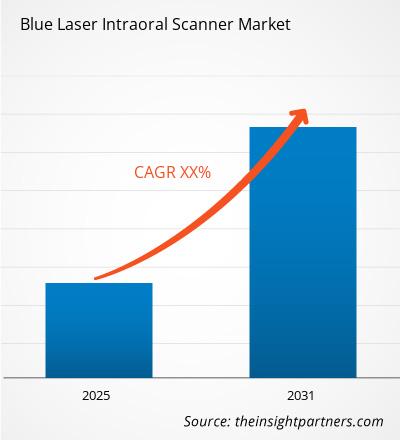
The Blue Laser Intraoral Scanner Market size is expected to grow from US$ 507.38 Million in 2025 to US$ 1,214.4 Million by 2034, representing a CAGR of 10.18% for the period 2026–2034. This growth is attributed to increasing inclination towards digitization from traditional physical impressions due to chair-side restoration techniques, multiple specialty applications, increased accuracy of image capturing, and better connectivity among scanners, CAD software, labs, and treatment planning software.
North America continues to be the most evolved commercialization market where the market is backed by large dental service organizations, high penetration of scanners in restorative dentistry, and expanded use of reimbursement-driven digital documentation. North America is expected to witness a CAGR range of 9.7% – 10.3% in 2026–2034 due to aligner workflow and implant planning, as well as preference for portable scanners at multi-operatory dental clinics.
Blue Laser Intraoral Scanner Market Assessment and Insights
- North America held an estimated 38–42% share in 2025 and is growing at a CAGR range of 9.7–10.3% during 2026–2034, supported by digital dentistry penetration, dental service organization procurement, and early adoption of AI-assisted scanning workflows.
- US accounted for 78–82% of North America in 2025 and is advancing at a CAGR range of 9.8–10.4% during 2026–2034 due to clinic consolidation and expanding restorative applications.
- Europe represented 28–32% share in 2025 and is progressing at a CAGR range of 9.2–9.8% during 2026–2034, led by Germany, the UK, France, Italy, and Spain through structured dental digitization.
- Asia Pacific contributed 20–24% share in 2025 and is expanding at a CAGR range of 11.3–12.1% during 2026–2034, with China, Japan, South Korea, India, and Australia driving procurement across private dental networks.
- Largest Segment Handheld scanners accounted for 63–67% market share in 2025 and are growing at a CAGR range of 9.6–10.2% during 2026–2034 due to ergonomic use and chairside speed.
- High Growth Segment Portable scanners held 33–37% market share in 2025 and are growing at a CAGR range of 10.7–11.4% during 2026–2034, reflecting multi-room use and lower infrastructure dependence.
- Key companies analyzed in detail: I2S SA, 3Shape A/S, Planmeca Oy, Align Technology Inc., EM Dental, Dental Wings Inc., Densys Ltd., 3M Company, Dentsply Sirona Inc., Condor Technologies NV.
Source: The Insight Partners' analysis based on proprietary research, government publications, company annual reports, investor presentations, industry databases, and expert interviews.
Scanners have advanced from their humble intraoral image-taking role to integrated clinical solutions which help in restoration, orthodontics, implant, caries detection, and cloud-based collaborative practices. Vendors are redesigning their product lines based on compact optical engines, fast processors, disposable or sterilizable sleeves, and software-driven upgrades. The market is also shifting away from being purely hardware oriented because vendors integrate their scanning instruments with their platform subscription services, treatment simulation software, chairside milling capabilities, and laboratory communication tools.
In the coming period, rising scanner adoption is likely to occur within developing countries as more private dental clinics get established, better financing of clinics, and availability of digital laboratories in these regions. Strong tailwinds exist within regulatory fronts as far as infection control, patient records, and digital documentations are concerned. Investments will be made in portable scanners, AI diagnostics, and open platform operations.
Blue Laser Intraoral Scanner Market Report Scope
| Report Attribute | Details |
|---|---|
| Market size in 2025 | US$ 507.38 Million |
| Market Size by 2034 | US$ 1,214.4 Million |
| Global CAGR (2026 - 2034) | 10.18% |
| Historical Data | 2021-2024 |
| Forecast period | 2026-2034 |
Blue Laser Intraoral Scanner Market Analysis
More emphasis is now being placed on clinical efficiency as opposed to replacing equipment. The drivers for growth of Blue Laser Intraoral Scanner Market include reduction in remakes of impressions, shorter lab processing time, and improved patient communication via real-time visualization. Dental practices are also using the scanners to create standardization of workflows among dentists, assistants, laboratories, and aligner partners.
The value chain includes providers of optical components, scanner manufacturers, imaging software providers, CAD/CAM software providers, distributors, dental laboratories, and users. The supply chain favors players who have the ability to integrate hardware, workflow software, training, and technical support. As scanners become more popular, good service, data integration, and consumables hygiene systems become procurement requirements.
The competitive positioning is changing from a device-based evaluation towards the ecosystem depth. According to Blue Laser Intraoral Scanner Market analysis, 3Shape A/S, Align Technology Inc., Planmeca Oy, Dentsply Sirona Inc., and Dental Wings Inc. compete with the help of software, orthodontic, and cloud-based cooperation; while I2S SA, Densys Ltd., EM Dental, 3M Company, and Condor Technologies NV target specialized or legacy customers.
Trends in investment suggest that more money will be allocated for the AI-assisted diagnostics, wireless scanners, and web applications. Now, the key aspects of strategic differentiation are accuracy and speed of scanning, the field of view, design for hygiene, and compatibility with implants, restorations, and aligners. Open systems may attract independent clinics; while closed ecosystems stay appealing in cases when treatment conversion and branded consumables are important.
● REPORT CUSTOMIZATION
Tailor This Report To Align With Your Specific Business Requirements
This report can be customized to align precisely with your business objectives, scope, and target markets. Customization options include tailored segmentation, geography, competitive analysis, and strategic insights to support informed decision-making.
Customize This Report →WHAT YOU CAN ADJUST
- ● Segmentations
- ● Geography
- ● Competitive Analysis
- ● Language Preferences
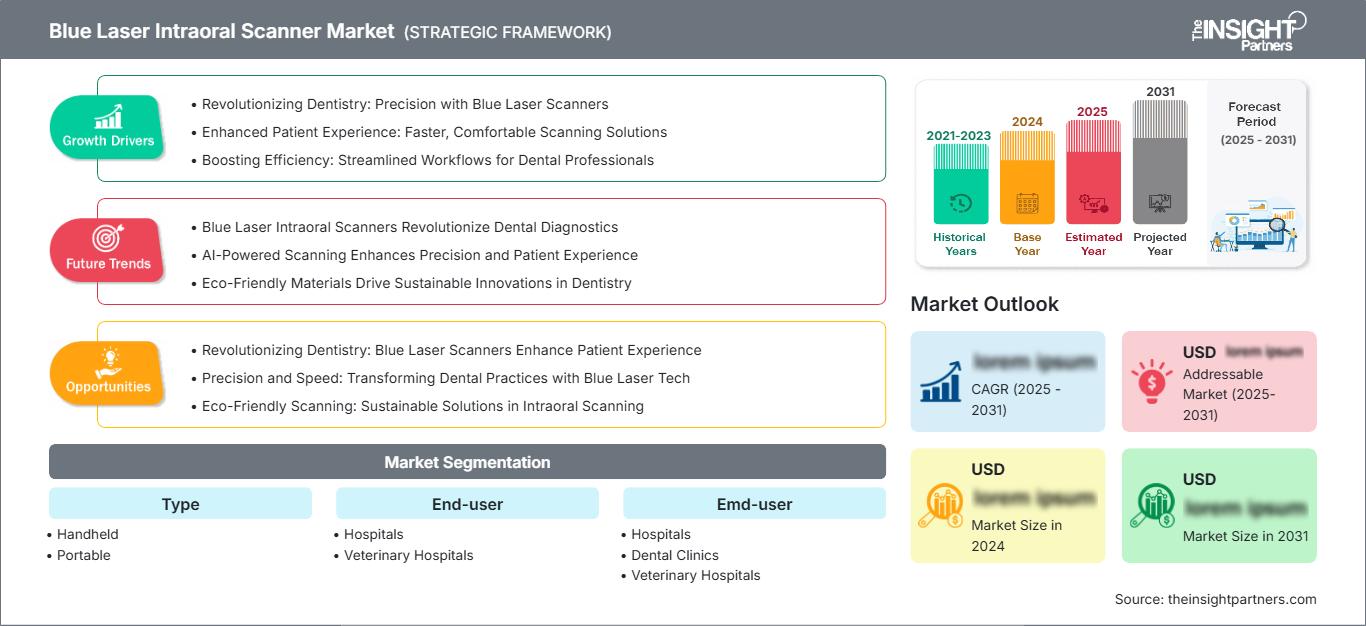
Blue Laser Intraoral Scanner Market: Strategic Insights
Regional Insights
North America Blue Laser Intraoral Scanner Market
North America accounted for an estimated 38–42% share in 2025 and is expected to grow at a CAGR range of 9.7–10.3% during 2026–2034. The Blue Laser Intraoral Scanner Market share is strongest in the region because dental service organizations increasingly purchase scanners across multiple sites to standardize chairside records and digital treatment planning.
Adoption is reinforced by orthodontic aligner demand, implant workflows, same-day crowns, and higher acceptance of cloud-based patient records. The American Dental Association’s digital dentistry guidance and FDA-cleared imaging devices support clinical confidence. Vendors also prioritize North America for product launches, training networks, and software upgrades because scanner utilization can be scaled across restorative, orthodontic, and preventive care.
<h3> U.S. Blue Laser Intraoral Scanner Market
In 2025, the United States constituted 78–82% of North America and is expected to grow at a CAGR of 9.8–10.4% between 2026 and 2034. Dentistry service firms, orthodontic franchises, and implant-specific facilities have increased their use of scanners due to higher case acceptance and decreased analog impression logistics at scattered locations.
There is a widespread company presence, where companies like Align Technology Inc., 3Shape A/S, Dentsply Sirona Inc., 3M Company, and Planmeca Oy have good distribution, education, and software infrastructure. In addition, clinics based out of the United States have started using scanners not only for crowns and bridges but also for clear aligners, monitoring, night guards, implants, and education purposes.
Europe Blue Laser Intraoral Scanner Market
Europe held an estimated 28–32% share in 2025 and is forecast to grow at a CAGR range of 9.2–9.8% during 2026–2034. Germany is the leading country due to strong dental technology manufacturing, high laboratory digitization, and early CAD/CAM adoption among restorative practices.
The UK is advancing through private dentistry growth, aligner uptake, and demand for shorter appointment cycles. Germany benefits from established dental labs and premium equipment adoption, while France, Italy, and Spain are expanding through aesthetic dentistry, implant planning, and clinic modernization. EU medical device compliance also encourages validated imaging workflows, favouring manufacturers with robust documentation and support infrastructure.
APAC Blue Laser Intraoral Scanner Market
APAC represented 20–24% share in 2025 and is expected to grow at a CAGR range of 11.3–12.1% during 2026–2034. China is the leading country, supported by expanding dental chains, local equipment distribution, and growing implant and orthodontic procedure volumes.
Japan and South Korea remain technology-intensive markets, while India and Australia are gaining through private dental investments and wider CAD/CAM laboratory access. Policy emphasis on healthcare digitization, domestic manufacturing, and dental education is improving scanner awareness. The region’s industrial base also supports lower-cost component supply and faster product localization.
Middle East & Africa Blue Laser Intraoral Scanner Market
The Middle East & Africa is estimated to register a CAGR growth between 7.4%-8.2% from 2026-2034, with Saudi Arabia being a leader in regional implementation. The growth will be seen in premium dental clinics, hospital dental units, and private specialty clinics within Saudi Arabia, UAE, South Africa, and other selected cities.
Investments related to energy-driven infrastructure development in the Gulf region will favor advanced medical services and imported dental equipment. UAE has an advantage due to its medical tourism and cosmetic dentistry, whereas South Africa acts as a hub for the region.
Segmentation Analysis
Type
The Type segment is expected to grow at a CAGR range of 9.8–10.5% during 2026–2034. The Blue Laser Intraoral Scanner Market scope across scanner types is widening as clinics balance ergonomic handheld performance with portable deployment models. Demand is shaped by operatory design, clinician comfort, scan frequency, software compatibility, and the ability to move devices across restorative, orthodontic, and implant rooms.
- Handheld scanners remain the dominant format because clinicians prefer direct control, familiar handling, and rapid capture during chairside procedures. Their strategic value lies in accuracy, speed, and integration with single-patient treatment workflows.
- Portable scanners are gaining importance among multi-operatory clinics and mobile dental providers. They reduce fixed-workstation dependence, improve asset utilization, and support practices seeking lower infrastructure burden with flexible digital impressions.
End-user
The End-user segment is forecast to grow at a CAGR range of 10.0–10.8% during 2026–2034. This segmentation reflects the broadening adoption base, with hospitals emphasizing specialized care, dental clinics driving core demand, and veterinary hospitals creating niche applications. Procurement decisions differ by procedure volume, clinical specialization, digital lab access, and budget flexibility.
- Hospitals require durable systems suitable for complex cases, shared departments, and regulated patient record environments. Their purchasing decisions emphasize accuracy, infection control, service continuity, and integration with imaging or surgical planning tools.
- Dental Clinics represent the largest demand pool due to routine restorative dentistry, clear aligners, implants, and patient education. Their strategic importance comes from recurring utilization and software-enabled treatment conversion.
Opportunity Snapshot
| Segment Name | Revenue Contribution | Trend Tag | Adoption Stage |
| Hospitals | Medium | Surgical Planning | Scaling |
| Dental Clinics | High | Chairside CAD | Mature |
Blue Laser Intraoral Scanner Market Growth Drivers and Impact Analysis
Rising Digital Dentistry Adoption Across Restorative Workflows
The adoption of digital workflows is displacing impression materials for crowns, bridges, implants, and aligners as clinics can cut down remakes, decrease lab communication cycles, and increase patient acceptance by visualization at the chair. The effect of this driver on the market is highest in the cases of clinics doing repeat volume of restorations where scanning improves efficiency and cuts down logistics time. Blue laser imaging can assist in capturing fine details for communication of margins, occlusion, and preparation before the case is sent to the labs. With more preference to digital data in dental laboratories, scanner usage is an imperative need rather than an added feature.
Expansion of Multi-Operatory and Group Practice Models
Clinic consolidation is changing scanner procurement from single-unit purchases to multi-location standardization. Dental service organizations and group practices value devices that can be deployed across operators, linked to centralized laboratories, and supported through common software protocols. This creates stronger demand for portable and cloud-connected systems that reduce dependence on fixed workstations. The commercial impact includes larger purchase orders, longer vendor relationships, and higher importance of technical service coverage. Manufacturers that offer training, remote support, and predictable hygiene systems are better positioned because buyers increasingly consider total operating efficiency. Scanner utilization also improves when assistants can capture scans before dentist review.
Growing Role of Scanners in Patient Communication
Intraoral scanners are evolving into consultation tools that help patients understand tooth wear, crowding, caries risk, and restorative needs through visual records. This matters because treatment acceptance often depends on clear communication rather than clinical diagnosis alone. High-resolution scans, colour visualization, and software overlays allow dentists to explain conditions during the same appointment, improving planning transparency. The impact extends beyond restorative dentistry into orthodontics, preventive monitoring, and cosmetic procedures. Vendors benefit when scanning becomes part of routine checkups, not only treatment initiation. This broader use case increases scan frequency, software value, and the likelihood that clinics upgrade devices regularly.
Blue Laser Intraoral Scanner Market Future Trends
AI-Guided Multi-Modal Imaging
AI-guided multi-modal imaging is expected to define Blue Laser Intraoral Scanner Market trends as scanners combine visible light, fluorescence, near-infrared, and automated interpretation into a single chairside workflow. Future platforms will not only capture geometry but also flag suspected caries, tooth wear, soft-tissue changes, and preparation issues for clinician review. This will shift competitive differentiation toward validated algorithms, explainable outputs, and regulatory-grade evidence. The trend may also increase software subscription revenues as clinics pay for diagnostic assistance, longitudinal monitoring, and patient-facing visualization tools that improve communication and treatment confidence.
Cloud-Native Scanning and Distributed Collaboration
Cloud-native scanning will reshape how clinics, laboratories, orthodontic partners, and specialists collaborate. Instead of storing scan data on dedicated carts or local computers, future systems will process, archive, and share files through secure browser-based platforms. This reduces hardware dependence and allows scans to move quickly between operators, rooms, and external partners. The trend favors vendors with cybersecurity capabilities, reliable service uptime, and integrated case management. It also supports remote design, centralized laboratory networks, and faster approval cycles for aligners, surgical guides, and restorations.
Blue Laser Intraoral Scanner Market Opportunities
Portable Scanners for Emerging Dental Chains
Portable scanners offer a strong investment opportunity in emerging dental chains where clinics need digital capability without expensive room-specific infrastructure. Blue Laser Intraoral Scanner Market Forecasts indicate that buyers will prioritize devices that can move between treatment rooms, connect to multiple software environments, and support quick onboarding for staff. Manufacturers can address this opportunity through leasing, bundled training, and service packages tailored for multi-site operators. Distributors can also create value by linking scanner sales with CAD/CAM labs, aligner partners, and local technical support. The opportunity is especially attractive in APAC and selected Middle Eastern private care markets.
Veterinary Dentistry and Specialty Oral Care
Veterinary hospitals represent a niche but underpenetrated opportunity, particularly in advanced companion animal dentistry. Specialty veterinarians increasingly need accurate oral records, prosthetic planning, and custom device workflows for complex cases. Vendors can adapt scanner training, software presets, and support materials for animal oral anatomy, creating differentiation beyond conventional human dental channels. The opportunity is not volume-led in the near term, but margins can be attractive where premium veterinary hospitals serve insured or high-income pet owners. Partnerships with veterinary dental associations and teaching hospitals could accelerate awareness while generating clinical evidence.
Recent Developments
- October 2025: Align Technology Inc. announced new iTero digital solution innovations, including chairside visualization features, expanded integrated software tools, and workflows intended to improve patient consultations and treatment communication. The update strengthened the company’s scanner ecosystem by connecting diagnostics, planning, treatment, and monitoring across Invisalign, restorative, and in-office fabrication use cases.
- March 2025: 3Shape A/S launched TRIOS 6 at IDS 2025, adding hyperspectral imaging that captures white, fluorescence, and near-infrared data, along with AI-assisted diagnostics through Dx Plus. The scanner was positioned as a shift from digital impressions toward diagnostic and patient communication workflows, with up to 110% higher scan resolution than its portfolio baseline.
- March 2025: Dentsply Sirona Inc. presented Primescan 2 updates at IDS 2025, including integrated caries detection, reduced bandwidth requirements through optimized compression, faster SureSmile simulations, and new cart and sleeve accessories. The enhancements expanded the cloud-native scanner’s clinical utility and addressed workflow barriers for practices adopting browser-based intraoral scanning.
Frequently Asked Questions

- Comprehensive Market Sizing and Forecast Analysis
- Detailed Segmentation Analysis
- In-Depth Market Dynamics Assessment
- Regional and Country-Level Insights
- Competitive Landscape and Company Benchmarking
- Strategic Business Intelligence
Recent Reports
Testimonials

The Insight Partners' SCADA System Market report is comprehensive, with valuable insights on current trends and future forecasts. The team was highly professional, responsive, and supportive throughout. We are very satisfied and highly recommend their services.
RAN KEDEM Partner, Reali Technologies LTDs
I requested a report on a very specific software market and the team produced the report in a few days. The information was very relevant and well presented. I then requested some changes and additions to the report. The team was again very responsive and I got the final report in less than a week.
JEAN-HERVE JENN Chairman, Future Analytica
We worked with The Insight Partners for an important market study and forecast. They gave us clear insights into opportunities and risks, which helped shape our plans. Their research was easy to use and based on solid data. It helped us make smart, confident decisions. We highly recommend them.
PIYUSH NAGPAL Sr. Vice President, High Beam Global
The Insight Partners delivered insightful, well-structured market research with strong domain expertise. Their team was professional and responsive throughout. The user-friendly website made accessing industry reports seamless. We highly recommend them for reliable, high-quality research services
YUKIHIKO ADACHI CEO, Deep Blue, LLC.
This is the first time I have purchased a market report from The Insight Partners.While I was unsure at first, I visited their web site and felt more comfortable to take the risk and purchase a market report.I am completely satisfied with the quality of the report and customer service. I had several questions and comments with the initial report, but after a couple of dialogs over email with their analyst I believe I have a report that I can use as input to our strategic planning process.Thank you so much for taking the extra time and making this a positive experience.I will definitely recommend your service to others and you will be my first call when we need further market data.
JOHN SUZUKI President and Chief Executive Officer, Board Director, BK Technologies
I wish to appreciate your support and the professionalism you displayed in the course of attending to my request for information regarding to infectious disease IVD market in Nigeria. I appreciate your patience, your guidance, and the fact that you were willing to offer a discount, which eventually made it possible for us to close a deal. I look forward to engaging The Insight Partners in the future, all thanks to the impression you have created in me as a result of this first encounter.
DR CHIJIOKE ONYIA MANAGING DIRECTOR, PineCrest Healthcare Ltd.Reason to Buy
- Informed Decision-Making
- Understanding Market Dynamics
- Competitive Analysis
- Identifying Emerging Markets
- Customer Insights
- Market Forecasts
- Risk Mitigation
- Boosting Operational Efficiency
- Strategic Planning
- Investment Justification
- Tracking Industry Innovations
- Aligning with Regulatory Trends





 Get Free Sample for