
Bonding Sheet Market Dynamics and Developments by 2034
Bonding Sheet Market Size and Forecasts (2021 - 2034), Global and Regional Share, Trends, and Growth Opportunity Analysis Report Coverage : by Adhesive Materials (Polyesters, Polyimides, Acrylics, Modified Epoxies); Application (Electronics/Optoelectronics, Telecommunication/5G Communication, Automotive, Building & Construction); and Geography (North America, Europe, Asia Pacific, and South and Central America)
- Status : Data Released
- Report Code : TIPRE00040289
- Category : Chemicals and Materials
- No. of Pages : 150
- Available Report Formats :


- Last update date : July 13, 2026


2025 Market Size
US$ 461.6 Mn
Base year value
2034 Forecast
US$ 870.8 Mn
Projected by 2034
CAGR 2026-2034
7.31 %
Growth rate
Addressable Market
US$ 6,010.22 Mn
(2026-2034)
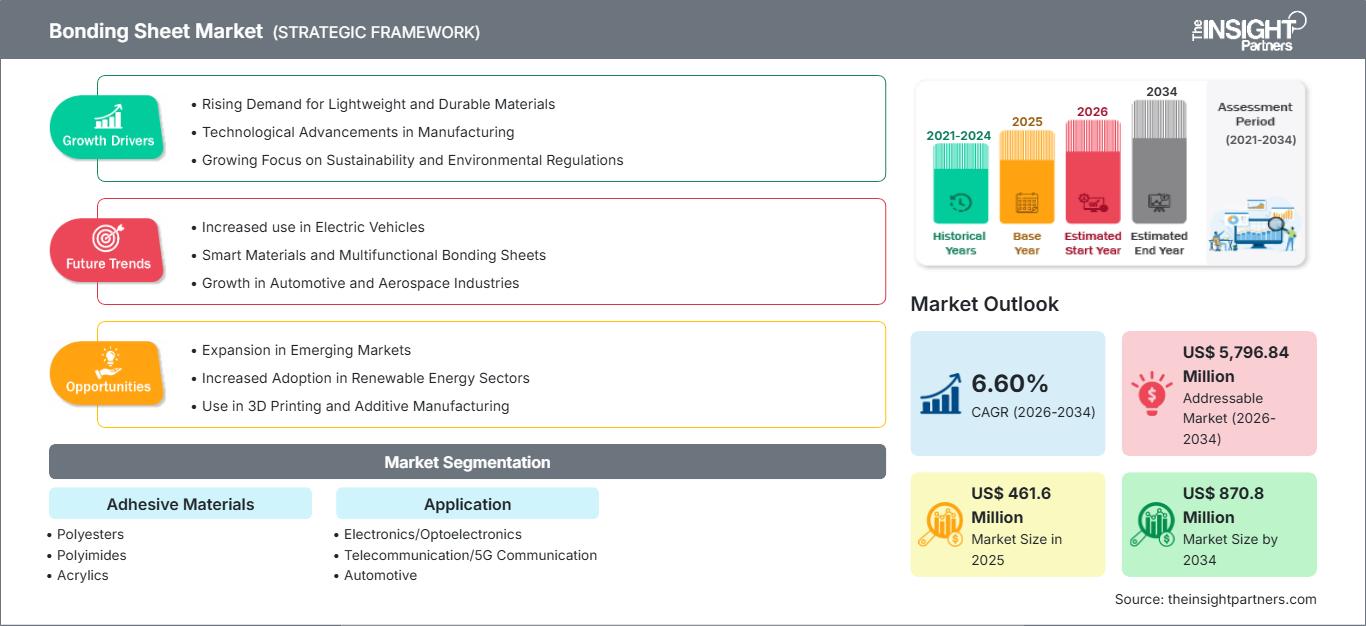
The global Bonding Sheet market was valued at US$ 461.6 million in 2025 and is expected to reach US$ 870.8 million by 2034; it is estimated to record a CAGR of 7.31% during 2026-2034.
Bonding Sheet Market Assessment and Insights
- North America: Accounted for 24%–28% of the Bonding Sheet Market share in 2025 and is projected to expand at a CAGR of 5.8%–6.3% during 2026–2034, supported by semiconductor fabrication investments, electronics reshoring initiatives, and growing electric vehicle production.
- U.S.: Represented 78%–82% of the North American market in 2025 and is anticipated to grow at a CAGR of 5.9%–6.4% owing to increasing advanced packaging capacity and expanding electronics manufacturing.
- Europe: Held 22%–26% share in 2025 and is forecast to grow at a CAGR of 5.5%–6.0%, with Germany, France, and the United Kingdom leading demand through automotive electronics, industrial automation, and specialty materials manufacturing.
- Asia Pacific: Captured 42%–46% share in 2025 and is expected to record the fastest expansion at a CAGR of 7.2%–7.8%, driven by China, Japan, South Korea, and Taiwan through semiconductor packaging, display manufacturing, and electronics exports.
- Largest Segment: Electronics/Optoelectronics accounted for 52%–56% market share in 2025 and is projected to grow at a CAGR of 6.7%–7.2% as demand for compact, thermally stable electronic assemblies continues to rise.
- High Growth Segment: Telecommunication/5G Communication represented 14%–18% market share in 2025 and is anticipated to expand at a CAGR of 8.2%–8.8% owing to increasing deployment of high-frequency communication infrastructure.
- Key companies analyzed in detail: Arisawa Manufacturing Co., Ltd., DuPont de Nemours, Inc., Dexerials Corporation, NAMICS Corporation, Nikkan Industries Co., Ltd., Nitto Denko Corporation, Resonac Corporation, Shin-Etsu Polymer Co., Ltd., Toray Industries, Inc., LINTEC Corporation.
Source: The Insight Partners' analysis based on proprietary research, government publications, company annual reports, investor presentations, industry databases, and expert interviews.
The evolution in semiconductor packaging, flexible electronics, and automobile electrification is changing the bonding sheet market forecast. Innovation in material science is now focusing more on the development of polyimide and modified epoxy types which possess thermal stability, dimensional stability, and electrical insulating properties. Manufacturers have started optimizing the thickness of bonding sheets along with adhesives for applications such as wafer level packaging, flexible displays, batteries, and miniaturized electronics.
Bonding Sheet Market growth in the coming years is likely to rely on the development of semiconductor capacity in regions such as APAC, NA, and Europe. National semiconductor policies, localization of the electronics supply chain, rising use of AI hardware, and electric mobility are likely to boost demand for advanced bonding materials. Material companies are also focusing on R&D for thinner, thermally conducting, and eco-friendly adhesives.
Bonding Sheet Market Report Scope
| Report Attribute | Details |
|---|---|
| Market size in 2025 | US$ 461.6 Million |
| Market Size by 2034 | US$ 870.8 Million |
| Global CAGR (2026 - 2034) | 7.31% |
| Historical Data | 2021-2024 |
| Forecast period | 2026-2034 |
Bonding Sheet Market Analysis
The Bonding Sheet Market growth is mainly driven by the rising number of semiconductor packaging processes, the increasing adoption of electric vehicles, and innovations in consumer electronics. Advanced bonding sheets increase electrical insulation, thermal conductivity, dimensional stability, and mechanical strength, thus being indispensable for multilayer printed circuit boards, camera modules, display panels, battery packs, and IC package applications. The rising investment in artificial intelligence servers, supercomputers, and ADAS requires highly reliable bonding materials that are able to withstand high temperature and mechanical loads. Initiatives in the US, Europe, Japan, and South Korea to promote semiconductors' manufacturing support the underlying long-term demand drivers.
The value chain in this market includes special resins suppliers, advanced polymers providers, coating companies, laminators, electronics component manufacturers, semiconductor packaging companies, and original equipment manufacturers. Polyester, polyimide, acrylic, and epoxy-modified materials still dominate the industry, since they offer a perfect combination of processability, heat resistance, dielectric properties, and adhesion strength. Cooperation with semiconductor packaging companies becomes more common on the stage of product development for wafer-level packaging, heterogeneous integration, and advanced electronic modules.
According to the Bonding Sheet Market report, there is moderate consolidation, and in such competitive conditions, product performance, application knowledge, manufacturing processes, and customer relations are the competitive advantages. Dexerials Corporation, Nitto Denko Corporation, DuPont de Nemours, Inc., Toray Industries, Inc., and Resonac Corporation actively develop material products for semiconductor packaging and electronic assembly applications. In its turn, Arisawa Manufacturing Co., Ltd., NAMICS Corporation, Nikkan Industries Co., Ltd., Shin-Etsu Polymer Co., Ltd., and LINTEC Corporation specialize in developing new adhesives and developing customized products in partnership with electronics manufacturers.
The investment will be directed at creating modern facilities, innovating in material developments, and expanding regions of manufacturing rather than adding manufacturing capacity only. Thinner bonding sheets, halogen-free, higher thermal conductivity, and compatibility with future semiconductor packaging solutions remain priorities for companies. Strategic collaboration with manufacturers of automotive electronics, semiconductor foundries, and telecommunication equipment also becomes popular in order to conclude long-term contracts within stable regional supply chains. Moreover, sustainability activities, namely reducing the amount of solvents, using recyclable processing materials, and decreasing emissions from manufacturing facilities are also expected to become important competitive drivers in the near future.
● REPORT CUSTOMIZATION
Tailor This Report To Align With Your Specific Business Requirements
This report can be customized to align precisely with your business objectives, scope, and target markets. Customization options include tailored segmentation, geography, competitive analysis, and strategic insights to support informed decision-making.
Customize This Report →WHAT YOU CAN ADJUST
- ● Segmentations
- ● Geography
- ● Competitive Analysis
- ● Language Preferences
Bonding Sheet Market: Strategic Insights
Regional Insights
North America Bonding Sheet
North America accounted for 24%–28% of the global market share in 2025 and is projected to expand at a CAGR of 5.8%–6.3% during 2026–2034. The Bonding Sheet market share in the region is supported by increasing investments in semiconductor fabrication, advanced electronics manufacturing, and electric vehicle production. Government incentives promoting domestic semiconductor capacity and resilient supply chains have accelerated demand for high-performance bonding materials used in packaging substrates, multilayer circuit boards, and automotive electronic modules.
The region also benefits from substantial research and development expenditure, established material science capabilities, and the presence of leading semiconductor equipment manufacturers. Adoption of AI servers, cloud infrastructure, aerospace electronics, and industrial automation systems continues to create demand for thermally stable and electrically reliable bonding sheets. Material suppliers are increasingly collaborating with semiconductor packaging companies to develop customized adhesive solutions compatible with advanced packaging technologies, including chiplet architectures and heterogeneous integration.
U.S. Bonding Sheet Market
The United States represented 78%–82% of the North American market in 2025 and is anticipated to register a CAGR of 5.9%–6.4% through 2034. Strong investment in domestic semiconductor fabrication, expansion of electronics manufacturing, and increasing electric vehicle production continue to support demand for advanced bonding sheet materials. Federal manufacturing initiatives and private investment in AI infrastructure further strengthen the country's position within the regional value chain.
Domestic manufacturers increasingly require bonding sheets capable of meeting stringent thermal management and electrical insulation requirements across semiconductor packaging, telecommunications equipment, and automotive electronics. Growing adoption of advanced packaging technologies, combined with continuous innovation by global materials suppliers operating in the United States, supports long-term market expansion while strengthening local supply chain resilience.
Europe Bonding Sheet Market
Europe held 22%–26% of the global market in 2025 and is expected to grow at a CAGR of 5.5%–6.0% through 2034. Germany remains the leading contributor owing to its advanced automotive electronics industry, industrial automation capabilities, and strong specialty chemicals sector. Increasing investment in semiconductor manufacturing and electronic component production further supports regional demand for high-performance bonding materials.
The United Kingdom continues the development of research in areas of advanced materials, aerospace electronics, and advanced communication technologies. More universities, innovation centers, and specialized manufacturers work together towards the development of high-temperature resistant adhesives for use in valuable electronics.
Germany is the biggest market due to its well-established automotive supplier network, high-precision manufacturing capabilities, and ongoing investments in digitalizing industries. The need for electric cars and automation increases the need for advanced bonding materials.
France, Italy, and Spain contribute to the expansion of the region through aerospace production, manufacturing of industrial equipment, consumer electronics assembly, and renewables. Programs focused on the digital transformation and advanced manufacturing drive the demand for electronic bonding solutions.
APAC Bonding Sheet Market
Asia Pacific captured 42%–46% of the global market in 2025 and is forecast to register the highest CAGR of 7.2%–7.8% during the forecast period. China leads regional consumption, followed by Japan, South Korea, Taiwan, and India, owing to their strong semiconductor, display panel, and consumer electronics manufacturing industries.
Government support for semiconductor localization, increasing electronics exports, expansion of electric vehicle manufacturing, and continued investment in 5G infrastructure sustain regional growth. Australia contributes primarily through advanced industrial manufacturing and research activities, while Southeast Asian countries continue strengthening electronics assembly capabilities.
Middle East & Africa Bonding Sheet Market
The Middle East & Africa market is expected to expand at a CAGR of 5.0%–5.5% between 2026 and 2034. Saudi Arabia and the United Arab Emirates continue investing in advanced manufacturing, digital infrastructure, and industrial diversification, creating opportunities for electronic materials used in communication equipment and industrial electronics.
South Africa remains the region's principal manufacturing hub for industrial electrical equipment, while other MEA countries are gradually increasing investment in electronics assembly and renewable energy infrastructure. Long-term industrial diversification strategies are expected to support steady adoption of advanced bonding sheet materials across multiple applications.
Segmentation Analysis
Adhesive Materials
The Bonding Sheet Market continues to expand as manufacturers develop advanced adhesive formulations capable of meeting increasingly demanding thermal, electrical, and mechanical performance requirements. This segment is projected to register a CAGR of 6.4%–6.8% during 2026–2034, supported by growing demand from semiconductor packaging, automotive electronics, and high-density printed circuit board manufacturing. Continuous material innovation and improved compatibility with automated production processes further strengthen long-term adoption.
- Polyesters – Polyesters remain widely used in cost-sensitive electronics applications due to their balanced adhesion performance, dimensional stability, and ease of processing. They continue serving consumer electronics and general electronic assembly where moderate thermal resistance is sufficient.
- Polyimides – Polyimide-based bonding sheets are increasingly preferred for semiconductor packaging, flexible electronics, and automotive modules because of their exceptional thermal stability, dielectric properties, and reliability under demanding operating environments.
- Acrylics – Acrylic adhesive systems provide strong bonding performance, excellent weather resistance, and good optical clarity, making them suitable for display technologies, optoelectronic components, and communication devices requiring consistent long-term adhesion.
- Modified Epoxies – Modified epoxy formulations deliver superior mechanical strength, chemical resistance, and thermal endurance. Their growing use in advanced semiconductor packages, automotive electronic control units, and industrial electronics supports expanding demand for high-reliability bonding materials.
Application
Application diversity continues to define long-term Bonding Sheet market expansion as bonding sheets become integral to next-generation electronic assemblies across multiple industries. This segment is expected to record a CAGR of 6.6%–7.1% during 2026–2034, supported by rising semiconductor content in vehicles, expansion of communication infrastructure, and continuous miniaturization of electronic devices requiring highly reliable bonding technologies.
- Electronics/Optoelectronics – This represents the largest application segment, supported by increasing production of smartphones, semiconductor packages, display modules, image sensors, wearable electronics, and advanced computing hardware requiring thermally stable adhesive solutions.
- Telecommunication/5G Communication – Deployment of 5G base stations, high-frequency communication modules, optical networking equipment, and data center infrastructure continues driving demand for precision bonding materials with enhanced dielectric performance and long-term reliability.
- Automotive – Vehicle electrification, advanced driver-assistance systems, battery management systems, and automotive sensors continue increasing the use of bonding sheets capable of withstanding vibration, elevated temperatures, and extended operational lifecycles.
- Building & Construction – Demand is gradually increasing through smart building technologies, industrial control systems, energy-efficient electrical infrastructure, and connected devices requiring durable electronic bonding materials for long-term operational performance.
Opportunity Snapshot
| Application | Revenue Contribution | Trend Tag | Adoption Stage |
| Electronics/Optoelectronics | High | Advanced Packaging | Mature |
| Telecommunication/5G Communication | High | 5G Infrastructure | Scaling |
| Automotive | Medium | EV Electronics | Scaling |
| Building & Construction | Low | Smart Buildings | Emerging |
Bonding Sheet Market Growth Drivers and Impact Analysis
Expansion of Advanced Semiconductor Packaging Technologies
Rapid evolution in semiconductor packaging technologies continues to increase demand for high-performance bonding materials capable of delivering thermal stability, electrical insulation, and dimensional precision. Advanced packaging methods including wafer-level packaging, chiplet integration, heterogeneous integration, and system-in-package architectures require bonding sheets that maintain reliable adhesion under increasingly demanding operating conditions. Semiconductor manufacturers are simultaneously reducing package dimensions while increasing functional density, making material reliability a critical performance parameter. Continued investment in semiconductor fabrication facilities across Asia Pacific, North America, and Europe further strengthens demand for specialized bonding materials. These structural industry developments are expected to support sustained material innovation while creating opportunities for manufacturers capable of supplying products that satisfy increasingly stringent manufacturing specifications.
Accelerating Adoption of Electric Vehicles and Automotive Electronics
The world-wide move towards electrification of automobiles has led to more incorporation of sophisticated electronic components in automobiles. The batteries, power controllers, inverters, sensors, information and entertainment systems, and driver assistance features in cars necessitate the use of high-quality adhesives that would be able to perform under conditions of temperature cycles, vibrations, and mechanical forces. Automotive companies have also continued to increase the amount of semiconductors incorporated into each car, leading to further need for advanced bonding sheets. Reduced emissions from vehicles, expanded capabilities of electric vehicles production, and innovations in autonomous driving technologies all help increase demand in automotive electronics.
Growth of High-Speed Communication Infrastructure
The rollout of the next generation communication infrastructure will still drive the need for high-level electronic materials which are required in high frequency networking systems. The growth of 5G infrastructure, hyperscale data centers, optical communication systems, and artificial intelligence infrastructure will increase the need for bonding materials that can guarantee good electrical and thermal performance during the operational period. Thinner and better thermal conductor bonding films are being used by communication systems manufacturers to make their products efficient and reduce assembly problems. Digital transformation programs across various industries and the public sector will ensure the continued investment in communication infrastructure.
Bonding Sheet Market Future Trends
Development of Ultra-Thin High-Performance Bonding Materials
The Bonding Sheet market trends are becoming more oriented towards the need for thinner materials which can be used to provide bonding solutions for state-of-the-art semiconductor packages, flexible electronics, and miniaturized electronic assemblies. Companies are still working on developing bonding sheets based on polyimide, thermally conductive, and electrically insulating materials in order to increase reliability as well as reduce the overall package thickness. Some of the areas where material development would concentrate are better thermal conductivity, better processability, lower dielectric constant, and better environmental resistance.
Increasing Focus on Sustainable Material Development
Due to regulations and sustainability goals set by the environmental authorities, manufacturers are now developing new types of bonding sheet materials with less VOCs emission, more efficient manufacturing process, and low environmental footprint. The companies are looking at various recyclable substrates, solvent-free coatings, and eco-resins that do not affect performance. As electronics manufacturers consider sustainability factors while selecting suppliers, material development in line with environmental considerations can become a key factor in future competition.
Bonding Sheet Market Opportunities
Localization of Semiconductor Supply Chains
The Bonding Sheet Market Forecasts indicate substantial investment opportunities arising from semiconductor manufacturing expansion across North America, Europe, India, and Southeast Asia. Governments continue introducing incentive programs supporting domestic semiconductor fabrication and advanced packaging facilities, encouraging regional sourcing of specialty electronic materials. Manufacturers capable of establishing local production capabilities, technical support centers, and collaborative product development programs will be well positioned to secure long-term supply agreements with semiconductor producers. Increasing localization also reduces supply chain risks while strengthening customer relationships through shorter lead times and improved application engineering support.
Expansion into Emerging High-Reliability Electronics Applications
Emerging applications including medical electronics, aerospace systems, industrial automation equipment, renewable energy technologies, and intelligent transportation infrastructure present attractive long-term growth opportunities. These sectors increasingly require bonding materials capable of delivering exceptional durability under demanding environmental conditions. Suppliers investing in application-specific material development, customized product formulations, and collaborative engineering partnerships can expand beyond traditional consumer electronics markets. As electronic content continues increasing across industrial sectors, diversified application portfolios are expected to improve revenue resilience while reducing dependence on any single end-use industry.
Recent Developments
- December 2025: Toray Industries, Inc. developed a photo-definable polyimide sheet for next-generation semiconductor packaging. The material shortens manufacturing processes and reduces production costs while supporting advanced semiconductor packaging applications that require high thermal stability and precise patterning.
- September 2025: Nitto Denko Corporation signed a joint development agreement with IBM to research advanced packaging materials. The collaboration focuses on new polymeric materials that improve thermo-mechanical reliability, reduce package warpage, and support high-density redistribution layer (RDL) interposer technologies for AI semiconductor packages.
Frequently Asked Questions

- Comprehensive Market Sizing and Forecast Analysis
- Detailed Segmentation Analysis
- In-Depth Market Dynamics Assessment
- Regional and Country-Level Insights
- Competitive Landscape and Company Benchmarking
- Strategic Business Intelligence
Recent Reports
Testimonials

The Insight Partners' SCADA System Market report is comprehensive, with valuable insights on current trends and future forecasts. The team was highly professional, responsive, and supportive throughout. We are very satisfied and highly recommend their services.
RAN KEDEM Partner, Reali Technologies LTDs
I requested a report on a very specific software market and the team produced the report in a few days. The information was very relevant and well presented. I then requested some changes and additions to the report. The team was again very responsive and I got the final report in less than a week.
JEAN-HERVE JENN Chairman, Future Analytica
We worked with The Insight Partners for an important market study and forecast. They gave us clear insights into opportunities and risks, which helped shape our plans. Their research was easy to use and based on solid data. It helped us make smart, confident decisions. We highly recommend them.
PIYUSH NAGPAL Sr. Vice President, High Beam Global
The Insight Partners delivered insightful, well-structured market research with strong domain expertise. Their team was professional and responsive throughout. The user-friendly website made accessing industry reports seamless. We highly recommend them for reliable, high-quality research services
YUKIHIKO ADACHI CEO, Deep Blue, LLC.
This is the first time I have purchased a market report from The Insight Partners.While I was unsure at first, I visited their web site and felt more comfortable to take the risk and purchase a market report.I am completely satisfied with the quality of the report and customer service. I had several questions and comments with the initial report, but after a couple of dialogs over email with their analyst I believe I have a report that I can use as input to our strategic planning process.Thank you so much for taking the extra time and making this a positive experience.I will definitely recommend your service to others and you will be my first call when we need further market data.
JOHN SUZUKI President and Chief Executive Officer, Board Director, BK Technologies
I wish to appreciate your support and the professionalism you displayed in the course of attending to my request for information regarding to infectious disease IVD market in Nigeria. I appreciate your patience, your guidance, and the fact that you were willing to offer a discount, which eventually made it possible for us to close a deal. I look forward to engaging The Insight Partners in the future, all thanks to the impression you have created in me as a result of this first encounter.
DR CHIJIOKE ONYIA MANAGING DIRECTOR, PineCrest Healthcare Ltd.Reason to Buy
- Informed Decision-Making
- Understanding Market Dynamics
- Competitive Analysis
- Identifying Emerging Markets
- Customer Insights
- Market Forecasts
- Risk Mitigation
- Boosting Operational Efficiency
- Strategic Planning
- Investment Justification
- Tracking Industry Innovations
- Aligning with Regulatory Trends





 Get Free Sample for