
Boom lift Market Size, Share & Forecast by 2034
Coverage: By Product Type (Articulating Boom Lifts, Telescopic Boom Lifts, Straight Boom Lifts, Genie Boom Lifts, Towable Boom Lifts); Movement Type (Mobile Boom Lifts, Fixed Boom Lifts, Marine Boom Lifts); End User (Construction Industry, Mining Industry, Oil and Gas Industry, Shipping and Port Building, Automotive Industry, Aerospace) , and Geography (North America, Europe, Asia Pacific, and South and Central America)
- Status : Data Released
- Report Code : TIPRE00024022
- Category : Manufacturing and Construction
- No. of Pages : 150
- Available Report Formats :


- Last update date : August 26, 2026


2025 Market Size
US$ 15.07 Bn
Base year value
2034 Forecast
US$ 31.86 Bn
Projected by 2034
CAGR 2026-2034
8.67 %
Growth rate
Addressable Market
US$ 210.31 Bn
(2026-2034)
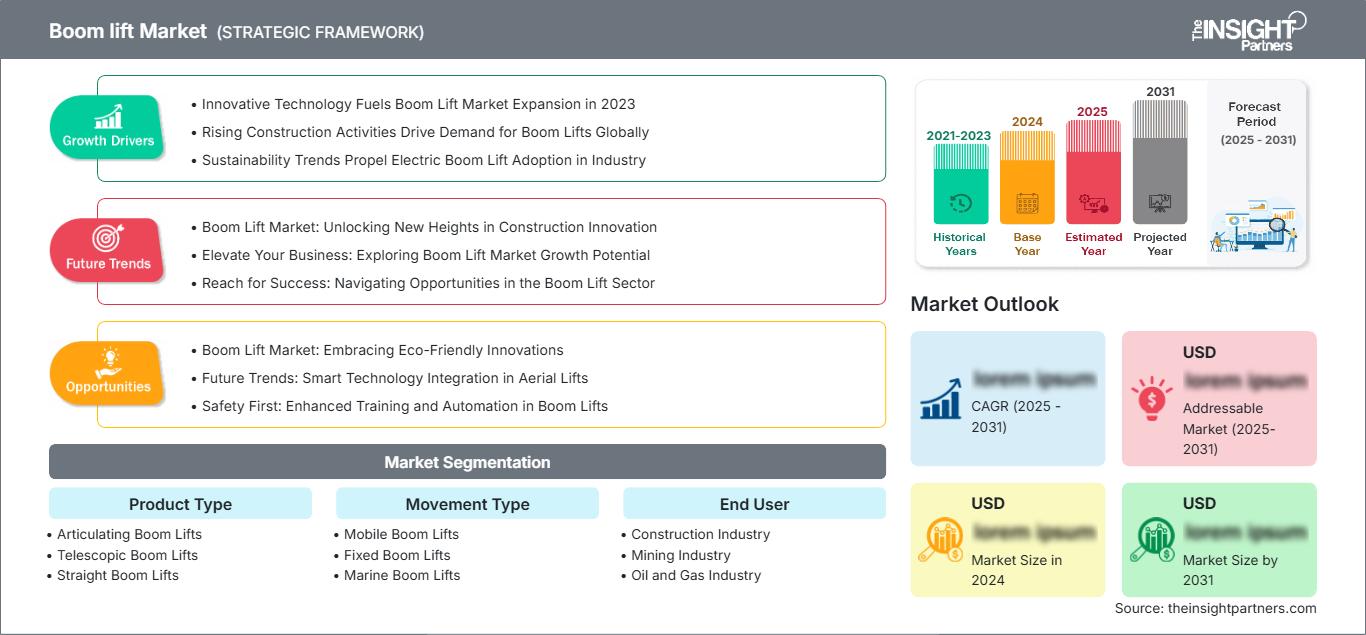
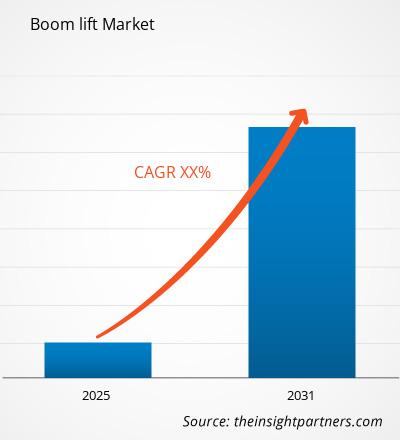
The global boom lift market size was valued at US$ 15.07 Billion in 2025 and is projected to reach US$ 31.86 Billion by 2034, registering a CAGR of 8.67% from 2026 to 2034. The market is experiencing substantial growth driven by rapid urbanization, increasing investments in infrastructure development, and the growing adoption of aerial work platforms across diverse industries for enhanced safety and operational efficiency.
North America holds a significant share, with the regional market estimated to grow at a CAGR of 7.5–8.0% through the forecast period. Growth in the region is propelled by a robust construction sector, increasing renovation activities, and stringent workplace safety regulations that mandate the use of advanced aerial work platforms.
Boom lift Market Assessment and Insights
- North America: The North American boom lift market share accounted for approximately 28–30% of the global market share in 2025, with the region growing at a CAGR of 7.5–8.0% from 2026 to 2034. Growth is driven by substantial infrastructure spending and construction sector expansion.
- US: The U.S. constituted roughly 85–88% of the North American market in 2025, expanding at a CAGR of 7.5–8.0% during the forecast period. The market benefits from extensive construction activities and widespread equipment rental penetration.
- Europe: Europe captured approximately 22–24% in 2025, with a projected CAGR of 7.0–7.5% from 2026 to 2034. Leading countries include Germany, the UK, France, Italy, and Spain.
- Asia Pacific: Asia Pacific held a dominant share of 35–38% in 2025, registering the highest CAGR of 9.5–10.0% from 2026 to 2034. China, India, and Japan are the leading countries in the region.
- Largest Segment: The construction industry end-user segment was the largest category in 2025, holding a market share of 42–44%. This segment is projected to grow at a CAGR of 8.5–9.0% from 2026 to 2034 due to rising infrastructure projects worldwide.
- High Growth Segment: The articulating boom lifts product segment is among the fastest-growing categories, with a market share of 32–35% in 2025 and a projected CAGR of 9.0–9.5% from 2026 to 2034, driven by their versatility in confined spaces.
- Key companies analyzed in detail: Terex Corporation, Tadano Ltd., Galmon (Singapore), Zoomlion Heavy Industry Science and Technology Co., Ltd., Sany Heavy Industry Co., Ltd., Altech Industries, XCMG Construction Machinery Co., Ltd., KATO WORKS CO., LTD., Kobelco Construction Machinery Co., Ltd., FURUKAWA UNIC CORPORATION
Source: The Insight Partners' analysis based on proprietary research, government publications, company annual reports, investor presentations, industry databases, and expert interviews.
Technological innovation is quite evident in the Boom Lift Market, with hybrid and electric models being designed and manufactured in order to ensure low emissions and cost savings. The process of manufacturing has changed, moving from traditional methods to advanced manufacturing practices, such as welding and assembly of the equipment through automation. Telematics and Internet of Things sensors are being integrated into the equipment, allowing the monitoring of its condition.
The future of the Boom Lift Market looks promising, with new geographies in Southeast Asia, Latin America, and the Middle East offering good potential. Increased spending on renewable energy generation facilities and airports will contribute to the growth of the market. The increased use of rental equipment by various firms creates a good source of income for the manufacturers, and partnership between equipment manufacturers and rental firms is becoming more common.
Boom lift Market Report Scope
| Report Attribute | Details |
|---|---|
| Market size in 2025 | US$ 15.07 Billion |
| Market Size by 2034 | US$ 31.86 Billion |
| Global CAGR (2026 - 2034) | 8.67% |
| Historical Data | 2021-2024 |
| Forecast period | 2026-2034 |
Boom lift Market Analysis
Market growth is mainly attributed to worldwide expansion of construction projects and concern for labor safety. The increasing urbanization and industrialization in developing nations is the main driver of increased need for aerial work platforms.
Value chain analysis includes material suppliers, component suppliers, assemblers of the equipment, and rental service providers. Vertical integration is increasingly becoming common in this industry due to cost effectiveness and quality control measures taken by key players. Supply is affected by availability of steel and electronics components as key components of the equipment, with manufacturers forming strategic partnership to ensure regular supply.
Main players include both global firms and regional firms. Terex Corporation and Tadano Ltd. have been making significant investments in research and development in electric and hybrid boom lifts, while Zoomlion and XCMG have been concentrating on diversification and geographic expansion. Key investment trends show that investment in sustainable manufacturing process and technology is growing.
Players have been positioning themselves with product differentiation strategy; where some manufacturers are developing products that are environmentally friendly while others are focusing on heavy lifting and long reach capability. Galmon (Singapore) and Altech Industries are utilizing regional distribution strategies to grab market share.
● REPORT CUSTOMIZATION
Tailor This Report To Align With Your Specific Business Requirements
This report can be customized to align precisely with your business objectives, scope, and target markets. Customization options include tailored segmentation, geography, competitive analysis, and strategic insights to support informed decision-making.
Customize This Report →WHAT YOU CAN ADJUST
- ● Segmentations
- ● Geography
- ● Competitive Analysis
- ● Language Preferences
Boom lift Market: Strategic Insights
Regional Insights
North America Boom Lift Market
North America accounted for approximately 28–30% of the global boom lift market share in 2025, with the region projected to grow at a CAGR of 7.5–8.0% from 2026 to 2034. North America is dominated by the U.S. owing to extensive constructions and equipment rental activities. Canada is also growing owing to the infrastructural investments by the government as well as mining operations. Major equipment manufacturers and an established safety culture make North America one of the strong markets, where consumers prefer the green boom lifts.
U.S. Boom Lift Market
The U.S. represented roughly 85–88% of the North American market in 2025 and is projected to grow at a CAGR of 7.5–8.0% through 2034. There is high demand for telescopic and articulating boom lifts in construction, oil and gas operations, and maintenance operations. Companies such as Terex Corporation and JLG Industries are prominent players in this market, with innovations made specifically in electric boom lifts and integration of smart technologies [source:5]. Increased use of rentals and higher expenditure on infrastructure is contributing towards demand for boom lifts.
Europe Boom Lift Market
Europe captured around 22–24% of the global market share in 2025, with the regional market projected to grow at a CAGR of 7.0–7.5% from 2026 to 2034. Germany is the leading country in Europe because of its vibrant manufacturing industry and its attempts at infrastructure modernization. The UK market is growing as a result of an increase in construction and renovation projects. In France, Italy, and Spain, construction and infrastructure development also play a big role in boosting the market.
APAC Boom Lift Market
Asia Pacific held a dominant share of 35–38% of the global market in 2025, registering the highest CAGR of 9.5–10.0% from 2026 to 2034. The market leader in the region is China owing to its huge infrastructure spending and being the leading manufacturer of construction equipment in the world. India and Japan are also notable markets with high urbanization levels and government initiatives aimed at developing infrastructure. The capacity of the region to manufacture cost-effective boom lifts makes it a notable hub for boom lift manufacture.
Middle East & Africa Boom Lift Market
The MEA is projected to expand at a CAGR of 6.5–7.0% from 2026 to 2034. Saudi Arabia, UAE, and South Africa are leading the regional market, driven by growing investments in infrastructure, construction, and oil and gas sectors. The UAE is witnessing notable growth, supported by ambitious mega-projects and the expansion of the construction sector. In South Africa, mining and industrial applications are driving demand for aerial work platforms, while energy infrastructure projects in the region indirectly support market growth.
Segmentation Analysis
Product Type
The boom lift market scope by product type includes articulating boom lifts, telescopic boom lifts, straight boom lifts, Genie boom lifts, and towable boom lifts. This segmentation reflects the diverse operational requirements of end-users across various industries.
- Articulating Boom Lifts- Articulating boom lifts feature a jointed arm design that offers superior maneuverability in confined spaces. The segment is projected to grow at a robust pace through 2034. These lifts are preferred for indoor and construction applications where precise positioning is required.
- Telescopic Boom Lifts- Telescopic boom lifts provide straight reach and high lifting capacity, making them suitable for outdoor construction and industrial applications. The segment benefits from increasing demand for high-altitude access equipment.
- Straight Boom Lifts- Straight boom lifts offer vertical reach capabilities without articulation joints. This segment serves applications requiring direct access to elevated work areas, such as building maintenance and warehouse operations.
- Genie Boom Lifts- Genie brand boom lifts are recognized for their reliability and performance. The segment represents a significant portion of the market due to strong brand recognition and aftermarket support.
- Towable Boom Lifts- Towable boom lifts are portable units that can be towed by vehicles. This segment offers flexibility for rental companies and contractors requiring temporary access solutions.
Movement Type
The market is segmented by movement type into mobile boom lifts, fixed boom lifts, and marine boom lifts, addressing distinct operational environments.
- Mobile Boom Lifts- Mobile boom lifts are self-propelled units offering maximum flexibility on construction sites. The segment is experiencing robust growth driven by demand for versatile and efficient access equipment.
- Fixed Boom Lifts- Fixed boom lifts are permanently installed units used in manufacturing and warehouse applications. This segment caters to facilities requiring consistent, dedicated access solutions.
- Marine Boom Lifts- Marine boom lifts are specialized equipment designed for shipbuilding and offshore applications. The segment benefits from the growth of the maritime industry and port infrastructure development.
End User
The market is segmented by end user into construction industry, mining industry, oil and gas industry, shipping and port building, automotive industry, and aerospace. This categorization addresses the diverse application requirements across industrial sectors.
- Construction Industry- The construction industry represents the largest end-user segment, driven by infrastructure projects and residential construction. Boom lifts are essential for high-rise construction and maintenance activities.
- Mining Industry- Mining operations utilize boom lifts for maintenance and equipment servicing. The segment benefits from the expansion of mining activities in resource-rich regions.
- Oil and Gas Industry- Oil and gas facilities use boom lifts for maintenance, inspection, and construction activities. The segment is supported by ongoing investments in energy infrastructure.
- Shipping and Port Building- Shipping and port building applications require boom lifts for infrastructure development and vessel maintenance. The segment benefits from growing maritime trade and port expansion projects.
- Automotive Industry- The automotive industry utilizes boom lifts for facility maintenance and production line servicing. This segment caters to large-scale manufacturing operations.
- Aerospace- Aerospace applications involve boom lifts for aircraft maintenance and hangar construction. The segment serves specialized requirements in the aviation industry.
Opportunity Snapshot
| Segments | Revenue Contribution | Trend Tag | Adoption Stage |
| Articulating Boom Lifts | High | Versatile Access | Scaling |
| Telescopic Boom Lifts | High | Long Reach | Mature |
| Straight Boom Lifts | Medium | Direct Access | Mature |
| Genie Boom Lifts | High | Brand Trust | Mature |
| Towable Boom Lifts | Medium | Portable Access | Scaling |
| Construction | High | Infrastructure | Mature |
| Mining | Medium | Heavy-Duty | Mature |
| Oil and Gas | Medium | Energy Access | Mature |
| Shipping and Port | Medium | Maritime Growth | Scaling |
| Automotive | Medium | Facility Use | Mature |
| Aerospace | Medium | Precision Access | Emerging |
Boom lift Market Growth Drivers and Impact Analysis
Expansion of Global Infrastructure and Construction Activities
The rapid expansion of infrastructure projects worldwide is a primary driver. Governments are investing heavily in transportation networks, commercial buildings, and public facilities. The construction industry's growth, particularly in emerging economies, is fueling demand for aerial work platforms. Boom lifts are essential for high-rise construction, maintenance, and renovation activities. The trend towards urbanization and mega-infrastructure projects is expected to sustain market growth, with contractors increasingly requiring versatile and efficient access equipment.
Furthermore, the development of airports, bridges, industrial facilities, energy projects, and large-scale residential complexes is generating sustained demand for equipment capable of providing safe access to elevated work areas. Contractors are increasingly selecting boom lifts because they offer greater flexibility and horizontal reach compared with conventional access solutions. Rental companies are also expanding their fleets to support fluctuating construction activity and reduce the upfront equipment costs faced by smaller contractors. As cities continue to expand and existing infrastructure requires modernization, the need for efficient height-access equipment is expected to increase across both developed and developing markets.
Increasing Focus on Workplace Safety Regulations
Stringent workplace safety regulations and standards are driving the adoption of boom lifts across industries. Regulatory bodies mandate the use of safe access equipment for elevated work to reduce fall-related accidents. Boom lifts offer stable, secure platforms for workers at height, replacing traditional scaffolding and ladders. Industries are prioritizing safety to protect workers and avoid legal liabilities. The growing awareness of occupational safety and the implementation of workplace safety programs are accelerating the adoption of modern aerial work platforms.
In addition, companies are placing greater emphasis on employee training, equipment inspections, and compliance with established safety procedures for elevated operations. Boom lifts equipped with guardrails, emergency controls, overload protection, and other safety features can help organizations manage risks associated with working at height. The increasing cost of workplace accidents, insurance claims, project delays, and regulatory penalties is encouraging businesses to invest in reliable access equipment. This trend extends beyond construction to sectors such as utilities, telecommunications, warehousing, facility maintenance, and industrial operations, where workers regularly require secure and efficient access to elevated locations.
Technological Advancements in Aerial Work Platforms
Continuous innovation in boom lift technology is driving market expansion. The development of hybrid and all-electric models offers reduced emissions and lower operational costs. Advanced features such as telematics, remote monitoring, and automatic safety systems enhance equipment efficiency and reliability. Manufacturers are focusing on improving lift capacity, reach, and maneuverability. The integration of IoT capabilities enables predictive maintenance and fleet management. These technological advancements are expanding the application scope of boom lifts.
Manufacturers are also incorporating intelligent control systems, improved battery technologies, and lightweight structural components to enhance overall machine performance. Connected equipment allows fleet operators to monitor utilization, operating hours, battery levels, location, and maintenance requirements in real time, helping improve asset management. Electric and hybrid boom lifts are gaining attention in indoor and environmentally sensitive applications because of their lower noise levels and reduced emissions. As customers increasingly seek equipment that combines productivity, sustainability, and operational safety, ongoing technological development is expected to create new opportunities and encourage the replacement of older aerial work platforms.
Boom lift Market Future Trends
Electrification and Sustainability of Boom Lift Fleet
The boom lift market trend includes significant shift towards electric and hybrid models. Manufacturers are developing emission-free, noise-reduced equipment suitable for indoor and urban applications. This trend is driven by tightening environmental regulations and the construction industry's commitment to sustainability. Electric boom lifts offer lower maintenance costs and reduced operational expenses. The adoption of lithium-ion batteries is enabling longer operating cycles and faster charging.
Integration of Telematics and Smart Fleet Management
The integration of telematics and IoT technologies is emerging as a prominent trend. Smart features enable real-time equipment tracking, diagnostics, and remote monitoring. Fleet owners can optimize equipment utilization and schedule maintenance proactively. This trend caters to the growing rental industry, where efficient fleet management is crucial. Data analytics provide insights into machine performance, enabling predictive maintenance and reducing downtime.
Boom lift Market Opportunities
Development of Rental Market for Boom Lifts
As per the global boom lift market forecast, the expansion of the equipment rental market represents a significant opportunity for boom lift manufacturers. Contractors and small businesses increasingly prefer rental models to avoid high capital costs. Rental companies are expanding their fleets to meet growing demand. Manufacturers can capitalize on this trend by establishing partnerships with rental firms and developing equipment tailored to rental requirements. The rental market offers recurring revenue streams and enhances market penetration.
Expansion into Emerging Infrastructure Markets
Emerging economies in Southeast Asia, Africa, and Latin America present substantial opportunities. Rapid urbanization, industrialization, and government infrastructure spending are driving demand. Manufacturers can leverage these opportunities by establishing regional production facilities and distribution networks. Strategic partnerships with local dealers and rental companies are essential for market entry. The development of cost-competitive and durable equipment suited to local conditions can capture market share.
Recent Developments
- July 2025: Sinoboom has launched two new models in its range of narrow electric articulating boom lifts, the AB13ERJN and AB15ERJN. These follow in the footsteps of the very popular AB10ERJN which came to market in 2023 and has been widely used in a variety of scenarios including maintenance and construction.
- August 2025: Haulotte, a global leader in people lifting equipment, announces the launch of the next generation 61ft articulating boom from the Pulseo range: HA61 E and HA61 E PRO, 100% electric rough terrain. This cutting-edge MEWP joins the HA46 E and HA46 E PRO, extending the line of rough terrain electric booms designed to meet the evolving demands of modern job sites..
Frequently Asked Questions

- Comprehensive Market Sizing and Forecast Analysis
- Detailed Segmentation Analysis
- In-Depth Market Dynamics Assessment
- Regional and Country-Level Insights
- Competitive Landscape and Company Benchmarking
- Strategic Business Intelligence
Recent Reports
Testimonials

The Insight Partners' SCADA System Market report is comprehensive, with valuable insights on current trends and future forecasts. The team was highly professional, responsive, and supportive throughout. We are very satisfied and highly recommend their services.
RAN KEDEM Partner, Reali Technologies LTDs
I requested a report on a very specific software market and the team produced the report in a few days. The information was very relevant and well presented. I then requested some changes and additions to the report. The team was again very responsive and I got the final report in less than a week.
JEAN-HERVE JENN Chairman, Future Analytica
We worked with The Insight Partners for an important market study and forecast. They gave us clear insights into opportunities and risks, which helped shape our plans. Their research was easy to use and based on solid data. It helped us make smart, confident decisions. We highly recommend them.
PIYUSH NAGPAL Sr. Vice President, High Beam Global
The Insight Partners delivered insightful, well-structured market research with strong domain expertise. Their team was professional and responsive throughout. The user-friendly website made accessing industry reports seamless. We highly recommend them for reliable, high-quality research services
YUKIHIKO ADACHI CEO, Deep Blue, LLC.
This is the first time I have purchased a market report from The Insight Partners.While I was unsure at first, I visited their web site and felt more comfortable to take the risk and purchase a market report.I am completely satisfied with the quality of the report and customer service. I had several questions and comments with the initial report, but after a couple of dialogs over email with their analyst I believe I have a report that I can use as input to our strategic planning process.Thank you so much for taking the extra time and making this a positive experience.I will definitely recommend your service to others and you will be my first call when we need further market data.
JOHN SUZUKI President and Chief Executive Officer, Board Director, BK Technologies
I wish to appreciate your support and the professionalism you displayed in the course of attending to my request for information regarding to infectious disease IVD market in Nigeria. I appreciate your patience, your guidance, and the fact that you were willing to offer a discount, which eventually made it possible for us to close a deal. I look forward to engaging The Insight Partners in the future, all thanks to the impression you have created in me as a result of this first encounter.
DR CHIJIOKE ONYIA MANAGING DIRECTOR, PineCrest Healthcare Ltd.Reason to Buy
- Informed Decision-Making
- Understanding Market Dynamics
- Competitive Analysis
- Identifying Emerging Markets
- Customer Insights
- Market Forecasts
- Risk Mitigation
- Boosting Operational Efficiency
- Strategic Planning
- Investment Justification
- Tracking Industry Innovations
- Aligning with Regulatory Trends





 Get Free Sample for