
Boron Trifluoride Market Share, Size & Demand by 2034
Coverage: By Application (Catalyst, Reagent, Others); End Use (Semicondutor, Chemical, Pharmaceuticals, Others) , and Geography (North America, Europe, Asia Pacific, and South and Central America)
- Status : Data Released
- Report Code : TIPRE00022223
- Category : Chemicals and Materials
- No. of Pages : 150
- Available Report Formats :


- Last update date : July 15, 2026


2025 Market Size
US$ 279.43 Mn
Base year value
2034 Forecast
US$ 375.18 Mn
Projected by 2034
CAGR 2026-2034
3.33 %
Growth rate
Addressable Market
US$ 2,973.03 Mn
(2026-2034)
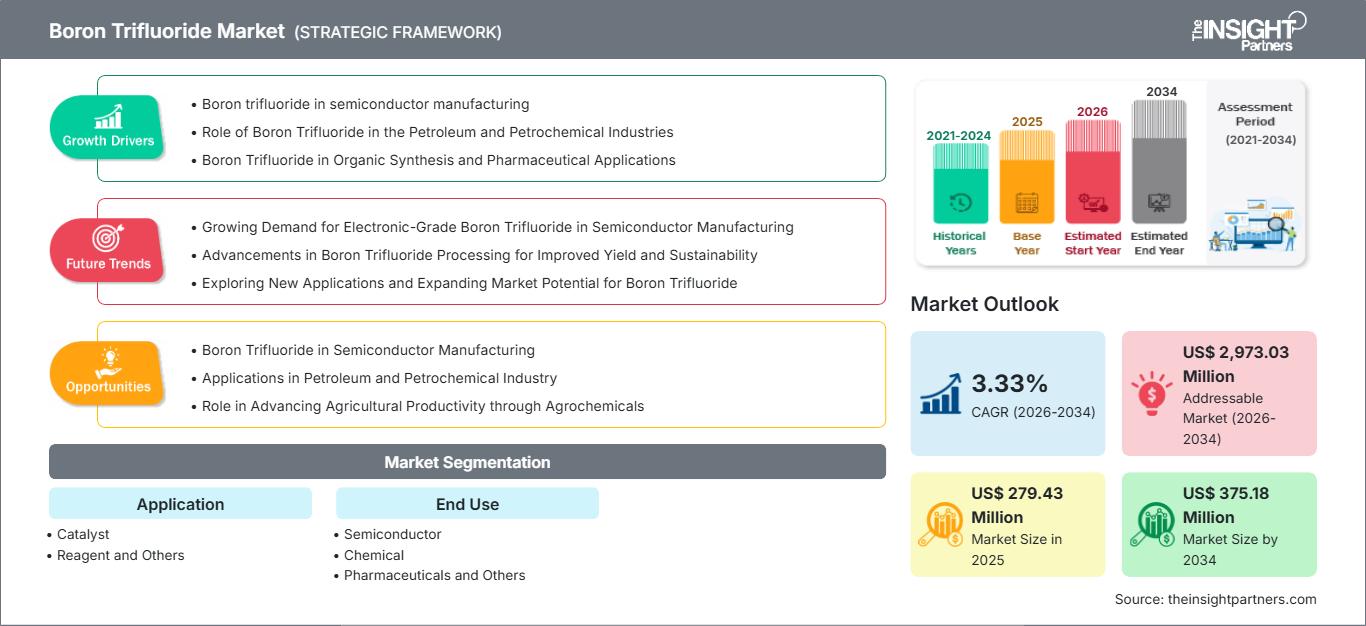
The Boron Trifluoride Market size was assessed to be at US$ 279.43 million in 2025 and will be valued at US$ 375.18 million in 2034 with a CAGR of 3.33% during 2026-2034. The market will continue to play an important role in the manufacturing of high-purity chemicals, the semiconductor industry, specialized catalysis, and pharmaceutical processes. Increased investment in the advanced electronics manufacturing industry, rising use of precise chemical intermediates, and process improvements across various manufacturing industries are expected to drive demand for high-purity boron trifluoride products.
In North America, growth will be driven by the development of the semiconductor manufacturing industry, pharmaceutical research, and specialty chemical production. In North America, the CAGR is estimated to be of 3.0–3.4% during 2026-2034 due to investments in the domestic chip manufacturing industry, increased use of electronic-grade process chemicals, and improvements in the local supply chain. Size of the Boron Trifluoride Market is being boosted by sustained investments in manufacturing processes and higher use of ultra-high purity process gases.
Boron Trifluoride Market Assessment and Insights
- North America: Accounted for 33–36% share in 2025 and is anticipated to expand at a CAGR of 3.0–3.4% during 2026–2034. Strong semiconductor fabrication investments, pharmaceutical manufacturing, and specialty chemical production continue supporting regional demand for high-purity boron trifluoride.
- US: Represented 76–80% of the North American market in 2025 and is projected to register a CAGR of 3.1–3.5% during 2026–2034, supported by domestic semiconductor capacity expansion, specialty chemical manufacturing, and continued investments in advanced industrial processing.
- Europe: Held 25–28% share in 2025 and is forecast to grow at a CAGR of 2.8–3.2% during 2026–2034. Germany, France, and the UK remain leading contributors owing to their established pharmaceutical, specialty chemical, and advanced manufacturing industries.
- Asia Pacific: Captured 30–33% share in 2025 and is anticipated to witness the highest CAGR of 3.8–4.2% during 2026–2034. China, Japan, South Korea, and India continue expanding semiconductor manufacturing, electronics production, and industrial chemical processing capacities.
- Largest Segment: Application – Catalyst accounted for 55–59% market share in 2025 and is projected to expand at a CAGR of 3.2–3.5% during 2026–2034, supported by widespread utilization in petrochemical processing and specialty chemical synthesis.
- High Growth Segment: End Use – Semiconductor represented 26–30% market share in 2025 and is expected to register a CAGR of 4.2–4.6% during 2026–2034, driven by rising investments in wafer fabrication, electronic-grade chemicals, and next-generation chip manufacturing.
- Key companies analyzed in detail: Tanfac Industries Limited, BASF SE, AK Scientific, Inc., Linde plc, Chemos GmbH & Co. KG, Laborchemie Apolda GmbH, Hunan Heaven Materials Development Co., Ltd., Hangzhou Yuhao Chemical Technology Co., Ltd., Hangzhou Meite Industry Co., Ltd., Stella Chemifa Corporation.
Source: The Insight Partners' analysis based on proprietary research, government publications, company annual reports, investor presentations, industry databases, and expert interviews.
The evolution of production capacities has occurred in tandem with rising purity standards in both semiconductor manufacturing and specialty chemical production. The continuous efforts towards development of purification facilities, improvement of cylinder handling and the integration of fluorochemicals manufacturing processes will secure reliable supply sources. Electronic-grade boron trifluoride became strategically significant because the manufacture of advanced semiconductors requires minimal metal contamination, and catalyst applications remained the largest market segment of the Boron Trifluoride Market.
Further growth will be concentrated in the Asia-Pacific region, with selected capacity expansion in North America, driven by semiconductor localization policies. Compliance with environmental standards, technological developments in gas recovery, and investment in high-quality specialty chemicals will ensure competitiveness and encourage manufacturers to develop an electronic grades range and improve gas transportation logistics.
Boron Trifluoride Market Report Scope
| Report Attribute | Details |
|---|---|
| Market size in 2025 | US$ 279.43 Million |
| Market Size by 2034 | US$ 375.18 Million |
| Global CAGR (2026 - 2034) | 3.33% |
| Historical Data | 2021-2024 |
| Forecast period | 2026-2034 |
Boron Trifluoride Market Analysis
Demand fundamentals remain supported by expanding electronics manufacturing, pharmaceutical synthesis, and catalyst-intensive chemical production. The Boron Trifluoride Market growth trajectory is increasingly influenced by higher consumption of ultra-high-purity grades used in ion implantation and plasma processing. In conventional chemical manufacturing, boron trifluoride continues to serve as a preferred Lewis acid catalyst for alkylation, esterification, polymerization, nitration, and condensation reactions because of its high catalytic efficiency and broad compatibility with industrial synthesis routes.
The performance of the supply chain is contingent upon access to boron feedstocks, fluorine chemistry equipment, gas purification facilities, and a secure transport mechanism. The producers have taken steps to integrate their production chain from the source of materials through purification, packaging, and distribution to reduce risks associated with gas handling.
The Boron Trifluoride Market Report reveals that competition will center on technological competence rather than manufacturing output alone. Manufacturers such as BASF SE, Linde plc, Stella Chemifa Corporation, and Tanfac Industries Limited have been focusing on purity, grade specifications, and customer relationships. Chinese manufacturers are further expanding manufacturing capacities for meeting rising demand fueled by investments in electronics manufacturing.
Increasing investment trends are seen in purification technology, cylinder management system, process automation, and manufacturing of electronic-grade products. Strategic differentiation will be based on regulatory compliance, manufacturing consistency, availability, and technical service abilities, especially for customers who need ultra-purity boron trifluoride products for semiconductor production and pharmaceutical intermediates.
● REPORT CUSTOMIZATION
Tailor This Report To Align With Your Specific Business Requirements
This report can be customized to align precisely with your business objectives, scope, and target markets. Customization options include tailored segmentation, geography, competitive analysis, and strategic insights to support informed decision-making.
Customize This Report →WHAT YOU CAN ADJUST
- ● Segmentations
- ● Geography
- ● Competitive Analysis
- ● Language Preferences
Boron Trifluoride Market: Strategic Insights
Regional Insights
North America Boron Trifluoride
North America accounted for 33–36% of the Boron Trifluoride Market share in 2025 and is anticipated to expand at a CAGR of 3.0–3.4% during 2026–2034. The region benefits from a mature specialty chemicals industry, advanced semiconductor manufacturing capabilities, and sustained investments in pharmaceutical research and development. Growing demand for electronic-grade process chemicals, coupled with initiatives to strengthen domestic manufacturing of strategic materials, continues to support regional market expansion.
The adoption of manufacturing incentives for semiconductors, higher investments in fab factories, and technological upgrade of chemical manufacturing infrastructure has helped create an environment that is conducive to continuous demand. Investments in high-purity manufacturing technology, logistics channels, and manufacturing compliance have continued. Increased interaction between specialty chemical makers and semiconductor manufacturers is likely to contribute to sustainable growth in North America.
U.S. Boron Trifluoride Market
The United States accounted for 76–80% of the North American market share in 2025 and is estimated to record a CAGR of 3.1–3.5% during 2026–2034. Extensive domestic investments in semiconductors, growing pharmaceutical manufacturing, and highly sophisticated specialty chemical production are key factors contributing to the high demand for high-purity boron trifluoride. Several government-led initiatives that facilitate manufacturing and innovation further consolidate the country's competitive standing in the regional market.
The availability of state-of-the-art semiconductor manufacturing plants, research centers, and chemical manufacturing units ensures constant demand from various end-use industries. The growing manufacturing of highly advanced electronics, the production of pharmaceutical active ingredients, and the adoption of catalytic reactions are key factors facilitating long-term market growth.
Europe Boron Trifluoride Market
Europe held 25–28% market share in 2025 and is forecast to grow at a CAGR of 2.8–3.2% during 2026–2034, supported by its established pharmaceutical, chemical, and advanced manufacturing sectors. Germany remains the leading regional market owing to its strong specialty chemicals industry, extensive industrial manufacturing base, and continuous investment in process innovation. The country's focus on sustainable production technologies also supports demand for high-performance catalytic materials.
Innovation in the pharmaceutical field, contract manufacturing, and specialty chemicals have continued to bring advantages for the UK, while industrial chemicals, life science, and manufacturing applications help France keep steady demand. Italy and Spain have been helping with diversified chemicals, industrial exports, and fine chemical manufacturing. Overall, these nations help maintain stable consumption in Europe and promote investment in clean production technologies and regulatory compliance in the chemical processing industry.
APAC Boron Trifluoride Market
Asia Pacific accounted for 30–33% share in 2025 and is expected to record the fastest regional expansion with a CAGR of 3.8–4.2% during 2026–2034. China leads regional demand through large-scale chemical manufacturing and semiconductor investments, while Japan and South Korea maintain strong consumption across high-purity electronics production.
India continues expanding specialty chemical manufacturing capacity, and Australia supports regional supply through mineral resource development and advanced industrial projects. Government incentives encouraging domestic electronics production, semiconductor investments, and industrial modernization are expected to strengthen long-term regional demand.
Middle East & Africa Boron Trifluoride Market
The Middle East & Africa is forecast to experience a CAGR of 2.7-3.1% between 2026 and 2034 owing to growth in petrochemical investments along with diversification towards the production of specialty chemicals. Saudi Arabia accounts for the highest demand in the region, followed by the UAE, where growth in industrialization and downstream chemical processing is driving new applications.
South Africa plays its part owing to its chemical industries; on the other hand, the Rest of the Middle East & Africa contributes due to the development of infrastructure and manufacturing processes. Growth in investment in energy, refining, and industrial diversification will provide steady demand for boron trifluoride in the region.
Segmentation Analysis
Application
The Application segment is expected to register a CAGR of 3.2–3.5% during 2026–2034. Demand is primarily driven by the use of boron trifluoride as a highly efficient Lewis acid in catalytic reactions and specialty chemical synthesis. Its ability to enhance reaction selectivity, improve process efficiency, and support high-purity manufacturing makes it indispensable across petrochemical, pharmaceutical, and electronics industries. The Boron Trifluoride Market scope continues to expand as manufacturers adopt advanced catalytic technologies and optimize production processes for higher yields and improved sustainability.
- Catalyst – This sub-segment accounted for the largest application share due to extensive utilization in alkylation, polymerization, and organic synthesis. Consistent demand from petrochemical processing and specialty chemical manufacturing reinforces its strategic importance across industrial production.
- Reagent – Boron trifluoride is widely used as a reagent in laboratory synthesis, pharmaceutical intermediate production, and fine chemical manufacturing. Increasing research activities and demand for high-value specialty compounds continue supporting adoption across industrial and academic applications.
End Use
The End Use segment is anticipated to grow at a CAGR of 3.5–3.9% during 2026–2034, supported by expanding utilization across semiconductor manufacturing, specialty chemicals, and pharmaceutical production. Increasing investments in high-purity chemical processing, advanced electronics manufacturing, and precision industrial synthesis continue strengthening consumption across multiple end-use industries. Growing emphasis on domestic manufacturing capabilities and supply chain resilience is also contributing to sustained market expansion.
- Semiconductor – Rapid expansion of wafer fabrication facilities, increasing production of advanced integrated circuits, and growing demand for ultra-high-purity process chemicals continue positioning this sub-segment as the fastest-growing end-use category.
- Chemical – Specialty chemical manufacturers utilize boron trifluoride in catalytic reactions, fluorination processes, and intermediate production. Stable industrial demand and continuous process optimization sustain its importance across diversified chemical manufacturing operations.
- Pharmaceuticals – Pharmaceutical companies employ boron trifluoride in complex organic synthesis and active pharmaceutical ingredient production. Rising investments in drug development and precision chemical synthesis continue supporting long-term demand for high-purity grades.
Opportunity Snapshot
| Segment Name | Revenue Contribution | Trend Tag | Adoption Stage |
| Semiconductor | High | Wafer Fabrication | Scaling |
| Chemical | High | Process Catalysis | Mature |
| Pharmaceuticals | Medium | API Synthesis | Scaling |
| Others | Low | Research Chemistry | Emerging |
Boron Trifluoride Market Growth Drivers and Impact Analysis
Expansion of Semiconductor Manufacturing and Advanced Electronics Production
Increasing global investments in semiconductor fabrication facilities are significantly supporting demand for boron trifluoride, particularly in high-purity electronic-grade applications. Government-backed manufacturing initiatives in the United States, Europe, Japan, South Korea, and India are encouraging domestic chip production while strengthening supply chain resilience. As integrated circuits become more sophisticated, manufacturers require highly consistent specialty chemicals capable of meeting stringent purity specifications. Boron trifluoride plays an important role in several precision chemical processes supporting semiconductor production. Continuous expansion of artificial intelligence hardware, automotive electronics, industrial automation, and high-performance computing is expected to sustain demand for advanced semiconductor materials, creating stable long-term opportunities for boron trifluoride producers investing in quality improvement, production expansion, and localized manufacturing capabilities.
Growing Utilization in Specialty Chemical and Catalytic Processing
The expanding specialty chemicals industry continues to increase consumption of boron trifluoride because of its effectiveness as a Lewis acid catalyst in alkylation, polymerization, esterification, and numerous organic synthesis reactions. Manufacturers increasingly focus on improving reaction efficiency, reducing energy consumption, and maximizing product yields, making advanced catalytic materials strategically important across industrial production. Growing demand for high-performance polymers, electronic chemicals, specialty intermediates, and performance materials further strengthens catalyst consumption. Investments in process modernization, digital manufacturing technologies, and environmentally compliant production facilities are encouraging chemical companies to adopt high-purity catalytic solutions. These developments reinforce the long-term commercial importance of boron trifluoride across diversified industrial processing applications worldwide.
Rising Pharmaceutical Research and Fine Chemical Manufacturing
Growing pharmaceutical innovation and increasing production of complex active pharmaceutical ingredients are creating additional opportunities for boron trifluoride across laboratory and commercial-scale synthesis. Pharmaceutical manufacturers continue expanding research into specialty therapeutics, precision medicines, and advanced chemical intermediates requiring highly selective reaction conditions. Boron trifluoride supports numerous organic synthesis pathways that improve reaction efficiency and product consistency. Expansion of contract development and manufacturing organizations, combined with increasing investments in pharmaceutical production facilities across Asia Pacific and North America, is further supporting demand. As healthcare systems prioritize reliable drug manufacturing and continuous process improvement, high-purity boron trifluoride is expected to remain an important reagent and catalyst for sophisticated pharmaceutical synthesis.
Boron Trifluoride Market Future Trends
Increasing Adoption of Ultra-High-Purity Chemical Production
Demand for ultra-high-purity boron trifluoride is expected to accelerate as semiconductor manufacturers, pharmaceutical companies, and specialty chemical producers tighten quality specifications. Advanced purification technologies, contamination control systems, and automated production processes are becoming standard across manufacturing facilities. Boron Trifluoride Market trends increasingly indicate that producers capable of supplying consistent electronic-grade and pharmaceutical-grade materials will gain competitive advantages. Continued investment in quality assurance systems, traceability, and environmentally responsible manufacturing practices is expected to reshape supplier strategies while supporting premium product offerings in global industrial markets.
Regionalization of Specialty Chemical Supply Chains
Manufacturers are increasingly establishing regional production facilities and distribution networks to improve supply security and reduce dependence on long-distance imports. Industrial policies supporting domestic chemical manufacturing, combined with rising investments in strategic sectors such as semiconductors and pharmaceuticals, are encouraging localized production of critical process chemicals. This transition is expected to improve delivery reliability, shorten procurement cycles, and strengthen customer relationships. Companies expanding regional manufacturing capacity while maintaining high product purity standards are likely to enhance competitiveness and better address evolving regulatory and customer requirements throughout the forecast period.
Boron Trifluoride Market Opportunities
Expanding Investment in Domestic Semiconductor Chemical Supply Chains
Governments and private investors are increasingly prioritizing localized semiconductor ecosystems to reduce supply chain vulnerabilities and improve manufacturing resilience. These initiatives extend beyond wafer fabrication facilities to include domestic production of high-purity specialty chemicals essential for chip manufacturing. Boron Trifluoride Market Forecasts indicate that suppliers capable of establishing regional purification, packaging, and distribution infrastructure will be well positioned to secure long-term contracts with semiconductor manufacturers. Investment in electronic-grade production technologies, quality certification, and strategic partnerships with integrated device manufacturers can improve market access while supporting stable revenue generation. Companies expanding capacity near emerging semiconductor clusters are expected to benefit from sustained industrial investment and increasing demand for secure local sourcing.
Growth Potential in High-Value Pharmaceutical and Fine Chemical Applications
The increasing complexity of pharmaceutical synthesis and specialty chemical manufacturing is creating attractive opportunities for producers of high-purity boron trifluoride. Research organizations and pharmaceutical manufacturers continue investing in advanced reaction pathways that require selective catalysts and reagents capable of delivering consistent performance. Expansion of contract development and manufacturing services across Asia Pacific, Europe, and North America is expected to increase procurement of specialty process chemicals. Manufacturers focusing on customized packaging, stringent quality assurance, regulatory compliance, and technical customer support can strengthen long-term commercial relationships. Continued innovation in pharmaceutical intermediates and specialty organic synthesis is expected to generate sustainable demand across high-value industrial applications.
Recent Developments
- May 2025: SK Materials Co., Ltd. announced plans to expand production of high-purity specialty gases, including boron trifluoride (BF₃), to support growing semiconductor demand. The investment is intended to strengthen the company's electronic materials portfolio and enhance the domestic supply of critical process gases for advanced memory and logic chip manufacturing.
- July 2025: Researchers from the University of Chicago and University of Pittsburgh developed a boron-based chemical strategy that expands the design of protein therapeutics by enabling selective protein modification. The advancement highlights the growing role of boron chemistry in drug discovery and is expected to strengthen demand for boron-derived reagents and catalysts, used in pharmaceutical synthesis and medicinal chemistry research.
Frequently Asked Questions

- Comprehensive Market Sizing and Forecast Analysis
- Detailed Segmentation Analysis
- In-Depth Market Dynamics Assessment
- Regional and Country-Level Insights
- Competitive Landscape and Company Benchmarking
- Strategic Business Intelligence
Recent Reports
Testimonials

The Insight Partners' SCADA System Market report is comprehensive, with valuable insights on current trends and future forecasts. The team was highly professional, responsive, and supportive throughout. We are very satisfied and highly recommend their services.
RAN KEDEM Partner, Reali Technologies LTDs
I requested a report on a very specific software market and the team produced the report in a few days. The information was very relevant and well presented. I then requested some changes and additions to the report. The team was again very responsive and I got the final report in less than a week.
JEAN-HERVE JENN Chairman, Future Analytica
We worked with The Insight Partners for an important market study and forecast. They gave us clear insights into opportunities and risks, which helped shape our plans. Their research was easy to use and based on solid data. It helped us make smart, confident decisions. We highly recommend them.
PIYUSH NAGPAL Sr. Vice President, High Beam Global
The Insight Partners delivered insightful, well-structured market research with strong domain expertise. Their team was professional and responsive throughout. The user-friendly website made accessing industry reports seamless. We highly recommend them for reliable, high-quality research services
YUKIHIKO ADACHI CEO, Deep Blue, LLC.
This is the first time I have purchased a market report from The Insight Partners.While I was unsure at first, I visited their web site and felt more comfortable to take the risk and purchase a market report.I am completely satisfied with the quality of the report and customer service. I had several questions and comments with the initial report, but after a couple of dialogs over email with their analyst I believe I have a report that I can use as input to our strategic planning process.Thank you so much for taking the extra time and making this a positive experience.I will definitely recommend your service to others and you will be my first call when we need further market data.
JOHN SUZUKI President and Chief Executive Officer, Board Director, BK Technologies
I wish to appreciate your support and the professionalism you displayed in the course of attending to my request for information regarding to infectious disease IVD market in Nigeria. I appreciate your patience, your guidance, and the fact that you were willing to offer a discount, which eventually made it possible for us to close a deal. I look forward to engaging The Insight Partners in the future, all thanks to the impression you have created in me as a result of this first encounter.
DR CHIJIOKE ONYIA MANAGING DIRECTOR, PineCrest Healthcare Ltd.Reason to Buy
- Informed Decision-Making
- Understanding Market Dynamics
- Competitive Analysis
- Identifying Emerging Markets
- Customer Insights
- Market Forecasts
- Risk Mitigation
- Boosting Operational Efficiency
- Strategic Planning
- Investment Justification
- Tracking Industry Innovations
- Aligning with Regulatory Trends





 Get Free Sample for