
Botox Injection Market Size, Growth & Demand by 2034
Coverage: By Type (50U, 100U, Others); Application (Medical, Cosmetic) , and Geography (North America, Europe, Asia Pacific, and South and Central America)
- Status : Data Released
- Report Code : TIPRE00023149
- Category : Life Sciences
- No. of Pages : 150
- Available Report Formats :


- Last update date : August 05, 2026


2025 Market Size
US$ 5.15 Bn
Base year value
2034 Forecast
US$ 6.39 Bn
Projected by 2034
CAGR 2026-2034
2.43 %
Growth rate
Addressable Market
US$ 52.36 Bn
(2026-2034)
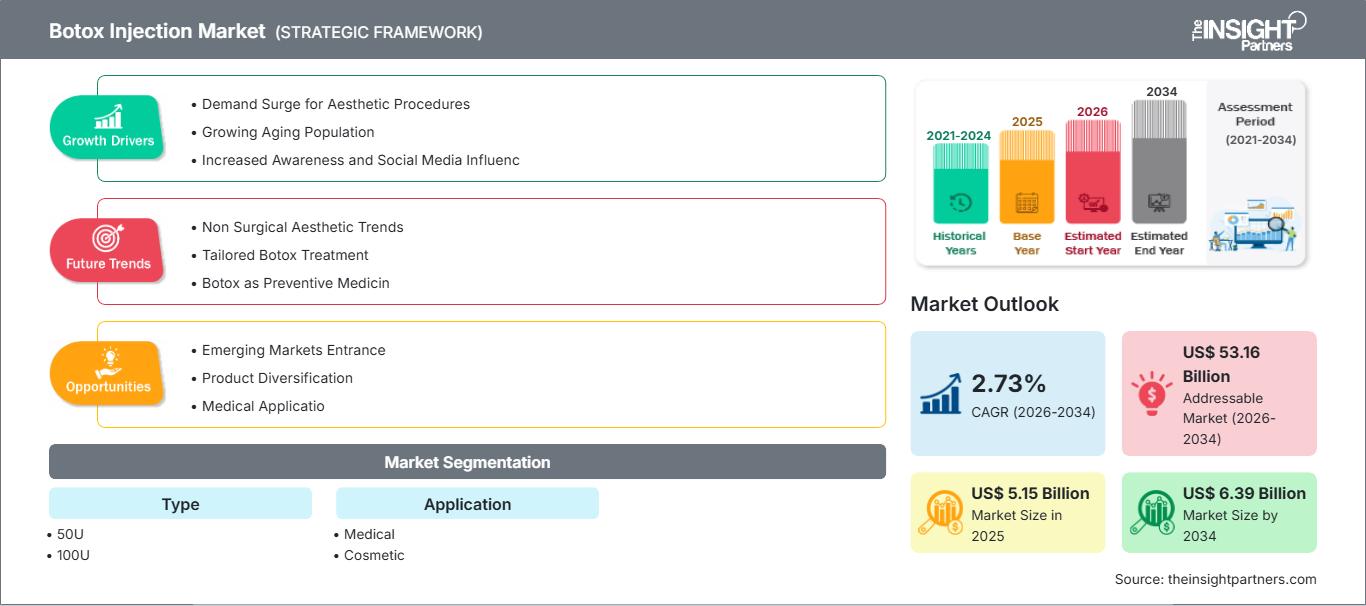
The Botox Injection market was valued at US$ 5.15 billion in 2025 and is expected to reach US$ 6.39 billion by 2034; it is estimated to record a CAGR of 2.43% during 2026-2034.
Botox Injection Market Assessment and Insights
- North America accounted for 40–43% share in 2025 and is expected to grow at 2.4–2.8% CAGR between 2026–2034, led by high aesthetic procedure volumes, strong physician adoption, and established therapeutic reimbursement pathways.
- US represented 84–87% of North America in 2025 and is projected to expand at 2.3–2.7% CAGR between 2026–2034, driven by branded neuromodulator loyalty and specialist clinic density.
- Europe held 25–28% share in 2025 and is forecast to grow at 2.1–2.5% CAGR between 2026–2034, with Germany, the UK, France, Italy, and Spain leading institutionalized aesthetic and therapeutic demand.
- Asia Pacific captured 21–24% share in 2025 and is projected to grow at 3.4–3.8% CAGR between 2026–2034, supported by China, Japan, South Korea, India, and Australia, where medical aesthetics infrastructure is expanding.
- Largest Segment Medical application held 54–58% market share in 2025 and is expected to grow at 2.5–2.9% CAGR between 2026–2034, reflecting recurring use in neurological and muscular disorders.
- High Growth Segment Cosmetic application held 42–46% market share in 2025 and is projected to expand at 3.0–3.4% CAGR between 2026–2034, supported by preventive aesthetics and non-surgical facial rejuvenation.
- Key companies analyzed in detail: AbbVie Inc., Ipsen S.A., Merz Pharmaceuticals GmbH, Medytox Inc., US WorldMeds, LLC, Lanzhou Institute of Biological Products Co., Ltd., Revance Therapeutics, Inc., Dolphin Pharmaceutical Limited, Lotus International, Balaji Pharma
Source: The Insight Partners' analysis based on proprietary research, government publications, company annual reports, investor presentations, industry databases, and expert interviews.
Standards for manufacturing in the industry have developed from the removal of toxins to different vial setups, stabilization procedures, and dosing regimes based on indications. The industry is getting better at handling cold chains, sterility, and batch-to-batch consistency due to increased scrutiny by regulators on injectable biological products. Clinically, there has been a reduction in variability due to improved ultrasound visualization, mapping of anatomy, and injector training, thus allowing treatment of patients and cosmetic users with increased certainty.
In terms of future developments, growth in the market is anticipated to be moderate in newer urban areas with rising disposable income, development of dermatological clinics chains, and access to neurology treatments. Tailwinds are coming mainly through approvals of new indications by health authorities and improved product traceability. Capital is being invested into local distribution arrangements, educational facilities for doctors, and online patient engagement tools.
Botox Injection Market Report Scope
| Report Attribute | Details |
|---|---|
| Market size in 2025 | US$ 5.15 Billion |
| Market Size by 2034 | US$ 6.39 Billion |
| Global CAGR (2026 - 2034) | 2.43% |
| Historical Data | 2021-2024 |
| Forecast period | 2026-2034 |
Botox Injection Market Analysis
The major driver for Botox Injection Market growth would be the combination of necessity of medical application and electiveness in aesthetic procedures. The former gains from existing demand in the area of spasticity, cervical dystonia, treatment of migraine-related conditions, and hyperhidrosis, and the latter is driven by quick procedure times and small recovery period. The supply side involves biological products manufacturers, specialty distributors, licensed injectors, dermatological clinics, neurologists, rehabilitation centers, and medical spas. Supply is quite concentrated due to complicated fermentation process, purification of neurotoxins and filling being regulated.
Demand planning is more and more associated with clinic usage and repeat treatments rather than one-time adoption. Clinics prefer branded products with reliable potency, proper timing and solid post-market safety record. This brings certain price elasticity advantages for incumbents; however, the local producers in Asia are penetrating the market. The market grows on the wave of treatment standardization, doctors' training and wider spread of medical indications.
Competitive intensity is determined by brand trust, clinical evidence, injector’s expertise, and distribution control. As per the Botox Injection Market report, the standard in the industry remains AbbVie Inc. through Allergan Aesthetics whereas Ipsen S.A. and Merz Pharmaceuticals GmbH continue to compete with each other through therapeutic portfolio and formulation difference. Medytox Inc. and Lanzhou Institute of Biological Products Co., Ltd. bring about regional competition, while US WorldMeds, LLC and Revance Therapeutics, Inc. provide for specialty positioning.
There is an increased trend of investment towards lifecycle management and not commodity expansion. The focus for companies is on new indications, duration of evidence, different toxins, and directly working with large clinics. Dolphin Pharmaceutical Limited, Lotus International, and Balaji Pharma are still important players in terms of supply and regional channel participation, especially where price sensitivity influences purchase decision-making.
● REPORT CUSTOMIZATION
Tailor This Report To Align With Your Specific Business Requirements
This report can be customized to align precisely with your business objectives, scope, and target markets. Customization options include tailored segmentation, geography, competitive analysis, and strategic insights to support informed decision-making.
Customize This Report →WHAT YOU CAN ADJUST
- ● Segmentations
- ● Geography
- ● Competitive Analysis
- ● Language Preferences
Botox Injection Market: Strategic Insights
Regional Insights
North America Botox Injection Market
North America had the highest market share at 40-43% in 2025 and will have a 2.4-2.8% CAGR between 2026 and 2034. This regional market is sustained by dermatological clinics, plastic surgery practices, neurologists, and rehabilitation physicians. Structured demand in the region includes repeated procedures, recognized payment structures for selected medical indications, and higher consumer awareness of injectable medications.
Botox Injection Market share in North America continues to be dominated because of the highly regulated environment, which prefers the products that have a long safety record. Moreover, early adoption of novel administration techniques and injector credentialing plays an important role for demand in the region. Canada ensures consistent growth due to the urban aesthetic centers and medical indications, while Mexico ensures cross-border procedure demand.
U.S. Botox Injection Market
The U.S. accounted for 84–87% of North America in 2025 and is expected to grow at 2.3–2.7% CAGR during 2026–2034. The country has the strongest company presence, including AbbVie Inc., Ipsen S.A., Merz Pharmaceuticals GmbH, US WorldMeds, LLC, and Revance Therapeutics, Inc. Demand is supported by neurologists, dermatologists, plastic surgeons, and certified aesthetic injectors.
Trends in application show that usage for medical purposes still has depth in spasticity, dystonia, treatment of migraines, and urology, while cosmetic needs continue to grow in terms of preventative treatment in younger generations. Consent forms have become standardized as well as facial analysis and booking. The United States is the pricing standard because brand strength, proof, and injector preference play an important role in decision-making.
Europe Botox Injection Market
Share of Europe was estimated to be 25-28% in 2025 and is projected to expand at CAGR 2.1-2.5% for 2026-2034. Germany has the dominant position in the region on account of advanced infrastructure of neurology, adoption of private aesthetics, and extensive training of physicians. The demand for neuromodulators in the UK is driven by regulated aesthetic practices and repetitive cosmetic treatments.
France, Italy, and Spain offer consistent adoption through dermatology centers in cities, areas for medical tourism, and increasing awareness of non-invasive facial anti-aging treatments. Application of the therapy continues to be primarily hospital-based and specialized, whereas cosmetic procedures take place in private clinics. The opportunities for growth are not promising as a result of the influence of reimbursement policy, physician-only use expectations, and national drug-device combination regulations.
APAC Botox Injection Market
The market share of APAC in 2025 was estimated between 21% and 24%, and it will grow at a 3.4%-3.8% CAGR in 2026-2034. The main contributor among countries is China due to its significant urban aesthetic needs, biologic capabilities and increasing numbers of private clinics. Japan and South Korea help because of their high aesthetic standards and procedure complexity.
Other contributors include India and Australia, which have dermatology chains, growing acceptance of medical aesthetics and specialist training. Regulations that drive the industry include biologics regulation, local manufacturing regulation and import regulation. Capability of industrialization in China and South Korea ensures competitive pricing and APAC is the fastest growing region.
Middle East & Africa Botox Injection Market
MEA region growth is estimated to range between 2.7% CAGR and 3.1% CAGR during the period of 2026-2034. Saudi Arabia leads in MEA on account of investments in private healthcare, specialty clinics, and increased demand for high-end cosmetic treatments. UAE derives strength from medical tourism, specialty dermatology centers, and wealthy urban population base.
Private specialist services and mature aesthetic practices drive demand in South Africa within the African subregion. Rest of MEA is unevenly penetrated due to differences in physician penetration, regulatory developments, and product costs. Investments in healthcare cities and private hospitals are contributing to better penetration in terms of infrastructure.
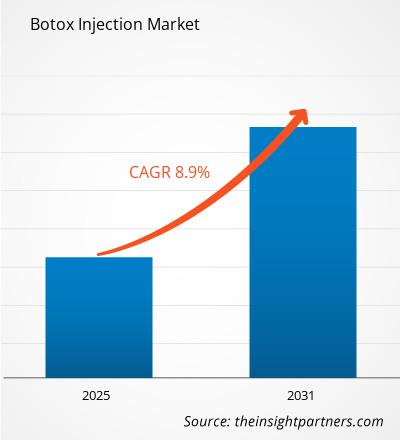
Segmentation Analysis
Type
The Type segment is projected to grow at 2.4–2.8% CAGR during 2026–2034. The Botox Injection Market scope across vial formats is defined by dose flexibility, clinic inventory planning, and indication-specific usage. Smaller vials support conservative dosing and low-volume clinics, while larger vials improve operational efficiency for high-throughput aesthetic and therapeutic practices.
- 50U vials are strategically important for low-dose procedures, conservative facial correction, and smaller clinics seeking inventory control. Demand is steady where patient flow is variable or dosing customization is prioritized.
- 100U vials remain preferred in high-volume practices and therapeutic settings where larger cumulative dosing is common. They support procurement efficiency, predictable stock management, and broader procedural flexibility.
Application
The Application segment is projected to grow at 2.7–3.1% CAGR during 2026–2034. Medical application provides stable recurring demand because neurologic and muscular conditions often require ongoing treatment. Cosmetic application adds faster private-pay momentum as patients prefer minimally invasive procedures that fit shorter recovery expectations and enable gradual appearance management.
- Medical application held the largest position, supported by spasticity, cervical dystonia, hyperhidrosis, migraine-related care, and urology use. Its strategic importance lies in repeat prescriptions and specialist-led treatment protocols.
- Cosmetic application is the high growth area, supported by facial line reduction, preventive aesthetics, and combination treatment planning. Demand is strongest in urban clinics with trained injectors and repeat consumers.
Opportunity Snapshot
| Application | Revenue Contribution | Trend Tag | Adoption Stage |
| Medical | High | Neurology Use | Mature |
| Cosmetic | Medium | Preventive Aesthetics | Scaling |
Botox Injection Market Growth Drivers and Impact Analysis
Rising Therapeutic Use Across Neurology and Rehabilitation
Therapeutic adoption is strengthening the market because treatment is increasingly embedded in multidisciplinary care for spasticity, dystonia, hyperhidrosis, and related movement disorders. Physicians value localized muscle relaxation when oral therapies create systemic side effects or inadequate symptom control. The real-world market impact is a more stable demand base, since medical patients often follow scheduled retreatment patterns. Hospitals, neurology centers, and rehabilitation clinics also require consistent potency, regulated storage, and clinically supported dosing protocols. This favors established suppliers with strong quality systems and medical education infrastructure. Over the forecast period, broader specialist familiarity is expected to improve referral conversion and reduce under-treatment in regions where botulinum toxin care remains concentrated in major cities.
Expansion of Minimally Invasive Cosmetic Procedures
Cosmetic demand is creating resilient private-pay volume as consumers choose non-surgical facial rejuvenation with limited downtime. The market benefits from this shift because treatment sessions are short, repeatable, and compatible with combination procedures such as dermal fillers and skin quality injectables. Clinics are improving patient assessment through facial mapping, photography, and individualized dosing plans, which supports retention and trust. Younger consumers increasingly seek subtle treatment rather than corrective intervention at later ages. The market impact is visible in higher clinic utilization and broader injector training demand. However, brand selection remains influenced by safety reputation, onset expectations, and patient awareness, making education and consistent outcomes central to manufacturer competitiveness.
Strengthening Regulatory Oversight and Product Traceability
Regulatory scrutiny is becoming a growth driver because it separates clinically validated products from informal or unauthorized supply channels. Authorities are emphasizing biologic quality, cold-chain integrity, adverse-event reporting, and approved labeling, which improves confidence among physicians and patients. Stronger oversight supports premium brand retention in mature economies and encourages formalization in emerging countries. Traceability systems also help clinics manage inventory risk and reassure patients about product authenticity. The market impact is a shift toward compliant distributors, documented training, and tighter procurement practices. Although regulation can raise entry costs, it supports sustainable growth by reducing counterfeit exposure and strengthening clinical accountability.
Botox Injection Market Future Trends
Longer-Acting and Indication-Specific Neurotoxin Development
A key direction in Botox Injection Market trends is the development of differentiated neurotoxin profiles that address duration, onset, diffusion, and indication-specific outcomes. Future competition will not depend only on price or brand heritage; it will increasingly depend on evidence showing how formulations perform in defined patient groups. Companies are likely to pursue targeted clinical programs in migraine, spasticity, and refined aesthetic uses where treatment intervals matter. Longer-acting options could reduce clinic visits for patients, while short-duration products may appeal to first-time cosmetic users seeking reversibility and lower commitment. This trend will reshape product portfolios and injector decision-making.
Digitalized Injector Training and Patient Follow-up
Digital training ecosystems will become more important as demand expands beyond major specialist centers. Manufacturers and clinic networks are expected to use remote education, simulation tools, treatment-planning software, and structured post-treatment follow-up to reduce variability. This trend is especially relevant in emerging markets, where trained injector supply can limit adoption. Better documentation may also support safety monitoring, outcome benchmarking, and repeat appointment adherence. For providers, digital tools can improve patient communication and reduce dissatisfaction linked to unrealistic expectations. For manufacturers, education platforms create loyalty while reinforcing compliant use and appropriate dosing.
Botox Injection Market Opportunities
Localized Distribution Partnerships in Emerging Cities
Botox Injection Market Forecasts indicate that emerging urban centers will offer attractive opportunities for manufacturers and distributors that can balance access, authenticity, and physician training. Secondary cities in Asia Pacific, the Middle East, and Latin America are developing private dermatology clinics, neurology services, and medical spa chains, but they often face inconsistent product availability. Companies can invest in authorized distribution, cold-chain monitoring, and local training partnerships to build trust early. This approach supports both medical and cosmetic demand while reducing reliance on informal channels. The strongest opportunity lies in combining reliable supply with education-led market development rather than competing only on price.
Integrated Therapeutic Care Pathways
An actionable opportunity is the creation of integrated care pathways that connect neurologists, rehabilitation physicians, urologists, dermatologists, and trained injectors. Many eligible patients remain untreated because referral routes are fragmented or physicians lack confidence in dosing protocols. Companies can support pathway development through clinical education, patient identification tools, and treatment-center partnerships. This can expand recurring medical use while improving outcomes in conditions requiring long-term management. For healthcare systems, structured pathways can reduce unmanaged symptoms and improve patient quality of life. For suppliers, the opportunity is to build durable institutional demand that is less exposed to discretionary spending cycles than cosmetic procedures.
Recent Developments
- July 2026: Ipsen S.A. announced positive topline Phase III results from its BEOND migraine program evaluating Dysport for episodic and chronic migraine prevention in adults. The company reported that both trials met primary endpoints, positioning Dysport as a potential broader migraine treatment option subject to regulatory review.
- August 2025: Merz Therapeutics GmbH announced enrollment of the first patients in two global Phase III trials evaluating XEOMIN for prevention of episodic and chronic migraine in adults. The program is designed to assess patient-centered endpoints and expand evidence for incobotulinumtoxinA in neurological care.
- October 2024: Allergan Aesthetics, an AbbVie company, received U.S. FDA approval for BOTOX Cosmetic for temporary improvement in moderate to severe platysma bands in adults. The approval expanded the product’s aesthetic indication base beyond upper facial lines into the neck region.
Frequently Asked Questions

- Comprehensive Market Sizing and Forecast Analysis
- Detailed Segmentation Analysis
- In-Depth Market Dynamics Assessment
- Regional and Country-Level Insights
- Competitive Landscape and Company Benchmarking
- Strategic Business Intelligence
Recent Reports
Testimonials

The Insight Partners' SCADA System Market report is comprehensive, with valuable insights on current trends and future forecasts. The team was highly professional, responsive, and supportive throughout. We are very satisfied and highly recommend their services.
RAN KEDEM Partner, Reali Technologies LTDs
I requested a report on a very specific software market and the team produced the report in a few days. The information was very relevant and well presented. I then requested some changes and additions to the report. The team was again very responsive and I got the final report in less than a week.
JEAN-HERVE JENN Chairman, Future Analytica
We worked with The Insight Partners for an important market study and forecast. They gave us clear insights into opportunities and risks, which helped shape our plans. Their research was easy to use and based on solid data. It helped us make smart, confident decisions. We highly recommend them.
PIYUSH NAGPAL Sr. Vice President, High Beam Global
The Insight Partners delivered insightful, well-structured market research with strong domain expertise. Their team was professional and responsive throughout. The user-friendly website made accessing industry reports seamless. We highly recommend them for reliable, high-quality research services
YUKIHIKO ADACHI CEO, Deep Blue, LLC.
This is the first time I have purchased a market report from The Insight Partners.While I was unsure at first, I visited their web site and felt more comfortable to take the risk and purchase a market report.I am completely satisfied with the quality of the report and customer service. I had several questions and comments with the initial report, but after a couple of dialogs over email with their analyst I believe I have a report that I can use as input to our strategic planning process.Thank you so much for taking the extra time and making this a positive experience.I will definitely recommend your service to others and you will be my first call when we need further market data.
JOHN SUZUKI President and Chief Executive Officer, Board Director, BK Technologies
I wish to appreciate your support and the professionalism you displayed in the course of attending to my request for information regarding to infectious disease IVD market in Nigeria. I appreciate your patience, your guidance, and the fact that you were willing to offer a discount, which eventually made it possible for us to close a deal. I look forward to engaging The Insight Partners in the future, all thanks to the impression you have created in me as a result of this first encounter.
DR CHIJIOKE ONYIA MANAGING DIRECTOR, PineCrest Healthcare Ltd.Reason to Buy
- Informed Decision-Making
- Understanding Market Dynamics
- Competitive Analysis
- Identifying Emerging Markets
- Customer Insights
- Market Forecasts
- Risk Mitigation
- Boosting Operational Efficiency
- Strategic Planning
- Investment Justification
- Tracking Industry Innovations
- Aligning with Regulatory Trends





 Get Free Sample for