
Botulinum Toxin Injection Market Size, Share & Forecast by 2034
Coverage: By Product (Botulinum toxin A, and Botulinum toxin B); Gender (Male, and Female); Application ( Medical, and Aesthetic); End User (Hospitals, Dermatology Clinics, and Spas and Cosmetic Centers), and Geography (North America, Europe, Asia Pacific, and South and Central America)
- Status : Data Released
- Report Code : TIPRE00019625
- Category : Life Sciences
- No. of Pages : 150
- Available Report Formats :


- Last update date : August 05, 2026


2025 Market Size
US$ 9.48 Bn
Base year value
2034 Forecast
US$ 14.07 Bn
Projected by 2034
CAGR 2026-2034
4.49 %
Growth rate
Addressable Market
US$ 106.96 Bn
(2026-2034)
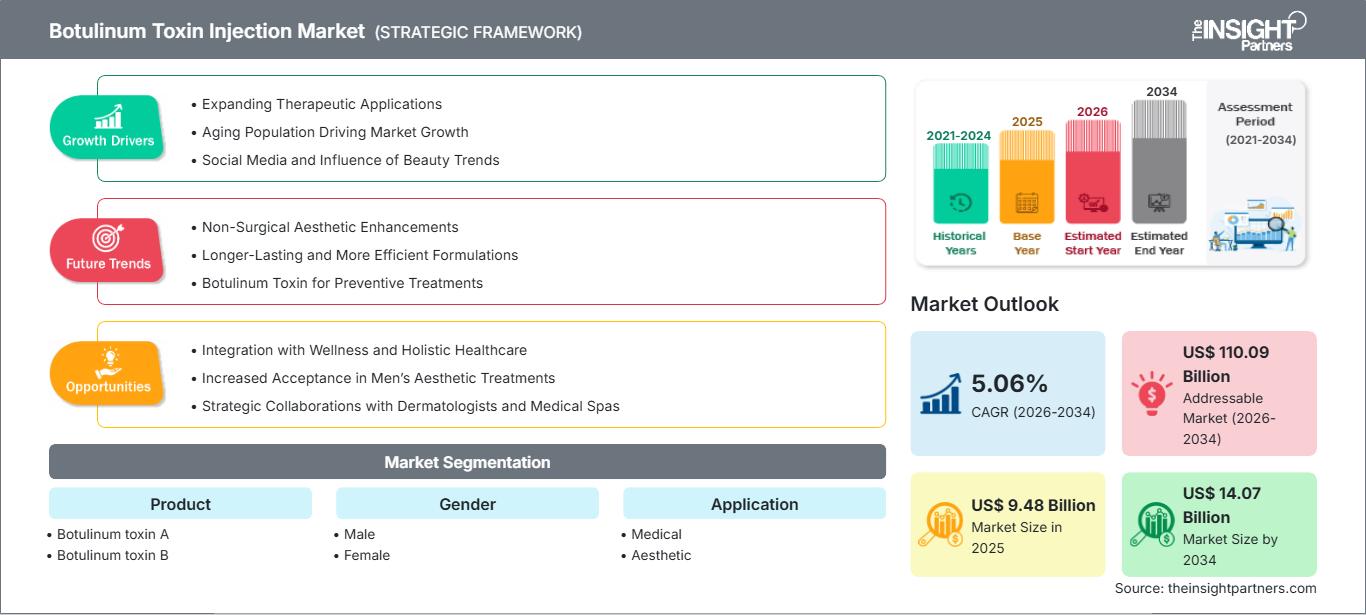
The global Botulinum Toxin Injection market was valued at US$ 9.48 billion in 2025 and is expected to reach US$ 14.07 billion by 2034; it is estimated to record a CAGR of 4.49% during 2026-2034.
Botulinum Toxin Injection Market Assessment and Insights
- North America accounted for 47–49% share in 2025 and is growing at a CAGR of 4.6–5.0% during 2026–2034, supported by high disposable income, broad FDA-approved indications, mature injector networks, and recurring procedure behaviour across aesthetic and therapeutic settings.
- US represented 84–86% of North America in 2025 and is growing at a CAGR of 4.5–4.9% during 2026–2034, led by frequent repeat treatments, prominent branded products, and strong medical spa utilization.
- Europe held 24–26% share in 2025 and is growing at a CAGR of 4.3–4.7% during 2026–2034, with Germany, the UK, France, Italy, and Spain leading demand through specialist clinics and regulated aesthetic practices.
- Asia Pacific captured 20–22% share in 2025 and is growing at a CAGR of 6.2–6.8% during 2026–2034, driven by China, Japan, South Korea, India, and Australia as procedure access widens and local brands scale.
- Largest Segment: Botulinum toxin A held 92–94% market share in 2025 and is growing at a CAGR of 5.0–5.4% during 2026–2034 due to extensive brand availability and clinical familiarity.
- High Growth Segment: Spas and Cosmetic Centers held 16–18% market share in 2025 and are growing at a CAGR of 6.4–7.0% during 2026–2034 as consumers seek convenient, lower-friction aesthetic access.
- Key companies analyzed in detail: Hugel, Inc.; AbbVie Inc.; Revance Therapeutics, Inc.; Allergan Aesthetics, an AbbVie company; Eisai Co., Ltd.; Evolus, Inc.; Medytox Inc.; Hugh Source International Limited; Merz Pharma GmbH & Co. KGaA; Ipsen Pharma.
Source: The Insight Partners' analysis based on proprietary research, government publications, company annual reports, investor presentations, industry databases, and expert interviews.
The manufacturing sector has evolved from the traditional vial approach to the more sophisticated neurotoxin platforms, cold chain adherence, and injector-specific training systems. Suppliers of the Botulinum Toxin Injection Market now have to compete not only on the basis of dosage equivalence but also in terms of duration profile, onset, brand equity, pharmacovigilance, and clinic economics. Type A is favored due to the high level of approvals in aesthetics, physician awareness, and consumer brand awareness that lies in that category while type B retains therapeutic relevance.
In the future, market growth will be driven by opportunities that lie beyond the core markets of the United States and Western Europe. Countries in Asia and the Middle East are beginning to develop in dermatology, wellness tourism, and specialty care services in order to facilitate self-pay surgeries. Regulations, reimbursement for new products, and neurological applications along with injector qualifications and counterfeit prevention efforts will drive adoption rates.
Botulinum Toxin Injection Market Report Scope
| Report Attribute | Details |
|---|---|
| Market size in 2025 | US$ 9.48 Billion |
| Market Size by 2034 | US$ 14.07 Billion |
| Global CAGR (2026 - 2034) | 4.49% |
| Historical Data | 2021-2024 |
| Forecast period | 2026-2034 |
Botulinum Toxin Injection Market Analysis
Procedure demand is influenced by repeat-use behavior, minimal invasiveness, and clinical needs. The Botulinum Toxin Injection Market growth comes from repeat customers in aesthetics, which come at intervals of three to six months, as well as patients suffering from chronic migraine, spasticity, cervical dystonia, and hyperhidrosis. The value chain consists of biologic production, formulation control, batch release tests, specialized distribution, physician training, and follow-up after treatment.
Supply is still concentrated due to the fact that toxin production involves regulatory expertise, testing of potency, sterility, and cold chain logistics. WHO emphasizes the prevalence of headache disorders as neurological diseases, whereas aesthetic societies state that botulinum toxin is the most popular nonsurgical procedure, thus driving strong medical and cosmetic demand. Increasingly, clinics are interested in suppliers who can offer not only product but also evidence, training, and patient retention solutions.
Positioning is spearheaded by AbbVie Inc., Merz Pharma GmbH & Co. KGaA, Ipsen Pharma, Revance Therapeutics, Inc., Evolus, Inc., Hugel, Inc. and Medytox Inc. on one side and Eisai Co., Ltd. and Hugh Source International Limited on the other through adjacent commercial pathways. Botulinum Toxin Injection Market report indicates that differentiation is going to be based on duration, formulation purity, branding and payor access.
The investment trend is in account-based marketing, education of physicians, direct-to-consumer awareness and geographic registration. The advantages for AbbVie Inc. lie in Botox franchise strength, Revance Therapeutics, Inc. positions with peptide-formulated approach, Evolus, Inc. with performance beauty channels and Korean players are going global with international registrations. The success factor is the need to find a balance between price competitiveness and safety documentation, clinical training and availability.
● REPORT CUSTOMIZATION
Tailor This Report To Align With Your Specific Business Requirements
This report can be customized to align precisely with your business objectives, scope, and target markets. Customization options include tailored segmentation, geography, competitive analysis, and strategic insights to support informed decision-making.
Customize This Report →WHAT YOU CAN ADJUST
- ● Segmentations
- ● Geography
- ● Competitive Analysis
- ● Language Preferences
Botulinum Toxin Injection Market: Strategic Insights
Regional Insights
North America Botulinum Toxin Injection Market
North America accounted for 47–49% share in 2025 and is projected to expand at a 4.6–5.0% CAGR during 2026–2034. The region benefits from high procedure awareness, established reimbursement for selected therapeutic indications, and dense networks of dermatology clinics, plastic surgery practices, and medical spas. Botulinum Toxin Injection Market share is strengthened by repeat users and strong brand recall.
The USA generates regional volumes, whereas Canada has its contribution through specialized aesthetic services from private clinics. The development of procedures is fueled by the aging population, preventive treatment among younger patients, as well as growing indications in neurology and urology. Access to the market is determined by payment coverage, qualification of injectors, and patient’s willingness to spend money on procedures.
U.S. Botulinum Toxin Injection Market
In 2025, the US accounted for 84-86% of the total North America and is projected to record a CAGR of 4.5-4.9% from 2026-2034. The dominance is attributed to a huge pay-as-you-go aesthetics base, high physician knowledge, robust loyalty programs, and extensive presence in hospitals, dermatology clinics, spas, and cosmetic centers.
Players like AbbVie Inc., Allergan Aesthetics, Revance Therapeutics, Inc., Evolus, Inc., Merz Pharma GmbH & Co. KGaA, and Ipsen Pharma have an active presence in either their commercial or therapeutic offerings. The need for aesthetic therapy is dominated by glabellar lines, forehead lines, and crow’s feet, whereas the need for medical usage is aided by chronic migraines, cervical dystonia, spasticity, and overactive bladder treatments.
Europe Botulinum Toxin Injection Market
Europe's share was 24–26% in 2025 and is forecast to increase at a CAGR of 4.3–4.7% from 2026 to 2034. The market in Germany is dominant, owing to the presence of specialist clinics, neurologists, dermatologists, and regulated pharmaceutical distribution. In the UK, there is robust private aesthetics demand and an increasing emphasis on practitioners' training and traceability of products.
Therapy is well developed in Germany and France in such fields as neurology, rehabilitation, and ophthalmology, while Italy and Spain contribute in the form of private aesthetic clinics and medical tourism in some cities. Legal requirements concerning advertising, injection training, and antipiracy are beneficial for current suppliers. Demand is not volatile but steady, taking into consideration the prices and prudent attitude to spending.
APAC Botulinum Toxin Injection Market
The APAC region has a 20-22% share in 2025 and is expected to register 6.2-6.8% CAGR during 2026-2034. The highest growth potential by countries is China; Japan, South Korea, India, and Australia generate demand from aesthetic medicine, dermatology, and private specialty care.
There are various possibilities for development in several areas like manufacturing in South Korea, the aging population in Japan, clinics in Indian cities, and injector laws in Australia. Accessibility has been facilitated due to biologics policies, medical tourism, and the social acceptance of non-surgical facials. The established brands are under pressure from competing local brands to protect their market position.
Middle East & Africa Botulinum Toxin Injection Market
Middle East & Africa region is expected to witness a 5.4% to 6.0% CAGR in the coming years (2026-2034), where UAE leads regional adoption via top-of-the-line dermatological clinics, medical tourism, and high disposable income urban populations. Saudi Arabia is increasing its private healthcare delivery capacity, whereas South Africa drives treatment via specialists in sub-Saharan regions.
Investment due to energy sector, hospital upgrades, and premium wellness facilities drive demand in Gulf states. Yet, disparities in provider access, time taken for product clearance, and financial barriers hinder regional penetration. Growth would be driven by authorized distribution, injector training, and combining cosmetic treatments with dermatology, plastic surgery, and neurology clinics.
Segmentation Analysis
Product
The Product segment is projected to grow at a 5.0–5.4% CAGR during 2026–2034. Botulinum Toxin Injection Market scope is anchored by type A products because most commercial brands, clinical evidence, and aesthetic use cases are concentrated in this category. Type B remains strategically relevant in selected therapeutic settings, particularly where physician choice depends on response history, tolerability, or specific clinical need.
- Botulinum toxin A dominates market position due to extensive aesthetic approvals, broad injector familiarity, strong consumer brand recognition, and wide use across facial lines, migraine, spasticity, and bladder indications.
- Botulinum toxin B serves a narrower therapeutic role, offering strategic importance for selected patients and physicians who require alternative toxin profiles, differentiated formulation behavior, or options after treatment response changes.
Gender
The Gender segment is projected to grow at a 4.8–5.2% CAGR during 2026–2034. Female consumers continue to represent the larger aesthetic base, supported by established treatment patterns and higher engagement with dermatology and cosmetic services. Male adoption is rising from a smaller base as workplace appearance, social media visibility, and minimally invasive acceptance reduce barriers to first-time treatment.
- Male demand is increasing as men seek subtle facial rejuvenation, jawline refinement, and sweat-control treatments, making this group important for clinic acquisition strategies and differentiated consultation models.
- Female users remain the core repeat-treatment population, with demand supported by preventive aesthetics, wrinkle reduction, combination treatments, and stronger familiarity with injectable maintenance cycles.
Application
The Application segment is projected to grow at a 5.1–5.5% CAGR during 2026–2034. Aesthetic use leads volume because treatments are frequent, visible, and accessible through private-pay clinics. Medical applications provide durable value through approved neurological, muscular, bladder, and sweating indications, where physician pathways and reimbursement can support repeat therapy over longer patient timelines.
- Medical applications are strategically important for chronic migraine, cervical dystonia, spasticity, overactive bladder, and hyperhidrosis, where clinical guidelines, patient persistence, and reimbursement influence treatment continuity.
- Aesthetic applications dominate procedure volume because facial wrinkle management, preventive treatment behavior, and short recovery time align with consumer preference for minimally invasive and repeatable interventions.
End User
The End User segment is projected to grow at a 5.3–5.7% CAGR during 2026–2034. Hospitals remain important for therapeutic indications and complex patient management, while dermatology clinics capture high-value aesthetic and medical cases. Spas and cosmetic centers are expanding rapidly where regulations allow supervised injectables, flexible appointments, and consumer-oriented membership models.
- Hospitals retain strategic importance for neurological, urological, and rehabilitation-related indications, especially where multidisciplinary care, reimbursement documentation, and specialist oversight are required for repeat treatment.
- Dermatology Clinics command strong revenue contribution through physician-led aesthetic care, cosmetic consultations, combination therapies, and treatment plans that integrate skin health with injectable maintenance.
- Spas and Cosmetic Centers are scaling as consumers prioritize convenience, transparent pricing, loyalty programs, and appointment flexibility, although supervision quality and product sourcing remain key risk controls.
Opportunity Snapshot
| Segment Name | Revenue Contribution | Trend Tag | Adoption Stage |
| Hospitals | Medium | Neuro Care | Mature |
| Dermatology Clinics | High | Skin Protocols | Mature |
| Spas and Cosmetic Centers | Medium | Med Spa | Scaling |
Botulinum Toxin Injection Market Growth Drivers and Impact Analysis
Rising Repeat Demand for Minimally Invasive Aesthetic Care
The consumer’s demand is moving towards processes that yield noticeable effects in absence of surgery, hospitalization, or long recovery periods. Botulinum toxin injections cater to this demand because they involve short visits, have minimal recovery period and can be planned in accordance with changing needs over time. The business benefit from this is in the establishment of a regular business model, as a lot of aesthetic clients keep coming back on a schedule. This repeat customer pattern makes inventory management easier, develops loyalty and stability on the part of the service providers and suppliers. Neurotoxins serve more as an anchor for aesthetics than a standalone treatment.
Expanding Therapeutic Use Across Neurology and Specialty Care
Indications for medical use result in a more non-discretionary demand base compared to those for aesthetic purposes alone. Patients who have a chronic migraine, spasticity, cervical dystonia, overactive bladder, or severe hyperhidrosis may need repeated treatment under the supervision of a physician. This makes demand for hospitals and specialist clinics stronger since the treatment becomes part of a wider care pathway. While coverage, documentation, and guidelines do affect adoption, they give botulinum toxin legitimacy as a medical treatment. Better diagnosis and increased knowledge of injection procedures by neurologists will help mitigate cycles in consumer spending.
Injector Training and Brand Differentiation Improving Market Access
Supplier-led education is set to be one of the key buying drivers as it plays a crucial role in the success of treatments in relation to knowledge of anatomy, dosage, patients to choose, and complications to address. Firms that offer structured education, evidence of their product's effect, and practical help may positively affect retention by physicians and high volume practices. There is a range of other factors affecting decision-making of account managers rather than prices alone, such as duration claims, onset effect, characteristics of formulations, loyalty schemes, and supply capacity.
Botulinum Toxin Injection Market Future Trends
Longer-Acting and Precision-Dosed Neurotoxin Platforms
Botulinum Toxin Injection Market trends will increasingly focus on formulations that offer longer duration, predictable onset, and more tailored dosing by facial zone or therapeutic indication. Longer-acting products could reduce annual treatment frequency for some patients, but they may also lift revenue per visit and strengthen premium positioning. Precision dosing supported by imaging, digital facial assessment, and standardized injection maps is expected to reduce variability among providers. This trend will favour suppliers that can combine differentiated clinical profiles with strong safety education, because patients and physicians will demand predictable results as treatment choices widen.
Digital Patient Engagement and Membership-Based Aesthetic Models
Clinics are expected to use digital platforms to retain patients, schedule maintenance visits, track satisfaction, and bundle neurotoxin treatments with skincare or filler services. Membership-based pricing can reduce seasonality, improve patient loyalty, and help providers forecast product needs more accurately. Suppliers may deepen integration with practice management systems, promotional compliance tools, and patient education content. Over time, data-driven retention strategies could become as important as product differentiation, particularly in competitive urban markets where consumers compare brands, injectors, duration claims, and total treatment cost before booking.
Botulinum Toxin Injection Market Opportunities
Therapeutic Expansion in Underserved Neurology Care Pathways
Therapeutic use offers a durable opportunity where access to trained injectors, diagnosis, and reimbursement remains underdeveloped. Botulinum Toxin Injection Market Forecasts indicate stronger investment potential in chronic migraine, spasticity, dystonia, and bladder-related care as specialty networks expand in middle-income countries. Companies can improve adoption by supporting physician training, payer evidence packages, and patient navigation services. The most attractive strategy is not broad promotion alone, but building referral pathways between neurologists, rehabilitation specialists, urologists, and hospitals that can identify eligible patients and maintain repeat treatment schedules.
Premium Aesthetic Clinic Networks in Urban Emerging Markets
Urban centers in Asia Pacific, the Middle East, and parts of Latin America offer attractive expansion potential because consumers are adopting minimally invasive treatments while premium clinics seek trusted brands. Suppliers can capture value by partnering with regulated clinic chains, supporting cold-chain verification, and providing injector certification programs. This opportunity is action-oriented because market entry requires localized pricing, product registration discipline, and anti-counterfeit controls. Brands that help clinics demonstrate safety, authenticity, and consistent outcomes are better positioned than those competing only through discounts or broad distributor coverage.
Recent Developments
- June 2026: Revance Therapeutics, Inc. announced Julianne Hough as celebrity brand partner for DAXXIFY, supporting consumer awareness around its peptide-formulated injectable positioning. The campaign highlights how neurotoxin brands are investing in patient education, lifestyle messaging, and differentiated aesthetics communication as competition increases among physician-dispensed injectable products.
- March 2026: Evolus, Inc. reported full-year 2025 net revenue of US$ 297.2 million, up 12% year over year, and highlighted continued Jeuveau momentum alongside its broader injectable portfolio strategy. The update underlines the role of performance beauty positioning, account penetration, and loyalty programs in competing against larger neurotoxin franchises.
- February 2026: AbbVie Inc. reported full-year 2025 Botox Cosmetic net revenues of US$ 2.602 billion and Botox Therapeutic net revenues of US$ 3.769 billion, confirming the continued scale of its neurotoxin franchise across aesthetic and medical applications despite rising competitive pressure in injectables.
Frequently Asked Questions

- Comprehensive Market Sizing and Forecast Analysis
- Detailed Segmentation Analysis
- In-Depth Market Dynamics Assessment
- Regional and Country-Level Insights
- Competitive Landscape and Company Benchmarking
- Strategic Business Intelligence
Recent Reports
Testimonials

The Insight Partners provided valuable market intelligence that supported our global go-to-market strategy. Their team was professional, responsive, and attentive to our feedback, providing thoughtful analysis and helpful methodological clarifications throughout the project.
Junmo Kim Chief Financial Officer (CFO), Enertech Co., Ltd.
The Insight Partners' SCADA System Market report is comprehensive, with valuable insights on current trends and future forecasts. The team was highly professional, responsive, and supportive throughout. We are very satisfied and highly recommend their services.
RAN KEDEM Partner, Reali Technologies LTDs
I requested a report on a very specific software market and the team produced the report in a few days. The information was very relevant and well presented. I then requested some changes and additions to the report. The team was again very responsive and I got the final report in less than a week.
JEAN-HERVE JENN Chairman, Future Analytica
We worked with The Insight Partners for an important market study and forecast. They gave us clear insights into opportunities and risks, which helped shape our plans. Their research was easy to use and based on solid data. It helped us make smart, confident decisions. We highly recommend them.
PIYUSH NAGPAL Sr. Vice President, High Beam Global
The Insight Partners delivered insightful, well-structured market research with strong domain expertise. Their team was professional and responsive throughout. The user-friendly website made accessing industry reports seamless. We highly recommend them for reliable, high-quality research services
YUKIHIKO ADACHI CEO, Deep Blue, LLC.
This is the first time I have purchased a market report from The Insight Partners.While I was unsure at first, I visited their web site and felt more comfortable to take the risk and purchase a market report.I am completely satisfied with the quality of the report and customer service. I had several questions and comments with the initial report, but after a couple of dialogs over email with their analyst I believe I have a report that I can use as input to our strategic planning process.Thank you so much for taking the extra time and making this a positive experience.I will definitely recommend your service to others and you will be my first call when we need further market data.
JOHN SUZUKI President and Chief Executive Officer, Board Director, BK Technologies
I wish to appreciate your support and the professionalism you displayed in the course of attending to my request for information regarding to infectious disease IVD market in Nigeria. I appreciate your patience, your guidance, and the fact that you were willing to offer a discount, which eventually made it possible for us to close a deal. I look forward to engaging The Insight Partners in the future, all thanks to the impression you have created in me as a result of this first encounter.
DR CHIJIOKE ONYIA MANAGING DIRECTOR, PineCrest Healthcare Ltd.Reason to Buy
- Informed Decision-Making
- Understanding Market Dynamics
- Competitive Analysis
- Identifying Emerging Markets
- Customer Insights
- Market Forecasts
- Risk Mitigation
- Boosting Operational Efficiency
- Strategic Planning
- Investment Justification
- Tracking Industry Innovations
- Aligning with Regulatory Trends





 Get Free Sample for