
Braiding Machines Market Size, Share & Growth by 2034
Coverage: by Type (Horn Gear Braider, Track and Column Braider, Wardwell Rapid Braider, Others); End-user (Textile, Electrical, Marine, Others) , and Geography (North America, Europe, Asia Pacific, and South and Central America)
- Status : Data Released
- Report Code : TIPRE00010597
- Category : Manufacturing and Construction
- No. of Pages : 150
- Available Report Formats :


- Last update date : September 07, 2026


2025 Market Size
US$ 523.31 Mn
Base year value
2034 Forecast
US$ 666.44 Mn
Projected by 2034
CAGR 2026-2034
2.72 %
Growth rate
Addressable Market
US$ 5,399.07 Mn
(2026-2034)
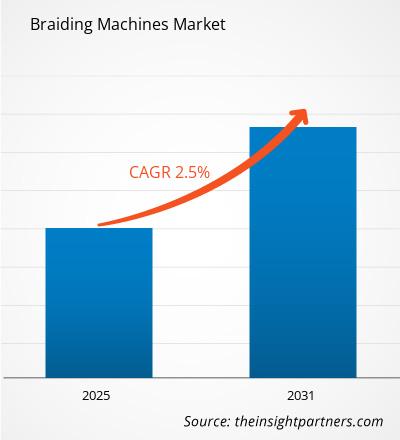
The braiding machines market size reached US$ 523.31 Million in 2025 and is projected to reach US$ 666.44 Million by 2034, advancing at a CAGR of 2.72% during 2026–2034. Demand reflects measured capital replacement across established textile operations and expanding requirements for precisely reinforced cables, marine lines, hoses, and engineered components. Equipment upgrades increasingly prioritize repeatable tension control, lower maintenance, flexible carriers, and programmable production, supporting steady rather than cyclical expansion across diversified industrial end users.
Purchases in North America are forecast to grow at an estimated 2.4–2.8% CAGR up to 2034 on account of the growth of reshoring of cable harnesses, as well as overseas, medical, and military productions that will create opportunities for replacement. The braiding machines market share benefits from manufacturers seeking shorter setup times, traceable process parameters, and domestic technical support. Capital spending remains selective, however, because long machine service lives encourage retrofits and controls upgrades before wholesale fleet replacement.
Braiding Machines Market Assessment and Insights
- North America: Share in 2025 is modeled at 22–25%, with CAGR between 2026–2034 of 2.4–2.8%, supported by harness localization, medical-device capacity, cable investment, and demand for serviceable automated equipment.
- US: Represented 79–82% of North American revenue in 2025 and is expected to record a 2.5–2.9% CAGR during 2026–2034.
- Europe: Share in 2025 is modeled at 24–27%, with CAGR between 2026–2034 of 2.3–2.7%; Germany leads, while Italy, Spain, France, and the UK sustain specialist machinery and technical-textile demand.
- Asia Pacific: Share in 2025 is modeled at 43–47%, with CAGR between 2026–2034 of 2.9–3.3%; China leads, supported by Japan, South Korea, India, and Australia.
- Largest Segment: Textile held an estimated 45–49% market share in 2025 and is projected to grow at a 2.3–2.7% CAGR during 2026–2034.
- High Growth Segment: Electrical accounted for an estimated 29–33% market share in 2025 and is forecast to expand at a 3.1–3.5% CAGR during 2026–2034.
- Key companies analyzed in detail: Mayer & Cie. GmbH & Co. KG, HERZOG GmbH, Machine Solutions Inc. (Steeger USA), Wardwell Braiding Co., Cobra Braiding Machinery Ltd., Kyang Yhe Delicate Machine Co., Ltd., Talleres Ratera, S.A., Spirka Schnellflechter GmbH, OMEC S.r.l., and O.M.A. S.r.l.
Source: The Insight Partners' analysis based on proprietary research, government publications, company annual reports, investor presentations, industry databases, and expert interviews.
Production is moving away from manually controlled braiders and towards electronic controls, recipe holding, take-up coordination and better yarn or wire tension control. Manufacturers are offering families of machines suited for different carrier counts and material types but allowing a shorter engineering cycle time than before. Modular guarding, access design, and predictive maintenance capabilities are affecting buying decisions as well as throughput. The trend favors companies that can offer winding, payoff, braiding and inspection capabilities and keep spare parts available for long equipment lifetime.
For the period through 2034, new investments should be made in manufacturing clusters in Asia, localized supply chain networks in North America and technical textile facilities in Europe. Machines with adaptability to electrical protection, lightweight composite, marine cordage and controlled medical production should attract investment. Efficiency requirements and workplace safety considerations will affect the control system and cabinet design while repeatable process operation will be expected from the customer. The market will grow incrementally due to durability of installed fleets that limits replacement.
Braiding Machines Market Report Scope
| Report Attribute | Details |
|---|---|
| Market size in 2025 | US$ 523.31 Million |
| Market Size by 2034 | US$ 666.44 Million |
| Global CAGR (2026 - 2034) | 2.72% |
| Historical Data | 2021-2024 |
| Forecast period | 2026-2034 |
Braiding Machines Market Analysis
The braiding machines market growth is tied to consumption of reinforced products, not just production of textiles. Wire harnesses, shielded cable, pressure hose, rope, and narrow technical fabrics need consistent geometry and control of coverage. Total costs, downtime, scrap, safety, and maintenance are considered by buyers. ITMF's March 2025 survey showed 73% capacity use in the textile industry and 2.2 month order backlog, suggesting prudent investment instead of expansion across the board.
The value chain involves precision machine ways and carriers, motors, controls, spools, payoffs, take-ups, safety guards, and application engineering. Metals, electronics, and custom components affect scheduling. Supplier qualification could add to acceptance cycles. Machining capability in-house or standardized assemblies provide a supplier with an advantage. Aftermarket parts and training along with rebuilds provide stability for revenues, since machines last many years after installation.
The braiding machines market report shows a fragmented competitive field with differentiation rooted in application knowledge. HERZOG GmbH and O.M.A. S.r.l. span broad industrial needs, while Machine Solutions Inc. positions Steeger USA around precision medical and technical braiding. Wardwell Braiding Co. combines wire, cable, and harness equipment with established aftermarket coverage. Talleres Ratera, S.A., Spirka Schnellflechter GmbH, and OMEC S.r.l. reinforce Europe’s specialist base.
Expenditures are focused on controls, modularity, capability of demonstrating performance, and production equipment as opposed to capacity alone. HERZOG's 2025 open house showcased over 60 machines and over 40 new or advanced development products, exemplifying the extensive range necessary to cater to varied applications. Cobra Braiding Machinery Ltd., Kyang Yhe Delicate Machine Co., Ltd., and Mayer & Cie. GmbH & Co. KG offer competition via specialization, regional presence, and customization.
● REPORT CUSTOMIZATION
Tailor This Report To Align With Your Specific Business Requirements
This report can be customized to align precisely with your business objectives, scope, and target markets. Customization options include tailored segmentation, geography, competitive analysis, and strategic insights to support informed decision-making.
Customize This Report →WHAT YOU CAN ADJUST
- ● Segmentations
- ● Geography
- ● Competitive Analysis
- ● Language Preferences
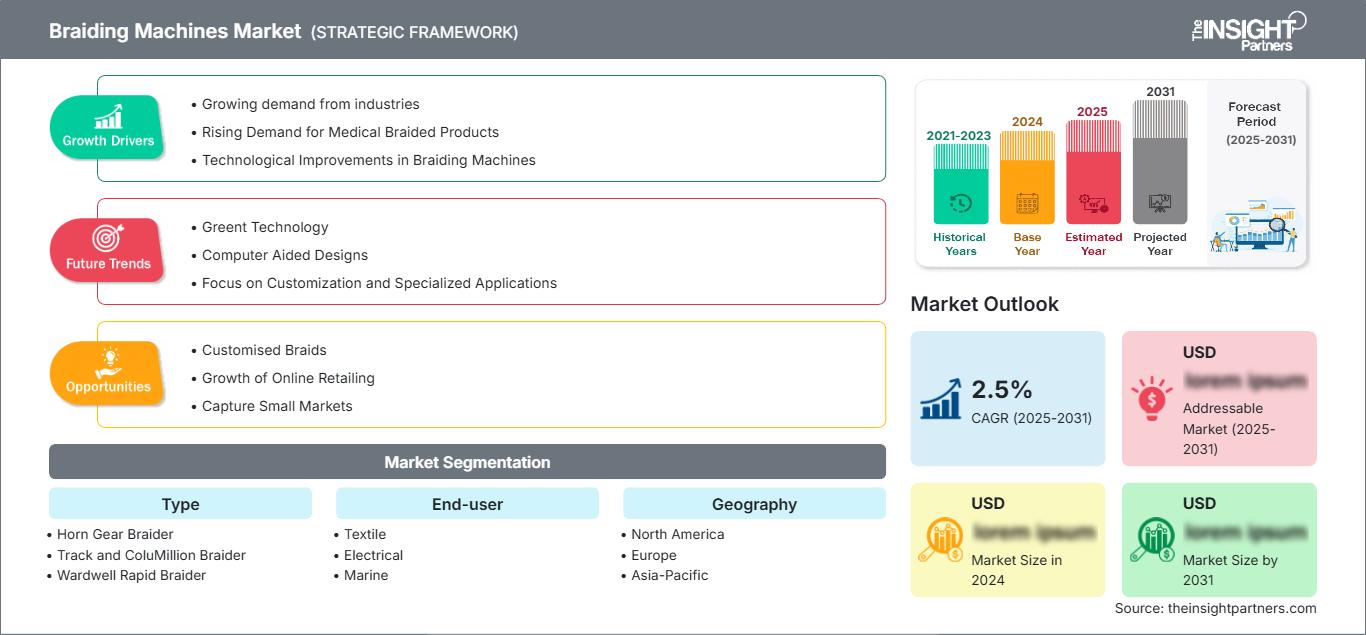
Braiding Machines Market: Strategic Insights
Regional Insights
North America braiding machines market
North America represented a modeled 22–25% share in 2025 and should advance at a 2.4–2.8% CAGR through 2034. The braiding machines market share reflects a mature installed base across cable, hose, aerospace, defense, and medical manufacturing. Replacement cycles are long, but reshoring and supplier-risk mitigation encourage investment in flexible equipment, domestic commissioning, recipe control, and reliable spare-parts support.
The demand is also aided by offshore energy cabling, electrified vehicles, data infrastructure, and minimally invasive medical devices, which need braided reinforcements. The Wardwell Braiding Co. and Machine Solutions Inc. play an important role in providing application services in the United States, whereas their competitors in Europe do so via modern platforms. Customers now demand enclosures for machines, help in setting up machines digitally, documentation of tensions, and fast changeovers. Canada is involved in cable, marine, mining, and industrial hose applications, and Mexico provides harness and appliance production due to its regional manufacturing network. Growth is moderate due to frequent rebuilding of machines instead of buying new platforms.
U.S. braiding machines market
The U.S. braiding machines market accounted for 79–82% of North American revenue in 2025 and is projected to expand at a 2.5–2.9% CAGR through 2034. Its concentration reflects broad demand from electrical harnesses, industrial hose, defense systems, medical catheters, and specialty textiles. Domestic machine builders and service teams shorten commissioning and repair cycles, an important advantage for plants operating qualified processes.
Machine Solutions Inc. is offering Steeger USA machines for fine wire and medical applications where the carriers may range from standard 8 carrier machines to very high carrier machines. Wardwell Braiding Company caters to wire, cable, textile, and harness manufacturing and declares that it caters to its customers in over 50 countries. The applications show trends towards programmable braid density, motion controlled pick counts, ergonomic horizontal harnessing, and incorporating winding in the process. Federal construction projects, grid upgrade projects, aerospace purchases, and semiconductor facility builds create indirect demand for cables and protective sleeve applications. However, the customers consider cost of utilization and qualification, which makes process capability and upgrading important in awarding projects.
Europe braiding machines market
The Europe braiding machines market held a 24–27% share in 2025 and is forecast to record a 2.3–2.7% CAGR through 2034. Germany leads through its machinery engineering, automotive wiring, medical manufacturing, and technical-textile base. HERZOG GmbH and Spirka Schnellflechter GmbH support application breadth, while sustainability rules encourage energy-efficient drives, longer equipment life, safer guarding, and documented production control.
In the UK market, the focus is on aerospace, defense, composite preforms, and rope or cable specialty applications; flexibility and service are prioritized for lower volume systems. Italy utilizes its expertise in textile machinery production along with production of hoses, fashion, and industrial braids, with companies such as O.M.A. S.r.l. and OMEC S.r.l. providing additional support. The Spanish market is helped by the presence of Talleres Ratera, S.A., while France adds aerospace, transportation, energy, and medical needs. The issue of regulatory traceability increases control components. In all of these markets, modernization tends to occur via selective retrofits and machine replacements rather than new installations.
APAC braiding machines market
The Asia Pacific braiding machines market led with a modeled 43–47% share in 2025 and is expected to grow at a 2.9–3.3% CAGR through 2034. China remains the leading country because of its large textile, cable, hose, marine, and machinery supply chains. Japan and South Korea prioritize precision, automation, and advanced materials.
Advantages that India has include expansion of its electrical infrastructure, technical textiles, and domestic production inducements, whereas contributions from Australia relate to mining, maritime, and energy sectors. The company Kyang Yhe Delicate Machine Co., Ltd. enhances local supply of machines. Policies encouraging industrial modernization and exports have led to increased usage of digitally controlled machines.
Middle East & Africa braiding machines market
The Middle East and Africa braiding machines market is projected to expand at a 2.6–3.0% CAGR through 2034, from a comparatively small base. Saudi Arabia leads through energy, industrial localization, cable, hose, and infrastructure investment. The UAE adds marine services, logistics, utilities, and advanced manufacturing requirements.
While South Africa provides support for mining, energy, wiring, and technical textiles sectors, the Rest of MEA is project-driven and service-oriented. Consumers usually prefer robust machinery, easy maintenance, remote diagnostics, and reliability of spare parts. Opportunities exist in terms of diversification and new infrastructure, but equipment cost and financing limitations prevent rapid adoption.
Segmentation Analysis
Type
Type is expected to expand at a 2.6–3.0% CAGR during 2026–2034. The braiding machines market scope spans economical circular mechanisms, programmable track systems, and rapid specialist configurations. Selection depends on braid geometry, carrier count, material sensitivity, output diameter, changeover frequency, and target productivity. Modular controls increasingly allow manufacturers to serve several product families from a common mechanical platform.
- Horn Gear Braider: Maintains a strong position in standardized rope, cord, hose, and textile work where mechanical simplicity, predictable maintenance, and cost-efficient continuous output matter most.
- Track and ColuMillion Braider: Serves complex profiles and advanced preforms requiring controlled carrier paths, flexible architecture, and precise yarn placement, making it strategically important for composites and technical applications.
- Wardwell Rapid Braider: Addresses wire and cable producers prioritizing high line speed, dependable coverage, coordinated payoff and take-up, and established aftermarket support for production-critical equipment.
End-user
End-user demand is forecast to grow at a 2.7–3.1% CAGR during 2026–2034. Textile remains the volume foundation, while electrical applications provide faster expansion through harness protection, shielding, and infrastructure cables. Marine purchasing emphasizes abrasion resistance and dependable heavy-material handling. Across users, capital approval increasingly depends on measurable scrap reduction, quick product changeover, safe operation, and local service.
- Textile: Retains the largest installed base through cords, laces, narrow fabrics, ropes, and technical products, with replacement demand shaped by labor efficiency and diversified output requirements.
- Electrical: Gains strategic importance as vehicles, grids, data systems, and industrial automation require protected harnesses and shielded cable, supporting demand for consistent braid coverage and traceable settings.
- Marine: Represents a specialized market for ropes, lines, nets, and reinforced products, where corrosion exposure, high loads, abrasion resistance, and dependable handling define machine specifications.
Opportunity Snapshot
| End Users | Revenue Contribution | Trend Tag | Adoption Stage |
| Textile | High | Technical Fabrics | Mature |
| Electrical | High | Harness Shielding | Scaling |
| Marine | Medium | Offshore Cordage | Scaling |
Braiding Machines Market Growth Drivers and Impact Analysis
Electrification Expands Protective Braiding Requirements
Electrified transportation, strengthened grids, power from renewables, and manufacturing automation are driving up both the quantity and the complexity of cables that need protection from interference, wear, tension, or flexibility. Braiding turns metal wire or synthetic fiber into consistent protective systems without adding unnecessary bulk. Demand for equipment increases when cable manufacturers have to change diameters, materials, and coverage requirements while keeping production lines running. This is true especially for those equipment lines that incorporate programmed speed control, coordinated winding, automatic set-up, and quality documentation. Equipment suppliers who can demonstrate coverage validation and application testing are able to compete in more complex electrical products. Growth is constrained somewhat by cable design replacement and customers' re-use of existing braiders.
Automation Improves Economics of Shorter Production Runs
The customer base is increasingly producing greater variety of products in small batch sizes, where the costs of setup, testing of material, and adjusting by operators become prohibitive. With the use of recipe management, electronic pitch control, synchronized winding, and quick carrier changes, nonproductive time is minimized, along with improving consistency from shift to shift. The automation enables an investment even in the case where there is little growth in end-use volumes. The practical impact comes through the form of decreased scrap, faster qualification, and better efficiency instead of simply increased speed. The machine manufacturers differentiate themselves through intuitive controls, remote monitoring, alarms, and ability to retrofit existing machines. The adoption varies among smaller textile manufacturers because of the increased cost due to controls and the need for training.
Technical Applications Raise Process-Precision Requirements
Medical devices, aerospace harnesses, composite preforms, pressure hoses, and offshore products demand controlled braid angle, tension, density, and material handling. These specifications shift purchasing away from general-purpose capacity toward application-engineered systems with stable carriers, accurate motion, and validation support. Precision also expands ancillary demand for bobbin winding, payoff, take-up, inspection, and operator training. Manufacturers benefit when customers value lifecycle performance over initial price, but qualification cycles become longer and service obligations more demanding. The impact favors experienced suppliers with demonstration laboratories, installed references, and the ability to customize without creating unsupported one-off designs. It also encourages common modular platforms that preserve repeatability while accommodating different carrier counts, mandrel geometries, and sensitive fibers or wires.
Braiding Machines Market Future Trends
Connected Controls Become a Standard Buying Criterion
The braiding machines market trends will increasingly center on connected controls that preserve recipes, record alarms, monitor utilization, and support remote troubleshooting. Customers will expect data interfaces compatible with plant systems, especially where production is validated or distributed across several sites. Connectivity should reduce service travel and accelerate root-cause analysis, but buyers will scrutinize cybersecurity, access control, and long-term software support. Suppliers that separate essential machine operation from optional cloud functions can address conservative factories without limiting digital value. Over time, operating data may enable condition-based maintenance for carriers, bearings, tracks, and drives, converting aftermarket service from reactive parts supply into planned lifecycle support.
Material Diversity Reshapes Carrier and Tension Design
Future platforms will handle a broader mix of fine metal wire, high-performance polymer fiber, recycled yarn, carbon fiber, and hybrid bundles. Each material presents different friction, breakage, static, and tension behavior, increasing the value of configurable carriers and controlled payout. Machine builders will pursue wider process windows without sacrificing speed or braid uniformity. This direction supports modular guides, low-friction contact surfaces, automated tension feedback, and application-specific enclosures. Customers may consolidate several legacy machines into flexible cells, but qualification requirements will limit abrupt migration. Suppliers that combine material trials with reproducible setup documentation will be better positioned to capture emerging technical applications.
Braiding Machines Market Opportunities
Retrofit Programs for Aging Installed Fleets
Large numbers of durable mechanical braiders remain productive, creating an addressable retrofit market for drives, guarding, controls, winding, and tension systems. braiding machines market forecasts support a service-led strategy because modest global expansion coexists with customers seeking efficiency without replacing proven frames. Manufacturers can audit fleets, prioritize bottlenecks, and offer staged upgrade packages with documented safety and productivity outcomes. Recurring revenue can come from parts kits, training, preventive maintenance, and remote support contracts. Execution requires disciplined obsolescence management and compatibility records. Suppliers should standardize retrofit modules by installed model while preserving engineered options for high-value lines, thereby improving margins without creating excessive project complexity.
Recent Developments
- January 2025: HERZOG GmbH introduced a new modular braiding machine platform with advanced automation capabilities, enabling faster changeovers and improved material handling for textile and composites applications across European markets.
- July 2025: German textile machinery manufacturer Mayer & Cie. has delivered its first MR-15 braiding machine equipped with 48 carriers, marking another milestone in the company’s expansion of its braiding technology business. The machine was completed and shipped from the company’s Albstadt facility at the end of July 2025. The delivery follows the earlier dispatch of a 48-carrier MR-11 machine in late 2024, highlighting the company’s continued development of larger-capacity braiding systems.
Frequently Asked Questions

- Comprehensive Market Sizing and Forecast Analysis
- Detailed Segmentation Analysis
- In-Depth Market Dynamics Assessment
- Regional and Country-Level Insights
- Competitive Landscape and Company Benchmarking
- Strategic Business Intelligence
Recent Reports
Testimonials

The Insight Partners provided valuable market intelligence that supported our global go-to-market strategy. Their team was professional, responsive, and attentive to our feedback, providing thoughtful analysis and helpful methodological clarifications throughout the project.
Junmo Kim Chief Financial Officer (CFO), Enertech Co., Ltd.
The Insight Partners' SCADA System Market report is comprehensive, with valuable insights on current trends and future forecasts. The team was highly professional, responsive, and supportive throughout. We are very satisfied and highly recommend their services.
RAN KEDEM Partner, Reali Technologies LTDs
I requested a report on a very specific software market and the team produced the report in a few days. The information was very relevant and well presented. I then requested some changes and additions to the report. The team was again very responsive and I got the final report in less than a week.
JEAN-HERVE JENN Chairman, Future Analytica
We worked with The Insight Partners for an important market study and forecast. They gave us clear insights into opportunities and risks, which helped shape our plans. Their research was easy to use and based on solid data. It helped us make smart, confident decisions. We highly recommend them.
PIYUSH NAGPAL Sr. Vice President, High Beam Global
The Insight Partners delivered insightful, well-structured market research with strong domain expertise. Their team was professional and responsive throughout. The user-friendly website made accessing industry reports seamless. We highly recommend them for reliable, high-quality research services
YUKIHIKO ADACHI CEO, Deep Blue, LLC.
This is the first time I have purchased a market report from The Insight Partners.While I was unsure at first, I visited their web site and felt more comfortable to take the risk and purchase a market report.I am completely satisfied with the quality of the report and customer service. I had several questions and comments with the initial report, but after a couple of dialogs over email with their analyst I believe I have a report that I can use as input to our strategic planning process.Thank you so much for taking the extra time and making this a positive experience.I will definitely recommend your service to others and you will be my first call when we need further market data.
JOHN SUZUKI President and Chief Executive Officer, Board Director, BK Technologies
I wish to appreciate your support and the professionalism you displayed in the course of attending to my request for information regarding to infectious disease IVD market in Nigeria. I appreciate your patience, your guidance, and the fact that you were willing to offer a discount, which eventually made it possible for us to close a deal. I look forward to engaging The Insight Partners in the future, all thanks to the impression you have created in me as a result of this first encounter.
DR CHIJIOKE ONYIA MANAGING DIRECTOR, PineCrest Healthcare Ltd.Reason to Buy
- Informed Decision-Making
- Understanding Market Dynamics
- Competitive Analysis
- Identifying Emerging Markets
- Customer Insights
- Market Forecasts
- Risk Mitigation
- Boosting Operational Efficiency
- Strategic Planning
- Investment Justification
- Tracking Industry Innovations
- Aligning with Regulatory Trends





 Get Free Sample for