
Brewery Equipment Market Size, Demand & Growth by 2034
Coverage: By Mode of Operation (Manual, Automatic, Semi-Automatic); Brewery Type (Macro brewery, Craft Brewery); Equipment Type (Macro brewery Equipment, Craft Brewery Equipment) , and Geography (North America, Europe, Asia Pacific, and South and Central America)
- Status : Data Released
- Report Code : TIPRE00004532
- Category : Manufacturing and Construction
- No. of Pages : 150
- Available Report Formats :


- Last update date : July 17, 2026


2025 Market Size
US$ 23.74 Bn
Base year value
2034 Forecast
US$ 39.38 Bn
Projected by 2034
CAGR 2026-2034
5.78 %
Growth rate
Addressable Market
US$ 285.96 Bn
(2026-2034)
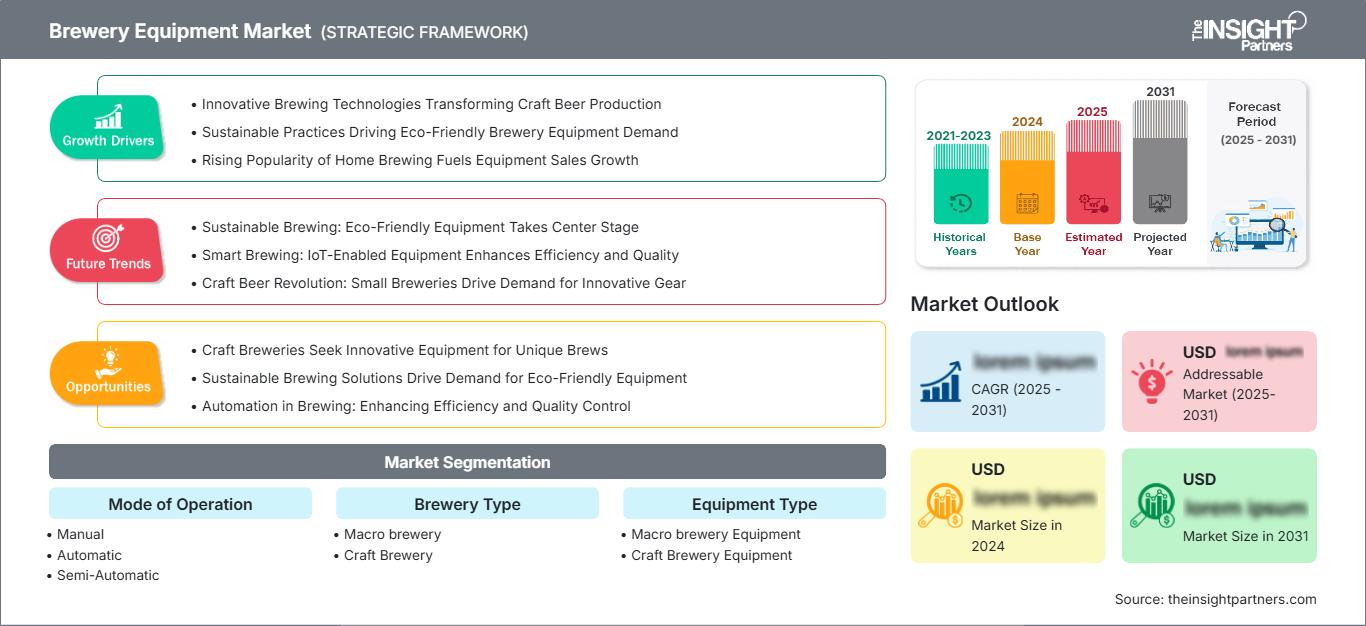
The brewery equipment market is projected to increase from US$ 23.74 Billion in 2025 to US$ 39.38 Billion by 2034, registering a CAGR of 5.78% during 2026–2034. The market is shaped by capacity modernization across industrial breweries, automation in craft production, and replacement demand for efficient brewhouses, fermentation systems, filtration units, and packaging lines that improve throughput, consistency, and resource performance.
Across North America, the brewery equipment market size is expected to advance at an estimated 5.4–5.9% CAGR through 2034, supported by craft brewery renewal cycles and industrial brewers’ focus on water, energy, and labor efficiency. Demand is strongest for automated cellar systems, centrifuges, hygienic heat exchangers, and modular brewhouses that help producers maintain product differentiation while managing tighter margins and compliance needs.
Brewery Equipment Market Assessment and Insights
- North America held 31–34% share in 2025 and is projected to grow at a CAGR of 5.4–5.9% during 2026–2034, driven by craft upgrades and automation-led replacement demand.
- US accounted for 78–82% of North America in 2025 and is expected to expand at a CAGR of 5.2–5.7% during 2026–2034.
- Europe represented 29–32% share in 2025 and is forecast to grow at 4.9–5.4% CAGR, led by Germany, the UK, France, Italy, and Spain.
- Asia Pacific captured 24–27% share in 2025 and is expected to grow at 6.4–6.9% CAGR, with China, India, Japan, South Korea, and Australia supporting new capacity.
- Largest Segment Macro brewery Equipment accounted for 61–64% market share in 2025 and is projected to grow at 5.1–5.6% CAGR during 2026–2034.
- High Growth Segment Automatic systems held 36–39% share in 2025 and are projected to grow at 6.5–7.0% CAGR during 2026–2034.
- Key companies analyzed in detail: Alfa Laval AB, GEA Group Aktiengesellschaft, Krones AG, Paul Mueller Company, Praj Industries Limited, Meura SA, Della Toffola S.p.A., Criveller Group, KASPAR SCHULZ Brauereimaschinenfabrik & Apparatebauanstalt GmbH, BrauKon GmbH.
Source: The Insight Partners' analysis based on proprietary research, government publications, company annual reports, investor presentations, industry databases, and expert interviews.
Equipment has evolved from simple vessel purchases into complex processing platforms that incorporate automation of the brew house, heat recovery, cleaning-in-place, oxygen management, and data driven quality monitoring. Beer production in the global market was relatively static in 2024 with the top 40 brewing companies producing 1,639 million hectoliters showing that efficiency rather than growth in volumes is driving investments. This means that the market is connected to margin protection, recipe flexibility, and sustainable utilities.
The future capital investment in equipment is forecasted to become more pronounced in the Asia Pacific region, in the export areas of Latin America, and in high-quality markets where there is a trend from manual work to semi-automated and automated processes. Water discharge, food safety, and energy efficiency legislation will encourage investments in separators, pasteurizers, filters, and packing lines.
Brewery Equipment Market Report Scope
| Report Attribute | Details |
|---|---|
| Market size in 2025 | US$ 23.74 Billion |
| Market Size by 2034 | US$ 39.38 Billion |
| Global CAGR (2026 - 2034) | 5.78% |
| Historical Data | 2021-2024 |
| Forecast period | 2026-2034 |
Brewery Equipment Market Analysis
Drivers for the market include replacing older brewhouses, increasing craft brewing, and efforts to cut down on water and energy consumption. There is an emphasis in breweries on equipment that will help them minimize batch time, maximize efficiency, and maintain consistent flavor regardless of the recipes used. The demand is positively affected by the increase in the production of non-alcoholic and light beers that need better temperature management and separation.
The players in the ecosystem are stainless steel tank producers, automation companies, valve/pump producers, filter systems providers, packaging systems, and service providers. The dynamics of the supply chain rely on the cost of steel, the availability of control components, and the local engineering skills. More and more, manufacturers want to see their suppliers deliver package solutions comprising brewhouse, utilities, installation, training, and after-installation services.
The brewery equipment market analysis indicates a moderately concentrated competitive environment at the high-capacity end, while craft systems remain fragmented. In terms of separation, heat transfer, and process modules, ALFA LAVAL AB and GEA Group Aktiengesellschaft, whereas KRONES AG offers competitive advantages in terms of filling, packaging, and entire beverage line. Paul Mueller Company, Meura SA, and Praj Industries Limited are other players who possess specialization and different regions.
The latest trends for investments include cost of ownership, lifecycle maintenance, and monitoring via digital solutions as opposed to separate purchase of machinery. Such companies as Della Toffola S.p.A., Criveller Group, KASPAR SCHULZ Brauereimaschinenfabrik & Apparatebauanstalt GmbH, and BrauKon GmbH offer products for flexible crafts and middle-scale facilities. The differentiation takes place based on the hygiene, setup period, energy efficiency, and local services.
● REPORT CUSTOMIZATION
Tailor This Report To Align With Your Specific Business Requirements
This report can be customized to align precisely with your business objectives, scope, and target markets. Customization options include tailored segmentation, geography, competitive analysis, and strategic insights to support informed decision-making.
Customize This Report →WHAT YOU CAN ADJUST
- ● Segmentations
- ● Geography
- ● Competitive Analysis
- ● Language Preferences
Brewery Equipment Market: Strategic Insights
Regional Insights
North America Brewery Equipment Market
North America held 31–34% share in 2025 and is expected to grow at 5.4–5.9% CAGR during 2026–2034. North American brewery equipment market share is underpinned by a large installed base of craft breweries, mature macro facilities, and frequent upgrades to fermentation, cooling, and packaging systems that support premium, seasonal, and low-alcohol product lines.
Purchasing patterns are shaped by energy costs, labor scarcity, and quality consistency requirements. U.S. craft brewery closures have made buyers more selective, but surviving producers are investing in automation, efficient centrifuges, and modular brewhouses. Canada and Mexico add demand through export-oriented beverage production and modernization of industrial brewing assets.
U.S. Brewery Equipment Market
In 2025, the U.S. made up 78-82% of North America, while the forecasted CAGR for the period between 2026 and 2034 would be 5.2-5.7%. The key factors behind the demand include craft breweries that are increasing cellar capacity, regional breweries seeking flexibility in packaging, and big breweries requiring fast fill and process utility.
The participants will be a number of companies such as the Paul Mueller Company for stainless systems for the local market, Krones AG for the automation in packaging, and Alfa Laval AB for heat exchangers and separators. The applications will move to hazy ales, beer alongside hard seltzers, non-alcoholic, and craft beers which require quick changeovers and oxygen management.
Europe Brewery Equipment Market
The Europe share was 29-32% in 2025 and forecasted to increase at 4.9-5.4% CAGR until 2034; Germany will be dominating the region. The UK boosts its demands with the presence of brewpubs and production of premium ale; Germany has the well-developed brewing sector that focuses on highly-efficient brewhouses, hygienic design, and adherence to production norms.
France, Italy, and Spain boost their investments in the development of craft breweries, tourism-related breweries, and flexible packaging. Energy efficiency requirements and diversification of beverages affect equipment purchases. Among the companies benefiting from regional engineering are Krones AG, GEA Group Aktiengesellschaft, Meura SA, Della Toffola S.p.A., KASPAR SCHULZ Brauereimaschinenfabrik & Apparatebauanstalt GmbH, and BrauKon GmbH.
APAC Brewery Equipment Market
APAC commanded 24–27% market share in 2025 and is forecasted to show CAGR of 6.4–6.9%, the highest among all regions. China continues dominating in terms of capacity, but India, Japan, South Korea, and Australia drive the demand via premiumization, craft taprooms, and beer innovation.
Food processing policy, development of cold chain, and local manufacturing reduce the equipment costs. Breweries in APAC are using automatic brewhouses, fermentation control and utilities to ensure high production volume along with product quality. The company Praj Industries Limited is specifically useful for those customers who seek local solutions.
Middle East & Africa Brewery Equipment Market
The Middle East & Africa market will see a 5.8–6.3% CAGR during 2026–2034, driven by South Africa. Saudi Arabia and the UAE drive demand via infrastructure for beverages and non-alcoholic malt. South Africa drives commercial brewing demand.
Purchasing depends on energy supply, water availability, and import dependency. Purchasers focus on durability, energy utilization, and utility systems for hot climates. Demand from RoMEA is slow but driven by hospitality, urbanization, and malt production facilities investments.
Segmentation Analysis
Mode of Operation
Mode of Operation is expected to grow at 5.7–6.2% CAGR during 2026–2034. The brewery equipment market scope across manual, semi-automatic, and automatic systems reflects different capital budgets and production ambitions. Automatic platforms are gaining share in high-throughput facilities, while semi-automatic systems remain practical for craft brewers seeking consistency without excessive upfront investment.
- Manual systems remain relevant for small brewpubs, pilot lines, and low-volume producers that prioritize hands-on recipe control, lower capital expenditure, and operational simplicity over throughput efficiency.
- Automatic systems are strategically important for macro breweries and expanding craft producers seeking labor savings, repeatability, recipe management, remote monitoring, and lower batch-to-batch variability.
- Semi-Automatic systems balance affordability and process control, supporting mid-sized breweries that need improved temperature regulation, pumping, and cleaning routines without fully integrated automation architecture.
Brewery Type
Brewery Type is projected to grow at 5.5–6.0% CAGR during 2026–2034. Macro breweries drive large-ticket investments in filling, utilities, fermentation, and filtration, while craft breweries generate frequent demand for modular, recipe-flexible systems. The segment is shaped by volume economics, premium product launches, and the need to reduce downtime during changeovers.
- Macro brewery demand is tied to high-volume production, plant modernization, and energy-efficient utilities, making reliability, automation, and high-speed packaging integration central procurement criteria.
- Craft Brewery adoption focuses on flexible brewhouses, compact fermentation tanks, taproom-linked production, and scalable systems that allow seasonal recipes and premium small-batch releases.
Equipment Type
Equipment Type is expected to grow at 5.6–6.1% CAGR during 2026–2034. Macro brewery equipment remains the largest revenue contributor because large plants require integrated systems and service contracts. Craft brewery equipment is expanding faster in unit terms as entrepreneurs and regional brewers seek flexible, lower-capacity lines.
- Macro brewery Equipment includes large brewhouses, fermentation halls, filtration, pasteurization, and packaging lines where uptime, hygiene, and lifecycle service determine procurement decisions.
- Craft Brewery Equipment covers compact brewhouses, cellar tanks, kegging, canning, and pilot systems designed for recipe agility, constrained spaces, and phased capacity expansion.
Opportunity Snapshot
| Equipment Type | Revenue Contribution | Trend Tag | Adoption Stage |
| Macro brewery Equipment | High | Plant Automation | Mature |
| Craft Brewery Equipment | Medium | Flexible Batches | Scaling |
Brewery Equipment Market Growth Drivers and Impact Analysis
Automation to Offset Labor and Quality Pressures
Breweries are ramping up their automation efforts in order to become less reliant on manual observation, enhance consistency within recipes, and minimize waste due to inconsistencies during fermentation or cleaning processes. The automation of control systems, sensors, valves, and data collection helps the brewery operator manage temperature, pressure, oxygenation, and cleaning processes without deviation. This effect will be seen most strongly in regional craft breweries that are scaling up from taproom level as well as macro-breweries that want to streamline their process of labor.
Sustainability Mandates Reshaping Utility Systems
As water, steam, refrigeration, and wastewater become increasingly expensive, breweries must look at the lifecycle efficiency and not just the cost of acquiring equipment alone. The use of contemporary heat exchangers, wort boiling processes, condensate return, efficient separators, and cleaning-in-place processes will result in reduced resource usage and adherence to discharge and energy regulations. This particular driver is critical for regions experiencing water scarcity and markets with high utility rates. Suppliers of equipment, who calculate the cost savings in the planning stage of projects, have the power to sway decisions on purchasing equipment.
Premium and Low-Alcohol Products Expanding Process Needs
Premium lagers, craft ales, flavored beers, and low-alcohol variants require tighter control over raw materials, fermentation, clarification, and packaging oxygen pickup. This widens equipment requirements beyond basic brewing vessels to include precision dosing, separation, stabilization, and flexible filling systems. The market impact is a higher replacement rate for older systems that cannot support multiple recipes or smaller runs efficiently. Producers also need sanitation designs that prevent cross-contamination between product styles, making hygienic engineering and rapid changeover capability critical in procurement decisions.
Brewery Equipment Market Future Trends
Digital Brewhouse Intelligence
The brewery equipment market trends will increasingly center on connected brewhouses that convert process data into predictive maintenance, recipe optimization, and quality assurance. Sensors linked to fermentation, filtration, temperature, and cleaning systems will help operators detect deviations before they affect yield or taste. Over the forecast period, digital twins and cloud dashboards are expected to move from large breweries into mid-sized craft operations as subscription support models reduce upfront complexity. Vendors that protect data integrity and simplify operator interfaces will gain adoption faster.
Modular Plants for Regional Beverage Portfolios
Modular plant design will become more important as brewers manage uncertain demand, smaller brand portfolios, and localized product launches. Skid-mounted brewhouses, scalable fermentation capacity, and containerized utilities allow producers to add capacity in phases instead of committing to large plants immediately. This approach supports emerging markets, contract brewing, and hospitality-linked production formats. It also shortens installation timelines and reduces engineering risk, making it attractive for investors seeking faster commercialization and more flexible asset deployment.
Brewery Equipment Market Opportunities
Aftermarket Services and Retrofit Packages
Many breweries prefer retrofit investments over full plant replacement because capital discipline remains high. Suppliers can capture recurring revenue by offering automation upgrades, energy audits, separator modernization, valve replacement, and cleaning-in-place optimization for existing plants. The brewery equipment market forecasts point to sustained demand for lifecycle services as operators seek measurable efficiency gains without major downtime. The opportunity is strongest where installed assets are mechanically sound but digitally outdated. Bundled maintenance contracts, spare parts availability, and operator training can improve customer retention and stabilize supplier margins.
Emerging Market Craft and Premium Brewing Hubs
Asia Pacific, parts of Latin America, and selected African cities offer opportunities for compact, scalable brewing systems aligned with premium consumption growth and hospitality-led brand building. Equipment providers can succeed by localizing fabrication, financing, and technical service instead of exporting standardized systems only. Investors should prioritize markets where urban consumers support premium beer pricing and where regulatory frameworks allow brewery licensing. Partnerships with beverage groups, hotels, and contract manufacturers can accelerate market entry while reducing project execution risk.
Recent Developments
- June 2026: Anheuser-Busch announced a $20 million+ investment in its St. Louis and Arnold, Missouri operations. The investment will focus on upgrading brewery and packaging equipment.
- September 2025: Alfa Laval AB — Carlsberg used Alfa Laval separators to scale craft beer production while maintaining quality, reducing separation energy consumption, and improving filtration efficiency for high-hop products at industrial scale.
Frequently Asked Questions

- Comprehensive Market Sizing and Forecast Analysis
- Detailed Segmentation Analysis
- In-Depth Market Dynamics Assessment
- Regional and Country-Level Insights
- Competitive Landscape and Company Benchmarking
- Strategic Business Intelligence
Recent Reports
Testimonials

The Insight Partners' SCADA System Market report is comprehensive, with valuable insights on current trends and future forecasts. The team was highly professional, responsive, and supportive throughout. We are very satisfied and highly recommend their services.
RAN KEDEM Partner, Reali Technologies LTDs
I requested a report on a very specific software market and the team produced the report in a few days. The information was very relevant and well presented. I then requested some changes and additions to the report. The team was again very responsive and I got the final report in less than a week.
JEAN-HERVE JENN Chairman, Future Analytica
We worked with The Insight Partners for an important market study and forecast. They gave us clear insights into opportunities and risks, which helped shape our plans. Their research was easy to use and based on solid data. It helped us make smart, confident decisions. We highly recommend them.
PIYUSH NAGPAL Sr. Vice President, High Beam Global
The Insight Partners delivered insightful, well-structured market research with strong domain expertise. Their team was professional and responsive throughout. The user-friendly website made accessing industry reports seamless. We highly recommend them for reliable, high-quality research services
YUKIHIKO ADACHI CEO, Deep Blue, LLC.
This is the first time I have purchased a market report from The Insight Partners.While I was unsure at first, I visited their web site and felt more comfortable to take the risk and purchase a market report.I am completely satisfied with the quality of the report and customer service. I had several questions and comments with the initial report, but after a couple of dialogs over email with their analyst I believe I have a report that I can use as input to our strategic planning process.Thank you so much for taking the extra time and making this a positive experience.I will definitely recommend your service to others and you will be my first call when we need further market data.
JOHN SUZUKI President and Chief Executive Officer, Board Director, BK Technologies
I wish to appreciate your support and the professionalism you displayed in the course of attending to my request for information regarding to infectious disease IVD market in Nigeria. I appreciate your patience, your guidance, and the fact that you were willing to offer a discount, which eventually made it possible for us to close a deal. I look forward to engaging The Insight Partners in the future, all thanks to the impression you have created in me as a result of this first encounter.
DR CHIJIOKE ONYIA MANAGING DIRECTOR, PineCrest Healthcare Ltd.Reason to Buy
- Informed Decision-Making
- Understanding Market Dynamics
- Competitive Analysis
- Identifying Emerging Markets
- Customer Insights
- Market Forecasts
- Risk Mitigation
- Boosting Operational Efficiency
- Strategic Planning
- Investment Justification
- Tracking Industry Innovations
- Aligning with Regulatory Trends





 Get Free Sample for