
Bupronorphine and Naloxone Market Size, Trends & Demand by 2034
Bupronorphine and Naloxone Market Size and Forecasts (2021–2034), Global and Regional Share, Trends, and Growth Opportunity Analysis Report Coverage : by Type (Branded and Generics); Formulation (Sublingual Tablets and Sublingual Films); Distribution Channel (Hospital Pharmacies, Retail Pharmacies, Other Distribution Channels); and Geography (North America, Europe, Asia Pacific, and South and Central America)
- Status : Data Released
- Report Code : TIPRE00040688
- Category : Life Sciences
- No. of Pages : 150
- Available Report Formats :


- Last update date : August 12, 2026


2025 Market Size
US$ 5.0 Bn
Base year value
2034 Forecast
US$ 7.0 Bn
Projected by 2034
CAGR 2026-2034
3.81 %
Growth rate
Addressable Market
US$ 54.50 Bn
(2026-2034)
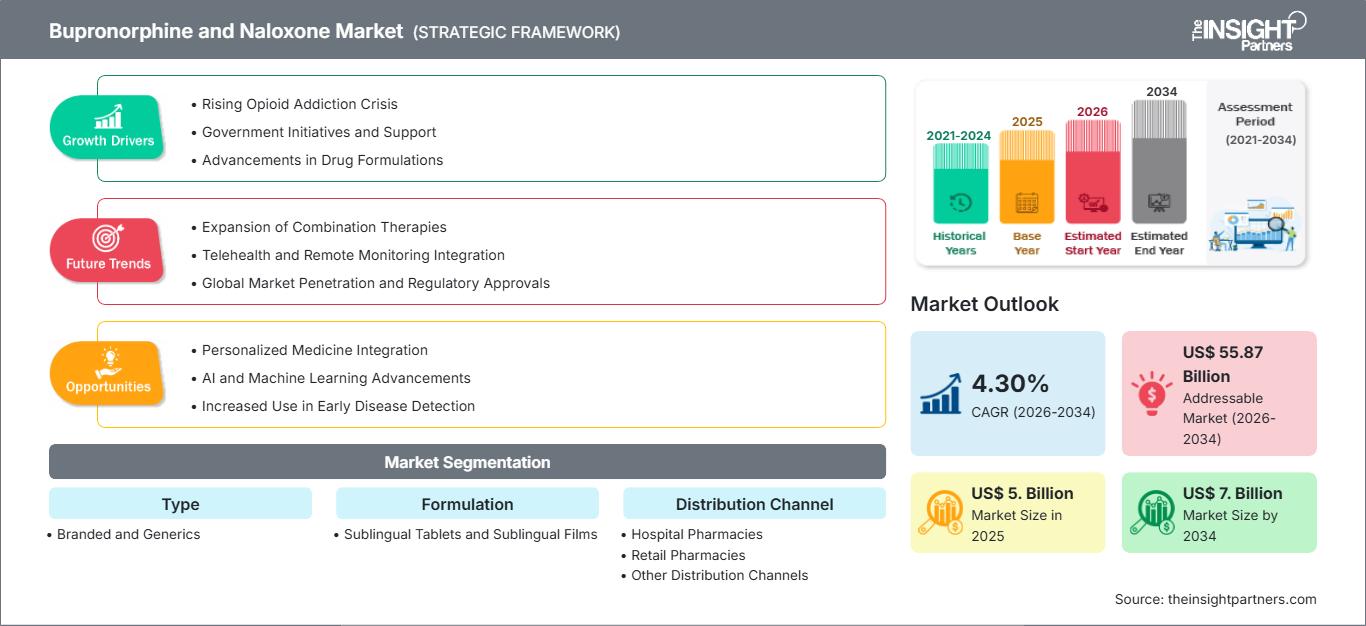
The Bupronorphine and Naloxone market was valued at US$ 5 billion in 2025 and is expected to reach US$ 7 billion by 2034; it is estimated to record a CAGR of 3.81% during 2026-2034.
Bupronorphine and Naloxone Market Assessment and Insights
- North America accounted for 56–58% share in 2025 and is expected to grow at a CAGR of 3.8–4.2% during 2026–2034, supported by broad payer coverage, pharmacy dispensing scale, and persistent opioid treatment demand.
- US represented 84–86% of North America in 2025 and is projected to grow at a CAGR of 3.7–4.1% during 2026–2034, driven by large treated-patient volumes and active generic supply.
- Europe held 22–24% share in 2025 and is forecast to expand at a CAGR of 3.5–3.9% during 2026–2034, led by the UK, Germany, and France through structured substitution therapy programs.
- Asia Pacific represented 13–15% share in 2025 and is expected to grow at a CAGR of 5.5–6.1% during 2026–2034, with China, Japan, India, and Australia strengthening access and dependence-care pathways.
- Largest Segment Generics held 52–54% market share in 2025 and is expected to grow at a CAGR of 4.5–4.9% during 2026–2034 due to payer preference and multi-source supply.
- High Growth Segment Sublingual Films held 46–48% market share in 2025 and is forecast to grow at a CAGR of 4.8–5.4% during 2026–2034, reflecting adherence advantages and clinical familiarity.
- Key companies analyzed in detail: Indivior PLC, Viatris Inc., Sandoz Group AG, Dr. Reddy's Laboratories Ltd., Hikma Pharmaceuticals PLC, Teva Pharmaceutical Industries Ltd., Amneal Pharmaceuticals, Inc., Mallinckrodt plc, Lannett Company, Inc., and Orexo AB.
Source: The Insight Partners' analysis based on proprietary research, government publications, company annual reports, investor presentations, industry databases, and expert interviews.
Commercial evolution has evolved from originator-controlled film prescription to a blend between branded and generic films, whereby cost, stock levels, and payer formularies impact on repeat prescriptions. The manufacturing environment will be dictated by issues of compliance with controlled-substances, REMS requirements, DEA scheduling, and manufacturing consistency for film or tablets. In the Bupronorphine and Naloxone market, technological changes are more focused on dose variation, tamper-proofing, patient adherence, and supply reliability through both retail and institutional channels.
In terms of future growth, new geographies are bound to develop from a low base due to de-centralization of addict medications and incorporation of the same in pharmacies. Tailwinds from the regulator are anticipated in situations where the government sees the problem of opioid addiction as a chronic condition and not an occasional one. Investors are bound to invest in companies that have the capacity to distribute drugs under control, participate in tender procedures, and be formulary compliant.
Bupronorphine and Naloxone Market Report Scope
| Report Attribute | Details |
|---|---|
| Market size in 2025 | US$ 5.0 Billion |
| Market Size by 2034 | US$ 7.0 Billion |
| Global CAGR (2026 - 2034) | 3.81% |
| Historical Data | 2021-2024 |
| Forecast period | 2026-2034 |
Bupronorphine and Naloxone Market Analysis
Bupronorphine and Naloxone Market growth will be dependent on the rate at which diagnosed opioid dependency is managed by effective and maintained treatments. The demand will flourish where prescribers, pharmacies, behavioral health providers, and insurance companies form an ecosystem. For the supply, active pharmaceutical ingredient control, film-casting capability, tablet compression, and distribution will be crucial. Public health organizations are increasingly focusing on medication-assisted treatments, which facilitate sustained prescription volumes as opposed to one-off prescriptions.
Value chain-wise, the retail pharmacies will take care of the sustainable prescription refill business, while hospitals will take care of the induction process as well as complicated cases. The introduction of generic products has ensured that the prices per unit remain moderate while allowing for more widespread adoption of the drug in both the U.S. market and in some countries within Europe. The dual-drug formulation continues to hold relevance since naloxone deters abuse outside of the proper sublingual method of administration.
Bupronorphine and Naloxone Market report suggests a moderate level of concentration in terms of the competitive landscape with Indivior PLC being the leader in terms of brand recognition through its product SUBOXONE, while competitors including Viatris Inc., Dr. Reddy's Laboratories Ltd., Sandoz Group AG, Teva Pharmaceutical Industries Ltd., and Amneal Pharmaceuticals, Inc. compete in terms of generics range. Orexo AB maintains its importance through ZUBSOLV, a unique branded pill product.
Investor attention is being drawn towards companies which have the ability to navigate issues of compliance with regulations on controlled substances, contracts with payers and consistent supply chain. The players like Hikma Pharmaceuticals PLC, Mallinckrodt plc, and Lannett Company, Inc. provide additional capabilities in terms of generics range, but still formulary coverage and price discipline are determining factors for success.
● REPORT CUSTOMIZATION
Tailor This Report To Align With Your Specific Business Requirements
This report can be customized to align precisely with your business objectives, scope, and target markets. Customization options include tailored segmentation, geography, competitive analysis, and strategic insights to support informed decision-making.
Customize This Report →WHAT YOU CAN ADJUST
- ● Segmentations
- ● Geography
- ● Competitive Analysis
- ● Language Preferences
Bupronorphine and Naloxone Market: Strategic Insights
Regional Insights
North America Bupronorphine and Naloxone Market
North America held 56–58% of global revenue in 2025 and is projected to grow at a CAGR of 3.8–4.2% during 2026–2034. The region’s Bupronorphine and Naloxone Market share is reinforced by broad medication-assisted treatment infrastructure, active overdose response policy, and a large base of patients receiving buprenorphine-based therapy. FDA’s 2024 labeling clarification for transmucosal buprenorphine products is also expected to reduce dosing misinterpretation and support individualized maintenance therapy.
Structural demand is characterized by outpatient-based treatment approaches, retail pharmacy refill trends, and correctional health services. United States leads consumption within the region whereas Canada supplies through the government-sponsored pathway for opioid agonist treatment. Generic products are more common due to the emphasis on cost reduction within the payers’ and pharmacy benefit plans; however, branded films and tablets have clinical relevance.
U.S. Bupronorphine and Naloxone Market
The U.S. constituted 84-86% share of North America market in 2025 and will witness a CAGR of 3.7-4.1% between 2026 and 2034. The demand will be boosted by increasing prevalence of opioid use disorder, extensive network of pharmacies, and ongoing efforts to boost the availability of evidence-based treatment. Companies such as Indivior PLC, Viatris Inc., Dr. Reddy's Laboratories Ltd., Teva Pharmaceutical Industries Ltd., Amneal Pharmaceuticals, Inc., and Orexo AB continue to be commercially relevant.
Current trends related to the application are driven by the aspects related to maintenance therapy, the intricacies of dosing in the fentanyl era, and consistency of access after induction. The guidelines provided by FDA about the label of transmucosal buprenorphine indicate that for some patients it will be required to have a customized daily maintenance dosage.
Europe Bupronorphine and Naloxone Market
The region represented 22-24% share in 2025 and is expected to register a CAGR of 3.5-3.9% from 2026 to 2034. United Kingdom was the dominant country in the region due to well-established opioid substitution therapy programs, pharmacy practice, and familiarity with buprenorphine-based treatment. Penetration of generics is increasing in countries where health care systems emphasize budget management and consistent treatment availability.
Germany derives its strengths from addiction care reimbursement structure, specialized prescriptions, and rigorous pharmaceutical regulations. The French demand is sustained by experience in substitution therapies and addiction treatment in the out-patient setting, whereas Italy and Spain offer moderate growth by providing treatment structures for public health care system. Overall, European growth is moderate as compared to APAC due to matured access, although adherence formulations and tenders help increase volume.
APAC Bupronorphine and Naloxone Market
APAC maintained 13-15% market share in 2025 and is expected to register a CAGR of 5.5-6.1% for the period of 2026-2034. Australia has taken the lead owing to existing substitution treatment structures, while Japan and South Korea add to the market via specialized controlled care facilities.
China and India are long-term growth drivers owing to development of infrastructure for dependence treatment and formulation of policies. This growth will be driven by growing healthcare infrastructure in cities, growing awareness about dependence treatment, and generic drug manufacturing capabilities, despite stigma and lack of reimbursement.
Middle East & Africa Bupronorphine and Naloxone Market
MEA region is projected to have a CAGR of 4.6–5.2% for the forecasted period of 2026-2034. Among the MEA region, Saudi Arabia dominates due to hospital-based treatment methods and growth in infrastructure for behavioral healthcare, while UAE makes use of specialist care networks to enhance access to treatments.
In South Africa, treatments can be provided both privately and publicly; however, there are variations regarding affordability and accessibility among provinces. RoMEA has limited penetration levels; however, infrastructural improvements, effective dispensation processes, and overall development of policies concerning mental health will gradually improve access to treatments.
Segmentation Analysis
Type
The Type segment is expected to grow at a CAGR of 4.2–4.6% during 2026–2034. The Bupronorphine and Naloxone Market scope across branded and generic products reflects a balance between clinical familiarity and affordability. Branded products support prescriber confidence and patient continuity, while generics expand access through lower costs, broader stocking, and payer-preferred formularies in outpatient maintenance therapy.
- Branded products retain strategic importance where patient experience, dose format, brand familiarity, and physician preference influence continuity, especially for patients stabilized on specific films or tablets.
- Generics lead volume growth because pharmacy benefit managers, national health systems, and retail chains favor multi-source products that reduce treatment cost and support refill availability.
Formulation
The Formulation segment is projected to grow at a CAGR of 4.4–4.8% during 2026–2034. Sublingual tablets remain cost-effective and widely dispensed, while films benefit from convenience, portability, and perceived adherence advantages. Formulation choice is increasingly linked to patient stability, taste acceptance, diversion risk management, and the ability to maintain uninterrupted treatment in community settings.
- Sublingual Tablets are widely used in stable maintenance care because they are familiar to prescribers, cost-efficient for payers, and practical for high-volume retail dispensing.
- Sublingual Films are gaining share due to flexible administration, strong brand legacy, patient preference in selected groups, and suitability for treatment plans focused on adherence.
Distribution Channel
The Distribution Channel segment is expected to grow at a CAGR of 4.0–4.4% during 2026–2034. Retail pharmacies dominate recurring refills, hospitals support induction and complex patient management, and other channels include specialty clinics, public health programs, and institutional care settings. Channel performance depends on prescribing authorization, controlled-medicine handling, reimbursement, inventory reliability, and patient follow-up capacity.
- Hospital Pharmacies support treatment initiation, acute withdrawal management, comorbid patient care, and transitions into outpatient therapy, making them important for complex cases.
- Retail Pharmacies capture the largest refill base because stable patients require repeated dispensing, insurance processing, medication counseling, and accessible community-based treatment continuity.
Opportunity Snapshot
| Segments | Revenue Contribution | Trend Tag | Adoption Stage |
| Branded | Medium | Brand Continuity | Mature |
| Generics | High | Cost Access | Scaling |
| Sublingual Tablets | High | Stable Refills | Mature |
| Sublingual Films | High | Adherence Format | Scaling |
| Hospital Pharmacies | Medium | Care Initiation | Mature |
| Retail Pharmacies | High | Refill Scale | Mature |
Bupronorphine and Naloxone Market Growth Drivers and Impact Analysis
Expanding Medication-Assisted Treatment Access
The expansion of medication assisted treatment is the most significant structural enabler because of the fact that buprenorphine-based medication assists in minimizing the withdrawal effects and helps in recovery with the help of counseling and follow-up care. Public health organizations continue to focus on evidence-based treatments for the problem of opioid use disorder, and the data of United States reveal that the prescriptions for buprenorphine have seen an increase by a substantial margin during the last decade. The practical consequence of this would be repeat purchasing throughout all three stages of drug use cycle.
Generic Penetration and Payer-Led Affordability
Generic penetration creates access to the market by reducing the cost of therapy and improving treatment availability via distribution channels. Generic competition in sublingual tablets and films allows the payer to use preferred formulary while not limiting the clinical freedom altogether. It helps generics-centered businesses like Viatris Inc., Sandoz Group AG, Dr. Reddy's Laboratories Ltd., Teva Pharmaceutical Industries Ltd., and Amneal Pharmaceuticals Inc. More prescriptions will be prescribed to the cost-conscious population and increased supply redundancy will be created in the market due to the effect. Margins have been reduced, which means that manufacturers have to be economically prudent with their production.
Regulatory Clarity for Transmucosal Buprenorphine
There has been increased regulatory clarity about the effectiveness of individually-tailored maintenance treatments. The notice by the FDA in 2024 recommended that the labeling of the drugs containing buprenorphine in transmucosal preparations be altered since the current language could have been incorrectly interpreted as indicating an upper limit on the daily dose even though it does not. The impact of the marketing will not be just an increase in prescriptions but improved continuity of treatment, no forced cessation of doses and increased prescription-patient relationship.
Bupronorphine and Naloxone Market Future Trends
Patient-Centric Formulation Selection
Bupronorphine and Naloxone Market trends will increasingly center on matching formulation to patient behavior, not only clinical indication. Films may gain in patients who value convenience, discreet administration, and consistent dissolution experience, while tablets will remain important for cost-sensitive maintenance therapy. Future prescribing decisions are expected to incorporate adherence history, diversion concerns, taste tolerability, and payer rules. This trend will push companies to support education, packaging reliability, and real-world evidence that connects formulation choice with treatment retention, relapse reduction, and lower avoidable healthcare utilization.
Integration with Digital and Community Care Models
Treatment delivery is likely to move further into hybrid care models that combine community pharmacies, telehealth follow-ups, electronic prescribing, and behavioral-health coordination. This creates demand for products that fit predictable refill cycles and controlled dispensing requirements. Pharmacies may play a larger role in adherence monitoring, patient education, and naloxone co-dispensing. Manufacturers and distributors that align with these workflows can improve channel reliability. The long-term effect will be a more decentralized treatment ecosystem, where access depends on local pharmacy readiness as much as specialist clinic capacity.
Bupronorphine and Naloxone Market Opportunities
Scaling Retail Pharmacy-Based Maintenance Therapy
Retail pharmacies represent an actionable opportunity because most stable patients depend on recurring access rather than hospital-based dispensing. The Bupronorphine and Naloxone Market Forecasts indicate that companies with strong wholesaler relationships, inventory consistency, and payer-aligned generic pricing can capture durable refill demand. Manufacturers should invest in pharmacist education, controlled-substance documentation support, and reliable pack availability across strengths. This opportunity is especially relevant in the U.S. and Europe, where outpatient continuity is central to treatment retention. Better retail execution can reduce missed doses, improve patient trust, and strengthen long-term revenue visibility.
Expanding Access in Underserved Treatment Systems
Underserved regions and institutional settings offer growth potential where opioid dependence treatment is available but not yet consistently integrated into care pathways. Correctional healthcare, rural clinics, publicly funded addiction programs, and emerging APAC treatment systems can benefit from affordable generics and clear initiation protocols. Companies should prioritize partnerships with public agencies, tender organizations, and distributors experienced in controlled medicines. The opportunity is operational rather than purely promotional: reliable supply, training support, and affordability can convert unmet clinical need into sustained treatment demand while supporting public-health goals.
Recent Developments
- December 2025: Indivior PLC announced JAMA Network Open data showing that SUBLOCADE, an extended-release buprenorphine product, reduced opioid use rapidly and supported abstinence in individuals with moderate-to-severe opioid use disorder. The study reported no new safety signals and identified potential benefit of a 300 mg maintenance dose in high-frequency fentanyl users.
- April 2025: Viatris Inc. announced a nationwide settlement framework for opioid-related claims and stated that it continues to manufacture a generic buprenorphine/naloxone product for opioid addiction treatment, alongside injectable naloxone. The company said the settlement was not an admission of wrongdoing and could total up to US$ 335 million over nine years.
- December 2024: The U.S. FDA issued a Federal Register notice encouraging sponsors of buprenorphine-containing transmucosal products to submit labeling supplements clarifying maintenance dosage language. The notice covered products including SUBOXONE, ZUBSOLV, buprenorphine and naloxone sublingual tablets, and buprenorphine and naloxone sublingual film.
Frequently Asked Questions

- Comprehensive Market Sizing and Forecast Analysis
- Detailed Segmentation Analysis
- In-Depth Market Dynamics Assessment
- Regional and Country-Level Insights
- Competitive Landscape and Company Benchmarking
- Strategic Business Intelligence
Recent Reports
Testimonials

The Insight Partners' SCADA System Market report is comprehensive, with valuable insights on current trends and future forecasts. The team was highly professional, responsive, and supportive throughout. We are very satisfied and highly recommend their services.
RAN KEDEM Partner, Reali Technologies LTDs
I requested a report on a very specific software market and the team produced the report in a few days. The information was very relevant and well presented. I then requested some changes and additions to the report. The team was again very responsive and I got the final report in less than a week.
JEAN-HERVE JENN Chairman, Future Analytica
We worked with The Insight Partners for an important market study and forecast. They gave us clear insights into opportunities and risks, which helped shape our plans. Their research was easy to use and based on solid data. It helped us make smart, confident decisions. We highly recommend them.
PIYUSH NAGPAL Sr. Vice President, High Beam Global
The Insight Partners delivered insightful, well-structured market research with strong domain expertise. Their team was professional and responsive throughout. The user-friendly website made accessing industry reports seamless. We highly recommend them for reliable, high-quality research services
YUKIHIKO ADACHI CEO, Deep Blue, LLC.
This is the first time I have purchased a market report from The Insight Partners.While I was unsure at first, I visited their web site and felt more comfortable to take the risk and purchase a market report.I am completely satisfied with the quality of the report and customer service. I had several questions and comments with the initial report, but after a couple of dialogs over email with their analyst I believe I have a report that I can use as input to our strategic planning process.Thank you so much for taking the extra time and making this a positive experience.I will definitely recommend your service to others and you will be my first call when we need further market data.
JOHN SUZUKI President and Chief Executive Officer, Board Director, BK Technologies
I wish to appreciate your support and the professionalism you displayed in the course of attending to my request for information regarding to infectious disease IVD market in Nigeria. I appreciate your patience, your guidance, and the fact that you were willing to offer a discount, which eventually made it possible for us to close a deal. I look forward to engaging The Insight Partners in the future, all thanks to the impression you have created in me as a result of this first encounter.
DR CHIJIOKE ONYIA MANAGING DIRECTOR, PineCrest Healthcare Ltd.Reason to Buy
- Informed Decision-Making
- Understanding Market Dynamics
- Competitive Analysis
- Identifying Emerging Markets
- Customer Insights
- Market Forecasts
- Risk Mitigation
- Boosting Operational Efficiency
- Strategic Planning
- Investment Justification
- Tracking Industry Innovations
- Aligning with Regulatory Trends





 Get Free Sample for