
Burn Care Products and Accessories Market Demand, Share & Growth by 2034
Coverage: By Product Type ( Advanced Dressing, Biologics, Antiseptic and Antibiotics Creams and Sprays ); End User ( Hospitals and Clinics, Burn Care Units, Other End Users ), and Geography (North America, Europe, Asia Pacific, and South and Central America)
- Status : Data Released
- Report Code : TIPRE00020016
- Category : Life Sciences
- No. of Pages : 150
- Available Report Formats :


- Last update date : August 13, 2026


2025 Market Size
US$ 3.13 Bn
Base year value
2034 Forecast
US$ 4.79 Bn
Projected by 2034
CAGR 2026-2034
4.85 %
Growth rate
Addressable Market
US$ 35.96 Bn
(2026-2034)
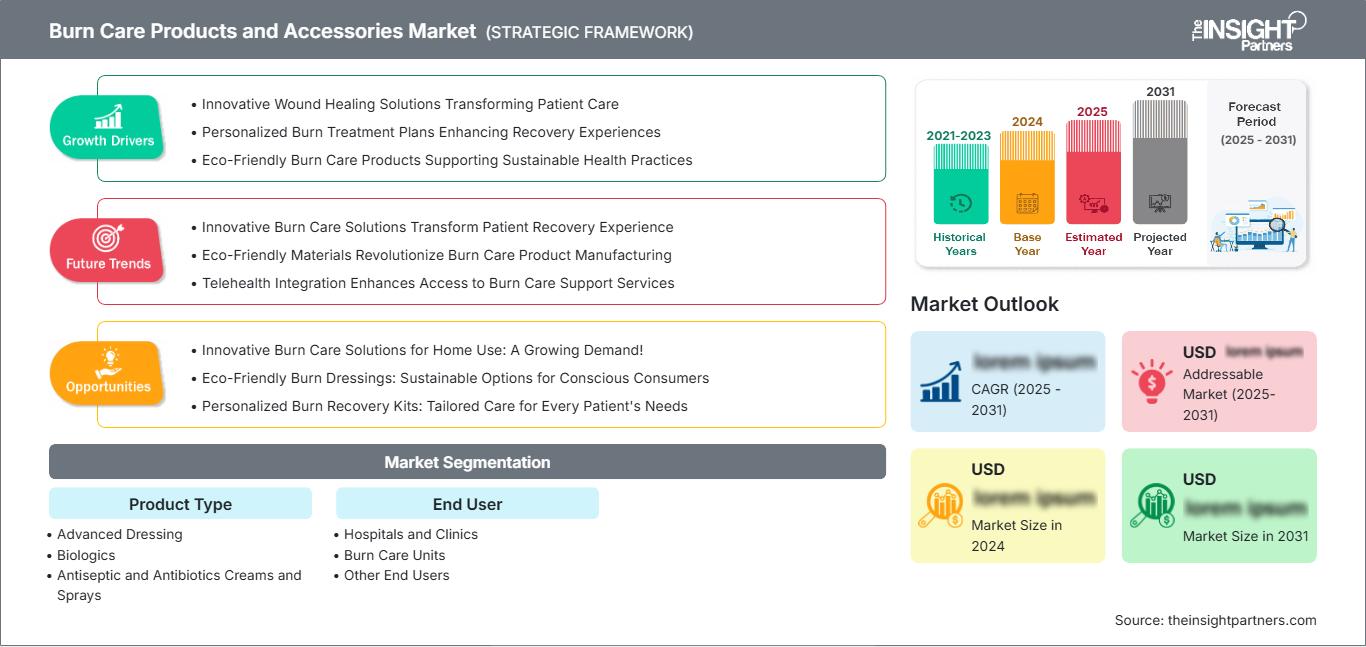
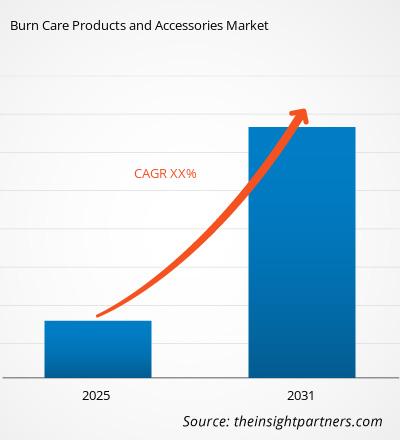
The Burn Care Products and Accessories Market is estimated to rise from US$ 3.13 billion in 2025 to reach a valuation of US$ 4.79 billion by 2034 growing at a CAGR of 4.85% between 2026 and 2034. This market is witnessing constant growth due to the increased demand for technologically advanced dressings, biologics, and topical infection control products used in hospital settings, clinics, burn units, and other treatment facilities that cater to the patients with acute thermal, chemical, electrical, and traumatic injuries.
North America is expected to continue as one of the major markets in terms of value due to presence of speciality burn centers and well-established avenues for reimbursement and faster uptake of antimicrobial dressings. The Burn Care Products and Accessories Market size in this region is anticipated to grow at a CAGR of 4.4-4.9% between 2026 and 2034.
Burn Care Products and Accessories Market Assessment and Insights
- North America accounted for 34–37% share in 2025 and is projected to grow at a CAGR of 4.4–4.9% between 2026–2034, supported by established burn centers, trauma networks, and advanced wound care reimbursement models.
- US represented 82–86% of North America in 2025 and is expected to grow at a CAGR of 4.5–5.0% between 2026–2034, led by burn unit density and specialist procurement.
- Europe held 25–28% share in 2025 and is projected to grow at a CAGR of 4.1–4.6% between 2026–2034, with Germany, the UK, France, Italy, and Spain leading clinical adoption.
- Asia Pacific represented 22–25% share in 2025 and is expected to grow at a CAGR of 5.6–6.2% between 2026–2034, led by China, Japan, India, South Korea, and Australia.
- Largest Segment Advanced Dressing held 49–53% market share in 2025 and is projected to grow at a CAGR of 4.7–5.2% between 2026–2034, supported by infection control and exudate management.
- High Growth Segment Biologics held 18–22% market share in 2025 and is projected to grow at a CAGR of 6.0–6.7% between 2026–2034, driven by graft substitution and tissue regeneration needs.
- Key companies analyzed in detail: Smith & Nephew plc, Solventum Corporation, Baxter International Inc., ConvaTec Group plc, Integra LifeSciences Holdings Corporation, Medtronic plc, Mölnlycke Health Care AB, Coloplast A/S, Ethicon LLC, Hollister Incorporated, Cardinal Health Inc., and Paul Hartmann AG.
Source: The Insight Partners' analysis based on proprietary research, government publications, company annual reports, investor presentations, industry databases, and expert interviews.
From the past application of passive gauze to burns, clinical practice is now geared towards integrated treatment including wound bed preparation, moisture management, antimicrobial therapy, and biologic scaffolding. This trend has seen manufacturers coming up with multilayer foams, silver dressings, collagen matrices, hydrogels, and enzymatic debriding agents aimed at minimizing the need for frequent changes and fostering epithelialization. The dynamics in production are also changing as companies localize advanced wound care manufacturing.
During the forecast period, new regions are likely to increase access to burn treatments through tertiary hospital investments, trauma network developments, and national efforts focusing on injury care. The favorable regulatory trends involve more defined procedures related to biological dressings, antimicrobial wound products, and skin substitute solutions. Increasingly, procurement will emphasize clinical efficacy in terms of minimizing infections, hospital stays, and integration into multidisciplinary burn treatment approaches.
Burn Care Products and Accessories Market Report Scope
| Report Attribute | Details |
|---|---|
| Market size in 2025 | US$ 3.13 Billion |
| Market Size by 2034 | US$ 4.79 Billion |
| Global CAGR (2026 - 2034) | 4.85% |
| Historical Data | 2021-2024 |
| Forecast period | 2026-2034 |
Burn Care Products and Accessories Market Analysis
Increasing burn occurrences, infection complications, and pressures to reduce hospital stay are driving factors in the growth of the Burn Care Products and Accessories Market. WHO cites burns as a critical public health concern, with approximately 180,000 people dying each year, primarily in LMICs. As such, demand is driven by emergencies, surgical debridement, infection prevention, outpatient dressing change, and scar management programs.
Participants in the supply chain include raw materials for foams, hydrofiber, alginates, collagens, silver products, and topicals, after which the market enters into sterile manufacturing, clinical trials, hospital contracts, and distributor-driven replenishment. Increasing U.S. and European manufacturing, robust inventories, and preference among physicians for dressings that can last longer and provide a wider antimicrobial coverage are driving forces for the supply chain.
The competitive pressure in the Burn Care Products and Accessories Market Report is increasing due to the combination of product range with clinical education and evidence generation among global wound care companies. According to analysis of the Market, Smith & Nephew plc, Mölnlycke Health Care AB, ConvaTec Group plc, Integra LifeSciences Holdings Corporation, and Solventum Corporation focus on advanced dressings that provide measurable clinical results, rather than mere coverage.
The strategic investments are directed at proprietary foam technologies, nitric oxide dressings, placental matrices, wound cleansing, and digital wound evaluation technologies. The market relevance of Baxter International Inc., Medtronic plc, Ethicon LLC, Coloplast A/S, Hollister Incorporated, Cardinal Health Inc., and Paul Hartmann AG is maintained due to the access to hospitals and surgical products adjacent with chronic wounds.
● REPORT CUSTOMIZATION
Tailor This Report To Align With Your Specific Business Requirements
This report can be customized to align precisely with your business objectives, scope, and target markets. Customization options include tailored segmentation, geography, competitive analysis, and strategic insights to support informed decision-making.
Customize This Report →WHAT YOU CAN ADJUST
- ● Segmentations
- ● Geography
- ● Competitive Analysis
- ● Language Preferences
Burn Care Products and Accessories Market: Strategic Insights
Regional Insights
North America Burn Care Products and Accessories Market
North America accounted for 34–37% Burn Care Products and Accessories Market share in 2025 and is projected to grow at a CAGR of 4.4–4.9% between 2026–2034. The region benefits from specialized burn centers, trauma referral systems, high adoption of antimicrobial dressings, and strong reimbursement for advanced wound products across inpatient and outpatient care.
The American Burn Association reported 32,540 burn center inpatient cases in 2023 and 156,073 cases over five years, supporting sustained procedural and dressing demand. Its 2024 summary also highlighted ICU utilization above 110,000 days in 2023 among contributing centers, reinforcing demand for infection-control products and durable wound coverage.
U.S. Burn Care Products and Accessories Market
The U.S. represented 82–86% of North America in 2025 and is projected to grow at a CAGR of 4.5–5.0% between 2026–2034. Its leadership is supported by burn center density, broader trauma reimbursement, high penetration of silver dressings, and specialist use of collagen, foam, and negative pressure-adjacent wound technologies.
Presence in the market is strong, with companies such as Smith & Nephew plc, Solventum Corporation, ConvaTec Group plc, Integra LifeSciences Holdings Corporation, Mölnlycke Health Care AB, and Cardinal Health Inc. providing their products to the hospitals and outpatient clinics. Market application trends include antimicrobial dressing in cases of partial-thickness burn wounds and biologic dressing in complicated wounds.
Europe Burn Care Products and Accessories Market
Europe held 25–28% share in 2025 and is expected to grow at a CAGR of 4.1–4.6% during 2026–2034. Germany is the leading country due to hospital infrastructure, specialist surgical capacity, and deep penetration of advanced wound care. The UK follows with centralized burn services and strong nursing-led wound management.
Germany and the UK are continuously setting the standard of procurement via clinical pathways for antimicrobial dressings, debridement assistance, and biologic replacement. Adoption of science-based products is increasing in France, Italy, and Spain at trauma centers, while activities of the European Burn Association help in educating and collaborating in burn centers.
APAC Burn Care Products and Accessories Market
APAC represented 22–25% share in 2025 and is forecast to grow at a CAGR of 5.6–6.2% between 2026–2034. China is the leading country, supported by tertiary hospital expansion, domestic manufacturing, and rising access to advanced wound care.
The countries of Japan, South Korea, India, and Australia get added impetus through aging population trends, investment in public hospitals, and burn management training programs. The WHO says India registers more than 1 million cases of moderate and serious burns per year.
Middle East & Africa Burn Care Products and Accessories Market
Middle East & Africa is projected to grow at a CAGR of 4.9–5.5% between 2026–2034, with Saudi Arabia as the leading country. Growth is supported by hospital infrastructure programs, trauma service upgrades, and higher spending on specialist wound care.
Premium hospital supply is important in the UAE, while South Africa has burn treatment requirements associated with injuries from homes and workplaces. The WHO says that deaths caused by burns are common in developing countries, hence the importance of affordable advanced dressings and antimicrobials for burns in the entire region.
Segmentation Analysis
Product Type
Product Type is projected to grow at a CAGR of 4.8–5.3% between 2026–2034. The market scope across this segment includes acute burn stabilization, infection management, wound-bed preparation, and tissue repair. Hospitals are moving toward products that reduce dressing-change frequency, support moist healing, and provide antimicrobial protection without increasing clinician workload.
- Advanced Dressing remains the largest sub-segment, driven by foam, hydrofiber, alginate, hydrogel, and silver-based products used for exudate management, microbial control, and reduced trauma during dressing removal.
- Biologics are strategically important in deep partial-thickness and complex burns, where collagen matrices, skin substitutes, and regenerative products help support closure when autograft availability is limited.
- Antiseptic and Antibiotics Creams and Sprays remain widely used in first-line burn management, especially where topical infection control, outpatient accessibility, and cost-sensitive care models influence prescribing behavior.
End User
End User is projected to grow at a CAGR of 4.6–5.1% between 2026–2034. Demand is shaped by care-site specialization, procedure intensity, and post-discharge wound monitoring. Acute hospitals generate high product volumes, while dedicated burn units influence premium product selection through formulary decisions, clinical protocols, and multidisciplinary treatment standards.
- Hospitals and Clinics account for broad demand because emergency departments, surgical wards, and outpatient clinics manage burns from initial assessment through dressing changes and follow-up care.
- Burn Care Units drive high-value adoption of advanced dressings and biologics because complex burns require infection prevention, debridement support, tissue coverage, and coordinated rehabilitation planning.
Opportunity Snapshot
| Segment Name | Revenue Contribution | Trend Tag | Adoption Stage |
| Hospitals and Clinics | High | Protocol Care | Mature |
| Burn Care Units | High | Specialist Use | Scaling |
| Other End Users | Medium | Home Recovery | Emerging |
Burn Care Products and Accessories Market Growth Drivers and Impact Analysis
Rising Burden of Burn Injuries and Hospital Admissions
Burn injury burden continues to create direct demand for dressings, creams, biologics, and adjunctive wound products across emergency, inpatient, and outpatient settings. WHO estimates 180,000 burn-related deaths annually, while the American Burn Association recorded 32,540 inpatient burn center cases in 2023 among contributing centers. These figures illustrate a recurring care burden that requires standardized wound coverage, infection control, and follow-up treatment. In practical terms, higher burn admissions increase consumption of sterile dressings, antimicrobial creams, and biologic products per patient episode. The driver also affects procurement because hospitals must maintain inventory for mass casualty events, occupational burns, domestic burns, and pediatric scald injuries.
Shift Toward Advanced Antimicrobial and Moisture-Balancing Dressings
Clinical preference is moving toward dressings that combine exudate absorption, bacterial barrier performance, conformability, and lower removal trauma. This shift matters because burn wounds are vulnerable to infection, fluid loss, pain, and delayed re-epithelialization. Advanced dressings allow facilities to reduce dressing-change frequency, improve patient comfort, and standardize protocols across departments. Silver, foam, hydrofiber, hydrogel, and silicone-interface technologies are gaining importance in partial-thickness burns and donor-site care. The market impact is visible in procurement patterns, where products with clinical evidence, longer wear time, and antimicrobial properties command stronger formulary positions than basic gauze or commodity wound covers.
Expansion of Specialized Burn Centers and Trauma Networks
The growth of specialized burn centers and trauma referral pathways strengthens demand for high-performance products used in severe burns, graft preparation, donor-site management, and post-acute healing. Burn care units often require broad product portfolios because treatment varies by burn depth, infection risk, anatomical site, fluid loss, and surgical timing. As facilities upgrade to multidisciplinary burn programs, product selection increasingly involves surgeons, wound nurses, pharmacists, and procurement teams. This creates opportunities for suppliers that combine clinical training, evidence support, and reliable supply. The driver is especially important in emerging markets, where hospital modernization is expanding access to advanced burn care.
Burn Care Products and Accessories Market Future Trends
Regenerative and Biologic Integration in Burn Closure
Burn Care Products and Accessories Market trends are expected to move toward biologic matrices, placental-derived products, collagen scaffolds, and engineered substitutes that support tissue regeneration in complex burns. The trend is not limited to premium centers because clinicians are seeking alternatives that reduce donor-site burden and improve closure quality. As clinical evidence improves, biologics may become more structured within treatment algorithms for deep partial-thickness wounds, graft support, and difficult anatomical areas. Suppliers will need to demonstrate reproducible outcomes, cost justification, and compatibility with surgical workflows to gain broader adoption.
Localized Manufacturing and Supply Resilience
Manufacturers are expected to increase regional production capacity for wound care products after pandemic-era supply disruptions exposed reliance on long global chains. Localized manufacturing supports shorter replenishment cycles, better hospital contracting, and improved resilience during emergency surges such as fires, industrial incidents, or conflict-related trauma. Mölnlycke Health Care AB’s U.S. wound care manufacturing expansion illustrates this direction. Over time, buyers may prioritize suppliers with regional inventory, validated quality systems, and sustainable operations. This trend will influence tender decisions, especially among hospital groups seeking continuity for standardized burn-care formularies.
Burn Care Products and Accessories Market Opportunities
Outpatient Burn Management and Post-Discharge Care Models
Outpatient transition creates an important investment avenue as hospitals seek to discharge stable burn patients earlier while maintaining wound protection and follow-up quality. Burn Care Products and Accessories Market Forecasts point to stronger demand for dressings that patients and caregivers can manage safely between visits. Companies can capture value by developing kits, educational materials, telehealth-compatible monitoring tools, and products with longer wear times. The opportunity is strongest in hospitals and clinics where minor to moderate burns are managed outside specialist units. This model can reduce inpatient burden while expanding recurring demand for advanced dressings and topical products.
Emerging Market Access Through Affordable Advanced Dressings
Emerging markets offer a practical growth opportunity for companies that can balance antimicrobial performance, cost, and distribution reach. Many low- and middle-income countries face high burn burden but limited access to premium biologics and advanced dressings. Suppliers can create scalable offerings through simplified product lines, regional manufacturing partnerships, hospital training, and government procurement programs. The opportunity is not purely volume-based because better infection control can reduce complications and hospital stays. Companies that adapt packaging, pricing, and education to public hospital needs are likely to build durable positions in Asia, the Middle East, Africa, and Latin America.
Recent Developments
- March 2026: Smith & Nephew plc launched ALLEVYN COMPLETE CARE Foam Dressing, a next-generation five-layer wound dressing designed for wound management and pressure injury prevention. The company stated that the dressing locks in more exudate than other foam dressings, keeps over 99% of bacteria away from the wound bed, and is initially available in the U.S.
- September 2025: Mölnlycke Health Care AB broke ground on a US$ 135 million expansion of its wound care manufacturing facility in Brunswick, Maine. The investment is intended to increase U.S. manufacturing capacity, localize production, support supply resilience, and create new jobs over five years while using renewable energy solutions.
- April 2025: ConvaTec Group plc received regulatory approval for ConvaNiox, a nitric oxide-generating multimodal dressing for hard-to-heal wounds. The company announced initial market launches in France, Germany, Italy, Poland, Spain, and the UK, with a full launch planned in 2026 following clinical evidence in diabetic foot ulcers.
Frequently Asked Questions

- Comprehensive Market Sizing and Forecast Analysis
- Detailed Segmentation Analysis
- In-Depth Market Dynamics Assessment
- Regional and Country-Level Insights
- Competitive Landscape and Company Benchmarking
- Strategic Business Intelligence
Recent Reports
Testimonials

The Insight Partners provided valuable market intelligence that supported our global go-to-market strategy. Their team was professional, responsive, and attentive to our feedback, providing thoughtful analysis and helpful methodological clarifications throughout the project.
Junmo Kim Chief Financial Officer (CFO), Enertech Co., Ltd.
The Insight Partners' SCADA System Market report is comprehensive, with valuable insights on current trends and future forecasts. The team was highly professional, responsive, and supportive throughout. We are very satisfied and highly recommend their services.
RAN KEDEM Partner, Reali Technologies LTDs
I requested a report on a very specific software market and the team produced the report in a few days. The information was very relevant and well presented. I then requested some changes and additions to the report. The team was again very responsive and I got the final report in less than a week.
JEAN-HERVE JENN Chairman, Future Analytica
We worked with The Insight Partners for an important market study and forecast. They gave us clear insights into opportunities and risks, which helped shape our plans. Their research was easy to use and based on solid data. It helped us make smart, confident decisions. We highly recommend them.
PIYUSH NAGPAL Sr. Vice President, High Beam Global
The Insight Partners delivered insightful, well-structured market research with strong domain expertise. Their team was professional and responsive throughout. The user-friendly website made accessing industry reports seamless. We highly recommend them for reliable, high-quality research services
YUKIHIKO ADACHI CEO, Deep Blue, LLC.
This is the first time I have purchased a market report from The Insight Partners.While I was unsure at first, I visited their web site and felt more comfortable to take the risk and purchase a market report.I am completely satisfied with the quality of the report and customer service. I had several questions and comments with the initial report, but after a couple of dialogs over email with their analyst I believe I have a report that I can use as input to our strategic planning process.Thank you so much for taking the extra time and making this a positive experience.I will definitely recommend your service to others and you will be my first call when we need further market data.
JOHN SUZUKI President and Chief Executive Officer, Board Director, BK Technologies
I wish to appreciate your support and the professionalism you displayed in the course of attending to my request for information regarding to infectious disease IVD market in Nigeria. I appreciate your patience, your guidance, and the fact that you were willing to offer a discount, which eventually made it possible for us to close a deal. I look forward to engaging The Insight Partners in the future, all thanks to the impression you have created in me as a result of this first encounter.
DR CHIJIOKE ONYIA MANAGING DIRECTOR, PineCrest Healthcare Ltd.Reason to Buy
- Informed Decision-Making
- Understanding Market Dynamics
- Competitive Analysis
- Identifying Emerging Markets
- Customer Insights
- Market Forecasts
- Risk Mitigation
- Boosting Operational Efficiency
- Strategic Planning
- Investment Justification
- Tracking Industry Innovations
- Aligning with Regulatory Trends





 Get Free Sample for