
Cadcam Milling Machine For Dental Laboratory Market Trends, Size & Forecast by 2034
Coverage: By Type (Lab Scale Milling Machine, Office Scale Milling Machine); Application (Crowns, Dentures, Bridges, Veneers, Inlays/Onlays); End User (Dental Laboratories, Dental Clinics, Research Institutes) , and Geography (North America, Europe, Asia Pacific, and South and Central America)
- Status : Data Released
- Report Code : TIPRE00018028
- Category : Life Sciences
- No. of Pages : 150
- Available Report Formats :


- Last update date : August 12, 2026


2025 Market Size
US$ 1.89 Bn
Base year value
2034 Forecast
US$ 3.44 Bn
Projected by 2034
CAGR 2026-2034
6.89 %
Growth rate
Addressable Market
US$ 24.09 Bn
(2026-2034)
The CAD/CAM Milling Machine for Dental Laboratory Market was valued at US$ 1.10 billion in 2025 and is projected to reach US$ 2.08 billion by 2034, registering a CAGR of 7.12% during 2026–2034. The market is moving from standalone laboratory equipment toward digitally connected manufacturing cells that support repeatable restoration quality, shorter turnaround times, and tighter integration with scanner, design software, and post-processing workflows.
Across North America, the CAD/CAM Milling Machine for Dental Laboratory Market size is shaped by consolidated dental laboratory networks, high chairside digital adoption, and demand for precision prosthetics. The region is estimated to expand at a CAGR range of 6.6–7.4% during 2026–2034, supported by investments in open digital workflows, outsourcing partnerships, and premium demand for zirconia, hybrid ceramic, and implant-supported restorations.
Cadcam Milling Machine For Dental Laboratory Market Assessment and Insights
- North America held a 34–37% share in 2025 and is expected to grow at a CAGR range of 6.6–7.4% during 2026–2034, supported by advanced laboratory automation, high prosthodontic procedure volumes, and stronger reimbursement visibility.
- US accounted for 78–82% of North America in 2025 and is expected to grow at a CAGR range of 6.7–7.5% during 2026–2034, led by multi-site dental service organizations and outsourced milling centers.
- Europe captured a 27–30% share in 2025 and is expected to grow at a CAGR range of 6.3–7.1% during 2026–2034, with Germany, France, Italy, Spain, and the UK leading adoption through laboratory modernization.
- Asia Pacific represented a 22–25% share in 2025 and is expected to grow at a CAGR range of 7.8–8.8% during 2026–2034, led by China, Japan, South Korea, India, and Australia.
- Largest Segment Signal Cables held a market share range of 46–50% in 2025 and is expected to grow at a CAGR range of 6.8–7.4% during 2026–2034, reflecting broad machine-control relevance.
- High Growth Segment Hybrid Cables held a market share range of 18–22% in 2025 and is expected to grow at a CAGR range of 8.2–9.0% during 2026–2034, driven by compact, multifunctional equipment architecture.
- Key companies analyzed in detail: Junkosha Inc.; TE Connectivity plc; Oki Electric Industry Co., Ltd.; ODU GmbH & Co. KG; Proterial Cable America, Inc.; Olympus Corporation; Medtronic plc; Bolton Surgical Ltd.; Fort Wayne Metals Research Products, LLC; Stryker Corporation.
Source: The Insight Partners' analysis based on proprietary research, government publications, company annual reports, investor presentations, industry databases, and expert interviews.
Laboratory milling systems have changed their form from closed-loop material-specific systems to connected manufacturing machines meant for high-output prosthetic production. This change is seen through spindle accuracy, capability of mixing wet-dry machining processes, tool life tracking system, and cables used for transmitting power, signals, imaging, and control information with low downtime. In the CAD/CAM Milling Machine for Dental Laboratory, production trends are favoring modular machinery, qualified materials, and business models that minimize rework due to hand finishing and remakes.
Moving forward, new dental clusters in Asia Pacific and the Middle East region will affect the purchasing behavior of laboratories as they look for scalable and compact machinery. With increased regulatory focus on traceability, biocompatibility, and process validation, the demand for digital-controlled manufacturing is rising. Funding is flowing into multi-axis milling technology, remote diagnostic tools, and design of integrated connectors.
Cadcam Milling Machine For Dental Laboratory Market Report Scope
| Report Attribute | Details |
|---|---|
| Market size in 2025 | US$ 1.89 Billion |
| Market Size by 2034 | US$ 3.44 Billion |
| Global CAGR (2026 - 2034) | 6.89% |
| Historical Data | 2021-2024 |
| Forecast period | 2026-2034 |
Cadcam Milling Machine For Dental Laboratory Market Analysis
The factors contributing to shaping the demand include dental laboratory consolidation, increase in the number of aesthetic restorations, and the desire to reduce production times while maintaining the margin of fit. The CAD/CAM Milling Machine for Dental Laboratory Market is also expected to benefit from aging populations, implant dentistry, and preference of dentists for digital work flow over manual layered restoration.
The supply chain in the industry consists of scanner companies, design software suppliers, milling machine manufacturers, tool manufacturers, material suppliers, cable & connector manufacturers and service partners. Technical nature of the supply chain is becoming a key component due to the demand for milling machines with signal transmission, motion control, vibration control and sterilization.
The competition in the market becomes characterized by reliability, integration capabilities, after-sales services and production capacity. Junkosha Inc., TE Connectivity plc, ODU GmbH & Co. KG and Proterial Cable America, Inc. have the expertise in high performance connectivity solutions, while Olympus Corporation, Medtronic plc, and Stryker Corporation offer experience in adjacent markets of medical devices.
The CAD/CAM Milling Machine for Dental Laboratory Market Report demonstrates that the strategic positioning of firms is moving from the sale of the machines towards the workflow management. Firms which possess the engineering capabilities on a global scale and have the materials expertise, along with the custom cabling solutions, are better positioned to supply laboratories using several milling machines.
● REPORT CUSTOMIZATION
Tailor This Report To Align With Your Specific Business Requirements
This report can be customized to align precisely with your business objectives, scope, and target markets. Customization options include tailored segmentation, geography, competitive analysis, and strategic insights to support informed decision-making.
Customize This Report →WHAT YOU CAN ADJUST
- ● Segmentations
- ● Geography
- ● Competitive Analysis
- ● Language Preferences
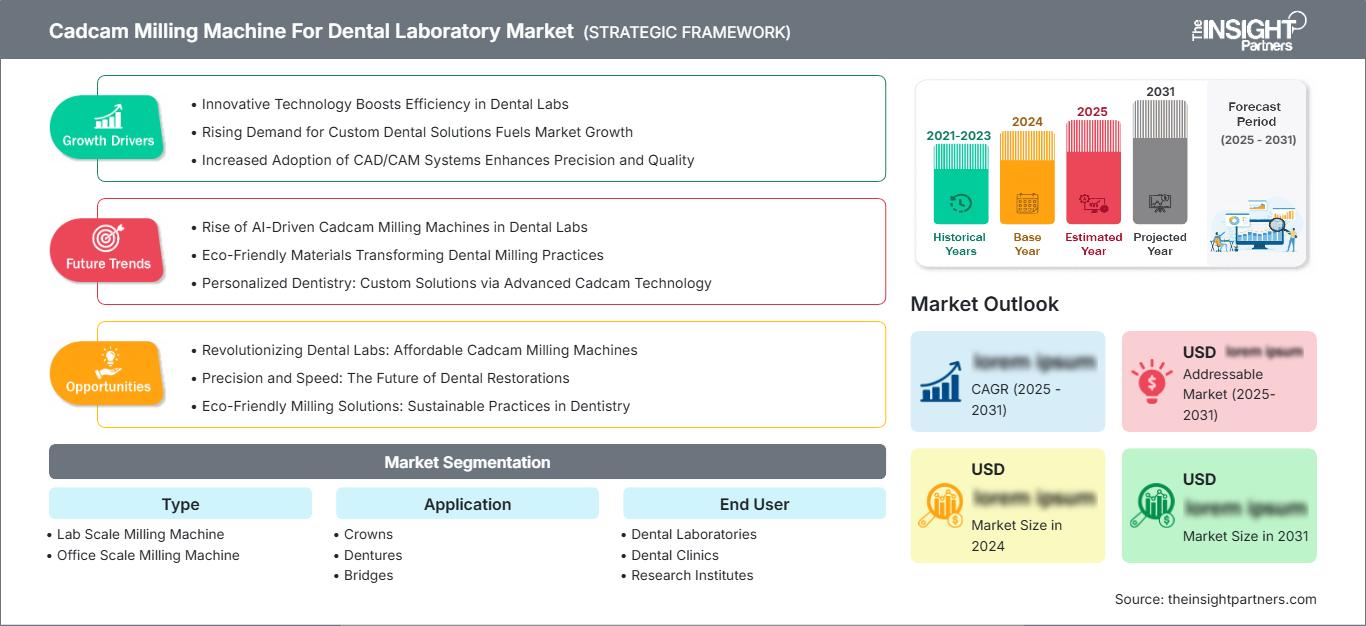
Cadcam Milling Machine For Dental Laboratory Market: Strategic Insights
Regional Insights
North America CAD/CAM Milling Machine for Dental Laboratory Market
North America accounted for a 34–37% share in 2025 and is expected to grow at a CAGR range of 6.6–7.4% during 2026–2034. The region benefits from mature laboratory outsourcing, high scanner penetration, and dental service organization procurement models. CAD/CAM Milling Machine for Dental Laboratory Market share remains concentrated in the US because production centers increasingly standardize on repeatable milling workflows.
Canada helps in the form of sophisticated prosthodontic techniques and cross-border flow of machinery, while Mexico helps in the form of affordable laboratory work. Reliability of parts is considered during procurement because laboratories look at minimizing breakdowns, validated materials, and computerized milling systems. The growth in the region is connected with implant restoration, same-week prosthetics, and quality esthetic dentistry.
U.S. CAD/CAM Milling Machine for Dental Laboratory Market
The US represented 78–82% of North America in 2025 and is expected to expand at a CAGR range of 6.7–7.5% during 2026–2034. Multi-location laboratories and dental service organizations are increasing centralized milling capacity to support crowns, bridges, implant bars, surgical guides, and full-arch restorations. Equipment selection is increasingly influenced by service availability and open-system compatibility.
The company’s presence is widespread, as it is backed by companies like TE Connectivity plc, Proterial Cable America, Inc., Fort Wayne Metals Research Products, LLC, Medtronic plc, and Stryker Corporation, which are involved in the adjacent precision medical manufacturing eco-system. Remote monitoring and preventive maintenance programs are being implemented in laboratories in the USA as well.
Europe CAD/CAM Milling Machine for Dental Laboratory Market
The region was valued at 27–30% in 2025 and is anticipated to exhibit a CAGR of 6.3–7.1% between 2026 and 2034. The country leads in the region on account of equipment engineering capability, dental materials, and extensive laboratory network. The market in the UK has been driven by private dentistry and outsourcing trends, with laboratories focusing on digital case acceptance and turnaround time consistency.
Germany dominates the manufacturing and technology standards as their demands are based on the needs of high axis milling and machinery strength and workflow validation. In France, the market demand is based on the need for updating prosthetics and consolidation of the laboratories. In Italy and Spain, there is high adoption rate of digital milling machinery by the laboratories.
APAC CAD/CAM Milling Machine for Dental Laboratory Market
Asia Pacific accounted for a 22–25% share in 2025 and is expected to grow at a CAGR range of 7.8–8.8% during 2026–2034. China is the leading country because of its large dental patient base, expanding private clinics, and competitive laboratory outsourcing. Japan and South Korea support high-precision demand, while India is scaling affordable digital dentistry.
The country provides excellent demand for restorations, owing to digital enabled clinics and specialist laboratories. Industry-based drivers are reduced milling costs, available technicians, and material processing facilities. Policy-based drivers include oral health care programs and medical production facilities, encouraging laboratories to purchase efficient machinery instead of opting for imported restorations.
Middle East & Africa CAD/CAM Milling Machine for Dental Laboratory Market
The Middle East & Africa market is expected to grow at a CAGR range of 6.9–7.9% during 2026–2034. Saudi Arabia is the leading country, supported by healthcare infrastructure investment and private dental chains. The UAE is a regional hub for premium cosmetic dentistry and medical tourism, creating demand for high-quality restoration turnaround.
Demand in the African region is driven by specialist dental laboratories in South Africa. Rest of MEA continues to be in a more nascent state, although adoption of equipment has been gaining traction owing to the packaging of training, materials, and maintenance by distributors. Infrastructure investment in energy-rich Gulf nations fuels premium healthcare investments, including digital dental laboratories.
Segmentation Analysis
Type
Type is expected to grow at a CAGR range of 6.8–7.4% during 2026–2034. This segment defines the CAD/CAM Milling Machine for Dental Laboratory Market scope because machine performance depends on stable power, signal, and data movement across compact production equipment. Demand is strongest where laboratories require durable cabling that supports continuous milling, vibration resistance, and integrated machine monitoring.
- Signal Cables dominate installed systems because motion control, spindle feedback, sensor communication, and safety interlocks require consistent low-latency transmission during long restoration milling cycles.
- Fiber Optic Cables are strategically important in laboratories adopting faster imaging, diagnostics, and real-time equipment monitoring, especially where electromagnetic interference reduction is required.
- Hybrid Cables are gaining preference in compact equipment platforms because they combine power, signal, and data functions, reducing routing complexity and improving serviceability.
Endoscope Type
Endoscope Type is expected to grow at a CAGR range of 7.3–8.1% during 2026–2034. Although the classification is component-oriented, its relevance lies in flexible and rigid visualization architectures used in precision device ecosystems. The segment is shaped by miniaturization, bend durability, imaging clarity, and the need for cable assemblies that support repeatable handling in clinical and laboratory-adjacent settings.
- Flexible Endoscopes require highly flexible cable and connector designs that preserve signal quality under repeated bending, making them important for compact and mobile medical visualization platforms.
- Rigid Endoscopes prioritize mechanical stability, robust connector interfaces, and precise imaging pathways, supporting applications where alignment, durability, and repeatable sterilization performance are critical.
Material
Material is expected to grow at a CAGR range of 6.6–7.2% during 2026–2034. Material selection affects cable flexibility, chemical resistance, cleaning compatibility, and long-term reliability. Laboratories and device manufacturers increasingly evaluate materials based on lifecycle cost, mechanical endurance, and suitability for compact systems operating near coolants, dust, vibration, and heat-generating components.
- Silicone remains valued for flexibility, biocompatibility, and thermal stability, particularly in components exposed to repeated handling or environments requiring softness and durability.
- Thermoplastic Elastomer offers processing efficiency, abrasion resistance, and design flexibility, making it suitable for scalable manufacturing where cost control and mechanical performance must align.
Connector Type
Connector Type is expected to grow at a CAGR range of 7.0–7.8% during 2026–2034. Connector selection influences machine uptime, maintenance speed, and resistance to contamination. Demand is moving toward compact locking mechanisms, clear mating feedback, and customized configurations that allow laboratories and equipment manufacturers to reduce assembly errors and simplify field servicing.
- Standard Connectors support cost-efficient equipment assembly and replacement, making them important in widely deployed milling platforms requiring predictable sourcing and maintenance simplicity.
- Custom Connectors are strategically important for differentiated equipment designs where compact geometry, shielding, traceability, and multi-function integration improve performance and service efficiency.
Opportunity Snapshot
| Type | Revenue Contribution | Trend Tag | Adoption Stage |
| Signal Cables | High | Motion Control | Mature |
| Fiber Optic Cables | Medium | Data Integrity | Scaling |
| Hybrid Cables | Medium | Compact Routing | Scaling |
Cadcam Milling Machine For Dental Laboratory Market Growth Drivers and Impact Analysis
Expansion of Digital Dental Laboratory Workflows
Dental laboratories are increasing reliance on end-to-end digital workflows because scanned impressions, CAD design, milling, coloring, sintering, and finishing can be coordinated with fewer manual transfer points. This improves case consistency and reduces remakes, a critical cost factor for laboratories handling crowns, bridges, veneers, and implant prosthetics. The practical impact is higher demand for milling equipment that operates reliably across extended production shifts. The driver also strengthens demand for stable cabling, clean signal routing, and modular designs because machine interruptions directly affect case turnaround. As laboratories scale from single-unit milling to multi-machine production cells, procurement criteria move beyond purchase price toward uptime, validation support, and service responsiveness.
Rising Demand for Implant-Supported Restorations
Implant dentistry is increasing the need for precise custom abutments, full-arch frameworks, surgical guides, and high-strength zirconia restorations. These products require dimensional accuracy, stable spindle performance, and repeatable milling paths, which raises the technical expectations placed on laboratory equipment. The market impact is strongest in regions with aging populations and expanding private dental expenditure, where patients increasingly seek fixed and esthetic restoration options. Laboratories must process harder materials while maintaining marginal accuracy, so they favor machines with reliable motion control, durable connectors, and reduced vibration sensitivity. This driver supports premium equipment demand and encourages suppliers to differentiate through precision, serviceability, and validated material compatibility.
Shift Toward Centralized Production and Outsourcing
Centralized dental production centers are becoming more important as small clinics and laboratories outsource complex milling to facilities with higher equipment utilization. This shift changes purchasing behavior because centralized operators require machines that can run longer cycles, manage multiple material types, and support standardized quality processes. The impact is stronger demand for robust components, quick replacement interfaces, and preventive maintenance systems that limit downtime. Outsourcing also encourages laboratories to adopt open workflows, allowing them to serve customers using different scanner and design platforms. Suppliers that can support high-throughput production, spare parts availability, and integration with digital case management systems are positioned to capture larger recurring opportunities.
Cadcam Milling Machine For Dental Laboratory Market Future Trends
Connected Milling Cells and Predictive Maintenance
CAD/CAM Milling Machine for Dental Laboratory Market trends are moving toward connected production cells where machine status, spindle hours, tool wear, coolant use, and error codes are continuously monitored. By 2034, more laboratories are expected to use predictive maintenance dashboards that schedule service before failure disrupts case delivery. This will increase demand for higher-integrity data transmission, sensor-ready connectors, and machine architectures that support remote diagnostics. The trend will also change supplier relationships, as laboratories will expect equipment vendors to provide analytics, replacement planning, and lifecycle support. Connectivity will become a measurable productivity lever rather than a secondary equipment feature.
Material-Specific Milling Optimization
Future milling systems are expected to become more material-aware, with software and hardware settings optimized for zirconia, lithium disilicate, PMMA, titanium, cobalt-chromium, and hybrid ceramics. Laboratories will benefit from reduced tool wear, cleaner margins, and lower post-processing variability. This trend will increase the importance of precise motor control, vibration management, and thermal stability across the production environment. Component suppliers will need to align cabling and connectors with more compact, sensor-rich machine designs. As restoration portfolios diversify, laboratories will favor equipment platforms that can shift between materials without lengthy calibration, creating an advantage for modular, validated, and service-friendly systems.
Cadcam Milling Machine For Dental Laboratory Market Opportunities
Scalable Milling Solutions for Emerging Dental Hubs
Emerging dental hubs in China, India, Saudi Arabia, the UAE, and parts of Southeast Asia offer investment potential for suppliers that can deliver scalable milling packages with training, financing, materials, and service contracts. CAD/CAM Milling Machine for Dental Laboratory Market Forecasts indicate that these markets will require equipment that balances precision with operational simplicity. Vendors can create value by offering tiered platforms, from entry-level dry milling to advanced wet-dry multi-axis systems. Local distributor partnerships and technician education will be critical because adoption depends on confidence in maintenance and material handling. Suppliers that localize support can convert first-time buyers into multi-unit laboratory customers.
Custom Connectivity for Compact Equipment Platforms
Compact milling equipment creates opportunity for custom connectors, hybrid cables, and miniaturized transmission assemblies that reduce internal routing complexity. Equipment manufacturers can use differentiated connectivity to improve machine footprint, service access, shielding, and reliability under vibration. This opportunity is especially relevant as laboratories seek smaller systems for urban locations and distributed production models. Component suppliers should work earlier in the design cycle, helping machine manufacturers optimize cable bend radius, locking mechanisms, and maintenance accessibility. The investment case is compelling because customized connectivity can reduce assembly errors, improve lifecycle performance, and support premium positioning in equipment categories where mechanical reliability strongly influences purchasing decisions.
Recent Developments
- May 2026: Olympus Corporation announced a global distribution agreement with EndoRobotics to add robot-assisted technologies to its EndoTherapy portfolio, strengthening its role in advanced minimally invasive procedural ecosystems and reinforcing demand for integrated visualization, control, and precision component platforms relevant to next-generation medical and laboratory equipment architectures.
- November 2025: Proterial Ltd. announced that it would exhibit at MEDICA 2025, presenting fine-pitch terminal processing, AWG 48 to 58 ultra-fine coaxial and multi-core wire, SilMED non-adhesive silicone cable, and medical tubes for endoscopes, surgical cables, ultrasonic probes, and catheters.
- February 2025: ODU GmbH & Co. KG presented Push-Lock Medical, a modular ODU-MAC Blue-Line connector variant designed for medical environments, offering push-pull locking, hygienic materials, flexible configuration for signal, data, and power transmission, and suitability for robotics and demanding clinical equipment applications.
Frequently Asked Questions

- Comprehensive Market Sizing and Forecast Analysis
- Detailed Segmentation Analysis
- In-Depth Market Dynamics Assessment
- Regional and Country-Level Insights
- Competitive Landscape and Company Benchmarking
- Strategic Business Intelligence
Recent Reports
Testimonials

The Insight Partners' SCADA System Market report is comprehensive, with valuable insights on current trends and future forecasts. The team was highly professional, responsive, and supportive throughout. We are very satisfied and highly recommend their services.
RAN KEDEM Partner, Reali Technologies LTDs
I requested a report on a very specific software market and the team produced the report in a few days. The information was very relevant and well presented. I then requested some changes and additions to the report. The team was again very responsive and I got the final report in less than a week.
JEAN-HERVE JENN Chairman, Future Analytica
We worked with The Insight Partners for an important market study and forecast. They gave us clear insights into opportunities and risks, which helped shape our plans. Their research was easy to use and based on solid data. It helped us make smart, confident decisions. We highly recommend them.
PIYUSH NAGPAL Sr. Vice President, High Beam Global
The Insight Partners delivered insightful, well-structured market research with strong domain expertise. Their team was professional and responsive throughout. The user-friendly website made accessing industry reports seamless. We highly recommend them for reliable, high-quality research services
YUKIHIKO ADACHI CEO, Deep Blue, LLC.
This is the first time I have purchased a market report from The Insight Partners.While I was unsure at first, I visited their web site and felt more comfortable to take the risk and purchase a market report.I am completely satisfied with the quality of the report and customer service. I had several questions and comments with the initial report, but after a couple of dialogs over email with their analyst I believe I have a report that I can use as input to our strategic planning process.Thank you so much for taking the extra time and making this a positive experience.I will definitely recommend your service to others and you will be my first call when we need further market data.
JOHN SUZUKI President and Chief Executive Officer, Board Director, BK Technologies
I wish to appreciate your support and the professionalism you displayed in the course of attending to my request for information regarding to infectious disease IVD market in Nigeria. I appreciate your patience, your guidance, and the fact that you were willing to offer a discount, which eventually made it possible for us to close a deal. I look forward to engaging The Insight Partners in the future, all thanks to the impression you have created in me as a result of this first encounter.
DR CHIJIOKE ONYIA MANAGING DIRECTOR, PineCrest Healthcare Ltd.Reason to Buy
- Informed Decision-Making
- Understanding Market Dynamics
- Competitive Analysis
- Identifying Emerging Markets
- Customer Insights
- Market Forecasts
- Risk Mitigation
- Boosting Operational Efficiency
- Strategic Planning
- Investment Justification
- Tracking Industry Innovations
- Aligning with Regulatory Trends





 Get Free Sample for