
Calcium Hydroxide Market Share, Growth & Demand by 2034
Coverage: by Application (Water Treatment, Construction, Environmental Gas Treatment, Food and Beverages, Pulp and Paper, Others) , and Geography (North America, Europe, Asia Pacific, and South and Central America)
- Status : Data Released
- Report Code : TIPRE00012832
- Category : Chemicals and Materials
- No. of Pages : 150
- Available Report Formats :


- Last update date : July 20, 2026


2025 Market Size
US$ 13.14 Bn
Base year value
2034 Forecast
US$ 16.39 Bn
Projected by 2034
CAGR 2026-2034
2.80 %
Growth rate
Addressable Market
US$ 136.12 Bn
(2026-2034)
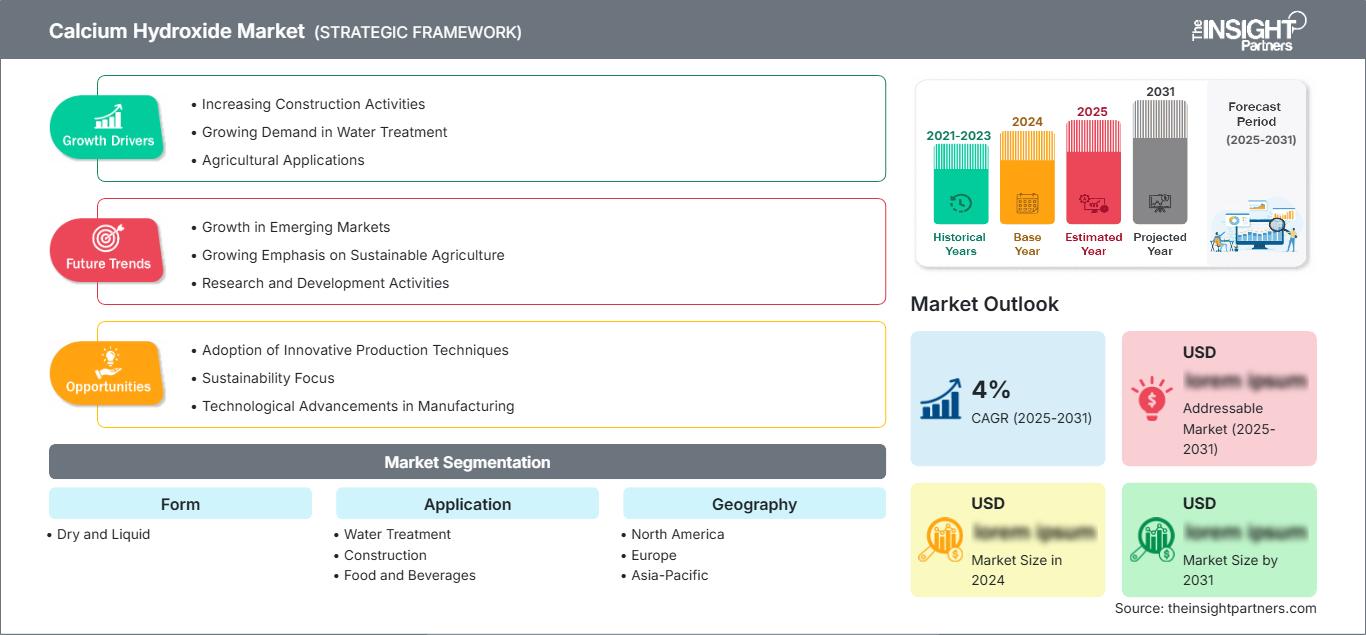
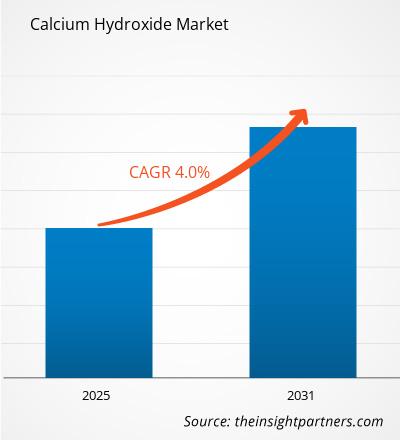
The Calcium Hydroxide market is valued at US$ 13.14 billion in 2025 and is projected to reach US$ 16.39 billion by 2034, registering a CAGR of 2.80% during 2026–2034. Demand continues to be supported by its established role in municipal water treatment, construction materials, environmental remediation, pulp and paper manufacturing, and food processing. The material remains an essential alkaline reagent because of its cost efficiency, broad industrial compatibility, and compliance with stringent environmental and public health regulations across developed and emerging economies.
Across North America, the Calcium Hydroxide Market size continues to expand steadily as investments in water infrastructure modernization and environmental compliance accelerate consumption. The regional market is anticipated to grow at a CAGR of 2.6%–3.1% during 2026–2034, supported by the replacement of aging treatment facilities, increasing wastewater recycling projects, and sustained construction activity. Additional demand stems from industrial emission control applications, where hydrated lime remains an important reagent for flue gas treatment and process neutralization.
Calcium Hydroxide Market Assessment and Insights
- North America: The region benefits from mature municipal water treatment infrastructure, environmental compliance requirements, and stable industrial consumption. Share in 2025: 28%–32%; CAGR between 2026–2034: 2.6%–3.1%.
- U.S.: Strong investments in drinking water upgrades, industrial wastewater treatment, and environmental remediation support sustained demand. Share in 2025: 74%–78% of North America; CAGR between 2026–2034: 2.6%–3.0%.
- Europe: Stringent environmental regulations and circular economy initiatives continue to support consumption across Germany, France, the UK, Italy, and Spain. Share in 2025: 24%–28%; CAGR between 2026–2034: 2.3%–2.8%.
- Asia Pacific: Rapid industrialization, expanding municipal infrastructure, and growing investments in environmental protection drive demand across China, India, Japan, and South Korea. Share in 2025: 34%–38%; CAGR between 2026–2034: 3.3%–3.8%.
- Largest Segment: Application – Water Treatment remains the leading segment because hydrated lime is extensively used for pH adjustment, softening, sludge stabilization, and contaminant removal. Market share in 2025: 34%–38%; CAGR between 2026–2034: 2.9%–3.3%.
- High-Growth Segment: Application – Agriculture is expected to record the fastest expansion due to increasing soil conditioning practices and sustainable crop productivity initiatives. Market share in 2025: 11%–15%; CAGR between 2026–2034: 3.8%–4.3%.
- Key companies analyzed in detail: CAO Industries Sdn. Bhd., Carmeuse Europe, Graymont Limited, Hydrite Chemical Co., Innovo Chemicals Limited, Jost Chemical Co., Lhoist Group, Minerals Technologies Inc., Mississippi Lime Company, United States Lime & Minerals, Inc.
Source: The Insight Partners' analysis based on proprietary research, government publications, company annual reports, investor presentations, industry databases, and expert interviews.
The production process of calcium hydroxide has undergone changes as a result of more stringent environmental controls, increased capital investments in city infrastructure, and advanced techniques for lime manufacturing. The producers are now making an effort towards enhancing kilns, perfecting the hydration process, and developing regional distribution networks that would help achieve consistent product quality and supply. Increased digitalization of the manufacturing process, better control of energy consumption, and environmentally-friendly production processes are helping increase efficiency while catering to the needs of water purification, construction, pulp and paper, agriculture, and the food industry.
Looking ahead, the Calcium Hydroxide Market participants are expected to prioritize capacity expansion in rapidly industrializing economies while strengthening supply resilience through regional production facilities and long-term raw material sourcing strategies. Investments in water recycling technology, stringent rules concerning effluent discharge and the development of environmental restoration projects are expected to facilitate future growth in demand. On the other hand, improvements in technologies related to emissions controls, sustainable building materials, and soil management in agriculture are expected to generate business for producers of calcium hydroxide.
Calcium Hydroxide Market Report Scope
| Report Attribute | Details |
|---|---|
| Market size in 2025 | US$ 13.14 Billion |
| Market Size by 2034 | US$ 16.39 Billion |
| Global CAGR (2026 - 2034) | 2.80% |
| Historical Data | 2021-2024 |
| Forecast period | 2026-2034 |
Calcium Hydroxide Market Analysis
Increasing investment in municipal water infrastructure, industrial wastewater treatment, and environmental protection continues to support Calcium Hydroxide Market growth across major economies. This raw material is essential for the processes of pH regulation, water softening, sludge stabilization, and acid neutralization since it provides a combination of high levels of alkalinity, practical efficiency, and favorable cost-effectiveness. Moreover, the increasing demand stems from the need for soil and mortar stabilization in construction projects as well as the use of hydrated lime in pulp and paper production. Increased legislation on emissions in industry also contributes to the ongoing consumption of the raw material.
The starting point of the value chain is limestone mining, followed by calcination to get quicklime and hydration to obtain calcium hydroxide. Consistency of the grain sizes, purity, and moisture management are the factors stressed by the producers to ensure that they meet varied industrial requirements. Location of production sites and effective logistics continue to be essential since hydrated lime can be moved short distances due to cost efficiency considerations. Coordination among raw materials providers, lime producers, distributors, engineering companies, and the industrial users has improved supply chain reliability and ensured steady product availability.
According to the analysis of the market of calcium hydroxide, competition in the market is seen through companies that manufacture lime and have substantial quarry assets, well-developed processing facilities, and loyal industrial customers. These companies include Lhoist Group, Graymont Limited, Carmeuse Europe, Mississippi Lime Company, United States Lime & Minerals, Inc., Minerals Technologies Inc., Hydrite Chemical Co., Jost Chemical Co., Innovo Chemicals Limited, and CAO Industries Sdn. Bhd. They compete on the basis of product quality and technical assistance, rather than prices.
Strategic investments in the Calcium Hydroxide Market increasingly focus on capacity modernization, automation, and energy-efficient hydration technologies to improve productivity and reduce operational emissions. Manufacturers are also expanding technical service capabilities to address evolving customer requirements in water treatment, food processing, and environmental remediation. Partnerships with municipal utilities, engineering contractors, and industrial processors are enhancing long-term supply agreements and supporting recurring demand. As governments continue prioritizing water security, pollution control, and sustainable infrastructure development, established producers with integrated limestone resources, diversified application portfolios, and strong regional distribution networks are expected to maintain a competitive advantage throughout the forecast period.
● REPORT CUSTOMIZATION
Tailor This Report To Align With Your Specific Business Requirements
This report can be customized to align precisely with your business objectives, scope, and target markets. Customization options include tailored segmentation, geography, competitive analysis, and strategic insights to support informed decision-making.
Customize This Report →WHAT YOU CAN ADJUST
- ● Segmentations
- ● Geography
- ● Competitive Analysis
- ● Language Preferences
Calcium Hydroxide Market: Strategic Insights
Regional Insights
North America Calcium Hydroxide
North America accounted for an estimated 28%–32% Calcium Hydroxide Market share of the global market in 2025 and is projected to register a CAGR of 2.6%–3.1% during 2026–2034. The region will profit from already existing municipal water treatment plants, strict environmental regulations, and investment in wastewater management. Calcium Hydroxide will maintain its demand as government entities will continue paying attention to the purity of drinking water, industrial wastewater treatment, and soil contamination cleanup. The use of hydrated lime in construction, mining, and emission reduction technology also provides strong demand growth.
Additionally, the development of new water systems and treatment plants, along with the replacement of old water systems and their modernization, creates opportunities for demand growth. The industries such as pulp and paper, chemicals, steel, and food manufacturing will continue using calcium hydroxide for pH regulation and cleaning purposes. Reliable sources of limestone, integrated plants, and the presence of major companies in the region, such as Graymont Limited, Mississippi Lime Company, United States Lime & Minerals, Inc., and Lhoist Group, create good supply security and future growth opportunities.
U.S. Calcium Hydroxide Market
The United States represented approximately 74%–78% of the North American Calcium Hydroxide Market in 2025 and is expected to expand at a CAGR of 2.6%–3.0% through 2034. Significant investments through federal infrastructure programs contribute significantly to the rising demand for hydrated lime for water treatment, wastewater management, and environmental remediation applications. Industries such as chemical industries, food processing, construction, and mining continue to consume hydrated lime on account of its efficiency in neutralization and purification applications.
The availability of limestone deposits and established production infrastructure ensures a steady supply of hydrated lime in the country’s industrial zones. Major players like Mississippi Lime Company, United States Lime & Minerals, Inc., Minerals Technologies Inc., and Hydrite Chemical Co. continue to improve their product offerings and services in the market. The growing demand for industrial emission control, water management, and sustainable construction materials will drive market demand in the future.
Europe Calcium Hydroxide Market
Europe accounted for an estimated 24%–28% share of the global Calcium Hydroxide Market in 2025 and is projected to register a CAGR of 2.3%–2.8% during 2026–2034. Environmental legislation, circular economy initiatives, and continued investments in wastewater treatment support stable regional demand. Germany leads the regional market owing to its extensive chemical manufacturing base, advanced environmental infrastructure, and strong demand from the steel, pulp and paper, and construction industries. The country also benefits from the presence of established lime producers and continuous investment in sustainable industrial processes.
The UK maintains steady demand through municipal drinking water treatment, flue gas desulfurization, and infrastructure maintenance projects. France, Italy, and Spain collectively contribute substantial consumption owing to expanding wastewater recycling programs, industrial process optimization, and agricultural soil conditioning. France benefits from environmental compliance initiatives, Italy supports demand through construction and manufacturing, while Spain records increasing utilization in water reuse and mining operations. The presence of leading companies such as Lhoist Group and Carmeuse Europe further strengthens regional production capabilities and supply reliability.
APAC Calcium Hydroxide Market
Asia Pacific represented an estimated 34%–38% share of the global Calcium Hydroxide Market in 2025 and is expected to expand at a CAGR of 3.3%–3.8% during 2026–2034, making it the fastest-growing regional market. China remains the leading producer and consumer, while India continues to record strong demand from water treatment and infrastructure projects. Japan and South Korea support consumption through advanced chemical, electronics, and environmental applications.
Government investments in wastewater infrastructure, industrial pollution control, and urban development continue to strengthen regional demand. Australia contributes through mining, water management, and environmental remediation activities, while Southeast Asian economies increasingly invest in municipal treatment facilities and sustainable industrial development, creating favorable long-term growth opportunities.
Middle East & Africa Calcium Hydroxide Market
The Middle East & Africa Calcium Hydroxide Market is projected to register a CAGR of 3.0%–3.5% during 2026–2034. Saudi Arabia remains the leading market owing to industrial diversification, desalination projects, and investments in mining and infrastructure. The UAE continues to increase consumption through municipal water treatment and construction activities supported by ongoing urban development.
South Africa maintains stable demand from mining, metallurgy, and water treatment sectors, while the Rest of the Middle East & Africa benefits from expanding wastewater management and environmental protection initiatives. Growing investments in industrial infrastructure, resource processing, and sustainable water management are expected to support steady adoption of calcium hydroxide across the region during the forecast period.
Segmentation Analysis
Form
The Form segment represents a fundamental classification of the market based on product handling, transportation, storage, and end-use requirements. Demand varies according to application-specific processing conditions, with dry products preferred for bulk industrial operations and liquid formulations adopted where automated dosing and rapid dispersion are required. The Calcium Hydroxide Market scope continues to broaden as manufacturers develop application-specific formulations to improve operational efficiency. The Form segment is projected to register a CAGR of 2.7%–3.1% during 2026–2034.
- Dry: Dry calcium hydroxide accounts for the largest share of consumption due to its long shelf life, ease of transportation, economical storage, and extensive use in water treatment, construction materials, mining, and flue gas treatment applications.
- Liquid: Liquid calcium hydroxide is increasingly adopted where continuous dosing, rapid mixing, and automated industrial operations improve process efficiency, particularly across municipal water treatment plants, chemical processing facilities, and selected food manufacturing applications.
Application
The Application segment dominates overall demand because calcium hydroxide serves multiple industrial processes requiring alkalinity control, neutralization, purification, stabilization, and environmental compliance. Continued investments in municipal infrastructure, industrial manufacturing, and sustainable agricultural practices support long-term expansion across several end-use industries. The Application segment is anticipated to record a CAGR of 2.9%–3.3% during 2026–2034.
- Water Treatment: Water treatment remains the leading application owing to widespread utilization for pH adjustment, water softening, heavy metal precipitation, sludge stabilization, and drinking water purification across municipal and industrial treatment facilities.
- Construction: Construction applications utilize calcium hydroxide in mortar, plaster, soil stabilization, masonry products, and infrastructure projects where improved durability, workability, and long-term structural performance remain essential requirements.
- Food and Beverages: Food and beverage manufacturers employ food-grade calcium hydroxide for sugar processing, corn treatment, food preservation, acidity regulation, and selected processing operations requiring approved alkaline ingredients.
- Pulp and Paper: Pulp and paper producers rely on calcium hydroxide for chemical recovery, pH control, bleaching support, and wastewater treatment to improve production efficiency while meeting environmental discharge standards.
- Agriculture: Agricultural applications continue expanding as farmers increasingly utilize calcium hydroxide for soil conditioning, acidity correction, nutrient availability enhancement, livestock sanitation, and disease management within sustainable farming systems.
Opportunity Snapshot
| Application | Revenue Contribution | Trend Tag | Adoption Stage |
| Water Treatment | High | Water Reuse | Mature |
| Construction | High | Green Cement | Mature |
| Food and Beverages | Medium | Food Safety | Scaling |
| Pulp and Paper | Medium | Process Recovery | Mature |
| Agriculture | Medium | Soil Conditioning | Scaling |
| Others | Low | Emission Control | Emerging |
Calcium Hydroxide Market Growth Drivers and Impact Analysis
Expansion of Municipal Water Treatment and Wastewater Infrastructure
Increasing public spending on infrastructure development for drinking water and wastewater facilities is one of the key factors stimulating the growth of demand for calcium hydroxide. Authorities in North America, Europe, and the Asia Pacific region are constantly investing in improving their aging facilities that do not meet the new standards of water quality and cannot handle increased urbanization. Hydrated lime is an essential chemical component involved in pH control, water softening, sludge stabilization, phosphates elimination, and metal precipitation and, and thus, is crucial in treatment processes at municipal facilities. Growing trends of wastewater reuse in industries are likely to boost the consumption in the production sector.
Strengthening Environmental Regulations Across Industrial Sectors
Calcium hydroxide is becoming a popular choice for industrial operators as more stringent regulations on emissions, effluent disposal, and hazardous waste handling come into place. Hydrated lime is employed by steel mills, mines, chemical companies, and power producers in the neutralization of acids, flue gas treatment, purification processes, and sludge conditioning. Governments are increasing compliance standards in order to minimize environmental effects related to industrial operations and stimulate increased usage of alkaline chemicals. Simultaneously, industries are improving production processes to become cleaner, generating steady demand for high-quality lime producers that can meet strict requirements.
Growing Infrastructure Development and Sustainable Agriculture
Diversification of demand due to the development of infrastructure and agricultural techniques is ongoing. Building firms make use of calcium hydroxide in their soil stabilization processes, mortar making, and construction projects in order to boost efficiency and performance. At the same time, farmers employ the use of hydrated lime in improving the pH levels of soils to allow for more efficient crop growth. The increase in investments in transport infrastructure, housing developments, irrigation systems, and land restoration projects will go a long way in ensuring that markets become promising for manufacturers.
Calcium Hydroxide Market Future Trends
Integration of Sustainable Production Technologies
Manufacturers are increasingly investing in energy-efficient kilns, digital process automation, and low-emission hydration technologies to improve operational efficiency and reduce environmental impact. This shift reflects broader industrial decarbonization strategies and stricter environmental compliance requirements across major economies. The adoption of renewable energy sources, waste heat recovery systems, and advanced process controls is expected to lower production costs while improving product consistency. These developments are reshaping Calcium Hydroxide Market trends by encouraging producers to modernize manufacturing facilities and strengthen sustainability credentials. Companies capable of integrating efficient production technologies with reliable supply chains are expected to achieve stronger long-term competitiveness while meeting evolving customer expectations for environmentally responsible industrial materials.
Increasing Adoption in Circular Water Management Systems
Water reuse and resource recovery initiatives are expected to become increasingly important growth areas over the coming decade. Municipal authorities and industrial operators are investing in advanced wastewater treatment systems that maximize water recycling while minimizing environmental impact. Calcium hydroxide will continue supporting these initiatives through pH regulation, contaminant removal, sludge stabilization, and phosphorus recovery processes. Growing investments in desalination, industrial water recycling, and integrated water management projects are expected to create additional demand across both developed and emerging economies. Producers that develop specialized grades for advanced treatment applications and collaborate closely with engineering firms are likely to benefit from expanding infrastructure investments.
Calcium Hydroxide Market Opportunities
Expansion into Emerging Water Infrastructure Projects
Rapid urbanization across the Asia Pacific, the Middle East, Africa, and parts of Latin America continues to accelerate investments in municipal water supply, wastewater treatment, and industrial water recycling facilities. Calcium Hydroxide Market Forecasts indicate that long-term infrastructure spending and increasingly stringent environmental regulations will create sustained demand for high-quality hydrated lime products. Manufacturers can capitalize on these opportunities by establishing regional production facilities, expanding technical service capabilities, and forming strategic partnerships with engineering procurement contractors and municipal authorities. Localized supply chains and customized product offerings will help companies strengthen competitive positioning while supporting large-scale infrastructure development and long-term customer relationships.
Development of High-Purity Specialty Grades
Growing demand from food processing, pharmaceutical manufacturing, specialty chemicals, and advanced environmental applications is creating opportunities for high-purity calcium hydroxide products. Producers investing in improved quality control, advanced hydration technologies, and application-specific formulations can address increasingly stringent customer specifications. These premium products typically command higher margins while supporting long-term customer retention through technical collaboration and regulatory compliance. Continued innovation in specialty formulations, supported by certification programs and enhanced manufacturing capabilities, is expected to strengthen market differentiation and enable suppliers to expand beyond traditional bulk industrial applications into higher-value end-use sectors.
Recent Developments
- September 2025: Graymont Limited completed the acquisition of the Compact Energy lime processing facility in Banting, Malaysia. The acquisition added approximately 390,000 tonnes of annual quicklime capacity and 70,000 tonnes of hydrated lime capacity, strengthening Graymont's production network and supply capabilities across Malaysia and the broader Asia Pacific region.
- January 2025: Century Lithium Corp. announced the successful production of high-purity (>99.5%) lithium hydroxide at its Demonstration Plant in Nevada. The lithium hydroxide was produced from lithium carbonate derived from the Angel Island lithium claystone deposit using the company's patent-pending alkaline leach and Direct Lithium Extraction (DLE) process. The final conversion employed a conventional liming process with calcium hydroxide, demonstrating its critical role in producing battery-grade lithium hydroxide for electric vehicle and energy storage applications.
Frequently Asked Questions

- Comprehensive Market Sizing and Forecast Analysis
- Detailed Segmentation Analysis
- In-Depth Market Dynamics Assessment
- Regional and Country-Level Insights
- Competitive Landscape and Company Benchmarking
- Strategic Business Intelligence
Recent Reports
Testimonials

The Insight Partners' SCADA System Market report is comprehensive, with valuable insights on current trends and future forecasts. The team was highly professional, responsive, and supportive throughout. We are very satisfied and highly recommend their services.
RAN KEDEM Partner, Reali Technologies LTDs
I requested a report on a very specific software market and the team produced the report in a few days. The information was very relevant and well presented. I then requested some changes and additions to the report. The team was again very responsive and I got the final report in less than a week.
JEAN-HERVE JENN Chairman, Future Analytica
We worked with The Insight Partners for an important market study and forecast. They gave us clear insights into opportunities and risks, which helped shape our plans. Their research was easy to use and based on solid data. It helped us make smart, confident decisions. We highly recommend them.
PIYUSH NAGPAL Sr. Vice President, High Beam Global
The Insight Partners delivered insightful, well-structured market research with strong domain expertise. Their team was professional and responsive throughout. The user-friendly website made accessing industry reports seamless. We highly recommend them for reliable, high-quality research services
YUKIHIKO ADACHI CEO, Deep Blue, LLC.
This is the first time I have purchased a market report from The Insight Partners.While I was unsure at first, I visited their web site and felt more comfortable to take the risk and purchase a market report.I am completely satisfied with the quality of the report and customer service. I had several questions and comments with the initial report, but after a couple of dialogs over email with their analyst I believe I have a report that I can use as input to our strategic planning process.Thank you so much for taking the extra time and making this a positive experience.I will definitely recommend your service to others and you will be my first call when we need further market data.
JOHN SUZUKI President and Chief Executive Officer, Board Director, BK Technologies
I wish to appreciate your support and the professionalism you displayed in the course of attending to my request for information regarding to infectious disease IVD market in Nigeria. I appreciate your patience, your guidance, and the fact that you were willing to offer a discount, which eventually made it possible for us to close a deal. I look forward to engaging The Insight Partners in the future, all thanks to the impression you have created in me as a result of this first encounter.
DR CHIJIOKE ONYIA MANAGING DIRECTOR, PineCrest Healthcare Ltd.Reason to Buy
- Informed Decision-Making
- Understanding Market Dynamics
- Competitive Analysis
- Identifying Emerging Markets
- Customer Insights
- Market Forecasts
- Risk Mitigation
- Boosting Operational Efficiency
- Strategic Planning
- Investment Justification
- Tracking Industry Innovations
- Aligning with Regulatory Trends





 Get Free Sample for