
Cancer mTOR Inhibitors Market Trends, Share & Demand by 2034
Coverage: By Type (Torisel, Afinitor, Afinitor Dizperz, Others); Application (Cancer, Neuroendocrine Tumors, Hematological Malignancy, Hepatocellular Carcinoma, Glioblastoma) , and Geography (North America, Europe, Asia Pacific, and South and Central America)
- Status : Data Released
- Report Code : TIPRE00027320
- Category : Life Sciences
- No. of Pages : 150
- Available Report Formats :


- Last update date : August 12, 2026


2025 Market Size
US$ 4.91 Bn
Base year value
2034 Forecast
US$ 7.88 Bn
Projected by 2034
CAGR 2026-2034
5.4 %
Growth rate
Addressable Market
US$ 58.01 Bn
(2026-2034)
The Cancer mTOR Inhibitors market was valued at US$ 4.91 billion in 2025 and is expected to reach US$ 7.88 billion by 2034; it is estimated to record a CAGR of 5.4% during 2026-2034.
Cancer mTOR Inhibitors Market Assessment and Insights
- North America accounted for 39–42% share in 2025 and is projected to grow at a CAGR between 2026–2034 of 5.8–6.4%, supported by oncology infrastructure, molecular diagnostics, and broad use of targeted therapy combinations.
- US represented 82–86% of North America in 2025 and is expected to grow at a CAGR between 2026–2034 of 5.9–6.5%, reflecting high trial activity and specialty drug access.
- Europe held 26–29% share in 2025 and is forecast to expand at a CAGR between 2026–2034 of 5.4–6.0%, led by Germany, the UK, France, Italy, and Spain.
- Asia Pacific generated 21–24% share in 2025 and is likely to grow at a CAGR between 2026–2034 of 6.8–7.4%, led by China, Japan, South Korea, and India.
- Largest Segment Cancer held 43–47% market share in 2025 and is expected to grow at a CAGR between 2026–2034 of 5.7–6.3%, supported by renal, breast, and pathway-selected oncology use.
- High Growth Segment Neuroendocrine Tumors held 20–24% market share in 2025 and is projected to grow at a CAGR between 2026–2034 of 6.7–7.5%, reflecting specialist adoption.
- Key companies analyzed in detail: LC Laboratories, UniProt, Biotool, Exelixis, Inc., Novartis AG, Enzymlogic, BioLegend, Inc., Enzo Biochem, Inc., Cell Signaling Technology, Inc., Fluofarma, Pfizer Inc., F. Hoffmann-La Roche Ltd, Sunshine Biopharma, Inc., MedChemExpress LLC, and Selleck Chemicals LLC.
Source: The Insight Partners' analysis based on proprietary research, government publications, company annual reports, investor presentations, industry databases, and expert interviews.
Clinical application has evolved from a monotherapy approach to pathway inhibition to combination treatment which aims to circumvent endocrine resistance, immune evasion and compensation by PI3K-AKT signaling. Manufacturing is determined by the branded oncology pipeline, generic availability of everolimus and demand for research grade reagents from translational labs. The market remains balanced between traditional rapalog drugs and the next generation of kinase inhibitors that target both mTORC1 and mTORC2 pathways in solid cancers.
In the coming forecast years, new geographic regions will become significant contributors to volume growth due to increased cancer incidence and availability of targeted drug therapy in regional oncology centers. Regulatory environment favorable to precision medicine, sequencing and hospital oncology purchases will favor market penetration. Development investment will be directed at combination regimens, dose-finding studies and biomarker guided clinical trials.
Cancer mTOR Inhibitors Market Report Scope
| Report Attribute | Details |
|---|---|
| Market size in 2025 | US$ 4.91 Billion |
| Market Size by 2034 | US$ 7.88 Billion |
| Global CAGR (2026 - 2034) | 5.4% |
| Historical Data | 2021-2024 |
| Forecast period | 2026-2034 |
Cancer mTOR Inhibitors Market Analysis
The demand is building up due to the focus on pathway directed treatment of cancers that have activation of PI3K-AKT-mTOR, hormone resistance, and angiogenesis. Development of the Market is propelled by application in clinical and experimental combinations, such as the use of endocrine treatment and everolimus in ER-positive cancer cases. The chain of the value includes producers of active substances, formulators, sponsors of trials, diagnostic labs, specialized pharmacies, and hospital oncology departments.
Dynamics of the supply will continue being divided by the category of drug products. Branded drugs constitute the foundation for physician awareness, whereas generic everolimus provides cost-effectiveness options in selected markets. Inhibitors for research applications by LC Laboratories, MedChemExpress LLC, and Selleck Chemicals LLC facilitate drug discovery pipelines, while BioLegend, Inc., Enzo Biochem, Inc., and Cell Signaling Technology, Inc. provide pathway validation through antibodies, assays, and signaling reagents. NCI identifies mTOR as one of the pathways often modified in cancers.
Positioning in the market depends on the following factors such as the clinical data, stability of formulations, labeling and relationships with oncology centers. According to Cancer mTOR Inhibitors Market report, the manufacturers with diagnostics, reagents, and therapeutics experience derive advantage from continued studies in the pathways. Novartis AG has maintained the dominance through Afinitor and Afinitor Disperz, while Pfizer Inc. continues its presence with respect to Torisel in renal cell carcinoma labeling.
Innovation is taking place on rational combinations instead of extending the monotherapy approach. F. Hoffmann-La Roche Ltd, via Genentech, has announced encouraging results in phase III of the study involving giredestrant plus everolimus for ER-positive, HER2-negative advanced breast cancer after CDK4/6 inhibitors therapy, emphasizing the significance of all oral regimen. Exelixis, Inc. and dedicated research providers remain relevant through oncology ecosystem involvement, compound screening, and pathway targeting.
● REPORT CUSTOMIZATION
Tailor This Report To Align With Your Specific Business Requirements
This report can be customized to align precisely with your business objectives, scope, and target markets. Customization options include tailored segmentation, geography, competitive analysis, and strategic insights to support informed decision-making.
Customize This Report →WHAT YOU CAN ADJUST
- ● Segmentations
- ● Geography
- ● Competitive Analysis
- ● Language Preferences
Cancer mTOR Inhibitors Market: Strategic Insights
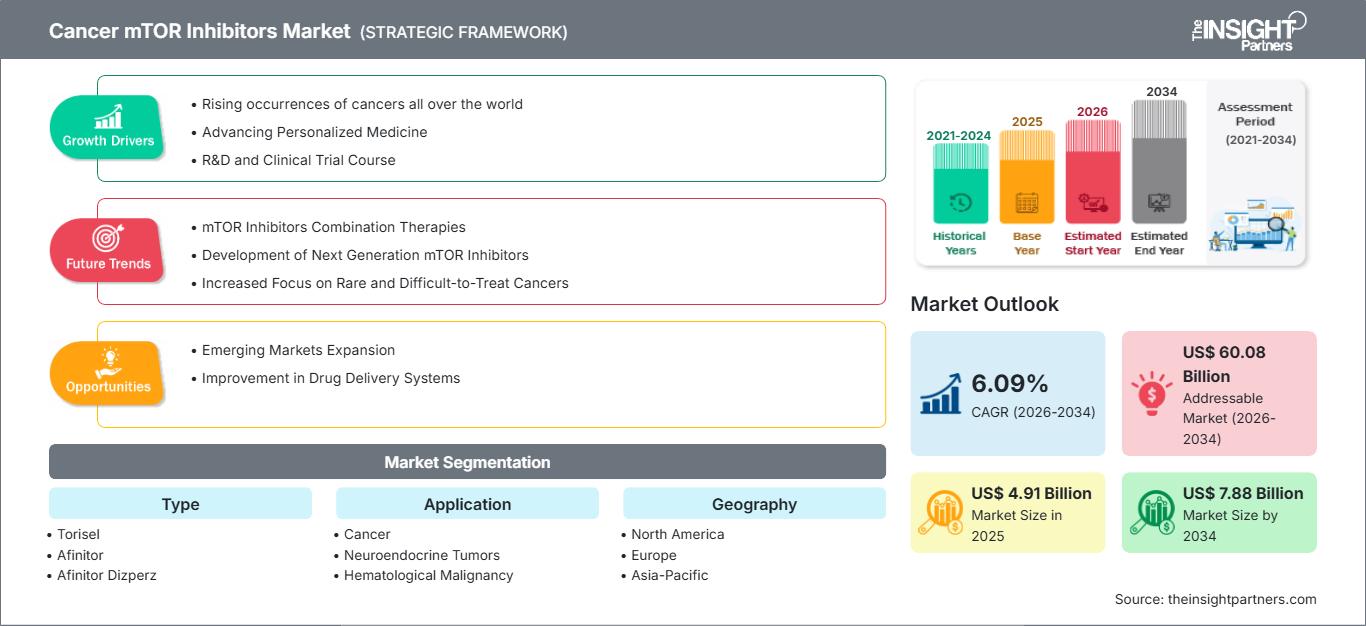
Regional Insights
North America Cancer mTOR Inhibitors Market
North America accounted for 39-42% market share in 2025 and is expected to expand at a CAGR of 5.8-6.4% through 2026-2034. The Cancer mTOR Inhibitors Market shares are backed by a high expenditure on oncology drugs, well-established specialty pharmacy distribution channels, and ongoing physician experience with everolimus and temsirolimus. Large cancer hospitals help speed up the combination trials for endocrine therapy, VEGF pathway drugs, and molecular diagnostics.
FDA labeling of medicines, extensive clinical trials network, and swift adoption of evidenced-based procedures are among factors that favor this market share. For example, Pfizer's Torisel labeling describes temsirolimus as a kinase inhibitor for treatment of advanced renal cell carcinoma, and NCI mentions mTOR inhibitors used for pancreatic neuroendocrine tumors.
U.S. Cancer mTOR Inhibitors Market
The USA constitutes 82-86% share of North America market in 2025 and is expected to grow at a CAGR of 5.9-6.5% from 2026-2034 due to high concentration of oncologists, clinical trial locations and managed access by payers for oral targeted therapies. The application demand is high in advanced solid cancers, neuroendocrine cancers and renal cancer.
There is high presence of companies such as Pfizer Inc., Novartis AG, F. Hoffmann-La Roche Ltd, LC Laboratories, BioLegend, Inc., Cell Signaling Technology, Inc., and Enzo Biochem, Inc. for their involvement in therapeutic, reagent and research process. EvERA update by Genentech in 2025 increased the interest in everolimus oral combinations in post-CDK4/6 breast cancer treatment.
Europe Cancer mTOR Inhibitors Market
Europe accounts for 26-29% share in 2025 and is projected to experience CAGR growth at 5.4-6.0% in 2026-2034. The major driver of demand in the region is Germany due to the presence of density of oncology centers, reimbursement policy, and molecular pathology network. In the UK, adoption is driven by health technology assessment, whereas in France, demand is driven by oncology networks and cancer pathways in hospitals.
The major drivers of volume are Italy and Spain due to prescribing in renal cancer, neuroendocrine cancers, and combinations in breast cancer. The demand is affected by pricing and cost-effectiveness evaluation in the region; however, evidence-based therapies are used in the protocol of advanced cancer patients. The presence of Novartis AG in Europe increases treatment compliance, and laboratories help with translational pathway research.
APAC Cancer mTOR Inhibitors Market
APAC accounts for 21–24% market share in 2025 and is forecast to increase at a CAGR of 6.8–7.4% between 2026 and 2034. China leads the market due to development of oncology infrastructure, local R&D, and greater availability of targeted drugs. Japan and South Korea focus on precision oncology, while India and Australia contribute with their cancer specialists' networks.
The industrial and regulatory factors driving APAC growth are localization of the pharmaceutical industry, bioscience investments, and expansion of molecular tests. The APAC market growth will be highest when more oral regimens get coverage and when hospitals use pathway testing in therapy.
Middle East & Africa Cancer mTOR Inhibitors Market
The Middle East & Africa region is projected to witness a CAGR of 5.2–5.8% in the period of 2026–2034. Saudi Arabia leads the charge, due to investment in healthcare infrastructure, increased capacity in oncology centers, and specialty medicines procurement. In the UAE, the advantages lie in private hospital facilities and medical tourism, whereas South Africa is still the most important gateway for sub-Saharan oncology.
Energy-based fiscal strength in Gulf states drives hospital upgrades, diagnostics improvements, and availability of branded therapies. Demand in the RoMEA segment is constrained by reimbursement issues, but public programs and private oncology centers are gradually enhancing targeted treatment availability..
Segmentation Analysis
Type
The Type segment is expected to grow at a CAGR of 5.8–6.4% during 2026–2034. Cancer mTOR Inhibitors Market scope is defined by branded formulations, dispersible tablets, injectable products, generics, and research-use inhibitors. Adoption depends on indication fit, dosing convenience, toxicity management, and availability through hospital or specialty channels. Oral products are favored where long-term outpatient management is feasible.
- Torisel remains strategically relevant in advanced renal cell carcinoma, where intravenous administration supports monitored specialist use and maintains a role in selected patients requiring established clinical protocols.
- Afinitor holds the strongest commercial position among branded products, supported by oral dosing, broader oncology familiarity, and use across selected breast cancer and neuroendocrine tumor settings.
- Afinitor Dizperz addresses patients requiring dispersible administration, supporting pediatric and neurologically complex applications where swallowing limitations or dose flexibility influence treatment selection.
Application
The Application segment is projected to grow at a CAGR of 6.1–6.7% during 2026–2034. Demand is shaped by tumor biology, sequencing after prior therapy, and guideline-based combination use. mTOR inhibition is most valuable where it offsets resistance pathways or slows tumor progression in selected advanced cancers. Biomarker-informed prescribing and tolerability management will influence long-term uptake across applications.
- Cancer remains the broadest application, supported by solid tumor usage, combination research, and clinical familiarity in renal cancer, breast cancer, and pathway-driven malignancies.
- Neuroendocrine Tumors show strong strategic importance because mTOR pathway inhibition is embedded in specialist practice for progressive pancreatic, gastrointestinal, and lung-origin tumors.
- Hematological Malignancy represents selective demand, with research interest focused on pathway activation, relapse biology, and combination strategies that may complement existing targeted agents.
- Hepatocellular Carcinoma reflects investigational and niche clinical relevance, where mTOR signaling intersects with angiogenesis, metabolic dysregulation, and resistance after systemic therapy.
- Glioblastoma remains an exploratory application, driven by pathway activation studies, blood-brain barrier challenges, and the need for rational combinations in aggressive brain tumors.
Opportunity Snapshot
| Application | Revenue Contribution | Trend Tag | Adoption Stage |
| Cancer | High | Resistance Care | Mature |
| Neuroendocrine Tumors | High | NET Protocols | Scaling |
| Hematological Malignancy | Medium | Relapse Biology | Emerging |
| Hepatocellular Carcinoma | Medium | Liver Oncology | Emerging |
| Glioblastoma | Low | Brain Trials | Emerging |
Cancer mTOR Inhibitors Market Growth Drivers and Impact Analysis
Rising Use of Targeted Therapy After Resistance
Advanced cancer care increasingly depends on therapies that address resistance after endocrine therapy, VEGF inhibitors, kinase inhibitors, or chemotherapy. mTOR inhibitors remain relevant because the pathway regulates cellular growth, metabolism, and survival, making it a rational target when tumor signaling adapts. The greatest commercial impact is in settings where oral combinations can delay chemotherapy and preserve outpatient treatment. Genentech’s positive 2025 Phase III evERA results for giredestrant plus everolimus illustrate how established mTOR inhibition can gain renewed relevance through better partners and patient selection. This driver supports sustained prescribing, follow-on trials, and payer interest in regimens that demonstrate measurable progression-free survival benefit.
Expansion of Neuroendocrine Tumor Diagnosis
Neuroendocrine tumor diagnosis has improved through advanced imaging, pathology standardization, and specialist referral pathways. This creates a more identifiable treatment population for mTOR inhibitors, particularly in progressive pancreatic, gastrointestinal, and lung-origin disease. NCI notes that mTOR-targeted drugs such as everolimus changed treatment for pancreatic neuroendocrine tumors, linking basic pathway research to clinical practice. Market impact is visible in durable demand from tertiary cancer centers and multidisciplinary tumor boards. As diagnosis occurs earlier and more consistently, treatment sequencing becomes more structured, improving the addressable base for approved products and competitive oral alternatives.
Research Ecosystem Supporting Next-Generation Inhibitors
Academic and industry research continues to refine mTOR inhibition beyond first-generation rapalogs. New discovery programs are evaluating compounds that inhibit both mTORC1 and mTORC2 to address compensatory signaling and improve antitumor depth. Recent preclinical work from the Chinese Academy of Sciences described a new ATP-competitive inhibitor with broad anticancer activity, reflecting continuing innovation around potency and selectivity. Commercial impact extends beyond therapeutics to reagents, antibodies, assay kits, and screening compounds supplied by specialist companies. This ecosystem strengthens pipeline replenishment and keeps the Market scientifically active.
Cancer mTOR Inhibitors Market Future Trends
Oral Combination Regimens in Precision Oncology
Cancer mTOR Inhibitors Market trends point toward oral combinations that integrate endocrine agents, pathway inhibitors, and biomarker-defined treatment selection. This shift is strategically important because it can improve patient convenience while extending treatment duration before chemotherapy. Positive late-stage evidence for giredestrant plus everolimus supports the trend toward all-oral regimens after CDK4/6 inhibitor exposure. Future adoption will depend on progression-free survival benefit, safety management, and payer acceptance. Companies able to pair mTOR inhibition with differentiated endocrine or kinase partners will have stronger positioning than those relying on single-agent legacy use.
Dual mTORC1 and mTORC2 Targeting
Next-generation research is moving toward more complete pathway blockade by targeting both mTORC1 and mTORC2. The rationale is clear: first-generation rapalogs mainly inhibit mTORC1, while compensatory signaling can reduce efficacy in some tumors. AACR-published 2025 research described superselective mTOR kinase inhibitors designed to address these limitations through improved potency and selectivity. If safety profiles are manageable, dual-complex inhibition could reshape clinical development in resistant tumors. The trend may also increase demand for pathway assays, phosphoprotein antibodies, and predictive biomarkers.
Cancer mTOR Inhibitors Market Opportunities
Biomarker-Led Trial Design
A major opportunity is the design of smaller, biomarker-enriched trials that identify patients most likely to benefit from mTOR inhibition. Cancer mTOR Inhibitors Market Forecasts will improve when developers connect pathway activation, resistance mutations, prior treatment exposure, and tumor-specific biology to measurable outcomes. Investors should focus on trials using genomic sequencing, phosphoprotein assays, and adaptive enrollment. This approach can reduce late-stage failure risk and create stronger reimbursement arguments. It also supports partnerships between pharmaceutical companies, diagnostic laboratories, and reagent suppliers that validate pathway activity in real-world clinical samples.
Generic Access and Emerging Market Penetration
Generic everolimus availability creates an opportunity to widen access in cost-sensitive geographies while preserving clinical relevance in approved indications. Sunshine Biopharma announced a Canadian everolimus launch in April 2025, showing how generic suppliers can expand market participation beyond originator brands. Similar access models can support hospital formularies in Asia Pacific, Latin America, and parts of the Middle East. Companies should prioritize regulatory filings, oncology distributor partnerships, and physician education on adverse-event management. Wider availability may increase treatment volumes even where average selling prices decline.
Recent Developments
- September 2025: F. Hoffmann-La Roche Ltd, through Genentech, announced positive Phase III evERA results for giredestrant plus everolimus in ER-positive, HER2-negative advanced breast cancer after CDK4/6 inhibitor and endocrine therapy. The study met both co-primary endpoints and showed statistically significant progression-free survival improvement, supporting renewed clinical interest in everolimus-based oral combinations.
- April 2025: Sunshine Biopharma, Inc. announced that its wholly owned Canadian subsidiary Nora Pharma Inc. launched Everolimus in Canada. The product is a generic equivalent of Afinitor and is available in 2.5 mg, 5 mg, and 10 mg strengths, expanding Canadian access to an oncology mTOR inhibitor.
- February 2026: Chinese Academy of Sciences researchers reported development of a new ATP-competitive mTOR inhibitor, T133, with broad anticancer activity in preclinical models. The compound showed potent mTOR inhibition, dose-dependent tumor suppression in xenograft research, and a safety profile that supported further investigation of next-generation pathway blockade.
Frequently Asked Questions

- Comprehensive Market Sizing and Forecast Analysis
- Detailed Segmentation Analysis
- In-Depth Market Dynamics Assessment
- Regional and Country-Level Insights
- Competitive Landscape and Company Benchmarking
- Strategic Business Intelligence
Recent Reports
Testimonials

The Insight Partners' SCADA System Market report is comprehensive, with valuable insights on current trends and future forecasts. The team was highly professional, responsive, and supportive throughout. We are very satisfied and highly recommend their services.
RAN KEDEM Partner, Reali Technologies LTDs
I requested a report on a very specific software market and the team produced the report in a few days. The information was very relevant and well presented. I then requested some changes and additions to the report. The team was again very responsive and I got the final report in less than a week.
JEAN-HERVE JENN Chairman, Future Analytica
We worked with The Insight Partners for an important market study and forecast. They gave us clear insights into opportunities and risks, which helped shape our plans. Their research was easy to use and based on solid data. It helped us make smart, confident decisions. We highly recommend them.
PIYUSH NAGPAL Sr. Vice President, High Beam Global
The Insight Partners delivered insightful, well-structured market research with strong domain expertise. Their team was professional and responsive throughout. The user-friendly website made accessing industry reports seamless. We highly recommend them for reliable, high-quality research services
YUKIHIKO ADACHI CEO, Deep Blue, LLC.
This is the first time I have purchased a market report from The Insight Partners.While I was unsure at first, I visited their web site and felt more comfortable to take the risk and purchase a market report.I am completely satisfied with the quality of the report and customer service. I had several questions and comments with the initial report, but after a couple of dialogs over email with their analyst I believe I have a report that I can use as input to our strategic planning process.Thank you so much for taking the extra time and making this a positive experience.I will definitely recommend your service to others and you will be my first call when we need further market data.
JOHN SUZUKI President and Chief Executive Officer, Board Director, BK Technologies
I wish to appreciate your support and the professionalism you displayed in the course of attending to my request for information regarding to infectious disease IVD market in Nigeria. I appreciate your patience, your guidance, and the fact that you were willing to offer a discount, which eventually made it possible for us to close a deal. I look forward to engaging The Insight Partners in the future, all thanks to the impression you have created in me as a result of this first encounter.
DR CHIJIOKE ONYIA MANAGING DIRECTOR, PineCrest Healthcare Ltd.Reason to Buy
- Informed Decision-Making
- Understanding Market Dynamics
- Competitive Analysis
- Identifying Emerging Markets
- Customer Insights
- Market Forecasts
- Risk Mitigation
- Boosting Operational Efficiency
- Strategic Planning
- Investment Justification
- Tracking Industry Innovations
- Aligning with Regulatory Trends





 Get Free Sample for