
Carbamate Insecticides Market Share, Size & Demand by 2034
Coverage: by Type (Aldicarb, Oxamyl, Carbaryl, Methiocarb, Carbofuran, Methomyl, Thiodicarb); Application (Agriculture, Forests, Residential Buildings, Commercial Buildings) , and Geography (North America, Europe, Asia Pacific, and South and Central America)
- Status : Data Released
- Report Code : TIPRE00009420
- Category : Chemicals and Materials
- No. of Pages : 150
- Available Report Formats :


- Last update date : April 28, 2026


2025 Market Size
US$ 15.25 Bn
Base year value
2034 Forecast
US$ 25.33 Bn
Projected by 2034
CAGR 2026-2034
5.80 %
Growth rate
Addressable Market
US$ 183.88 Bn
(2026-2034)
The Carbamate Insecticides Market size is expected to reach US$ 25.33 Billion by 2034 from US$ 15.25 Billion in 2025. The market is estimated to record a CAGR of 5.80% from 2026 to 2034.
Carbamate Insecticides Market covers analysis by Type (Aldicarb, Oxamyl, Carbaryl, Methiocarb, Carbofuran, Methomyl, Thiodicarb); Application (Agriculture, Forests, Residential Buildings, Commercial Buildings), and Geography (North America, Europe, Asia Pacific, and South and Central America). Carbamates insecticides are structurally and mechanistically, similar to organophosphate (OP) insecticides. Carbamates are N-methyl carbamates derived from a carbamic acid and cause carbamylation of acetylcholinesterase at neuronal synapses and neuromuscular junctions. The salt ammonium carbamate is produced on a large scale as an intermediate in the production of the commodity chemical urea from ammonia and carbon dioxide.
Purpose of the Report
The report Carbamate Insecticides Market by The Insight Partners aims to describe the present landscape and future growth, top driving factors, challenges, and opportunities. This will provide insights to various business stakeholders, such as:
- Technology Providers/Manufacturers: To understand the evolving market dynamics and know the potential growth opportunities, enabling them to make informed strategic decisions.
- Investors: To conduct a comprehensive trend analysis regarding the market growth rate, market financial projections, and opportunities that exist across the value chain.
- Regulatory bodies: To regulate policies and police activities in the market with the aim of minimizing abuse, preserving investor trust and confidence, and upholding the integrity and stability of the market.
Carbamate Insecticides Market Segmentation
Type
- Aldicarb
- Oxamyl
- Carbaryl
- Methiocarb
- Carbofuran
- Methomyl
- Thiodicarb
Application
- Agriculture
- Forests
- Residential Buildings
- Commercial Buildings
Market Assessment and Insights
- Global market for Carbamate Insecticides was valued at US$ 15.25 Billion in 2025
- Annual market size is expected to reach US$ 25.33 Billion by 2034
- Total addressable market (TAM) during 2026-2034 is projected to reach approximately US$ 183.88 Billion
- Market is anticipated to register a CAGR of 5.8% during the forecast period
- The United States represents a key market, supported by Carbamate Insecticides Gain Popularity for Pest and Disease Control, Rising Global Population Drives Demand for Carbamate Insecticides in Agriculture, Advancements in Formulation and Application Boost Carbamate Insecticide Market, as well as evolving industry dynamics
- Market analysis covers North America, Europe, Asia-Pacific, South and Central America, Middle East and Africa, with growth evaluated across the forecast period
- Market opportunities such as Bio-Based Carbamate Insecticides and Innovation Drive Market Growth, Asia-Pacific and South America Lead Carbamate Insecticide Market Demand, Rising Adoption of IPM Practices Boosts Carbamate Insecticide Market are expected to influence market dynamics and addressable market
- Report profiles industry participants, including BASF SE, Bayer AG, Drexel Chemical Co, DuPont, Lebanon Seaboard Corp, Monsanto Company, Sumimoto Chemical Co Ltd., Syngenta, The Dow Chemical Company, Winfield Solutions LLC, while analyzing competitive strategies and innovation developments
-
Source: The Insight Partners' analysis based on proprietary research, government publications, company annual reports, investor presentations, industry databases, and expert interviews.
● REPORT CUSTOMIZATION
Tailor This Report To Align With Your Specific Business Requirements
This report can be customized to align precisely with your business objectives, scope, and target markets. Customization options include tailored segmentation, geography, competitive analysis, and strategic insights to support informed decision-making.
Customize This Report →WHAT YOU CAN ADJUST
- ● Segmentations
- ● Geography
- ● Competitive Analysis
- ● Language Preferences
Carbamate Insecticides Market: Strategic Insights
-
Get Top Key Market Trends of this report.This FREE sample will include data analysis, ranging from market trends to estimates and forecasts.
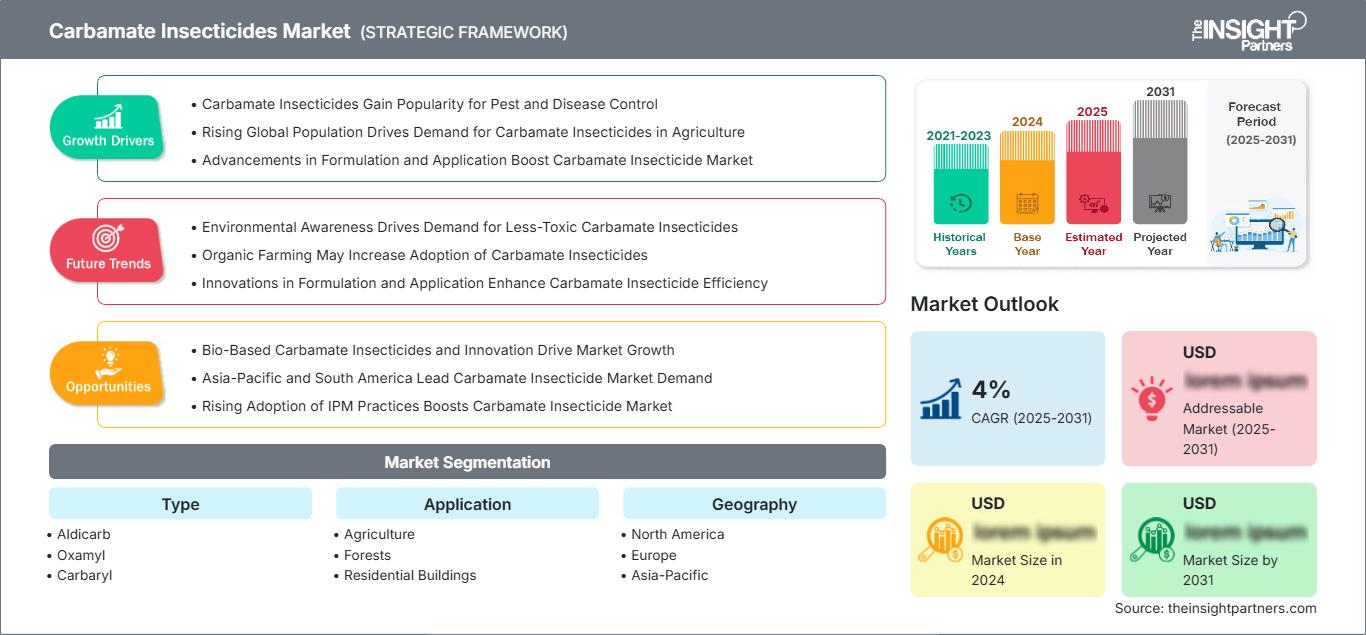
Carbamate Insecticides Market Growth Drivers
- Carbamate Insecticides Gain Popularity for Pest and Disease Control: Carbamate insecticides are broad-spectrum pesticides, that have gained popularity due to a high extent among farmers and agricultural experts, with their efficacy against a wide range of pests. Their effectiveness in controlling insects and some diseases in crops enhances their appeal, further contributing to increased usage across different agricultural practices.
- Rising Global Population Drives Demand for Carbamate Insecticides in Agriculture: The carbamate insecticides market is mainly driven by the agriculture sector. Rising world populations are resulting in rising demands for pest control solutions to ensure food security. For instance, the constantly fluctuating prices of agricultural commodities also push farmers to attain quality insecticides that ensure proper protection to the crops and maximize the yield.
- Advancements in Formulation and Application Boost Carbamate Insecticide Market: The improvements in formulation and application methods of carbamate insecticides are an important driving force behind the market growth. Their stability and effectiveness, combined with ease of use, make the products more appealing to customers. For instance, slow-release formulations can increase efficiency in pest control and lessen the number of times it is applied.
Carbamate Insecticides Market Future Trends
- Environmental Awareness Drives Demand for Less-Toxic Carbamate Insecticides: The growing culture of environmental awareness among consumers and governments worldwide, sustainable agriculture practices are finding increased acceptance. This is likely to increase the demand for perceived-to-be-less-toxic carbamate insecticides as an alternative to some of the very toxic pesticides being used.
- Organic Farming May Increase Adoption of Carbamate Insecticides: The other trend that may impact the carbamate insecticides market is organic farming. Organic farming typically employs the minimum use of synthetic chemicals, but carbamate insecticides would likely find their way into organic pest management if they can be promoted as lesser evils.
- Innovations in Formulation and Application Enhance Carbamate Insecticide Efficiency: Improvements in formulation technology and application methods will lead to a better efficiency and safety record of carbamate insecticides. Innovation such as nano-encapsulation and controlled-release formulation, which helps in the improved efficiency of pest control, drives the growth of the carbamate insecticides market.
Carbamate Insecticides Market Opportunities
- Bio-Based Carbamate Insecticides and Innovation Drive Market Growth: There is an increased focus on developing bio-based variants of carbamate insecticides. There are huge investments by manufacturers on research and development to enhance the properties of these insecticides and ultimately support the development of environmentally friendly alternatives. Innovation-related focus is expected to open up upmarket growth opportunities for the market.
- Asia-Pacific and South America Lead Carbamate Insecticide Market Demand: The main share of market comes from the Asia-Pacific and South & Central America, such as India, Brazil, among others. Rapid agricultural growth may stimulate demand for effective pest control solutions, including carbamate insecticides in these regions, with modernization.
- Rising Adoption of IPM Practices Boosts Carbamate Insecticide Market: The adoption of IPM practices by farmers is on the rise and provides opportunities for carbamate insecticides. These products can be easily incorporated into IPM strategies that include biological, cultural, and chemical methods for controlling pests. This is expected to drive the market during the estimated period.
Carbamate Insecticides Market Report Scope
| Report Attribute | Details |
|---|---|
| Market size in 2025 | US$ 15.25 Billion |
| Market Size by 2034 | US$ 25.33 Billion |
| Global CAGR (2026 - 2034) | 5.80% |
| Historical Data | 2021-2024 |
| Forecast period | 2026-2034 |
| Segments Covered |
By Type
|
| Regions and Countries Covered |
North America
|
| Market leaders and key company profiles |
|
Carbamate Insecticides Market Players Density: Understanding Its Impact on Business Dynamics
The Carbamate Insecticides Market is growing rapidly, driven by increasing end-user demand due to factors such as evolving consumer preferences, technological advancements, and greater awareness of the product's benefits. As demand rises, businesses are expanding their offerings, innovating to meet consumer needs, and capitalizing on emerging trends, which further fuels market growth.
Key Selling Points
- Comprehensive Coverage: The report comprehensively covers the analysis of products, services, types, and end users of the Carbamate Insecticides Market, providing a holistic landscape.
- Expert Analysis: The report is compiled based on the in-depth understanding of industry experts and analysts.
- Up-to-date Information: The report assures business relevance due to its coverage of recent information and data trends.
- Customization Options: This report can be customized to cater to specific client requirements and suit the business strategies aptly.
The research report on the Carbamate Insecticides Market can, therefore, help spearhead the trail of decoding and understanding the industry scenario and growth prospects. Although there can be a few valid concerns, the overall benefits of this report tend to outweigh the disadvantages.
Frequently Asked Questions

- Comprehensive Market Sizing and Forecast Analysis
- Detailed Segmentation Analysis
- In-Depth Market Dynamics Assessment
- Regional and Country-Level Insights
- Competitive Landscape and Company Benchmarking
- Strategic Business Intelligence
Recent Reports
Testimonials

The Insight Partners provided valuable market intelligence that supported our global go-to-market strategy. Their team was professional, responsive, and attentive to our feedback, providing thoughtful analysis and helpful methodological clarifications throughout the project.
Junmo Kim Chief Financial Officer (CFO), Enertech Co., Ltd.
The Insight Partners' SCADA System Market report is comprehensive, with valuable insights on current trends and future forecasts. The team was highly professional, responsive, and supportive throughout. We are very satisfied and highly recommend their services.
RAN KEDEM Partner, Reali Technologies LTDs
I requested a report on a very specific software market and the team produced the report in a few days. The information was very relevant and well presented. I then requested some changes and additions to the report. The team was again very responsive and I got the final report in less than a week.
JEAN-HERVE JENN Chairman, Future Analytica
We worked with The Insight Partners for an important market study and forecast. They gave us clear insights into opportunities and risks, which helped shape our plans. Their research was easy to use and based on solid data. It helped us make smart, confident decisions. We highly recommend them.
PIYUSH NAGPAL Sr. Vice President, High Beam Global
The Insight Partners delivered insightful, well-structured market research with strong domain expertise. Their team was professional and responsive throughout. The user-friendly website made accessing industry reports seamless. We highly recommend them for reliable, high-quality research services
YUKIHIKO ADACHI CEO, Deep Blue, LLC.
This is the first time I have purchased a market report from The Insight Partners.While I was unsure at first, I visited their web site and felt more comfortable to take the risk and purchase a market report.I am completely satisfied with the quality of the report and customer service. I had several questions and comments with the initial report, but after a couple of dialogs over email with their analyst I believe I have a report that I can use as input to our strategic planning process.Thank you so much for taking the extra time and making this a positive experience.I will definitely recommend your service to others and you will be my first call when we need further market data.
JOHN SUZUKI President and Chief Executive Officer, Board Director, BK Technologies
I wish to appreciate your support and the professionalism you displayed in the course of attending to my request for information regarding to infectious disease IVD market in Nigeria. I appreciate your patience, your guidance, and the fact that you were willing to offer a discount, which eventually made it possible for us to close a deal. I look forward to engaging The Insight Partners in the future, all thanks to the impression you have created in me as a result of this first encounter.
DR CHIJIOKE ONYIA MANAGING DIRECTOR, PineCrest Healthcare Ltd.Reason to Buy
- Informed Decision-Making
- Understanding Market Dynamics
- Competitive Analysis
- Identifying Emerging Markets
- Customer Insights
- Market Forecasts
- Risk Mitigation
- Boosting Operational Efficiency
- Strategic Planning
- Investment Justification
- Tracking Industry Innovations
- Aligning with Regulatory Trends





 Get Free Sample for