
Cast Elastomers Market Growth, Trends & Demand by 2034
Coverage: By Type (Hot Cast, Cold Cast); Raw Materials (MDI Based, TDI Based); End Use Industry (Automotive and Transportation, Building and construction, Industrial, Mining, Oil and Gas, Energy and Power, Other) , and Geography (North America, Europe, Asia Pacific, and South and Central America)
- Status : Data Released
- Report Code : TIPRE00019934
- Category : Chemicals and Materials
- No. of Pages : 150
- Available Report Formats :


- Last update date : August 07, 2026


2025 Market Size
US$ 1.41 Bn
Base year value
2034 Forecast
US$ 2.04 Bn
Projected by 2034
CAGR 2026-2034
4.22 %
Growth rate
Addressable Market
US$ 15.69 Bn
(2026-2034)
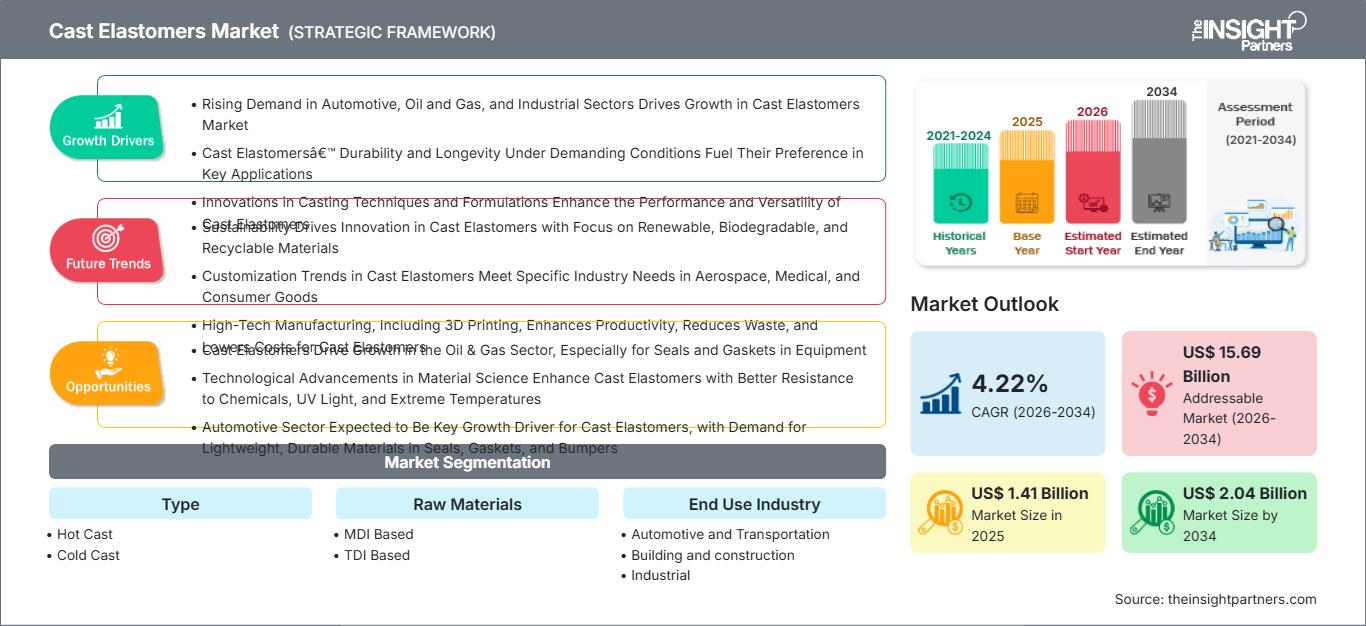
The Cast Elastomers market was valued at US$ 1.41 Billion in 2025 and is projected to reach US$ 2.04 Billion by 2034, registering a CAGR of 4.22% during 2026–2034. Demand continues to strengthen across industrial manufacturing, automotive, mining, and construction sectors as manufacturers increasingly adopt durable polyurethane-based materials that deliver high abrasion resistance, load-bearing capability, and extended service life in demanding operating environments.
Across North America, the Cast Elastomers Market size continues to expand as industrial automation, mining modernization, and infrastructure rehabilitation stimulate demand for advanced polyurethane components. The region is expected to grow at a CAGR of 3.8–4.3% during 2026–2034, supported by investments in energy infrastructure, increasing replacement demand for wear-resistant equipment parts, and the presence of established polyurethane formulators and specialty chemical manufacturers.
Cast Elastomers Market Assessment and Insights
- North America: Accounted for a 34–38% share in 2025 and is projected to grow at a CAGR of 3.8–4.3% during 2026–2034, supported by strong mining, industrial machinery, and transportation sectors, together with continuous investments in infrastructure maintenance and advanced manufacturing technologies.
- U.S.: Represented 78–82% of the North American market in 2025 and is anticipated to register a CAGR of 3.9–4.4% during 2026–2034, driven by robust industrial production, automotive component manufacturing, and increasing adoption of high-performance polyurethane solutions.
- Europe: Held 27–31% share in 2025 and is forecast to expand at a CAGR of 3.7–4.2% during 2026–2034, with Germany, France, Italy, and the UK leading demand owing to advanced engineering, machinery manufacturing, and sustainability-focused industrial production.
- Asia Pacific: Captured 24–28% share in 2025 and is expected to witness the fastest regional expansion at a CAGR of 5.2–5.8% during 2026–2034, led by China, India, Japan, and South Korea through industrialization, infrastructure investments, and manufacturing expansion.
- Largest Segment: Hot Cast accounted for 64–68% market share in 2025 and is projected to grow at a CAGR of 4.0–4.5% during 2026–2034, supported by superior mechanical performance and widespread industrial adoption.
- High Growth Segment: Mining represented 13–17% market share in 2025 and is expected to expand at a CAGR of 5.3–5.9% during 2026–2034, fueled by increasing mineral extraction activities and growing demand for abrasion-resistant equipment components.
- Key companies analyzed in detail: Huntsman International LLC, PLIXXENT Holding GmbH, BASF SE, RAMPF Group, Inc., Isothane Ltd., SAPICI S.p.A., Alchimica S.A., Chemline Inc., Notedome Limited, FSi Limited
Source: The Insight Partners' analysis based on proprietary research, government publications, company annual reports, investor presentations, industry databases, and expert interviews.
Industrial manufacturing has steadily transformed the production landscape through improved polyurethane formulations, automated dispensing systems, and precision casting technologies that enhance dimensional consistency and product durability. Continuous innovation in isocyanate chemistry, coupled with improved processing efficiency and customization capabilities, has enabled manufacturers to develop application-specific products for mining, heavy equipment, transportation, and industrial machinery. These developments continue to strengthen Cast Elastomers Market growth by improving operational efficiency while reducing maintenance frequency across demanding industrial environments.
In the future, it is expected that investments in manufacturing throughout Southeast Asia, the Middle East, and select parts of Latin America will expand production capacities, while environmental regulations favoring more durable industrial materials, along with investments in renewable energy products, automation, and infrastructural development, will generate demand and encourage manufacturers to incorporate lower emission processing systems and recyclable polyurethane formulations during the forecast period.
Cast Elastomers Market Report Scope
| Report Attribute | Details |
|---|---|
| Market size in 2025 | US$ 1.41 Billion |
| Market Size by 2034 | US$ 2.04 Billion |
| Global CAGR (2026 - 2034) | 4.22% |
| Historical Data | 2021-2024 |
| Forecast period | 2026-2034 |
Cast Elastomers Market Analysis
Growing industrial modernization continues to reinforce demand for polyurethane cast products across sectors requiring exceptional wear resistance, impact strength, and operational reliability. Mining operations, automated manufacturing facilities, material handling systems, and construction equipment increasingly require durable elastomeric components capable of minimizing downtime and extending equipment life. Consequently, the Cast Elastomers Market analysis indicates that manufacturers are emphasizing customized formulations capable of delivering enhanced chemical resistance, higher load-bearing capacity, and longer replacement intervals, thereby strengthening long-term customer value while improving lifecycle economics.
The value chain of the industry is enabled by the cooperation between raw materials producers, polyurethane system formulators, components manufacturers, machinery integrators, distributors and the end-users. The raw materials based on MDI and TDI continue to be very important to obtain the required mechanical characteristics, whereas technological progress in casting equipment ensures increased accuracy and minimizes production losses. In addition, the supply chain becomes more reliable due to regional approaches to sources and additional production sites.
Competitive intensity in the Cast Elastomers Market continues to increase as established manufacturers and specialized producers invest in research, production optimization, and customer-specific product development. Firms like Huntsman International LLC, BASF SE, PLIXXENT Holding GmbH, and RAMPF Group, Inc. continue to develop service offerings and customized formulation options, while companies like SAPICI S.p.A., Isothane Ltd., Alchimica S.A., Chemline Inc., Notedome Limited, and FSi Limited are consolidating their position through industry-specific applications, fast development of new products, and engineering support for difficult customer needs.
Investments are more and more aimed at production flexibility, process monitoring, and eco-friendly polyurethane materials. Processing facilities are becoming modernized by automating, controlling production quality, and improving formulations laboratories. Collaborations with OEMs, mining equipment manufacturers, and industrial machinery are helping to increase innovations and create high-value solutions for difficult environments and performance needs.
● REPORT CUSTOMIZATION
Tailor This Report To Align With Your Specific Business Requirements
This report can be customized to align precisely with your business objectives, scope, and target markets. Customization options include tailored segmentation, geography, competitive analysis, and strategic insights to support informed decision-making.
Customize This Report →WHAT YOU CAN ADJUST
- ● Segmentations
- ● Geography
- ● Competitive Analysis
- ● Language Preferences
Cast Elastomers Market: Strategic Insights
Regional Insights
North America Cast Elastomers Market
North America accounted for 34–38% of the global Cast Elastomers market share in 2025 and is anticipated to expand at a CAGR of 3.8–4.3% during 2026–2034. Constant demand in mining, industrial equipment, construction machinery, and the transport sector is still supporting consumption in the region. The modernization of infrastructure, automation of manufacturing, and energy development have led to greater use of abrasion-resistant polyurethane components in conveyors, rollers, seals, and heavy industrial machinery.
Moreover, the region can be proud of the existing polyurethane production infrastructure, which is ensured by the availability of modern chemical facilities, engineering companies, and OEM cooperation. The rising demand for replacement of durable industrial components, together with increased maintenance efficiency needs, makes end-users more interested in using advanced cast elastomers with greater operating lifespan.
U.S. Cast Elastomers Market
The U.S. represented 78–82% of the North American Cast Elastomers Market in 2025 and is projected to register a CAGR of 3.9–4.4% through 2034. The market demand continues to be centered in industrial manufacturing, automotive manufacturing, the mining industry, oil and gas machinery, and materials handling industries. Continued investment in manufacturing plants domestically, facilitated by the resourcing trend, continues to ensure steady demand for high-quality polyurethane parts.
Major manufacturers such as Huntsman International LLC and Chemline Inc. have a considerable manufacturing capacity in the country, which is a major contributor to innovations in products and industrial applications. Mining equipment, conveyor components, suspension, wheels, and vibration control products continue to be important applications. Increased spending on industrial maintenance and increased focus on durability are promoting the replacement of traditional rubber and metal parts with more sophisticated cast polyurethane products.
Europe Cast Elastomers Market
Europe captured 27–31% of the global Cast Elastomers Market in 2025 and is expected to grow at a CAGR of 3.7–4.2% during 2026–2034. The leading country is Germany, owing to its automobile manufacturing industry, production of industrial machines, and chemical industry. The growing trend towards automation, eco-friendly manufacturing processes, and precision engineering is contributing to increased demand for premium-grade polyurethane castings.
The demand in the UK remains strong and is sustained by infrastructure maintenance, defense manufacturing, and industrial equipment reconditioning. Local manufacturers and formulators are focusing more on developing customized polyurethane products suitable for engineering applications. Increased spending on manufacturing and maintenance improvements is expected to favor the use of durable cast elastomers in various industrial sectors.
In France, Italy, and Spain, increased demand in the region is driven by increased construction activity, production of industrial machinery, investments in renewable energy, and manufacturing of transportation equipment. Industrial companies are increasingly using advanced polyurethane products to increase efficiency, reduce maintenance, and extend equipment lifespan. Structural factors are expected to ensure continued stable growth in the region during the forecast period. The German market is leading the market development in the region.
APAC Cast Elastomers Market
Asia Pacific accounted for 24–28% of the global Cast Elastomers Market in 2025 and is projected to record the highest regional CAGR of 5.2–5.8% during 2026–2034. China is the largest consumer region, with Japan, India, South Korea, and Australia following in that order, thanks to increased manufacturing capabilities, mining, and infrastructure development.
Governments’ programs on industrialization and manufacturing and infrastructure continue to boost the demand for polyurethane castings. The fast growth in mining, material handling solutions, renewable energy solutions, and heavy equipment manufacturing has placed Asia Pacific as the fastest-growing region.
Middle East & Africa Cast Elastomers Market
The Middle East & Africa market is expected to expand at a CAGR of 4.5–5.0% during 2026–2034, supported by infrastructure development, mining investments, and oil and gas activities. Saudi Arabia is the biggest consumer in the region, followed by the UAE and South Africa, where diversified industrial initiatives continue to drive consumption of durable polyurethane parts.
Large-scale energy projects, mining, and logistics sector infrastructure investments are driving demand for advanced industrial materials. Increasing localization and modernization initiatives in the industrial sector in the Rest of MEA are expected to aid demand for cast elastomer products in the coming years.
Segmentation Analysis
Type
The Type segment is projected to register a CAGR of 4.2–4.6% during 2026–2034. The Cast Elastomers Market scope continues to broaden as manufacturers develop application-specific polyurethane systems capable of delivering enhanced abrasion resistance, mechanical strength, and dimensional stability. Product selection depends on production efficiency, curing requirements, operating environment, and end-use performance expectations across industrial applications.
- Hot Cast: Hot cast elastomers remain the dominant product category owing to superior tensile strength, load-bearing capability, and abrasion resistance. These materials are extensively utilized in mining equipment, industrial wheels, rollers, conveyor systems, and heavy-duty engineering applications.
- Cold Cast: Cold cast elastomers offer simplified processing, lower production costs, and suitability for medium-performance industrial components. Their ease of manufacturing makes them attractive for maintenance, repair, prototyping, and customized production applications.
Raw Materials
The Raw Materials segment is anticipated to grow at a CAGR of 4.0–4.5% during 2026–2034. Material selection significantly influences durability, flexibility, chemical resistance, and mechanical performance. Manufacturers continue investing in advanced polyurethane chemistry to improve processing efficiency while meeting increasingly demanding industrial performance specifications.
- MDI-Based: MDI-based systems dominate premium industrial applications because they provide excellent wear resistance, higher mechanical strength, and improved durability under continuous heavy-duty operating conditions.
- TDI-Based: TDI-based formulations continue serving applications requiring flexibility, cost efficiency, and reliable processing characteristics. They remain widely adopted across general industrial manufacturing and selected transportation components.
End Use Industry
The End Use Industry segment is forecast to expand at a CAGR of 4.3–4.8% during 2026–2034. Industrial diversification, infrastructure development, mining investments, and increasing equipment modernization continue to support demand across multiple sectors. Application-specific polyurethane formulations enable manufacturers to address varying operational requirements while extending equipment lifespan and lowering maintenance costs.
- Automotive and Transportation: Increasing adoption of lightweight, durable, and vibration-resistant polyurethane components supports vehicle performance, ride comfort, and maintenance reduction across commercial and passenger transportation applications.
- Building and construction: Construction equipment manufacturers increasingly utilize polyurethane products in wheels, seals, pads, and protective components to improve durability under harsh operating environments and continuous mechanical stress.
- Industrial: General industrial manufacturing remains a major consumer through extensive use in rollers, conveyor components, machine parts, couplings, and wear-resistant equipment designed for high-production manufacturing environments.
- Mining: Mining companies increasingly deploy polyurethane liners, screens, scraper blades, and conveyor components to reduce equipment downtime, improve wear resistance, and extend maintenance intervals under abrasive operating conditions.
- Oil and Gas: Exploration, drilling, and processing facilities utilize cast polyurethane products for sealing, protection, and vibration-control applications that operate under demanding environmental and chemical conditions.
- Energy and Power: Renewable energy installations and conventional power generation facilities continue to adopt durable polyurethane components to improve operational reliability, reduce maintenance frequency, and enhance long-term equipment performance.
Opportunity Snapshot
| End Use Industry | Revenue Contribution | Trend Tag | Adoption Stage |
| Automotive and Transportation | High | Lightweight Parts | Mature |
| Building and construction | Medium | Infrastructure | Scaling |
| Industrial | High | Smart Manufacturing | Mature |
| Mining | High | Wear Protection | Scaling |
| Oil and Gas | Medium | Asset Integrity | Mature |
| Energy and Power | Medium | Grid Equipment | Emerging |
Cast Elastomers Market Growth Drivers and Impact Analysis
Rising Demand for Wear-Resistant Materials in Heavy Industries
The mining industry, bulk handling, construction, and industries involved in industrial processing have continued to emphasize the importance of machinery efficiency and minimal maintenance expenses, leading to an increased need for cast polyurethane parts. Cast elastomers outperform ordinary rubber components by their improved properties of abrasion resistance, tear strength, shock absorbency, and weight support, among others, in many industrial applications. Industrial roller components, scrapers, screens, wheels, liners, and seals have been found incorporating polyurethane formulations to ensure efficiency and longevity. With the increasing expansion of mining operations and modernization of industrial processing facilities, manufacturers are now making investments in elastomer formulas that will help them cope with tougher conditions.
Expansion of Industrial Automation and Advanced Manufacturing
Automated production lines, robotics, and material handling processes in manufacturing plants continue to be driven by industrial automation. There is a need for elastomers that are resistant to wear and tear in such applications. This has seen an increase in the use of polyurethane cast parts in rollers, vibration isolators, machine pads, conveyors, and automated handlers due to their high fatigue resistance. The rising number of smart factories being developed in North America, Europe, and the Asia Pacific region has increased the use of engineered elastomers in place of traditional materials to prolong equipment longevity. Equipment manufacturers are focusing on custom component design, which is efficient and cost-effective in operations.
Growing Infrastructure and Energy Investments Worldwide
Heavy investments in transportation infrastructure, renewable energy installations, mining operations, and oil and gas infrastructure are consistently creating demand for durable engineering materials. Polyurethane cast elastomers are currently being utilized in sealant technology, cabling protection products, pipe support components, vibration absorbers, and mechanical assemblies due to their ability to withstand harsh environments. Developing nations’ infrastructure upgrade programs are adding to the demand for performance-based engineering materials with the potential to serve for long periods with reduced maintenance needs. Material suppliers are also coming up with novel polyurethane blends that are more resistant to chemicals, heat, and easier to process. Future investments from both the private and public sectors are anticipated to propel future growth in the market.
Cast Elastomers Market Future Trends
Development of Sustainable Polyurethane Formulations
Environmental regulations and corporate sustainability initiatives are encouraging manufacturers to develop polyurethane systems with reduced emissions, improved resource efficiency, and increased recyclability. Producers are investing in bio-based raw materials, lower-emission production technologies, and optimized manufacturing processes that minimize waste generation while maintaining high mechanical performance. These developments are reshaping the Cast Elastomers Market trends by enabling industrial customers to achieve sustainability objectives without compromising product durability. Growing collaboration between chemical suppliers and industrial manufacturers is expected to accelerate the commercialization of environmentally responsible elastomer technologies throughout the forecast period.
Increasing Digitalization of Polyurethane Manufacturing
Digital manufacturing technologies are becoming increasingly important across polyurethane production facilities as manufacturers integrate automation, artificial intelligence, process monitoring, and predictive quality control systems into casting operations. Real-time production analytics improve formulation consistency, reduce material waste, and enhance manufacturing efficiency while supporting customized production requirements. Digital twins, automated dispensing equipment, and advanced inspection technologies further improve dimensional accuracy and product reliability. As manufacturers continue investing in Industry 4.0 initiatives, digital production capabilities are expected to become an important competitive differentiator across the global cast elastomer manufacturing ecosystem.
Cast Elastomers Market Opportunities
Expansion Across Renewable Energy Equipment Manufacturing
The global transition toward renewable energy creates significant opportunities for polyurethane component manufacturers supplying wind, hydroelectric, and solar infrastructure. Turbine systems, cable management equipment, vibration control assemblies, and protective industrial components increasingly require durable elastomer materials capable of operating under demanding environmental conditions. Cast Elastomers Market Forecasts indicate that manufacturers investing in application-specific polyurethane technologies and regional production capacity can strengthen long-term relationships with renewable energy equipment suppliers. Strategic investments in advanced materials research and engineering support are expected to improve competitiveness while expanding participation in rapidly growing clean energy supply chains.
Growing Penetration in Emerging Industrial Economies
Industrial expansion across Southeast Asia, Latin America, the Middle East, and selected African countries presents attractive investment opportunities for manufacturers seeking geographic diversification. Rapid growth in mining, infrastructure development, industrial manufacturing, logistics, and transportation sectors is increasing demand for durable engineering materials that improve operational efficiency and reduce maintenance costs. Companies establishing regional manufacturing facilities, technical service centers, and localized distribution networks can improve customer responsiveness while reducing supply chain risks. Long-term partnerships with industrial equipment manufacturers and infrastructure contractors are expected to strengthen market penetration and support sustainable business growth across emerging economies.
Recent Developments
- March 2026: BASF SE introduced the Elastollan GripTec thermoplastic polyurethane portfolio at CHINAPLAS 2026. The new TPU grades were designed to deliver improved grip, abrasion resistance, processing efficiency, and a lower product carbon footprint for footwear applications, reinforcing BASF's strategy of expanding sustainable high-performance polyurethane materials across industrial markets.
- September 2025: BASF SE showcased new polyurethane material innovations and circularity solutions at SIMAC 2025, including Elastopan, Elastollan, and Infinergy technologies designed to improve automation, recyclability, lightweight performance, and sustainable footwear manufacturing, demonstrating continued investment in advanced polyurethane product development.
Frequently Asked Questions

- Comprehensive Market Sizing and Forecast Analysis
- Detailed Segmentation Analysis
- In-Depth Market Dynamics Assessment
- Regional and Country-Level Insights
- Competitive Landscape and Company Benchmarking
- Strategic Business Intelligence
Recent Reports
Testimonials

The Insight Partners' SCADA System Market report is comprehensive, with valuable insights on current trends and future forecasts. The team was highly professional, responsive, and supportive throughout. We are very satisfied and highly recommend their services.
RAN KEDEM Partner, Reali Technologies LTDs
I requested a report on a very specific software market and the team produced the report in a few days. The information was very relevant and well presented. I then requested some changes and additions to the report. The team was again very responsive and I got the final report in less than a week.
JEAN-HERVE JENN Chairman, Future Analytica
We worked with The Insight Partners for an important market study and forecast. They gave us clear insights into opportunities and risks, which helped shape our plans. Their research was easy to use and based on solid data. It helped us make smart, confident decisions. We highly recommend them.
PIYUSH NAGPAL Sr. Vice President, High Beam Global
The Insight Partners delivered insightful, well-structured market research with strong domain expertise. Their team was professional and responsive throughout. The user-friendly website made accessing industry reports seamless. We highly recommend them for reliable, high-quality research services
YUKIHIKO ADACHI CEO, Deep Blue, LLC.
This is the first time I have purchased a market report from The Insight Partners.While I was unsure at first, I visited their web site and felt more comfortable to take the risk and purchase a market report.I am completely satisfied with the quality of the report and customer service. I had several questions and comments with the initial report, but after a couple of dialogs over email with their analyst I believe I have a report that I can use as input to our strategic planning process.Thank you so much for taking the extra time and making this a positive experience.I will definitely recommend your service to others and you will be my first call when we need further market data.
JOHN SUZUKI President and Chief Executive Officer, Board Director, BK Technologies
I wish to appreciate your support and the professionalism you displayed in the course of attending to my request for information regarding to infectious disease IVD market in Nigeria. I appreciate your patience, your guidance, and the fact that you were willing to offer a discount, which eventually made it possible for us to close a deal. I look forward to engaging The Insight Partners in the future, all thanks to the impression you have created in me as a result of this first encounter.
DR CHIJIOKE ONYIA MANAGING DIRECTOR, PineCrest Healthcare Ltd.Reason to Buy
- Informed Decision-Making
- Understanding Market Dynamics
- Competitive Analysis
- Identifying Emerging Markets
- Customer Insights
- Market Forecasts
- Risk Mitigation
- Boosting Operational Efficiency
- Strategic Planning
- Investment Justification
- Tracking Industry Innovations
- Aligning with Regulatory Trends





 Get Free Sample for